
Zeroth Law of Thermodynamics:

The Zeroth Law of Thermodynamics explains why temperature can be measured in a meaningful and consistent way. It says that if two systems are each in thermal equilibrium with a third system, then they are in thermal equilibrium with each other.
This page belongs to the Laws of Thermodynamics cluster within Thermodynamics. It prepares students for the First Law of Thermodynamics, Second Law of Thermodynamics, Third Law of Thermodynamics, Entropy in Thermodynamics, and Free Energy in Thermodynamics.
Although the Zeroth Law is often stated briefly, it is one of the most important ideas in thermal physics. It explains why a thermometer can act as a reliable third object for comparing temperatures. Without this law, temperature would be only a local sensation rather than a transferable physical quantity.
In everyday language, the Zeroth Law tells us why we can say two objects have the same temperature without placing them directly in contact with each other. If both separately match the same thermometer reading, then they match each other thermally.
What the Zeroth Law Really Says
The Zeroth Law can be written in a compact form:
If A is in thermal equilibrium with C, and B is in thermal equilibrium with C, then A is in thermal equilibrium with B.
Here, C may be a thermometer. If object A gives the same thermometer reading as C, and object B gives the same thermometer reading as C, then A and B have the same temperature.
This makes thermal equilibrium a transferable relationship. It allows temperature to function as a property that can be compared, measured, recorded, and used in scientific laws.
Why It Is Called the Zeroth Law
The Zeroth Law was named after the First, Second, and Third Laws were already well established. Scientists realised that the idea of temperature and thermal equilibrium logically comes before the other laws. It is more basic than energy conservation, entropy, heat engines, and absolute zero.
Because it comes before the First Law in logical order, it was called the Zeroth Law rather than being inserted as a new “First Law” and renaming the rest.
| Law | Main Question It Answers | Core Idea |
|---|---|---|
| Zeroth Law | What does it mean for temperature to be measurable? | Thermal equilibrium is transferable |
| First Law | Where does energy go? | Energy is conserved through heat and work |
| Second Law | Which processes happen naturally? | Entropy and irreversibility give direction |
| Third Law | What happens near absolute zero? | Entropy approaches a limiting value |
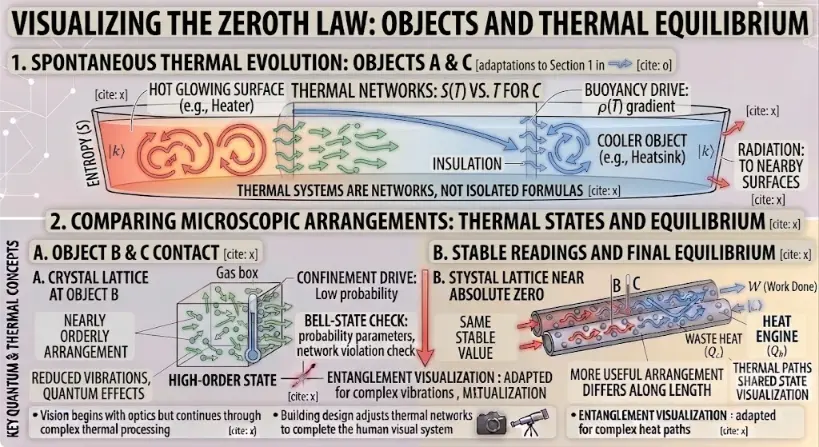
Concept image visualizing the Zeroth Law of Thermodynamics using three objects and a thermometer acting as a bridge. The top panel shows hot object A and thermometer C reaching equilibrium. The lower panels track useful work and spontaneity, demonstrating how thermometer C provides a stable same value for both object A and object B, concluding with a simple shared state visualization for objects A and B having the same temperature even without direct contact, linking equilibrium states within a complex thermodynamic network.
The image is a multi-panel educational infographic titled “VISUALIZING THE ZEROTH LAW: OBJECTS AND THERMAL EQUILIBRIUM,” set against a clean white background with subtle geometric network traces. It adopts a structured diagrammatic and illustrative style, linked by a large central conceptual title banner adapted from image_61.png: “THERMAL SYSTEMS ARE NETWORKS, NOT ISOLATED FORMULAS”. integrated quantum concepts kets like |k⟩ suggestion connections with microscopic probability states, inspired by the structure of image_61.png.
Part 1: Spontaneous Thermal Evolution: Objects A & C
This upper panel provides a visual non-contact heat transfer diagram between hot glowing surface Object A and cooler object Thermometer C, reaching a stable same value:- Thermal Crossed Flow: A detailed cross-section diagram similar in layout to Section 1 of image_61.png features detailed hot glowing Object A and cooler target Object Thermometer C. Red and blue swirling arrows, adapted from the flow and radiation metaphors of image_61.png, illustrate “HEAT FLOW DIRECTION (Spontaneous)” with callouts detailed as: “ENERGY NETWORKS: AVAILABILITY VS. ENTROPY”.
- Verification and Callouts: Text callouts detail: “EMISSIVITY (ϵ) of source”, “INSULATION”, and “RADIATION: TO NEARBY SURFACES”, adapted to the non-contact context. integrated kets like |k⟩ and citation brackets are integrated.
Part 2: Comparing Microscopic Arrangements: Thermal States and Equilibrium
This lower panel directly compares microscopic system arrangements within different objects to track thermal states and equilibrium spontaneity, using comparisons adapted from Section 2 in image_61.png:- Sub-Diagram A: Object B & C Contact: On the left, this section shows a magnified view of a gas box depicted as a crystal lattice, where Object B (gas box, high entropy, low probability) is placed in contact with the Thermometer C (gas box, low entropy, high probability). A large red downward arrow connects Section A to Section B, labeled “SPONTANEOUS DIRECTION (ΔG < 0)”. Data callouts include: “CONFINEMENT DRIVE: Low probability”, “BELL-STATE CHECK: probability parameters, network violation check”, and adapted entanglement and shared state visualization concepts. Callouts repeat quantum concepts and summaries.
- Sub-Diagram B: Stable Readings and Final Equilibrium: On the right, this section shows magnified, parallel gas boxes where gas has spread, depicting two separate views: one showing B and C with stable thermometer readings and identical “SAME STABLE VALUE” labels, and a second view showing both Object A and Object B, now with identical “SAME TEMPERATURE LABEL”. Blue and red wave arrows show efficient energy transfer and widespread possibilities. A prominent label states: “MORE USEFUL ARRANGEMENT DIFFERS ALONG LENGTH”. It explicitly features “HEAT ENGINE (Qh)”, “WASTE HEAT (Qc)”, and useful work “W (Work Done)” callouts. Quantum concepts callouts are repeated.
Thermal Equilibrium
Thermal equilibrium means that two systems in thermal contact no longer exchange net energy as heat. Their temperatures are the same, so there is no natural direction for heat to flow between them.
For example, if a hot metal spoon is placed in a cup of cooler water, heat flows from the spoon to the water. After enough time, the spoon and water reach a common temperature. At that point, they are in thermal equilibrium.
| Situation | Thermal State | What Happens? |
|---|---|---|
| Hot object touches cold object | Not in thermal equilibrium | Heat flows from hot to cold |
| Two objects have the same temperature | Thermal equilibrium | No net heat flow occurs |
| A thermometer reading is still changing | Not yet in equilibrium | The thermometer is still adjusting |
| A thermometer reading becomes stable | Thermal equilibrium with the object | The reading can be used as the object’s temperature |
Temperature as a Measurable Property
The Zeroth Law gives temperature its practical meaning. It allows temperature to be treated as a physical property shared by systems in thermal equilibrium.
When a thermometer is placed in contact with an object, the thermometer changes until it reaches thermal equilibrium with the object. The thermometer reading then represents the temperature of the object.
Without the Zeroth Law, this procedure would not be logically secure. We would not know whether a thermometer reading could be used to compare different objects.
Temperature Is Not the Same as Heat
Students often confuse temperature with heat. The Zeroth Law is a good place to separate the two ideas clearly.
| Concept | Meaning | Example |
|---|---|---|
| Temperature | A measure related to the thermal state of a system | A room is at 25°C |
| Heat | Energy transferred because of temperature difference | Energy flows from hot tea to a spoon |
| Thermal equilibrium | State where systems have no net heat exchange | A thermometer and water reach the same reading |
Temperature tells us about thermal condition. Heat describes energy transfer. The Zeroth Law is mainly about temperature and thermal equilibrium, not about calculating heat transfer.
The Thermometer as the Third System
The most familiar use of the Zeroth Law is the thermometer. A thermometer works because it can come into thermal equilibrium with another object and then display a measurable physical change.
Different thermometers use different physical properties:
| Thermometer Type | Physical Property Used | How It Indicates Temperature |
|---|---|---|
| Liquid-in-glass thermometer | Thermal expansion of liquid | The liquid column rises or falls |
| Thermocouple | Voltage produced by two joined metals | Voltage changes with temperature difference |
| Resistance thermometer | Electrical resistance | Resistance changes with temperature |
| Infrared thermometer | Thermal radiation | Radiation pattern is used to estimate temperature |
| Gas thermometer | Gas pressure or volume | Gas behaviour changes with temperature |
Although these instruments use different mechanisms, they depend on the same underlying idea: when the thermometer reaches equilibrium with the object, its reading can represent the object’s temperature.
The Transitive Nature of Thermal Equilibrium
Mathematically, the Zeroth Law says that thermal equilibrium behaves like a transitive relationship.
If:
TA = TC
and:
TB = TC
then:
TA = TB
This may look obvious, but it is a deep assumption about physical systems. It says that temperature is not merely a private property of each object. It can be compared consistently across systems.
Thermal Contact and Heat Flow
Two systems are in thermal contact if energy can be transferred between them as heat. Thermal contact does not always mean direct touching. It can also occur through a conducting wall, a fluid, or radiation.
| Mode of Thermal Contact | Example | Possible Heat Transfer |
|---|---|---|
| Direct contact | A spoon in hot soup | Conduction |
| Through a wall | Water heating inside a metal pot | Conduction through the pot |
| Through moving fluid | Warm air heating a room | Convection |
| Through radiation | Sunlight warming skin | Thermal radiation |
Thermal equilibrium is reached when the systems can exchange energy, but no longer have a temperature difference that drives net heat flow.
Everyday Examples of the Zeroth Law
The Zeroth Law appears in many everyday situations, even when we do not name it.
Checking Body Temperature
A thermometer is placed in contact with the body. Once the reading stabilises, the thermometer is assumed to be in thermal equilibrium with the body region being measured.Cooking and Food Safety
A kitchen thermometer measures the temperature of food by reaching thermal equilibrium with the part it is inserted into.Room Temperature Measurement
A room thermometer gives a useful reading only after it has equilibrated with the surrounding air.Laboratory Experiments
Experiments often require water baths, thermal probes, and sensors to reach stable readings before data are recorded.Weather Stations
Air temperature readings depend on sensors reaching suitable thermal contact with the surrounding air while avoiding misleading heating from direct sunlight.Engineering Control Systems
Thermostats use temperature sensors to compare a system’s thermal state with a desired setting.Why the Zeroth Law Comes Before the First Law
The First Law of Thermodynamics deals with energy conservation in thermal systems. It uses ideas such as heat, work, and internal energy. But before we can discuss heat flow properly, we need a way to define and compare temperature.
That is why the Zeroth Law is foundational. It gives meaning to temperature, and temperature difference is what helps determine the direction of heat transfer.
| Before Studying… | Students Need to Understand… |
|---|---|
| Heat transfer | Temperature difference |
| Thermometers | Thermal equilibrium |
| First Law | How heat is identified as energy transfer |
| Second Law | Why heat has a natural direction |
| Entropy | How thermal states relate to energy spreading |
Microscopic View of Temperature
At the microscopic level, temperature is related to the random motion and energy distribution of particles. In a gas, higher temperature usually means the molecules have greater average kinetic energy. In solids and liquids, thermal energy also involves vibrations and interactions among particles.
The Zeroth Law itself is a macroscopic law. It does not require students to know all the details of molecular motion. However, the microscopic view helps explain why systems in contact tend to settle toward a shared thermal state.
When two systems are at different temperatures and can exchange energy, microscopic interactions transfer energy until the systems no longer have a temperature difference that drives net heat flow.
Temperature Scales
Once temperature can be measured consistently, different temperature scales can be created. The most common are Celsius, Kelvin, and Fahrenheit.
| Scale | Symbol | Common Use | Important Note |
|---|---|---|---|
| Celsius | °C | Daily weather, classrooms, laboratories in many countries | Water freezes near 0°C and boils near 100°C at standard pressure |
| Kelvin | K | Scientific thermodynamics | Absolute temperature scale starting from absolute zero |
| Fahrenheit | °F | Daily use in some countries | Different reference spacing from Celsius |
In thermodynamics, Kelvin is especially important because many equations require absolute temperature, not Celsius temperature.
Kelvin and Absolute Temperature
The Kelvin scale begins at absolute zero, the theoretical lower limit of thermodynamic temperature. A temperature difference of 1 K has the same size as a temperature difference of 1°C, but the zero points are different.
The conversion between Celsius and Kelvin is:
T(K) = T(°C) + 273.15
For example, 25°C is:
25 + 273.15 = 298.15 K
The Kelvin scale becomes especially important in later topics such as gas laws, entropy, heat engines, and free energy.
Applications of the Zeroth Law
The Zeroth Law may look simple, but it supports many practical technologies and scientific procedures. Whenever temperature is measured, compared, calibrated, or controlled, the Zeroth Law is quietly present.
Thermometer Calibration
Temperature instruments must be calibrated against known reference states or standard devices so readings are consistent.Medical Temperature Measurement
Clinical thermometers depend on reaching a meaningful thermal relationship with the body region being measured.Engineering Sensors
Temperature sensors in engines, batteries, buildings, and machines depend on thermal equilibrium or predictable thermal response.Climate and Weather Monitoring
Air, ocean, and soil temperature readings require careful sensor placement and interpretation.Laboratory Experiments
Chemistry, biology, materials science, and physics experiments often require controlled temperature conditions.Industrial Process Control
Manufacturing, food processing, semiconductor fabrication, and chemical plants depend on reliable temperature measurement.Thermal Comfort Systems
Air-conditioning and heating systems use thermostats to compare actual temperature with a desired setting.Scientific Standards
Temperature standards allow scientists in different laboratories to compare results meaningfully.Challenges and Practical Limitations
The Zeroth Law gives the foundation for temperature measurement, but real measurements are not always simple. A thermometer reading may be misleading if the sensor has not reached equilibrium, if it disturbs the system, or if the environment affects the reading.
| Challenge | Why It Matters | Example |
|---|---|---|
| Slow thermal response | The thermometer may take time to reach equilibrium | A thick temperature probe responds slowly in air |
| Poor thermal contact | The sensor may not match the object’s true temperature | A loose probe on a metal surface gives an unreliable reading |
| Sensor disturbance | The thermometer can change the temperature of a small system | A cold probe placed in a tiny liquid sample cools it |
| Temperature gradients | Different parts of a system may have different temperatures | A pot of soup may be hotter near the bottom than at the surface |
| Radiation errors | Radiant heating or cooling may bias a sensor | A thermometer in sunlight may read too high for air temperature |
| Non-equilibrium systems | A single temperature may not describe the whole system well | Rapidly expanding gases or plasmas may have different energy distributions |
| Calibration drift | Sensors can become inaccurate over time | Industrial sensors need periodic checking |
The practical lesson is that temperature measurement is not merely reading a number. It requires understanding whether the sensor, object, and surroundings have reached the kind of thermal relationship assumed by the Zeroth Law.
Future Directions and Emerging Trends
The Zeroth Law is a classical thermodynamic principle, but the need for accurate temperature measurement continues to grow in modern science and technology. New systems often require temperature sensing at smaller scales, faster times, harsher environments, and more complex interfaces.
Nanoscale Thermometry
As devices become smaller, scientists need ways to measure temperature in tiny regions where ordinary probes may disturb the system.Quantum Temperature Sensing
Quantum systems and defects in materials may be used as sensitive temperature probes in advanced research and imaging.Biomedical Thermal Imaging
Improved non-contact sensing can help monitor tissue temperature, inflammation, blood flow, and thermal treatment processes.Battery and Electronics Monitoring
Reliable temperature sensing is essential for safety and performance in electric vehicles, data centres, and power electronics.Space and Extreme Environments
Spacecraft, high-temperature reactors, cryogenic systems, and fusion experiments require robust temperature measurement.Smart Buildings and Climate Control
Networks of sensors can improve energy efficiency by measuring temperature more locally and adaptively.Thermal Metamaterials
Engineered materials may guide or control heat flow in new ways, making temperature measurement and thermal design more sophisticated.AI-Assisted Thermal Systems
Machine learning may help interpret complex temperature data from sensor networks, industrial systems, and climate monitoring.These developments do not replace the Zeroth Law. Instead, they show why its basic question remains important: how can we compare thermal states reliably when systems become smaller, faster, more complex, or harder to access?
Connections with Wider Physics and Technology
The Zeroth Law connects thermodynamics with measurement, energy transfer, material behaviour, engineering control, and scientific standards.
Thermodynamics
The Zeroth Law introduces temperature and thermal equilibrium, two ideas needed throughout thermal physics.Laws of Thermodynamics
This law provides the foundation for the First, Second, and Third Laws by making temperature measurable and comparable.Heat Transfer
Heat flow depends on temperature difference, so the Zeroth Law supports the meaning of hot, cold, and equilibrium.Classical Thermodynamics
Classical thermodynamics uses macroscopic variables such as temperature, pressure, volume, and energy.Engineering Thermodynamics
Engines, turbines, refrigerators, heat pumps, and industrial systems all require reliable temperature measurement.Computational Thermodynamics
Thermal models depend on well-defined temperature variables and equilibrium assumptions.Non-Equilibrium Thermodynamics
When systems are not in equilibrium, defining and measuring temperature becomes more subtle and important.Modern Physics
Statistical mechanics and quantum physics deepen the meaning of temperature beyond the macroscopic law.Learning Pathway Within the Laws of Thermodynamics
The Zeroth Law is the best starting point because it defines the meaning of temperature and thermal equilibrium. The later pages build from this foundation toward energy conservation, entropy, absolute zero, and useful work.
Zeroth Law of Thermodynamics
Current page. Learn how thermal equilibrium defines temperature and why thermometers work.First Law of Thermodynamics
Understand how energy is conserved as heat, work, and internal energy change in thermal systems.Second Law of Thermodynamics
Explore why heat flows naturally from hot to cold and why real processes have a direction.Third Law of Thermodynamics
Study what happens to entropy and material behaviour as temperature approaches absolute zero.Entropy in Thermodynamics
Learn how entropy connects energy spreading, probability, irreversibility, and natural change.Free Energy in Thermodynamics
See how Gibbs and Helmholtz free energy predict useful work, spontaneity, and equilibrium.Quick Check: Zeroth Law of Thermodynamics
Quick Check: Thermal Equilibrium and Temperature
Q1. If object A is in thermal equilibrium with thermometer C, and object B is also in thermal equilibrium with C, what can we say about A and B?
Object A and object B are in thermal equilibrium with each other. They have the same temperature.
Q2. Why does a thermometer reading need time to stabilise?
The thermometer must reach thermal equilibrium with the object or environment being measured. Before that, its reading is still changing.
Q3. Does thermal equilibrium mean no energy exists in the system?
No. Thermal equilibrium means there is no net heat flow between systems in contact. The systems still contain internal energy.
Q4. Why is the Zeroth Law important before studying heat engines?
Heat engines depend on temperature differences. The Zeroth Law provides the basis for defining and comparing those temperatures.
Common Misunderstandings About the Zeroth Law
Misunderstanding 1: The Zeroth Law Is Too Obvious to Matter
It may sound obvious, but it gives temperature its scientific meaning. It explains why thermometers can compare objects that are not directly compared with each other.
Misunderstanding 2: Thermal Equilibrium Means No Energy Is Present
Thermal equilibrium does not mean absence of energy. It means there is no net heat transfer between systems in thermal contact.
Misunderstanding 3: Temperature and Heat Are the Same
Temperature describes thermal state. Heat is energy transferred because of temperature difference. The Zeroth Law concerns temperature and equilibrium.
Misunderstanding 4: A Thermometer Instantly Gives the True Temperature
A thermometer needs time to reach thermal equilibrium. A reading taken too quickly may not represent the true temperature of the object or environment.
Misunderstanding 5: One Temperature Always Describes a Whole Object Perfectly
If an object has temperature gradients or is changing rapidly, different parts may have different temperatures. A single reading may describe only the sensor location.
Key Terms
- Zeroth Law of Thermodynamics
- The law stating that if two systems are each in thermal equilibrium with a third system, they are in thermal equilibrium with each other.
- Thermal equilibrium
- A state in which systems in thermal contact have no net heat flow between them.
- Temperature
- A physical quantity that indicates thermal state and allows systems in thermal equilibrium to be compared.
- Heat
- Energy transferred because of a temperature difference.
- Thermal contact
- A condition in which energy can be exchanged as heat between systems.
- Thermometer
- An instrument that measures temperature by reaching a predictable thermal relationship with the object or environment being measured.
- Kelvin
- The SI unit of thermodynamic temperature, used as an absolute temperature scale.
- Absolute zero
- The theoretical lower limit of thermodynamic temperature, equal to 0 K.
- Thermostat
- A control device that uses temperature measurement to regulate heating or cooling.
- Calibration
- The process of comparing and adjusting an instrument against a known standard.
Frequently Asked Questions: Zeroth Law of Thermodynamics
What is the Zeroth Law of Thermodynamics?
The Zeroth Law states that if two systems are each in thermal equilibrium with a third system, then they are in thermal equilibrium with each other.
Why is the Zeroth Law important?
It gives temperature a consistent meaning and explains why thermometers can be used to compare the thermal states of different objects.
What is thermal equilibrium?
Thermal equilibrium is a state in which systems in thermal contact no longer exchange net energy as heat. They have the same temperature.
How does the Zeroth Law explain thermometers?
A thermometer reaches thermal equilibrium with an object. If two objects separately give the same thermometer reading, the Zeroth Law allows us to say they have the same temperature.
Why is it called the Zeroth Law instead of the Fourth Law?
It was named after the First, Second, and Third Laws were already established, but scientists recognised that it comes before them logically because it defines temperature.
Is temperature the same as heat?
No. Temperature describes thermal state, while heat is energy transferred because of a temperature difference.
Can two objects have the same temperature but different internal energies?
Yes. Temperature and internal energy are related but not identical. Two objects can have the same temperature while containing different amounts of internal energy because of differences in mass, material, or molecular structure.
Does the Zeroth Law apply only to solids?
No. It applies to thermodynamic systems generally, including solids, liquids, gases, and many engineered systems when thermal equilibrium is well defined.
Why must a thermometer reading stabilise?
A changing reading means the thermometer has not yet fully reached thermal equilibrium with what it is measuring.
How does the Zeroth Law connect to the First Law?
The First Law discusses energy transfer by heat and work. The Zeroth Law comes first because heat flow depends on temperature differences, and temperature must be meaningfully defined.
How does the Zeroth Law connect to the Second Law?
The Second Law explains the natural direction of thermal processes. The Zeroth Law helps define the temperatures needed to describe those processes.
Why should students learn the Zeroth Law?
It helps students understand temperature measurement, thermal equilibrium, thermometers, heat flow, and the foundation on which the other laws of thermodynamics are built.
Review Questions and Answers
- What does the Zeroth Law of Thermodynamics state?Answer: If two systems are each in thermal equilibrium with a third system, then they are in thermal equilibrium with each other.
- Why is the Zeroth Law important for thermometers?Answer: It explains why a thermometer can be used as a third system to compare the temperatures of different objects.
- What is thermal equilibrium?Answer: Thermal equilibrium is the state in which systems in thermal contact have no net heat flow between them.
- What is the difference between heat and temperature?Answer: Temperature describes thermal state, while heat is energy transferred because of a temperature difference.
- Why does a thermometer need time before its reading is reliable?Answer: It needs time to reach thermal equilibrium with the object or environment being measured.
- Why does the Zeroth Law logically come before the First Law?Answer: The First Law uses heat and energy transfer, but heat flow depends on temperature difference. The Zeroth Law defines how temperature can be compared.
- Can two systems be at the same temperature but have different amounts of internal energy?Answer: Yes. Temperature is not the same as total internal energy. Mass, material type, and molecular structure also matter.
- What does it mean for thermal equilibrium to be transitive?Answer: It means that if A is in thermal equilibrium with C, and B is in thermal equilibrium with C, then A is in thermal equilibrium with B.
Thought-Provoking Questions and Answers
- Why does a simple thermometer depend on a deep law of physics?Answer: A thermometer works only because thermal equilibrium is transferable. The Zeroth Law guarantees that a third object can be used to compare the temperatures of other objects.
- Why might temperature measurement become difficult in very small systems?Answer: In small systems, a sensor may disturb the system, fluctuations may be significant, and a single equilibrium temperature may be harder to define.
- Why is “same temperature” not always the same as “same amount of heat”?Answer: Heat is energy in transfer, while temperature describes thermal state. A large object and a small object can have the same temperature but very different internal energies.
- How does the Zeroth Law support scientific communication?Answer: It allows temperature readings from different instruments and laboratories to be compared meaningfully when instruments are properly calibrated.
- Why is thermal equilibrium an idealisation in many real situations?Answer: Real systems may have gradients, flows, changing conditions, sensor delays, or external heating and cooling. Equilibrium is often approached rather than perfectly achieved.
- What does the Zeroth Law teach us about measurement in science?Answer: It shows that measurement depends on relationships. We do not merely “read” temperature; we infer it through a controlled interaction between systems.
Numerical Problems and Solutions
- Convert 25°C to Kelvin.Solution:
- Use T(K) = T(°C) + 273.15.
- T = 25 + 273.15.
- T = 298.15 K.
Answer: 25°C = 298.15 K. - Convert 300 K to Celsius.Solution:
- Use T(°C) = T(K) − 273.15.
- T = 300 − 273.15.
- T = 26.85°C.
Answer: 300 K = 26.85°C. - Object A is in thermal equilibrium with thermometer C. Object B is also in thermal equilibrium with thermometer C. If C reads 40°C for both, what can be concluded about A and B?Solution:
- Since A is in equilibrium with C, TA = TC.
- Since B is in equilibrium with C, TB = TC.
- Therefore, TA = TB.
Answer: A and B are in thermal equilibrium with each other, and both are at 40°C. - A thermometer reads 18°C outdoors and later reads 24°C indoors after stabilising. What is the temperature difference in kelvins?Solution:
- A temperature difference has the same numerical size in Celsius degrees and kelvins.
- ΔT = 24 − 18 = 6.
Answer: The temperature difference is 6 K. - A sensor takes 30 s to reach a stable reading after being placed in water. If a student records the value after only 5 s, what is the likely problem?Solution:
- A changing sensor reading means the sensor has not reached thermal equilibrium with the water.
- The reading after 5 s may represent the sensor’s changing temperature, not the true water temperature.
Answer: The reading is likely unreliable because the sensor has not yet reached thermal equilibrium with the water. - A Celsius thermometer and a Kelvin thermometer measure the same object at thermal equilibrium. The Celsius thermometer reads 100°C. What should the Kelvin thermometer read?Solution:
- Use T(K) = T(°C) + 273.15.
- T = 100 + 273.15.
- T = 373.15 K.
Answer: The Kelvin thermometer should read 373.15 K. - A thermometer reads 20°C, 23°C, 24.5°C, and 25.0°C at equal time intervals, then remains at 25.0°C. When is it reasonable to record the temperature?Solution:
- The changing readings show the thermometer is still adjusting.
- The stable reading indicates thermal equilibrium has been reached.
Answer: It is reasonable to record the temperature when the reading stabilises at 25.0°C. - Two objects are both measured by the same calibrated thermometer. Object A reads 310 K, and object B reads 37°C. Are they at the same temperature?Solution:
- Convert 37°C to kelvins.
- TB = 37 + 273.15 = 310.15 K.
- Compare 310 K and 310.15 K.
Answer: They are approximately at the same temperature, with a small difference of 0.15 K.
External References for Further Reading
The following references provide useful background on temperature, thermal equilibrium, the Zeroth Law, and thermodynamic temperature.
- OpenStax University Physics: Temperature and Thermal Equilibrium — A clear introduction to temperature, thermal equilibrium, and the Zeroth Law.
- OpenStax Physics: Zeroth Law of Thermodynamics and Thermal Equilibrium — A student-friendly explanation of thermal contact and equilibrium.
- Chemistry LibreTexts: The Zeroth Law of Thermodynamics — A concise explanation of the law and its connection to temperature.
- Chemistry LibreTexts: Zeroth Law in Physical Chemistry — A more formal discussion of thermal equilibrium as a transitive relationship.
- NIST: Kelvin and Thermodynamic Temperature — A reference on thermodynamic temperature and the Kelvin scale.
Why This Topic Matters
The Zeroth Law matters because it makes temperature a reliable scientific quantity. It allows thermometers, sensors, laboratories, weather stations, engines, buildings, hospitals, and industrial systems to compare thermal states consistently.
For students, it is the doorway into thermodynamics. Before studying heat engines, entropy, refrigeration, phase change, chemical equilibrium, or free energy, students must first understand what temperature means and how it can be measured.
The Zeroth Law also teaches a wider lesson about science: measurement depends on relationships. A number becomes meaningful only when the physical conditions behind the measurement are understood.
Summary
The Zeroth Law of Thermodynamics states that if two systems are each in thermal equilibrium with a third system, they are in thermal equilibrium with each other.
This law gives temperature its measurable meaning. It explains why thermometers work, why stable readings matter, and why different objects can be compared using a shared reference system.
Although the law sounds simple, it supports the entire structure of thermodynamics. It comes before the First, Second, and Third Laws because temperature must be defined before heat flow, energy transfer, entropy, and free energy can be studied properly.
Reflection Question
If every temperature measurement depends on a system reaching thermal equilibrium with a measuring device, how should scientists and engineers think about accuracy when measuring objects that are very small, very hot, rapidly changing, or difficult to touch directly?