
The Second Law of Thermodynamics:

The Second Law of Thermodynamics explains why natural processes have a direction. Energy may be conserved by the First Law of Thermodynamics, but the Second Law tells us why heat flows naturally from hot to cold, why engines cannot convert all heat into work, and why real processes are usually irreversible.
This page belongs to the Laws of Thermodynamics cluster within Thermodynamics. It builds on the Zeroth Law of Thermodynamics and the First Law of Thermodynamics, and it prepares students for the Third Law of Thermodynamics, Entropy in Thermodynamics, and Free Energy in Thermodynamics.
In everyday experience, a hot cup of tea cools down in a room; it does not spontaneously become hotter by taking heat from the cooler air. A broken egg does not naturally reassemble itself. Friction turns organised motion into thermal energy, but random thermal energy does not normally reorganise itself into a moving object. The Second Law explains this one-way character of real processes.
The Second Law is also the law behind engine efficiency. It tells us that a heat engine must reject some heat to a colder reservoir and cannot convert all absorbed heat into useful work. This is not only an engineering inconvenience. It is a fundamental feature of nature.
What the Second Law Really Says
The Second Law of Thermodynamics can be stated in several equivalent ways. Each version highlights a different aspect of the same deep idea: natural processes have a preferred direction, and entropy plays a central role in that direction.
| Statement | Main Idea | Student-Friendly Meaning |
|---|---|---|
| Entropy statement | The total entropy of an isolated system never decreases | Natural processes move toward greater energy spreading |
| Clausius statement | Heat does not spontaneously flow from cold to hot | A refrigerator needs work input to move heat from cold to warm |
| Kelvin-Planck statement | No cyclic heat engine can convert all absorbed heat into work | No engine can be 100% efficient when operating between heat reservoirs |
| Carnot statement | No engine is more efficient than a reversible Carnot engine between the same temperatures | Temperature difference sets a theoretical efficiency limit |
These statements may look different, but they are connected. They all express the same underlying principle: energy conservation alone does not determine what can actually happen naturally.
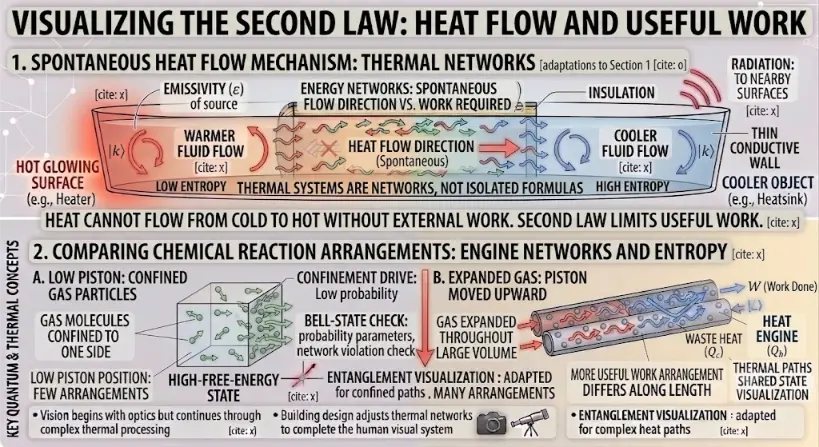
Infographic visualizing the second law of thermodynamics, comparing the basic mechanism of non-contact heat flow with the varied interactions of a heat engine application. The top panel illustrates how a temperature gradient drives spontaneous flow within a complex thermal network, while a crossed-out arrow indicates that heat cannot flow from cold to hot without external work. The lower panels track useful work and engine network efficiency, demonstrating that real thermal systems with widespread possibilities (expanded gas) move from low-probability to high-probability states, but also generate waste heat, driving changes in a thermodynamic network.
The image is a comprehensive multi-panel scientific infographic titled “VISUALIZING THE SECOND LAW: HEAT FLOW AND USEFUL WORK,” set against a clean white background with subtle geometric and network traces. It adopts a precise diagrammatic and illustrative style, featuring soft glowing accents and prominent textual callouts, Arranged in stacked formations with clear directional flow. Integrated quantum kets like |k⟩ and citation brackets suggestion connections with microscopic probability states, inspired by the structure of image_57.png.
Part 1: Spontaneous Heat Flow Mechanism: Thermal Networks
This upper panel provides a visual model of natural non-contact heat transfer Mechanisms, demonstrating it as a multi-mode loop within a thermal network. It adapts the crossed-flow visual metaphors from image_57.png:- Thermal Crossed Flow: A detailed cross-section diagram similar in layout to Section 1 of image_57.png. On the far left, a “HOT GLOWING SURFACE (e.g., Heater)” emits a red-orange glow, with internal swirling red and orange arrows labeled “WARMER FLUID FLOW,” entering from the left and approaching a “COOLER OBJECT” (e.g., Heatsink). On the right, blue swirling arrows labeled “COOLER FLUID FLOW” are present.
- Flow Tracking and Space: Countless small, curved red and blue wave arrows, adapted from the flow and radiation metaphors of image_57.png, travel through a “THIN CONDUCTIVE WALL” into the central container metaphor. A prominent central horizontal banner connects the layers: “THERMAL SYSTEMS ARE NETWORKS, NOT ISOLATED FORMULAS”. Within this network, a large red arrow indicates “HEAT FLOW DIRECTION (Spontaneous)” from hot to cold, with faded and crossed-out arrows in the opposite direction, and callouts detailed as: “ENERGY NETWORKS: SPONTANEOUS FLOW DIRECTION VS. WORK REQUIRED”. Text callouts detail: “EMISSIVITY (ϵ) of source”, “INSULATION”, and “RADIATION: TO NEARBY SURFACES”, adapted to this non-contact context. integrated kets like |k⟩ and citation brackets are integrated into the diagrammatic flow, suggesting a connection between the macroscopic fluid flow and microscopic concepts seen in image_57.png.
Part 2: Comparing Chemical Reaction Arrangements: Engine Networks and Entropy
This lower panel directly applies the concepts to a heat engine application, split vertically to show two distinct views of gas expansion, inspired by the microscopic state comparisons in Section 2 of image_57.png:- Section A: Low Piston: Confined Gas Particles: On the left, this section shows a vertical gas cylinder with the movable piston near the base. All moving gas particles with small, co-directional green flow arrows are confined to a small volume, labeled “LOW PISTON POSITION: FEW ARRANGEMENTS” and “HIGH-FREE-ENERGY STATE”. It adopts the microscopic matrix layout of image_57.png. Data callouts include: “CONFINEMENT DRIVE: Low probability”, “BELL-STATE CHECK: probability parameters, network violation check”, and adapted entanglement and shared state visualization concepts. Callouts repeat quantum concepts and summaries.
- Section B: Expanded Gas: Piston Moved Upward: On the right, this section shows a magnified view of a gas cylinder where the gas has expanded, pushing the piston significantly upward, labeled with large green “W (Work Done)” arrows. The expanded gas with many moving particles is spread throughout a larger volume, labeled “GAS EXPANDED THROUGHOUT LARGE VOLUME” and “LOW-FREE-ENERGY STATE”. Blue and red wave arrows show the efficient energy transfer and widespread possibilities. A prominent label states: “MORE USEFUL WORK ARRANGEMENT DIFFERS ALONG LENGTH”, emphasizing how the expanded state allows for useful work. It explicitly features “HEAT ENGINE (Qh)”, “WASTE HEAT (Qc)”, and useful work “W (Work Done)” callouts. Quantum concepts callouts are repeated.
Why the First Law Is Not Enough
The First Law says that energy is conserved:
ΔU = Q − W
This equation tells us how energy is accounted for, but it does not tell us which processes are naturally possible. For example, energy conservation alone does not forbid heat from flowing from a cold object to a hot object. Such a reverse flow would still conserve energy. Yet we do not observe it happening spontaneously.
The Second Law adds the missing idea of direction. It explains why some energy transformations are possible in principle but not naturally observed in practice.
| Question | Answered Mainly By | Example |
|---|---|---|
| Is energy conserved? | First Law | Heat input equals work output plus energy changes |
| Which direction does the process naturally take? | Second Law | Heat flows from hot to cold |
| Can all heat become work? | Second Law | No cyclic heat engine can be perfectly efficient |
| What happens near absolute zero? | Third Law | Entropy approaches a limiting value |
Heat Flows Naturally from Hot to Cold
One of the simplest expressions of the Second Law is that heat flows naturally from a hotter body to a colder body. This continues until thermal equilibrium is reached.
This does not mean heat can never be moved from cold to hot. Refrigerators and heat pumps do exactly that. But they require external work. Without work input or some other compensating change, heat does not spontaneously move from a colder object to a hotter object.
| Process | Spontaneous? | Second Law Interpretation |
|---|---|---|
| Hot coffee cools in a room | Yes | Heat flows from hot coffee to cooler surroundings |
| Ice melts in warm air | Yes | Heat flows from warm surroundings into colder ice |
| Cold water makes a hot pan even hotter without work | No | Heat would need to flow from cold to hot spontaneously |
| Refrigerator moves heat from inside to room air | Only with work input | Electrical work drives heat against its natural direction |
Entropy and the Second Law
Entropy is a thermodynamic quantity that helps measure how energy is spread out and how many microscopic arrangements are compatible with a macroscopic state. The Second Law can be stated using entropy:
ΔStotal ≥ 0
For an isolated system, the total entropy can increase or remain constant, but it cannot decrease.
| Condition | Entropy Change | Meaning |
|---|---|---|
| Reversible ideal process | ΔStotal = 0 | No net entropy is produced |
| Irreversible real process | ΔStotal > 0 | Entropy is generated |
| Impossible natural process | ΔStotal < 0 | Would violate the Second Law for an isolated system |
A common expression for entropy change during a reversible heat transfer is:
ΔS = Qrev / T
Here, Qrev is heat transferred reversibly and T is absolute temperature in kelvins. Temperature must be in kelvins, not degrees Celsius, when used in thermodynamic entropy equations.
Entropy Is Not Simply “Disorder”
Entropy is often introduced as “disorder,” but that word can be misleading. A better student-friendly idea is energy spreading. Natural processes tend to spread energy into more possible microscopic arrangements.
When heat flows from a hot object to a cold object, energy becomes more evenly distributed. The total entropy of the combined system increases, even though the entropy of the hot object may decrease.
| Oversimplified View | Better View |
|---|---|
| Entropy means messiness | Entropy measures energy spreading and microscopic possibilities |
| Entropy always increases everywhere | Total entropy of an isolated system does not decrease |
| Local order is impossible | Local order can increase if entropy increases elsewhere |
| Entropy means energy is lost | Energy is conserved, but its usefulness for work may decrease |
Reversible and Irreversible Processes
A reversible process is an ideal process that can be reversed without leaving any net change in the system and surroundings. Real processes are usually irreversible because they involve friction, heat transfer across finite temperature differences, mixing, turbulence, electrical resistance, or rapid expansion.
| Process Type | Key Feature | Entropy Effect |
|---|---|---|
| Reversible process | Ideal, infinitely careful, no dissipative losses | ΔStotal = 0 |
| Irreversible process | Real process with friction, mixing, finite gradients, or dissipation | ΔStotal > 0 |
Reversible processes are useful models because they define ideal limits. They are not ordinary practical processes. In real systems, some entropy is generated, and this reduces the amount of energy available for useful work.
The Arrow of Time
The Second Law gives thermodynamics a direction in time. Many microscopic laws of physics are nearly time-symmetric, but macroscopic thermal processes clearly have a preferred direction.
Cream mixes into coffee, but mixed coffee does not spontaneously separate into cream and black coffee. Gas expands into an empty container, but it does not spontaneously return to one corner. Friction slows motion and warms surfaces, but random warmth does not spontaneously push the object back to its original speed.
This is sometimes called the arrow of time. Entropy helps explain why the past and future look different in everyday thermal experience.
Heat Engines
A heat engine is a device that operates in a cycle and converts part of the heat absorbed from a hot reservoir into useful work. It must also reject some heat to a cold reservoir.
For a heat engine:
W = Qh − Qc
where Qh is heat absorbed from the hot reservoir, Qc is heat rejected to the cold reservoir, and W is the net work output.
The thermal efficiency is:
η = W / Qh
Using W = Qh − Qc, this becomes:
η = 1 − (Qc / Qh)
| Quantity | Meaning |
|---|---|
| Qh | Heat absorbed from the hot reservoir |
| Qc | Heat rejected to the cold reservoir |
| W | Useful work output |
| η | Thermal efficiency |
Why No Heat Engine Can Be 100% Efficient
The Second Law says that no cyclic heat engine can convert all absorbed heat into work while producing no other effect. Some heat must be rejected to a colder reservoir.
This is why a perfect heat engine with:
Qc = 0
is not possible for a cyclic engine operating between ordinary reservoirs. Such a machine would violate the Kelvin-Planck statement of the Second Law.
The First Law would allow the energy accounting. The Second Law forbids the perfect conversion.
The Carnot Limit
A Carnot engine is an ideal reversible heat engine operating between a hot reservoir at temperature Th and a cold reservoir at temperature Tc. Its efficiency is the maximum possible efficiency for any engine operating between those two temperatures.
The Carnot efficiency is:
ηC = 1 − (Tc / Th)
Temperatures must be in kelvins.
| Temperature Condition | Effect on Maximum Efficiency |
|---|---|
| Higher Th | Increases possible efficiency |
| Lower Tc | Increases possible efficiency |
| Tc = Th | No possible heat-engine work output |
| Tc = 0 K | Would imply 100% Carnot efficiency, but absolute zero cannot be reached |
Real engines are less efficient than the Carnot limit because real processes involve friction, turbulence, heat loss, finite temperature differences, mechanical losses, and other irreversibilities.
Refrigerators and Heat Pumps
A refrigerator or heat pump moves heat from a colder region to a warmer region. This does not violate the Second Law because external work is supplied.
For a refrigerator, the useful effect is removing heat Qc from the cold region. The coefficient of performance is:
COPR = Qc / W
For a heat pump, the useful effect is delivering heat Qh to the warm region:
COPHP = Qh / W
| Device | Main Purpose | Useful Output |
|---|---|---|
| Heat engine | Convert heat into work | W |
| Refrigerator | Remove heat from cold space | Qc |
| Heat pump | Deliver heat to warm space | Qh |
A refrigerator does not make heat flow naturally from cold to hot. It uses work input to force that transfer while releasing additional heat to the warmer surroundings.
Perpetual Motion of the Second Kind
A perpetual motion machine of the second kind would be a device that extracts heat from a single reservoir and converts it completely into work in a cycle, with no other effect.
The Second Law forbids such a machine. It is not enough for a proposed device to conserve energy. It must also obey entropy and irreversibility constraints.
| Type of Impossible Machine | Law Violated | Claim |
|---|---|---|
| Perpetual motion of the first kind | First Law | Creates energy from nothing |
| Perpetual motion of the second kind | Second Law | Converts heat completely into work in a cycle without other effects |
Microscopic View: Probability and Microstates
At the microscopic level, entropy is connected to the number of possible microscopic arrangements, or microstates, that correspond to the same macroscopic state.
A famous statistical expression for entropy is:
S = kB ln Ω
Here, S is entropy, kB is Boltzmann’s constant, and Ω is the number of accessible microstates.
This helps explain why some processes are overwhelmingly likely. A gas spreads throughout a room because there are vastly more microscopic arrangements corresponding to “spread out everywhere” than to “all molecules gathered in one corner.”
Everyday Examples of the Second Law
The Second Law appears constantly in ordinary life. It is one reason the world feels directional rather than reversible.
Cooling Coffee
Heat flows from hot coffee to cooler surroundings until thermal equilibrium is approached.Melting Ice
Heat from the surroundings enters the colder ice, increasing total entropy as the ice melts.Frictional Heating
Mechanical energy becomes thermal energy through friction, but random thermal motion does not naturally reassemble into organised motion.Mixing Cream and Coffee
Once mixed, the cream and coffee do not spontaneously separate because the mixed state corresponds to many more microscopic arrangements.Engines Producing Waste Heat
Car engines, turbines, and generators reject heat because not all heat input can become useful work.Refrigerators Requiring Electricity
A refrigerator needs work input to move heat from the cold interior to the warmer room.Applications of the Second Law
The Second Law is central to engineering, energy technology, climate science, chemistry, biology, and information science. It helps explain not only what energy is present, but how useful that energy can be.
Chemical Spontaneity
Gibbs free energy predicts whether reactions are thermodynamically favourable at constant temperature and pressure.Equilibrium Calculations
The relationship ΔG° = −RT ln K connects free energy with equilibrium constants.Batteries and Fuel Cells
Electrochemical devices convert chemical free energy into electrical work.Biological Energy
Cells use free energy from metabolism to build molecules, move substances, contract muscles, and maintain order.Phase Transitions
Free energy determines which phase is stable and where phase coexistence occurs.Materials Engineering
Free-energy landscapes guide alloy design, crystallisation, precipitation, and microstructure control.Atmospheric and Climate Processes
Phase changes, moisture, pressure, temperature, and energy flows involve thermodynamic potentials.Thermal and Mechanical Systems
Free energy helps distinguish total energy from energy that can actually perform useful work under constraints.Challenges and Practical Limitations
The Second Law is conceptually powerful, but applying it to real systems can be challenging. Real devices involve many interacting losses, non-uniform temperatures, finite rates, material limits, and measurement uncertainties.
| Challenge | Why It Matters | Example |
|---|---|---|
| Identifying the full system | Total entropy includes system and surroundings | A refrigerator lowers entropy inside but increases entropy outside |
| Non-uniform temperature | A single temperature may not describe a large or changing system | Combustion gases in an engine cylinder |
| Irreversibility from friction | Friction converts organised energy into less useful thermal energy | Pistons, bearings, tyres, and pumps |
| Finite temperature differences | Real heat transfer needs a temperature difference and produces entropy | Heat exchangers and radiators |
| Material limits | Higher engine temperature can improve efficiency but may damage materials | Turbine blades and combustion chambers |
| Heat leakage | Unwanted heat transfer reduces performance | Insulation limits in refrigerators and buildings |
| Measurement difficulty | Entropy is not always measured directly | Complex chemical, biological, or atmospheric systems |
| Ideal models versus real machines | Carnot models set limits but do not include all engineering losses | Real engines operate far below ideal reversible performance |
The Second Law gives the direction and limits, but real engineering still requires materials science, fluid mechanics, heat transfer, control systems, cost analysis, and safety design.
Future Directions and Emerging Trends
The Second Law remains deeply relevant in modern technology because future systems must do more useful work with less wasted energy. As energy systems, electronics, engines, batteries, and computing devices become more advanced, entropy and irreversibility become design concerns rather than abstract textbook ideas.
High-Efficiency Heat Pumps
Better heat pumps can reduce energy use in buildings and industry by moving heat more effectively.Waste Heat Recovery
Thermoelectric, organic Rankine, and industrial heat-recovery systems aim to recover useful energy from heat that would otherwise be wasted.Advanced Turbines and Engines
Higher-temperature materials and improved cycles can move real engines closer to thermodynamic limits.Battery Thermal Management
Electric vehicles and grid storage require careful control of heat generation, cooling, and entropy-related losses.Low-Power Computing
The relationship between information, heat, and entropy is increasingly important for efficient computing hardware.Micro- and Nano-Heat Engines
Small-scale thermodynamic devices explore how the Second Law behaves when fluctuations become important.Climate and Energy Modelling
Entropy production, heat flow, and radiation balance help scientists analyse Earth systems and future energy pathways.AI-Assisted Thermal Optimisation
Sensor networks and optimisation algorithms can help reduce avoidable irreversibility in buildings, factories, and power systems.These future directions all share one theme: energy conservation is not enough. Modern technology must also manage energy quality, entropy generation, and useful work.
Connections with Wider Physics and Technology
The Second Law connects thermodynamics with energy engineering, materials, chemistry, biology, climate science, computation, and statistical physics.
Thermodynamics
The Second Law is one of the central principles of thermodynamics because it explains direction, irreversibility, and efficiency limits.Laws of Thermodynamics
It follows energy conservation and prepares students for deeper study of entropy, free energy, and thermal equilibrium.Heat Transfer
The Second Law explains why heat flows naturally from hot to cold and why finite temperature differences create entropy.Engineering Thermodynamics
Engines, turbines, compressors, refrigerators, and heat pumps all operate under Second Law limits.Classical Thermodynamics
Classical thermodynamics uses entropy and equilibrium to analyse macroscopic systems without tracking every molecule.Non-Equilibrium Thermodynamics
Real systems often involve gradients, flows, finite rates, and entropy production away from equilibrium.Phase Equilibria and Phase Transitions
Entropy and free energy help explain melting, boiling, crystallisation, and phase stability.Modern Physics
Statistical mechanics gives entropy a microscopic interpretation through probability and microstates.Learning Pathway Within the Laws of Thermodynamics
The Second Law is the third step in the Laws of Thermodynamics pathway. It explains direction and limits after students have learned temperature and energy conservation.
Zeroth Law of Thermodynamics
Learn how thermal equilibrium defines temperature and why thermometers work.First Law of Thermodynamics
Understand how energy is conserved as heat, work, and internal energy change in thermal systems.Second Law of Thermodynamics
Current page. Explore why heat flows naturally from hot to cold, why engines cannot be perfectly efficient, and how entropy gives processes direction.Third Law of Thermodynamics
Study what happens to entropy and material behaviour as temperature approaches absolute zero.Entropy in Thermodynamics
Learn how entropy connects energy spreading, probability, irreversibility, and natural change.Free Energy in Thermodynamics
See how Gibbs and Helmholtz free energy predict useful work, spontaneity, and equilibrium.Quick Check: Second Law of Thermodynamics
Quick Check: Entropy, Heat Flow, and Efficiency
Q1. Does the Second Law say energy is not conserved?
No. Energy is conserved by the First Law. The Second Law explains the direction of natural processes and the limits on converting heat into useful work.
Q2. Why does heat flow naturally from hot to cold?
Heat flowing from hot to cold increases the total entropy of the combined system and surroundings.
Q3. Can a heat engine be 100% efficient?
No cyclic heat engine operating between ordinary reservoirs can convert all absorbed heat into work. Some heat must be rejected to a colder reservoir.
Q4. Why must Carnot temperatures be in kelvins?
Carnot efficiency uses absolute temperature ratios, so Th and Tc must be measured in kelvins.
Common Misunderstandings About the Second Law
Misunderstanding 1: The Second Law Says Energy Is Lost
Energy is not lost. The First Law still holds. The Second Law says that energy tends to become less available for useful work because entropy increases in real processes.
Misunderstanding 2: Entropy Always Increases Everywhere
Entropy can decrease locally if entropy increases elsewhere by a larger amount. The Second Law applies to the total entropy of an isolated system.
Misunderstanding 3: Refrigerators Violate the Second Law
Refrigerators move heat from cold to hot, but they require work input. This work input produces the compensating change required by the Second Law.
Misunderstanding 4: A More Advanced Engine Can Become Perfectly Efficient
Better engines can reduce losses, but no real cyclic heat engine can exceed the Carnot limit for its reservoir temperatures.
Misunderstanding 5: Entropy Is Only About Messiness
Entropy is better understood as a measure related to energy spreading, microscopic possibilities, and the direction of natural processes.
Key Terms
- Second Law of Thermodynamics
- The law stating that natural processes have a preferred direction and that the total entropy of an isolated system never decreases.
- Entropy
- A thermodynamic quantity related to energy spreading, microscopic possibilities, and irreversibility.
- Irreversible process
- A real process that cannot be undone without leaving some net change in the system and surroundings.
- Reversible process
- An ideal process that can be reversed without net entropy production.
- Heat engine
- A device that operates in a cycle, absorbs heat from a hot reservoir, converts part of it into work, and rejects heat to a cold reservoir.
- Thermal efficiency
- The fraction of heat input converted into useful work by a heat engine.
- Carnot engine
- An ideal reversible heat engine with the maximum possible efficiency between two reservoirs.
- Carnot efficiency
- The maximum theoretical heat-engine efficiency, ηC = 1 − (Tc / Th), for reservoirs at absolute temperatures Th and Tc.
- Cold reservoir
- The lower-temperature region to which a heat engine rejects heat.
- Hot reservoir
- The higher-temperature region from which a heat engine absorbs heat.
- Refrigerator
- A device that uses work input to remove heat from a cold region and reject heat to a warmer region.
- Heat pump
- A device that uses work input to deliver heat to a warmer region, often for heating buildings.
- Coefficient of performance
- A performance measure for refrigerators and heat pumps, comparing useful heat transfer with required work input.
- Perpetual motion machine of the second kind
- A hypothetical machine that would convert heat from a single reservoir entirely into work in a cycle, violating the Second Law.
Frequently Asked Questions: Second Law of Thermodynamics
What is the Second Law of Thermodynamics?
The Second Law states that natural processes have a preferred direction and that the total entropy of an isolated system does not decrease.
How is the Second Law different from the First Law?
The First Law says energy is conserved. The Second Law says which energy transformations happen naturally and why some energy becomes unavailable for useful work.
Why does heat flow from hot to cold?
Heat flows naturally from hot to cold because that direction increases the total entropy of the combined system and surroundings.
What is entropy?
Entropy is a thermodynamic quantity related to energy spreading, microscopic arrangements, and the direction of natural processes.
Can entropy decrease?
Entropy can decrease locally, but only if entropy increases elsewhere by at least as much. The total entropy of an isolated system cannot decrease.
Why can no heat engine be perfectly efficient?
A cyclic heat engine must reject some heat to a colder reservoir. It cannot convert all absorbed heat into work without violating the Second Law.
What is Carnot efficiency?
Carnot efficiency is the maximum theoretical efficiency of a reversible heat engine operating between hot and cold reservoirs: ηC = 1 − (Tc / Th), with temperatures in kelvins.
Do refrigerators violate the Second Law?
No. Refrigerators move heat from cold to hot only by using work input, which produces the compensating change required by the Second Law.
What is an irreversible process?
An irreversible process is a real process that produces entropy and cannot be perfectly reversed without leaving some net change in the system and surroundings.
Why is the Second Law important in engineering?
It sets limits on engines, refrigerators, power plants, heat pumps, batteries, electronics cooling, and many energy systems.
How does the Second Law relate to time?
The Second Law helps explain the arrow of time because entropy tends to increase in natural macroscopic processes.
Why should students learn the Second Law?
It explains heat flow, efficiency limits, entropy, irreversibility, energy quality, and the direction of real-world processes.
Review Questions and Answers
- What does the Second Law of Thermodynamics explain?Answer: It explains the direction of natural processes, the increase of total entropy in isolated systems, and the limits on converting heat into work.
- How does the Second Law differ from the First Law?Answer: The First Law conserves energy, while the Second Law explains irreversibility, entropy, and efficiency limits.
- What is the entropy statement of the Second Law?Answer: The total entropy of an isolated system never decreases. It remains constant for ideal reversible processes and increases for real irreversible processes.
- What does the Clausius statement say?Answer: Heat does not spontaneously flow from a colder body to a hotter body without some external effect, such as work input.
- What does the Kelvin-Planck statement say?Answer: No cyclic heat engine can convert all the heat it absorbs from a single reservoir completely into work without any other effect.
- What is a heat engine?Answer: A heat engine is a device that absorbs heat from a hot reservoir, converts part of it into work, and rejects the remaining heat to a cold reservoir.
- What is Carnot efficiency?Answer: Carnot efficiency is the maximum theoretical efficiency of a reversible heat engine operating between two reservoir temperatures.
- Why must Carnot temperatures be measured in kelvins?Answer: Carnot efficiency uses ratios of absolute temperature, so kelvins must be used.
Thought-Provoking Questions and Answers
- Why does the Second Law make energy quality as important as energy quantity?Answer: The First Law says energy is conserved, but the Second Law shows that not all energy is equally useful for doing work. Energy can become more spread out and less available.
- Why can life create local order without violating the Second Law?Answer: Living systems maintain local order by taking in energy and releasing heat and waste, increasing entropy in their surroundings.
- Why is waste heat such a major issue in modern technology?Answer: Waste heat represents energy that is conserved but less useful. It also creates cooling demands in engines, electronics, factories, and data centres.
- Why does the Carnot limit matter even though no real engine is perfectly reversible?Answer: It gives an ideal upper limit. Engineers use it as a benchmark to judge how much room remains for improvement.
- How does entropy help explain why the future looks different from the past?Answer: Entropy tends to increase in natural macroscopic processes, giving everyday events a preferred direction in time.
- What does the Second Law teach us about sustainability?Answer: It shows that energy use is not only about supply. It is also about reducing avoidable irreversibility, waste heat, and loss of useful work potential.
Numerical Problems and Solutions
- A heat engine absorbs 1000 J from a hot reservoir and rejects 600 J to a cold reservoir. Find the work output and efficiency.Solution:
- Use W = Qh − Qc.
- W = 1000 − 600 = 400 J.
- Use η = W / Qh.
- η = 400 / 1000 = 0.40.
Answer: The work output is 400 J, and the efficiency is 40%. - A heat engine has efficiency 30% and absorbs 2000 J of heat from the hot reservoir. Find the work output.Solution:
- Efficiency 30% = 0.30.
- Use W = η Qh.
- W = 0.30 × 2000.
- W = 600 J.
Answer: The work output is 600 J. - A Carnot engine operates between Th = 600 K and Tc = 300 K. Find its maximum efficiency.Solution:
- Use ηC = 1 − (Tc / Th).
- ηC = 1 − (300 / 600).
- ηC = 1 − 0.5 = 0.5.
Answer: The maximum efficiency is 50%. - A Carnot engine operates between 500°C and 50°C. Find the Carnot efficiency.Solution:
- Convert to kelvins: Th = 500 + 273.15 = 773.15 K.
- Convert to kelvins: Tc = 50 + 273.15 = 323.15 K.
- Use ηC = 1 − (Tc / Th).
- ηC = 1 − (323.15 / 773.15).
- ηC ≈ 1 − 0.418 = 0.582.
Answer: The Carnot efficiency is approximately 58.2%. - A refrigerator removes 1200 J of heat from its cold compartment while requiring 300 J of work. Find its coefficient of performance.Solution:
- Use COPR = Qc / W.
- COPR = 1200 / 300.
- COPR = 4.0.
Answer: The refrigerator coefficient of performance is 4.0. - A heat pump delivers 5000 J of heat to a room while using 1000 J of work. Find its coefficient of performance.Solution:
- Use COPHP = Qh / W.
- COPHP = 5000 / 1000.
- COPHP = 5.0.
Answer: The heat pump coefficient of performance is 5.0. - 400 J of heat is transferred reversibly to a system at 300 K. Find the entropy change of the system.Solution:
- Use ΔS = Qrev / T.
- ΔS = 400 / 300.
- ΔS = 1.33 J/K.
Answer: The entropy change is 1.33 J/K. - 600 J of heat flows from a hot reservoir at 600 K to a cold reservoir at 300 K. Find the total entropy change.Solution:
- Entropy change of hot reservoir: ΔSh = −600 / 600 = −1.0 J/K.
- Entropy change of cold reservoir: ΔSc = 600 / 300 = 2.0 J/K.
- Total entropy change: ΔStotal = −1.0 + 2.0 = 1.0 J/K.
Answer: The total entropy change is 1.0 J/K, so the process is consistent with the Second Law.
External References for Further Reading
The following references provide useful background on the Second Law, entropy, heat engines, Carnot efficiency, refrigerators, and thermodynamic direction.
- OpenStax Physics: Second Law of Thermodynamics and Entropy — A clear introduction to entropy and spontaneous heat transfer.
- OpenStax College Physics: Heat Engines and Efficiency — A student-friendly discussion of heat engines and the Second Law.
- OpenStax College Physics: Carnot’s Perfect Heat Engine — A reference on Carnot efficiency and ideal heat-engine limits.
- OpenStax College Physics: Heat Pumps and Refrigerators — A useful reference on refrigerators, heat pumps, and coefficients of performance.
- NASA Glenn Research Center: Thermodynamics — A concise overview of thermodynamic laws, entropy, and engineering relevance.
- Physics LibreTexts: The Second Law of Thermodynamics — A supplementary explanation of heat flow, heat engines, and Carnot ideas.
Why This Topic Matters
The Second Law matters because it explains why energy conservation is not the whole story. Energy may still exist after a process, but it may be more spread out and less useful for doing work.
For students, the Second Law is the doorway to entropy, heat engines, refrigerators, heat pumps, free energy, phase change, chemical spontaneity, information theory, and the arrow of time.
For modern society, it is essential for understanding power generation, energy efficiency, waste heat, climate control, electronics cooling, sustainable design, transport, manufacturing, and future energy systems.
Summary
The Second Law of Thermodynamics explains the direction of natural processes. Heat flows naturally from hot to cold, real processes are irreversible, and the total entropy of an isolated system does not decrease.
The law also sets limits on heat engines. A cyclic engine cannot convert all absorbed heat into work, and the Carnot efficiency gives the maximum theoretical efficiency between two reservoir temperatures:
ηC = 1 − (Tc / Th)
The Second Law is not a replacement for the First Law. The First Law conserves energy, while the Second Law explains direction, usefulness, irreversibility, and limits. Together, they form the foundation for understanding real thermal systems.
Reflection Question
If the First Law tells us that energy is conserved, but the Second Law tells us that useful energy becomes harder to recover, how should engineers, scientists, and societies think about waste heat, efficiency, and responsible energy use?