
The Third Law of Thermodynamics:

The Third Law of Thermodynamics explains what happens to entropy as temperature approaches absolute zero. It gives entropy an absolute reference point and helps students understand why 0 K is not simply “very cold,” but a profound physical limit.
This page belongs to the Laws of Thermodynamics cluster within Thermodynamics. It follows the Zeroth Law of Thermodynamics, the First Law of Thermodynamics, and the Second Law of Thermodynamics. It also prepares students for deeper study of Entropy in Thermodynamics and Free Energy in Thermodynamics.
In simple terms, the Third Law says that the entropy of a perfect crystal approaches zero as its temperature approaches absolute zero. This gives scientists a way to assign absolute entropy values rather than only entropy changes.
The law also explains why absolute zero cannot be reached in practice. Cooling a system closer and closer to 0 K becomes increasingly difficult, and no finite physical process can remove the final remaining thermal energy completely.
What the Third Law Really Says
A common statement of the Third Law is:
The entropy of a perfect crystal approaches zero as the temperature approaches 0 K.
In symbolic form:
S → 0 as T → 0 K
This statement applies to an ideal pure perfect crystal with a unique lowest-energy arrangement. Real materials may have imperfections, disorder, glassy structure, magnetic disorder, or multiple equivalent low-energy arrangements, so their very-low-temperature behaviour can be more subtle.
| Condition | Third Law Meaning |
|---|---|
| Pure perfect crystal | Entropy approaches zero as T → 0 K |
| Imperfect crystal | Some configurational disorder may remain |
| Glass | Structure may be frozen into a disordered state |
| System with multiple ground states | Residual entropy may remain |
| Real cooling process | Absolute zero cannot be reached by a finite number of steps |
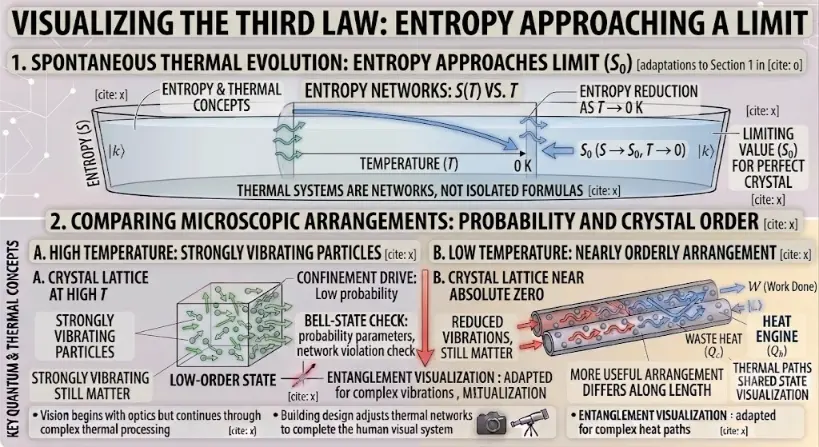
Visualizing the Third Law of Thermodynamics. The infographic connects macroscopic entropy behavior with microscopic crystal order as temperature approaches absolute zero. The top panel graphs entropy approaching a non-zero limit (S0), while the lower panels directly compare microscopic states, demonstrating how high-temperature chaotic vibrations give way to a nearly orderly arrangement, with explicit notes that quantum effects still matter to avoid a classical “frozen” misinterpretation.
The image is a comprehensive multi-panel scientific educational infographic illustration titled “VISUALIZING THE THIRD LAW: ENTROPY APPROACHING A LIMIT,” set against a clean white background with subtle diagrammatic and network traces. It adopts a precise diagrammatic and illustrative style, featuring soft glowing accents and prominent textual callouts, linked by a large central horizontal title banner adapted from image_59.png, highlighting the core concept: “THERMAL SYSTEMS ARE NETWORKS, NOT ISOLATED FORMULAS”. Integrated quantum kets like |k⟩ and citation brackets suggest connections with microscopic probability states, inspired by the structure of image_59.png.
Part 1: Spontaneous Thermal Evolution: Entropy Approaches Limit (S₀)
This upper panel provides a visual graph of entropy approaching a limit as temperature falls towards absolute zero, demonstrating it as a spontaneous thermal evolution within a network:- Entropy-Temperature Graph: A detailed graph plotting “ENTROPY (S)” on the vertical axis against “TEMPERATURE (T)” on the horizontal axis. A blue curve slopes downward as temperature approaches “0 K”, with an arrowhead pointing to a non-zero limiting value labeled “S0 (S → S0, T → 0)”. This curve and label provide a direct link to microscopic concepts.
- Thermal and Limit Callouts: Text callouts detail: “ENTROPY & THERMAL CONCEPTS”, “ENTROPY REDUCTION AS T → 0 K”, and “LIMITING VALUE (S0) FOR PERFECT CRYSTAL”, adapted to this non-contact context. integrated kets like |k⟩ and citation brackets are integrated into the diagrammatic flow, suggesting a connection between the macroscopic graph and microscopic concepts seen in image_59.png.
Part 2: Comparing Microscopic Arrangements: Probability and Crystal Order
This lower panel directly visualizes and compares different microscopic system arrangements within a crystal lattice to link macroscopic behavior with crystal order, using comparisons adapted from Section 2 in image_59.png:- Sub-Diagram A: High Temperature: Strongly Vibrating Particles: On the left, this section shows a magnified view of a crystal lattice where particles are confined, depicting the initial high-vibration state similar in layout to Section 2A in image_59.png. Green flow arrows, adapted from the flow and radiation metaphors of image_59.png, indicate strong, highly chaotic vibrations. It is labeled “CRYSTAL LATTICE AT HIGH T“, “STRONGLY VIBRATING PARTICLES”, and “LOW-ORDER STATE”. Data callouts include: “CONFINEMENT DRIVE: Low probability”, “BELL-STATE CHECK: probability parameters, network violation check”, and adapted entanglement and shared state visualization concepts. integrated kets like |k⟩ are visible.
- Sub-Diagram B: Low Temperature: Nearly Orderly Arrangement: On the right, this section shows a magnified view of two parallel gas boxes where gas has spread. In this context, it depicts a second view of the crystal lattice where particles are nearly orderly, spread throughout a larger, highly structured volume, labeled “CRYSTAL LATTICE NEAR ABSOLUTE ZERO”, “REDUCED VIBRATIONS, QUANTUM EFFECTS STILL MATTER”, and “HIGH-ORDER STATE”. This illustrates how energy spreads and possibilities grow as order is approached, with blue and red wave arrows indicating efficient energy transfer and widespread possibilities. A prominent label states: “MORE USEFUL ARRANGEMENT DIFFERS ALONG LENGTH”, emphasizing how the second case allows for complexity. It includes “WASTE HEAT (Qc)” callouts. Callouts repeat quantum concepts and summaries.
Why Absolute Zero Is Special
Absolute zero is 0 K, equal to −273.15°C. It is the lower limit of thermodynamic temperature. No object can have a temperature below absolute zero in the ordinary thermodynamic sense.
As temperature approaches 0 K, thermal motion and thermal disorder are reduced. However, this does not mean all microscopic motion disappears in a simple classical way. Quantum mechanics allows zero-point energy and quantum ground states, so the low-temperature world is not just ordinary matter becoming motionless.
| Temperature Region | Typical Physical Meaning |
|---|---|
| Room temperature | Thermal motion is strong and many microscopic states are accessible |
| Low temperature | Fewer excited states are accessible |
| Near 0 K | The system approaches its lowest accessible energy state |
| Exactly 0 K | An ideal limiting state, not practically reachable by finite cooling steps |
Why It Is Called the Third Law
The Third Law completes the classical sequence of thermodynamic laws by setting the low-temperature reference for entropy. The Zeroth Law defines temperature, the First Law conserves energy, the Second Law introduces entropy and irreversibility, and the Third Law gives entropy an absolute foundation near 0 K.
| Law | Main Question | Core Idea |
|---|---|---|
| Zeroth Law | What does temperature mean? | Thermal equilibrium makes temperature measurable |
| First Law | Where does energy go? | Energy is conserved as heat, work, and internal energy |
| Second Law | Which processes happen naturally? | Total entropy of an isolated system does not decrease |
| Third Law | What happens to entropy near absolute zero? | Entropy approaches a limiting value, zero for a perfect crystal |
Entropy on an Absolute Scale
The Second Law often focuses on entropy change. The Third Law allows entropy itself to be placed on an absolute scale for many substances.
If the entropy of a perfect crystal is taken as zero at 0 K, then the entropy at a higher temperature can be built up by adding the entropy gained through heating and phase changes.
A simplified expression for entropy change during reversible heating is:
dS = δQrev / T
For heating at constant pressure:
dS = (Cp dT) / T
So, in a simplified case without phase transitions:
S(T) = ∫0T (Cp / T) dT
Real substances may also undergo phase transitions, so entropy changes from melting, boiling, or structural changes must be included when calculating absolute entropy.
Entropy and Microstates
At the microscopic level, entropy is connected to the number of possible microscopic arrangements, or microstates, that correspond to the same macroscopic state.
Boltzmann’s formula expresses this idea:
S = kB ln Ω
Here, S is entropy, kB is Boltzmann’s constant, and Ω is the number of accessible microstates.
For a perfect crystal at 0 K, the ideal picture is that there is only one lowest-energy arrangement:
Ω = 1
Therefore:
S = kB ln 1 = 0
This microscopic view helps explain why the perfect-crystal condition matters. If more than one arrangement remains possible at the lowest energy, the entropy may not be zero.
Residual Entropy
Residual entropy is entropy that remains even as temperature approaches 0 K. It can occur when a system has more than one possible low-energy arrangement or when disorder becomes frozen into the material.
This does not destroy the usefulness of the Third Law. Instead, it reminds students that the ideal statement refers to a pure perfect crystal with a unique ordered ground state.
| Material Situation | Possible Low-Temperature Entropy | Reason |
|---|---|---|
| Perfect crystal with unique ground state | Approaches zero | Only one ideal arrangement remains |
| Crystal with orientational disorder | May have residual entropy | Molecules may remain arranged in more than one equivalent way |
| Glass | May retain frozen disorder | Structure does not reach perfect crystal order |
| Magnetically frustrated material | May have many low-energy arrangements | Spin arrangements may not settle into one unique pattern |
Heat Capacity Near Absolute Zero
The Third Law has important consequences for heat capacity. For many stable materials, heat capacity becomes very small as temperature approaches 0 K. This means the material has fewer ways to absorb thermal energy.
A common low-temperature behaviour for insulating crystals is described by a Debye-like T3 dependence:
CV ∝ T3
The exact behaviour depends on the material. Metals, superconductors, magnets, glasses, and quantum fluids may have different low-temperature heat-capacity patterns.
| Material Type | Low-Temperature Behaviour |
|---|---|
| Insulating crystal | Heat capacity often decreases strongly as temperature falls |
| Metal | Electronic contributions may become important |
| Superconductor | Heat capacity changes across the superconducting transition |
| Glass | Low-temperature behaviour can differ from perfect crystals |
| Magnetic material | Spin ordering can affect entropy and heat capacity |
The Unattainability of Absolute Zero
A key implication of the Third Law is that absolute zero cannot be reached by a finite number of physical operations. Cooling can bring systems extremely close to 0 K, but the final approach becomes increasingly difficult.
This does not mean low-temperature science is limited to ordinary cold conditions. Modern laboratories can cool atoms, solids, and quantum devices to extremely low temperatures. However, reaching exactly 0 K remains impossible in practice.
| Cooling Goal | Physical Difficulty |
|---|---|
| Lower the temperature | Remove thermal energy from the system |
| Approach 0 K | Fewer thermal excitations remain to remove |
| Reach exactly 0 K | Not achievable by finite physical steps |
| Maintain ultralow temperature | Requires isolation from heat leaks and environmental noise |
Third Law and Standard Entropy
Standard molar entropy values found in chemistry and thermodynamics tables depend on the Third Law. Because entropy can be referenced to 0 K, scientists can assign absolute entropy values to substances at standard conditions.
This is different from internal energy, where only changes are usually meaningful without choosing an arbitrary reference. The Third Law makes entropy more directly tabulatable.
| Quantity | Reference Issue |
|---|---|
| Internal energy | Usually only changes are physically important |
| Enthalpy | Often tabulated relative to chosen reference states |
| Entropy | Can be given an absolute scale using the Third Law |
| Gibbs free energy | Uses entropy and enthalpy to predict spontaneity and equilibrium |
Third Law and Free Energy
The Third Law connects strongly with free energy because free energy depends on entropy. For example, Gibbs free energy is:
G = H − TS
Here, G is Gibbs free energy, H is enthalpy, T is absolute temperature, and S is entropy.
As temperature changes, the TS term changes the balance between enthalpy and entropy. This affects phase stability, chemical reactions, equilibrium, and material behaviour.
The Third Law matters because it helps establish meaningful entropy values that can be used in free-energy calculations.
Third Law and Phase Transitions
When a substance changes phase, entropy changes because the microscopic arrangements and energy distribution change. Melting usually increases entropy because a liquid has more accessible arrangements than a solid. Boiling usually increases entropy even more because a gas has many more accessible arrangements than a liquid.
For a reversible phase transition at temperature Ttrans, entropy change can be calculated using:
ΔStrans = ΔHtrans / Ttrans
Here, ΔHtrans is the enthalpy change of the phase transition.
| Transition | Typical Entropy Change | Reason |
|---|---|---|
| Solid to liquid | Entropy increases | Molecules gain more freedom of arrangement |
| Liquid to gas | Entropy increases strongly | Molecules occupy a much larger range of positions |
| Gas to liquid | Entropy decreases for the substance | Molecules become more constrained |
| Liquid to solid | Entropy decreases for the substance | Molecules become more ordered |
Low-Temperature Physics
The Third Law is especially important in low-temperature physics. As temperatures approach absolute zero, quantum effects become more visible. Materials may become superconducting, superfluid, magnetically ordered, or strongly quantum mechanical.
At very low temperatures, thermal noise is reduced. This allows scientists to study delicate quantum states and build technologies that would be disturbed at higher temperatures.
Superconductivity
Some materials lose electrical resistance below a critical temperature, revealing a collective quantum state.Superfluidity
Certain fluids at ultralow temperatures flow with unusual quantum behaviour, including extremely low viscosity.Quantum Computing
Some quantum devices require cryogenic temperatures to reduce thermal noise and preserve quantum states.Low-Temperature Detectors
Sensitive detectors use cryogenic conditions to measure weak signals in astronomy, particle physics, and materials research.Magnetic Ordering
Spins in materials may order at low temperatures, changing entropy, heat capacity, and magnetic properties.Precision Measurement
Low temperatures can reduce noise and reveal small physical effects that are hidden at room temperature.Everyday Analogies and Their Limits
Students sometimes imagine the Third Law as “everything stops moving at absolute zero.” This is not quite correct. It may be a useful starting picture for reducing thermal motion, but quantum mechanics prevents a simple classical interpretation.
| Everyday Analogy | Helpful Part | Limitation |
|---|---|---|
| A crowded room becoming quiet | Suggests fewer accessible motions | Does not capture quantum ground states |
| A crystal becoming perfectly arranged | Shows why order matters | Real materials may retain defects or residual disorder |
| Removing the last bit of heat | Shows why cooling becomes harder | Heat is energy transfer, not a substance stored inside matter |
| Reaching the bottom of a valley | Suggests a lowest-energy state | There may be multiple equivalent low-energy states |
Good analogies should help students begin, but the full meaning of the Third Law requires entropy, microstates, absolute temperature, and quantum behaviour.
Applications of the Third Law
The Third Law may sound abstract, but it supports many practical fields. It helps scientists calculate absolute entropy, understand low-temperature behaviour, design cryogenic systems, and analyse material stability.
Absolute Entropy Tables
Thermodynamic tables use the Third Law to assign absolute entropy values to substances.Cryogenic Engineering
Cooling systems for superconductors, quantum devices, space instruments, and medical equipment depend on low-temperature thermodynamics.Superconducting Technology
The Third Law helps frame the low-temperature conditions under which superconducting materials are studied and used.Chemical Thermodynamics
Standard entropy values support calculations of Gibbs free energy, equilibrium, and spontaneity.Materials Science
Low-temperature entropy and heat capacity reveal information about crystal structure, defects, magnetic ordering, and phase stability.Quantum Technologies
Cryogenic environments help protect fragile quantum states from thermal disturbance.Astrophysics
Low-temperature matter appears in interstellar clouds, dense objects, and cosmic background studies.Precision Measurement
Low-temperature systems can reduce thermal noise and improve the sensitivity of scientific instruments.Challenges and Practical Limitations
The Third Law gives a clear ideal limit, but real materials and real experiments are complicated. Reaching very low temperatures requires advanced equipment, careful insulation, and a deep understanding of heat leaks, material disorder, and quantum effects.
| Challenge | Why It Matters | Example |
|---|---|---|
| Absolute zero is unattainable | No finite process can cool a system exactly to 0 K | Cryogenic systems can approach but not reach absolute zero |
| Heat leaks | Even tiny energy inputs disturb ultracold systems | Wires, radiation, supports, and vibrations can warm a cryostat |
| Material imperfections | Defects can create residual entropy or change low-temperature behaviour | Impure crystals may not behave like perfect crystals |
| Glassy states | Disorder may become frozen before equilibrium is reached | Glasses can retain structural disorder at low temperatures |
| Measurement difficulty | Temperature sensing becomes harder near absolute zero | Ordinary thermometers may not work in ultracold regimes |
| Quantum effects | Classical thermal intuition becomes unreliable | Zero-point energy, tunnelling, and quantum statistics matter |
| Cost and complexity | Cryogenic systems require specialised equipment | Quantum computers and superconducting magnets need cooling infrastructure |
| Non-equilibrium effects | Systems may not equilibrate quickly at low temperature | Some materials relax very slowly near 0 K |
The practical lesson is that the Third Law is not only about a final temperature. It also teaches why the approach toward that limit becomes physically, experimentally, and technologically demanding.
Future Directions and Emerging Trends
The Third Law continues to matter because many frontier technologies operate close to the limits of temperature, entropy, and quantum control. As devices become smaller and more sensitive, low-temperature thermodynamics becomes increasingly important.
Quantum Computing
Many quantum processors require cryogenic operation to reduce thermal noise and preserve quantum coherence.Advanced Cryogenic Sensors
Low-temperature detectors are being developed for astronomy, medical imaging, dark matter searches, and particle physics.Superconducting Power Systems
Superconducting cables, magnets, and devices may support future energy, transport, and medical technologies.Ultracold Atomic Physics
Laser cooling and trapping allow atoms to be studied at temperatures extremely close to absolute zero.Low-Temperature Materials Discovery
New quantum materials may reveal unusual magnetic, superconducting, or topological behaviour at low temperatures.Space-Based Cryogenics
Infrared telescopes and space instruments often need very low temperatures to reduce thermal noise.Nanoscale Thermodynamics
Researchers are exploring how entropy, heat capacity, and temperature behave in very small systems.AI-Assisted Cryogenic Design
Optimisation algorithms may help design more efficient cooling systems, thermal shields, and low-temperature instruments.These trends show that the Third Law is not merely a final note in a thermodynamics chapter. It is a gateway into quantum technology, cryogenic engineering, low-temperature materials, and precision measurement.
Connections with Wider Physics and Technology
The Third Law connects thermodynamics with entropy, quantum physics, materials science, cryogenics, chemistry, free energy, and modern technology.
Thermodynamics
The Third Law completes the thermodynamic laws by setting the low-temperature reference for entropy.Laws of Thermodynamics
It follows the Zeroth, First, and Second Laws and prepares students for entropy and free energy.Entropy in Thermodynamics
The Third Law gives entropy an absolute reference point and helps explain residual entropy.Free Energy in Thermodynamics
Entropy values from the Third Law are used in Gibbs and Helmholtz free-energy calculations.Phase Equilibria and Phase Transitions
Entropy changes during melting, boiling, crystallisation, and low-temperature phase changes are linked to the Third Law.Modern Physics
Quantum mechanics explains why low-temperature behaviour cannot be understood using only classical motion.Superconductivity
Superconducting materials reveal striking low-temperature behaviour that depends on quantum states and entropy changes.Materials Engineering
Low-temperature entropy, heat capacity, defects, and crystal structure influence material design and performance.Learning Pathway Within the Laws of Thermodynamics
The Third Law is the fourth step in the Laws of Thermodynamics pathway. It completes the set of laws by explaining the low-temperature limit of entropy and the meaning of absolute entropy.
Zeroth Law of Thermodynamics
Learn how thermal equilibrium defines temperature and why thermometers work.First Law of Thermodynamics
Understand how energy is conserved as heat, work, and internal energy change in thermal systems.Second Law of Thermodynamics
Explore why heat flows naturally from hot to cold, why engines cannot be perfectly efficient, and how entropy gives processes direction.Third Law of Thermodynamics
Current page. Study what happens to entropy and material behaviour as temperature approaches absolute zero.Entropy in Thermodynamics
Learn how entropy connects energy spreading, probability, irreversibility, and natural change.Free Energy in Thermodynamics
See how Gibbs and Helmholtz free energy predict useful work, spontaneity, and equilibrium.Quick Check: Third Law of Thermodynamics
Quick Check: Entropy Near Absolute Zero
Q1. What does the Third Law say about a pure perfect crystal at 0 K?
It says the entropy of a pure perfect crystal approaches zero as temperature approaches 0 K.
Q2. Why is the word “perfect” important in the Third Law?
A perfect crystal has one ideal ordered arrangement. Real materials with defects, disorder, or multiple ground states may retain residual entropy.
Q3. Can absolute zero be reached exactly?
No. Systems can be cooled extremely close to 0 K, but absolute zero cannot be reached by a finite number of physical operations.
Q4. Why is the Third Law useful for thermodynamic tables?
It gives entropy an absolute reference point, allowing standard molar entropy values to be tabulated.
Common Misunderstandings About the Third Law
Misunderstanding 1: Absolute Zero Means All Motion Completely Stops
Thermal motion is minimised near absolute zero, but quantum mechanics still allows zero-point energy. The low-temperature state is not simply a classical picture of total stillness.
Misunderstanding 2: The Third Law Says Every Material Has Zero Entropy at 0 K
The simple zero-entropy statement applies to a pure perfect crystal with a unique ordered ground state. Some real systems can have residual entropy.
Misunderstanding 3: Absolute Zero Is Just a Very Cold Temperature That Better Technology Will Eventually Reach
The Third Law implies that reaching exactly 0 K is not merely difficult. It is unattainable by finite physical operations.
Misunderstanding 4: The Third Law Is Only About Chemistry Tables
Entropy tables are important, but the Third Law also connects to cryogenics, quantum materials, superconductivity, low-temperature detectors, and quantum technologies.
Misunderstanding 5: Entropy Is Always About Visible Disorder
Entropy is related to accessible microstates and energy distribution. A material can look ordered visually while still having subtle microscopic or quantum contributions to entropy.
Key Terms
- Third Law of Thermodynamics
- The law stating that the entropy of a pure perfect crystal approaches zero as temperature approaches 0 K.
- Absolute zero
- The lower limit of thermodynamic temperature, equal to 0 K or −273.15°C.
- Entropy
- A thermodynamic quantity related to energy spreading, microscopic possibilities, and irreversibility.
- Perfect crystal
- An ideal crystal with a completely ordered structure and no defects or disorder.
- Residual entropy
- Entropy that remains at very low temperature because of frozen disorder or multiple possible ground-state arrangements.
- Microstate
- A specific microscopic arrangement of particles or quantum states compatible with a macroscopic condition.
- Ground state
- The lowest-energy state of a system.
- Heat capacity
- The amount of heat required to raise a system’s temperature by a given amount.
- Cryogenics
- The science and engineering of very low temperatures.
- Kelvin
- The SI unit of thermodynamic temperature, measured from absolute zero.
- Zero-point energy
- The quantum mechanical energy that remains even in the lowest-energy state of a system.
- Standard molar entropy
- The absolute entropy of one mole of a substance under standard conditions, often tabulated using the Third Law reference.
Frequently Asked Questions: Third Law of Thermodynamics
What is the Third Law of Thermodynamics?
The Third Law states that the entropy of a pure perfect crystal approaches zero as temperature approaches absolute zero.
What is absolute zero?
Absolute zero is 0 K, equal to −273.15°C. It is the lower limit of thermodynamic temperature.
Can absolute zero be reached?
No. Systems can be cooled extremely close to absolute zero, but exact 0 K cannot be reached by finite physical operations.
Why does the Third Law mention a perfect crystal?
A perfect crystal has one ideal ordered arrangement. This gives it a unique reference state with zero entropy in the ideal limit.
What is residual entropy?
Residual entropy is entropy that remains at very low temperature because a material retains disorder or has more than one possible low-energy arrangement.
Does the Third Law mean particles stop moving?
Not in a simple classical sense. Thermal motion is reduced, but quantum zero-point energy and ground-state behaviour remain important.
Why is the Third Law useful?
It allows entropy to be placed on an absolute scale, supporting standard entropy tables, free-energy calculations, and low-temperature physics.
How does the Third Law connect to entropy?
It provides the low-temperature reference point for entropy, especially for pure perfect crystals.
How does the Third Law connect to free energy?
Free energy includes entropy terms such as TS, so absolute entropy values from the Third Law help predict equilibrium and spontaneity.
What happens to heat capacity near absolute zero?
For many stable materials, heat capacity becomes very small as temperature approaches 0 K, although the exact behaviour depends on the material.
Why is low-temperature physics important?
Low temperatures reveal quantum behaviour, superconductivity, superfluidity, magnetic ordering, and other effects that are hidden at higher temperatures.
Why should students learn the Third Law?
It helps students understand absolute entropy, absolute zero, cryogenic limits, low-temperature materials, quantum behaviour, and free-energy calculations.
Review Questions and Answers
- What does the Third Law of Thermodynamics state?Answer: It states that the entropy of a pure perfect crystal approaches zero as temperature approaches 0 K.
- Why is absolute zero important?Answer: Absolute zero is the lower limit of thermodynamic temperature and provides the reference point for the Third Law.
- What is meant by a perfect crystal?Answer: A perfect crystal is an ideal crystal with no defects, impurities, or disorder, and with one unique ordered arrangement.
- What is residual entropy?Answer: Residual entropy is entropy that remains at very low temperature because of frozen disorder or multiple possible low-energy arrangements.
- Can absolute zero be reached exactly?Answer: No. Absolute zero can be approached, but it cannot be reached by a finite number of physical operations.
- How does the Third Law help create entropy tables?Answer: It provides a zero reference for entropy, allowing absolute entropy values to be calculated and tabulated.
- How does the Third Law connect to S = kB ln Ω?Answer: For a perfect crystal with one accessible ground-state microstate, Ω = 1, so S = kB ln 1 = 0.
- Why is the Third Law important in low-temperature physics?Answer: It helps explain entropy, heat capacity, and material behaviour near absolute zero, where quantum effects become important.
Thought-Provoking Questions and Answers
- Why does the Third Law make entropy feel more concrete than in the Second Law?Answer: The Second Law often uses entropy change, but the Third Law gives entropy an absolute reference point, making entropy values tabulatable and comparable.
- Why is a perfect crystal an idealisation rather than an everyday object?Answer: Real materials usually contain defects, impurities, vibrations, stresses, surfaces, or frozen disorder, while a perfect crystal is an ideal ordered reference state.
- Why does absolute zero remain unreachable even with advanced cooling technology?Answer: As a system approaches 0 K, removing the remaining thermal energy becomes increasingly difficult, and the final limit cannot be reached by finite physical steps.
- Why does the Third Law matter for quantum technology?Answer: Many quantum devices require low temperatures to reduce thermal noise and preserve delicate quantum states. The Third Law frames the limits of that cooling.
- How does residual entropy challenge a simple idea of order?Answer: A material may appear ordered macroscopically while still having multiple microscopic arrangements, defects, or frozen disorder that contribute to entropy.
- What does the Third Law teach us about limits in science?Answer: It shows that some limits are not merely engineering targets. They are built into the structure of physical law.
Numerical Problems and Solutions
- Convert −273.15°C to kelvins.Solution:
- Use T(K) = T(°C) + 273.15.
- T = −273.15 + 273.15.
- T = 0 K.
Answer: −273.15°C = 0 K. - A system has only one accessible ground-state microstate at 0 K. Use S = kB ln Ω to find its entropy.Solution:
- For one accessible microstate, Ω = 1.
- Use S = kB ln Ω.
- S = kB ln 1 = 0.
Answer: The entropy is 0, consistent with the ideal Third Law statement for a perfect crystal. - A material has two equivalent ground-state arrangements per particle in a simplified model. Estimate the molar residual entropy using S = R ln 2.Solution:
- Use S = R ln 2.
- Use R = 8.31 J/(mol·K).
- S = 8.31 × 0.693.
- S ≈ 5.76 J/(mol·K).
Answer: The molar residual entropy is approximately 5.76 J/(mol·K). - A substance is heated reversibly from 50 K to 100 K with constant heat capacity C = 20 J/K. Estimate the entropy change using ΔS = C ln(T2 / T1).Solution:
- Use ΔS = C ln(T2 / T1).
- ΔS = 20 ln(100 / 50).
- ΔS = 20 ln 2.
- ΔS = 20(0.693) = 13.86 J/K.
Answer: The entropy change is approximately 13.9 J/K. - A solid melts reversibly at 300 K with enthalpy of fusion ΔHfus = 6000 J/mol. Find the entropy change of fusion.Solution:
- Use ΔSfus = ΔHfus / Tfus.
- ΔSfus = 6000 / 300.
- ΔSfus = 20 J/(mol·K).
Answer: The entropy change of fusion is 20 J/(mol·K). - A material has low-temperature heat capacity C = aT3, where a = 0.010 J/K4. Estimate the entropy at T = 10 K using S = ∫0T (C / T) dT.Solution:
- Since C = aT3, C / T = aT2.
- S = ∫0T aT2 dT = (aT3) / 3.
- Substitute a = 0.010 and T = 10 K.
- S = 0.010(103) / 3.
- S = 10 / 3 ≈ 3.33 J/K.
Answer: The entropy at 10 K is approximately 3.33 J/K. - A substance has entropy 45 J/(mol·K) at 298 K. Its entropy at 0 K is taken as zero for an ideal perfect crystal. How much entropy has been accumulated from 0 K to 298 K?Solution:
- If S(0 K) = 0, then accumulated entropy is S(298 K) − S(0 K).
- ΔS = 45 − 0.
- ΔS = 45 J/(mol·K).
Answer: The accumulated entropy is 45 J/(mol·K). - A cryogenic system cools from 4.0 K to 1.0 K. By what factor has the absolute temperature decreased?Solution:
- Use the ratio T1 / T2 = 4.0 / 1.0.
- T1 / T2 = 4.
Answer: The absolute temperature has decreased by a factor of 4. The system is closer to absolute zero, but it has not reached 0 K.
External References for Further Reading
The following references provide useful background on the Third Law, absolute entropy, absolute zero, residual entropy, and thermodynamic temperature.
- OpenStax Chemistry 2e: The Second and Third Laws of Thermodynamics — A clear explanation of entropy, spontaneous processes, and the Third Law.
- Chemistry LibreTexts: The Third Law of Thermodynamics — A useful discussion of entropy at 0 K, perfect crystals, and residual entropy.
- Chemistry LibreTexts: Absolute Zero Is Unattainable — A reference on the unattainability aspect of the Third Law.
- NIST: How Low Can Temperature Go? — A public-facing discussion of Lord Kelvin, absolute zero, and ultracold temperature science.
- NIST: Kelvin and Thermodynamic Temperature — A reference on the Kelvin scale and thermodynamic temperature.
Why This Topic Matters
The Third Law matters because it gives entropy an absolute foundation. Without it, entropy would often be discussed only as a change. With it, scientists can calculate and compare absolute entropy values for real substances.
For students, the Third Law connects thermodynamics with chemistry, materials science, cryogenics, quantum physics, superconductivity, and free energy. It shows that the laws of thermodynamics do not stop at everyday temperatures.
For modern technology, the Third Law is relevant to low-temperature detectors, superconducting magnets, quantum computers, cryogenic instruments, space telescopes, precision measurement, and advanced materials research.
Summary
The Third Law of Thermodynamics states that the entropy of a pure perfect crystal approaches zero as temperature approaches 0 K.
This law gives entropy an absolute reference point and supports standard entropy tables, free-energy calculations, and low-temperature thermodynamics.
The Third Law also implies that absolute zero cannot be reached exactly through any finite physical process. Systems can be cooled extremely close to 0 K, but the final limit remains unattainable.
The deeper meaning of the Third Law is that matter near absolute zero is not merely “cold.” It is a domain where entropy, quantum states, heat capacity, material order, and measurement limits become deeply connected.
Reflection Question
If absolute zero is a limit that can be approached but never reached, what does the Third Law teach us about the difference between mathematical ideals and physical reality?