
The First Law of Thermodynamics is the law of energy conservation applied to thermal systems. It explains how the internal energy of a system changes when energy enters or leaves as heat or work.
This page belongs to the Laws of Thermodynamics cluster within Thermodynamics. It builds on the Zeroth Law of Thermodynamics, which explains temperature and thermal equilibrium, and prepares students for the Second Law of Thermodynamics, Third Law of Thermodynamics, Entropy in Thermodynamics, and Free Energy in Thermodynamics.
In everyday language, the First Law says that energy does not disappear. A system may gain energy by being heated. It may lose energy by doing work on its surroundings. It may store energy internally through changes in molecular motion, vibration, phase, chemical structure, or pressure-volume state. But the energy must be accounted for.
This law is the foundation for analysing engines, turbines, refrigerators, heat pumps, power plants, batteries, compressed gases, chemical reactions, biological metabolism, atmospheric processes, and many engineering systems. It turns the simple idea of energy conservation into a practical accounting tool.
What the First Law Really Says
The First Law of Thermodynamics states that the change in internal energy of a system equals the energy added as heat minus the work done by the system.
Using the common physics sign convention:
ΔU = Q – W
Here, ΔU is the change in internal energy, Q is heat added to the system, and W is work done by the system on its surroundings.
| Symbol | Meaning | Positive When… |
|---|---|---|
| ΔU | Change in internal energy | The system stores more internal energy |
| Q | Heat transferred to the system | Energy enters the system as heat |
| W | Work done by the system | The system pushes or acts on the surroundings |
The equation is simple, but its meaning is powerful: internal energy changes only because energy crosses the system boundary as heat or work.
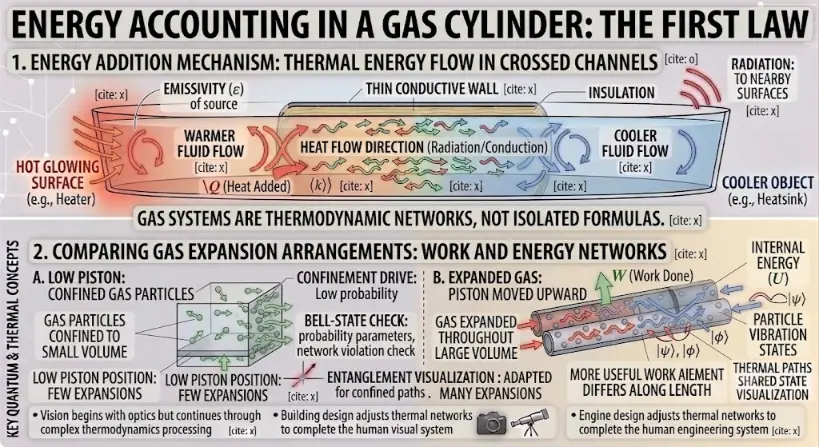
Conceptual illustration of the first law of thermodynamics applied to a gas cylinder with a movable piston. The infographic visually maps how heat energy added to the system is accounted for through increases in internal energy and work done by the system, connecting these changes in a thermodynamic network.
The image is a comprehensive multi-panel scientific educational infographic titled “ENERGY ACCOUNTING IN A GAS CYLINDER: THE FIRST LAW,” presented against a light technical background with subtle network and diagrammatic traces. It adopts a diagrammatic quality with soft glowing accents and clear textual labels, organized into two primary vertical panels linked by a large central conceptual title banner: “GAS SYSTEMS ARE THERMODYNAMIC NETWORKS, NOT ISOLATED FORMULAS”. The entire layout, organization, and labeling style are inspired by image_53.png.
Part 1: Energy Addition Mechanism: Thermal Energy Flow in Crossed Channels
This upper panel provides a visual model of heat transfer mechanisms and microscopic energy flow:- Crossed Channels and Fluid Flow: A magnified view of the bottom of a gas cylinder section is depicted, inspired by the crossed flow and container concepts in image_53.png. Multiple swirling red and orange arrows, labeled “WARMER FLUID FLOW”, approach from the left, representing the heat source. Swirling blue arrows, labeled “COOLER FLUID FLOW”, move in a separate crossed channel.
- Flow Tracking and Microscopic Mechanism: Countless small, curved blue and red wave arrows travel through a “THIN CONDUCTIVE WALL” into the cylinder base, labeled “HEAT FLOW DIRECTION (Radiation/Conduction)”. This provides a direct link between macroscopic heat transfer and microscopic behavior. Labeled callouts detail: “EMISSIVITY (ϵ) of source”, “INSULATION”, and “RADIATION: TO NEARBY SURFACES”. A prominent red arrow labeled “Q (Heat Added)” enters the gas. Integrated kets like |k⟩ and citation brackets are integrated into the diagrammatic flow, suggesting a connection between the macroscopic fluid flow and microscopic concepts seen in image_53.png.
Part 2: Comparing Gas Expansion Arrangements: Work and Energy Networks
This lower panel directly applies the concepts to a gas cylinder application, split vertically into two sub-diagrams of gas expansion:- Section A: Low Piston: Confined Gas Particles: On the left, this section shows a vertical gas cylinder with the movable piston near the base. All moving gas particles with small, co-directional green flow arrows are confined to a small volume, labeled “GAS PARTICLES CONFINED TO SMALL VOLUME” and “LOW PISTON POSITION: FEW EXPANSIONS”. It adopts the microscopic matrix layout of image_53.png. Data callouts repeat quantum concepts, including “CONFINEMENT DRIVE: Low probability”, “BELL-STATE CHECK: probability parameters, network violation check”, and adapted entanglement and shared state visualization concepts.
- Section B: Expanded Gas: Piston Moved Upward: On the right, this section shows a second view of the cylinder where the gas has expanded, pushing the piston significantly upward, labeled with large green “W (Work Done)” arrows. The expanded gas with many moving particles is spread throughout a larger volume, labeled “GAS EXPANDED THROUGHOUT LARGE VOLUME” and “PISTON MOVED UPWARD: MANY EXPANSIONS”. Blue and red wave arrows show the efficient energy transfer and widespread possibilities. A prominent label states: “MORE USEFUL WORK ARRANGEMENT DIFFERS ALONG LENGTH”, emphasizing how the expanded case allows for more useful work. Inside the gas, callouts explicitly trace and label “INTERNAL ENERGY (U)” and “PARTICLE VIBRATION STATES”, featuring vibrational arcs and state kets like |ψ⟩ and |φ⟩, suggesting a connection to particle-level states. Callouts repeat quantum concepts and summaries.
System, Surroundings, and Boundary
Before applying the First Law, we must define the system. The system is the part of the universe being studied. The surroundings are everything outside the system. The boundary separates the two.
| Term | Meaning | Example |
|---|---|---|
| System | The object or region being analysed | Gas inside a piston-cylinder |
| Surroundings | Everything outside the system | The piston, air, heater, and laboratory |
| Boundary | The surface separating system and surroundings | The cylinder walls and piston face |
The First Law is applied to a clearly defined system. If the system boundary is chosen differently, the heat and work terms may change, even though total energy remains conserved.
Internal Energy
Internal energy is the energy stored inside a system at the microscopic level. It includes energy associated with molecular motion, vibration, rotation, intermolecular forces, phase, and other microscopic contributions.
For an ideal gas, internal energy depends mainly on temperature. For real substances, internal energy can also depend strongly on phase, molecular structure, bonding, and interactions between particles.
| System | Internal Energy Includes |
|---|---|
| Gas | Random molecular motion and molecular degrees of freedom |
| Solid | Atomic vibrations and bonding energy |
| Liquid | Molecular motion plus intermolecular interaction energy |
| Phase-changing substance | Energy associated with changing molecular arrangement |
| Chemical system | Thermal energy plus chemical bond energy |
Internal energy is a state function. This means its change depends only on the initial and final states of the system, not on the path taken between them.
Heat Is Energy Transfer
Heat is not a substance stored inside an object. Heat is energy transferred because of a temperature difference. When energy crosses a system boundary because one side is hotter than the other, that energy transfer is called heat.
If heat enters the system, Q is positive in the physics convention used here. If heat leaves the system, Q is negative.
| Situation | Sign of Q | Meaning |
|---|---|---|
| Heat enters the system | Q > 0 | The system receives energy as heat |
| Heat leaves the system | Q < 0 | The system loses energy as heat |
| No heat transfer | Q = 0 | The process is adiabatic or thermally isolated |
Work Is Energy Transfer by Force and Motion
Work is energy transferred when a force acts through a distance. In thermodynamics, work often appears when a gas expands or is compressed.
For pressure-volume work, a common expression is:
W = ∫ P dV
For constant pressure, this becomes:
W = PΔV
| Process | Volume Change | Sign of W | Meaning |
|---|---|---|---|
| Expansion | ΔV > 0 | W > 0 | The system does work on the surroundings |
| Compression | ΔV < 0 | W < 0 | The surroundings do work on the system |
| Constant volume | ΔV = 0 | W = 0 | No pressure-volume work is done |
Work depends on the process path. For the same initial and final states, different expansion or compression paths can involve different amounts of work.
Sign Convention: Physics and Chemistry
Students often become confused because different books use different sign conventions for work.
| Convention | Equation | Positive Work Means… |
|---|---|---|
| Physics convention | ΔU = Q – W | Work is done by the system |
| Chemistry convention | ΔU = q + w | Work is done on the system |
Both conventions describe the same physics. The important rule is to define the convention clearly and use it consistently. This page uses the physics convention:
ΔU = Q – W
State Functions and Path Functions
A state function depends only on the current state of the system. A path function depends on how the system moves from one state to another.
| Quantity | Type | Why? |
|---|---|---|
| Internal energy U | State function | Depends only on the thermodynamic state |
| Temperature T | State function | Defined by the state of the system |
| Pressure P | State function | Defined by the state of the system |
| Volume V | State function | Defined by the state of the system |
| Heat Q | Path function | Depends on how energy is transferred |
| Work W | Path function | Depends on the process path |
This distinction is central to thermodynamics. A system does not “contain heat” or “contain work.” Heat and work describe energy crossing the boundary during a process.
Common Thermodynamic Processes
The First Law becomes easier to use when applied to common idealised processes. These processes help students understand engines, gases, cycles, and heat transfer.
| Process | Condition | First Law Consequence |
|---|---|---|
| Isochoric process | Constant volume | W = 0, so ΔU = Q |
| Isobaric process | Constant pressure | W = PΔV |
| Isothermal process | Constant temperature | For an ideal gas, ΔU = 0, so Q = W |
| Adiabatic process | No heat transfer | Q = 0, so ΔU = –W |
| Cyclic process | Final state equals initial state | ΔU = 0, so Q = W |
Constant-Volume Heating
In a constant-volume process, the system does no pressure-volume work because the volume does not change:
W = 0
The First Law becomes:
ΔU = Q
This means heat added to the system increases internal energy. A sealed rigid container being heated is a good example. Since the gas cannot expand, the added energy mainly increases internal energy and temperature.
Constant-Pressure Expansion
In a constant-pressure process, pressure remains constant while volume changes. The work done by the system is:
W = PΔV
The First Law becomes:
ΔU = Q – PΔV
Part of the heat added may increase internal energy, while part may be used to expand the system and do work on the surroundings.
Isothermal Process
In an isothermal process, temperature remains constant. For an ideal gas, internal energy depends only on temperature, so:
ΔU = 0
The First Law becomes:
0 = Q – W
Therefore:
Q = W
In an ideal isothermal expansion, heat added to the gas is converted into work done by the gas, while the internal energy stays constant.
Adiabatic Process
In an adiabatic process, no heat is transferred:
Q = 0
The First Law becomes:
ΔU = –W
If a gas expands adiabatically and does work, its internal energy decreases and its temperature may fall. If a gas is compressed adiabatically, work is done on it, internal energy increases, and its temperature may rise.
Cyclic Process
In a cyclic process, the system returns to its initial state. Since internal energy is a state function:
ΔU = 0
The First Law becomes:
Q = W
This does not mean heat and work are identical as concepts. It means that, over one complete cycle, the net heat added equals the net work done by the system under this sign convention.
PV Diagrams and Work
A pressure-volume diagram, or PV diagram, is a useful way to visualise thermodynamic work. Work done by a gas is represented by the area under the curve on a P–V graph.
For a process from V1 to V2:
W = ∫V1V2 P dV
| PV Diagram Feature | Meaning |
|---|---|
| Horizontal line | Constant-pressure process |
| Vertical line | Constant-volume process, so W = 0 |
| Area under curve | Work done by the gas |
| Closed loop | Thermodynamic cycle |
PV diagrams help students see why work depends on the path, not only on the starting and ending states.
First Law and Ideal Gases
For an ideal gas, internal energy depends only on temperature. For a monatomic ideal gas:
U = 3 ⁄ 2 nRT
Therefore:
ΔU = 3 ⁄ 2 nRΔT
Here, n is the number of moles, R is the gas constant, and T is absolute temperature in kelvins.
| Temperature Change | Change in Internal Energy for Ideal Gas |
|---|---|
| ΔT > 0 | ΔU > 0 |
| ΔT < 0 | ΔU < 0 |
| ΔT = 0 | ΔU = 0 |
Heat Capacity and the First Law
Heat capacity describes how much energy must be added as heat to raise a system’s temperature. For a simple temperature change, heat transfer can often be estimated by:
Q = mcΔT
Here, m is mass, c is specific heat capacity, and ΔT is temperature change.
However, the First Law reminds us that heat added to a system does not always only raise temperature. If the system also does work or undergoes a phase change, the energy accounting becomes more complex.
Everyday Examples of the First Law
The First Law appears whenever energy is transferred, stored, or transformed in thermal systems.
Heating Water in a Kettle
Electrical energy is converted into thermal energy, increasing the internal energy and temperature of the water.Gas Expanding in a Piston
Heat added to the gas can increase internal energy and allow the gas to do work by pushing the piston.Bicycle Pump Heating Up
Compressing air does work on the gas, increasing its internal energy and temperature.Car Engine
Chemical energy from fuel becomes thermal energy, and part of that energy is converted into mechanical work.Refrigerator
Work is done by the compressor to move heat from a colder region to a warmer region.Human Body
Food energy is transformed into internal energy, mechanical work, heat release, and biochemical processes.Applications of the First Law
The First Law is a practical tool for analysing thermal devices and natural systems. It helps engineers and scientists track energy flows and identify where useful work, waste heat, and stored energy appear.
Heat Engines
The First Law helps account for how heat input becomes work output and waste heat.Power Plants
Energy balances are used to analyse boilers, turbines, condensers, and generators.Refrigerators and Heat Pumps
The law explains how work input can move heat from one region to another.Internal Combustion Engines
Fuel energy, heat release, gas expansion, and mechanical work are analysed using energy balances.Chemical Reactions
Thermochemistry uses the First Law to connect heat, work, and internal energy changes.Atmospheric Science
Rising and falling air parcels can warm or cool through work and heat transfer.Biological Systems
Metabolism obeys energy conservation as food energy is transformed into work, heat, and stored chemical energy.Engineering Design
Energy balances guide the design of engines, turbines, compressors, heat exchangers, and thermal control systems.Challenges and Practical Limitations
The First Law is exact as an energy conservation statement, but applying it to real systems can be difficult. Real devices involve heat losses, friction, turbulence, leaks, non-uniform temperature, changing material properties, and uncertain boundaries.
| Challenge | Why It Matters | Example |
|---|---|---|
| Choosing the system boundary | Heat and work terms depend on what is included in the system | A turbine can be analysed alone or as part of a power plant |
| Heat loss to surroundings | Energy may leave in unnoticed ways | A hot pipe loses heat to room air |
| Friction and irreversibility | Mechanical work can become internal energy through dissipation | A compressor heats more than the ideal model predicts |
| Non-uniform temperature | A single temperature may not describe the system well | A large engine block has hot and cooler regions |
| Unsteady processes | Energy stored in the system changes with time | A tank filling with compressed gas |
| Material property variation | Heat capacities and behaviour may change with temperature | High-temperature gases in combustion |
| Sign convention confusion | Wrong signs lead to wrong conclusions | Mixing physics and chemistry work conventions |
| Measurement uncertainty | Heat, work, pressure, and temperature may not be measured perfectly | Laboratory calorimetry and engine testing |
The First Law tells us that energy must be conserved, but it does not automatically tell us how easily energy can be converted into useful work. That deeper question belongs to the Second Law.
Future Directions and Emerging Trends
The First Law remains central to modern energy technology. As society develops cleaner, smaller, smarter, and more efficient systems, energy accounting becomes even more important.
Renewable Energy Systems
Energy balances help analyse solar thermal systems, wind systems, geothermal plants, and energy storage.Battery Thermal Management
Electric vehicles and grid batteries require careful accounting of heat generation, storage, and cooling.Hydrogen and Fuel Cells
The First Law helps track chemical energy, electrical work, heat release, and system efficiency.Advanced Heat Pumps
Modern heat pumps use work input to move heat efficiently for buildings and industry.Micro- and Nano-Thermal Systems
Small devices require careful energy accounting because heat transfer and stored energy can behave differently at tiny scales.AI-Assisted Energy Optimisation
Sensor data and machine learning can help monitor energy flows in buildings, factories, and power systems.Thermal Management in Electronics
Data centres, chips, and power electronics depend on energy balances to prevent overheating.Low-Carbon Industrial Processes
Energy accounting supports the redesign of cement, steel, chemical, and manufacturing systems.These developments show that the First Law is not only a classroom equation. It is a practical language for understanding energy in a world that must use energy more intelligently.
Connections with Wider Physics and Technology
The First Law connects energy conservation with thermodynamics, mechanics, engineering, chemistry, climate science, biology, and modern energy systems.
Thermodynamics
The First Law is one of the central foundations of thermodynamics because it tracks heat, work, and internal energy.Laws of Thermodynamics
It follows the Zeroth Law and prepares students for the Second Law, entropy, and free energy.Heat Transfer
Heat transfer describes how energy crosses boundaries because of temperature differences.Engineering Thermodynamics
Engines, turbines, compressors, pumps, and heat exchangers all rely on First Law energy balances.Classical Thermodynamics
The law provides a macroscopic energy accounting framework for gases, liquids, solids, and cycles.Computational Thermodynamics
Energy balance equations are central in simulations of engines, materials, chemical systems, and thermal devices.Mechanics
Work connects thermodynamics with forces, motion, pressure, pistons, and mechanical energy transfer.Modern Physics
Statistical mechanics explains internal energy through microscopic particle motion and energy distribution.Learning Pathway Within the Laws of Thermodynamics
The First Law is the second step in the Laws of Thermodynamics pathway. It turns temperature and thermal equilibrium into energy accounting.
Zeroth Law of Thermodynamics
Learn how thermal equilibrium defines temperature and why thermometers work.First Law of Thermodynamics
Current page. Understand how energy is conserved as heat, work, and internal energy change in thermal systems.Second Law of Thermodynamics
Explore why heat flows naturally from hot to cold, why engines cannot be perfectly efficient, and how entropy gives processes direction.Third Law of Thermodynamics
Study what happens to entropy and material behaviour as temperature approaches absolute zero.Entropy in Thermodynamics
Learn how entropy connects energy spreading, probability, irreversibility, and natural change.Free Energy in Thermodynamics
See how Gibbs and Helmholtz free energy predict useful work, spontaneity, and equilibrium.Quick Check: First Law of Thermodynamics
Quick Check: Heat, Work, and Internal Energy
Q1. Using ΔU = Q – W, what happens to internal energy if heat enters a system and the system does no work?
If W = 0, then ΔU = Q. Heat added to the system increases internal energy.
Q2. If a gas expands and does work without receiving heat, what happens to its internal energy?
For an adiabatic process, Q = 0, so ΔU = –W. If the gas does positive work, its internal energy decreases.
Q3. Is heat a form of energy transfer or energy stored inside a system?
Heat is energy transfer caused by temperature difference. It is not energy stored inside a system.
Q4. Why does the First Law not tell us whether a process is naturally possible?
The First Law tracks energy conservation, but it does not determine the direction of natural processes. That role belongs mainly to the Second Law and entropy.
Common Misunderstandings About the First Law
Misunderstanding 1: Heat Is Stored Inside an Object
Objects store internal energy, not heat. Heat is energy crossing a boundary because of temperature difference.
Misunderstanding 2: Work and Heat Are State Functions
Heat and work are path functions. They depend on how the process occurs. Internal energy is a state function.
Misunderstanding 3: All Heat Added Must Raise Temperature
Heat added to a system may raise temperature, do work, cause phase change, or support chemical and structural changes.
Misunderstanding 4: The First Law Explains Efficiency Limits Completely
The First Law conserves energy, but it does not explain why some energy becomes unavailable for useful work. The Second Law is needed for that.
Misunderstanding 5: Sign Conventions Do Not Matter
Sign conventions matter greatly. A wrong sign for work or heat can reverse the meaning of a calculation.
Key Terms
- First Law of Thermodynamics
- The law stating that the change in internal energy of a system equals heat added to the system minus work done by the system, using the physics convention.
- Internal energy
- The microscopic energy stored inside a system through molecular motion, interactions, phase, and structure.
- Heat
- Energy transferred across a boundary because of temperature difference.
- Work
- Energy transferred when a force acts through a distance; in thermodynamics, often associated with expansion or compression.
- System
- The part of the universe chosen for analysis.
- Surroundings
- Everything outside the system.
- Boundary
- The surface or interface separating the system from its surroundings.
- State function
- A quantity that depends only on the current state of the system, not on the path taken.
- Path function
- A quantity that depends on the process path, such as heat or work.
- Adiabatic process
- A process in which no heat is transferred, so Q = 0.
- Isothermal process
- A process that occurs at constant temperature.
- Isochoric process
- A constant-volume process in which pressure-volume work is zero.
- Isobaric process
- A process that occurs at constant pressure.
- Cyclic process
- A process in which the system returns to its initial thermodynamic state.
Frequently Asked Questions: First Law of Thermodynamics
What is the First Law of Thermodynamics?
The First Law states that energy is conserved in thermodynamic systems. Using the physics convention, it is written as ΔU = Q – W.
What does ΔU = Q – W mean?
It means the change in internal energy equals heat added to the system minus work done by the system.
What is internal energy?
Internal energy is the microscopic energy stored inside a system through molecular motion, interactions, vibration, phase, and structure.
Is heat the same as internal energy?
No. Heat is energy transferred because of temperature difference. Internal energy is energy stored within the system.
What is work in thermodynamics?
Work is energy transfer caused by force acting through distance. In gases, work is often associated with expansion or compression.
Why do different textbooks use different signs for work?
Physics often treats work done by the system as positive, giving ΔU = Q – W. Chemistry often treats work done on the system as positive, giving ΔU = q + w.
What happens in an adiabatic process?
No heat is transferred, so Q = 0. The change in internal energy comes from work done by or on the system.
What happens in a constant-volume process?
There is no pressure-volume work because volume does not change. Therefore, ΔU = Q.
What does the area under a PV curve represent?
The area under a pressure-volume curve represents the work done by the gas during expansion or compression.
Can the First Law explain why heat flows from hot to cold?
No. The First Law accounts for energy conservation. The direction of natural heat flow is explained by the Second Law.
Why is the First Law important in engineering?
It allows engineers to analyse energy flows in engines, turbines, compressors, refrigerators, power plants, heat pumps, and thermal systems.
Why should students learn the First Law?
It is the main energy accounting rule for thermal systems and prepares students for engines, entropy, free energy, heat transfer, and energy technology.
Review Questions and Answers
- What does the First Law of Thermodynamics state?Answer: It states that energy is conserved in thermodynamic systems. The change in internal energy equals heat added minus work done by the system.
- What is the equation of the First Law using the physics convention?Answer: ΔU = Q – W.
- What does Q > 0 mean?Answer: It means heat is added to the system.
- What does W > 0 mean in this page’s convention?Answer: It means the system does work on the surroundings.
- Why is internal energy a state function?Answer: Its change depends only on the initial and final states, not on the process path.
- Why are heat and work path functions?Answer: They depend on how energy crosses the system boundary during a particular process.
- What is the First Law for a constant-volume process?Answer: Since W = 0, the First Law becomes ΔU = Q.
- What is the First Law for an adiabatic process?Answer: Since Q = 0, the First Law becomes ΔU = –W.
Thought-Provoking Questions and Answers
- Why does the First Law make thermodynamics a form of energy accounting?Answer: It forces us to track where energy enters, where it leaves, and how much remains stored in the system as internal energy.
- Why is it misleading to say that an object contains heat?Answer: Heat is energy in transit because of temperature difference. Once energy is inside the system, it contributes to internal energy rather than being called heat.
- Why does the First Law not guarantee high efficiency?Answer: The First Law conserves energy but does not say how much energy can be converted into useful work. The Second Law is needed to understand efficiency limits.
- How does the First Law connect engines and the human body?Answer: Both transform energy. Engines convert fuel energy into work and heat, while the body converts food energy into movement, heat, and stored biochemical energy.
- Why is choosing the system boundary important?Answer: Heat and work are defined by energy crossing the boundary. Changing the boundary changes what counts as energy transfer into or out of the system.
- What does the First Law teach us about energy sustainability?Answer: It reminds us that energy cannot be created from nothing. Sustainable design must manage energy sources, conversions, losses, and useful outputs carefully.
Numerical Problems and Solutions
- A system receives 500 J of heat and does 200 J of work. Find ΔU.Solution:
- Use ΔU = Q – W.
- ΔU = 500 – 200.
- ΔU = 300 J.
Answer: The internal energy increases by 300 J. - A gas absorbs 800 J of heat and its internal energy increases by 300 J. How much work does the gas do?Solution:
- Use ΔU = Q – W.
- Rearrange: W = Q – ΔU.
- W = 800 – 300.
- W = 500 J.
Answer: The gas does 500 J of work. - A system loses 150 J of heat and has 100 J of work done on it. Find ΔU using the physics convention.Solution:
- Heat lost means Q = -150 J.
- Work done on the system means work done by the system is negative: W = -100 J.
- Use ΔU = Q – W.
- ΔU = -150 – (-100).
- ΔU = -50 J.
Answer: The internal energy decreases by 50 J. - A gas expands at constant pressure P = 2.0 × 10⁵ Pa from 0.010 m3 to 0.016 m3. Find the work done by the gas.Solution:
- Use W = PΔV.
- ΔV = 0.016 – 0.010 = 0.006 m3.
- W = (2.0 × 10⁵)(0.006).
- W = 1200 J.
Answer: The gas does 1200 J of work. - In a constant-volume process, 600 J of heat is added to a gas. Find the change in internal energy.Solution:
- At constant volume, W = 0.
- Use ΔU = Q – W.
- ΔU = 600 – 0.
- ΔU = 600 J.
Answer: The internal energy increases by 600 J. - A gas expands adiabatically and does 400 J of work. Find ΔU.Solution:
- For an adiabatic process, Q = 0.
- Use ΔU = Q – W.
- ΔU = 0 – 400.
- ΔU = -400 J.
Answer: The internal energy decreases by 400 J. - A monatomic ideal gas has n = 2.0 mol and temperature increases by 30 K. Estimate ΔU = 3 ⁄ 2 nRΔT, using R = 8.31 J/(mol·K).Solution:
- ΔU = 3 ⁄ 2 (2.0)(8.31)(30).
- 3 ⁄ 2 (2.0) = 3.0.
- ΔU = 3.0 × 8.31 × 30.
- ΔU = 747.9 J.
Answer: ΔU ≈ 748 J. - In one complete cycle, a heat engine receives 2000 J of heat and rejects 1400 J of heat. Find the net work output.Solution:
- Over a complete cycle, ΔU = 0.
- Net heat input is Qnet = 2000 – 1400 = 600 J.
- For a cycle, Qnet = Wnet.
Answer: The net work output is 600 J.
External References for Further Reading
The following references provide useful background on the First Law, internal energy, heat, work, and thermodynamic sign conventions.
- OpenStax University Physics: First Law of Thermodynamics — A physics-based explanation of heat, work, and internal energy.
- OpenStax College Physics: The First Law of Thermodynamics — A student-friendly introduction to the First Law as conservation of energy.
- NASA Glenn Research Center: First Law of Thermodynamics — A concise explanation of internal energy, heat transfer, and work in thermodynamic systems.
- NASA Glenn Research Center: First Law and Internal Energy — A beginner-friendly aeronautics reference on energy changes in thermodynamic systems.
- Chemistry LibreTexts: Heat, Work, and the First Law — A chemistry-oriented explanation using the alternate work sign convention.
Why This Topic Matters
The First Law matters because every real thermal system must obey energy conservation. It tells us that engines cannot produce work without an energy source, refrigerators require work input, and heat lost to the environment must be included in honest energy accounting.
For students, it is one of the most useful bridges between mechanics and thermal physics. The ideas of work and energy from mechanics reappear in thermodynamics, but now they are joined by heat, temperature, internal energy, and system boundaries.
For modern society, the First Law is essential for understanding energy efficiency, power generation, climate control, transport, manufacturing, battery safety, heat recovery, and low-carbon technologies.
Summary
The First Law of Thermodynamics is the law of conservation of energy applied to thermal systems. Using the physics convention, it is written as:
ΔU = Q – W
Heat and work are energy transfers across a system boundary. Internal energy is energy stored inside the system. Heat and work depend on the process path, while internal energy depends only on the state.
The First Law explains energy accounting in gases, engines, refrigerators, heat pumps, power plants, biological systems, and many engineering devices. However, it does not by itself explain why natural processes have a preferred direction or why no heat engine can be perfectly efficient. Those questions lead to the Second Law of Thermodynamics.
Reflection Question
If the First Law tells us that energy is never destroyed, why do engineers and societies still worry so much about energy waste, efficiency, and sustainability?