
Prepare for University Studies & Career Advancement

Single-Photon Experiments

Single-photon experiments are among the clearest ways to see why quantum optics is different from ordinary classical optics. In these experiments, light is studied one photon at a time. Each photon is detected as a single event, yet many repeated events can build patterns that reveal wave-like behaviour, probability, interference, and the role of measurement.
This page introduces Single-Photon Experiments in a student-friendly way. It belongs to the wider Quantum Optics cluster, which serves as a vital component of advanced physical sciences.
The central question is simple but profound: if light arrives as individual photons, why can it still produce interference patterns that look wave-like? Single-photon experiments help students see that quantum physics is not just a theory of tiny particles. It is a new way of thinking about possibility, measurement, and evidence.

What Single-Photon Experiments Really Are
A single-photon experiment is an experiment designed so that photons are emitted, guided, or detected one at a time, or nearly one at a time. Instead of treating light as a continuous beam, the experiment records individual detection events.
This does not mean that one photon is watched like a tiny object travelling along a visible path. A photon is not a small glowing bead. In quantum optics, a photon is a quantum object associated with a state of the electromagnetic field. The experiment usually reveals the photon only when it is detected.
Single-photon experiments are powerful because they show both sides of quantum light. A detector records one event at one location, which looks particle-like. Yet the probability pattern formed by many such events can show interference, which looks wave-like.
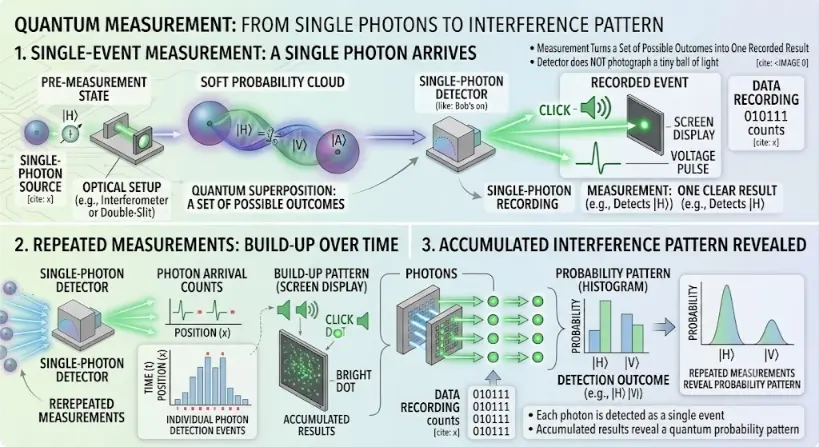
A three-panel scientific infographic titled "QUANTUM MEASUREMENT: FROM SINGLE PHOTONS TO INTERFERENCE PATTERN". Panel 1, "SINGLE-EVENT MEASUREMENT: A SINGLE PHOTON ARRIVES", shows a single photon emerging as a soft probability cloud from a source, passing through an interferometer or double-slit setup, and producing a single green click, dot, or voltage pulse at a detector. Panel 2, "REPEATED MEASUREMENTS: BUILD-UP OVER TIME", tracks repeated photon emissions, plotting individual arrival counts on a bar graph and showing green dots randomly accumulating on a sensor array screen. Panel 3, "ACCUMULATED INTERFERENCE PATTERN REVEALED", demonstrates how these countless individual events eventually build up a clear probability pattern histogram and a smooth interference curve plot. Bullet points state that each photon is detected as a single event, but the accumulated results reveal a quantum probability pattern.
The gradual build-up of a quantum interference pattern. This three-stage infographic demonstrates that while each individual photon is registered on a sensor screen as a single, isolated detection event (a dot), a massive sequence of repeated measurements over time slowly maps out the underlying wave-like quantum probability distribution.
The image is a comprehensive, multi-pane scientific infographic titled “QUANTUM MEASUREMENT: FROM SINGLE PHOTONS TO INTERFERENCE PATTERN”. The visual layout walks students through the transition from independent, single-particle arrivals to an ensemble quantum interference distribution using soft neon-green and blue graphics on a clean tech background.

Part 1: SINGLE-EVENT MEASUREMENT: A SINGLE PHOTON ARRIVES

The top panel establishes the behavior of an isolated particle system moving through space:
  • Source to Setup: On the far left, a “SINGLE-PHOTON SOURCE” releases one light particle into a “PRE-MEASUREMENT STATE”. It passes through an “OPTICAL SETUP (e.g., Interferometer or Double-Slit)”.
  • Superposition Wave Packet: While traveling, the photon is visualized as a “SOFT PROBABILITY CLOUD”—a multi-layered wave packet glowing in purple and green containing symbols for ket H, ket V, and ket A, labeled “QUANTUM SUPERPOSITION: A SET OF POSSIBLE OUTCOMES”.
  • Isolated Collapse: Upon hitting the “SINGLE-PHOTON DETECTOR”, the probability cloud vanishes and resolves into a single, localized “RECORDED EVENT”. This event is represented by three simultaneous readouts: an audio “CLICK” icon, a sharp green spot on a “SCREEN DISPLAY”, and a discrete “VOLTAGE PULSE” timeline trace. A sidebar explicitly reminds students: “Measurement turns a set of possible outcomes into one recorded result” and “Detector does NOT photograph a tiny ball of light.”

Part 2: REPEATED MEASUREMENTS: BUILD-UP OVER TIME

The lower-left panel explores what happens when the exact same experiment is repeated sequentially over an extended timeline:
  • Accumulating Dots: Multiple individual photons are sent sequentially through the setup. A timeline graph titled “INDIVIDUAL PHOTON DETECTION EVENTS” tracks arrival coordinates on axes for Position (x) and Time (t).
  • The Sensor Matrix: Nearby, a small display labeled “ACCUMULATED RESULTS” shows individual green impact dots scattering randomly across a black screen matrix, proving that individual impact points cannot be predicted with absolute certainty.

Part 3: ACCUMULATED INTERFERENCE PATTERN REVEALED

The final, lower-right panel shows the grand statistical conclusion of quantum mechanics:
  • Emergent Ordering: As thousands of photons accumulate through a large “DETECTOR ARRAY”, the seemingly random dots form distinct, parallel vertical bands.
  • Mathematical Distribution: This physical pattern is verified by a “PROBABILITY PATTERN (HISTOGRAM)” bar graph and a final smooth, fluctuating wave plot labeled “REPEATED MEASUREMENTS REVEAL PROBABILITY PATTERN” showing high-probability peaks (constructive interference) and low-probability troughs (destructive interference).
  • Takeaway Summary: A summary box in the bottom right wraps up the core lesson with two final points:
    • Each photon is detected as a single event.
    • Accumulated results reveal a quantum probability pattern.

The Evolutionary Path: History, Particle Hurdles, and Foundry Foundations

The shift from standard light streams to isolated single-photon manipulation changed laboratory methods from observing continuous beams to tracking individual probability collapses.

The Historical Journey

The conceptual origin of single-photon isolation emerged from the foundational work of Max Planck in 1900 and Albert Einstein’s 1905 explanation of light quantization. For decades, single-photon behavior remained primarily a thought experiment due to weak light limits. This boundary shifted in 1974 when physicists Clauser and Freedman observed non-classical photon correlations, followed by the definitive 1986 anti-bunching experiments of Grangier, Roger, and Aspect. By measuring single photons hitting a beam splitter, they proved that a single quantum packet could not be split into two simultaneous clicks, providing the first direct confirmation of light particle isolation independent of wave structures.

Contemporary Scientific Challenges

The absolute operational hurdle in single-photon mechanics is **multiphoton suppression and fiber insertion loss**. Most standard low-intensity setups use heavily attenuated lasers, which follow Poissonian statistics. This means there is always a statistical probability that multiple photons pass through the rail simultaneously, a loophole that can break secure cryptography lines.
Furthermore, single photons traveling down silica fiber tracks run into high scattering and structural channel boundaries. Because the no-cloning theorem states that an unknown quantum state cannot be duplicated perfectly, traditional amplifiers cannot be used to boost the single particle without triggering **wavefunction collapse**, making signal loss a severe design challenge for terrestrial links.

Future Horizons: Quantum Dots and Integrated Nanophotonics

Modern hardware engineering relies on solid-state crystal architectures and compact on-chip routing lines to isolate single particles with high precision:
  • On-Demand Semiconductor Quantum Dots: To replace random down-conversion crystals, industrial foundries are fabricating single indium-arsenide quantum dots inside microscopic optical cavities. When triggered by a fast electrical pulse, these artificial atoms release a single photon with near 100% purity and high indistinguishability, providing a scalable source for hardware processors.
  • Lithium Niobate Nanophotonic Matrices: Bypassing bulky free-space alignment benches, modern laboratories are pattern-etching waveguides, micro-ring resonators, and superconducting nanowire detectors directly onto single lithium niobate wafers. These integrated chips guide, modulate, and count single photons inside a tiny footprint, establishing the structural foundation for quantum key distribution.

Why Single Photons Matter

Many ordinary light experiments use bright beams containing enormous numbers of photons. In those situations, light often behaves very much like a classical electromagnetic wave. That wave picture is useful and accurate for many lenses, mirrors, fibres, lasers, and imaging systems.
Single-photon experiments move to a different level. They ask what happens when light is reduced to individual quantum events. This makes it possible to test whether classical ideas are enough, or whether the quantum state of light is needed.
These experiments matter because they prepare students for some of the deepest ideas in modern physics: wave-particle duality, superposition, measurement, entanglement, photon counting, and quantum communication.

Weak Light Is Not Always the Same as Single-Photon Light

A common confusion is to think that any very dim light beam is automatically a single-photon source. A weak classical light beam may have a low average number of photons, but the photon arrivals can still be statistically uneven. Sometimes no photon arrives; sometimes one photon arrives; occasionally more than one may arrive close together.
A true single-photon source aims to produce one photon at a time in a controlled way. In practice, real sources are never perfect, but experimental design can strongly reduce the chance of multiple photons being present when only one is desired.
This distinction is important in quantum optics and quantum communication. A system intended to use individual photons must be judged not only by brightness, but also by photon statistics, timing, purity, and detection reliability.

Basic Parts of a Single-Photon Experiment

Single-photon experiments may look complex in a laboratory, but their basic structure can be understood through a few key parts.
Part of ExperimentMain RoleStudent-Friendly Meaning
Photon sourceProduces very weak light, heralded photons, or controlled single photonsThe beginning of the quantum light signal
Optical elementsGuide, split, reflect, filter, or polarise the photon stateThe path and test setup for the photon
Interferometer or slit systemAllows different paths or alternatives to combineThe place where wave-like probability effects appear
Single-photon detectorRegisters individual photon eventsThe device that produces “clicks”
Timing electronicsRecords when events occurThe clock and counting system
Data analysisBuilds patterns from many eventsThe step that reveals the probability distribution

Photon Sources

A photon source is the starting point of a single-photon experiment. Different experiments use different kinds of sources. Some use heavily attenuated laser light as a simple approximation. Others use more specialised sources that create photon pairs or emit individual photons from quantum systems.
One important method in quantum optics is spontaneous parametric down-conversion. In this process, a higher-energy photon inside a nonlinear crystal can produce a pair of lower-energy photons. Detecting one photon can “herald” the presence of its partner. This does not make the experiment simple, but it gives researchers a useful way to prepare single-photon events.
Other approaches include single atoms, ions, molecules, colour centres, semiconductor quantum dots, and integrated photonic sources. Students do not need to master every source at first. The main idea is that the source must make photon-level behaviour measurable and controlled.

Single-Photon Detectors

A single-photon detector is designed to respond to very small amounts of light, ideally one photon at a time. When a photon is detected, the device may produce an electrical pulse, often described informally as a “click.”
Detectors are not perfect. They may miss some photons. They may produce occasional dark counts even when no intended photon arrives. They may have timing uncertainty called jitter. They may also need careful cooling, calibration, shielding, and electronic readout.
This reminds students that quantum optics is both conceptual and experimental. The philosophical meaning of a single photon cannot be separated from the practical ability to produce, guide, and detect individual events reliably.

The Single-Photon Double-Slit Experiment

The double-slit experiment is one of the most famous experiments in physics. In its classical form, light passes through two narrow slits and produces an interference pattern. This shows the wave nature of light.
The single-photon version is even more striking. Photons are sent toward the double slit one at a time. Each photon is detected as a single spot on the screen or detector. At first, the spots may look random. But after many photons have been detected, an interference pattern gradually appears.
This result teaches a deep lesson. A single photon is not simply travelling as an ordinary classical particle through one slit like a small ball. The quantum state must include the possible alternatives in a way that can produce interference.

Interference One Photon at a Time

Interference is usually introduced using waves. Two wave contributions overlap, and depending on their phase relationship, they can strengthen or weaken each other. In single-photon experiments, the interference is not between two different photons arriving at the same time. It is better understood as interference between probability amplitudes associated with different alternatives available to the photon.
This is one of the most important ideas in quantum mechanics. The experiment does not say that a photon is a classical wave spread through space in the ordinary sense, nor does it say that the photon is a tiny classical object taking one definite path. It shows that quantum probability amplitudes can interfere.
Students should be careful with language. Phrases such as “the photon goes through both slits” can be useful as a shortcut, but they can also mislead. A more careful statement is that the photon’s quantum state includes alternatives whose probability amplitudes can interfere when which-path information is not available.

Which-Path Information

A key question in single-photon experiments is whether it is possible to know which path the photon took. If the experiment is arranged so that which-path information is available, the interference pattern can disappear.
This does not simply mean that a human observer must look at the experiment. The important issue is whether the physical setup contains information that can distinguish the alternatives. If the paths become distinguishable, the conditions for interference are changed.
This idea connects directly with Quantum Measurement and Light, where students can study more deeply how measurement affects what can be observed.

Mach-Zehnder Interferometer Experiments

A Mach-Zehnder interferometer is another important setup for single-photon experiments. It uses beam splitters and mirrors to create two possible paths for light, then recombines the paths so that interference can occur.
In a single-photon version, one photon enters the interferometer. At the first beam splitter, the photon’s quantum state is placed into a superposition of path possibilities. When the paths recombine, the final detection probabilities depend on the relative phase between the paths.
This setup is useful because it makes the idea of path superposition more visible. The experiment can be adjusted to show how phase, path length, beam splitters, and detection outcomes are related.

Beam Splitters and Probability

A beam splitter is an optical component that can transmit part of an incoming light field and reflect part of it. For a classical beam, this may mean that some fraction of optical power goes one way and the rest goes another way.
For a single photon, the beam splitter does not cut the photon into two smaller photons. Instead, it creates a quantum situation in which different output possibilities have probability amplitudes. When the photon is finally detected, it appears as one event in one output detector or another.
This is a useful example of why quantum optics is subtle. The photon is not divided like a small piece of matter. The state evolves according to quantum rules, and the measurement gives one result.

Photon Antibunching

Photon antibunching is an experimental sign that light is genuinely non-classical. In simple terms, a good single-photon source should not emit two photons at the same time when only one is expected. If one detector records a photon, a second detector should be less likely to record another photon at exactly the same moment.
This behaviour differs from many ordinary classical light sources. It helps researchers test whether a source is really producing single-photon-like light rather than merely weak classical light.
Students do not need the full statistical theory at first. The main lesson is this: quantum light can have photon-arrival patterns that cannot be fully explained by classical wave intensity alone.

Quantum Eraser Ideas

Some experiments explore what happens when which-path information is marked and then made unavailable in a suitable way. These are often called quantum eraser experiments. They are conceptually delicate, so students should avoid sensational interpretations.
A careful way to state the idea is this: interference depends on whether the alternatives are distinguishable in the final experimental arrangement. Quantum eraser experiments show how changing the available information about alternatives can change the observed statistical patterns.
These experiments do not allow messages to be sent into the past, and they do not mean that human consciousness controls reality. They show that quantum measurement, information, and interference are deeply linked.

What Single-Photon Experiments Teach

Single-photon experiments are important not because they make light mysterious, but because they make the rules of quantum physics visible in a controlled way.

Detection Is Discrete

A photon is detected as a single event, not as a small continuous smear of energy across the detector.

Patterns Are Probabilistic

Individual detection events may not be predictable, but many repeated events can form a precise probability pattern.

Interference Can Survive One Photon at a Time

Interference does not require many photons meeting each other. It can arise from the quantum amplitudes of one photon’s alternatives.

Measurement Matters

The experimental arrangement determines which properties can be observed and whether interference conditions are preserved.

Classical Pictures Have Limits

Neither the simple particle picture nor the simple classical wave picture fully captures single-photon behaviour.

Quantum Technology Depends on Control

Quantum communication, entanglement experiments, and quantum networks require reliable sources, detectors, and optical control.

Experimental Challenges

Single-photon experiments require careful design because the signals are extremely small. Background light must be reduced. Detectors must be shielded and calibrated. Optical components must be aligned. Timing must be controlled. Data must be collected over enough repeated events to reveal the pattern.
ChallengeWhy It MattersStudent-Friendly Meaning
Background lightUnwanted photons may imitate or obscure real eventsThe experiment must be kept optically clean
Detector efficiencySome photons may not be detectedA missing click does not always mean no photon arrived
Dark countsDetectors may sometimes click without an intended photonThe detector has its own noise
Timing jitterDetection time has uncertaintyThe clock is not infinitely precise
AlignmentSmall optical errors can destroy the expected patternQuantum optics needs careful geometry
Statistical repetitionMany events are needed to see probability patternsOne photon is not enough to reveal the full pattern

Case Studies: Single-Photon Experiments in Action

Case Study 1: Single-Photon Double-Slit Pattern

A source sends photons toward a double slit one at a time. Each photon is detected as a single dot. At first, the dots appear scattered. After many detections, the dots reveal an interference pattern.
This case study shows the heart of wave-particle duality. The detection events are discrete, but the overall distribution follows a wave-like probability pattern.

Case Study 2: Mach-Zehnder Interferometer

A single photon enters an interferometer with two possible paths. Beam splitters and mirrors create and recombine those paths. The final detector outcomes depend on the relative phase between the paths.
This case study helps students understand path superposition and interference without relying only on the double-slit picture.

Case Study 3: Testing a Single-Photon Source

Researchers may test whether a light source behaves like a true single-photon source by measuring photon correlations. If the source rarely emits two photons at the same time, it may show antibunching.
This case study shows that “single photon” is not just a label. It is something that must be demonstrated through measurement.

Case Study 4: Single Photons in Quantum Communication

In quantum communication, individual photons or very weak optical pulses can carry quantum states. Detection and measurement then become part of the communication process. The security ideas depend on quantum behaviour, not merely on ordinary signal hiding.
This case study prepares students for Quantum Communication.

Connections with Wider Physics and Technology

Single-photon experiments connect quantum optics with wave optics, photonics, laser optics, detectors, quantum communication, and the deeper interpretation of measurement.

Light and Optics

Single-photon experiments grow from the wider study of light, including reflection, interference, diffraction, polarisation, and optical instruments.

Wave Optics

Interference, phase, diffraction, coherence, and superposition of wave patterns help students understand the experimental background.

Photonics

Photonics provides the devices and systems used to generate, guide, modulate, and detect light in practical experiments.

Laser Optics

Lasers and optical components often support the preparation, alignment, and control of experimental light fields.

Modern Physics

The mathematical language of operators, wavefunctions, and matrix math rules how single light packets evolve across a target coordinate track.

Electromagnetic Waves

Photons are quanta of electromagnetic radiation, linking quantum events with the classical field description of light.

Learning Pathway Within Quantum Optics

This page builds on the idea of photons and quantum states of light. It prepares students for entanglement, quantum communication, and the deeper problem of measurement.

Single-Photon Experiments

Current page. Explore how one-photon-at-a-time experiments reveal interference, probability, which-path information, and the limits of classical pictures.

Quantum Communication

See how quantum states of photons can support secure communication ideas and future quantum networks.

Quick Check: Single-Photon Experiments

Quick Check: One Photon at a Time

Q1. Does a beam splitter divide one photon into two smaller photons?
No. A single photon is not split into two half-photons. The beam splitter creates different possible output paths, and the photon is later detected as one event in one output.
Q2. Why can single photons form an interference pattern after many trials?
Each photon is detected as one event, but the probability amplitudes associated with different alternatives can interfere. Many detection events reveal the probability pattern.
Q3. What happens when which-path information becomes available?
When the alternatives become distinguishable, the interference pattern can disappear because the conditions for interference have changed.
Q4. Why are single-photon detectors important?
They allow experiments to record individual photon events, build statistical patterns, and test quantum predictions about light.

Common Misunderstandings About Single-Photon Experiments

Misunderstanding 1: A Photon Is Just a Tiny Ball Passing Through One Slit

This picture is too classical. A photon is detected as a single event, but its quantum state can include alternatives whose probability amplitudes interfere. The experiment cannot be fully explained by imagining a tiny ball moving through one definite slit.

Misunderstanding 2: Interference Requires Many Photons to Meet Each Other

Single-photon interference shows that photons do not need to arrive together for an interference pattern to build. The pattern appears after many individual events because the quantum probabilities are shaped by the experimental arrangement.

Misunderstanding 3: Weak Light Automatically Means Single Photons

A weak beam may have a low average photon number, but it may still occasionally contain more than one photon in a short time interval. True single-photon behaviour requires careful source design and testing.

Misunderstanding 4: Measurement Means a Human Must Look

In quantum physics, measurement does not require human consciousness. What matters is the physical interaction that records or distinguishes an outcome or alternative.

Misunderstanding 5: Quantum Eraser Experiments Send Messages Backward in Time

Quantum eraser experiments are about distinguishability, measurement arrangements, and statistical correlations. They do not allow usable information to be sent into the past.

Key Terms

Antibunching
A non-classical photon-arrival pattern in which simultaneous photon detections are reduced.
Beam splitter
An optical component that creates different possible output paths for light.
Coincidence counting
A method of identifying related photon events by comparing detections within a chosen time window.
Dark count
A detector count that occurs even without an intended incoming photon due to random thermal noise inside the tracking substrate.
Detection event
A recorded click, pulse, dot, or signal caused by a photon being detected.
Heralded photon
A photon whose presence is inferred from the detection of a partner photon produced in the same event.
Interference
The strengthening or weakening of probability patterns due to the combination of quantum amplitudes.
Mach-Zehnder interferometer
An optical setup using beam splitters and mirrors to create and recombine two path alternatives.
Photon source
A device or process used to produce photons for an experiment.
Probability amplitude
A quantum quantity whose magnitude and phase help determine measurement probabilities.
Quantum eraser
An experiment showing how interference depends on whether path information remains distinguishable in the final measurement arrangement.
Single-photon detector
A detector capable of registering individual photon events.
Single-photon experiment
An experiment designed to study light at the level of individual photon events.
Timing jitter
The internal temporal uncertainty that limits the exact time recorded for a single particle click.
Which-path information
Information that allows the path or alternative taken by a photon to be distinguished.

Review Questions

  1. What is a single-photon experiment?
    Answer: It is an experiment designed to study light at the level of individual photon events rather than as a continuous classical beam.
  2. Why is a weak light beam not always the same as a single-photon source?
    Answer: A weak beam may have a low average photon number, but it can still sometimes contain zero, one, or more than one photon in a short time interval.
  3. What does the single-photon double-slit experiment show?
    Answer: It shows that photons are detected as individual events, yet many events can build an interference pattern that reveals wave-like quantum probability behaviour.
  4. What is which-path information?
    Answer: Which-path information is information that makes it possible to distinguish which path or alternative a photon took in an experiment.
  5. What happens to interference when path alternatives become distinguishable?
    Answer: The interference pattern can disappear because the alternatives no longer combine in the same way.
  6. What role does a beam splitter play in a single-photon experiment?
    Answer: It creates different possible output paths for the photon’s quantum state. It does not divide the photon into two smaller pieces.
  7. Why are single-photon detectors imperfect?
    Answer: Real detectors may miss photons, produce dark counts, have timing uncertainty, and require careful calibration and shielding.
  8. Why are single-photon experiments important for quantum communication?
    Answer: Quantum communication often depends on encoding and detecting quantum states of individual photons or very weak optical signals.

Thought-Provoking Questions

  1. Why does a single-photon interference pattern challenge the idea that a photon is just a tiny particle?
    Answer: A tiny classical particle would be expected to pass through one path and build a simple particle distribution. Single-photon interference shows that quantum probability amplitudes associated with alternatives can shape the final pattern.
  2. Why does measurement matter in quantum optics?
    Answer: The measurement arrangement determines which information becomes available. If the setup reveals path information, it can change whether interference is observed.
  3. Why is it not enough to perform a single trial in a quantum experiment?
    Answer: One detection event does not reveal the full probability pattern. Quantum predictions are usually tested by repeating the experiment many times and comparing the statistical distribution with theory.
  4. Why should students avoid sensational explanations of quantum eraser experiments?
    Answer: Quantum eraser experiments are subtle, but they do not allow time travel or mind-controlled reality. They show how distinguishability, measurement, and correlations affect observed statistical patterns.
  5. How do single-photon experiments show the partnership between theory and instrumentation?
    Answer: Quantum theory predicts probability patterns, but experiments require sources, detectors, timing electronics, alignment, shielding, and data analysis to reveal those patterns.

Comprehensive Numerical Problems with Solutions

  1. A high-speed single-photon detector records 2.0 × 10⁵ photon counts over an active measurement timeline of 10 s. Calculate the average count rate.
    Solution:
    Use the standard particle registration rate expression:
    $$\text{Count Rate} = \frac{\text{Total Counts}}{\text{Time}}$$
    Substitute values straight into the equation:
    $$\text{Count Rate} = \frac{2.0 \times 10^5}{10\text{ s}} = 2.0 \times 10^4\text{ s}^{-1}$$
    Answer: The average particle count rate balances at exactly 2.0 × 10⁴ counts s−1.
  2. A light packet propagates with an operating wavelength tracker value of 700 nm. Estimate its localized energy in electron volts using the standard energy quotient shortcut.
    Solution:
    Apply the electron-volt shortcut index formula:
    $$E(\mathrm{eV}) \approx \frac{1240}{\lambda(\mathrm{nm})}$$
    Substitute the tracking wavelength ($\lambda$ = 700 nm):
    $$E \approx \frac{1240}{700} \approx 1.7714\text{ eV}$$
    Answer: The calculated single photon packet energy evaluates to approximately 1.77 eV.
  3. A single-photon avalanche detector presents an operational efficiency rating of 60%. If exactly 1000 single photons strike the active array area, calculate how many detections are expected on average.
    Solution:
    The expected total counts represent the product of total incident particles and collection efficiency fractions:
    $$\text{Expected Detections} = \text{Efficiency} \times \text{Incident Photons}$$
    $$\text{Expected Detections} = 0.60 \times 1000 = 600$$
    Answer: Exactly 600 single particle counts are expected to accumulate on average.
  4. A photon sensor yields a background dark count rate of 50 counts s−1. How many fake clicks are expected to stack up during a 20 s testing block?
    Solution:
    Cumulative noise clicks equal the product of the background dark click frequency and total timeframe parameters:
    $$\text{Dark Counts} = \text{Rate} \times \text{Time}$$
    $$\text{Dark Counts} = 50\text{ s}^{-1} \times 20\text{ s} = 1000$$
    Answer: Exactly 1000 noise dark counts are expected to build up across the logger.
  5. A balanced 50:50 beam splitter routes a single photon to detector A with a probability of 0.5 and detector B with a probability of 0.5. If this single particle experiment run is repeated 2000 times sequentially, how many counts are expected at detector A on average?
    Solution:
    Multiply the specific channel route probability index by the total number of experimental repetitions:
    $$\text{Expected Counts}_A = \text{Probability} \times \text{Total Trials}$$
    $$\text{Expected Counts}_A = 0.5 \times 2000 = 1000$$
    Answer: Exactly 1000 particle counts are expected to trigger at detector A.
  6. An optical nanophotonic track monitor captures 4800 raw signals alongside 300 background noise events. Estimate the true corrected signal count.
    Solution:
    Isolate the true signal metrics by subtracting the structural background noise block from raw parameters:
    $$\text{Corrected Signal} = \text{Raw Signals} – \text{Background Events}$$
    $$\text{Corrected Signal} = 4800 – 300 = 4500$$
    Answer: The true corrected data signal count scales to precisely 4500.

External References for Further Reading

The following references provide helpful background for students who want to read beyond this introductory page.
  1. OpenStax University Physics: Wave-Particle Duality — A student-level introduction to the wave and particle behaviour of light and matter.
  2. OpenStax College Physics: The Particle-Wave Duality — A useful explanation of quantum interference and particle-wave behaviour.
  3. NIST: Single Photonics and Quantum Information — A standards-focused overview of single-photon technologies and quantum information research.
  4. NIST: Single-Photon Detectors — A reference on detector performance, efficiency, timing, and applications in quantum networks.

Why This Topic Matters

Single-photon experiments matter because they make quantum behaviour visible in a direct and memorable way. They show that light cannot always be understood as an ordinary wave or an ordinary stream of tiny particles. Instead, quantum states, probability amplitudes, measurement, and detection events must be used together.
For students, this topic builds a bridge between the first idea of photons and the later topics of entanglement, quantum communication, and quantum measurement. It also shows that modern quantum physics is not just philosophical. It is experimental, measurable, and technologically important.
The deeper lesson is that nature does not always reveal itself through one event. Sometimes we understand it by watching many individual events slowly form a pattern.

Summary

Single-photon experiments study light one photon at a time. Each photon is detected as an individual event, yet many repeated events can form interference patterns that reveal quantum probability behaviour.
Important ideas include single-photon sources, photon detectors, beam splitters, double-slit interference, Mach-Zehnder interferometers, which-path information, antibunching, and the role of measurement. These ideas show why quantum optics goes beyond simple classical pictures of light.
Students who understand single-photon experiments are ready to study quantum entanglement with photons, quantum communication, and quantum measurement and light.

Reflection Question

If one photon is detected as one event, but many such events build a wave-like interference pattern, what does this suggest about the difference between individual outcomes and the deeper probability rules of quantum physics?
Last updated: 14 Jul 2026