Prepare for University Studies & Career Advancement
Coherence and Interferometry
Coherence and interferometry explain why some light waves can form stable interference patterns while others cannot. In ordinary language, coherence means that waves keep a reliable relationship with one another. Interferometry is the art and science of using that reliable relationship to measure distance, wavelength, surface quality, motion, vibration, and tiny changes that may be far too small to see directly.
This page belongs to the wider study of wave optics, which functions as a structural core inside the broader field of physical science. It follows naturally from interference of light, because an interference pattern is only useful when the waves maintain a stable phase relationship. The same ideas also connect with diffraction and resolution, thin-film interference, polarization of light, and diffraction gratings.
At first, coherence may sound like a technical word used only in advanced optics. But the idea is simple. If two waves arrive with a predictable phase relationship, they can produce clear bright and dark fringes. If their relationship changes randomly, the fringes blur away. Interferometry turns this fragile wave relationship into a powerful measuring tool. It allows light to act like an extremely fine ruler.
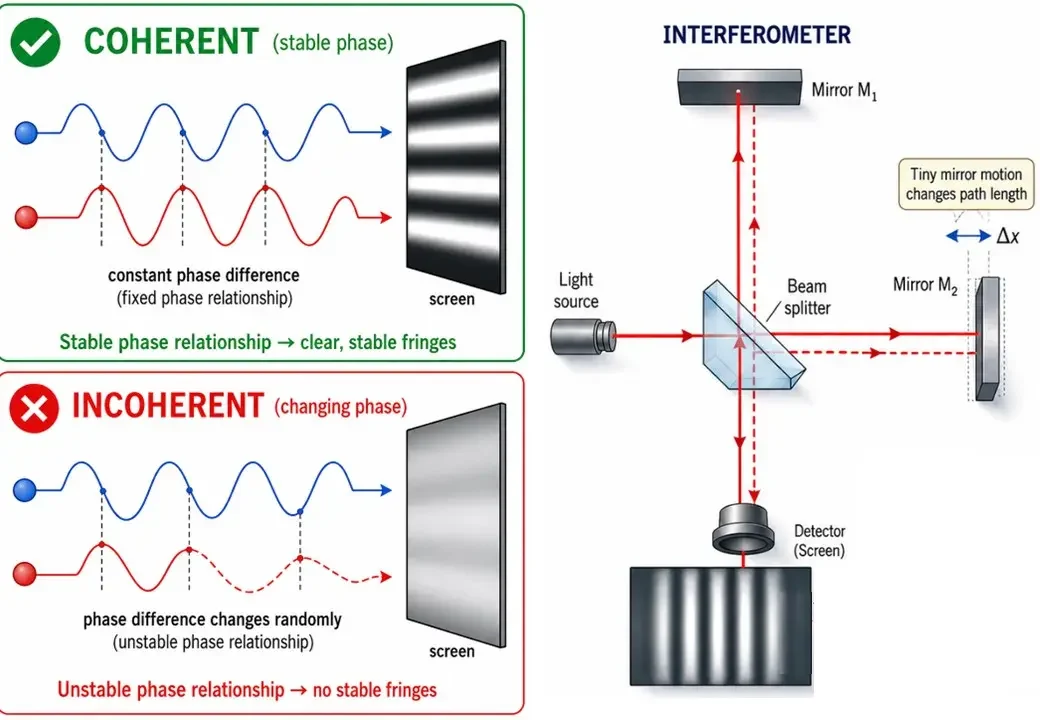
Coherent waves keep a stable phase relationship and can form clear interference fringes, while incoherent waves lose that regularity. Interferometers use these stable fringe patterns to measure extremely small changes in path length.
This visual explanation shows the connection between coherence and interferometry. The left side compares coherent waves, which keep a constant phase difference and produce clear stable fringes, with incoherent waves, whose phase relationship changes and produces washed-out patterns. The right side shows a simplified interferometer, where light is split into two paths and then recombined. A tiny movement of a mirror changes the path length, causing the fringes to shift. This helps students see how a stable wave relationship can become a precise measuring tool.
The Evolutionary Path: History, System Barriers, and Foundry Paradigms
The active management of light synchronization transformed optical measurements from raw intensity tracking into high-resolution spatial mapping across shared physical coordinates.
The Historical Journey
The study of optical coherence tracking began with Thomas Young’s 1801 double-slit configurations, which bypassed the phase instability of independent light paths by dividing a single pinhole wavefront. In 1887, Albert Michelson and Edward Morley deployed their path-splitting interferometer design, using localized phase synchronization loops to perform their famous ether-drift measurements. The theoretical math underpinnings behind spatial and temporal wave trains solidified in 1938 via the van Cittert-Zernike theorem, which described how extended incoherent source light gains partial coherence during spatial propagation. The field shifted completely in 1960 with the development of the ruby laser, giving industrial research foundries high-coherence emitters that keep an orderly phase profile across enormous distances.
Contemporary Technical Hurdles
The main challenge in manufacturing commercial phase interferometers is managing **thermal drift parameters and environmental acoustic noise**. Because visible light tracks across extremely small sub-micron wavelengths, tiny ambient shifts change the optical paths inside the measuring tracks. If a structural guide rail undergoes a fractional temperature change, the glass expands or contracts unevenly, introducing geometric tracking errors that alter the localized phase vector calculations. To lock down the measurement coordinates, cleanrooms must isolate high-precision interferometers using heavy magnetic optical benches, feedback stabilization scripts, and vacuum-sealed chambers.
Future Paradigms: Frequency-Comb Telemetry and On-Chip Arrays
Next-generation hardware layouts replace bulky mirror configurations with robust chip-scale tracks and broad micro-resonator arrays:
Chip-Scale Integrated Silicon Nanophotonics: Optical foundries are pattern-etching complete Michelson and Mach-Zehnder routing lines straight onto compact silicon chips. By running light paths through thin solid-state waveguides rather than loose free-space lines, engineers eliminate mechanical shift errors, building durable micro-sensors that measure local pressure indices and fluid flow rates without drift.
Optical Frequency Comb Synthesizers: To achieve absolute phase precision across diverse coordinate links, developers deploy on-chip micro-ring resonators to generate a dense teeth grid of highly coherent laser outputs. This locked spectral field allows instruments to verify multi-wavelength coherence fields simultaneously, accelerating deep cross-layer diagnostics inside automated chip inspection facilities.
Learning Pathway: Where Coherence and Interferometry Fit in Wave Optics
Coherence and interferometry form a bridge between the basic idea of interference and many advanced optical applications. Interference explains how waves combine. Coherence explains when the pattern remains stable. Interferometry uses that stable pattern for measurement.
Shows how many closely spaced openings or lines separate light into spectra and measure wavelength.
Coherence and Interferometry
Explains why stable phase relationships matter and how interference fringes can be used for precision measurement.
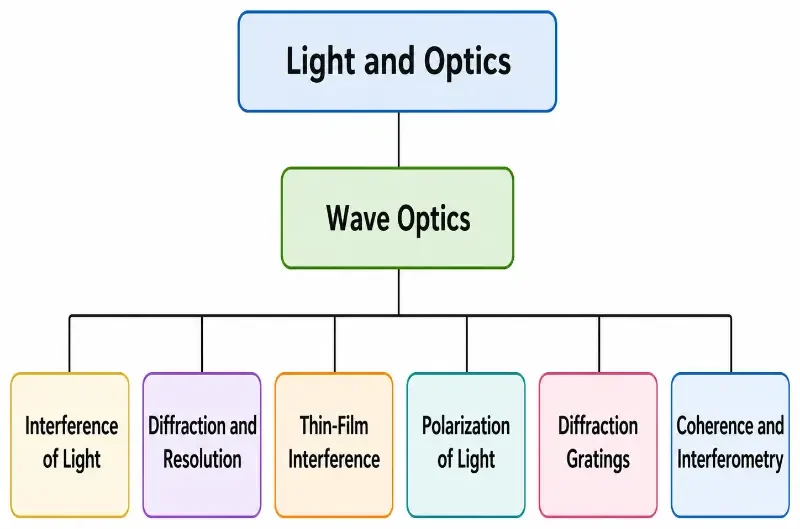
This 1-1-6 tree chart shows how Coherence and Interferometry fits within the Wave Optics cluster under Light and Optics.
This hierarchical tree chart presents the structure of the Wave Optics cluster. Light and Optics forms the parent topic, Wave Optics acts as the central subtopic, and six related pages branch from it: Interference of Light, Diffraction and Resolution, Thin-Film Interference, Polarization of Light, Diffraction Gratings, and Coherence and Interferometry. The chart helps students see that coherence and interferometry are part of a wider family of wave-based optical ideas involving phase, interference, diffraction, polarization, spectral separation, and precision measurement.
What Coherence and Interferometry REALLY Mean
Coherence means that waves maintain a predictable phase relationship. Two waves do not need to be identical everywhere, but they must keep enough regularity for interference effects to remain visible. Without coherence, interference still happens moment by moment, but the pattern changes so rapidly or irregularly that a stable fringe pattern cannot be observed.
Interferometry uses interference patterns to make measurements. The basic idea is to split a beam of light into two paths, allow the two beams to travel different routes, and then recombine them. If one path changes slightly, the interference pattern shifts. By observing that shift, we can infer a small change in distance, phase, wavelength, refractive index, or surface shape.
This is the central beauty of interferometry: a tiny change in path length can become a visible movement of fringes. Light waves have very small wavelengths, so a change of even a fraction of a wavelength can affect the pattern. In this way, interferometry converts hidden smallness into visible structure.
Why Ordinary Light Does Not Always Produce Clear Fringes
It is tempting to think that any two light sources should produce interference fringes. After all, interference is a wave property. However, clear fringes require more than the mere overlap of light beams. The waves must have a stable phase relationship for long enough that the pattern can be observed.
Two ordinary lamps usually do not produce a clear interference pattern. The atoms in each lamp emit light independently and randomly. The phase relationship between light from one lamp and light from the other changes too quickly. The result is not a stable set of bright and dark fringes, but an averaged illumination.
In contrast, a laser can produce highly coherent light. Its waves have a much more stable phase relationship, often over a significant distance and time. This is why lasers are widely used in interferometry, holography, precision alignment, and optical measurement.
Two Main Types of Coherence
Coherence is usually discussed in two related ways: temporal coherence and spatial coherence. They describe different kinds of wave regularity.
Temporal Coherence
Temporal coherence describes how well a wave maintains a predictable phase relationship with itself at different times. A light source with high temporal coherence has a narrow range of frequencies or wavelengths. Its wave train remains orderly over a relatively long time.
Temporal coherence is important when two beams travel paths of different lengths. If the path difference becomes too large, the waves may no longer maintain a stable phase relationship when they recombine. The fringes then become weak or disappear.
A useful quantity is the coherence time, written as \(\tau_c\). It is the approximate time over which the wave remains predictably related to itself. A related quantity is the coherence length, written as \(L_c\). It is the approximate path difference over which interference remains observable.
A simple approximate relationship is:
$$L_c \approx c\tau_c$$
where c is the speed of light in vacuum. In a material medium, the speed of light in that medium should be considered instead.
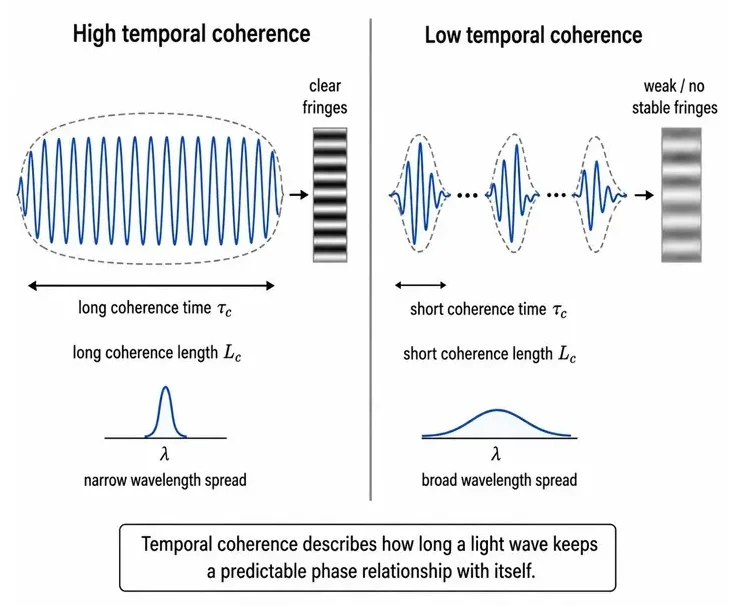
Temporal coherence describes how long a light wave keeps a predictable phase relationship with itself. Long coherence time and length produce clearer fringes, while short coherence produces weaker or unstable fringes.
This diagram compares high and low temporal coherence in light waves. A highly coherent wave remains orderly over a longer time and distance, so it can produce clear interference fringes. A less coherent wave loses its predictable phase relationship more quickly, so the interference pattern becomes weak, blurred, or unstable. The picture also connects coherence length with wavelength spread: a narrow wavelength spread gives longer coherence, while a broad wavelength spread gives shorter coherence.
Spatial Coherence
Spatial coherence describes how well waves at different points across a wavefront maintain a predictable phase relationship. A small or well-collimated source usually has better spatial coherence than a large extended source.
Spatial coherence is important in experiments such as Young’s double-slit experiment. The light arriving at the two slits must be related well enough for the slits to act as coherent sources. If the illumination across the slits is not spatially coherent, the fringe pattern becomes faint or disappears.
In simple terms, temporal coherence asks, “Does the wave keep time with itself?” Spatial coherence asks, “Do different parts of the wavefront keep step with each other?” Both are important for high-quality interference patterns.
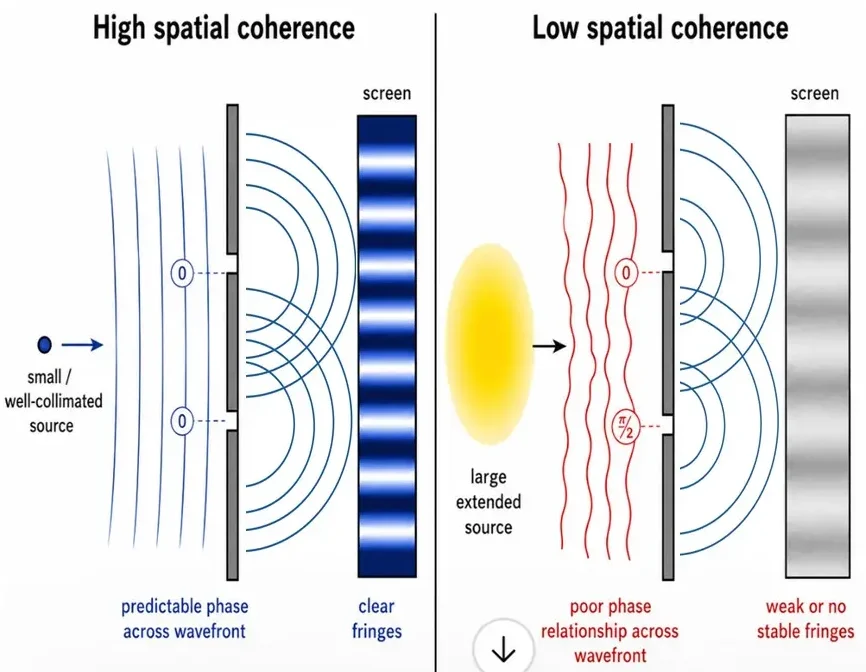
Spatial coherence describes how well different parts of a wavefront keep step with one another. Good spatial coherence allows the two slits to produce clear fringes, while poor spatial coherence weakens or washes out the pattern.
This diagram compares high and low spatial coherence in a double-slit arrangement. On the left, a small or well-collimated source produces wavefronts with a predictable phase relationship across the two slits, so the emerging waves can form clear interference fringes on the screen. On the right, a large extended source produces poorer phase agreement across the wavefront, so the two slits no longer act as well-related sources and the fringe pattern becomes weak or unstable. The picture helps students see that spatial coherence is about whether different parts of the same wavefront keep step with each other.
Coherence Length and Spectral Width
A light source with only one exact wavelength would have very high temporal coherence. Real sources, however, usually contain a range of wavelengths. The broader the range of wavelengths, the shorter the coherence length tends to be.
A commonly used approximate relationship is:
$$L_c \approx \frac{\lambda^2}{\Delta \lambda}$$
where \(\lambda\) is the central wavelength and \(\Delta \lambda\) is the wavelength spread of the light source. This expression is an approximation, but it gives a useful physical message: a narrow wavelength spread gives a longer coherence length.
For example, a laser with a very narrow wavelength spread may produce interference over a long path difference. A white-light source has a wide range of wavelengths, so its coherence length is much shorter. White-light interferometry is still possible, but it requires special arrangements and is often used near the condition where the optical path difference is very small.
How Interferometry Works
Most interferometers follow the same basic logic. A beam of light is split into two beams. The beams travel along different paths. They are then recombined. If the two beams remain coherent, they interfere and form a pattern of bright and dark fringes.
The important quantity is the optical path difference. This is not always just the physical distance difference. If light travels through different materials, the refractive index also matters. The optical path length is approximately:
$$\text{Optical Path Length} = nL$$
where n is the refractive index of the medium and L is the physical path length. The optical path difference between two beams determines their phase difference when they recombine.
The phase difference is given by:
$$\phi = \frac{2\pi \Delta L}{\lambda}$$
where \(\Delta L\) represents the relevant optical path difference and \(\lambda\) is the wavelength of light in the same context. When the phase difference changes, the interference pattern shifts.
Bright and Dark Fringes in Interferometry
In interferometry, bright and dark fringes are not merely patterns to admire. They are measurement signals. A bright fringe appears where the recombined beams reinforce. A dark fringe appears where they cancel or nearly cancel.
For constructive interference:
$$\Delta L = m\lambda$$
For destructive interference:
$$\Delta L = \left(m + \frac{1}{2}\right)\lambda$$
Here, \(\Delta L\) is the optical path difference between the two beams, \(\lambda\) is the wavelength, and m is an integer. A small change in \(\Delta L\) can move the system from bright to dark or from dark to bright.
This sensitivity is the reason interferometry is so powerful. A path change of only half a wavelength can move a fringe from bright to dark. Since visible wavelengths are only hundreds of nanometres, interferometers can detect extremely small changes.
The Michelson Interferometer
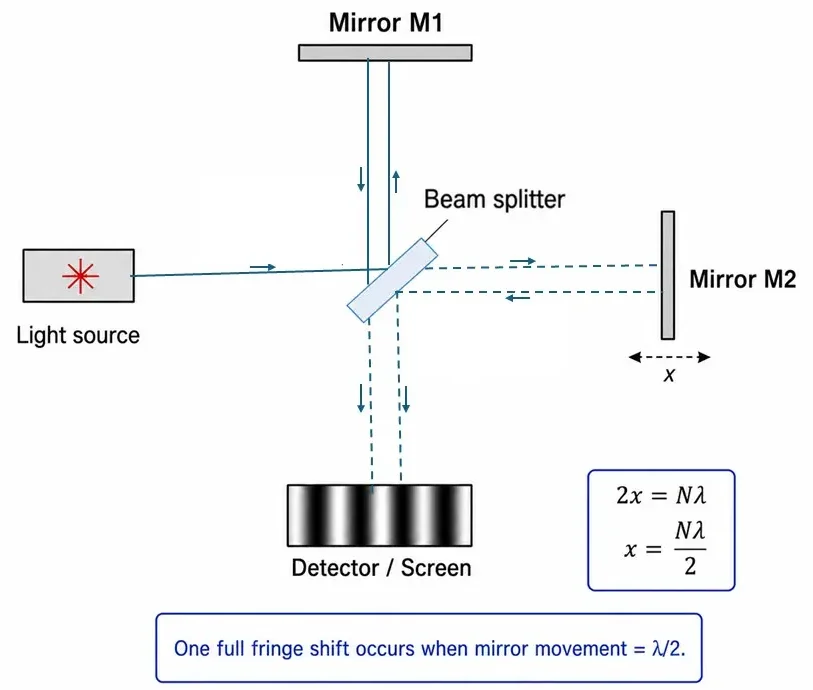
One of the most famous interferometers is the Michelson interferometer. It uses a beam splitter to divide one incoming beam into two perpendicular beams. Each beam reflects from a mirror and returns to the beam splitter. The returning beams recombine and produce interference.
If one mirror moves slightly, the path length of that arm changes. Because the light travels to the mirror and back, a mirror movement of x changes the round-trip path by 2x. This means a small mirror movement can produce a noticeable shift in the fringes.
If the mirror moves by \(\frac{\lambda}{2}\), the round-trip path changes by \(\lambda\), causing one full fringe shift. Therefore:
$$2x = N\lambda$$
where x is the mirror displacement, N is the number of fringe shifts, and \(\lambda\) is the wavelength. Rearranging gives:
$$x = \frac{N\lambda}{2}$$
This simple relationship shows how counting fringe shifts can reveal tiny mirror movements.
A Michelson interferometer splits light into two paths, reflects the beams from two mirrors, and recombines them to form fringes. Moving one mirror by x changes the round-trip path by 2x, allowing tiny displacements to be measured by counting fringe shifts.
This diagram shows the main parts of a Michelson interferometer: a light source, a beam splitter, two mirrors, and a detector screen where interference fringes are observed. One mirror can move by a small distance x. Because the light travels to that mirror and back, the round-trip path changes by 2x. When this path change equals one wavelength, one full fringe shift occurs. By counting the number of fringe shifts, very small mirror movements can be measured with high precision.
The Mach-Zehnder Interferometer
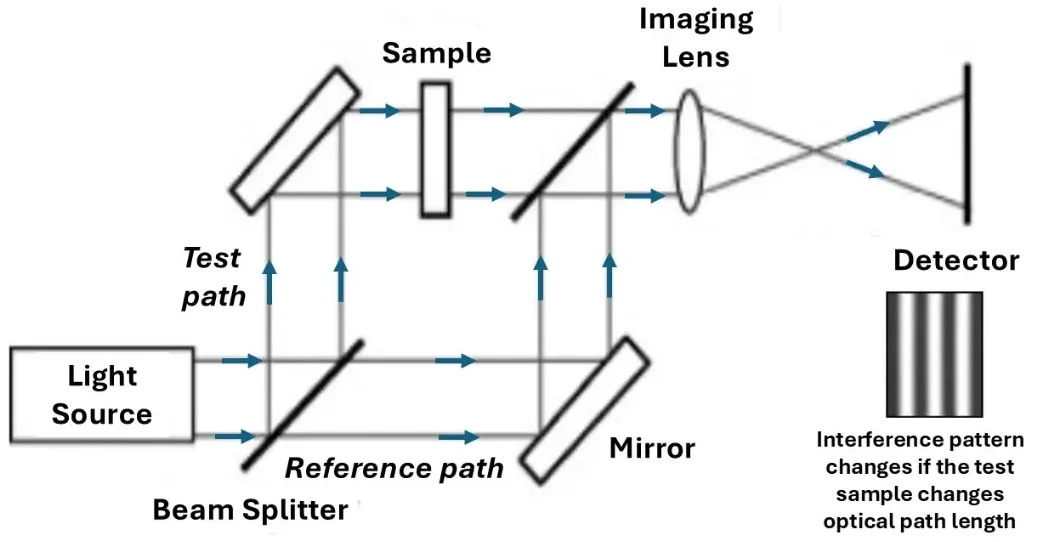
Another important arrangement is the Mach-Zehnder interferometer. It also splits a beam into two paths, but the two beams travel along separate routes and are then reunited using another beam splitter.
The Mach-Zehnder interferometer is useful because one path can pass through a test object, gas, liquid, transparent material, or optical component while the other path serves as a reference. If the test path changes the optical path length, the interference pattern changes.
This makes the Mach-Zehnder design useful for studying refractive index changes, fluid flow, thermal gradients, transparent materials, and optical phase shifts. It shows that interferometry can measure not only distance, but also changes in materials through which light passes.
A Mach-Zehnder interferometer splits light into a test path and a reference path, then recombines the beams so that changes in the sample can be detected through shifts in the interference pattern.
This diagram shows the basic working idea of a Mach-Zehnder interferometer. Light from the source is divided into two separate paths. The test path passes through a sample, while the reference path avoids the sample and provides a comparison beam. When the two beams are recombined and directed toward the detector, they form an interference pattern. If the sample changes the optical path length, the fringes shift or change, allowing the instrument to study refractive index changes, transparent materials, fluid flow, thermal effects, and other phase-related changes.
Fringe Visibility and Contrast
A good interference pattern has clear bright and dark fringes. A weak pattern has low contrast, where the bright fringes are not much brighter than the dark fringes. This contrast is often called fringe visibility.
where Imax is the maximum intensity and Imin is the minimum intensity. If the bright and dark fringes are very distinct, V is close to 1. If there is little difference between bright and dark regions, V is close to 0.
Fringe visibility can be reduced by poor coherence, unequal beam intensities, vibration, misalignment, broad wavelength spread, polarization mismatch, or environmental disturbance. This is why real interferometers often require careful alignment and stable conditions.
Applications of Coherence and Interferometry
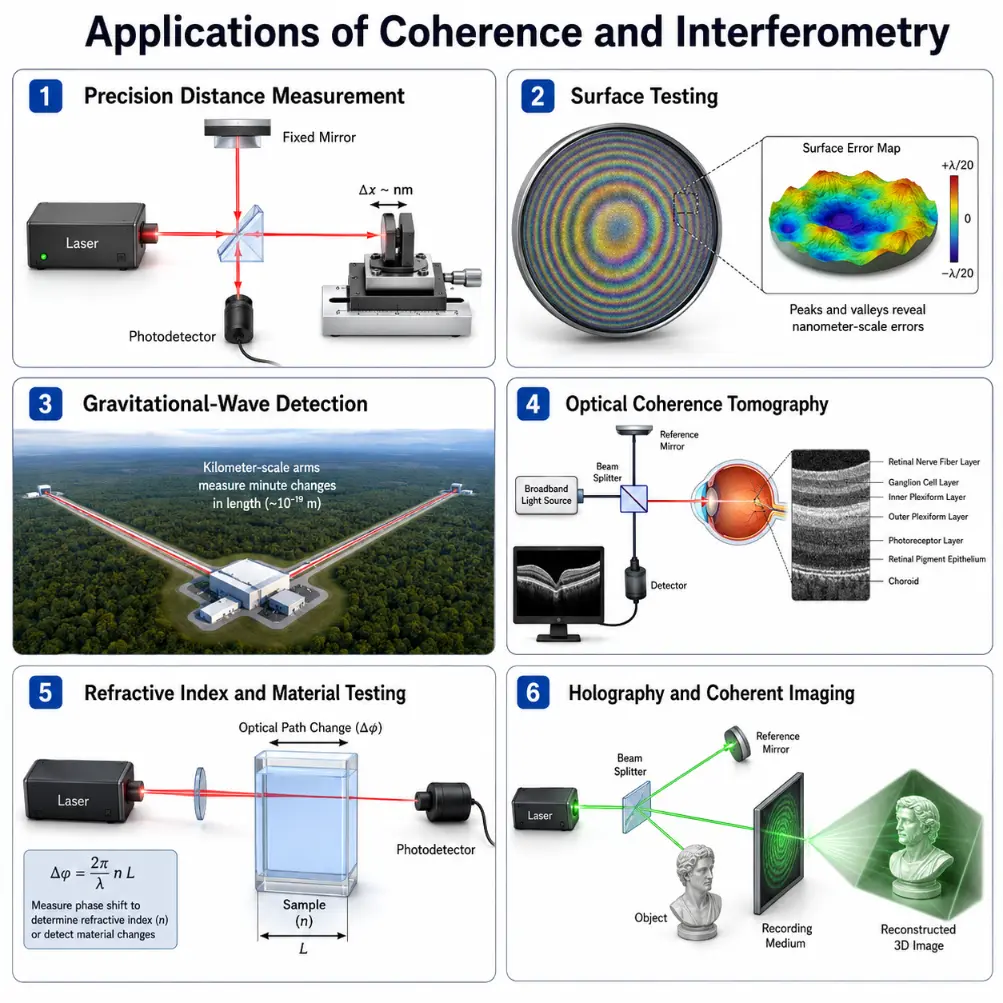
Coherence and interferometry are not only abstract ideas. They support many technologies and scientific instruments because they allow tiny differences in optical path to become measurable.
Precision Distance Measurement
Interferometers can measure very small changes in distance by counting fringe shifts. This is useful in engineering, machine calibration, laboratory measurement, and optical alignment.
Surface Testing of Mirrors and Lenses
Optical surfaces must often be smooth to a small fraction of a wavelength. Interference patterns can reveal surface errors that are far too small to see directly. This is important in telescope mirrors, camera lenses, microscope optics, and high-quality optical components.
Gravitational-Wave Detection
Large interferometers can detect tiny changes in distance caused by passing gravitational waves. These measurements require extraordinary stability because the changes being measured are extremely small compared with everyday length scales.
Optical Coherence Tomography
Optical coherence tomography, often called OCT, uses low-coherence interferometry to create depth-resolved images of biological tissue. It is widely known for imaging structures in the eye, where it helps reveal layers that cannot be studied easily with ordinary viewing.
Refractive Index and Material Testing
When light passes through a material, its optical path changes according to the refractive index. Interferometry can detect these changes and is useful for studying transparent materials, gases, liquids, thermal gradients, and optical components.
Holography and Coherent Imaging
Holography depends on coherence because it records both amplitude and phase information. A coherent reference beam and object beam interfere to store information about the wavefront, allowing a three-dimensional impression to be reconstructed.
Coherence and interferometry allow tiny optical path changes to become measurable, supporting technologies from precision engineering and surface testing to gravitational-wave detection, OCT imaging, material analysis, and holography.
This infographic shows how coherence and interferometry are used in real-world science and technology. Interferometers can measure tiny distance changes by observing fringe shifts, test optical surfaces by revealing small imperfections, and detect extremely small length changes in gravitational-wave observatories. The same principles also support optical coherence tomography for imaging biological tissue, refractive index and material testing, and holography, where coherent light records phase information to reconstruct three-dimensional images.
Coherence, Lasers, and Ordinary Light
Lasers are often associated with coherence because their light is usually more orderly than light from ordinary sources. A laser beam can have high temporal coherence, high spatial coherence, narrow spectral width, and strong directionality. These properties make lasers especially useful in interferometry.
However, not all lasers are equally coherent, and not all interferometry requires a highly coherent laser. Some techniques deliberately use low-coherence light, especially when depth selection or surface profiling is needed. The best light source depends on the measurement task.
This is an important lesson: coherence is not simply “good” or “bad.” It is a property to be matched to the purpose. Long coherence is powerful for detecting tiny path changes over large differences. Short coherence can be useful when we want to locate where matching path lengths occur.
Common Misconceptions About Coherence and Interferometry
Misconception 1: Coherence Means All Waves Are Identical
Coherence does not mean that every wave is identical in every way. It means that waves maintain a predictable phase relationship. The important issue is not sameness alone, but stable relationship.
Misconcepton 2: Any Two Bright Beams Can Produce Clear Fringes
Brightness alone is not enough. Two beams can be intense but still fail to produce a stable interference pattern if their phases fluctuate randomly or their coherence is poor.
Misconception 3: Interferometry Measures Only Distance
Distance measurement is a major application, but interferometry can also measure wavelength, refractive index, surface shape, vibration, strain, temperature-related changes, and phase shifts.
Misconception 4: A Dark Fringe Means Light Has Been Destroyed
A dark fringe indicates local cancellation of fields. The energy is redistributed in the interference pattern. Interferometry uses these changes in intensity to infer phase and path information.
Misconception 5: More Coherence Is Always Better
High coherence is useful in many interferometers, but low-coherence light is also valuable in techniques such as optical coherence tomography. The right amount of coherence depends on what we want to measure.
Study Tips for Coherence and Interferometry
Keep phase difference and path difference conceptually separate, even though they are mathematically related.
Remember that coherence means a stable relationship, not simply strong brightness.
Distinguish temporal coherence from spatial coherence.
For a Michelson interferometer, remember that mirror motion changes the round-trip path by twice the mirror displacement.
Use \(x = \frac{N\lambda}{2}\) only when counting fringe shifts caused by mirror displacement in a Michelson-type arrangement.
Think of interferometry as a method of turning tiny path changes into visible fringe changes.
Review Questions
Question 1: What does coherence mean in wave optics?
Answer: Coherence means that waves maintain a predictable phase relationship, allowing stable interference effects to be observed.
Question 2: Why do ordinary lamps usually fail to produce clear interference fringes with each other?
Answer: Their light is emitted randomly by many independent atoms, so the phase relationship changes too quickly to form a stable pattern.
Question 3: What is temporal coherence?
Answer: Temporal coherence describes how well a wave maintains a predictable phase relationship with itself over time.
Question 4: What is spatial coherence?
Answer: Spatial coherence describes how well different points across a wavefront maintain a predictable phase relationship with each other.
Question 5: What does an interferometer do?
Answer: An interferometer splits light into two paths, recombines the beams, and uses the resulting interference pattern to measure changes in path length, phase, wavelength, refractive index, or other quantities.
Question 6: Why is a Michelson interferometer sensitive to small mirror movements?
Answer: Moving one mirror changes the round-trip path length by twice the mirror displacement, so even a small movement can shift the fringes.
Question 7: What does fringe visibility measure?
Answer: Fringe visibility measures the contrast between bright and dark fringes. High visibility means the fringes are clear and distinct.
Question 8: Why can low-coherence light be useful?
Answer: Low-coherence light can be useful when we want interference only over a short path difference, such as in depth-resolved imaging methods like optical coherence tomography.
Comprehensive Numerical Problems with Solutions
A Michelson interferometer uses light of wavelength 632.8 nm. One mirror is shifted, and exactly 50 fringe steps are counted across the grid. Find the absolute mirror displacement.
Solution:
In a Michelson interferometer, the mirror displacement scales half a fringe track wavelength per count:
Answer: The mirror undergoes an absolute geometric displacement of exactly 15.82 \(\mu\text{m}\).
A light source emits a central tracking wavelength parameter of 600 nm with an absolute spectral width spread of 2.0 nm. Estimate its coherence length.
Solution:
Apply the standard coherence-to-spectral spread ratio relation:
$$L_c \approx \frac{\lambda^2}{\Delta \lambda}$$
Substitute the wavelength dimensions directly while maintaining matching scalar units:
Answer: The source coherence length evaluates to approximately 0.18 mm.
An interference track monitors a maximum peak intensity of 90 units and a minimum baseline trough intensity reading 10 units. Determine the fringe visibility contrast.
Solution:
Apply the Michelson visibility modulation formula:
Answer: The fringe visibility contrast holds exactly at a value of 0.80.
A Michelson interferometer operates using a light tracking wavelength of 500 nm. If one mirror translates by exactly 10 \(\mu\text{m}\), calculate how many total fringe shifts pass across the detector screen.
Solution:
Isolate the fringe count variable from the round-trip distance expression:
$$2x = N\lambda \Rightarrow N = \frac{2x}{\lambda}$$
Convert the mirror translation dimensions to standard meters metrics (\(x = 10 \times 10^{-6}\,\text{m}\), \(\lambda = 500 \times 10^{-9}\,\text{m}\)):
Answer: Exactly 40 complete fringe shifts pass across the array field.
A broadband source emits a central wavelength tracking at 550 nm alongside a wavelength spread of 5.0 nm. Estimate its absolute spatial coherence length limits.
Solution:
Deploy the inverse spectral bandwidth width function:
Answer: The source coherence path length parameter rounds to approximately 0.0605 mm.
An advanced optical tracking matrix registers a maximum peak intensity reading 120 units and a minimum leakage floor tracking at 30 units. Find the net system fringe visibility.
Answer: The calculated fringe visibility value indexes at exactly 0.60.
Inside a Mach-Zehnder interferometer path loop, a localized sample changes the net optical path difference by exactly 250 nm. If the light engine runs at a wavelength parameter of 500 nm, find the absolute phase change in radians.
Solution:
The angular phase displacement maps linearly over path alterations relative to wavelength scaling:
Answer: The absolute phase displacement shift measures exactly \(\pi\) radians.
Frequently Asked Questions
Question 1: What is coherence in light?
Answer: Coherence is the ability of light waves to maintain a predictable phase relationship. Coherent light can produce stable interference patterns.
Question 2: What is interferometry?
Answer: Interferometry is a measurement method that uses interference between light beams to detect changes in path length, phase, wavelength, refractive index, or surface shape.
Question 3: Why are lasers often used in interferometry?
Answer: Lasers are often used because they usually have good coherence, narrow wavelength spread, and strong directionality. These properties help produce stable and clear interference patterns.
Question 4: What is the difference between temporal coherence and spatial coherence?
Answer: Temporal coherence describes phase stability over time or path difference. Spatial coherence describes phase stability across different points on a wavefront.
Question 5: What is coherence length?
Answer: Coherence length is the approximate path difference over which light can still produce observable interference. A longer coherence length means interference can remain visible over a larger path difference.
Question 6: Does interferometry always require a laser?
Answer: No. Lasers are common because they are convenient coherent sources, but some interferometry methods use low-coherence or broadband light for special purposes.
Question 7: What does a fringe shift mean?
Answer: A fringe shift means that the phase relationship between two recombined beams has changed. This usually indicates a change in optical path length, refractive index, wavelength, or alignment.
Question 8: Why is interferometry so sensitive?
Answer: Interferometry is sensitive because visible light has a very small wavelength. A path change of a fraction of a wavelength can noticeably alter the interference pattern.
External References
The following external references provide additional background from scientific, institutional, or reference sources. They are included for wider reading and do not replace the explanations on this page.
Coherence explains why some light waves produce stable interference patterns while others do not. A coherent wave relationship is not merely about brightness; it is about phase stability. Temporal coherence concerns stability over time or path difference, while spatial coherence concerns stability across a wavefront.
Interferometry uses coherent or partly coherent light to measure very small changes. By splitting a beam into two paths and recombining the beams, an interferometer converts differences in optical path into changes in fringe position, brightness, or contrast. This makes interferometry one of the most sensitive measurement methods in optics.
From surface testing and precision engineering to gravitational-wave detection, optical coherence tomography, holography, and refractive index measurement, coherence and interferometry show how wave relationships can become practical tools. They remind us that light is not only something that illuminates objects. It is also a precise carrier of phase, timing, and hidden information.
Reflection Question
If a tiny change in path length can shift an interference pattern, what does this suggest about the power of waves to reveal details that ordinary vision cannot see?