
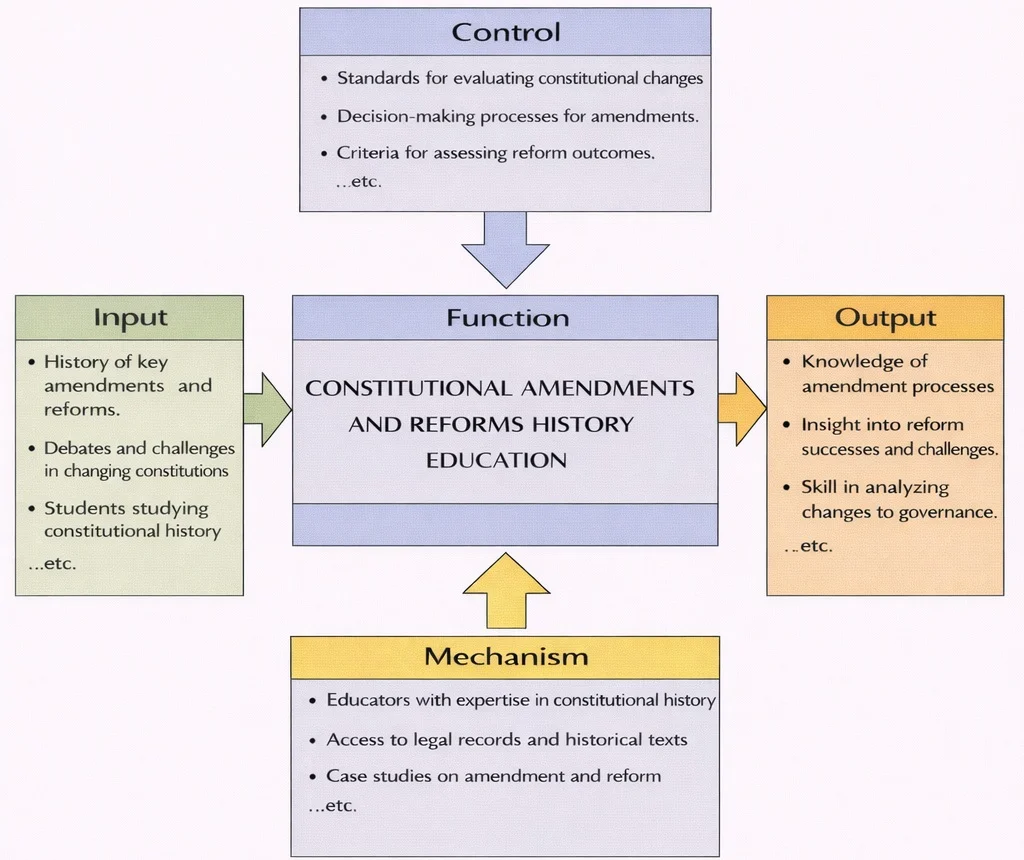
Constitutional Amendments and Reforms History Education begins with a simple but powerful idea: constitutions do not only “exist”—they change, often when societies feel strain, hope, or urgency. By tracing the history of key amendments and reforms, students see how new rights are argued into existence, how institutions are redesigned, and how political compromise leaves fingerprints on legal text. The process feeds into a learning framework guided by standards for evaluating constitutional changes, decision-making pathways for amendments, and criteria for judging reform outcomes. Supported by legal records, historical texts, and targeted case studies, learners practice reading reforms as both ideas and events. The outputs are practical and lasting: students gain knowledge of how amendment processes work, develop insight into why reforms succeed or stall, and build skill in analyzing how constitutional change reshapes governance over time.

Interactive Constitutional Amendment Rigidity & Ratification Simulator
Use this interactive simulator to analyze how different constitutional supermajority thresholds (Legislative vs. Sub-national/Referendum requirements) impact the mathematical probability of passing amendments and the risk of political gridlock.
Constitutional Amendment Process Simulator
Simulation Results:
Configure procedural thresholds above and click Calculate Amendment Feasibility to model ratification outcomes.
Key Features of Constitutional Amendments and Reforms
Flexibility in Constitutional Design
Constitutions often include provisions for amendments, detailing the procedures for enacting changes while safeguarding against arbitrary or frequent alterations.
- Example: The U.S. Constitution requires a two-thirds majority in both houses of Congress and ratification by three-fourths of state legislatures for amendments, ensuring both deliberation and consensus.
Types of Amendments
Amendments can be broadly categorized based on their purpose and scope.
- Substantive Amendments: Introduce significant changes to constitutional principles or structures. For example, the 19th Amendment to the U.S. Constitution granted women the right to vote.
- Clarificatory Amendments: Address ambiguities or inconsistencies in the constitutional text. For example, India’s First Amendment (1951) clarified restrictions on free speech, addressing issues raised by judicial interpretations.
- Emergency Amendments: Reflect temporary changes or responses to crises. For example, India’s 42nd Amendment (1976) expanded executive power during the Emergency (1975–77).
Challenges in Amendment Processes
The procedures for constitutional amendments often balance the need for flexibility with the importance of stability, leading to specific challenges:
- Political Gridlock: High thresholds for approval can result in difficulties achieving consensus. The Equal Rights Amendment (ERA) in the U.S. failed to gain the necessary state ratifications despite significant support.
- Public Resistance: Amendments that lack popular support may face public backlash or legal challenges. In Australia, constitutional referenda frequently fail due to strict voting requirements and insufficient public consensus.
Interactive Review Questions (Click to Toggle)
Test your comprehension of procedural entrenchment and historical amendment cases by toggling the sections below:
Why did India’s 44th Amendment (1978) reverse major provisions of the 42nd Amendment (1976)?
What is the “Basic Structure Doctrine” established by the Indian Supreme Court in Kesavananda Bharati (1973)?
Why do referenda-based amendment systems like Australia’s experience low passage rates?
Case Studies in Constitutional Amendments
The Equal Rights Amendment (U.S.)
Context & Impact: Proposed in 1923 and passed by Congress in 1972, the ERA sought to guarantee equality of rights under the law regardless of sex. Despite falling short of formal ratification by the 38-state deadline due to conservative opposition, it catalyzed gender equality jurisprudence under the 14th Amendment’s Equal Protection Clause.
India’s Emergency-Era Amendments (1975–77)
Context & Impact: During the Emergency declared by Prime Minister Indira Gandhi, the 39th Amendment shielded executive elections from judicial scrutiny, while the 42nd Amendment severely curtailed judicial review and strengthened central executive power. Most provisions were rolled back by the 44th Amendment in 1978 to re-establish democratic equilibrium.
The 13th Amendment to the U.S. Constitution
Context & Impact: Ratified in 1865 in the wake of the American Civil War, the 13th Amendment formally abolished slavery and involuntary servitude (except as criminal punishment), fundamentally altering the legal structure of American federalism and individual liberty.
South Africa’s Post-Apartheid Amendments
Context & Impact: Enacted following the 1996 Constitution, subsequent amendments refined electoral machinery, adjusted provincial competencies, and established constitutional court jurisdiction, ensuring the new democratic framework adapted to socio-economic challenges.
Themes in Constitutional Amendments and Reforms
Expanding Rights
Amendments frequently broaden rights and freedoms. For example, the 26th Amendment to the U.S. Constitution lowered the voting age to 18, aligning voting eligibility with military draft responsibilities during the Vietnam War.
Addressing Governance Challenges
Reforms optimize institutional performance. India’s 73rd Amendment (1992) established constitutional recognition for local self-governance via rural Panchayati Raj bodies.
Responses to Political Crises
Crises often trigger emergency amendments. However, misuse of emergency clauses—such as Article 48 of Germany’s Weimar Constitution—can lead to democratic backsliding or authoritarian consolidation.
Challenges in Constitutional Amendments
Political Polarization
High supermajority barriers cause institutional paralysis in deeply polarized political climates, preventing necessary updates to campaign finance or electoral structures.
Judicial Interpretation
Courts play a critical role in interpreting amended text. Evolutionary interpretations of the U.S. 14th Amendment have dynamically shaped jurisprudence on desegregation, gender parity, and privacy rights.
Public Awareness
In referenda-based systems, low civic literacy or misinformation can suppress voter turnout and defeat well-supported reform proposals.
Why Study Constitutional Amendments and Reforms
Understanding Constitutions as Living Documents
Constitutions are not static texts; they adapt to social, economic, and political shifts. Studying amendments illustrates how legal frameworks evolve over time to preserve stability while pursuing social justice.
Exploring the Tensions Between Tradition and Change
Amendments highlight the perpetual balancing act between preserving structural continuity and adopting institutional innovations in response to public mobilization.
Analyzing Processes, Mechanisms, and Constraints
Students evaluate how procedural rules, supermajority requirements, referenda, and judicial checks dictate the speed and feasibility of legal transformation.
Constitutional Amendments and Reforms: Conclusion
Constitutional amendments and reforms are indispensable tools for preserving the relevance and resilience of foundational legal texts. Whether expanding suffrage, restructuring fiscal relationships, or counteracting authoritarian overreach, amendment processes showcase how law responds to human history. Understanding these mechanisms equips citizens and scholars to participate thoughtfully in ongoing debates on institutional design and rights protection.
Frequently Asked Questions
What are constitutional amendments and reforms?
Constitutional amendments are formal, legally prescribed revisions to the written constitutional text, while reforms encompass broader institutional, statutory, and judicial shifts that alter governance practices.
Why do constitutions require amendment mechanisms?
Amendment mechanisms allow legal systems to adapt to changing societal values, technological advancements, and economic realities without requiring complete governmental collapse or extra-legal revolution.
What is the difference between a formal amendment and judicial reinterpretation?
Formal amendments directly alter the written text through legislative supermajorities or referenda, whereas judicial reinterpretation adapts the legal meaning of existing clauses through court rulings without changing the wording.
What is an entrenchment clause or eternity clause?
An entrenchment clause makes certain constitutional provisions unamendable (e.g., Article 79(3) of the German Basic Law), forbidding any reform that alters human dignity or the democratic federal structure.
How do supermajority requirements protect constitutional stability?
Supermajority requirements (such as 2/3 or 3/4 votes) prevent transient political majorities from altering basic rights or electoral rules for short-term partisan advantage.
What are the risks of extreme constitutional rigidity?
Extreme rigidity can lead to political gridlock, preventing necessary reforms and potentially sparking political crises or extra-constitutional conflicts when legal avenues for change are blocked.
Comprehensive Practice Module
Section 1: Foundational Review Questions
- What are constitutional amendments and reforms, and why are they significant in political history?
Answer: Constitutional amendments and reforms are formal legal modifications made to a nation’s foundational governing document. They are significant because they allow legal systems to adapt to shifting social values, economic crises, and political demands while preserving underlying institutional continuity. - How have constitutional amendments contributed to the historical expansion of civil rights?
Answer: Amendments extend civil rights by enshrining explicit protections directly into foundational law—such as abolishing slavery (US 13th Amendment), expanding voting rights regardless of sex (US 19th Amendment), or lowering the voting age (US 26th Amendment). - In what ways do reforms in constitutional law impact the balance of power within a state?
Answer: Reforms redistribute authority among executive, legislative, and judicial branches. For example, reforms can curb executive emergency powers, strengthen judicial review, or decentralize authority to local regional bodies (e.g., India’s 73rd Amendment). - What factors typically drive the public demand for constitutional reform?
Answer: Key drivers include social movements advocating for equality, political crises or regime transitions, severe economic upheaval demanding fiscal restructuring, and systemic electoral fraud or instability. - How did post-apartheid constitutional amendments shape democratic governance in South Africa?
Answer: Post-apartheid amendments refined electoral machinery, clarified provincial competencies, and entrenched judicial review via the Constitutional Court, helping to solidify democratic stability and socio-economic rights protections. - What challenges are associated with amending a constitution under high supermajority thresholds?
Answer: High supermajority thresholds create procedural entrenchment. While this prevents partisan tampering, it frequently results in political gridlock, making it extremely difficult to pass widely supported reforms during periods of polarization. - How do substantive amendments differ from clarificatory amendments?
Answer: Substantive amendments introduce fundamental shifts in rights or governmental design (e.g., expanding suffrage), whereas clarificatory amendments resolve legal ambiguities or judicial misinterpretations without altering core underlying principles. - What is the role of judicial interpretation in the evolution of constitutional amendments?
Answer: Courts interpret the scope and application of amended provisions over time, effectively determining how abstract text translates into practical legal precedents under changing societal circumstances.
Section 2: Analytical & Thought-Provoking Scenario Questions
- How might future technological innovations (such as secure digital voting or e-consultations) transform public participation in constitutional referenda?
Answer: Digital tools could democratize the amendment process by enabling direct public input, continuous citizen feedback, and real-time tracking of draft provisions. However, they also introduce cybersecurity risks, digital divide disparities, and potential vulnerability to algorithmic propaganda during referendum campaigns. - In what ways can historical case studies of emergency-era amendments (e.g., India’s 42nd Amendment or Weimar’s Article 48) inform safeguards against modern democratic backsliding?
Answer: Historical emergency abuses highlight the risk of executive overreach under the guise of crisis management. Modern constitutions incorporate sunset clauses, unamendable basic structure limits, and mandatory judicial review to prevent temporary emergencies from permanently eroding democracy. - How might the integration of indigenous legal traditions reshape modern constitutional reform processes in multi-ethnic states?
Answer: Incorporating indigenous traditions introduces restorative justice mechanisms, communal land rights, and consensus-based governance into formal frameworks, creating pluralistic legal orders that enhance legitimacy and address colonial-era disenfranchisement. - Analyze the tension between original intent and living constitutionalism when courts interpret 19th-century amendments in the modern era.
Answer: Originalism seeks to enforce text according to its historical meaning at adoption, prioritizing stability and democratic legitimacy. Living constitutionalism views amendments as dynamic frameworks that must evolve with contemporary norms, preventing obsolete 19th-century concepts from binding modern society. - Evaluate how hyper-partisanship impacts the procedural efficacy of constitutional amendment mechanisms in federal systems.
Answer: In federal systems requiring state ratification, hyper-partisanship enables minority political factions to form veto coalitions across sub-national legislatures, stalling urgent constitutional updates and shifting reform momentum toward informal judicial reinterpretation. - How do economic crises force constitutional amendments regarding fiscal responsibility and taxation powers?
Answer: Severe fiscal shocks (e.g., sovereign debt crises) often compel states to enact constitutional balanced-budget rules, redefine revenue-sharing formulas between federal and state governments, or entrench central bank independence to restore international credibility. - Discuss how global human rights treaties influence domestic constitutional amendment agendas.
Answer: International covenants set universal standards for gender equality, labor protections, and minority rights. Nations frequently adopt formal amendments to align domestic law with treaty obligations, ensuring international trade compliance and political standing. - Why might an unamendable “eternity clause” be considered both a shield for democracy and a constraint on popular sovereignty?
Answer: Eternity clauses shield fundamental rights and democratic structures from authoritarian takeover. However, they constrain popular sovereignty by preventing future generations from democratically modifying entrenched provisions, creating a tension with majoritarian rule.
Section 3: Mathematical & Institutional Comparative Metrics
- Calculate US Constitutional Amendment State Threshold: The US Constitution requires a 3/4 supermajority of states to ratify an amendment under Article V. Given there are 50 states, calculate the minimum number of states required to ratify, and the minimum number of states that can form a blocking minority.
Solution:
Ratification Threshold: 50 × (3/4) = 37.5 → Round up to 38 states.
Blocking Minority: 50 – 38 + 1 = 13 states.
Thus, 13 state legislatures can block an amendment supported by 37 states. - Calculate Congressional Supermajority Votes: In a 100-member Senate and a 435-member House of Representatives, an amendment requires a 2/3 supermajority in both chambers. Calculate the exact minimum votes required in each house.
Solution:
Senate requirement: 100 × (2/3) = 66.67 → 67 senators.
House requirement: 435 × (2/3) = 290.0 → 290 representatives. - Determine Australian Referendum Double Majority Result: In an Australian constitutional referendum, passing requires both a overall national majority (> 50%) AND a majority of voters in a majority of states (at least 4 out of 6 states). Suppose a referendum achieves 54% total national vote, but wins majorities in only 3 of 6 states. Does the amendment pass?
Solution:
National Majority: 54% > 50% (Passed).
State Majority: 3 out of 6 states = 50% < Required 4 states (Failed).
Conclusion: The amendment fails due to lack of the required double majority. - Calculate Amendment Frequency Rate: A nation enacted its constitution in 1950. As of 2026, it has passed 106 formal amendments. Calculate the average amendment frequency rate in amendments per decade.
Solution:
Total years = 2026 – 1950 = 76 years.
Decades = 76 / 10 = 7.6 decades.
Amendment Rate = 106 / 7.6 = 13.95 amendments per decade. - Calculate Bipartisan Voting Gap: In a 500-seat unicameral parliament, an amendment requires a 60% vote (300 seats). Party A holds 240 seats, Party B holds 180 seats, and Party C holds 80 seats. If Party A proposes the amendment and Party B votes against it, how many votes from Party C must Party A secure to pass the amendment?
Solution:
Required votes = 500 × 0.60 = 300 votes.
Party A votes = 240.
Deficit = 300 – 240 = 60 votes.
Party A must secure at least 60 votes out of Party C’s 80 seats. - Calculate Qualified Referendum Turnout Threshold: A constitution mandates that referenda are only valid if voter turnout is at least 50% of registered electors, and the proposal receives a 55% “Yes” vote among those who voted. In a country with 10,000,000 electors, 4,800,000 citizens vote, and 3,000,000 vote “Yes”. Is the referendum valid and passed?
Solution:
Turnout Rate = (4,800,000 / 10,000,000) × 100 = 48%.
Since 48% < 50% minimum threshold, the referendum is invalid due to insufficient turnout (despite the “Yes” percentage being 3,000,000 / 4,800,000 = 62.5%). - Determine Legislative Threshold Difference: Compare the percentage difference in required votes between a simple majority (50% + 1) and a three-fifths supermajority in a 300-member parliament.
Solution:
Simple Majority: (300 / 2) + 1 = 151 votes.
Three-Fifths Majority: 300 × 0.60 = 180 votes.
Difference = 180 – 151 = 29 additional votes required. - Calculate Equal Protection Class Size Growth: Over a 30-year period following a non-discrimination amendment, the protected class of legal voters in a region grew from 150,000 to 450,000 due to legislative expansion. Calculate the total percentage increase in the protected voter base.
Solution:
Increase = 450,000 – 150,000 = 300,000.
Percentage Growth = (300,000 / 150,000) × 100 = 200% growth.