
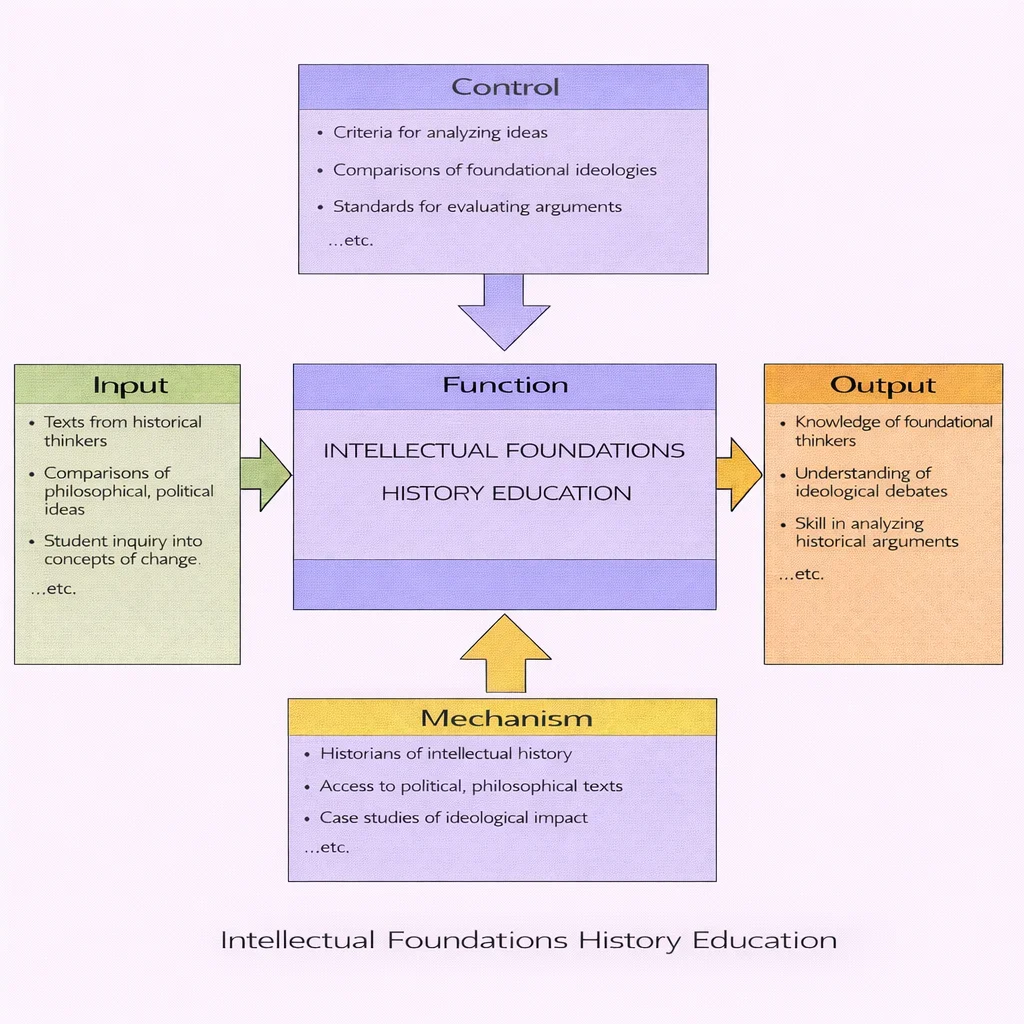
Intellectual Foundations of Revolution History Education treats political and philosophical ideas not as decorations around history, but as the quiet architecture that shapes what societies can imagine, permit, or resist. Students begin with core inputs—major texts, competing ideas, and their own inquiry—then work under clear controls: criteria for analysis, standards for evaluating arguments, and disciplined comparisons across ideologies. Supported by mechanisms such as expert guidance, access to key sources, and well-chosen case studies, the learning process turns raw ideas into usable historical insight. The outcome is not only knowledge of foundational thinkers and debates, but also a steadier ability to read historical claims critically—asking what assumptions are present, what values are being defended, and how ideas become power in the real world.
The study of intellectual foundations offers a gateway into the deep structures of thought that have shaped societies, political systems, and cultural norms throughout history. These foundations are evident in how ideas are constructed, challenged, and reimagined across time. Through the lens of the history of ideas, we encounter the evolution of concepts such as liberty, justice, sovereignty, and equality, which underpin modern political discourse and philosophical frameworks. These ideas do not arise in isolation—they are influenced by historical events, cultural conditions, and cross-disciplinary exchanges.
In exploring political ideologies, we see how philosophical doctrines become organizing principles for governance and collective action. From liberalism and socialism to conservatism and anarchism, ideologies reflect competing visions of the ideal society. They are embedded within political history and carried forward by thinkers and reformers chronicled in political biography. Understanding the intellectual currents behind political systems is key to interpreting the transformation of power structures, particularly within history of political systems.
Economics, too, is shaped by theoretical debate. Through the history of economic thought, we gain insights into how societies have grappled with production, distribution, and value. This field complements the history of political economy, where the intersection of economic theory and political realities becomes most evident. During crises, these intellectual foundations are tested and reshaped, as explored in political economy of crises.
Intellectual traditions are not confined to abstract theory—they often influence or respond to real-world struggles and transformations. The ideas that drove suffrage and civil rights movements were deeply rooted in philosophical and ethical arguments. Likewise, political campaigns and the role of technology in elections reveal the dynamic interplay between ideas and modern institutional processes.
War and diplomacy are domains where intellectual foundations inform strategic decisions. Concepts studied in military strategic studies and military history reflect centuries of accumulated knowledge. Meanwhile, treaty analysis and military diplomacy showcase how intellectual negotiations shape peace and power. The intellectual legacies of conflict and compromise are also explored in peace studies and conflict resolution.
Ideas also shape the social sphere. Social history, urban and rural history, and migration and diaspora studies show how intellectual traditions influence how communities are organized and remembered. Grassroots thought often contests dominant paradigms, leading to new theories of citizenship and resistance. This is echoed in the analysis of social and cultural history of warfare.
Finally, communication is the medium through which ideas spread. The media and communication history page traces how intellectual currents have traveled—from printing presses to digital platforms—shaping the public consciousness. The interplay between knowledge and power, between theory and action, defines the essence of intellectual foundations and their relevance to all fields of study.
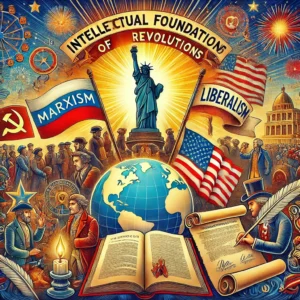
This vivid composition portrays political thought as the motor behind social transformation. At the center, an open book before a globe symbolizes how written manifestos travel across geographical boundaries to ignite action. Banners representing major ideological doctrines—such as Marxism and liberalism—rise above crowds, flags, and public assemblies, representing debate and mobilization. Civic monuments and government architecture highlight how philosophical ideas solidify into enduring state structures once power is seized.
Ideas that Ignite Revolutions: Curriculum Roadmap & Cluster Subhubs
Revolutions are not driven by action alone—they are grounded in ideas that challenge existing systems and imagine alternative futures. Intellectual foundations provide the vocabulary, justification, and vision that inspire societies to question authority. Explore the connected subhubs within this curriculum module:
Revolutionary Movements – Overview
Examine how revolutions arise, unfold, and transform political systems across historical eras.
Comparative Revolutions
Identify cross-case patterns to understand common causes, trajectories, and outcomes across distinct global uprisings.
Grassroots Movements
Explore how collective action emerges from shared beliefs, local grievances, and bottom-up organizing.
Intellectual Foundations (Current Module)
Study the philosophical texts, political doctrines, and ideological manifestos that inspire and legitimize radical change.
Leadership & Strategy
Analyse how abstract philosophical theories are translated into organized political action, vanguard strategy, and governance.
Revolutionary Aftermath
Investigate how revolutionary ideas shape post-conflict constitutions, state institutions, and societal structures.
Defining Intellectual Foundations of Revolutions
The Power of Ideas
Revolutions are almost always preceded by periods of intense intellectual ferment. Thinkers critique existing social structures, expose regime illegitimacy, and articulate alternative models of order. For example, Enlightenment thinkers like John Locke and Montesquieu questioned the divine right of absolute monarchs, providing the ideological architecture for the American and French Revolutions.
Key Elements of Revolutionary Ideas
- Critique of Existing Systems: Systematic philosophical exposure of structural flaws, economic exploitation, or arbitrary power in current governance.
- Vision for Change: Articulation of an idealized future state built on explicit core principles (e.g., natural rights, classless society, national self-determination).
- Mobilization of the Masses: Simplification and dissemination of complex philosophies through pamphlets, slogans, and manifestos to unify diverse social classes.
Historical Examples of Intellectual Foundations
Marxism and the Russian Revolution
- Context: Developed by Karl Marx and Friedrich Engels in the 19th century as a critique of industrial capitalism, advocating a proletarian revolution to establish socialism.
- Key Principles:
- Historical Materialism: History is driven by material conditions and class struggles between the bourgeoisie (capital owners) and proletariat (wage laborers).
- Abolition of Private Capital: Collective ownership of land, industry, and financial infrastructure.
- Dictatorship of the Proletariat: A transitional state structure designed to dismantle capitalist institutions.
- Impact: V.I. Lenin adapted Marxist theory to Russia’s peasant-heavy society, emphasizing a disciplined vanguard party. The October Revolution of 1917 established the Soviet Union based on these doctrines.
Liberalism and the American Revolution
- Context: Emerged during the European Enlightenment, prioritizing individual liberties, constitutional law, and consent of the governed.
- Key Thinkers:
- John Locke: Formulated social contract theory and inalienable natural rights (life, liberty, property).
- Montesquieu: Advocated the structural separation of executive, legislative, and judicial powers to prevent tyranny.
- Impact: Thomas Jefferson incorporated Lockean principles directly into the 1776 Declaration of Independence. The U.S. Constitution codifies these liberal ideals into a federal constitutional republic.
Nationalism and Latin American Independence
- Context: 19th-century movements against Spanish and Portuguese imperial dominance in the Americas.
- Key Figures: Simón Bolívar and José de San Martín articulated anti-colonial nationalisms that emphasized regional sovereignty, self-determination, and republican governance.
- Impact: Led to the dismantling of colonial viceroyalties and the establishment of independent Latin American republics.
Social Contract Theory and the French Revolution
- Context: Radicalization of French political thought during the late 18th century amidst severe fiscal breakdown.
- Key Thinkers: Jean-Jacques Rousseau conceptualized “popular sovereignty” and the “general will,” while Voltaire championed freedom of speech, secularism, and religious tolerance.
- Impact: Codified in the 1789 Declaration of the Rights of Man and of the Citizen, fundamentally dismantling feudal privileges and corporate monarchical power.
Themes in the Intellectual Foundations of Revolutions
Role of Philosophy in Mobilization
Abstract philosophical arguments provide moral legitimacy for illegal or extra-constitutional acts. Slogans like “Liberty, Equality, Fraternity” or “Land, Peace, Bread” distill complex theories into actionable political imperatives.
Adaptation of Ideas to Local Context
Philosophical doctrines are rarely implemented without modification. Lenin adapted industrial Marxism to agrarian Russia; Mao Zedong further adapted it to rural peasant guerrilla warfare in China.
Intersection of Ideas and Leadership
Charismatic leaders act as intellectual translators. Figures like Simón Bolívar, Vladimir Lenin, or Thomas Paine bridges high political philosophy and mass popular mobilization.
Interactive Tool: Ideological Alignment & Textual Analysis Simulator
Evaluate how different intellectual traditions diagnose societal problems and prescribe revolutionary solutions:
Interactive Revolutionary Ideology Matrix
Select an ideological tradition to inspect its foundational philosophical tenets, primary diagnostic target, and institutional prescription.
Why Study Intellectual Foundations
Understanding the Role of Ideas in Inspiring Revolutionary Action
Revolutionary movements are often sparked and sustained by powerful ideas about justice, liberty, equality, and self-determination. For students preparing for university, studying the intellectual foundations of revolutionary movements reveals how political theories, philosophical principles, and ideological debates serve as blueprints for action. These foundational ideas not only motivate resistance but also shape the goals, structures, and moral claims of revolutionary agendas.
Exploring the Influence of Political Thinkers and Philosophical Traditions
Students examine how revolutionary movements draw on a wide range of intellectual sources, including Enlightenment thinkers like Rousseau and Locke, Marxist theory, anti-colonial writings, religious teachings, and nationalist doctrines. By understanding these intellectual origins, learners can better appreciate how revolutions are grounded in both historical conditions and theoretical visions that challenge prevailing systems of power.
Analyzing the Translation of Theory into Practice
Revolutionary leaders and movements must translate abstract ideas into concrete strategies and institutional reforms. Students explore how intellectual blueprints are adapted or compromised during the revolutionary process—how slogans like “liberty, equality, fraternity” or “land, peace, bread” evolve into policy decisions and constitutional frameworks. This helps students evaluate the tensions between idealism and pragmatism in revolutionary settings.
Recognizing the Power of Ideas to Legitimize or Challenge Authority
Intellectual foundations serve not only to inspire but also to legitimize revolutionary action. Students examine how concepts such as the social contract, popular sovereignty, natural rights, or historical materialism provide justification for rebellion and for the creation of new political orders. Conversely, studying competing ideas reveals how revolutions are contested intellectually as well as politically.
Preparing for Critical Inquiry and Interdisciplinary Study
A foundation in the intellectual roots of revolution supports academic pursuits in political theory, philosophy, history, literature, and cultural studies. It sharpens critical reading, argumentation, and analytical reasoning skills—essential tools for university-level work. For students preparing for higher education, this field offers a profound understanding of how revolutionary movements are not only made on the streets, but also conceived in the minds of thinkers who dared to imagine a different world.
Interactive Conceptual Explanations
1. What is the difference between “ideology” and “political philosophy”?
2. How does Antonio Gramsci define “ideological hegemony”?
3. What is the “Social Contract” theory in Enlightenment thought?
Frequently Asked Questions
What are the intellectual foundations of revolutionary movements?
The intellectual foundations of revolutionary movements are the ideas, theories, and interpretive frameworks that help people make sense of injustice and imagine deep political, social, or economic change. These foundations can include philosophical arguments, religious teachings, social theory, historical narratives, and cultural symbols that give revolutions meaning and direction.
Why do revolutionary movements need more than just anger or dissatisfaction?
Anger or dissatisfaction alone rarely produces sustained revolutionary action. Intellectual foundations provide movements with explanations for why conditions are unjust, who is responsible, and what alternatives are possible. They help to transform scattered grievances into a coherent project, offering criteria for strategy, solidarity, and a vision of a different future.
What kinds of ideas have historically inspired revolutionary movements?
Revolutionary movements have drawn on a wide range of ideas, including religious calls for justice, Enlightenment notions of rights and popular sovereignty, socialist critiques of capitalism, nationalist claims to self-determination, and anti-colonial theories of liberation. These frameworks shape how supporters understand oppression and what they hope to build after the old order falls.
How do intellectuals contribute to the development of revolutionary thought?
Intellectuals—such as philosophers, writers, teachers, lawyers, clergy, journalists, and organisers—often systematise everyday experiences of injustice into broader analyses of power and inequality. They write pamphlets and books, give speeches, and create cultural works that help translate complex theories into accessible language for wider audiences in revolutionary movements.
Do revolutionary movements rely on a single set of ideas, or do they combine multiple traditions?
Many revolutionary movements are intellectually hybrid. They combine elements from different traditions—religious and secular, local and global, conservative and radical—in order to appeal to diverse supporters and respond to changing circumstances. This blending can create creative new syntheses but also internal tensions about priorities and principles.
What is the role of historical memory in the intellectual foundations of revolutions?
Historical memory provides stories of past resistance, martyrdom, and change that revolutionary movements use to frame their own struggles. References to previous uprisings, founding documents, or legendary figures help supporters see themselves as part of a longer narrative, lending moral authority and emotional depth to revolutionary claims.
How do revolutionary movements use concepts like justice, freedom, and equality?
Concepts such as justice, freedom, and equality are central to the intellectual foundations of revolutions, but they are interpreted in different ways. Movements define who should be free, equal, or protected by justice, and they argue about whether these values require changes in property relations, political institutions, cultural norms, or international orders.
Are the intellectual foundations of revolutionary movements always coherent and consistent?
Not always. The ideas behind revolutionary movements often contain tensions, ambiguities, and unresolved debates. Different factions may emphasise different principles, or interpret shared concepts in conflicting ways. Political history examines how these intellectual disagreements influence strategy, alliances, and the shape of post-revolutionary regimes.
How do global ideas and local contexts interact in the intellectual foundations of revolutions?
Revolutionary thought often travels across borders through books, exiles, conferences, and media, but it is reinterpreted in local contexts. Movements adapt global ideas to local histories, cultures, and social structures, producing distinctive versions of broader currents such as liberalism, socialism, nationalism, or religious reform.
Can the intellectual foundations of a revolution change over time?
Yes. Before a revolution, ideas may focus on critique and mobilisation; during the revolution, attention may shift to strategy and organisation; after power changes hands, debates intensify around institution-building, rights, and development. New experiences, internal conflicts, and external pressures can all reshape the movement’s guiding concepts and arguments.
How do historians study the intellectual foundations of revolutionary movements?
Historians study manifestos, pamphlets, speeches, philosophical works, religious texts, novels, songs, and visual art, as well as private letters, diaries, and organisational documents. They analyse how ideas were produced, circulated, translated, and contested, and how they were understood by different groups within and beyond the movement.
What can students learn from examining the intellectual foundations of revolutions?
By examining the intellectual foundations of revolutions, students learn how ideas shape political imagination, how critiques of existing orders are constructed, and how visions of a just society can inspire action while also creating new dilemmas. This helps them reflect critically on the role of theory, ideology, and narrative in contemporary politics and social change.
Comprehensive Practice Module: Intellectual Foundations
Section 1: Foundational Review Questions
- What are the intellectual foundations of revolutionary movements?
Answer: The intellectual foundations of revolutionary movements are the critical ideas, political theories, and philosophical debates that challenge existing regimes and provide an alternative vision for society. They include critiques of power, arguments for justice, and frameworks for legal and institutional reordering. - How did philosophical debates contribute to revolutionary ideas?
Answer: Philosophical debates challenged traditional sources of authority (such as divine right or feudal hierarchy) and popularized concepts like popular sovereignty, natural rights, and social contract theory, giving revolutionaries a coherent moral rationale for rebellion. - What role did key thinkers play in establishing the intellectual basis for revolutions?
Answer: Thinkers synthesized raw social grievances into structured political programs. Through books, pamphlets, and speeches, figures like Locke, Rousseau, Marx, and Fanon created shared political vocabularies that mobilized mass movements. - How do intellectual ideas translate into practical revolutionary action?
Answer: Ideas are translated into action when simplified into party manifestos, slogans, and revolutionary demands that guide strategic decisions, unite diverse social classes, and serve as blueprints for post-revolutionary constitutions. - What historical factors influenced the emergence of revolutionary intellectual foundations?
Answer: Severe economic distress, printing press expansion, urban university growth, imperial overreach, and visible state corruption created fertile ground for intellectual critiques of established authority to gain traction. - How do intellectual debates challenge established power structures during revolutions?
Answer: By systematically exposing the moral and practical failures of existing institutions, intellectual debates delegitimize state authority in the eyes of citizens, soldiers, and international observers. - How has the evolution of revolutionary thought influenced modern political change?
Answer: Historical concepts like universal suffrage, human rights, labor protections, and anti-colonial sovereignty originated in revolutionary thought and are now codified into global constitutional and international law. - What common themes emerge in the intellectual foundations of revolutionary movements?
Answer: Common themes include the critique of tyranny/exploitation, the assertion of fundamental human or class rights, the demand for popular participation in governance, and the pursuit of social and economic justice. - How do ideological conflicts contribute to the development of revolutionary movements?
Answer: Conflicts between rival ideologies (e.g., moderate liberal reform vs. radical socialist revolution) force factions to refine their programs, articulate clearer goals, and compete for public support during power vacuums. - What lessons can contemporary societies learn from the intellectual foundations of past revolutions?
Answer: Societies learn that ignoring fundamental structural grievances and suppressing intellectual critique accelerates state fragility, whereas adapting legal institutions to reflect evolving ideas of justice maintains stability.
Section 2: Analytical & Thought-Provoking Questions
- How do intellectual debates within revolutionary movements shape the trajectory of political change?
Answer: Debates over priorities (e.g., Jacobin radicalism vs. Girondin moderation, Bolshevik vanguardism vs. Menshevik gradualism) determine whether a revolution remains constitutional or escalates into radical purges, state centralization, and terror. - What is the role of dissent in the intellectual foundations of revolutionary thought?
Answer: Dissent acts as the primary catalyst for intellectual innovation. By questioning state orthodoxy, dissenting intellectuals create new conceptual categories that expose state vulnerability and propose alternative modes of governance. - How might the reinterpretation of classical revolutionary ideas influence modern political strategies?
Answer: Reinterpreting Enlightenment natural rights or Marxist surplus value allows contemporary reformers to address modern digital monopolies, algorithmic surveillance, and climate change within established frameworks of justice. - In what ways do grassroots intellectual initiatives contribute to the success of revolutionary movements?
Answer: Community reading groups, underground pamphlets, and worker education circles democratize theory, ensuring that revolutionary principles resonate with working-class realities rather than remaining elite academic exercises. - What challenges do revolutionary movements face when attempting to integrate diverse intellectual traditions?
Answer: Combining conflicting traditions (e.g., secular Marxism and traditional religious liberation theology) risks ideological inconsistency, internal schisms, and factional fighting over the design of post-revolutionary state institutions. - How can interdisciplinary research enhance our understanding of the intellectual foundations of revolutionary movements?
Answer: Combining history, sociology, economics, and literary analysis reveals not only what ideas were written, but how economic crises, media technology, and social networks enabled those ideas to spread and seize state power. - What impact do revolutionary intellectual foundations have on the legitimacy of new political regimes?
Answer: Grounding a new regime in a clear, coherent intellectual framework (e.g., constitutional republicanism) provides moral authority, unifies citizens, and secures international diplomatic recognition. - How can the lessons learned from revolutionary intellectual debates be applied to modern political reform efforts?
Answer: Reformers can use historical debates to anticipate how rapid policy shifts create unintended resistance, highlighting the necessity of combining radical goals with transparent, inclusive legal procedures. - How do economic and social conditions interact with revolutionary intellectual foundations to drive political change?
Answer: Economic hardship creates the widespread social friction, but intellectual foundations provide the directional spark and structural blueprint; without ideas, hardship leads to food riots rather than systemic revolution. - What strategies can revolutionary movements adopt to ensure the long-term sustainability of their intellectual foundations?
Answer: Strategies include embedding core principles into primary education, constitutional law, public civic rituals, and vibrant independent media, preventing post-revolutionary regimes from slipping back into authoritarianism. - How might future revolutionary movements integrate emerging technologies into their intellectual frameworks?
Answer: Future frameworks will incorporate open-source governance theory, decentralized autonomous decision-making (DAOs), data sovereignty, and algorithmic ethics into core definitions of human freedom and rights. - How can the comparative study of revolutionary intellectual foundations inform global strategies for political reform?
Answer: Comparative study shows which ideological formulations successfully build durable, inclusive institutions versus those that predictably lead to ideological purges and autocratic state collapse.
Section 3: Numerical Problems & Quantitative History Analysis
- Pamphlet Diffusion Rate Calculation: During an intellectual campaign prior to an uprising, 1,200 copies of a revolutionary manifesto are printed in Week 1. If circulation grows at a rate of 35% per week through re-printing and distribution networks, calculate the total circulation in Week 6.
Solution:
Using the compound growth formula: N = N0 × (1 + r)t-1
N = 1,200 × (1 + 0.35)5
N = 1,200 × (1.35)5 = 1,200 × 4.484 = 5,380.8 copies.
Final Answer: Circulation reaches approximately 5,381 copies by Week 6. - Literacy & Radical Reading Group Coverage: In a prerevolutionary city of 180,000 citizens, the literacy rate is 28%. An underground printing society reaches 15% of all literate adults through weekly reading circles. Calculate the absolute number of citizens directly exposed to these primary texts.
Solution:
1. Literate population = 180,000 × 0.28 = 50,400 citizens.
2. Exposed population = 50,400 × 0.15 = 7,560 citizens.
Final Answer: 7,560 citizens are directly engaged in the radical reading circles. - Legislative Assembly Factional Majority: In a 500-seat revolutionary national convention, three ideological factions exist: Moderate Liberals (210 seats), Radical Jacobins (180 seats), and Non-Aligned Centrists (110 seats). If 65% of the Non-Aligned Centrists vote with the Radical Jacobins on a constitutional motion, calculate the final voting total and percentage for the motion.
Solution:
1. Centrists voting with Jacobins = 110 × 0.65 = 71.5 → 72 seats.
2. Total votes for motion = 180 (Jacobins) + 72 = 252 votes.
3. Majority percentage = (252 / 500) × 100 = 50.4%.
Final Answer: The motion passes with 252 votes (50.4% majority). - Ideological Pamphlet Production Cost Index: An underground press prints 15,000 copies of a political treatise. Paper costs $0.12 per unit, ink costs $0.05 per unit, and clandestine distribution costs $0.08 per unit. If total funding raised is $4,000, calculate the remaining financial surplus or deficit.
Solution:
1. Cost per pamphlet = $0.12 + $0.05 + $0.08 = $0.25 per copy.
2. Total production cost = 15,000 × $0.25 = $3,750.
3. Net balance = $4,000 – $3,750 = $250 surplus.
Final Answer: The press operates with a $250 financial surplus. - Sociological Ideological Shift Survey: A survey of 2,500 political assembly delegates measures ideological allegiance before and after a major regime manifesto publication. Initially, 40% support Constitutional Monarchy, 35% support a Federal Republic, and 25% support Radical Democracy. After publication, 30% of Constitutional Monarchists shift to Federal Republic, and 20% of Federal Republicans shift to Radical Democracy. Calculate the new percentage share for Radical Democracy.
Solution:
1. Initial Radical Democrats = 2,500 × 0.25 = 625 delegates.
2. Initial Federal Republicans = 2,500 × 0.35 = 875 delegates.
3. Delegates shifting from Federal Republic to Radical Democracy = 875 × 0.20 = 175 delegates.
4. New Radical Democrat total = 625 + 175 = 800 delegates.
5. New share = (800 / 2,500) × 100 = 32.0%.
Final Answer: Radical Democracy now commands 32.0% of assembly delegates (800 total). - Enlightenment Salons & Network Propagation: A capital city has 24 prominent intellectual salons, each hosting an average of 35 influential writers and policy makers. If 75% of these attendees publish at least one political essay per year, calculate the total annual output of essays from the salon network.
Solution:
1. Total salon participants = 24 × 35 = 840 individuals.
2. Active writers = 840 × 0.75 = 630 writers.
3. Annual essay output = 630 × 1 = 630 essays per year.
Final Answer: The network produces 630 political essays annually. - Censorship Seizure Rate Analysis: Royal censors intercept 3,200 out of an estimated 16,000 smuggled copies of an illegal political text. Calculate the percentage efficiency of state censorship and the number of copies that successfully reached readers.
Solution:
1. Censorship efficiency = (3,200 / 16,000) × 100 = 20.0%.
2. Copies reaching readers = 16,000 – 3,200 = 12,800 copies.
Final Answer: Censorship efficiency was 20.0%; 12,800 copies successfully reached the public. - Vanguard Party Membership Scale Ratio: According to Leninist organizational theory, a disciplined vanguard party should represent approximately 1.5% of the total industrial labor force. In a city with 400,000 industrial workers, how many trained party cadres are required to maintain optimal organizational capacity?
Solution:
Optimal cadres = 400,000 × 0.015 = 6,000 cadres.
Final Answer: The vanguard party requires exactly 6,000 trained cadres.
Intellectual Foundations of Revolutions: Conclusion
The intellectual foundations of revolutions, such as Marxism, liberalism, and nationalism, illustrate the transformative power of ideas in shaping history. These philosophies have not only guided revolutionary movements but also left enduring legacies in modern political systems, inspiring debates about justice, governance, and human rights. By examining the thinkers and ideologies that have driven revolutions, we gain a deeper understanding of the complex interplay between ideas and action, offering valuable lessons for addressing contemporary political and social challenges.