
Arts, Design, and Media turn ideas into experiences—images, spaces, sounds, and stories that help people see the world anew. This hub gathers nine pathways that often meet and enrich one another. Explore Fine Arts, Performing Arts, Graphic Design, Architecture, Film & Media Studies, Journalism, Advertising, Public Relations, and Digital Communication. Start anywhere—the skills you build in one door strengthen the others.

This visually rich illustration explores the dynamic convergence of traditional and digital creativity. On one side, classical artistic elements such as painting, sculpture, and analog design tools symbolize timeless expression. On the other, digital innovations like virtual reality, 3D modeling, and touchscreen creation platforms represent the cutting edge of media and design. Together, they embody a seamless fusion of imagination, technology, and storytelling that defines contemporary practice in arts, design, and media.
How to Use This Hub
Three quick steps
- Pick one doorway below to start building depth.
- Bookmark a second doorway for range—skills transfer across areas.
- Begin a small portfolio project and iterate weekly.
Jump straight in
Fine Arts · Performing Arts · Graphic Design · Architecture · Film & Media Studies · Journalism · Advertising · Public Relations · Digital Communication
Choose a Doorway into Arts, Design & Media
Fine Arts
Study painting, sculpture, and mixed media to develop a visual voice and portfolio that speaks with clarity and intent.
Performing Arts
Explore acting, dance, and theatre craft—where movement, story, and stagecraft turn ideas into living moments.
Graphic Design
Learn layout, typography, and brand systems to design messages that are as functional as they are beautiful.
Architecture
Bridge art and engineering to shape spaces that respond to culture, climate, and human need.
Film & Media Studies
Analyze screen language and production to tell stories that travel across platforms and audiences.
Journalism
Practice evidence-based reporting, interviewing, and editing to serve the public with clarity and integrity.
Advertising
Craft campaigns that blend insight and creativity—turning audience attention into meaningful action.
Public Relations
Build reputation and trust through strategic messaging, stakeholder relations, and crisis communication.
Digital Communication
Plan content, channels, and analytics to grow communities and measure real impact online.
See the Bigger Picture
STEM
Pair creative vision with technical power—from interactive media to emerging tech workflows.
Humanities & Social Sciences
Give your work cultural depth with context, ethics, and audience insight.
Business, Economics & Law
Turn ideas into ventures—learn markets, IP, and the business of creative industries.
Education
Design learning experiences that make art and media accessible and transformative.
Health
Apply design to wellbeing—from health campaigns to human-centered environments.
Skills & Capacities You’ll Build
Seeing & Making
Observation, composition, form, rhythm, and material fluency—core studio habits that strengthen every pathway.
Story & Meaning
Narrative structure, character, point-of-view, and audience empathy for clear and moving communication.
Systems & Strategy
Design thinking, research, critique, iteration, and ethical decision-making across projects and platforms.
Production Toolkit
Sketching and prototyping, visual layout and typography, camera and editing basics, scripting and interviewing, presentation and pitching.
Pillars of Creativity: Foundations in Design and the Arts
🎨 Creative Expression and the Power of Art
Art speaks when words cannot. It reflects who we are and helps us understand others. In the performing arts and visual expression, creativity comes from life experience and shared memory. Every movement, brushstroke, or act on stage shows a personal truth—yet touches something deep in others too.
Art takes many forms—from classic fine art and sculpture to music, poetry, and live performance. Each form is a way of thinking and feeling. Art shows cultural identity, personal vision, and even our search for meaning. It’s not just talent—it’s awareness. We learn to listen within and respond through shapes, sounds, and symbols.
Creativity is not just about doing something new. It’s about revealing what’s been hidden. The artist’s role is to show us another way to see the world. To be creative is to be brave—to share openly and say, “This is what I feel. Do you see it too?”
🧠 Design Thinking: Creating with Care
Design is more than skill—it is a way of seeing the world. At its core is empathy: the desire to make things better for others. Great design balances beauty and usefulness. It mixes logic with imagination, order with emotion.
Good design starts with people. It listens to needs—spoken or unspoken. Whether building apps, clothing, buildings, or spaces, designers want to understand the real stories behind the users. Fields like graphic design, industrial design, fashion, architecture, and UX design are all ways to turn care into clear, useful solutions.
Design is not just about fixing problems—it’s about asking better questions. “What could improve?” “How should it feel?” Designers sketch futures, not just products. They turn complexity into clarity—and create things that feel right, not just work well.
📺 Digital Storytelling: Sharing Meaning in the Modern World
Stories shape how we see the world. Today, digital media lets us tell stories faster, wider, and in more powerful ways. Each photo, video, or post adds to how people understand current events and daily life. Storytelling is not just a skill—it is a responsibility.
By studying journalism, advertising, film production, and media, students learn to create stories that are clear, honest, and moving. They use tools like cameras, scripts, social platforms, and visuals—but always stay rooted in strong values: character, truth, and meaning.
Great storytelling builds trust. Whether exposing injustice, promoting ideas, or offering comfort, creators must be both persuasive and true. The most lasting stories are made with care and told with purpose.
To explore the ethical side of media, visit the Center for Journalism Ethics. It offers helpful reflections on truth, trust, and digital storytelling in today’s world.
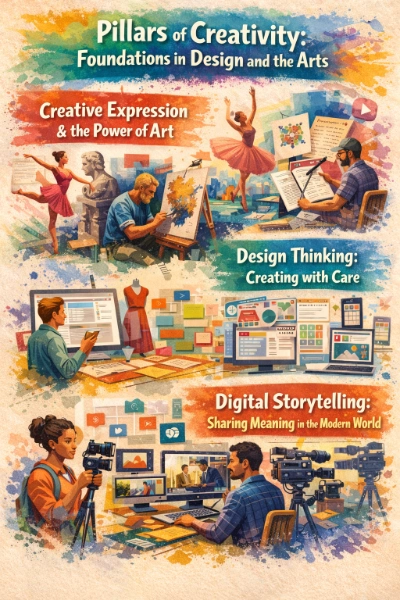
A vibrant watercolor-style infographic that introduces the “Pillars of Creativity: Foundations in Design and the Arts.” The top section, “Creative Expression & the Power of Art,” shows performing and visual arts—dancers in motion, an artist painting at an easel, a classical sculpture, and a musician—symbolizing personal truth and shared emotion. The middle section, “Design Thinking: Creating with Care,” depicts a workspace with sketches, color swatches, sticky notes, a garment form, and multiple screens displaying layouts and prototypes, emphasizing empathy, clarity, and iterative making across design fields. The bottom section, “Digital Storytelling: Sharing Meaning in the Modern World,” features a videographer, editing screens, cameras, and media icons, highlighting modern storytelling, journalism, and responsible communication through digital tools.
Interactive Design Studio: Aspect Ratio & Resolution Playground
Designers and media producers must bridge artistic vision with mathematical precision. Use this tool to calculate resolution scaling, pixel densities (PPI), and aspect ratio bounds for screen and print media.
Input Parameters
Portfolio Starter Projects
- One Poster, Three Audiences — redesign the same message for teens, professionals, and seniors (Graphic Design).
- 60-Second Micro-Documentary — capture a local craft or place in one minute (Film & Media Studies).
- Sketchbook of 30 — one observational drawing a day for a month (Fine Arts).
- Space to Feel — diagram a small room and propose two human-centred improvements (Architecture).
- Interview with Integrity — report a short feature with quotes and fact checks (Journalism).
- Mini Campaign Trio — headline, visual, and call-to-action across print, social, and video (Advertising).
- Reputation Brief — a one-page messaging plan for a community event (Public Relations).
- Channel Map — narrative, formats, and metrics for a month-long content plan (Digital Communication).
- Solo or Duet — choreograph or perform a 90-second piece with clear intent (Performing Arts).
Relevance and Real-World Applications of Arts, Design, and Media
🌍 Culture as Continuity: Artistic Guardians of Identity
In a world constantly in motion, the arts offer both anchor and compass. Through painting, music, dance, film, and literature, cultures are remembered—not by preserving them in amber, but by letting them evolve and speak anew. Every artistic act becomes a bridge across time, linking ancestral voices to modern visions.
Art is not a pastime—it is the soul’s testimony. It gives shape to identity, faith, defiance, and joy. In the patterns of indigenous textiles or the rhythm of urban street art, we find echoes of lived experience. These expressions keep culture alive, not static but ever transforming, as each generation adds its thread to the tapestry.
In our global mosaic, the arts open doors to empathy. They turn statistics into stories, amplify unheard voices, and reach where diplomacy falters. By weaving difference into shared humanity, artistic creation fosters deeper understanding and lights the path toward coexistence.
💼 Creative Economies: The Power of Imagination in Motion
Beneath every blockbuster film, eye-catching ad, and high-fashion runway is a vast network of creative minds turning vision into value. Arts, design, and media are not just cultural forces—they are engines of economic vitality. Industries from publishing to fashion thrive on this convergence of story, style, and strategy.
These sectors contribute trillions to global economies and offer careers that resist automation. Creativity remains irreplaceable. From animators and curators to strategists and writers, jobs in this space are rooted in originality. In an AI-driven world, the creative economy remains a realm where human imagination reigns.
With digital tools now widely accessible, the creative stage is open to all. Independent creators, from Etsy artisans to YouTube filmmakers, shape industries without waiting for permission. They turn passion into enterprise, transforming ideas into livelihoods, and crafting influence one creation at a time.
📣 Shaping Minds: Social Engagement through Art and Media
From ancient cave walls to viral videos, art has always been a force of persuasion. It guides thought, evokes feeling, and stirs collective action. Whether subtle or bold, creative expression molds our sense of truth, justice, and belonging. A single image can move nations—or ignite change.
Today, digital media amplifies this power. Campaigns on climate change, health, and human rights rely on animation, design, and storytelling to reach the heart as well as the mind. By merging fact with feeling, these messages cut through noise and awaken awareness. The arts no longer wait to reflect change—they help write it.
Those who master this craft become more than designers or filmmakers—they become cultural catalysts. Their work sparks reflection, shifts perception, and drives change. Organizations like The Ad Council show how creativity can serve the public good, turning media into a mirror and a megaphone for social progress.
In the end, art offers more than beauty—it grants agency. It invites us to speak, to question, to dream aloud. Culture is not inherited—it is co-created, shaped by every voice that dares to imagine a better world.
Principal Academic Branches in Arts, Design & Communication
Fine Arts
- Focus: Expressive creativity in painting, sculpture, drawing—seeing and shaping the world with hands and heart.
- Key Areas:
- Classical methods: oil, watercolour, clay.
- Modern approaches: installations, mixed media, conceptual pieces.
- Art history: tracing ideas and movements in culture.
- Applications:
- Enriching spaces with public or private art.
- Honouring cultural roots, sparking reflection.
This radiant depiction captures an artist’s sanctuary: an easel with a swirling abstract, tools laid out—a palette, brushes, paint jars—and a timeless bust. Lines and colours dance behind it, bridging inspiration, craft, and the disciplined spark needed for university-level art or creative careers.
Performing Arts
- Focus: Live storytelling—using music, movement, theatre to touch hearts and stir minds.
- Key Areas:
- Music: composing, performing, understanding sound.
- Theatre: acting, directing, designing stages, writing scripts.
- Dance: choreography, performance, cultural expression.
- Applications:
- Creating performances for stage, screen, concerts.
- Using music and movement in healing and well‑being.

A violinist bows in light, dancers curve and leap, theatrical masks smile and frown—all woven into vibrant hues and rhythms. This illustration sings of creative union: sound, movement, story—fanning curiosity, expression, transformation for students chasing professional artistry or personal freedom.
Graphic Design
- Focus: Shaping ideas through typography, images, layout—making meaning dance before your eyes.
- Key Areas:
- Branding: logos, identity systems.
- Digital design: UI/UX for apps and websites.
- Print design: brochures, posters, packaging.
- Applications:
- Elevating brand presence and engagement.
- Fueling marketing and advertising with visual voice.

A cosmos of digital tools—laptop, colour wheels, grids, styluses—unfolds around a central target, suggesting balance between precision and imagination. This visual metaphor traces a designer’s path: mastering craft, shaping stories, inspiring engagement through form and function.
Architecture
- Focus: Designing spaces—homes, cities, interiors that resonate with purpose, beauty, and care for the planet.
- Key Areas:
- Urban planning: shaping public realms.
- Sustainable architecture: green materials, energy wisdom.
- Interior design: crafting functional harmony indoors.
- Applications:
- Building and evolving cityscapes.
- Restoring landmarks and safeguarding their stories.

A small eco‑friendly home nestled in greenery stands before a gleaming glass skyline. The scene whispers of balance: human‑scale warmth and future‑facing ambition—an architectural dialogue of form, function, and care.
Film and Media Studies
- Focus: The art and analysis of visual storytelling—in film, television, and emerging digital worlds.
- Key Areas:
- Film production: directing, cinematography, editing.
- Media critique: decoding social and political narratives.
- Scriptwriting: weaving plots and dialogue.
- Applications:
- Making films, docs, web series that move minds.
- Shaping public discourse through visual storytelling.
Vintage reels, a clapperboard, colour charts, and an editing tablet converge—a visual chronicle from film’s analog roots to its digital present. It celebrates the craft of story‑making, combining creativity with technical insight for tomorrow’s storytellers.
Journalism
- Focus: Seeking truth, telling stories—news, visuals, and voice that shape how we understand our world.
- Key Areas:
- Investigative reporting: deep dives into critical topics.
- Broadcast journalism: shaping narratives on air and online.
- Photojournalism: freezing moments that speak volumes.
- Applications:
- Empowering democracy with informed citizens.
- Reporting local and global events with clarity.

A typewriter, camera, microphone, globe and notebook stand in still harmony, echoing journalism’s constant mission: listen, record, reveal. Black‑and‑white tones speak of legacy—our shared commitment to telling the world its own story.
Advertising
- Focus: Crafting compelling messages that invite thought, action, or wonder.
- Key Areas:
- Campaign strategy: weaving narratives across platforms.
- Creative execution: visuals and copy that resonate.
- Media planning: choosing the right stage for your message.
- Applications:
- Building brand loyalty and audience intrigue.
- Boosting visibility from startups to global icons.
A billboard reading “ADVERTISING” glows beside icons of email, cloud, video, social media—a modern marketplace of ideas. A megaphone and arrows of data hint at storytelling that travels far and wide, fueled by creativity and strategy.
Public Relations
- Focus: Building trust—shaping how people—and organisations—are seen and heard.
- Key Areas:
- Crisis support: managing narrative under pressure.
- Media relations: nurturing dialogue with journalists.
- Event coordination: crafting experiences that connect.
- Applications:
- Elevating reputation and trust.
- Guiding campaigns for nonprofits or governments.

Two hands clasp, surrounded by charts, megaphones, emails, satellites—this vibrant image shows PR’s essence: connection, clarity, and the art of making vision understood and valued.
Digital Communication
- Focus: Crafting messages for a world always online—real connection through screens and signals.
- Key Areas:
- Social media: nurturing conversation and community.
- Content creation: crafting blogs, podcasts, videos, interactive stories.
- Analytics: measuring impact and sharpening strategies (performance insight).
- Applications:
- Fostering online communities and brand resonance.
- Supercharging e‑commerce and digital marketing.

A glowing globe sits amid screens and data streams; social icons, email, and cloud hover nearby. Radiant lines weave connection across borders—an ode to how digital words and visuals bind our world in real time.
Capacities Cultivated Through Creative Practice
- Visual Communication and the Language of Form
Visual expression reaches where words cannot. Through shape, color, balance, and rhythm, creators convey emotions, clarify ideas, and spark meaning. In arts and design, visual literacy becomes a fluent language—used to guide perception, evoke feeling, and connect minds. Students explore composition, typography, color theory, and spatial design to shape powerful messages across fields like graphic design, architecture, branding, and multimedia storytelling. - Critical Thinking and Conceptual Development
Creativity is insight in motion. Far from mere impulse, it demands thoughtful inquiry and intentional design. Artists and designers learn to reflect on their world, ask hard questions, and shape responses through image, form, and narrative. Whether mapping a user journey or crafting a sculpture with social resonance, students sharpen the habit of inquiry—What matters here? What message emerges? Their work becomes a conversation between idea and context, imagination and ethics. - Storytelling and Audience Engagement Techniques
Every creative act tells a story—about who we are, what we value, and where we’re headed. Students in the arts learn to shape that story with care. Across mediums—visual, verbal, interactive—they master techniques like pacing, structure, and symbolism to move, inspire, or challenge. Whether making films, writing journalism, or building ad campaigns, they craft experiences that hold attention and resonate deeply. - Technical Proficiency in Professional Creative Tools
Great ideas need capable hands. Students gain mastery of the tools that bring imagination to life—like the Adobe Creative Suite for digital design, DaVinci Resolve for cinematic editing, and CAD tools like Rhino for architectural models. These skills support fast prototyping, clear communication, and polished delivery—ensuring visions don’t just stay in the mind, but make their way into the world with clarity and impact. - Collaboration, Project Management, and Interdisciplinary Synergy
The most meaningful work is rarely done alone. Students learn to co-create—sharing ideas, offering feedback, and managing complex workflows. Whether launching a performance, staging a design sprint, or leading a multimedia team, they practice empathy, leadership, and flexible planning. In these dynamic spaces, creativity becomes a collective force—where individual strengths unite to shape something richer than any one voice could achieve alone.
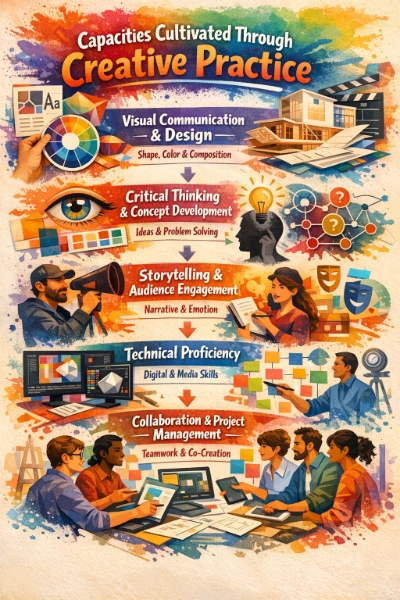
A vibrant, watercolor-style infographic that summarizes five key capacities developed through arts and design practice. From top to bottom, it highlights: (1) Visual Communication & Design (color wheel, typography and composition cues, architectural model), (2) Critical Thinking & Concept Development (eye, silhouette with a lightbulb, connected idea nodes), (3) Storytelling & Audience Engagement (megaphone, writer/creator, theatre masks and media symbols), (4) Technical Proficiency (screens showing digital design tools and workflows), and (5) Collaboration & Project Management (a diverse team planning together with notes, devices, and project materials). The overall layout uses bold headings and dynamic visuals to convey how creativity connects ideas, craft, and teamwork across disciplines.
Lifelong Relevance of Arts, Design, and Media Beyond University
- Creative Thinking as a Universal Asset
Creative thinking doesn’t end at the edge of a canvas or stage—it becomes a mindset that fuels every aspect of life. It helps us embrace uncertainty, spot patterns in chaos, and imagine paths no one else sees. In business, it powers bold strategies. In education, it sparks discovery. In tech, it shapes designs with empathy. Whether in management, information technology, or beyond, creative fluency is a compass for problem-solvers, dreamers, and innovators alike. - Artistic Expression as Personal and Civic Enrichment
Art is not only what we make—it’s how we make sense of ourselves. Long after grades are gone, creative practice remains a source of depth, healing, and connection. Whether performing, journaling, or crafting visual stories, individuals find moments of mindfulness and windows into empathy. Through the performing arts or daily acts of creation, we grow more aware, more grounded, and more attuned to the voices within and around us. Artistic expression becomes a lifelong dialogue between self and society. - Design Literacy in a Visual-Driven World
Today, we read the world through images. Before a word is spoken, meaning arrives through color, form, and flow. Understanding that visual language—how it persuades, informs, or deceives—is crucial. Design literacy gives you the power to navigate, decode, and shape this world. Whether building a personal brand, crafting a pitch, or analyzing a social media post, the skills rooted in graphic design and visual storytelling ensure you’re not just consuming media—but shaping the conversation.
Looking Towards the Future Trends and Opportunities in Arts, Design, and Media
- Immersive Media and the New Frontiers of Experience
Technologies like augmented reality (AR), virtual reality (VR), and mixed reality (MR) are reshaping how we engage with stories and spaces. No longer passive viewers, audiences become participants—navigating film worlds, exploring digital galleries, or interacting with gamified learning. These experiences demand creators fluent in both imagination and spatial design—artists who can build virtual worlds that respond to human touch, gaze, and choice. - Sustainability and the Ethics of Creative Practice
As we face climate disruption and social inequality, the creative world is reorienting around responsibility. Designers are turning to eco-conscious materials, circular production, and socially aware branding. Artists use their platforms to provoke dialogue on consumption, justice, and repair. Beauty now walks hand-in-hand with care. The future of art and design lies not only in what we make—but how, and why, we make it. - Digital Content Creation and AI-Enhanced Expression
With AI tools accelerating creative workflows—from image generation to auto-editing—artists are blending machine precision with human depth. These technologies aren’t replacing creativity—they’re expanding it. Using platforms like Adobe Creative Cloud alongside AI-based software, creators can personalize content, adapt for multiple audiences, and prototype at speed. The result is more room for nuance, reach, and resonance. - Cross-Cultural Collaboration in a Connected World
Today’s creatives build not just across disciplines, but across borders. Shared cloud studios and digital networks unite artists from Tokyo to Lagos, London to Jakarta. The result? Hybrid aesthetics, multicultural narratives, and collaborations rich in nuance and innovation. In this global canvas, cultural fluency matters as much as craft. Those who listen, adapt, and co-create thrive in shaping stories that transcend boundaries. - Transmedia Storytelling and the Rise of Creative Entrepreneurship
Creatives now stretch stories across platforms—comics, podcasts, games, installations—each adding dimension to the whole. Transmedia storytelling rewards those who think systemically, yet emotionally. At the same time, many are building their own studios, brands, and businesses. The modern artist must not only envision but also organize, market, and lead. Success lies in the ability to blend narrative with strategy—to be both poet and producer.
Arts, Design, and Media – Frequently Asked Questions
What can I learn in the Arts, Design, and Media section of Prep4Uni.online?
In the Arts, Design, and Media section you are introduced to how images, sounds, stories, and spaces are created, interpreted, and used in society. You will meet topics such as fine arts, architecture, graphic design, film and media studies, advertising, public relations, and performance. Each page explains key concepts, examples, and pathways so that you can see how creative work connects to real institutions, audiences, and careers.
How does the Arts, Design, and Media hub help me prepare for university studies?
The hub is designed as a bridge between school-level experience and university expectations. It helps you build vocabulary, interpret case studies, understand how projects are structured, and see how academic theories sit behind studio work and media practice. By using the hub and child pages, you will be better prepared for reading lists, studio briefs, essays, and group projects in first-year arts, design, and media programmes.
Do I need strong drawing, coding, or music skills before exploring these pages?
No, you do not need advanced practical skills to use these materials. The pages focus on ideas, methods, and ways of thinking that support any level of technical ability. As you read, you will see how concepts like composition, narrative, user-experience, branding, or performance are built step by step. This makes it easier to start building skills later, whether in drawing, digital design, sound, film, or interactive media.
What kinds of careers are linked to arts, design, and media studies?
Arts, design, and media studies lead to many careers, including graphic and interaction design, architecture, urban and interior design, film and television production, animation, game and experience design, arts management, advertising, public relations, journalism, content strategy, and cultural policy. The hub highlights how each topic can be part of a wider pathway that may also include business, technology, or social sciences.
How should I use the hub page together with its child pages when studying?
Start at the hub page to get an overview of key themes, examples, and links between disciplines. Then move into the child pages when you want more depth on a specific area such as architecture, advertising, or film and media studies. Use the “Why Study”, applications, and case-study sections to connect theory with practice, and return to the hub whenever you need to see how different creative fields fit together.
Can I combine Arts, Design, and Media with STEM or business-related degrees?
Yes. Many universities offer combined or interdisciplinary programmes where creative practice is integrated with computing, engineering, data, or business. Examples include digital media and communication, experience and service design, game development, creative technologies, design management, and cultural entrepreneurship. The hub encourages you to think about how visual and narrative skills support innovation, product development, and communication in technical and commercial fields.
How can I start building a portfolio while using the Arts, Design, and Media materials?
As you read each page, choose small exercises for yourself: sketch a storyboard, redesign a poster, analyse a film scene, outline a campaign, or annotate photographs and buildings. Collect these experiments in a digital folder or sketchbook and reflect briefly on what you tried and why. Over time, this becomes the basis for a portfolio that shows curiosity, reflection, and growth, which admissions tutors value alongside technical polish.
Are there numerical or technical skills involved in arts, design, and media studies?
Yes. While creativity is central, many areas use quantitative and technical skills. Examples include working with layout grids and proportions, analysing audience statistics, budgeting for productions, using colour models and resolution settings, planning schedules, and understanding user-testing or survey data. The hub often points to where measurement, estimation, and simple calculations enter creative decision-making.
How can studying arts, design, and media improve my communication and critical thinking?
Arts, design, and media subjects train you to decode images, spaces, and stories, to ask who is speaking, for whom, and with what effect. You practise explaining your ideas visually and verbally, giving and receiving critique, and revising work in response to feedback. These habits strengthen your ability to structure arguments, evaluate sources, and adapt messages for different audiences, which is valuable in any academic or professional context.
What is a good way to revise this section before applications, interviews, or studio tests?
Before interviews or portfolio reviews, revisit the hub and select a few child pages that match the courses you are applying for. Review key terms, re-read case studies, and choose concrete examples of artworks, buildings, campaigns, or media pieces you can talk about. Summarise in your own words what you found interesting, what questions you still have, and how you might explore them further at university. This prepares you to speak clearly about your interests and motivation.
Launch Your Creative Journey in Arts, Design, and Media
At Prep4Uni.online, we believe creativity is not a luxury, but a force for transformation. Through every line drawn, word spoken, image captured, and idea expressed, you shape not only your future—but the world’s. Our platform offers you the tools, guidance, and inspiration to thrive in the creative industries of tomorrow.
To enter the world of Arts, Design, and Media is to engage with the poetry of form. It is to explore how thought becomes texture, how emotion finds rhythm, and how vision takes shape. This journey is more than a career path—it is a way of seeing and being. It calls on you to look deeply, think freshly, and speak through color, movement, image, and code.
At Prep4Uni.online, creativity belongs to everyone. Whether you dream of painting on canvas or crafting interfaces, telling true stories or designing immersive worlds, we offer pathways that honor your passion and prepare your practice. You’ll explore the grammar of aesthetics, the architecture of narrative, and the ethics of communication—learning not only how to make, but why it matters.
Step into the visual and expressive richness of fine art and performing arts. These fields remain our most vital languages for feeling, remembering, and resisting. They teach us that beauty speaks when words fail, that movement holds memory, and that creation can be both rebellion and healing.
Design, whether in graphic form, architectural space, or UX flow, is where creativity meets care. It’s the art of solving problems with empathy and elegance. Through design, you’ll learn how to guide attention, reduce friction, and build bridges between people and technology, form and function, heart and mind.
In our media and communication tracks, you’ll learn to tell stories that matter—through journalism, film, visual campaigns, and advertising. You’ll practice the art of clarity in a noisy world, becoming not just a creator of content, but a curator of meaning. You’ll explore how narrative can inform, inspire, and move communities to act.
But we offer more than skills—we invite reflection. What does it mean to create ethically? To design with integrity? To tell the truth when it’s difficult? At Prep4Uni.online, you’ll be challenged to think critically about what your work says, who it serves, and what futures it helps shape.
Our curriculum nurtures your ability to think across boundaries—disciplinary, cultural, technological. You’ll learn to work with others, adapt with grace, and build ideas that travel. At every step, you will grow as a thinker, a maker, and a citizen of a complex, creative world.
This is your beginning. Whether you’re sketching your first concept, editing your first short film, or designing your first prototype—what matters is that you start. The world needs your voice. Your questions. Your courage. Creativity is not about having the answers—it’s about daring to imagine what comes next.
Let your journey begin here—with Prep4Uni.online as your guide, and your imagination as your compass. The canvas is open, and every stroke you make is a step toward possibility.
Arts, Design, and Media: Practice Exercises
What Did You Learn in Arts, Design, and Media?
What are the primary disciplines covered under arts, design, and media?
Answer: These include painting, sculpture, and photography in the visual arts; graphic, product, and interior design; and media such as film, broadcasting, and digital platforms. Each area blends creativity with the power to communicate and inspire.
How does design integrate functionality with aesthetics?
Answer: Good design doesn’t just look beautiful—it works well too. It combines visual style with practical purpose so people enjoy using what’s been created.
What role does digital media play in modern artistic expression?
Answer: Digital tools like design software, digital cameras, and video apps let creators explore new ways to express their ideas and connect with audiences around the world.
How can understanding color theory enhance a designer’s work?
Answer: Color theory helps designers pick colors that go well together and evoke the right emotions. It’s like painting with feeling, not just pigment.
What is the importance of visual communication in media?
Answer: Images, words, and layout can speak louder than speech. They guide viewers through ideas, making messages easier to understand and remember.
How does the evolution of technology impact the fields of arts, design, and media?
Answer: New technology opens doors to fresh forms of creativity. It changes how we make, share, and interact with art—bringing ideas to life in exciting ways.
What skills are essential for a successful career in creative industries?
Answer: Creative industries need people who can dream, build, and communicate. Skills like using digital tools, solving problems, and thinking visually are key.
How does storytelling influence media production?
Answer: Every great film, ad, or video tells a story. Stories help us feel, remember, and care. In media, storytelling is the heart of connection.
What is the significance of interdisciplinary collaboration in creative projects?
Answer: When people from different fields team up—like artists, engineers, and writers—they create work that’s richer, bolder, and more powerful than any could alone.
How do sustainability and ethics factor into modern creative practices?
Answer: Today’s creators care about the planet and people. They choose materials and messages that are kind to the Earth and respectful of every voice.
Beyond the Basics in Arts, Design, and Media
How might emerging technologies reshape traditional art and design practices?
Answer: New tools like virtual reality, augmented reality, and AI are changing how art is made and shared. These technologies allow artists to create immersive, interactive works that push past old limits and invite fresh ways of experiencing creativity.
In what ways can digital media democratize artistic expression?
Answer: Digital platforms let anyone share their work with the world. Artists no longer need galleries or big budgets to be seen, which opens space for new voices, diverse stories, and richer cultural conversations.
How does the integration of sustainability principles influence design and media projects?
Answer: When creators use eco-friendly materials and energy-saving methods, they help protect the planet. Projects that focus on sustainability also speak to audiences who care deeply about ethical and responsible choices.
What challenges do artists and designers face when balancing creativity with commercial viability?
Answer: Balancing passion with profit isn’t easy. Creators must meet client needs, manage budgets, and stay true to their vision. This takes clear thinking, strong communication, and smart compromises.
How can interdisciplinary collaborations enhance the impact of creative projects?
Answer: When different talents work together—like coders with illustrators or scientists with designers—they spark new ideas. These collaborations often lead to bold, layered projects that reach wider audiences.
In what ways might social media influence trends in arts, design, and media?
Answer: Social media spreads ideas fast. It shows what’s popular, gives feedback in real time, and helps artists test new styles. It also builds communities that support creative growth.
How does the concept of visual storytelling impact branding and marketing strategies?
Answer: Brands use images and stories to connect with people. A well-told visual story helps us remember a brand, trust it, and feel part of its world—making it more than just a logo.
What role does cultural context play in the interpretation and creation of art and design?
Answer: Art and design are shaped by culture. Symbols, colors, and stories all carry different meanings in different places. Knowing this helps creators make work that truly connects.
How can emerging design technologies, such as 3D printing, transform traditional manufacturing processes?
Answer: 3D printing lets designers test ideas quickly and make custom shapes that were once impossible. It can speed up production, cut waste, and open the door to more playful and personal designs.
In what ways might the convergence of arts, design, and media lead to new forms of interactive and immersive experiences?
Answer: When these fields blend, the results are magical. We get artworks we can walk through, videos that respond to touch, and stories that surround us—engaging all our senses.
How could advancements in computational design tools influence the future of creative industries?
Answer: These tools help designers try more ideas in less time. With data, simulations, and automation, creators can fine-tune their work to be smarter, faster, and more beautiful than ever before.
What ethical considerations should guide the use of digital and emerging technologies in creative practices?
Answer: Creators must think about fairness, privacy, and respect. This means protecting people’s data, honoring rights, and making sure new tools don’t leave anyone behind—so the future of creativity is open to all.
Numerical Dimension in Arts, Design, and Media
A creative agency allocates a budget of $50,000 for a multimedia project. If 30% of the budget is spent on design and 20% on production, how much remains for marketing and distribution?
Solution: Design and production use up half the budget: 30% + 20% = 50%. That’s $25,000 spent, leaving $25,000 for marketing and distribution.
A digital display has a resolution of 1920×1080 pixels over a 50-inch diagonal. Calculate the approximate pixel density (PPI).
Diagonal Pixels = √(19202 + 10802) = √(3,686,400 + 1,166,400) = √(4,852,800) ≈ 2202.91 px
PPI = 2202.91 / 50 ≈ 44.06 PPISolution: First, calculate the pixel diagonal: √(19202 + 10802) ≈ √(4,852,800) ≈ 2203 pixels. Divide by the screen size: 2203 ÷ 50 ≈ 44.06 PPI.
An artist prints a poster measuring 24 inches by 36 inches. Calculate its area in square centimeters. (1 inch = 2.54 cm)
Width = 24 × 2.54 = 60.96 cm
Height = 36 × 2.54 = 91.44 cm
Area = 60.96 × 91.44 = 5574.18 cm2Solution: Convert inches to centimeters: 24 in = 60.96 cm, 36 in = 91.44 cm. Multiply: 60.96 × 91.44 ≈ 5574.18 cm2.
A graphic designer needs to scale an image from 800×600 pixels to a width of 1200 pixels while maintaining the aspect ratio. Calculate the new height.
Aspect Ratio = 600 / 800 = 0.75
New Height = 1200 × 0.75 = 900 pxSolution: The aspect ratio is 600 ÷ 800 = 0.75. Multiply the new width by this ratio: 1200 × 0.75 = 900 pixels.
A video project requires a frame rate of 30 fps. How many frames are there in a 2-minute video?
Total Frames = 2 × 60 s × 30 fps = 3600 framesSolution: Two minutes = 120 seconds. Multiply by frame rate: 120 × 30 = 3600 frames.
In a design project, a poster’s resolution must be 300 DPI (dots per inch). What is the minimum number of dots required for a 18-inch by 24-inch poster?
Total Dots = (18 × 300) × (24 × 300) = 5400 × 7200 = 38,880,000 dotsSolution: Width: 18 × 300 = 5400 dots. Height: 24 × 300 = 7200 dots. Total: 5400 × 7200 = 38,880,000 dots.
A photographer uses a camera with an aperture of f/2.8. If the lens focal length is 50 mm, calculate the diameter of the aperture opening.
Aperture Diameter = f / N = 50 / 2.8 ≈ 17.86 mmSolution: Divide focal length by f-number: 50 ÷ 2.8 ≈ 17.86 mm.
A digital art file is 15 MB in size. If it is compressed to 40% of its original size, what is the new file size in MB?
Solution: 15 MB × 0.40 = 6 MB.
A website loads an image in 0.5 seconds. If the image is 2 MB in size, calculate the effective download speed in MB/s.
Solution: 2 MB ÷ 0.5 seconds = 4 MB/s.
A designer prints a brochure with a 4-color process. If each brochure costs $0.25 to print and 10,000 copies are made, what is the total printing cost?
Solution: 10,000 × $0.25 = $2500.
In a video editing software, a timeline is 120 seconds long and is divided into 3600 frames. What is the average duration of each frame in seconds?
Solution: 120 ÷ 3600 = 0.0333 seconds per frame.