
What Self-Focusing Really Means
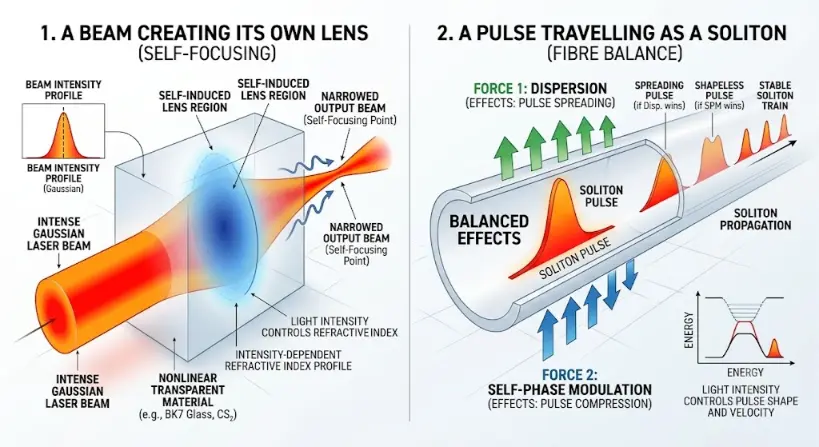
The image nonlinear_self_focusing_and_soliton_propagation.png is a clean, educational infographic composed of two main visual sections designed to illustrate how intense light can control its own spatial and temporal propagation through nonlinear materials.
The left section, titled “1. A BEAM CREATING ITS OWN LENS (SELF-FOCUSING),” demonstrates spatial self-action. It shows a powerful, intense red Gaussian laser beam entering a rectangular block of “Nonlinear Transparent Material.” Inset diagrams show that the centre of the Gaussian beam profile is more intense than the outer edges. This spatial intensity pattern modifies the material, creating a corresponding, gradient index “self-induced lens region.” Schematic diagrams and wave-like arrows illustrate the beam propagating, narrowing, and converging as it travels through the crystal, with labels for “NARROWED OUTPUT BEAM (Self-Focusing Point).” This visualization confirms that the light’s own intensity is controlling the refractive index.
The right section, titled "2. A PULSE TRAVELLING AS A SOLITON (FIBRE BALANCE)," illustrates temporal self-action in an optical waveguide (fibre). It depicts an optical pulse (visualized as an orange wave packet with specific duration) travelling inside an optical fibre. Below and above the fibre, diagrams indicate opposing physical forces that try to change the pulse duration. On top, green arrows labeled "FORCE 1: DISPERSION (EFFECTS: PULSE SPREADING)" show the tendency for the pulse to broaden. Below, blue arrows labeled "FORCE 2: SELF-PHASE MODULATION (EFFECTS: PULSE COMPRESSION)" show how nonlinear intensity-dependent effects try to compress the pulse. A visual diagram further illustrates that where these two effects perfectly "BALANCE," the pulse travels as a stable "SOLITON" over long distances, labelled "SOLITON PROPAGATION," maintaining its optimal shape. Smaller plots detail how light intensity controls the temporal pulse shape and velocity.
The Evolutionary Path: History, Core Limitations, and Wave Engineering
The Historical Journey
Contemporary Scientific Challenges
Future Horizons: Multimode Solitons and Spatial Photonic Networks
- Multimode and Vector Solitons: Optical engineers are designing complex soliton wave states within thick, multi-core fiber structures. By balancing modal dispersion against high-order Kerr interactions, these coupled packets exchange energy dynamically across dozens of modes without losing their cohesive temporal shape.
- Plasma-Stabilized Filamentation Fields: In atmospheric tracking applications, ultrashort terawatt-level pulses drive balanced propagation paths across hundreds of meters of open air. The intense self-focusing effect is continuously counterbalanced by low-density electron plasma defocusing channels, leaving behind stable conductive ionized threads used for lightning guidance and remote spectroscopy.
The Kerr Effect and Intensity-Dependent Refractive Index
| Symbol | Meaning | Why It Matters |
|---|---|---|
| \(n\) | Effective refractive index | Determines how the beam propagates through the material |
| \(n_0\) | Linear refractive index | The refractive index at low intensity |
| \(n_2\) | Nonlinear refractive index coefficient | Measures how strongly refractive index changes with intensity |
| \(I\) | Optical intensity | Higher intensity causes a stronger nonlinear index change |
Why a Beam Can Act Like a Lens
| Beam Region | Intensity | Refractive Index Change | Optical Effect |
|---|---|---|---|
| Centre | Highest | Largest increase in \(n\) | Greater optical phase delay |
| Middle region | Moderate | Moderate increase in \(n\) | Partial phase delay |
| Outer edge | Lowest | Smallest index change | Least phase delay |
Diffraction Versus Self-Focusing
| Effect | What It Does | When It Dominates |
|---|---|---|
| Diffraction | Spreads the beam | Low intensity, weak nonlinearity, small focusing effect |
| Self-focusing | Narrows the beam | High intensity and positive nonlinear refractive index |
| Balanced propagation | Beam shape may remain more stable | Nonlinear focusing compensates diffraction |
Critical Power for Self-Focusing
Catastrophic Self-Focusing and Filamentation
Self-Focusing in Bulk Media and Fibres
| Medium | Relevant Nonlinear Behaviour | Example Effect |
|---|---|---|
| Bulk glass or crystal | Kerr self-focusing | Beam narrowing and possible optical damage |
| Gas | Self-focusing plus plasma effects | Filamentation and long-distance nonlinear propagation |
| Optical fibre | Nonlinear phase shift and self-phase modulation | Solitons, spectral broadening, and pulse reshaping |
| Integrated waveguide | Strong confinement increases intensity | Compact nonlinear photonic devices |
Self-Phase Modulation
Dispersion: The Pulse-Spreading Effect
Nonlinear Length
What an Optical Soliton Really Is
| Soliton Type | Spreading Effect | Balancing Nonlinear Effect |
|---|---|---|
| Temporal soliton | Dispersion spreads the pulse in time | Self-phase modulation reshapes the pulse |
| Spatial soliton | Diffraction spreads the beam in space | Self-focusing narrows the beam |
| Spatiotemporal soliton | Both diffraction and dispersion spread the light packet | Nonlinearity balances both spatial and temporal spreading |
Temporal Solitons in Optical Fibres
Spatial Solitons
The Nonlinear Schrödinger Equation
| Term | Physical Meaning |
|---|---|
| \(i\frac{\partial A}{\partial z}\) | How the pulse evolves along the fibre |
| \(-\frac{\beta_2}{2}\frac{\partial^2 A}{\partial T^2}\) | Dispersion term that can spread or reshape the pulse |
| \(\gamma |A|^2A\) | Nonlinear Kerr term responsible for intensity-dependent phase change |
Soliton Order
| Soliton Order | Meaning |
|---|---|
| \(N = 1\) | Fundamental soliton; pulse can preserve its shape in the ideal model |
| \(N > 1\) | Higher-order soliton; pulse shape can oscillate periodically during propagation |
| \(N < 1\) | Dispersion is relatively stronger; pulse tends to broaden |
Bright and Dark Solitons
| Soliton Type | Visual Description | Typical Context |
|---|---|---|
| Bright soliton | A localised bright pulse or beam | Often associated with anomalous dispersion in fibres |
| Dark soliton | A localised dip in a bright background | Often associated with normal dispersion conditions |
| Vector soliton | Coupled soliton involving more than one field component | Polarisation or multimode systems |
| Dissipative soliton | Stable pulse maintained with gain, loss, dispersion, and nonlinearity | Mode-locked lasers and driven systems |
Solitons and Optical Communication
Solitons in Mode-Locked Lasers
Self-Focusing Versus Optical Solitons
| Feature | Self-Focusing | Optical Soliton |
|---|---|---|
| Main idea | Beam creates a lens-like index profile | Wave packet preserves shape through balance |
| Opposing effect | Diffraction often opposes focusing | Dispersion or diffraction is balanced by nonlinearity |
| Possible outcome | Beam narrowing, filamentation, collapse, or damage | Stable or periodic pulse/beam propagation |
| Key requirement | Intensity-dependent refractive index | Careful balance of spreading and nonlinear effects |
Modulational Instability
Supercontinuum Generation
Applications of Self-Focusing and Optical Solitons
Fibre-Optic Pulse Propagation
Soliton concepts help explain how dispersion and nonlinearity interact in optical fibres.
Ultrafast Lasers
Soliton-like pulses appear in many mode-locked laser systems where dispersion, nonlinearity, gain, and loss are balanced.
High-Power Laser Systems
Self-focusing must be managed because excessive nonlinear focusing can distort beams or damage optical components.
Supercontinuum Sources
Nonlinear pulse propagation, including soliton dynamics, can help generate broad optical spectra.
Atmospheric Filamentation
Intense laser pulses in air can form filaments through competing nonlinear focusing and defocusing effects.
Integrated Photonics
Waveguides can enhance nonlinear interactions by confining light tightly over small structures.
Nonlinear Imaging
Self-focusing and nonlinear propagation must be considered in high-intensity optical imaging and microscopy systems.
Fundamental Nonlinear Science
Solitons appear in many fields, making optical solitons part of a wider study of stable nonlinear waves.
Connections with Wider Physics and Technology
Nonlinear Optics
Self-focusing and solitons arise because material response depends on light intensity.
Frequency Mixing and Optical Parametric Processes
Both frequency mixing and soliton physics come from nonlinear light-matter interaction, although they emphasise different outcomes.
Wave Optics
Diffraction, dispersion, phase, interference, and coherence are essential for understanding beam spreading and pulse evolution.
Laser Optics
High-intensity laser beams often reveal nonlinear effects such as Kerr lensing, self-phase modulation, and self-focusing.
Fiber Optics
Optical fibres provide a major platform for studying dispersion, nonlinearity, pulse propagation, and soliton behaviour.
Photonics
Photonics uses nonlinear propagation in waveguides, fibres, resonators, and chip-scale devices.
Electromagnetic Waves
The electric field of light drives nonlinear refractive-index changes in matter.
Chemical Material Engineering
Nonlinear materials, fibres, waveguides, coatings, and optical components must be engineered to manage intensity-dependent effects.
Learning Pathway Within Nonlinear Optics
Second-Harmonic Generation
Learn how intense light in nonlinear materials can produce light at twice the original frequency and half the vacuum wavelength.
Frequency Mixing and Optical Parametric Processes
Understand how nonlinear optical media generate sum frequencies, difference frequencies, signal-idler pairs, tunable light, and amplified optical waves.
Self-Focusing and Optical Solitons
Current page. See how intense light can change a material’s refractive index, focus itself, and form stable optical solitons.
Nonlinear Optics in Lasers and Photonics
Discover how nonlinear optics supports ultrafast lasers, wavelength conversion, optical fibres, photonic devices, and advanced light-based technologies.
Quick Check: Self-Focusing and Optical Solitons
Quick Check: Nonlinear Propagation
Common Misunderstandings About Self-Focusing and Solitons
Misunderstanding 1: Self-Focusing Means a Beam Always Becomes Better Focused
Misunderstanding 2: Solitons Ignore Dispersion
Misunderstanding 3: A Soliton Is Just Any Short Pulse
Misunderstanding 4: Nonlinearity Is Always a Problem
Misunderstanding 5: Self-Focusing and Self-Phase Modulation Are the Same
Key Terms
- Self-focusing
- A nonlinear optical effect in which a light beam creates a refractive-index profile that tends to focus the beam.
- Kerr effect
- An intensity-dependent refractive-index effect often written as \(n = n_0 + n_2I\).
- Kerr lens
- An effective lens formed inside a nonlinear medium by the intensity profile of a light beam.
- Nonlinear refractive index
- The part of the refractive index that depends on optical intensity.
- Critical power
- The approximate beam power above which self-focusing can overcome diffraction in a Kerr medium.
- Diffraction
- The natural spreading of a light beam as it propagates.
- Filamentation
- The formation of long, narrow light channels through a balance of nonlinear focusing and limiting effects such as plasma defocusing.
- Self-phase modulation
- An intensity-dependent phase shift that can broaden the spectrum of an optical pulse.
- Dispersion
- The spreading or reshaping of a pulse because different frequency components travel at different speeds.
- Group-velocity dispersion
- Dispersion affecting the speed of pulse envelopes and their frequency components.
- Optical soliton
- A stable or self-maintaining optical pulse or beam created by a balance between spreading and nonlinear effects.
- Temporal soliton
- An optical pulse that preserves its time shape through a balance between dispersion and nonlinearity.
- Spatial soliton
- An optical beam that preserves its transverse shape through a balance between diffraction and nonlinear self-focusing.
- Nonlinear Schrödinger equation
- A mathematical equation often used to model pulse propagation, dispersion, nonlinearity, and soliton behaviour.
- Soliton order
- A dimensionless measure of the relative strengths of dispersion and nonlinearity in fibre soliton theory.
Review Questions
- What is self-focusing?Answer: Self-focusing is a nonlinear optical effect in which a light beam changes the refractive index of the medium and creates a lens-like profile that can focus the beam.
- What is the Kerr effect?Answer: The Kerr effect is an intensity-dependent refractive-index effect often described by \(n = n_0 + n_2I\).
- Why does a beam with a bright centre tend to self-focus in a positive Kerr medium?Answer: The bright centre raises the refractive index more than the edges, creating a lens-like profile that bends the beam inward.
- What effect opposes self-focusing in free-space beam propagation?Answer: Diffraction opposes self-focusing by naturally spreading the beam.
- What is an optical soliton?Answer: An optical soliton is a pulse or beam that preserves its shape because spreading effects are balanced by nonlinear effects.
- What balances what in a temporal soliton in an optical fibre?Answer: Group-velocity dispersion is balanced by Kerr nonlinearity, especially self-phase modulation.
- What balances what in a spatial soliton?Answer: Diffraction is balanced by nonlinear self-focusing.
- Why is self-focusing important in high-power laser systems?Answer: It can distort beams, raise intensity, cause instability, and damage optical materials if not controlled.
Thought-Provoking Questions
- Why does self-focusing challenge the idea that a medium is only a passive background for light?Answer: In self-focusing, the medium responds to the beam intensity and changes the beam’s path. The medium becomes part of the beam’s evolution rather than a passive stage.
- Why is a soliton a good example of balance in physics?Answer: A soliton exists because two effects that normally change a wave in opposite ways balance each other. Stability comes not from stillness, but from dynamic compensation.
- How can the same nonlinear effect be both useful and dangerous?Answer: Nonlinearity can create useful effects such as solitons and spectral broadening, but at high intensity it can also cause beam collapse, distortion, or material damage.
- Why are optical fibres such important laboratories for soliton physics?Answer: Fibres guide light over long distances while allowing dispersion and nonlinearity to accumulate, making soliton behaviour easier to observe and use.
- What does soliton physics suggest about stability in complex systems?Answer: It suggests that stability can arise from carefully balanced change. A system may remain coherent not because forces are absent, but because competing effects continually compensate one another.
Comprehensive Numerical Problems with Solutions
- A Kerr medium has n0 = 1.50, n2 = 3.0 × 10⁻²⁰ m2/W, and intensity I = 2.0 × 10¹⁴ W/m2. Find the nonlinear refractive-index change.Solution:Using the intensity-dependent index equation change formula:$$\Delta n = n_2 \cdot I$$Substitute the values:$$\Delta n = (3.0 \times 10^{-20}\text{ m}^2\text{/W}) \times (2.0 \times 10^{14}\text{ W/m}^2) = 6.0 \times 10^{-6}$$Answer: The nonlinear refractive-index change is exactly 6.0 × 10⁻⁶.
- Using the result from Problem 1, find the effective refractive index.Solution:Using the effective index framework matching the Kerr summation:$$n = n_0 + \Delta n$$$$n = 1.50 + 6.0 \times 10^{-6} = 1.500006$$Answer: The total effective refractive index evaluates to exactly 1.500006.
- A pulse has peak power P0 = 5.0 kW, fibre nonlinear coefficient γ = 2.0 W−1km−1, and propagation length L = 0.10 km. Estimate the nonlinear phase shift.Solution:Convert structural power metric into watts base units: 5.0 kW = 5000 W. Apply the formula:$$\phi_{\mathrm{NL}} = \gamma \cdot P_0 \cdot L$$$$\phi_{\mathrm{NL}} = (2.0\text{ W}^{-1}\text{km}^{-1}) \times 5000\text{ W} \times 0.10\text{ km} = 1000\text{ rad}$$Answer: The calculated nonlinear phase shift evaluates to exactly 1000 radians. This large value shows why intense pulses experience profound nonlinear effects.
- A pulse features an operational duration width T0 = 1.0 ps and a group velocity coefficient |β2| = 20 ps2/km. Find the dispersion length.Solution:Using the standard wave envelope dispersion length equation:$$L_D = \frac{T_0^2}{|\beta_2|}$$Substitute values:$$L_D = \frac{(1.0\text{ ps})^2}{20\text{ ps}^2\text{/km}} = \frac{1.0}{20} = 0.050\text{ km}$$Answer: The dispersion length is exactly 0.050 km (which translates to exactly 50 m).
- A waveguide fibre presents a tracking coefficient γ = 2.0 W−1km−1, and the pulse peak power is P0 = 10 W. Find the specific nonlinear length parameter.Solution:Using the standard definition layout for non-linear metric constraints:$$L_{\mathrm{NL}} = \frac{1}{\gamma \cdot P_0}$$Substitute structural values:$$L_{\mathrm{NL}} = \frac{1}{(2.0\text{ W}^{-1}\text{km}^{-1}) \times 10\text{ W}} = \frac{1}{20} = 0.050\text{ km}$$Answer: The nonlinear length parameter scales to exactly 0.050 km (which balances out to exactly 50 m).
- A propagation pulse features a calculated dispersion length LD = 50 m and a nonlinear length LNL = 50 m. Determine the soliton order index (N).Solution:The square of the soliton order tracks as the quotient of the two metric lengths:$$N^2 = \frac{L_D}{L_{\mathrm{NL}}}$$$$N^2 = \frac{50\text{ m}}{50\text{ m}} = 1 \implies N = \sqrt{1} = 1$$Answer: The soliton order is exactly N = 1, matching a stable fundamental soliton wave profile.
- A pulse configuration features parameters γ = 1.5 W−1km−1, P0 = 20 W, T0 = 2.0 ps, and |β2| = 30 ps2/km. Estimate the square of the soliton order index N2.Solution:Using the integrated multi-parameter soliton equation index:$$N^2 = \frac{\gamma \cdot P_0 \cdot T_0^2}{|\beta_2|}$$Substitute metrics directly:$$N^2 = \frac{(1.5\text{ W}^{-1}\text{km}^{-1}) \times 20\text{ W} \times (2.0\text{ ps})^2}{30\text{ ps}^2\text{/km}} = \frac{30 \times 4.0}{30} = 4$$Answer: The squared index value evaluates to exactly N2 = 4 (meaning the structural soliton order is N = 2, identifying a second-order periodic oscillating pulse).
- Estimate the critical power threshold for self-focusing using the paraxial Kerr model equation with input values λ = 1.0 × 10⁻⁶ m, n0 = 1.5, and n2 = 3.0 × 10⁻²⁰ m2/W.Solution:Using the critical power approximation formula:$$P_{\mathrm{cr}} \approx \frac{3.77 \cdot \lambda^2}{8\pi \cdot n_0 \cdot n_2}$$Substitute constants:$$P_{\mathrm{cr}} \approx \frac{3.77 \times (1.0 \times 10^{-6}\text{ m})^2}{8\pi \times 1.5 \times (3.0 \times 10^{-20}\text{ m}^2\text{/W})}$$$$P_{\mathrm{cr}} \approx \frac{3.77 \times 10^{-12}}{1.13097 \times 10^{-18}} \approx 3333422\text{ W}$$Answer: The model critical power evaluates to approximately 3.33 × 10⁶ W (or roughly 3.33 MW). Actual experimental setups vary based on structural beam profiles and target material traits.
External References for Further Reading
- RP Photonics Encyclopedia: Self-Focusing — A reference on Kerr self-focusing, critical power, collapse, and damage risks.
- RP Photonics Encyclopedia: Kerr Lens — A useful explanation of lens-like effects caused by intensity-dependent refractive index.
- RP Photonics Encyclopedia: Solitons — A clear introduction to solitons as pulses maintained by nonlinear and dispersive balance.
- RP Photonics Encyclopedia: B Integral — A reference on nonlinear phase shift and its importance in high-power laser systems.
- RP Photonics Encyclopedia: Effective Nonlinear Coefficient — A helpful reference on the nonlinear coefficient used in fibre and waveguide modelling.
- RP Photonics Encyclopedia: Modulational Instability — A reference on instability produced by the interaction of Kerr nonlinearity and dispersion.