
What Second-Harmonic Generation Really Means
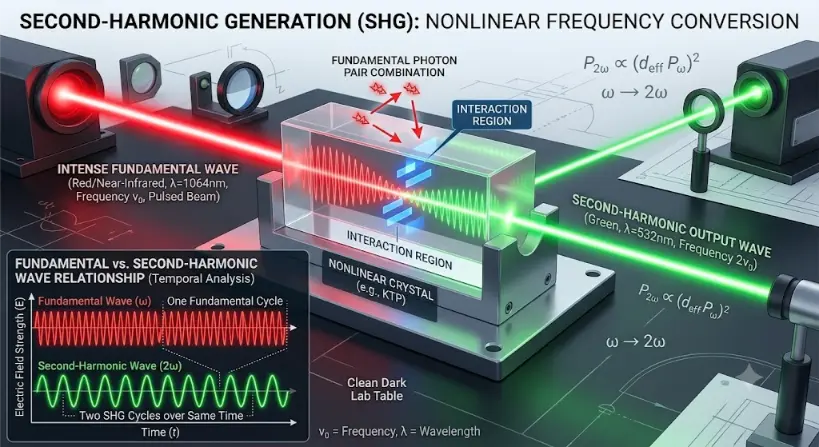
This conceptual scientific infographic illustrates Second-Harmonic Generation (SHG) as a form of non-linear frequency conversion. The primary section shows an intense red/near-infrared laser beam at 1064nm (labeled 'fundamental wave') entering a precise rectangular nonlinear crystal (KTP) mounted on a stage. Inside the crystal, pairs of red photons combine in a designated interaction region (detailed in an inset). This process, which doubles the frequency and halves the wavelength, generates a new, focused green laser beam at 532nm that emerges from the output side. A dedicated side panel analyzes the wave relationship on a temporal scale, showing graphs of electric field strength against time. The fundamental wave graph depicts one complete cycle, while the synchronized second-harmonic wave graph shows two complete cycles over the same duration. The image emphasizes that this process is genuine frequency conversion rather than ordinary color filtering. The background is a detailed laboratory environment.
The Evolutionary Path: History, Symmetry Restrictions, and Advanced Engineering
The Historical Journey
Contemporary Scientific Challenges
Future Horizons: Quantum-State Entanglement and Integrated Waveguides
- Engineered Ferroelectric Domains: Rather than relying on natural crystal anisotropy, material scientists use high-voltage pulses to physically flip crystal domains at micron scales. This process, known as quasi-phase matching (QPM), prevents wave cancellation by reversing the nonlinear coefficient every time the phase slips by 180°, allowing efficient conversion across customized spectral bands.
- On-Chip Nanophotonic Resonators: Incorporating QPM domains into thin-film silicon nitride or lithium niobate ring resonators traps light in micrometer-scale cross-sections over thousands of cavity loops. This spatial confinement forces milliwatt-level continuous lasers to generate high-intensity harmonic cascades, providing efficient light engines for chip-scale atom sensing and quantum logic systems.
Linear Versus Nonlinear Optical Response
| Term | Optical Meaning | Example Effect |
|---|---|---|
| \(\chi^{(1)}E\) | Linear response | Refraction, ordinary transmission, linear polarisation |
| \(\chi^{(2)}E^2\) | Second-order nonlinear response | Second-harmonic generation, sum-frequency generation, difference-frequency generation |
| \(\chi^{(3)}E^3\) | Third-order nonlinear response | Self-focusing, Kerr effect, four-wave mixing, optical solitons |
Why Squaring the Electric Field Creates a Double Frequency
The Fundamental Wave and the Second Harmonic
| Quantity | Fundamental Wave | Second Harmonic |
|---|---|---|
| Angular frequency | \(\omega\) | \(2\omega\) |
| Frequency | \(f\) | \(2f\) |
| Photon energy | \(hf\) | \(2hf\) |
| Vacuum wavelength | \(\lambda\) | \(\frac{\lambda}{2}\) |
| Example | \(1064\,\text{nm}\) | \(532\,\text{nm}\) |
The Photon Picture
Why SHG Needs Special Materials
| Material Feature | Effect on SHG |
|---|---|
| Strong \(\chi^{(2)}\) | Supports stronger second-harmonic generation |
| Non-centrosymmetric structure | Allows bulk second-order nonlinear response |
| Good transparency | Allows both fundamental and second-harmonic light to pass through |
| Damage resistance | Allows intense laser beams without destroying the material |
| Suitable birefringence or poling | Helps with phase matching or quasi-phase matching |
Phase Matching: Why Timing Matters
| Phase Condition | Result |
|---|---|
| Good phase matching | Second-harmonic waves add constructively and output grows strongly |
| Poor phase matching | Generated waves slip out of phase and conversion remains weak |
| Quasi-phase matching | The nonlinear response is periodically reversed to keep growth effective |
Coherence Length
Birefringent Phase Matching
Quasi-Phase Matching
| Method | Basic Idea | Advantage |
|---|---|---|
| Birefringent phase matching | Use crystal direction and polarisation to match phase velocities | Common and powerful in many bulk crystals |
| Temperature tuning | Adjust refractive indices by changing temperature | Can fine-tune phase matching |
| Quasi-phase matching | Periodically reverse the nonlinear coefficient | Allows efficient conversion in engineered materials |
| Waveguide phase matching | Use guided modes to control effective refractive index | Important in integrated photonics |
Conversion Efficiency
Why Laser Light Is Usually Used
Continuous-Wave and Pulsed SHG
| Laser Type | SHG Feature | Example Use |
|---|---|---|
| Continuous-wave laser | Steady output, often requiring careful enhancement for high efficiency | Frequency-doubled laser systems and precision sources |
| Nanosecond pulsed laser | High peak power for efficient conversion | Laboratory frequency conversion and pulsed green lasers |
| Picosecond or femtosecond laser | Very high peak intensity and ultrafast timing | Ultrafast optics, microscopy, spectroscopy, and photonics research |
SHG in Microscopy
SHG in Lasers
| Fundamental Wavelength | Second-Harmonic Wavelength in Vacuum | Typical Colour Region |
|---|---|---|
| \(1064\,\text{nm}\) | \(532\,\text{nm}\) | Green |
| \(800\,\text{nm}\) | \(400\,\text{nm}\) | Violet/near ultraviolet |
| \(1550\,\text{nm}\) | \(775\,\text{nm}\) | Near infrared/red edge |
| \(1030\,\text{nm}\) | \(515\,\text{nm}\) | Green |
SHG in Integrated Photonics
Energy and Momentum Conservation
Common SHG Setups
| Component | Purpose |
|---|---|
| Laser source | Provides intense coherent fundamental light |
| Polariser or wave plate | Controls polarisation for nonlinear interaction |
| Focusing lens | Increases intensity inside the nonlinear material |
| Nonlinear crystal | Generates second-harmonic light |
| Temperature or angle control | Helps achieve phase matching |
| Optical filters | Separate fundamental and second-harmonic wavelengths |
| Detector or camera | Measures the generated light |
Limitations and Practical Challenges
| Challenge | Why It Matters |
|---|---|
| Weak nonlinear response | Some materials generate very little second-harmonic light |
| Phase mismatch | Generated light can cancel rather than build up |
| Absorption | The material may absorb the fundamental or second-harmonic light |
| Thermal effects | Heating can change refractive indices and disturb phase matching |
| Optical damage | Very intense light can damage the nonlinear material |
| Walk-off | Interacting beams can separate inside birefringent crystals |
| Poor beam quality | Unfocused or unstable beams reduce conversion efficiency |
Applications of Second-Harmonic Generation
Green Laser Generation
Infrared laser light can be frequency doubled to produce visible green light, such as 1064 nm becoming 532 nm.
Ultrafast Laser Diagnostics
SHG can help measure ultrafast pulses and characterise short-duration laser systems.
Nonlinear Microscopy
SHG microscopy can image ordered structures such as collagen without requiring fluorescent labels.
Materials Characterisation
SHG can reveal symmetry properties, interfaces, surfaces, and non-centrosymmetric structures.
Integrated Photonics
On-chip SHG can support compact wavelength conversion, frequency combs, and photonic signal processing.
Quantum Photonics
Nonlinear frequency conversion can help connect photons of different wavelengths in quantum optical systems.
Spectroscopy
Frequency doubling can provide wavelengths that are useful for probing atoms, molecules, surfaces, and materials.
Laser Technology
SHG is used in frequency-doubled laser sources for laboratories, industry, imaging, and optical instruments.
Connections with Wider Physics and Technology
Nonlinear Optics
SHG is one of the clearest examples of nonlinear optics because the output frequency is directly related to the square of the input electric field.
Wave Optics
Phase, coherence, interference, wave number, and phase matching are essential for understanding efficient SHG.
Laser Optics
Lasers provide the intensity, coherence, and polarisation control needed for strong second-harmonic generation.
Photonics
SHG is used in photonic devices for wavelength conversion, compact light sources, and optical signal processing.
Quantum Optics
The photon picture of SHG connects frequency doubling with energy conservation and quantum light-matter interaction.
Electromagnetic Waves
The electric field of light drives material polarisation, making SHG a direct consequence of electromagnetic wave interaction with matter.
Chemical Material Engineering
Nonlinear crystals and engineered photonic materials must be designed for transparency, symmetry, damage resistance, and phase matching.
Learning Pathway Within Nonlinear Optics
Second-Harmonic Generation
Current page. Learn how intense light in nonlinear materials can produce light at twice the original frequency and half the vacuum wavelength.
Frequency Mixing and Optical Parametric Processes
Understand how nonlinear optical media generate sum frequencies, difference frequencies, new wavelengths, and tunable light.
Self-Focusing and Optical Solitons
See how intense light can change a material’s refractive index, focus itself, and form stable optical solitons.
Nonlinear Optics in Lasers and Photonics
Discover how nonlinear optics supports ultrafast lasers, wavelength conversion, optical fibres, photonic devices, and advanced light-based technologies.
Quick Check: Second-Harmonic Generation
Quick Check: Frequency Doubling
Common Misunderstandings About SHG
Misunderstanding 1: SHG Is Just Filtering Out a Colour
Misunderstanding 2: Any Material Can Efficiently Double Frequency
Misunderstanding 3: Doubling Frequency Always Means the Same Thing as Halving Wavelength Inside a Material
Misunderstanding 4: A Longer Crystal Always Gives More SHG
Misunderstanding 5: SHG Is Only a Laser Colour Trick
Key Terms
- Birefringence
- A material property in which refractive index depends on polarisation and propagation direction.
- Coherence length
- The distance over which the generated second-harmonic wave remains usefully in phase with the nonlinear driving polarisation.
- Conversion efficiency
- The fraction of fundamental power converted into second-harmonic power.
- Frequency doubling
- Another name for second-harmonic generation.
- Fundamental wave
- The original input light wave that drives the nonlinear process.
- Non-centrosymmetric material
- A material without inversion symmetry, required for strong bulk second-order nonlinear response.
- Nonlinear optics
- The study of optical effects that occur when material response is not simply proportional to the light field.
- Nonlinear polarisation
- The material polarisation response containing higher powers of the electric field.
- Phase matching
- A condition in which interacting waves maintain the correct phase relationship for efficient frequency conversion.
- Phase mismatch
- The difference Δk = k2ω − 2kω, which determines whether generated second-harmonic waves add or cancel.
- Quasi-phase matching
- A method that periodically reverses the nonlinear coefficient to maintain effective growth of the generated wave.
- Second harmonic
- The generated light wave with twice the frequency of the fundamental wave.
- Second-harmonic generation
- A nonlinear optical process in which light at frequency ω generates new light at frequency 2ω.
- χ(2)
- The second-order nonlinear susceptibility responsible for processes such as SHG, sum-frequency generation, and difference-frequency generation.
Review Questions
- What is second-harmonic generation?Answer: Second-harmonic generation is a nonlinear optical process in which light at frequency ω generates new light at frequency 2ω in a suitable material.
- Why is SHG called frequency doubling?Answer: It is called frequency doubling because the generated light has twice the frequency of the input fundamental light.
- Which nonlinear term is mainly responsible for SHG?Answer: SHG is mainly caused by the second-order nonlinear polarisation term involving χ(2)E2.
- Why are lasers commonly used for SHG?Answer: Lasers provide high intensity, coherence, narrow spectral width, and controlled polarisation, all of which help drive efficient nonlinear conversion.
- What is phase matching?Answer: Phase matching is the condition that allows the fundamental and second-harmonic waves to maintain the correct phase relationship so that generated light adds constructively.
- Why do many SHG materials need to be non-centrosymmetric?Answer: In centrosymmetric bulk materials, the second-order nonlinear response cancels under the electric-dipole approximation, making strong bulk SHG difficult.
- What is quasi-phase matching?Answer: Quasi-phase matching is a technique that periodically reverses the nonlinear coefficient so the second-harmonic output continues to grow effectively despite phase mismatch.
- Why is SHG useful in laser technology?Answer: SHG can convert one laser wavelength into another, such as converting infrared 1064 nm light into green 532 nm light.
Thought-Provoking Questions
- Why does SHG show that light can interact with light through matter?Answer: SHG occurs because intense light changes the material polarisation in a nonlinear way, and that nonlinear material response generates new light. The light waves do not interact strongly in empty space, but the material mediates the interaction.
- Why is phase matching as important as energy conservation?Answer: Energy conservation explains which output frequency is possible, but phase matching determines whether waves generated throughout the material add constructively or cancel.
- Why is SHG a good first topic in nonlinear optics?Answer: SHG has a simple frequency relationship, clear mathematical origin, practical laser applications, and strong links to symmetry, materials, waves, and photons.
- How does SHG challenge the idea that optical materials are passive?Answer: In SHG, the material does not merely transmit or refract light. It actively generates a new optical frequency when driven by intense light.
- Why might integrated photonics make SHG more important in future technologies?Answer: Integrated photonics can place nonlinear frequency conversion onto compact chips, supporting smaller optical systems for communication, sensing, quantum technology, and precision measurement.
Comprehensive Numerical Problems with Solutions
- A laser emits fundamental light at 1064 nm. What is the second-harmonic wavelength in vacuum?Solution:Using the structural wavelength relationship for frequency doubling in a vacuum:$$\lambda_{2\omega} = \frac{\lambda_{\omega}}{2}$$Substitute the structural fundamental wavelength parameter:$$\lambda_{2\omega} = \frac{1064\text{ nm}}{2} = 532\text{ nm}$$Answer: The second-harmonic wavelength is exactly 532 nm.
- A fundamental beam has a frequency of 3.75 × 10^{14} Hz. What is the second-harmonic frequency?Solution:The second-harmonic wave frequency is exactly twice the incoming fundamental frequency:$$f_{2\omega} = 2f_{\omega}$$Substitute metrics directly:$$f_{2\omega} = 2 \times (3.75 \times 10^{14}\text{ Hz}) = 7.50 \times 10^{14}\text{ Hz}$$Answer: The second-harmonic frequency is exactly 7.50 × 10^{14} Hz.
- A fundamental photon has an energy of 1.17 eV. What is the energy of a second-harmonic photon?Solution:Following energy conservation parameters, a single second-harmonic photon holds twice the energy of an individual fundamental photon:$$E_{2\omega} = 2E_{\omega}$$$$E_{2\omega} = 2 \times 1.17\text{ eV} = 2.34\text{ eV}$$Answer: The second-harmonic photon energy is exactly 2.34 eV.
- A 1550 nm telecom laser is frequency doubled. What is the second-harmonic wavelength in vacuum?Solution:Using the inverse proportional wavelength rule:$$\lambda_{2\omega} = \frac{\lambda_{\omega}}{2}$$$$\lambda_{2\omega} = \frac{1550\text{ nm}}{2} = 775\text{ nm}$$Answer: The second-harmonic wavelength scales to exactly 775 nm.
- If second-harmonic power is approximately proportional to the square of fundamental power, by what factor does the SHG power increase when the fundamental power doubles?Solution:State the low-conversion output power proportionality:$$P_{2\omega} \propto P_{\omega}^2$$If the fundamental power doubles ($P_{\omega} \rightarrow 2P_{\omega}$), evaluate the scalar scale change:$$\text{Scale Factor} = (2)^2 = 4$$Answer: The secondary output power increases by a factor of exactly 4.
- The phase mismatch across an experimental layout tracks at Δk = 2000 m−1. Estimate the coherence length.Solution:Using the coherence length equation:$$L_c = \frac{\pi}{|\Delta k|}$$Substitute constants into the formula:$$L_c = \frac{3.14159}{2000\text{ m}^{-1}} \approx 0.0015708\text{ m} = 1.57\text{ mm}$$Answer: The structural coherence length evaluates to approximately 1.57 mm.
- A fundamental beam has a wavelength of 800 nm. Calculate its frequency and the second-harmonic frequency in vacuum.Solution:1. Calculate fundamental wave frequency using $f = c / \lambda$, with $\lambda = 800 \times 10^{-9}\text{ m}$:$$f_{\omega} = \frac{3.00 \times 10^8\text{ m/s}}{800 \times 10^{-9}\text{ m}} = 3.75 \times 10^{14}\text{ Hz}$$2. Double the parameter value to find the second harmonic frequency:$$f_{2\omega} = 2 \times f_{\omega} = 2 \times (3.75 \times 10^{14}\text{ Hz}) = 7.50 \times 10^{14}\text{ Hz}$$Answer: The fundamental frequency is 3.75 × 10¹⁴ Hz, and the second-harmonic frequency is exactly 7.50 × 10¹⁴ Hz.
- A laser operates with a continuous fundamental power of 2.0 W. If the crystal conversion efficiency scales at 15%, what second-harmonic power is produced?Solution:Convert the percentage factor to a fraction: 15% = 0.15. Apply the conversion formula:$$P_{2\omega} = \eta \cdot P_{\omega}$$$$P_{2\omega} = 0.15 \times 2.0\text{ W} = 0.30\text{ W}$$Answer: The total generated second-harmonic output power equals exactly 0.30 W (or 300 mW).
External References for Further Reading
- RP Photonics Encyclopedia: Frequency Doubling — A detailed reference on second-harmonic generation, nonlinear crystals, phase matching, and conversion efficiency.
- RP Photonics Encyclopedia: Phase Matching — A useful explanation of phase matching in nonlinear frequency conversion.
- RP Photonics Encyclopedia: Intracavity Frequency Doubling — A reference on using high circulating laser power inside a resonator for efficient SHG.
- Robert W. Boyd: Second- and Higher-Order Harmonic Generation — A textbook-style chapter on harmonic generation in nonlinear optics.
- RP Photonics Encyclopedia: Critical Phase Matching — A reference on angle-based phase matching in birefringent nonlinear crystals.
- Second-Harmonic Generation Microscopy in Biological Imaging — An open-access discussion of SHG microscopy and biological imaging applications.