
What Nonlinear Optics Means in Lasers and Photonics
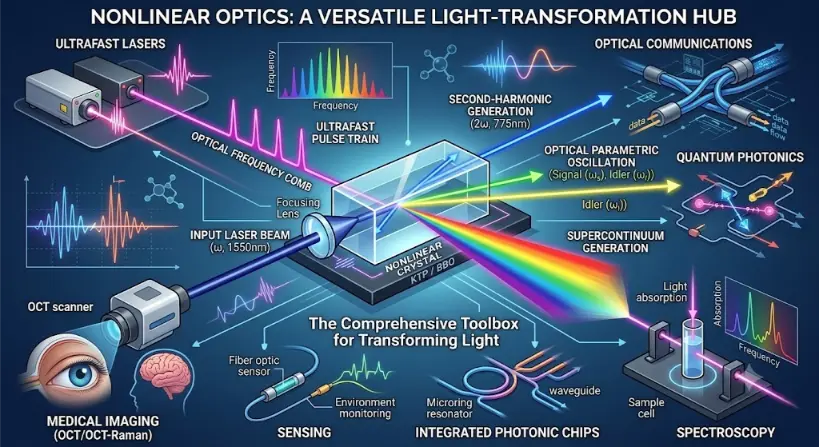
This conceptual infographic positions nonlinear optics as a "Vibrant Light-Transformation Hub," visualizing a single laser input entering a central nonlinear crystal (KTP/BBO) and emerging as four distinct transformed light outputs: a doubled frequency, a tunable signal-idler pair, a broadened supercontinuum spectrum, and a frequency comb pulse train. Each unique output light path is linked to illustrative diagrams of practical applications, clearly communicating that nonlinear processes represent a versatile toolbox rather than a single effect.
The Evolutionary Path: History, System Hurdles, and Foundational Milestones
The Historical Journey
Contemporary Technical Hurdles
Future Paradigms: Nano-Waveguides and Quantum Interconnects
- AI-Driven Inverse Dispersion Engineering: Photonic foundries are adopting machine-learning algorithms to calculate complex cross-sectional waveguide geometries. By pattern-sculpting custom refractive index profiles, artificial intelligence can discover structural dimensions that optimize multi-wave mixing parameters far beyond manual trial limits.
- Entanglement-Preserving Quantum Translators: As global quantum networks emerge, shifting single-photon emissions from local solid-state defects (such as diamond vacancies) to the low-loss infrared fiber window is critical. Foundries are constructing highly localized $\chi^{(2)}$ parametric mixers that seamlessly shift single-photon wavelengths across hundreds of nanometers without destroying their delicate quantum state identities.
The Nonlinear Polarisation Foundation
| Response Term | Main Meaning | Laser and Photonics Examples |
|---|---|---|
| \(\chi^{(1)}E\) | Linear optical response | Refraction, ordinary transmission, linear waveguiding |
| \(\chi^{(2)}E^2\) | Second-order nonlinear response | Second-harmonic generation, sum-frequency generation, difference-frequency generation, optical parametric amplification |
| \(\chi^{(3)}E^3\) | Third-order nonlinear response | Kerr effect, self-phase modulation, four-wave mixing, solitons, supercontinuum generation |
Why Lasers Are Central to Nonlinear Optics
| Laser Property | Why It Helps Nonlinear Optics |
|---|---|
| High intensity | Increases nonlinear response because nonlinear effects depend strongly on field strength |
| Coherence | Allows waves generated in different regions to add constructively |
| Narrow spectral width | Supports controlled phase matching and efficient conversion |
| Polarisation control | Allows use of crystal orientation and nonlinear tensor properties |
| Short pulse duration | Produces high peak power even when average power is moderate |
| Stable beam quality | Improves focusing, overlap, and conversion efficiency |
Wavelength Conversion in Lasers
| Process | Basic Frequency Relationship | Typical Purpose |
|---|---|---|
| Second-harmonic generation | \(\omega + \omega = 2\omega\) | Frequency doubling, such as infrared to green |
| Sum-frequency generation | \(\omega_1 + \omega_2 = \omega_3\) | Generating higher-frequency light from two inputs |
| Difference-frequency generation | \(\omega_3 = |\omega_1 – \omega_2|\) | Generating lower-frequency or infrared light |
| Optical parametric conversion | \(\omega_p = \omega_s + \omega_i\) | Generating tunable signal and idler wavelengths |
| Four-wave mixing | Commonly \(2\omega_p = \omega_s + \omega_i\) | Wavelength conversion in fibres, waveguides, and resonators |
Frequency-Doubled and Frequency-Converted Lasers
| Input Region | Nonlinear Process | Possible Output Region | Example Use |
|---|---|---|---|
| Near infrared | Second-harmonic generation | Visible | Green laser generation and imaging |
| Visible or near infrared | Sum-frequency generation | Higher-frequency visible or ultraviolet | Spectroscopy and precision experiments |
| Near infrared | Difference-frequency generation | Mid-infrared | Molecular sensing and infrared spectroscopy |
| Pump laser | Optical parametric oscillation | Tunable signal and idler wavelengths | Broadly tunable laser sources |
Nonlinear Optics in Ultrafast Lasers
| Ultrafast Laser Function | Nonlinear Optical Role |
|---|---|
| Pulse generation | Kerr lensing and nonlinear pulse shaping can support mode locking |
| Pulse compression | Self-phase modulation can broaden spectra before compression |
| Wavelength tuning | Optical parametric amplifiers provide tunable ultrafast output |
| Pulse measurement | Nonlinear mixing helps characterise ultrashort pulse duration and timing |
| Broadband generation | Nonlinear fibres and waveguides can produce supercontinuum spectra |
Kerr Lens Mode Locking
Self-Phase Modulation and Pulse Compression
Optical Parametric Amplifiers and Oscillators
| Device | Main Function | Why It Matters |
|---|---|---|
| Optical parametric amplifier | Amplifies a seed signal using pump energy | Produces tunable high-power or ultrafast output |
| Optical parametric oscillator | Uses a resonator to build up signal and/or idler waves | Provides tunable coherent light sources |
| Difference-frequency generator | Generates output at a frequency difference | Useful for infrared and molecular spectroscopy |
Nonlinear Optics in Optical Fibres
| Fibre Nonlinear Effect | What It Does | Why It Matters |
|---|---|---|
| Self-phase modulation | Broadens pulse spectrum | Pulse compression, supercontinuum generation, nonlinear signal distortion |
| Cross-phase modulation | One optical channel changes the phase of another | Important in multi-channel fibre systems |
| Four-wave mixing | Generates new frequencies from interacting waves | Wavelength conversion and nonlinear crosstalk |
| Stimulated Raman scattering | Transfers energy to longer wavelengths through vibrational interaction | Raman amplifiers and spectral shifting |
| Soliton propagation | Balances dispersion and nonlinearity | Stable pulse propagation and nonlinear fibre dynamics |
Supercontinuum Generation
| Feature | Meaning | Applications |
|---|---|---|
| Broad spectrum | Many wavelengths are generated from a narrower input | Spectroscopy, imaging, sensing |
| High brightness | Laser-like brightness over wide bandwidth | Optical coherence tomography and microscopy |
| Nonlinear fibre generation | Often produced in special fibres or waveguides | Compact broadband light sources |
Photonic Integrated Circuits
| Integrated Photonic Platform | Possible Nonlinear Use |
|---|---|
| Silicon photonics | Four-wave mixing, wavelength conversion, optical signal processing |
| Silicon nitride photonics | Kerr combs, supercontinuum generation, low-loss nonlinear waveguides |
| Lithium niobate photonics | \(\chi^{(2)}\) conversion, modulation, frequency doubling, parametric processes |
| Aluminium nitride photonics | Second-order nonlinear processes and integrated frequency conversion |
| Chalcogenide waveguides | Strong Kerr nonlinearity and infrared photonics |
| Microresonators | Frequency combs, solitons, wavelength conversion, resonant enhancement |
Microresonator Frequency Combs
Nonlinear Optics in Quantum Photonics
| Nonlinear Process | Quantum Photonics Role |
|---|---|
| Spontaneous parametric down-conversion | Generates correlated photon pairs |
| Four-wave mixing | Can generate photon pairs in fibres and waveguides |
| Difference-frequency generation | Can convert photons between wavelengths |
| Integrated nonlinear resonators | Can support compact quantum light generation |
Nonlinear Optics in Optical Communication
| Nonlinear Effect | Possible Benefit | Possible Problem |
|---|---|---|
| Four-wave mixing | Wavelength conversion | Crosstalk between channels |
| Self-phase modulation | Pulse shaping and spectral broadening | Signal distortion |
| Cross-phase modulation | All-optical control possibilities | Phase noise and channel interaction |
| Raman scattering | Optical amplification | Unwanted power transfer |
Materials for Nonlinear Laser and Photonic Systems
| Material Property | Why It Matters |
|---|---|
| Nonlinear coefficient | Determines how strongly the material responds to intense light |
| Transparency window | Determines which wavelengths can be used without strong absorption |
| Dispersion | Affects phase matching, pulse spreading, and comb generation |
| Damage threshold | Limits usable intensity in laser systems |
| Thermal stability | Affects tuning, reliability, and high-power operation |
| Fabrication quality | Controls loss, scattering, device uniformity, and scalability |
| Integration compatibility | Determines whether the material can be used in photonic chips |
Phase Matching and Dispersion Engineering
Resonant Enhancement
| Resonator Feature | Nonlinear Benefit |
|---|---|
| High quality factor | Stores light longer and increases field build-up |
| Small mode volume | Increases intensity for a given power |
| Careful dispersion design | Supports phase matching and comb formation |
| Integrated fabrication | Allows compact nonlinear photonic systems |
Applications of Nonlinear Optics in Lasers and Photonics
Frequency-Doubled Lasers
Nonlinear crystals can convert infrared laser light into visible or ultraviolet light through harmonic generation.
Tunable Laser Sources
Optical parametric oscillators and amplifiers provide wavelengths that may not be available directly from ordinary laser gain media.
Ultrafast Pulse Shaping
Self-phase modulation, parametric amplification, and nonlinear compression help generate and control extremely short pulses.
Supercontinuum Sources
Nonlinear fibres and waveguides can produce broad spectra for imaging, spectroscopy, sensing, and metrology.
Frequency Combs
Mode-locked lasers and nonlinear microresonators can generate regularly spaced optical frequencies for precision measurement.
Integrated Photonic Chips
Nonlinear waveguides and resonators support wavelength conversion, optical signal processing, and compact light sources.
Quantum Photonics
Parametric down-conversion and four-wave mixing can generate photon pairs and enable wavelength conversion for quantum systems.
Optical Communication
Nonlinear effects influence signal limits but can also support wavelength conversion, amplification, switching, and regeneration.
Challenges and Practical Limitations
| Challenge | Why It Matters | Typical Design Response |
|---|---|---|
| Weak nonlinear interaction | Many materials respond only slightly even at high intensity | Use high fields, long interaction lengths, resonators, or tight waveguide confinement |
| Phase mismatch | Generated waves can cancel rather than build up | Use phase matching, quasi-phase matching, or dispersion engineering |
| Optical loss | Absorption and scattering reduce efficiency and add heat | Improve material purity, fabrication, coatings, and waveguide design |
| Thermal drift | Heating changes refractive index and detunes devices | Use temperature control, robust designs, and thermal engineering |
| Optical damage | High intensity can damage crystals, fibres, or chips | Manage peak power, beam size, pulse duration, and material choice |
| Unwanted nonlinear effects | Competing processes can distort signals or waste energy | Optimise wavelength, dispersion, power, and device geometry |
| Fabrication tolerance | Small geometry errors can change dispersion and resonance | Use precise fabrication, post-trimming, tuning, and design margins |
| System complexity | Efficient nonlinear systems may need careful alignment and stabilisation | Move toward integrated, packaged, and self-stabilising designs |
Future Directions and Emerging Trends
Integrated Nonlinear Photonics
Waveguides and resonators on chips may make wavelength conversion, comb generation, and quantum light sources more compact and scalable.
Microresonator Frequency Combs
Compact comb sources may support precision measurement, spectroscopy, communication, navigation, and optical timing systems.
Hybrid Material Platforms
Combining materials such as silicon nitride, lithium niobate, aluminium nitride, silicon, and chalcogenides can help balance low loss, strong nonlinearity, and practical fabrication.
Chip-Scale Quantum Light Sources
Nonlinear photonics may provide smaller photon-pair sources and wavelength converters for future quantum communication and quantum information systems.
Mid-Infrared Photonics
Nonlinear conversion can help generate wavelengths useful for molecular sensing, environmental monitoring, and biomedical spectroscopy.
Ultrafast Photonic Systems
Nonlinear pulse shaping, compression, and parametric amplification may support more compact ultrafast sources for science and industry.
AI-Assisted Photonic Design
Computational optimisation may help design waveguides, resonators, and dispersion profiles that are difficult to find by manual trial and error.
Lower-Power Nonlinear Devices
Better confinement, resonant enhancement, and material engineering may reduce the power needed for useful nonlinear effects.
Connections with Wider Physics and Technology
Nonlinear Optics
This page applies nonlinear optical principles to real laser systems, fibres, waveguides, resonators, and photonic devices.
Second-Harmonic Generation
Frequency doubling is one of the most common examples of nonlinear wavelength conversion in laser systems.
Frequency Mixing and Optical Parametric Processes
Parametric amplifiers, oscillators, and wavelength converters are central tools in nonlinear laser and photonic systems.
Self-Focusing and Optical Solitons
Kerr effects, solitons, self-phase modulation, and nonlinear pulse propagation are essential in fibres, lasers, and resonators.
Laser Optics
Lasers provide the intensity, coherence, and controllability that make nonlinear optical processes useful.
Photonics
Photonics uses nonlinear effects for wavelength conversion, integrated devices, combs, sensing, and signal processing.
Fiber Optics
Optical fibres provide long interaction lengths for nonlinear effects such as self-phase modulation, four-wave mixing, Raman scattering, and solitons.
Quantum Optics
Nonlinear optics supports photon-pair generation, wavelength conversion, and quantum-compatible photonic devices.
Learning Pathway Within Nonlinear Optics
Second-Harmonic Generation
Learn how intense light in nonlinear materials can produce light at twice the original frequency and half the vacuum wavelength.
Frequency Mixing and Optical Parametric Processes
Understand how nonlinear optical media generate sum frequencies, difference frequencies, signal-idler pairs, tunable light, and amplified optical waves.
Self-Focusing and Optical Solitons
See how intense light can change a material’s refractive index, focus itself, and form stable optical solitons.
Nonlinear Optics in Lasers and Photonics
Current page. Discover how nonlinear optics supports ultrafast lasers, wavelength conversion, optical fibres, photonic devices, frequency combs, and quantum technologies.
Quick Check: Nonlinear Optics in Lasers and Photonics
Quick Check: Nonlinear Photonic Systems
Common Misunderstandings About Nonlinear Optics in Lasers and Photonics
Misunderstanding 1: Nonlinear Optics Is Only About High-Power Laboratory Lasers
Misunderstanding 2: Nonlinearity Is Always Undesirable
Misunderstanding 3: Wavelength Conversion Is the Same as Filtering
Misunderstanding 4: Smaller Photonic Devices Automatically Perform Better
Misunderstanding 5: Frequency Combs Are Just Many Random Laser Lines
Key Terms
- Dispersion engineering
- The deliberate design of how wave velocity depends on frequency, often used to control nonlinear interactions in fibres and photonic chips.
- Four-wave mixing
- A third-order nonlinear process in which interacting waves generate new frequencies.
- Frequency comb
- A spectrum of many regularly spaced optical frequencies, useful for precision measurement and photonic systems.
- Integrated photonics
- The implementation of optical functions on compact chips using waveguides, resonators, modulators, and related components.
- Kerr effect
- An intensity-dependent refractive-index effect often written as n = n0 + n2I.
- Kerr lens mode locking
- A mode-locking method that uses the intensity-dependent lensing effect of a nonlinear medium to favour short pulses.
- Microresonator
- A small optical resonator that can confine light strongly and enhance nonlinear interactions.
- Nonlinear optics
- The study and use of optical effects that occur when material response is not simply proportional to the light field.
- Optical parametric amplifier
- A nonlinear device that amplifies a signal wave by transferring energy from a strong pump wave.
- Optical parametric oscillator
- A resonator-based nonlinear device that generates tunable signal and idler waves from a pump.
- Photonics
- The science and technology of generating, guiding, controlling, detecting, and using light.
- Self-phase modulation
- An intensity-dependent phase shift that can broaden the spectrum of an optical pulse.
- Supercontinuum generation
- The generation of a broad optical spectrum from an intense pulse in a nonlinear medium.
- Ultrafast laser
- A laser that produces extremely short pulses, often with high peak power and strong nonlinear effects.
- Wavelength conversion
- The generation of new optical wavelengths through nonlinear processes such as harmonic generation, sum-frequency generation, difference-frequency generation, or four-wave mixing.
Review Questions
- What does nonlinear optics add to laser and photonic technology?Answer: It allows light to be converted, amplified, reshaped, broadened, compressed, and used to generate new frequencies or quantum states.
- Why are lasers often used to drive nonlinear optical processes?Answer: Lasers provide high intensity, coherence, narrow spectral width, and controlled polarisation, which make nonlinear effects stronger and more controllable.
- What is wavelength conversion?Answer: Wavelength conversion is the generation of light at a new wavelength through nonlinear optical interaction.
- What role does nonlinear optics play in ultrafast lasers?Answer: It supports pulse shaping, spectral broadening, pulse compression, mode locking, parametric amplification, and ultrashort pulse measurement.
- Why are optical fibres useful for nonlinear optics?Answer: Fibres confine light over long distances, allowing nonlinear effects to accumulate even when the material nonlinearity is modest.
- What is a microresonator frequency comb?Answer: It is a frequency comb generated in a small optical resonator through nonlinear effects, often involving Kerr nonlinearity and resonant enhancement.
- How can nonlinear optics support quantum photonics?Answer: It can generate photon pairs, convert photon wavelengths, and support integrated quantum light sources.
- Why is phase matching important in nonlinear laser systems?Answer: Phase matching allows generated waves to add constructively over the interaction length, improving conversion efficiency.
Thought-Provoking Questions
- Why does nonlinear optics make light feel less like a passive signal and more like an active material partner?Answer: Because intense light changes the material response, and that changed response then reshapes the light itself. The beam and material influence one another.
- Why is the same nonlinear effect sometimes useful in one device and harmful in another?Answer: The value of a nonlinear effect depends on context. Self-phase modulation may help broaden a pulse for compression, but in communication it may distort a signal.
- How does integrated photonics change the future of nonlinear optics?Answer: It can make nonlinear optical functions smaller, more scalable, more stable, and more compatible with electronic and photonic systems.
- Why is dispersion engineering so important in nonlinear photonic chips?Answer: Dispersion controls phase matching, pulse evolution, soliton formation, comb generation, and the efficiency of nonlinear wavelength conversion.
- What does nonlinear photonics teach us about technological progress?Answer: It shows that progress often comes from learning to control effects that first appear troublesome. Distortion, phase change, and instability can become useful tools when understood deeply.
Comprehensive Numerical Problems with Solutions
- A laser at 1064 nm is frequency doubled. What is the second-harmonic wavelength in vacuum?Solution:Using the standard second-harmonic generation equation link for vacuum propagation:$$\lambda_{2\omega} = \frac{\lambda_{\omega}}{2}$$Substitute the values:$$\lambda_{2\omega} = \frac{1064\text{ nm}}{2} = 532\text{ nm}$$Answer: The second-harmonic wavelength is exactly 532 nm.
- A pump frequency is 6.0 × 10¹⁴ Hz, and a signal frequency is 3.5 × 10¹⁴ Hz. What is the idler frequency in an optical parametric process?Solution:Using the structural parametric frequency conservation rule:$$f_p = f_s + f_i$$Isolate the idler frequency parameter:$$f_i = f_p – f_s$$$$f_i = (6.0 \times 10^{14}\text{ Hz}) – (3.5 \times 10^{14}\text{ Hz}) = 2.5 \times 10^{14}\text{ Hz}$$Answer: The idler frequency is exactly 2.5 × 10¹⁴ Hz.
- An optical fibre has a third-order nonlinear coefficient γ = 2.0 W−1km−1. A pulse with a high peak power P = 50 W travels an interaction track length of 0.20 km. Estimate the peak nonlinear phase shift.Solution:Using the self-phase modulation phase shift index equation:$$\phi_{\mathrm{NL}} = \gamma \cdot P \cdot L$$Substitute parameters directly:$$\phi_{\mathrm{NL}} = (2.0\text{ W}^{-1}\text{km}^{-1}) \times 50\text{ W} \times 0.20\text{ km} = 20\text{ rad}$$Answer: The peak nonlinear phase shift evaluates to exactly 20 radians.
- A microresonator frequency comb has spectral lines spaced exactly by 100 GHz. What is the comb line spacing expressed in standard hertz?Solution:Using standard metric base scaling rules, where 1 GHz = 109 Hz:$$\Delta f = 100 \times 10^9\text{ Hz} = 1.0 \times 10^{11}\text{ Hz}$$Answer: The comb spacing is exactly 1.0 × 10¹¹ Hz.
- A nonlinear wave converter receives 4.0 W of continuous pump power and yields 0.60 W of targeted converted wavelength output. Find its conversion efficiency.Solution:The efficiency parameter represents the quotient of converted output power over net input power:$$\text{Efficiency} = \frac{P_{\text{out}}}{P_{\text{in}}}$$$$\text{Efficiency} = \frac{0.60\text{ W}}{4.0\text{ W}} = 0.15$$Convert the raw decimal fraction to a standard percentage:$$\text{Percentage} = 0.15 \times 100\% = 15\%$$Answer: The conversion efficiency evaluates to exactly 15%.
- An integrated waveguide track presents a nonlinear metric coefficient γ = 10 W−1m−1 under a clean optical driving power level P = 0.20 W. Find the operational nonlinear length parameter (LNL).Solution:Using the standard definition formula for the nonlinear length metric:$$L_{\mathrm{NL}} = \frac{1}{\gamma \cdot P}$$Substitute the values:$$L_{\mathrm{NL}} = \frac{1}{(10\text{ W}^{-1}\text{m}^{-1}) \times 0.20\text{ W}} = \frac{1}{2.0\text{ m}^{-1}} = 0.50\text{ m}$$Answer: The nonlinear length parameter scales to exactly 0.50 m.
- An ultrashort laser pulse features a duration width parameter of exactly 100 fs. Convert this metric into seconds.Solution:Using standard metric scaling definitions, where 1 femtosecond (fs) equals 10−15 seconds (s):$$t = 100 \times 10^{-15}\text{ s} = 1.0 \times 10^{-13}\text{ s}$$Answer: The pulse duration in scientific formatting equals exactly 1.0 × 10⁻¹³ seconds.
- A microresonator cavity holds circulating photons for exactly 1000 optical round trips. If each independent round trip interval takes 5.0 ps, find the total structural storage time.Solution:The cumulative photon storage time represents the simple product of total trips and round trip duration:$$t_{\text{total}} = 1000 \times 5.0\text{ ps} = 5000\text{ ps}$$Convert the scaled picosecond value to standard nanoseconds (ns), where 1000 ps = 1 ns:$$t_{\text{total}} = \frac{5000}{1000} = 5.0\text{ ns}$$Answer: The net total cavity storage time evaluates to exactly 5.0 ns.
External References for Further Reading
- NIST: Optical Frequency Combs — A public-facing explanation of optical frequency combs and their role as precise optical frequency rulers.
- NIST: Microresonator Frequency Combs for the NIST-on-a-Chip Program — A reference on nonlinear optics, integrated photonics, and microresonator comb development.
- \(\chi^{(2)}\) Nonlinear Photonics in Integrated Microresonators — An open-access review of second-order nonlinear effects in integrated microresonator platforms.
- Advances in Resonator-Based Kerr Frequency Combs with High Conversion Efficiency — A review of Kerr frequency comb development and nonlinear microresonator performance.
- Surpassing the Nonlinear Conversion Efficiency of Soliton Microcombs — A research article on improving conversion efficiency in microcomb systems.
- Integrated Optical Frequency Comb Technologies — A review article on comb generation strategies and integrated photonic technologies.