
Interactive Quick Review: Cloud AI vs. Edge AI
What are the three primary architectural advantages of processing machine learning models on edge hardware instead of sending data to the cloud?
Toggle Answer
Answer: 1. Zero Network Latency: Immediate response times without round-trip network delays. 2. Data Privacy & Security: Raw sensor streams (audio, video, health metrics) never leave the local device. 3. Bandwidth & Power Savings: Eliminates continuous wireless data transmission overhead, allowing devices to run on small batteries or energy-harvesting systems for years.
Architectural & Theoretical Deep Dives
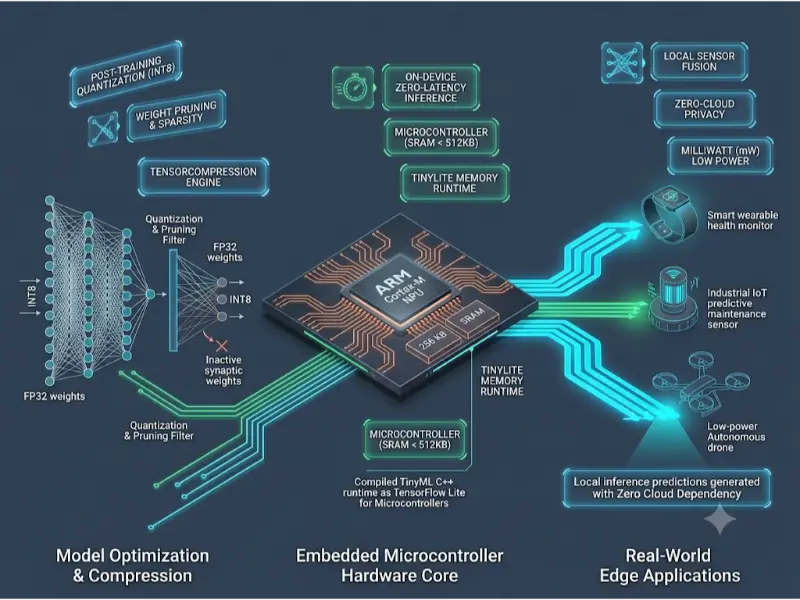
1. Model Compression Paradigms: Quantization, Pruning, & Distillation
To fit models into microcontrollers with kilobytes of RAM, engineers deploy three core optimization techniques:
- Quantization (FP32 → INT8): Maps continuous 32-bit floating-point weights $W_{\text{float}}$ to 8-bit integers $W_{\text{quant}}$ using a scale factor $S$ and zero-point offset $Z$:
$$W_{\text{quant}} = \text{round}\left( \frac{W_{\text{float}}}{S} \right) + Z$$
Quantization reduces model memory footprint by 75% and accelerates hardware arithmetic on microcontroller integer DSP cores. - Weight Pruning & Sparsity: Identifies and removes low-magnitude weight connections whose values are close to zero, converting dense weight matrices into sparse representations that require fewer multiply-accumulate (MAC) operations.
- Knowledge Distillation: Trains a compact “student” neural network to mimic the probability distribution outputs of a massive, pre-trained “teacher” network, compressing model capacity while preserving accuracy.
2. Embedded Hardware Accelerators & Runtimes
Executing neural networks on embedded systems relies on specialized hardware targets and bare-metal software runtimes:
Hardware Architectures: Range from general-purpose 32-bit ARM Cortex-M microcontrollers (MCU) to dedicated low-power Neural Processing Units (NPUs) like the Google Coral Edge TPU or STMicroelectronics STM32N6, which feature dedicated integer MAC matrix execution engines.
Software Runtimes: Runtimes like TensorFlow Lite for Microcontrollers (TFLM) and MicroTVM eliminate dynamic memory allocation (`malloc`), operating systems, and external C++ dependencies, compiling neural network graphs directly into static C arrays linked to the microcontroller firmware binary.
3. Python Implementation: Post-Training INT8 Quantization with PyTorch
import torch

import torch.nn as nn


# 1. Define a simple Convolutional Model for Edge Keyword Spotting

class EdgeAudioModel(nn.Module):

    def __init__(self):

        super().__init__()

        self.conv = nn.Conv2d(1, 16, kernel_size=3, stride=1, padding=1)

        self.relu = nn.ReLU()

        self.fc = nn.Linear(16 * 16 * 16, 4)


    def forward(self, x):

        x = self.relu(self.conv(x))

        x = x.view(x.size(0), -1)

        return self.fc(x)


# Initialize model and set to evaluation mode

float_model = EdgeAudioModel()

float_model.eval()


# 2. Configure Dynamic INT8 Quantization

quantized_model = torch.ao.quantization.quantize_dynamic(

    float_model,

    {nn.Linear}, # Target linear layers for integer quantization

    dtype=torch.qint8

)


# 3. Compare Size Memory Footprint

def print_model_size(model, name):

    torch.save(model.state_dict(), "temp.p")

    size_kb = torch.os.path.getsize("temp.p") / 1024

    print(f"{name} Memory Size: {size_kb:.2f} KB")

    torch.os.remove("temp.p")


print_model_size(float_model, "FP32 Baseline Model")

print_model_size(quantized_model, "Quantized INT8 TinyML Model")
Interactive Quick Review: Post-Training Quantization vs. Quantization-Aware Training
When should an engineer choose Quantization-Aware Training (QAT) over Post-Training Quantization (PTQ)?
Toggle Answer
Answer: Post-Training Quantization (PTQ) quantizes trained FP32 weights directly to INT8 without retraining, making it fast and easy. However, for ultra-small models or sensitive architectures (like MobileNets), PTQ can cause severe accuracy drops. Quantization-Aware Training (QAT) models quantization noise during fine-tuning backpropagation, allowing the neural network weights to adjust to INT8 precision and preserve high task accuracy.
Taxonomy & Embedded Hardware Matrix
| Hardware Class | Representative Target | SRAM Memory | Power Budget | Primary Use Cases |
|---|---|---|---|---|
| Microcontroller (TinyML) | ARM Cortex-M4 / ESP32 | 64 KB – 512 KB | < 50 mW | Keyword spotting, anomaly detection, gesture recognition |
| Embedded NPU Coprocessor | Google Coral / STM32N6 | 2 MB – 16 MB | 0.5 W – 2 W | Real-time object detection, face verification, audio classification |
| Edge Single-Board Computer | NVIDIA Jetson Orin Nano | 4 GB – 8 GB (Shared) | 5 W – 15 W | Autonomous mobile robots (AMR), multi-camera video analytics |
| Mobile SoC | Apple Neural Engine / Snapdragon NPU | System Memory | 2 W – 5 W | On-device language translation, computational photography |
Applications, Trade-offs, & Future Outlook
Real-World Applications
- Industrial Predictive Maintenance: Battery-powered vibration sensors running TinyML autoencoder models to detect bearing failures on remote pipelines in real time.
- Wearable Health & Biomedical Monitoring: Smartwatches running on-device ECG arrhythmia detection models, triggering immediate medical alerts without cloud latency.
- Precision Agriculture & Wildlife Tracking: Low-power camera traps using vision micro-NPUs to classify invasive species in off-grid environments for months on solar power.
Engineering Trade-offs
The core challenge in Edge AI is the Memory vs. Accuracy vs. Power Trilemma. Aggressive INT4/INT8 quantization and structural pruning dramatically reduce SRAM consumption and milliwatt draw, but risk dropping predictive accuracy on rare edge cases. Developers must carefully balance bit-precision against task safety thresholds.
Future Outlook & Emerging Research
Research is rapidly advancing toward Sub-Byte Quantization (INT2 / Binary Neural Networks) and Neuromorphic Event-Based Computing (spiking neural networks that consume zero power until triggered by hardware events). Concurrently, On-Device Federated Learning is enabling edge devices to update local model weights collaboratively without centralizing raw user data.
Frequently Asked Questions
What is TinyML?
TinyML is a subfield of Edge AI focused on running machine learning models on ultra-low-power microcontrollers consuming less than 1 milliwatt of power, enabling always-on intelligence on small coin-cell batteries.
Why is static memory allocation mandatory in TinyML runtimes?
Microcontrollers lack full operating systems and dynamic memory managers (`malloc`). Dynamic allocation causes memory fragmentation and runtime heap crashes. TinyML runtimes allocate a single static C-array tensor arena at compile time.
What are Multiply-Accumulate (MAC) Operations?
A MAC operation computes $a \leftarrow a + (b \times c)$. MACs form the foundational mathematical building block of matrix multiplication in neural network layers. Edge NPUs are benchmarked by their MAC efficiency per milliwatt (MACs/mW).
How does On-Device Keyword Spotting preserve battery life?
Keyword spotting uses a tiny 20 KB neural model running continuously on a low-power digital signal processor (DSP). It keeps the main application processor asleep until a wake-word (e.g., “Hey Siri”) is recognized, saving energy.
End-of-Page Exercises & Assessment
Part 1: Review Questions
Q1: Define Edge AI and explain how it differs from Cloud Machine Learning.
Answer: Edge AI executes model inference directly on local hardware devices (microcontrollers, sensors, smartphones) near the data source. Cloud ML sends raw data over networks to centralized server clusters for processing.
Q2: State the primary objective of Post-Training Quantization (PTQ).
Answer: PTQ converts trained 32-bit floating-point weights (FP32) to 8-bit integers (INT8) to reduce model memory footprint by 75% and accelerate integer arithmetic on low-power hardware without retraining.
Q3: What is the function of a Tensor Arena in TensorFlow Lite for Microcontrollers?
Answer: A Tensor Arena is a statically allocated memory buffer in SRAM used by the runtime interpreter to store model input, output, and intermediate layer activation tensors without dynamic heap allocation.
Q4: How does Weight Pruning create model sparsity?
Answer: Weight pruning zeroes out synaptic weights below a predefined magnitude threshold. This removes redundant parameters and allows sparse linear algebra kernels to skip zero-value multiplications.
Q5: Why are integer arithmetic operations preferred over floating-point operations on microcontrollers?
Answer: Integer operations require significantly fewer logic gates, execute in fewer clock cycles, and consume up to 10× less power than Floating Point Units (FPUs) on embedded processors.
Part 2: Thought-Provoking Questions
Q1: Memory Overflow Crashes on Microcontroller Firmware Deployment
Scenario: An embedded engineer attempts to deploy a 450 KB INT8 quantized image classification model onto an ARM Cortex-M4 board with 256 KB of SRAM. The compiler builds the binary successfully, but the device crashes during boot initialization.
Analysis: While model weights can reside in read-only Flash memory (which may have 1 MB capacity), intermediate activation tensors must fit inside volatile SRAM during the forward pass. The total SRAM requirement equals the statically allocated Tensor Arena plus stack/heap memory. The solution is applying Structured Channel Pruning or reducing input image resolution to shrink activation tensor shapes to fit within 256 KB SRAM.
Q2: Accuracy Degradation Following Post-Training Quantization
Scenario: A speech recognition model achieves 96% word accuracy in FP32. After converting the model to INT8 via Post-Training Quantization (PTQ), test accuracy drops to 62%, rendering the system unusable.
Analysis: Severe accuracy loss occurs when layer weight distributions contain wide dynamic ranges or extreme outliers, causing clipping or rounding errors during linear INT8 mapping. The solution is adopting Quantization-Aware Training (QAT), which simulates INT8 quantization noise during backpropagation, allowing neural weights to adapt to low-precision representation and restore accuracy to >94%.
Part 3: Numerical Engineering Problems
Problem 1: Model Weight Memory Compression Calculation
Question: An uncompressed deep neural network contains P = 2,000,000 (2M) parameters stored in FP32 format (4 bytes per parameter).
1. Calculate the raw uncompressed model size in Megabytes (MB).
2. Calculate the compressed model size in Megabytes (MB) if the model is quantized to INT8 precision (1 byte per parameter).
3. Compute the memory savings percentage.
Step-by-step Solution:
1. FP32 Model Size Calculation:
• Size (FP32) = 2,000,000 × 4 Bytes = 8,000,000 Bytes.
• Convert to MB (1 MB = 1,000,000 Bytes): 8,000,000 / 1,000,000 = 8.0 MB.
2. INT8 Quantized Model Size Calculation:
• Size (INT8) = 2,000,000 × 1 Byte = 2,000,000 Bytes = 2.0 MB.
3. Compute Memory Savings Percentage:
• Savings = (8.0 MB – 2.0 MB) / 8.0 MB = 6.0 / 8.0 = 75% reduction.
Final Answer: Uncompressed FP32 size is 8.0 MB; INT8 quantized size is 2.0 MB, delivering a 75% memory footprint reduction.
Problem 2: Microcontroller Battery Operating Lifetime Calculation
Question: A remote agricultural sensor runs on a 3.7V, 1000 mAh Li-ion battery (3700 mWh energy capacity).
• Continuous sensor sampling and Edge AI inference draws average power P = 10 mW.
Calculate total continuous operating lifetime in hours and days (assuming 100% battery efficiency).
Step-by-step Solution:
1. Lifetime in Hours Calculation:
• Operating Hours = Total Capacity (mWh) / Power Draw (mW)
• Operating Hours = 3700 mWh / 10 mW = 370 hours.
2. Convert Hours to Days:
• Days = 370 hours / 24 hours/day ≈ 15.42 days.
Final Answer: The continuous operating lifetime of the Edge AI sensor node is 370 hours (approximately 15.42 days).
AI Infrastructure & Governance Sub-Cluster
-
MLOps & AI Infrastructure
Explore automated CI/CD pipelines, containerized serving, model registries, and drift detection. -
AI Safety, Ethics & Governance
Master fairness metrics, bias mitigation algorithms, hallucination reduction, and regulatory compliance frameworks. -
Artificial Intelligence Hub
Return to the main Artificial Intelligence overview covering machine learning paradigms, deep learning, and intelligent systems.
External Academic & Technical References
- TinyML Foundation Official Research & Technical Portal – Industry association advancing ultra-low-power machine learning technologies.
- MobileNets: Efficient Convolutional Neural Networks for Mobile Vision Applications (Howard et al., 2017) – Seminal paper introducing depthwise separable convolutions for edge vision.
- TensorFlow Lite for Microcontrollers (TFLM) Official Documentation – Open-source C++ framework for running machine learning on microcontrollers.