
Overview
This topic introduces the fundamental language of physics — the ability to describe, quantify, and measure physical phenomena. These foundational ideas underpin all topics in physics and engineering.
Contents
- Physical Quantities and SI Units
- Prefixes for Multiples and Submultiples
- Derived Units and Dimensional Homogeneity
- Errors and Uncertainties
- Scalars and Vectors
Learning Outcomes
By the end of this topic, you should be able to:- Recall and use SI base quantities and units
- Convert units using SI prefixes
- Use dimensional analysis to check equations
- Identify types of measurement errors and estimate uncertainties
- Distinguish between scalar and vector quantities
- Add vectors using graphical and component methods
1. Physical Quantities and SI Units
A physical quantity is anything that can be measured—length, time, mass, temperature, etc. Every quantity is expressed as a number and a unit. For example, 5.2 m means a length whose numerical value is 5.2 and whose unit is the metre (m).
SI Base Quantities and Units
The International System of Units (SI) defines seven base quantities. All other measurable quantities (called derived quantities) are built from these.
| Quantity | Unit name | Symbol |
|---|---|---|
| Length | metre | m |
| Mass | kilogram | kg |
| Time | second | s |
| Electric current | ampere | A |
| Thermodynamic temperature | kelvin | K |
| Amount of substance | mole | mol |
| Luminous intensity | candela | cd |
- Numerical value: 2.10
- Unit: metre (m)
Tip: Write numbers and units with a space and use unit exponents, e.g. 3.0 m × s-2 for acceleration and 25 °C for temperature.
2. Prefixes for Multiples and Submultiples
SI prefixes make it easier to express very large or very small numbers. Instead of writing out many zeros, these prefixes scale base units for clarity and simplicity.
| Prefix | Symbol | Factor |
|---|---|---|
| kilo | k | 103 (1,000) |
| mega | M | 106 |
| giga | G | 109 |
| milli | m | 10-3 |
| micro | µ | 10-6 |
| nano | n | 10-9 |
- 1200 mm = ? m → Answer: 1.2 m
- 2.5 µs = ? s → Answer: 2.5 × 10⁻⁶ s
3. Derived Units and Dimensional Homogeneity
Derived units are combinations of SI base units used to express physical quantities that are not fundamental. They let us relate measurable quantities in a consistent, comparable way.
Examples of common derived units- Speed: speed = distance / time ⇒ m × s-1
- Acceleration: acceleration = Δspeed / time ⇒ m × s-2
- Force (Newton’s second law): F = m × a ⇒ kg × m × s-2 = N
- Energy (work): E = F × d ⇒ N × m = kg × m2 × s-2 = J
- Pressure: p = F / A ⇒ N / m2 = kg × m-1 × s-2 = Pa
Dimensional homogeneity means every term in a physical equation must have the same dimensions (e.g., all terms are lengths, or all are energies). Using the base dimensions [M] (mass), [L] (length), [T] (time), an equation is meaningful only if each term has identical [MaLbTc].
Example (kinematics): Consider the equation of motion:- u is initial velocity, units m × s-1 → dimensions [LT-1].
- a is acceleration, units m × s-2 → dimensions [LT-2].
- t is time, units s → dimensions [T].
- s is displacement, units m → dimensions [L].
Check each term: [u × t] = [LT-1][T] = [L], and [0.5 × a × t2] = [LT-2][T2] = [L]. Both terms on the right are lengths, matching s. The equation is dimensionally consistent.
Learn how to instantly spot invalid physics equations using the principle of dimensional homogeneity! In this short tutorial, you’ll learn:
- What dimensional homogeneity means and why it’s a must-have check
- Step-by-step how to compare units on both sides of any equation
- Common pitfalls to watch out for when you’re solving problems
- Real-world examples that demonstrate why mismatched dimensions always signal an error
4. Errors and Uncertainties
Every measurement carries uncertainty—from instrument limits to human reading. Quantifying and propagating that uncertainty lets you report results honestly and compare them reliably.
4.1 Types of Errors
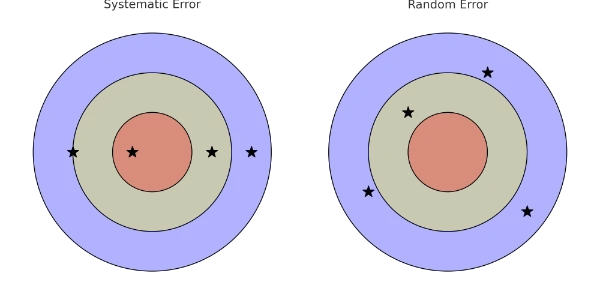
- Random errors: unpredictable scatter from reading to reading (e.g., display flicker, hand reaction time). They broaden the spread around the true value.
- Systematic errors: consistent bias that shifts all readings the same way (e.g., a scale with a non-zero offset). They move the average away from the true value.
4.2 Expressing Uncertainty
- Report as value ± absolute uncertainty, with matching decimal places, e.g. L = 25.4 ± 0.2 cm.
- Percent uncertainty: %Δ = (Δx / x) × 100%.
4.3 Propagation of Uncertainty (quick rules)
- Add/Subtract y = a ± b ± c: add absolute uncertainties Δy = Δa + Δb + Δc.
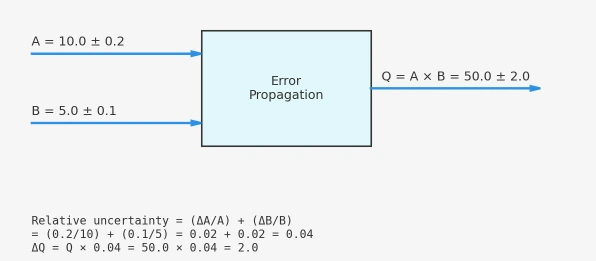
- Multiply/Divide y = (a × b) / c: add fractional (percentage) uncertainties Δy / y = (Δa / a) + (Δb / b) + (Δc / c).
- Powers y = an: Δy / y = |n| × (Δa / a).
4.4 Worked Example
- Measured time t = 2.00 ± 0.05 s, distance s = 10.0 ± 0.2 m.
- Speed v = s / t.
Fractional uncertainties:
Combine (product/quotient rule):
Best value: v = 10.0 / 2.00 = 5.00 m × s-1.
Absolute uncertainty: Δv = 0.045 × 5.00 ≈ 0.23 m × s-1.
Report: v = 5.00 ± 0.23 m × s-1 (value rounded to the same decimal place as the uncertainty).5. Scalars and Vectors
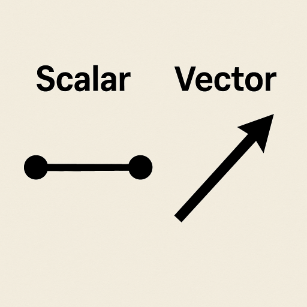
- Scalar: magnitude only (e.g., speed, time, energy, temperature).
- Vector: magnitude and direction (e.g., velocity, force, displacement, momentum).
Vector Representation
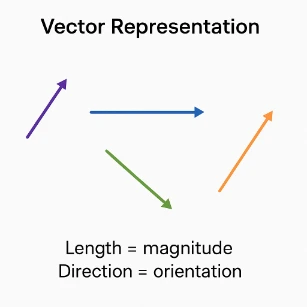
- Draw an arrow: length = magnitude, orientation = direction.
- Notation: bold v or italic v with an arrow in diagrams.
- In 2D Cartesian components: v = (vx, vy) or v = vxi + vyj.
- Magnitude (length): |v| = √(vx2 + vy2).
- Direction angle from the +x axis: θ = arctan(vy / vx).
Vector Addition Methods
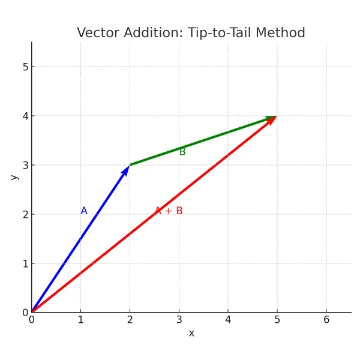
- Tip-to-tail method: place the tail of the second vector at the tip of the first; the resultant R runs from the free tail to the free tip.
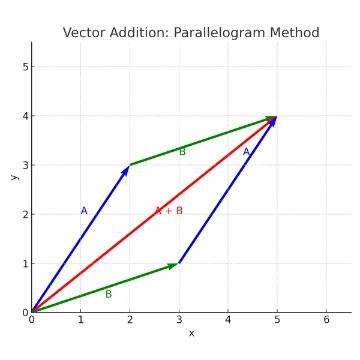
- Parallelogram method: draw both vectors from a common origin and complete the parallelogram; the diagonal is R.
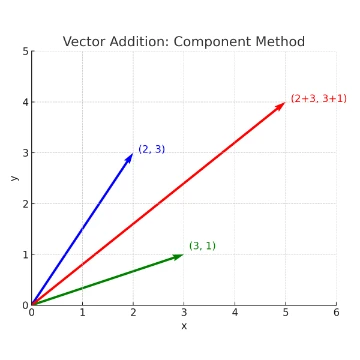
- Component method (most useful for calculation): resolve into x and y components and add them separately:R = A + B ⇒ Rx = Ax + Bx , Ry = Ay + By |R| = √(Rx2 + Ry2) , θR = arctan(Ry / Rx)
Worked Example: Resultant Displacement
A plane flies 100 km east, then 80 km north.
- Components: R = (100, 80) km.
- Magnitude: |R| = √(1002 + 802) = √(16400) ≈ 128.1 km.
- Direction: θ = arctan(80 / 100) ≈ 38.7° north of east.
- Horizontal: Fx = F × cos(30°) = 50 × cos(30°) ≈ 43.3 N.
- Vertical: Fy = F × sin(30°) = 50 × sin(30°) = 25.0 N.
| Concept | Definition / Formula |
|---|---|
| Physical Quantity | A measurable property expressed as value + unit (e.g., 5.2 m, 3.0 s). |
| SI Base Units | Length (m), Mass (kg), Time (s), Electric current (A), Temperature (K), Amount of substance (mol), Luminous intensity (cd) |
| SI Prefixes | kilo (k, 103), mega (M, 106), giga (G, 109), milli (m, 10-3), micro (µ, 10-6), nano (n, 10-9) |
| Derived Units & Dimensional Homogeneity | Combine base units, e.g., force: N = kg × m × s-2. Equations must be dimensionally consistent (each term with the same dimensions). |
| Measurement Uncertainty | Report as value ± uncertainty (e.g., 25.4 ± 0.2 cm). For + / -: add absolute uncertainties; for × / ÷: add percentage uncertainties. |
| Random vs Systematic Errors | Random: unpredictable scatter about a mean. Systematic: consistent bias (e.g., zero offset). |
| Scalars & Vectors | Scalar: magnitude only (e.g., time, energy). Vector: magnitude and direction (e.g., displacement, velocity). Magnitude example: |v| = √(vx2 + vy2). |
| Vector Addition | Graphical: tip-to-tail or parallelogram. Component form (2D): R = A + B ⇒ Rx = Ax + Bx, Ry = Ay + By, |R| = √(Rx2 + Ry2). |
Interactive 2D Vector Addition Simulator
Adjust the magnitudes and directional angles of Vectors A and B below to instantly compute the resultant vector R = A + B using the component method.
|R| = √(Rx2 + Ry2) | θR = arctan(Ry / Rx)
Interactive Review Questions
Click to Reveal: Why are SI base units defined independently rather than through mathematical combinations?
Click to Reveal: How does increasing sample size affect random errors versus systematic errors?
Frequently Asked Questions
What is the practical difference between precision and accuracy in measurements?
Accuracy refers to how close a measured value is to the true or accepted value, limited primarily by systematic errors. Precision refers to the repeatability and agreement among multiple independent measurements, limited primarily by random errors.
Why do we add percentage uncertainties when multiplying or dividing quantities?
When quantities are multiplied or divided, their relative variations compound. Using logarithmic differentiation shows that the relative (percentage) uncertainty of the result equals the sum of the relative uncertainties of each component factor.
Can a dimensionally consistent equation still be physically incorrect?
Yes. Dimensional homogeneity is a necessary condition for correctness, but not a sufficient one. Mismatched dimensionless constants (such as omitting 1/2 in kinetic energy) or missing physical variables leave an equation dimensionally correct yet quantitatively wrong.
Additional Resources
To deepen your understanding, you are strongly encouraged to explore the materials provided on the following pages:
- Classical Mechanics — Overview of foundational concepts in mechanical systems.
- Dynamics and Kinematics — Deep dive into vector representations of velocity and acceleration.
- Newton’s First Law of Motion — Examining force equilibrium and inertial reference frames.
- Newton’s Second Law of Motion — Connecting vector forces to component acceleration.
- Newton’s Third Law of Motion — Analyzing interaction force pairs.
- Fundamental Forces of Nature — Exploring core field interactions in modern physics.
- Kinematics — Motion equations and graphical trajectory analysis.
- Statics — Rigid body balance, moments, and zero net force conditions.
- Solid Mechanics — Engineering applications of stress, strain, and material forces.
End-of-Page Comprehensive Practice Module
Section 1: Foundational Core Concepts
- What are the seven SI base quantities? Answer: Length, mass, time, electric current, thermodynamic temperature, amount of substance, luminous intensity. (All other physical quantities are derived from these.)
- State the SI base unit for electric current. Answer: Ampere (A). 1 A corresponds to a specific electromagnetic definition based on the elementary charge.
- Which SI unit is used to measure temperature? Answer: Kelvin (K). Kelvin is absolute temperature measured from absolute zero.
- Which physical quantity is measured in kilograms (kg)? Answer: Mass. Mass quantifies the amount of matter/inertia.
- What is the SI unit for time? Answer: Second (s). Defined via the cesium-133 atomic transition.
- What is the prefix for 106? Answer: Mega (M): 1 Mm = 106 m.
- Convert 5 mm to metres. Answer: 5 mm = 5 × 10⁻³ m = 0.005 m. (Because 1 mm = 10-3 m.)
- What does the prefix “nano” represent? Answer: 10-9. Example: 1 ns = 10-9 s.
- Express 0.000001 s using a prefix. Answer: 1 µs (microsecond), since 1 µs = 10-6 s.
- How many metres are there in 2.5 km? Answer: 2.5 km = 2.5 × 10³ m = 2500 m.
Section 2: Analytical & Scenario-Based Problems
- What is the SI unit for force, and how is it expressed in base units? Answer: Newton (N), where 1 N = 1 kg × m × s-2.
- Show that the unit of force (N) is a derived unit using Newton’s Second Law. Answer: From F = m × a: [F] = [kg] × [m × s-2] = kg × m × s-2 = N.
- Write the base dimensions of kinetic energy. Answer: KE = 0.5 × m × v2 ⇒ [KE] = M × (L × T-1)2 = M × L2 × T-2.
- Check if the equation s = u × t + 0.5 × a × t2 is dimensionally consistent. Answer: [s] = L, [u × t] = (L × T-1) × T = L, [a × t2] = (L × T-2) × T2 = L. All terms are length ⇒ consistent.
- What is meant by dimensional homogeneity? Answer: Every term in a physical equation has the same dimensions, ensuring physical and algebraic consistency.
- Name two types of systematic errors. Answer: Zero error and calibration error. Both shift all readings in one consistent direction.
- What is the primary difference between random error and systematic error? Answer: Random errors cause unpredictable scatter (reduced by taking repeated averages). Systematic errors are consistent biases (requiring recalibration or mathematical correction).
- Define scalar quantity versus vector quantity and provide an example of each. Answer: A scalar has magnitude only (e.g., temperature, mass, energy). A vector has magnitude and direction (e.g., velocity, displacement, force).
Section 3: Numerical Problems with Step-by-Step Solutions
- A length is measured as 15.2 ± 0.1 cm. Calculate the percentage uncertainty. Solution: Percentage Uncertainty = (ΔL / L) × 100% Percentage Uncertainty = (0.1 / 15.2) × 100% = 0.66%
- If two quantities A = 5.0 ± 0.2 cm and B = 3.0 ± 0.1 cm are added, calculate the absolute uncertainty in A + B. Solution: For addition, add absolute uncertainties: ΔY = ΔA + ΔB ΔY = 0.2 + 0.1 = ±0.3 cm Total Value = 5.0 + 3.0 = 8.0 ± 0.3 cm
- A displacement of 4.0 m east is added to 3.0 m north. Calculate the resultant magnitude and direction angle. Solution: 1. Resultant Magnitude: R = √(4.02 + 3.02) = √(16 + 9) = √(25) = 5.0 m 2. Direction Angle: θ = arctan(3.0 / 4.0) = arctan(0.75) = 36.9° north of east
- A force F = 50.0 N acts at an angle of 30.0° above the horizontal. Calculate its horizontal and vertical components. Solution: 1. Horizontal Component: Fx = F × cos(30.0°) = 50.0 × 0.8660 = 43.3 N 2. Vertical Component: Fy = F × sin(30.0°) = 50.0 × 0.5000 = 25.0 N
- A rectangular plate has measured length L = 10.0 ± 0.2 cm and width W = 5.0 ± 0.1 cm. Calculate the area and its absolute uncertainty. Solution: 1. Nominal Area: A = L × W = 10.0 × 5.0 = 50.0 cm2 2. Percentage uncertainties: ΔL / L = 0.2 / 10.0 = 2.0%, ΔW / W = 0.1 / 5.0 = 2.0% 3. Total Percentage Uncertainty: 2.0% + 2.0% = 4.0% 4. Absolute Uncertainty: ΔA = 0.04 × 50.0 = 2.0 cm2 Reported Area: 50.0 ± 2.0 cm2
- Convert a power value of 2.5 MW to kW and Watts. Solution: 1. To Watts: 2.5 MW = 2.5 × 10⁶ W = 2,500,000 W 2. To kW: 2,500,000 W / 103 = 2,500 kW
- Vector P has components Px = 6.0 N, Py = 8.0 N. Vector Q has components Qx = -2.0 N, Qy = 4.0 N. Calculate the magnitude of resultant R = P + Q. Solution: 1. Sum x-components: Rx = Px + Qx = 6.0 + (-2.0) = 4.0 N 2. Sum y-components: Ry = Py + Qy = 8.0 + 4.0 = 12.0 N 3. Resultant Magnitude: |R| = √(4.02 + 12.02) = √(16 + 144) = √(160) = 12.65 N
- A sphere’s radius is measured as r = 2.00 ± 0.02 m. Calculate the percentage uncertainty in its volume V = (4/3) × π × r3. Solution: 1. Radius percentage uncertainty: (Δr / r) × 100% = (0.02 / 2.00) × 100% = 1.0% 2. Power rule for r3: Percentage uncertainty in volume = 3 × 1.0% = 3.0%