
What Frequency Mixing Really Means
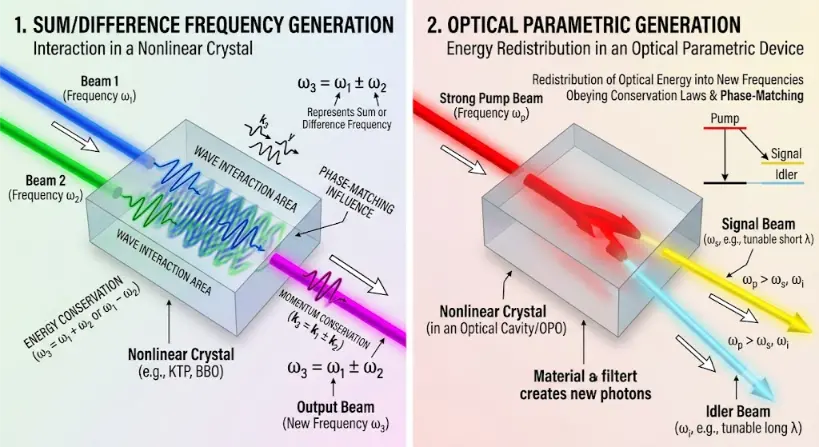
The image is a comprehensive, two-panel educational infographic explaining nonlinear optical processes:
Panel 1 (Left) — Sum/Difference Frequency Generation: Two distinct laser beams—one blue (Beam 1) and one green (Beam 2)—enter a transparent, rectangular nonlinear crystal labeled as KTP or BBO. Inside, their waveforms are shown overlapping and interacting in a designated "Wave Interaction Area". Emerging from the crystal is a new magenta output beam representing a different combined frequency (the sum or difference of the inputs). Diagrams and text annotations emphasize energy conservation and momentum conservation dictated by phase-matching conditions.
Panel 2 (Right) — Optical Parametric Generation: A single, intense red "Strong Pump Beam" enters a second nonlinear crystal housed within an optical cavity device. Inside the crystal, the red beam splits into two paths, transforming into a yellow "Signal Beam" (with a tunable short wavelength) and a light blue "Idler Beam" (with a tunable long wavelength). A small energy-level diagram on the top right shows the pump photon splitting into signal and idler photons. Annotations highlight that the pump frequency is greater than both the signal and idler frequencies, and explicitly state that the material is actively creating new photons to redistribute optical energy rather than acting as a simple filter.
The Evolutionary Path: History, Quantum Restrictions, and Phase Engineering
The Historical Journey
Contemporary Scientific Challenges
Future Paradigms: PPLN Chips and Squeezed Quantum States
- Periodically Poled Lithium Niobate (PPLN) Thin-Film Chips: Submicron integrated PPLN waveguides focus light within ultra-small cross-sections over several centimeters. This geometric confinement amplifies the effective $\chi^{(2)}$ field strength, enabling high-efficiency frequency synthesis using milliwatt-level continuous pumping fields.
- Squeezed-Light Generation via Down-Conversion: In quantum networks, optical parametric amplifiers operate below threshold to induce spontaneous parametric down-conversion. This converts individual pump photons into correlated photon pairs with correlated noise metrics below standard quantum limitations, providing the entangled channels required for secure quantum cryptography.
Nonlinear Polarisation and New Frequencies
| Nonlinear Term | What It Can Produce | Example Processes |
|---|---|---|
| \(\chi^{(2)}E^2\) | Second-order mixing | Second-harmonic generation, sum-frequency generation, difference-frequency generation, optical parametric processes |
| \(\chi^{(3)}E^3\) | Third-order mixing | Third-harmonic generation, four-wave mixing, self-phase modulation, Kerr effects |
Why Products of Waves Create New Frequencies
Sum-Frequency Generation
| Input | Output | Meaning |
|---|---|---|
| \(\omega_1\) | \(\omega_3 = \omega_1 + \omega_2\) | Two lower-frequency waves generate one higher-frequency wave |
| \(\omega_2\) |
Difference-Frequency Generation
| Process | Frequency Relationship | Typical Use |
|---|---|---|
| Sum-frequency generation | \(\omega_3 = \omega_1 + \omega_2\) | Generating higher-frequency light |
| Difference-frequency generation | \(\omega_3 = |\omega_1 – \omega_2|\) | Generating lower-frequency or infrared light |
| Second-harmonic generation | \(\omega_3 = 2\omega\) | Frequency doubling |
Optical Parametric Processes
| Wave | Role | Simple Meaning |
|---|---|---|
| Pump | Strong input wave | Provides energy for the process |
| Signal | One generated or amplified wave | Often the desired tunable output |
| Idler | The companion generated wave | Completes energy and momentum conservation |
Optical Parametric Generation
Optical Parametric Amplification
| Process | What Enters | What Comes Out |
|---|---|---|
| OPG | Strong pump only, with noise or weak spontaneous start | Signal and idler |
| OPA | Strong pump plus weak signal seed | Amplified signal plus idler |
| OPO | Pump inside resonator-supported nonlinear system | Oscillating signal and/or idler output |
Optical Parametric Oscillation
Energy Conservation in Frequency Mixing
| Process | Energy Relationship | Photon Picture |
|---|---|---|
| Second-harmonic generation | \(\omega + \omega = 2\omega\) | Two equal photons combine into one higher-energy photon |
| Sum-frequency generation | \(\omega_1 + \omega_2 = \omega_3\) | Two photons combine into one higher-energy photon |
| Difference-frequency generation | \(\omega_1 = \omega_2 + \omega_3\) | One higher-frequency photon supports generation of two lower-frequency components |
| Optical parametric process | \(\omega_p = \omega_s + \omega_i\) | One pump photon is converted into signal and idler photons |
Momentum Conservation and Phase Matching
| Condition | Meaning | Result |
|---|---|---|
| Good phase matching | Generated waves remain in step | Strong conversion or amplification |
| Poor phase matching | Generated waves slip out of phase | Weak output or cancellation |
| Tunable phase matching | Crystal angle, temperature, poling, or waveguide design is adjusted | Different output wavelengths become possible |
Phase Mismatch and Coherence Length
Birefringent and Quasi-Phase Matching
| Method | How It Works | Where It Helps |
|---|---|---|
| Birefringent phase matching | Uses crystal direction and polarisation to balance refractive indices | Bulk nonlinear crystals |
| Temperature tuning | Changes refractive indices by adjusting temperature | Fine control of output wavelength |
| Angle tuning | Changes propagation direction through the crystal | Tunable frequency conversion |
| Quasi-phase matching | Periodically reverses nonlinear domains | Periodically poled crystals and waveguides |
| Waveguide phase matching | Uses guided-mode design to control effective indices | Integrated photonics |
Pump, Signal, and Idler
Three-Wave Mixing Versus Four-Wave Mixing
| Type | Nonlinear Order | Typical Frequency Relationship | Examples |
|---|---|---|---|
| Three-wave mixing | \(\chi^{(2)}\) | Three interacting waves | SHG, SFG, DFG, OPA, OPO |
| Four-wave mixing | \(\chi^{(3)}\) | Four interacting waves | Parametric mixing in fibres, frequency combs, wavelength conversion |
Why Optical Parametric Devices Are Tunable
Nonlinear Materials for Frequency Mixing
| Material or Platform | Why It Is Useful | Example Use |
|---|---|---|
| BBO | Wide transparency and strong nonlinear performance | Ultrafast frequency conversion and tunable systems |
| LBO | Good damage resistance and useful phase matching | High-power laser frequency conversion |
| KTP | Useful nonlinear coefficient and practical laser conversion | Visible laser generation and OPO systems |
| Lithium niobate | Strong nonlinear response and electro-optic properties | Frequency conversion, modulators, and photonic devices |
| Periodically poled lithium niobate | Supports quasi-phase matching | Tunable frequency conversion and integrated nonlinear optics |
| Nonlinear waveguides | Confine light tightly for stronger interaction | On-chip wavelength conversion |
Frequency Mixing in Ultrafast Optics
Frequency Mixing in Infrared Generation
Frequency Mixing in Quantum Optics
Frequency Mixing in Integrated Photonics
Frequency Mixing Is Not Ordinary Colour Mixing
| Type of Mixing | What Happens | Example |
|---|---|---|
| Display colour mixing | Different light intensities stimulate the eye | RGB pixels produce perceived yellow |
| Pigment mixing | Materials absorb and reflect wavelengths | Paints produce surface colours |
| Nonlinear frequency mixing | New frequencies are generated in a material | \(\omega_1 + \omega_2\) produces \(\omega_3\) |
Practical Challenges
| Challenge | Why It Matters |
|---|---|
| Weak nonlinear coefficient | Produces low conversion efficiency |
| Phase mismatch | Generated waves cancel instead of building up |
| Absorption | Reduces useful output and can heat the material |
| Group-velocity mismatch | Short pulses may walk away from one another in time |
| Optical damage | High intensity can damage crystals or waveguides |
| Thermal drift | Temperature changes can disturb phase matching |
| Alignment sensitivity | Small changes in angle or focusing can reduce performance |
Applications of Frequency Mixing and Optical Parametric Processes
Tunable Laser Sources
Optical parametric oscillators and amplifiers can generate tunable light across broad wavelength ranges.
Infrared Spectroscopy
Difference-frequency generation and OPO systems can produce infrared light for molecular sensing and chemical analysis.
Ultrafast Science
Optical parametric amplifiers help generate short pulses at selected wavelengths for time-resolved experiments.
Quantum Optics
Parametric down-conversion can generate correlated photon pairs for quantum experiments and technologies.
Integrated Photonics
On-chip frequency conversion supports compact photonic devices, wavelength translation, and quantum light sources.
Laser Wavelength Conversion
Nonlinear crystals can shift laser output into visible, ultraviolet, or infrared regions.
Environmental Sensing
Tunable infrared sources can help detect gases and molecular signatures in environmental monitoring.
Biomedical and Materials Research
Frequency-converted light supports spectroscopy, microscopy, imaging, and analysis of biological and engineered materials.
Connections with Wider Physics and Technology
Nonlinear Optics
Frequency mixing is a central nonlinear optics topic because it shows how intense light can generate new frequencies in matter.
Second-Harmonic Generation
SHG is the simplest special case of sum-frequency generation, where two identical input frequencies produce 2ω.
Wave Optics
Phase, interference, coherence, dispersion, and wave-vector matching are essential for efficient frequency conversion.
Laser Optics
Lasers provide the intensity, coherence, and polarisation control needed for many frequency-mixing systems.
Photonics
Photonics uses frequency mixing for wavelength conversion, chip-scale devices, optical signal processing, and quantum light generation.
Quantum Optics
Parametric down-conversion connects nonlinear frequency mixing with photon pairs, quantum correlations, and quantum communication.
Electromagnetic Waves
Frequency mixing arises because the electric fields of electromagnetic waves drive nonlinear material polarisation.
Materials Engineering
Nonlinear crystals, periodically poled materials, and photonic waveguides must be engineered for transparency, symmetry, dispersion, and damage resistance.
Learning Pathway Within Nonlinear Optics
Second-Harmonic Generation
Learn how intense light in nonlinear materials can produce light at twice the original frequency and half the vacuum wavelength.
Frequency Mixing and Optical Parametric Processes
Current page. Understand how nonlinear optical media generate sum frequencies, difference frequencies, signal-idler pairs, tunable light, and amplified optical waves.
Self-Focusing and Optical Solitons
See how intense light can change a material’s refractive index, focus itself, and form stable optical solitons.
Nonlinear Optics in Lasers and Photonics
Discover how nonlinear optics supports ultrafast lasers, wavelength conversion, optical fibres, photonic devices, and advanced light-based technologies.
Quick Check: Frequency Mixing
Quick Check: New Frequencies from Nonlinear Light
Common Misunderstandings About Frequency Mixing
Misunderstanding 1: Frequency Mixing Is the Same as RGB Colour Mixing
Misunderstanding 2: Energy Conservation Alone Guarantees Efficient Conversion
Misunderstanding 3: The Idler Is Unimportant
Misunderstanding 4: Parametric Devices Are Ordinary Lasers
Misunderstanding 5: Any Nonlinear Crystal Works for Any Wavelength
Key Terms
- Difference-frequency generation
- A nonlinear process where two input frequencies generate an output at their difference.
- Four-wave mixing
- A \(\chi^{(3)}\) nonlinear process involving four interacting optical waves.
- Frequency mixing
- A nonlinear optical process in which interacting light waves generate new optical frequencies inside a material.
- Idler
- The companion output wave required by energy and momentum conservation.
- Optical parametric amplification
- A process in which a weak signal beam is amplified by energy transfer from a strong pump beam.
- Optical parametric generation
- A process in which a pump generates signal and idler waves, often starting from noise or weak seed fields.
- Optical parametric oscillator
- A resonator-based nonlinear device that generates tunable signal and/or idler waves from a pump.
- Optical parametric process
- A nonlinear process in which a pump wave transfers energy into signal and idler waves without ordinary material emission.
- Phase matching
- The condition that keeps interacting waves in the correct phase relationship for efficient nonlinear conversion.
- Pump
- The strong input wave that supplies energy for an optical parametric process.
- Quasi-phase matching
- A method that periodically reverses the nonlinear coefficient to sustain useful frequency conversion.
- Signal
- One of the output waves in an optical parametric process, often the desired or seeded wave.
- Sum-frequency generation
- A second-order nonlinear process where two input frequencies generate an output at their sum.
- Three-wave mixing
- A \(\chi^{(2)}\) nonlinear process involving three interacting optical waves.
Review Questions
- What is frequency mixing in nonlinear optics?Answer: Frequency mixing is a nonlinear optical process in which interacting light waves generate new optical frequencies inside a suitable material.
- What is sum-frequency generation?Answer: Sum-frequency generation occurs when two input waves generate a new output wave whose frequency is the sum of the two input frequencies.
- What is difference-frequency generation?Answer: Difference-frequency generation occurs when two input waves generate a new wave at the difference between their frequencies.
- What are pump, signal, and idler waves?Answer: The pump is the strong wave that supplies energy. The signal and idler are the two lower-frequency waves produced or amplified in an optical parametric process.
- What is the basic energy relationship in an optical parametric process?Answer: The basic relationship is ωp = ωs + ωi, where the pump frequency equals the sum of the signal and idler frequencies.
- Why is phase matching important?Answer: Phase matching ensures that generated waves from different parts of the nonlinear material add constructively rather than cancelling each other.
- How is an optical parametric oscillator different from an ordinary laser?Answer: An ordinary laser relies on stimulated emission from a gain medium, while an optical parametric oscillator relies on nonlinear frequency conversion driven by a pump wave.
- Why are optical parametric devices useful?Answer: They can generate tunable wavelengths that may be difficult to obtain directly from ordinary lasers, especially in infrared and ultrafast applications.
Thought-Provoking Questions
- Why does frequency mixing show that light and matter can cooperate creatively?Answer: The material does not merely transmit light. Its nonlinear polarisation mediates an interaction that creates new frequencies, showing that matter can reshape light when driven strongly enough.
- Why is tunability such an important feature of optical parametric devices?Answer: Tunability allows scientists to choose wavelengths suited to specific atoms, molecules, materials, tissues, or communication channels rather than being limited to fixed laser wavelengths.
- How does phase matching connect nonlinear optics with wave optics?Answer: Phase matching depends on wave number, phase velocity, dispersion, interference, and coherence, all of which are central ideas in wave optics.
- Why might integrated photonics make frequency mixing more widely useful?Answer: Integrated photonics can confine light strongly on chips, enabling compact devices for wavelength conversion, sensing, quantum light generation, and optical signal processing.
- Why is the idler wave philosophically interesting?Answer: The idler reminds us that a physical process may produce something not originally desired but still required by conservation laws. In physics, every transformation keeps an accounting of energy and momentum.
Comprehensive Numerical Problems with Solutions
- Two input waves have frequencies 2.0 × 10¹⁴ Hz and 3.0 × 10¹⁴ Hz. What is the sum frequency?Solution:Using the structural sum-frequency equation:$$f_3 = f_1 + f_2$$Substitute the given values:$$f_3 = (2.0 \times 10^{14}\text{ Hz}) + (3.0 \times 10^{14}\text{ Hz}) = 5.0 \times 10^{14}\text{ Hz}$$Answer: The sum frequency is exactly 5.0 × 10¹⁴ Hz.
- Two input waves have frequencies 4.5 × 10¹⁴ Hz and 3.2 × 10¹⁴ Hz. What is the difference frequency?Solution:Using the difference-frequency equation:$$f_3 = |f_1 – f_2|$$Substitute metrics into the evaluation:$$f_3 = |4.5 \times 10^{14}\text{ Hz} – 3.2 \times 10^{14}\text{ Hz}| = 1.3 \times 10^{14}\text{ Hz}$$Answer: The difference frequency is exactly 1.3 × 10¹⁴ Hz.
- A pump has a frequency of 6.0 × 10^{14 Hz. The signal has a frequency of 3.5 × 10^{14 Hz. What is the idler frequency?Solution:Using the frequency conservation equation for parametric conversion:$$f_p = f_s + f_i$$Isolate the idler variable:$$f_i = f_p – f_s$$$$f_i = (6.0 \times 10^{14}\text{ Hz}) – (3.5 \times 10^{14}\text{ Hz}) = 2.5 \times 10^{14}\text{ Hz}$$Answer: The idler frequency is exactly 2.5 × 10¹⁴ Hz.
- A pump wavelength is 800 nm, and the signal wavelength is 1200 nm. Estimate the idler wavelength in vacuum using frequency conservation rules.Solution:1. Write out the reciprocal wavelength formatting derived from $f = c / \lambda$:$$\frac{1}{\lambda_p} = \frac{1}{\lambda_s} + \frac{1}{\lambda_i}$$2. Rearrange to isolate the inverse idler value:$$\frac{1}{\lambda_i} = \frac{1}{\lambda_p} – \frac{1}{\lambda_s}$$$$\frac{1}{\lambda_i} = \frac{1}{800\text{ nm}} – \frac{1}{1200\text{ nm}}$$$$\frac{1}{\lambda_i} = 0.00125 – 0.0008333 = 0.0004167\text{ nm}^{-1}$$$$\lambda_i = \frac{1}{0.0004167\text{ nm}^{-1}} \approx 2400\text{ nm}$$Answer: The idler wavelength is approximately 2400 nm in vacuum.
- A system phase mismatch value is Δk = 1000 m−1. Estimate the coherence length using the wave-vector reciprocal formula.Solution:Using the coherence length formula:$$L_c = \frac{\pi}{|\Delta k|}$$Substitute values:$$L_c = \frac{3.14159}{1000\text{ m}^{-1}} \approx 0.0031416\text{ m} = 3.14\text{ mm}$$Answer: The structural coherence length limits to approximately 3.14 mm.
- An optical parametric amplifier increases a signal tracking from 5 mW up to 250 mW. What is the net gain factor?Solution:Calculate the quotient of output power over seed power:$$\text{Gain Factor} = \frac{P_{\mathrm{out}}}{P_{\mathrm{in}}}$$$$\text{Gain Factor} = \frac{250\text{ mW}}{5\text{ mW}} = 50$$Answer: The signal is amplified by a net factor of exactly 50.
- A nonlinear process produces a signal at 1500 nm and an idler at 3000 nm. What pump wavelength is required in vacuum?Solution:Using the inverse wavelength conservation layout:$$\frac{1}{\lambda_p} = \frac{1}{\lambda_s} + \frac{1}{\lambda_i}$$Substitute parameters:$$\frac{1}{\lambda_p} = \frac{1}{1500\text{ nm}} + \frac{1}{3000\text{ nm}}$$$$\frac{1}{\lambda_p} = 0.0006667 + 0.0003333 = 0.0010000\text{ nm}^{-1}$$$$\lambda_p = \frac{1}{0.0010000\text{ nm}^{-1}} = 1000\text{ nm}$$Answer: The required input pump wavelength is exactly 1000 nm.
- A sum-frequency process combines 1064 nm light and 1550 nm light. Estimate the output wavelength in vacuum.Solution:Using the sum-frequency generation layout:$$\frac{1}{\lambda_3} = \frac{1}{\lambda_1} + \frac{1}{\lambda_2}$$$$\frac{1}{\lambda_3} = \frac{1}{1064\text{ nm}} + \frac{1}{1550\text{ nm}}$$$$\frac{1}{\lambda_3} \approx 0.0009398 + 0.0006452 = 0.001585\text{ nm}^{-1}$$$$\lambda_3 = \frac{1}{0.001585\text{ nm}^{-1}} \approx 630.915\text{ nm}$$Answer: The combined output wavelength equals approximately 631 nm.
External References for Further Reading
- RP Photonics Encyclopedia: Sum and Difference Frequency Generation — A detailed reference on three-wave mixing processes in nonlinear optics.
- RP Photonics Encyclopedia: Optical Parametric Amplifiers — A useful explanation of OPA principles, gain, and applications.
- RP Photonics Encyclopedia: Optical Parametric Oscillators — A reference on OPO operation, tunability, resonators, and nonlinear conversion.
- RP Photonics Encyclopedia: Phase Matching — A clear explanation of phase-matching conditions in nonlinear frequency conversion.
- RP Photonics Encyclopedia: Quasi-Phase Matching — A reference on periodically poled materials and engineered phase matching.
- Robert W. Boyd: Second- and Higher-Order Harmonic Generation — A textbook-style reference for nonlinear wave mixing and harmonic generation concepts.