
Nuclear reactions are processes in which the composition, structure, or energy of an atomic nucleus changes. They are fundamentally different from chemical reactions, which mainly involve the rearrangement of outer electrons. In a nuclear reaction, the transformation happens deep inside the atom, where protons, neutrons, binding energy, and nuclear forces determine what the nucleus can become.
Within nuclear physics, nuclear reactions explain how nuclei transform, rearrange, split, combine, or exchange energy under different conditions. Some nuclear changes occur naturally, such as radioactive decay. Others are induced when nuclei are struck by particles, exposed to radiation, or brought into conditions where short-range nuclear interaction becomes possible.
At the heart of nuclear reactions is a delicate balance of competing forces. The strong nuclear force holds protons and neutrons together across very short distances, while electromagnetic repulsion pushes positively charged protons apart. When this balance is disturbed, the nucleus may absorb energy, release energy, emit particles, or change into a different element.

This illustration presents nuclear reactions as fundamental mechanisms of atomic transformation.
    It shows how nuclei exchange energy, emit or absorb subatomic particles, and change composition.
    The image connects microscopic interactions with macro-level energy release in fission, fusion, and decay.
1. Learning Pathway within Nuclear Physics
Nuclear reactions describe how nuclei transform through interactions, collisions, and energy exchange. This section connects fundamental principles to the key processes that drive nuclear change within the broader cluster.
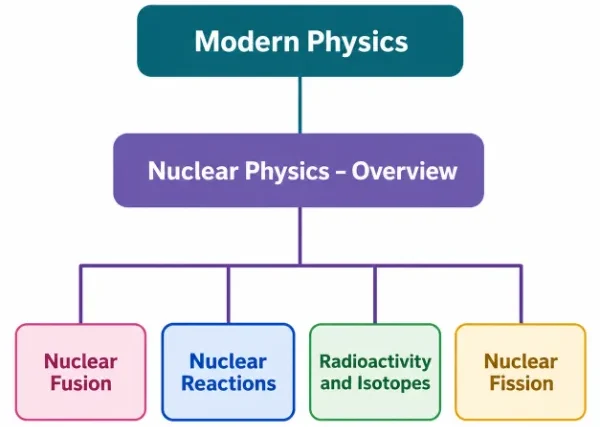
This structure chart places Nuclear Reactions within the wider Nuclear Physics cluster under Modern Physics.
    It shows Nuclear Reactions as one of four related subtopics, alongside Nuclear Fusion, Radioactivity and Isotopes, and Nuclear Fission.
    The chart helps students see how reaction processes connect with nuclear instability, energy release, fusion, and fission.
Modern Physics
Provides the foundational principles governing particle interactions, energy conservation, and behaviour at subatomic scales.Nuclear Physics – Overview
Explains nuclear structure, stability, and the forces that govern how protons and neutrons are bound within the nucleus.Nuclear Reactions
Examines how nuclei change through collisions, induced processes, and transformations that alter their composition and energy state.Radioactivity and Isotopes
Provides the baseline of spontaneous decay processes that nuclear reactions can extend, influence, or initiate under different conditions.Nuclear Fusion
Explores how light nuclei combine under extreme conditions, releasing large amounts of energy.Nuclear Fission
Describes how heavy nuclei split into smaller fragments, producing energy and enabling chain reactions.2. Theoretical Deep Dive: What Nuclear Reactions REALLY Are
At a deeper level, nuclear reactions are not simply events where nuclei collide or change. They are processes in which the internal balance of forces, energy, and particles inside a nucleus is disturbed and reorganised. A nucleus is a compact, dynamic system of protons and neutrons held together by the strong nuclear force while also shaped by electromagnetic repulsion between protons.
When an incoming particle approaches a nucleus, it interacts through fields and forces. Charged particles experience Coulomb repulsion before coming close enough for the strong nuclear force to act. Neutral particles, such as neutrons, enter more easily because they experience no electric barrier.
Many nuclear reactions involve an energy barrier. While classical physics requires incoming particles to possess sufficient kinetic energy to climb the potential barrier, quantum mechanics introduces quantum tunneling, allowing particles to penetrate energy barriers probabilistically even when classical energy is insufficient.
Once interaction occurs, the nucleus follows allowed reaction channels: absorbing the particle, scattering inelastically, emitting another particle, splitting, or fusing. The outcome is strictly constrained by conservation laws (charge, nucleon number, energy, momentum) and mass-energy equivalence:
$$ E = \Delta m \, c^2 $$
Pause and Think: What Makes a Nuclear Reaction Different?
A chemical reaction changes how atoms are bonded by rearranging valence electrons while keeping the atomic nuclei intact. A nuclear reaction alters the structure, composition, or energy state of the nucleus itself.
How can we distinguish a nuclear process from a chemical process?
Ask whether the identity, proton count, or energy state of the nucleus has changed. In a nuclear reaction, elemental transmutations occur and mass-energy conversion yields energy releases orders of magnitude larger (MeV vs eV) than in chemical reactions.
3. Core Physics Principles: Classification of Nuclear Reactions
Nuclear reactions are classified based on the mechanism of particle interaction and the structural changes undergone by the target nucleus:
1. Elastic Nuclear Reactions
Collisions where particles interact without changing internal nuclear energy states or compositions. Total kinetic energy is conserved.
n + 12C → n + 12C
2. Inelastic Nuclear Reactions
Part of the incident kinetic energy is absorbed by the target nucleus, raising it to an excited state. The nucleus subsequently decays back to the ground state by emitting a gamma photon.
n + 12C → n + 12C* → n + 12C + γ
3. Nuclear Transmutation
Interactions that change the proton count (Z), converting the target into a different chemical element. This can occur naturally via decay or artificially via particle bombardment.
14C → 14N + e− + ν̄e (Natural Beta Decay)
14N + α → 17O + p (Artificial Transmutation)
4. Capture Reactions
A nucleus absorbs an incident particle (usually a slow thermal neutron) to form a heavier isotope without immediately emitting nucleon fragments.
238U + n → 239U
5. Spallation Reactions
A extremely high-energy projectile strikes a heavy nucleus, fragmenting it and ejecting multiple light particles and nucleons. Used extensively in spallation neutron sources.
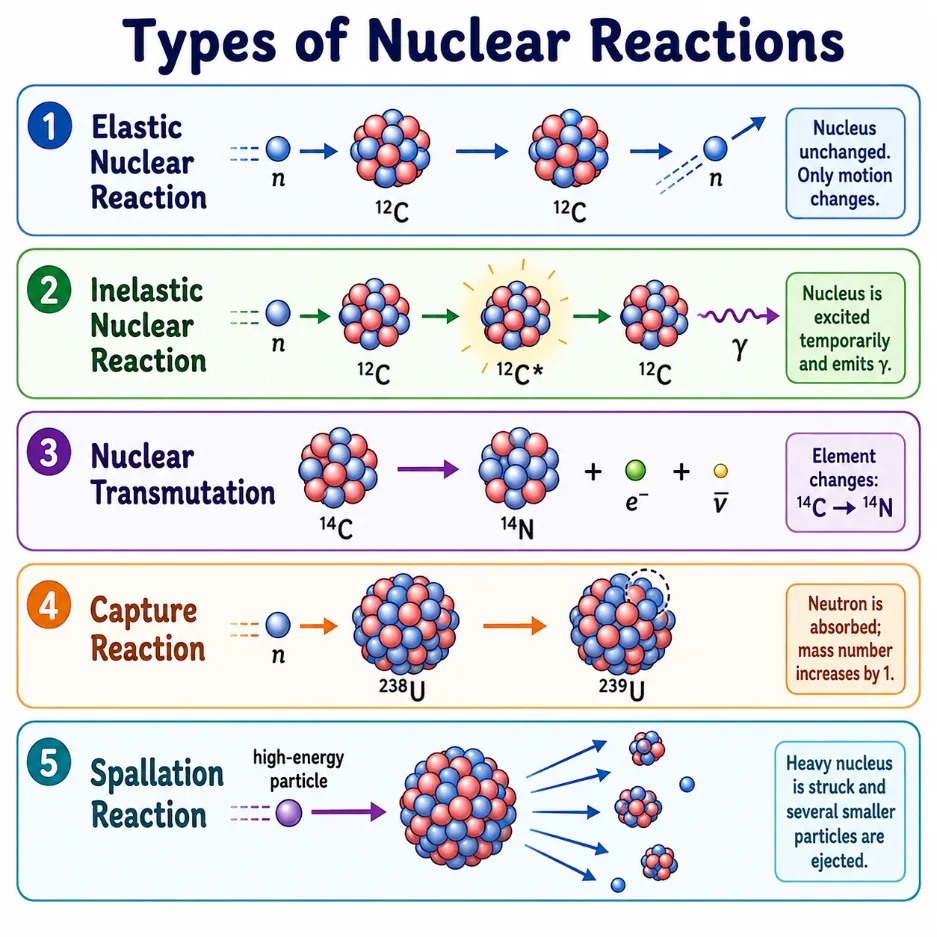
This diagram introduces five types of nuclear reactions.
    Elastic reactions change motion without changing internal energy.
    Inelastic reactions excite the target nucleus before gamma emission.
    Transmutation alters atomic number Z to form a new element.
    Capture reactions form heavier isotopes via neutron absorption.
    Spallation fragments heavy targets using high-energy particle bombardment.
Concept Check: Distinguishing Reaction Channels
What fundamental change distinguishes nuclear transmutation from elastic scattering?
In elastic scattering, the internal structure and atomic number (Z) remain identical. Transmutation explicitly changes the number of protons, converting the original target into a completely different chemical element.
4. Mathematical Foundations: Q-Value & Reaction Energetics
The Q-value represents the net energy liberated or absorbed during a nuclear reaction, calculated from the mass difference between reactants and products:
$$ Q = \left( m_{\text{initial}} – m_{\text{final}} \right) c^2 = \left( \sum m_{\text{reactants}} – \sum m_{\text{products}} \right) c^2 $$
- Exothermic Reactions (Q > 0): The total mass of products is less than reactants (Δm > 0). Mass defect converts into kinetic energy and gamma rays.
- Endothermic Reactions (Q < 0): The products are heavier than the reactants. The reaction requires a minimum threshold kinetic energy (Ethreshold) supplied by the projectile to occur.
When mass defect is measured in atomic mass units (u), the Q-value is calculated directly using 1 u ≈ 931.5 MeV:
Q (in MeV) = Δm (in u) × 931.5 MeV/u
5. Practical Applications, Controlled Systems & Misconceptions
Nuclear Power Generation
Controlled neutron-induced fission reactions release heat in power reactors, utilizing moderators and control rods to maintain steady critical operation.Medical Isotope Production
Neutron capture and cyclotron particle reactions produce short-lived radiopharmaceuticals (e.g., Technetium-99m, Fluorine-18) for PET scans and radiotherapy.Industrial Material Analysis
Neutron Activation Analysis (NAA) uses capture reactions to detect trace element concentrations at parts-per-billion levels in materials and forensics.Particle Physics & Research
Accelerators bombard target nuclei to probe nuclear force parameters, map the island of stability, and synthesize superheavy transuranic elements.Concept Check: The Necessity of Control
Why must reaction rates and parameters be strictly controlled in applied nuclear systems?
Nuclear reactions release energy orders of magnitude higher than molecular bonds. Precision control over cross-sections, neutron flux, and cooling prevents prompt-critical thermal excursions in reactors and ensures precise radioisotope dosage in medicine.
Common Misconceptions About Nuclear Reactions
“Nuclear Reactions Are Just Collisions”
Reactions are governed by quantum potential barriers, strong force coupling, and wave-particle interactions—not classical hard-sphere collisions.“All Nuclear Reactions Release Energy”
Many reactions are endothermic (Q < 0) and absorb energy, requiring accelerated high-energy projectiles to overcome activation thresholds.“Reactions Always Form New Elements”
Elastic and inelastic scattering alter kinetic energy or nuclear excitation levels without modifying atomic number Z.“Higher Particle Energy Guarantees Reaction”
Reaction probability is governed by cross-section curves (σ), which often exhibit sharp resonance peaks at specific particle energies.6. Key Terms Glossary
- Nuclear Reaction
- A process altering the energy, structure, or nucleon composition of an atomic nucleus via particle interaction or photon exposure.
- Q-Value
- The net energy released (Q > 0) or absorbed (Q < 0) during a nuclear reaction based on rest-mass conservation.
- Cross-Section (σ)
- A measure of the probability that a specific nuclear reaction will occur, expressed in units of area (barns, 1 barn = 10−28 m2).
- Transmutation
- The conversion of one chemical element or isotope into another by altering its proton number Z.
- Spallation
- The breakup of a heavy target nucleus into multiple fragments following high-energy particle impact.
- Threshold Energy
- The minimum initial kinetic energy required in the center-of-mass frame for an endothermic nuclear reaction to proceed.
7. Frequently Asked Questions
What is a nuclear reaction?
A nuclear reaction is a process in which the composition, structure, or energy of an atomic nucleus changes due to interaction with another particle, nucleus, or photon.
What determines whether a nuclear reaction occurs?
Occurrence depends on incoming particle energy, interaction forces (Coulomb vs strong nuclear force), reaction cross-section, and quantum tunneling probability.
What is the Q-value of a reaction?
The Q-value represents the net energy released or absorbed in a reaction, equal to the rest mass difference between initial reactants and final products multiplied by c2.
Why are nuclear reactions so energetic compared to chemical reactions?
Nuclear forces operating between nucleons are significantly stronger than electrostatic forces between valence electrons, converting measurable mass defects into mega-electronvolt (MeV) scales.
What is the difference between elastic and inelastic reactions?
Elastic reactions conserve total kinetic energy with no internal structural change. Inelastic reactions absorb kinetic energy to leave the target nucleus in an excited state.
8. Assessment Exercises
Part 1: Review Questions
Q1. What is a nuclear reaction?
Answer: A process in which the structure, nucleon count, or energy state of an atomic nucleus is transformed via subatomic interaction.
Q2. How does a nuclear reaction differ from a chemical reaction?
Answer: Nuclear reactions modify the nucleus itself and change element identities on MeV scales. Chemical reactions alter only electron shell arrangements on eV scales.
Q3. Why are conservation laws vital in analyzing nuclear reactions?
Answer: Total mass-energy, linear momentum, angular momentum, electric charge, and baryon (nucleon) number must be conserved, defining permitted reaction outcomes.
Q4. What is mass defect?
Answer: The difference between initial reactant mass and final product mass, converted directly to energy via E = Δmc2.
Q5. What is a cross-section in nuclear physics?
Answer: A statistical measure of the effective target area presented by a nucleus for a specific interaction, expressed in barns.
Part 2: Applied & Thought-Provoking Scenarios
Q1. How do particle accelerators expand nuclear reaction pathways?
Answer: Accelerators provide charged projectiles with sufficient kinetic energy to overcome electrostatic Coulomb barriers, enabling endothermic reactions and superheavy element synthesis.
Q2. Why are accurate cross-section measurements essential for reactor engineering?
Answer: Precise cross-section data allows engineers to calculate exact neutron capture vs fission probabilities, enabling safe reactor moderation and control.
Q3. How do nuclear reactions explain elemental abundance in the universe?
Answer: Stellar nucleosynthesis, s-process neutron capture in red giants, and r-process capture in neutron star mergers govern the cosmic creation of elements heavier than helium.
Part 3: Numerical Problems with Step-by-Step Worked Solutions
Problem 1: Reaction Type Identification
Identify the reaction type for: 14N + α → 17O + p.
Solution: Nitrogen (Z = 7) is struck by an alpha particle to produce oxygen (Z = 8) and a proton. Atomic number changes.
Answer: Nuclear Transmutation (Artificial Transmutation).
Problem 2: Q-Value Calculation from Mass Defect
Calculate the Q-value in MeV for a reaction where initial mass minitial = 4.0026 u and final product mass mfinal = 4.0015 u.
Solution:
$$ \Delta m = 4.0026 \text{ u} – 4.0015 \text{ u} = 0.0011 \text{ u} $$
$$ Q = 0.0011 \text{ u} \times 931.5 \text{ MeV/u} \approx 1.025 \text{ MeV} $$
Answer: Q = +1.025 MeV (Exothermic).
Problem 3: Reaction Rate in an 800 MW Reactor
A reactor generates 800 MW of power (8.0 × 10⁸ W). If each reaction releases 200 MeV (3.204 × 10⁻¹¹ J), find the number of reactions occurring per second.
Solution:
$$ \text{Reactions/sec} = \frac{8.0 \times 10^8 \text{ J/s}}{3.204 \times 10^{-11} \text{ J}} \approx 2.50 \times 10^{19} \text{ s}^{-1} $$
Answer: 2.50 × 10¹⁹ reactions/second.
Problem 4: Decay Constant from Half-Life
Calculate the decay constant λ for an isotope created in a reaction with a half-life of 5 days.
Solution:
Convert 5 days to seconds: 5 × 86400 s = 432,000 s.
$$ \lambda = \frac{\ln 2}{t_{1/2}} = \frac{0.69315}{432000 \text{ s}} \approx 1.605 \times 10^{-6} \text{ s}^{-1} $$
Answer: 1.605 × 10⁻⁶ s−1.
Problem 5: Mass Equivalent of Absorbed Energy
Calculate the mass equivalent in kg for an energy input of 1.0 × 10⁻¹⁰ J.
Solution:
$$ m = \frac{E}{c^2} = \frac{1.0 \times 10^{-10} \text{ J}}{(3.0 \times 10^8 \text{ m/s})^2} = \frac{1.0 \times 10^{-10}}{9.0 \times 10^{16}} \approx 1.11 \times 10^{-27} \text{ kg} $$
Answer: 1.11 × 10⁻²⁷ kg.
History, Challenges, and Future Prospects
The study of nuclear reactions established modern elemental transmutation and high-energy physics.
Historical Milestones: In 1919, Ernest Rutherford achieved the first artificial nuclear reaction by bombarding nitrogen gas with alpha particles to produce oxygen and protons. John Cockcroft and Ernest Walton executed the first particle-accelerator-driven transmutation in 1932. Enrico Fermi demonstrated slow-neutron capture reactions, paving the way for nuclear reactor kinetics.
Current Challenges: Accurately modeling multi-body nuclear reaction dynamics, measuring ultra-low cross sections of astrophysical interest, and managing heavy target cooling under extreme accelerator beam intensities.
Future Frontiers: Utilizing rare isotope beams (at facilities like FRIB) to synthesize superheavy elements, advancing spallation neutron sources for materials research, and developing accelerator-driven transmutation systems (ADS) to destroy long-lived nuclear waste.
Cluster Navigation & Academic References
Related Modern Physics Topics
- Modern Physics Hub — Overview of subatomic and non-classical physics.
- Nuclear Physics Overview — Binding energy, nuclear stability, and force balances.
- Radioactivity and Isotopes — Spontaneous decay modes and isotope kinetics.
- Nuclear Fusion — Light nucleus combination and plasma confinement.
- Nuclear Fission — Heavy element splitting and chain reaction control.
External References & Data Sources
- U.S. DOE: Nuclear Fission Mechanics — Educational resource on neutron-induced splitting.
- U.S. DOE: Fusion Reactions — Guide to reaction energetics and light element fusion.
- IAEA Experimental Nuclear Reaction Data (EXFOR) — Comprehensive international library of measured reaction cross-sections.
Archived version: This learning resource is archived on Zenodo at https://zenodo.org/records/20570351.
Suggested citation: Gan, J. (2026). Nuclear Reactions: Transmutation, Q-Values, and Reaction Energetics. Prep4Uni.online. Zenodo. https://doi.org/10.5281/zenodo.20570351