
Internet and Web Technologies Education is, in a quiet way, an education in public responsibility. When you build for the web, you are building in a shared city: your work must load quickly for strangers, stay stable under traffic, protect user data, and remain usable on devices you have never touched. The diagram makes this feel less mystical and more methodical.
Inputs begin the story with reality. Student demands reflect the desire to create—websites, apps, platforms, portfolios, tools that solve everyday problems. Industry directions bring the “weather report” of the web: shifting frameworks, evolving standards, security expectations, accessibility norms, and the relentless need for reliability. These inputs make sure learning is not frozen in an old snapshot of the internet.
Controls then add structure. Curriculum standards and academic policies prevent the subject from becoming a frantic chase after whatever is fashionable. They keep the learning anchored to lasting principles: how the web works, how requests and responses behave, why APIs exist, what security threats look like, how data is stored and protected, how interfaces respect human attention, and how accessibility is designed rather than “added later.”
Mechanisms provide the workshop—tools and resources that let students move from concept to working system: editors, browsers, debuggers, frameworks, databases, hosting environments, and guided examples. With these in place, the function can produce outputs that matter: developers who can reason clearly and work cleanly, and web projects that demonstrate not just code, but craftsmanship—tested, documented, and ready to live in the real internet.
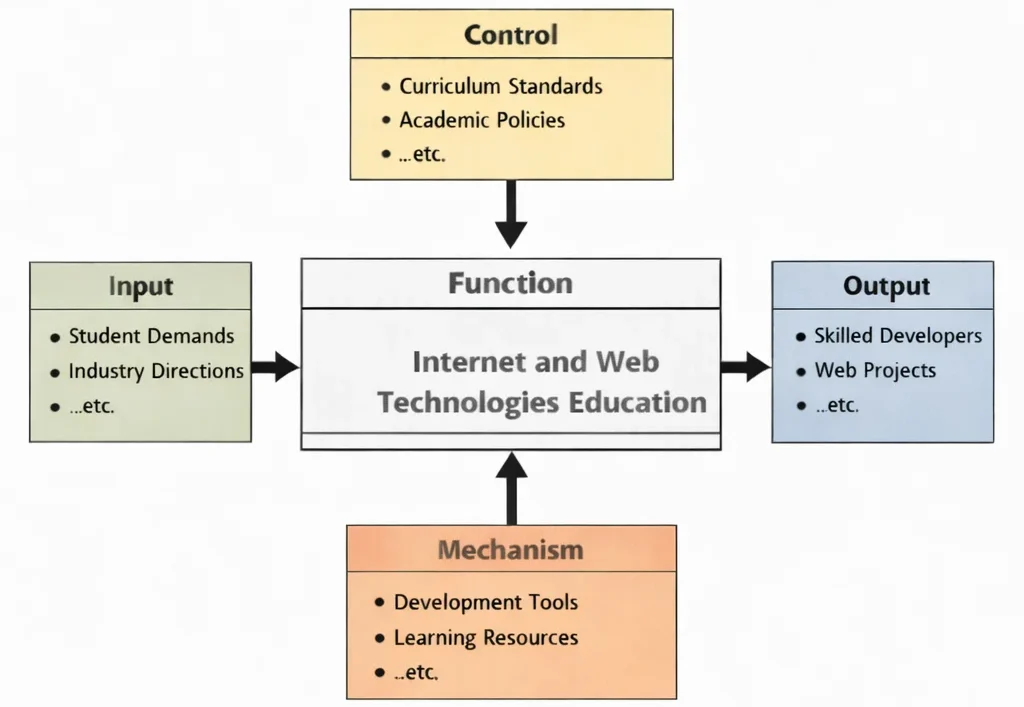
This IDEF0 diagram models “Internet and Web Technologies Education” as a structured transformation process. Inputs such as student demands and industry directions flow into the central learning function from the left. Controls—curriculum standards and academic policies—enter from above to define learning outcomes, assessment expectations, and the boundaries of good practice. Outputs emerge on the right as skilled developers and completed web projects. The process is enabled by mechanisms from below, including development tools and learning resources that support hands-on building, testing, debugging, deployment practice, and iterative improvement.
Interactive Check: Intro & System Concepts
Verify your understanding of how web architecture principles, standards, and public responsibility shape web engineering:
Introductory Concept Verification
1. Why is building for the web compared to building in a “shared city” in terms of public responsibility?
Answer: Web applications are shared infrastructure exposed globally. Developers must ensure code loads quickly for remote users, remains stable under traffic surges, protects user data, and supports accessible cross-device usage.
2. What function do curriculum standards and academic policies serve as “Controls” in Web Technologies Education?
Answer: They prevent students from chasing short-lived software trends by anchoring instruction in lasting web principles—request/response cycles, API design, security threats, secure storage, and built-in accessibility.
Internet and web technologies power how people discover, share, and build online—from real-time messaging and streaming to e-commerce, learning platforms, and cloud computing. At the network layer, the Internet moves packets using open protocols and global routing; at the web layer, HTTP/HTTPS, APIs (REST/GraphQL), and WebSockets serve dynamic, interactive content to browsers and devices. CDNs and caching bring content close to users for lower latency and higher reliability.
Security is built in, not bolted on. Strong cryptography protects data in transit; identity and access management verifies who can do what; and robust network security defends services from attacks. When incidents occur, well-practised incident response and forensics restore trust and availability.
Modern platforms are data-driven. Data science and analytics inform personalization and performance; reliable results depend on sound data cleaning and preprocessing, scalable collection and storage, and clear visualization. Design choices are guided by ethical and social considerations so that privacy, accessibility, and fairness remain central.
Beyond traditional sites, the web also underpins multiplayer experiences, rich media, and XR. In game development, engines integrate online features and AI-driven interactions—proof that web technologies are the connective tissue linking devices, services, and people worldwide.

This illustration portrays the internet as a bright, interconnected sphere—an abstract “network of networks” built from countless links between devices and services. Around the globe are visual cues for core web and internet building blocks: DNS for naming and routing requests, HTTP/HTTPS for moving web content securely, IP concepts (including IPv6) for addressing, plus servers, data centers, cloud platforms, and databases that store and deliver information at scale. The people at computer terminals represent developers, administrators, and everyday users who rely on this invisible machinery to communicate, publish, shop, learn, and collaborate. Security symbols woven into the scene hint at encryption, authentication, and protective layers that help keep online systems trustworthy.
Discover how Internet and Web Technologies govern transport stacks, API design, server-side rendering, and offline-first PWA architectures across the Networking and Telecommunication cluster.
Overview Hub
Presents core routing principles, packet transport, and the overarching telecommunication ecosystem.
Cloud Networking
Explores cloud-native backend routing, load balancing, multi-region database replication, and edge delivery.
Wireless & Mobile Communications
Examines cellular network architectures, radio frequency spectrum management, Wi-Fi standards, and mobile data transmission.
Telecommunication Systems & Standards
Covers global telecommunication infrastructure, regulatory standardization bodies, and carrier-grade switching networks.
Network Security
Details protecting web application layers against DDoS, TLS cipher vulnerabilities, and cross-site attacks.
Network Management & Administration
Focuses on network monitoring, configuration management, automated provisioning tools, and troubleshooting workflows.
Emerging Technologies
Explores next-generation innovations including 5G/6G wireless, quantum key distribution (QKD), and edge computing fabrics.
Internet & Web Technologies
Focuses on HTTP/2-3 protocol stacks, rendering strategies (SSR/CSR/SSG), API design (REST/GraphQL), web security, and offline service workers.
Network Architecture & Protocols
Explores OSI/TCP-IP reference models, OSPF and BGP routing algorithms, circuit vs. packet switching, and wireless protocols.
Data Transmission Technologies
Covers fiber optic light transmission, modulation techniques (AM/FM/PSK/QAM), and error detection coding (CRC, Hamming, Reed-Solomon).
Wireless & Mobile Communications
Covers delivering web experiences across high-latency cellular radio connections and constrained mobile bandwidth.
Web Architecture & Protocol Stack
The modern web rides on an open stack: IP routing at the network layer; TCP/UDP with QUIC at transport; and HTTP/1.1–3 at application. DNS maps names to addresses, TLS secures sessions, and CDNs/edge nodes shorten distance for speed and reliability.
- Flow: DNS → TLS handshake → HTTP request/response → caching/CDN → browser render.
- State & sessions: cookies, tokens, storage; see IAM.
- Real-time: WebSockets/SSE for events; WebRTC for low-latency media and P2P.
Rendering Strategies (CSR, SSR, SSG, ISR)
Rendering choices shape performance, SEO, and complexity. Pick based on content freshness, interactivity, and latency needs.
- CSR: client-side hydration—great for app-like UIs.
- SSR: server renders HTML—faster first paint + crawlable.
- SSG: build at deploy time—ultra-fast & CDN-friendly.
- ISR/DSG: re-generate pages on demand at the edge.
- Edge rendering: personalize close to users; see edge computing.
Key Topics in Internet and Web Technologies
Core ideas that every student should know—from DNS naming to HTTP/HTTPS, caching/CDNs, and IPv6 for long-term Internet scale.
- DNS: root → TLD → authoritative; caching via TTL; DNSSEC, DoH/DoT.
- HTTP/HTTPS: request–response, TLS, HSTS; HTTP/2 multiplexing; HTTP/3 over QUIC.
- Distribution & caching: CDNs, ETag/Cache-Control, edge execution.
- IPv6: 128-bit space, SLAAC, dual-stack rollout.
API Design & Integration Patterns
APIs connect frontends, services, and partners. Design for clarity, versioning, security, and resilience.
- Styles: REST, GraphQL, gRPC, webhooks.
- Contracts: OpenAPI/Swagger, JSON Schema, GraphQL SDL; contract tests in CI/CD.
- Resilience: idempotency keys, retries with backoff, timeouts, circuit breakers, pagination/streaming.
- Security: HTTPS, OAuth 2.0/OIDC, mTLS; scopes, rate limits—see Application Security.
- Observability: structured logs, request IDs, metrics, and traces mapped to releases.
Offline-First & Web Platform APIs
Build apps that keep working on poor or absent networks, then sync safely when back online.
- Service Workers: intercept requests; cache-first and stale-while-revalidate.
- Storage: IndexedDB, Cache Storage, Web Storage for local state and queued writes.
- Background: Background Sync, Push API, Notifications.
- Installability: PWA manifest, icons, offline fallback page.
Web Security Essentials for Developers
Combine browser defenses with backend policy and monitoring to protect users and data.
- Browser model: same-origin, CORS, sandbox, CSP.
- Transport/session: TLS/HSTS, secure/HttpOnly cookies, secret handling.
- Auth/access: OAuth 2.0/OIDC, MFA/passkeys (WebAuthn), least privilege/RBAC; see IAM.
- Ops: logs, alerts, and incident response.
Applications of Internet and Web Technologies
E-Commerce
- Overview: Online stores and marketplaces deliver catalog search, checkout, and post-purchase services over the web stack.
- Key capabilities:
- Trust & safety: end-to-end encryption (HTTPS/TLS), strong authentication, and fraud detection; see IAM and application security.
- Speed at scale: CDNs, edge caching, image optimization, and lazy loading for fast product pages worldwide.
- Dynamic experiences: inventory/pricing via APIs, real-time recommendations, and transactional email/webhooks.
- Resilience: multi-AZ hosting, queue-based order processing, and graceful degradation during peaks.
Social Networking
- Overview: Social apps connect billions of users for messaging, feeds, and media sharing.
- Key capabilities:
- Real-time delivery: HTTP/2 or HTTP/3 + WebSockets/Server-Sent Events for feeds, notifications, and presence.
- Personalization: secure APIs and analytics pipelines for ranking, relevance, and spam/abuse filtering (see data science & analytics).
- Media at the edge: adaptive bitrate streaming, thumbnail sprites, and CDN storage for photos/video.
- Privacy & controls: consent flows, data export/deletion, and rate-limited public APIs.
Web Services (APIs & Microservices)
- Overview: APIs expose business capabilities to web/mobile clients and to other services—forming the backbone of cloud-native systems.
- Key capabilities:
- Secure interfaces: HTTPS everywhere, OAuth/OIDC, mTLS for service-to-service calls, and schema contracts (OpenAPI/GraphQL SDL).
- Operability: containerized deployments with autoscaling, blue-green/canary releases, and observability (metrics, logs, traces). See DevOps & IaC.
- Performance: caching, pagination, compression, and idempotent retries; global routing via DNS and CDNs.
- Scalability: event streaming and message queues for decoupling; stateless services with serverless/FaaS where appropriate.
Streaming & Real-Time Communication
- Overview: Video, audio, and interactive sessions (classes, webinars, support) rely on low-latency web delivery.
- Key capabilities:
- Protocols: HLS/DASH for video on demand, WebRTC for live, peer-to-peer calls and screen sharing.
- Edge optimizations: transcoding, just-in-time packaging, DRM, and multi-CDN failover.
- Accessibility: captions, transcripts, and adaptive players to support diverse networks and devices.
Online Learning & Collaboration
- Overview: LMS platforms, shared documents, and coding/whiteboard tools deliver education and teamwork in the browser.
- Key capabilities:
- Interactive apps: PWAs, WebAssembly for heavy computation, and offline-first design.
- Security & privacy: role-based access, FERPA/GDPR-aligned data handling, and zero-trust networking; see network security.
- Analytics for learning: event streams and dashboards that respect user consent and minimize data collection.
Game: Scenario Architect — Choose the Right Web Stack
For each scenario, tick the building blocks you’d use. Then press Check answers.E-Commerce — global catalog + flash sales
Fast pages worldwide, secure checkout, resilient order processing.
Social Networking — live feed + messaging
Realtime updates, personalization, safe public APIs.
Web Services (APIs & Microservices) — partner integration
Secure interfaces, safe rollout, good operability.
Streaming & Real-Time Communication — live classes + recordings
Low latency for live, smooth VOD later, robust delivery.
Online Learning & Collaboration — browser-based tools
Interactive apps, privacy, works offline on weak networks.
Score: 0 / 5 (0%)
Performance & Accessibility (User Experience)
Fast, inclusive sites win. Optimize delivery and design so everyone can use your product.
- Core Web Vitals: LCP, INP, CLS—images, critical CSS, code splitting, HTTP/2/3.
- Caching & delivery: immutable assets (Cache-Control/ETag), preconnect/prefetch, edge render.
- A11y: semantic HTML, ARIA where needed, keyboard navigation, contrast, captions/alt text.
- Measurement: RUM + synthetic tests, trace profiles, error reporting per release.
Testing & Quality Engineering for the Web
Quality spans correctness, performance, and accessibility. Automate early; observe in production.
- Unit/integration: component tests and API contract tests in CI/CD.
- E2E & visual: cross-browser/device flows; visual regression baselines.
- Perf & a11y: Web-vitals budgets, Lighthouse/axe checks on every build.
- Observability: RUM, traces, error tracking; rollback playbooks.
SEO & Discoverability
Help users (and search engines) find content while keeping pages fast and secure.
- Metadata: titles, descriptions, canonical URLs, Open Graph/Twitter cards.
- Structured data: JSON-LD (FAQ, HowTo, Article) for rich results.
- Sitemaps & robots: XML sitemaps, robots.txt, clean redirects/404s.
- Rendering: prefer SSR/SSG/ISR for indexable content; avoid client-only rendering for pages that must rank.
Internationalization & Localization (i18n/l10n)
Design globally: text, layout, and data formats must adapt to locale and language.
- i18n basics: message catalogs, ICU formats, pluralization, RTL support.
- Workflow: string extraction, translation memory, locale QA, release gates.
- Formatting: locale-aware dates, currency, numbers; time-zones; Unicode readiness.
- Performance: locale code-splitting and CDN routing by language.
History and Evolution of the World Wide Web
The World Wide Web began in 1989 at CERN when Tim Berners-Lee invented HTML, URI, and HTTP to allow physicists to share documents globally. The 1990s marked the browser wars (Netscape vs. Internet Explorer), introducing JavaScript, CSS, and dynamic client-side scripting. The 2000s ushered in Web 2.0, moving static pages toward interactive applications powered by AJAX, robust JavaScript frameworks, and REST APIs. The 2010s and 2020s brought responsive design, mobile web standards, HTTP/2 and HTTP/3 (QUIC), Progressive Web Apps, WebAssembly, and cloud-native edge computing.
Current Technical & Operational Challenges
Architecting massive web applications introduces complex engineering hurdles:
- Hydration Bottlenecks and JS Bloat: Heavy client-side JavaScript execution bundles delay Time-to-Interactive (TTI) and degrade Core Web Vitals on mobile hardware.
- Cross-Origin Resource Sharing (CORS) & Security Misconfigurations: Managing strict browser same-origin policies while integrating distributed microservices and third-party APIs safely.
- State Synchronization in Offline-First Apps: Resolving conflicting database mutations when multiple offline users sync changes back to central servers via Service Workers and IndexedDB.
- Third-Party Script Supply Chain Vulnerabilities: Compromised external analytics or marketing pixels executing arbitrary script payloads within browser contexts.
Future Trends in Internet and Web Technologies
- Web3: self-sovereign identity, smart contracts, decentralized storage (IPFS). Mind scalability/regulation.
- AI/ML everywhere: search, recommendations, moderation, dev tooling—see data science.
- Quantum Internet: QKD research; prepare for post-quantum crypto—see cryptography.
- 5G & edge: MEC, network slicing; AR/VR, V2X, time-critical IoT.
- Wasm/WebGPU/WebXR & PWAs: near-native performance, immersive web, offline-first apps.
- Privacy & sustainability: passkeys/WebAuthn, consent & residency, carbon-aware delivery.
Interactive Quick Review: Web Stack Protocols & Architecture
Reinforce key concepts regarding HTTP/3 QUIC transport, API contracts, and Service Worker offline caching before reviewing the FAQ:
Quick Review Verification
1. How does HTTP/3 over QUIC solve head-of-line blocking issues present in TCP-based HTTP/2?
Answer: QUIC operates on top of UDP rather than TCP. While TCP stalls all multiplexed streams when a single packet is lost, QUIC isolates packet loss to individual independent streams, preventing stream blocking.
2. What is the operational purpose of a Service Worker in Progressive Web Apps (PWAs)?
Answer: A Service Worker acts as a programmable client-side proxy running in a background worker thread, intercepting network requests to enable cache-first loading, offline functionality, and background background sync.
Why Study Internet and Web Technologies
The web powers communication, commerce, media, and education. Learning the stack—DNS, HTTP/HTTPS, APIs, CDNs, and cloud backends—opens doors across industries.
- Full-stack skills: HTML/CSS/JS + Web APIs + servers/databases/security.
- Career paths: web dev, UX, SRE/DevOps, API engineering, product.
- Future-ready: foundations for edge computing, AI-driven apps, and real-time collaboration.
Internet and Web Technologies: Summary
Internet and web technologies knit together users, apps, and cloud services at global scale. Packets move via open Internet protocols; the web layer (HTTP/HTTPS, APIs, WebSockets) delivers interactive content; and CDNs, caching, and compression keep experiences fast and reliable—all with security designed in from the start.
- Networking foundations: IP addressing, DNS, and modern transports (e.g., TCP/UDP and QUIC) enable resilient, low-latency delivery.
- Web application stack: HTTP/2/3, REST/GraphQL, and streaming push real-time features to browsers and devices.
- Performance & reliability: CDNs, edge caching, load balancing, and observability keep services responsive at peak demand.
- Security by default: TLS encryption, sound identity and access management, and layered network security protect data and users.
- Data-driven decisions: Responsible analytics informs personalization, capacity planning, and UX—balanced by privacy and accessibility.
- Cloud alignment: Web platforms run efficiently on cloud computing with scalable storage, compute, and global distribution.
- What’s next: Progressive Web Apps, WebAssembly, 5G/edge, and privacy-preserving technologies will shape the next wave of the web.
End-of-Page Exercises: Review, Thought-Provoking & Engineering Problems
Internet and Web Technologies: Review Questions and Answers
1. What are internet and web technologies and how do they drive modern connectivity?
Answer: Hardware, software, and communication protocols enabling data exchange and content delivery across networks, supporting digital interactions from personal devices to global data centers.
2. How do web protocols such as HTTP and HTTPS facilitate secure communication?
Answer: HTTP formats web messages, while HTTPS encrypts transmission via TLS, safeguarding sensitive data (credentials, transactions) from interception and tampering.
3. What is the role of DNS in internet technology?
Answer: DNS translates human-readable domain names into numerical IP addresses, routing users to correct servers efficiently through hierarchical name servers.
4. How do HTML, CSS, and JavaScript contribute to modern web development?
Answer: HTML provides document structure, CSS handles visual styling/layout, and JavaScript powers dynamic client-side interactivity and application logic.
5. What are the key differences between the internet and the World Wide Web?
Answer: The Internet is the underlying global physical hardware network infrastructure, whereas the World Wide Web is an application-layer system of interlinked hypertext documents accessed via browsers over the internet.
6. How has cloud computing influenced the development of internet and web technologies?
Answer: Providing scalable, on-demand compute and storage resources that enable rapid application deployment, global distribution, and reduced hardware dependency.
7. What benefits do content delivery networks (CDNs) offer in web technologies?
Answer: Caching static assets on distributed edge servers close to users, reducing latency, absorbing DDoS traffic surges, and offloading origin servers.
8. How do emerging technologies such as IoT and 5G enhance internet connectivity and web performance?
Answer: 5G provides high-speed, ultra-low latency wireless connectivity, while IoT connects billions of sensors, feeding real-time data streams into web applications.
9. What are the common security challenges in internet and web technologies, and how can they be addressed?
Answer: Threats include data breaches, XSS, SQL injection, and phishing. Addressed via robust TLS encryption, MFA, input sanitization, CSP, and regular security audits.
10. How is data transmission optimized in modern networks to ensure efficient web communication?
Answer: Through HTTP/2-3 multiplexing, compression algorithms, TCP/QUIC tuning, CDNs, and optimized fiber optic routing paths.
Thought-Provoking Questions and Answers
1. How will the evolution of 6G technology transform data transmission and web connectivity on a global scale?
Answer: Terabit-per-second speeds and sub-millisecond latencies will enable real-time holographic web interactions and ultra-immersive spatial computing applications.
2. What ethical implications might arise from the widespread deployment of high-speed internet and web technologies?
Answer: Mass telemetry tracking, intrusive behavioral surveillance, and deepening digital divides for unconnected socioeconomic groups.
3. How can artificial intelligence and machine learning optimize web content delivery and improve user experiences?
Answer: AI predicts traffic surges, optimizes CDN edge caching strategies, personalizes UI components, and automates real-time anomaly threat detection.
4. What are the key challenges in integrating cloud-based services with traditional networking infrastructures?
Answer: Legacy hardware protocol mismatches, inconsistent security policy enforcement, and unpredictable latency bottlenecks across hybrid environments.
5. How might advancements in encryption techniques impact the future of data transmission and web security?
Answer: Post-quantum cryptographic standards will future-proof web communication against decryption by future quantum supercomputers.
6. What impact will the integration of IoT devices have on data transmission speeds and network reliability?
Answer: Billions of edge devices generate massive telemetry surges, requiring edge aggregation gateways and lightweight protocols (MQTT/CoAP) to preserve network reliability.
7. How can software-defined networking (SDN) revolutionize the management of modern telecommunication networks?
Answer: Centralized software controllers enable dynamic programmatic routing adjustments, automated traffic engineering, and rapid multi-tenant provisioning.
8. What future trends in web technologies do you foresee having the greatest impact on global communication?
Answer: WebAssembly for near-native browser compute, QUIC transport ubiquity, and AI-driven personalized edge rendering.
9. How might the convergence of cloud computing and web technologies improve content delivery?
Answer: Hyperscale cloud CDNs seamlessly cache and render dynamic assets at hundreds of edge points of presence (PoPs) worldwide, minimizing physical distance propagation delay.
10. What are the potential economic benefits of adopting emerging internet and web technologies for businesses?
Answer: Lower infrastructure overhead via cloud elasticity, broader global customer reach, faster time-to-market through automated CI/CD pipelines, and data-driven revenue optimization.
11. How can cross-industry collaboration drive advancements in internet and web technologies?
Answer: Establishing universal open standards (W3C, IETF) across telecom, finance, and software sectors ensures secure, interoperable cross-platform web ecosystems.
12. What future innovations in network protocols and infrastructure do you anticipate will shape the evolution of the web?
Answer: Autonomous self-optimizing transport protocols, hardware-accelerated TLS decryption on network interface cards, and decentralized peer-to-peer web delivery protocols.
Internet and Web Technologies: Numerical Engineering Problems & Solutions
Problem 1: Cloud Network Hourly & Daily Transmission Volume
A cloud network transmits data at 100 Mbps. Calculate total data transmitted in one hour in gigabytes (GB), total in 24 hours, and average data transmitted per minute.
Solution:
- Data per second = 100 Mbps = 100 × 106 bits/sec
- Data per hour = 100 × 106 × 3,600 = 360 × 109 bits
- Convert to GB: 360 × 109 ÷ (8 × 10⁹) = 45 GB
- Data per day = 45 GB × 24 = 1,080 GB
- Average per minute = 1,080 GB ÷ 1,440 min = 0.75 GB/min
Problem 2: High-Frequency Router Packet Processing Load
A router processes 2,500 packets per second. Calculate the number of packets processed per minute, per hour, and per day (24 hours).
Solution:
- Packets per minute = 2,500 × 60 = 150,000 packets/min
- Packets per hour = 150,000 × 60 = 9,000,000 packets/hour
- Packets per day = 9,000,000 × 24 = 216,000,000 packets/day
Problem 3: Telecommunication Link Total Data & Rate
A telecommunication link operates at 75 Mbps. For an 8-hour period, calculate total data transmitted in gigabytes (GB) and average data rate in MB per minute.
Solution:
- Data per second = 75 Mbps = 75 × 106 bits/sec
- Total bits in 8 hours = 75 × 106 × 8 × 3,600 = 2.16 × 1012 bits
- Convert to GB: 2.16 × 10¹² ÷ (8 × 10⁹) = 270 GB
- Average per minute = (270 GB × 1,000 MB/GB) ÷ 480 min = 270,000 MB ÷ 480 = 562.5 MB/min
Problem 4: Fiber Optic Distance Latency Comparison
A fiber optic cable has a latency of 4 ms per 100 km. Calculate latency for 800 km, for 1,500 km, and determine the difference between these two latencies.
Solution:
- Latency rate = 4 ms ÷ 100 km = 0.04 ms/km
- Latency for 800 km = 800 × 0.04 = 32.0 ms
- Latency for 1,500 km = 1,500 × 0.04 = 60.0 ms
- Difference = 60.0 ms – 32.0 ms = 28.0 ms
Problem 5: Packet Loss Rate & Successful Transmission
A network experiences a packet loss rate of 0.2% (0.002). If 5,000,000 packets are transmitted, calculate lost packets, successful packet transmissions, and overall success percentage.
Solution:
- Lost packets = 5,000,000 × 0.002 = 10,000 packets
- Successful packets = 5,000,000 – 10,000 = 4,990,000 packets
- Success percentage = (4,990,000 ÷ 5,000,000) × 100 = 99.8%
Problem 6: Wireless Access Point Transfer Volume
A wireless access point transmits at 250 Mbps. Calculate total data transmitted in 15 minutes (900 seconds) in megabytes (MB). (Note: 1 MB = 8 Megabits).
Solution:
- Data rate per second = 250 Megabits/sec
- Total bits in 15 minutes = 250 Mb/sec × 900 sec = 225,000 Megabits
- Convert Megabits to Megabytes: 225,000 Mb ÷ 8 bits/Byte = 28,125 MB
Problem 7: Network Monitoring Tool Log Accumulation
A network monitoring tool logs 500,000 events per hour. Calculate total events logged in one day, in one week (7 days), and average events per minute over the week.
Solution:
- Events per day = 500,000 × 24 = 12,000,000 events/day
- Events per week = 12,000,000 × 7 = 84,000,000 events/week
- Average per minute = 84,000,000 events ÷ (7 × 24 × 60 min) = 84,000,000 ÷ 10,080 = 8,333.33 events/min
Problem 8: Bandwidth Upgrade Additional Transfer Volume
A network upgrade increases bandwidth from 120 Mbps to 180 Mbps. Calculate percentage bandwidth increase, additional throughput in Mbps, and additional data transmitted in 1 hour in GB.
Solution:
- Percentage increase = ((180 – 120) ÷ 120) × 100 = 50.0%
- Additional bandwidth rate = 180 – 120 = 60 Mbps = 60 × 106 bits/sec
- Additional data in 1 hour = 60 × 106 bits/sec × 3,600 sec = 216 × 109 bits
- Convert to GB: 216 × 109 ÷ (8 × 10⁹) = 27 GB
Problem 9: Latency Reduction Percentage & Absolute Savings
A network’s average latency is measured at 20 ms. An optimization reduces latency by 30% (0.30). Calculate new average latency, absolute reduction in milliseconds, and percentage decrease.
Solution:
- New average latency = 20 ms × (1 – 0.30) = 20 × 0.70 = 14.0 ms
- Absolute reduction = 20 – 14 = 6.0 ms
- Percentage decrease = (6 ÷ 20) × 100 = 30.0%
Problem 10: High-Frequency Router Packet Accumulation
A router transmits 2,500 packets per second. Calculate total packets transmitted per minute, per hour, and per day (24 hours).
Solution:
- Packets per minute = 2,500 × 60 = 150,000 packets/min
- Packets per hour = 150,000 × 60 = 9,000,000 packets/hour
- Packets per day = 9,000,000 × 24 = 216,000,000 packets/day
Problem 11: Telecom Subscriber Monthly & Annual Usage
A telecom provider serves 18,000 subscribers, each using 2 GB of data per month. Calculate total monthly data usage, annual usage, and average annual data usage per subscriber.
Solution:
- Total monthly usage = 18,000 subscribers × 2 GB = 36,000 GB/month
- Total annual usage = 36,000 GB × 12 months = 432,000 GB/year
- Average annual usage per subscriber = 432,000 GB ÷ 18,000 = 24.0 GB/subscriber/year
Problem 12: Monitoring System Critical Anomaly Metrics
A network monitoring system processes 800,000 logs per day. If 0.1% (0.001) of these logs indicate critical issues, calculate critical logs per day, per 30-day month, and critical log percentage.
Solution:
- Critical logs per day = 800,000 × 0.001 = 800 logs/day
- Critical logs per month (30 days) = 800 × 30 = 24,000 logs/month
- Critical log percentage = (800 ÷ 800,000) × 100 = 0.1%
Internet and Web Technologies — Summary & Wrap-Up
Internet and Web Technologies form the application and transport layer foundation connecting global users to cloud-native services. By mastering HTTP/2-3 protocol stacks, rendering paradigms (SSR, CSR, SSG, ISR), secure API design, offline-first Progressive Web Apps, and rigorous testing frameworks, web engineers build fast, secure, accessible, and resilient digital experiences for the shared public web.