
DevOps, CI/CD, and IaC Education teaches a very modern kind of responsibility: making change safe. The diagram captures that promise. Learners bring in inputs—examples, exercises, and a basic grasp of code and systems—but the learning is steered by controls that are non-negotiable in real teams: security rules, quality gates, versioning discipline, and operational standards. With mechanisms such as guided labs and real toolchains, students practice turning messy manual steps into deliberate pipelines: build, test, scan, package, and deploy—again and again—until “repeatable” becomes a habit rather than a slogan. IaC completes the picture by treating infrastructure as something you can review, diff, roll back, and reproduce, instead of something you “hope” was configured correctly. The output is a learner who can explain a delivery workflow with confidence, automate the boring-but-critical checks, and create environments that behave the same way today, tomorrow, and on the next project.
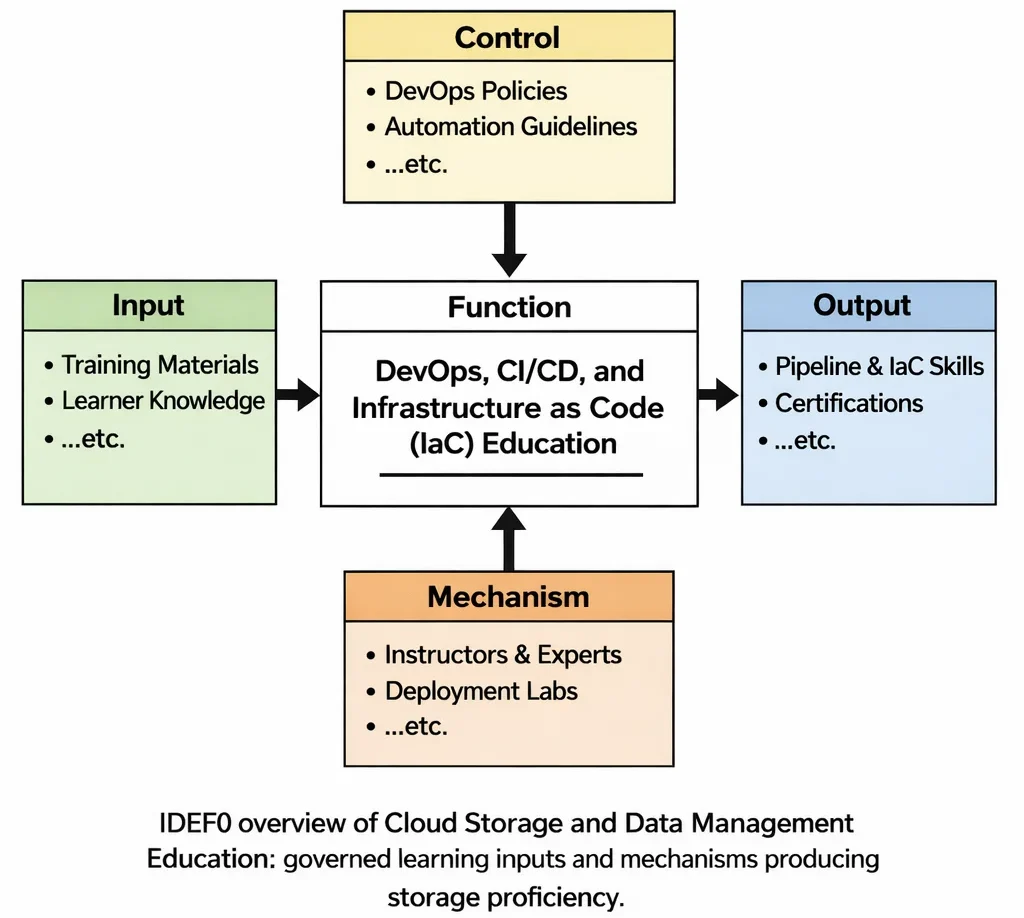
This IDEF0 (Input–Control–Output–Mechanism) diagram presents DevOps, CI/CD, and Infrastructure as Code (IaC) Education as a structured transformation process. Inputs such as learning materials, starter code, and learner readiness flow into the central function. Controls—standards, policies, quality gates, and security expectations—govern how pipelines and infrastructure practices are taught and assessed. Mechanisms such as instructors, toolchains, labs, and platforms enable hands-on practice. Outputs include learners who can design CI/CD workflows, apply automated testing and release discipline, and manage repeatable infrastructure through code—producing more reliable, auditable, and scalable delivery practices.
DevOps, CI/CD, and Infrastructure as Code (IaC) represent a transformative approach to software development and operations, bridging the gap between development and IT operations teams. As a foundational concept within information technology, these practices help deliver software faster, more reliably, and with greater alignment to business needs. By automating infrastructure provisioning and streamlining deployment workflows, they support scalable digital ecosystems across sectors of STEM and industry.
The rise of cloud computing has significantly accelerated the adoption of DevOps methodologies. Infrastructure can now be defined through code, making it version-controlled, testable, and repeatable. This aligns tightly with cloud service models such as IaaS and PaaS, and allows for rapid configuration across diverse cloud deployment models. Combined, these tools lay the foundation for resilient, automated systems.
Effective CI/CD pipelines rely on principles such as continuous integration, continuous delivery, and continuous deployment. These workflows benefit from strong support by underlying cloud architectures and practices like containerization and serverless computing. They ensure that application updates can be automatically built, tested, and deployed in real time with minimal human intervention.
With automation comes responsibility—especially around cybersecurity. Secure DevOps practices integrate application security, policy-driven access controls, and compliance management at every stage of the deployment cycle. More advanced integrations include AI and ML in cybersecurity, which enable predictive analytics and anomaly detection for secure code delivery.
Real-world implementation also demands an understanding of broader trends such as emerging technologies and edge computing. These innovations require continuous optimization and performance tuning to deliver applications close to the data source. The growing scale and complexity of infrastructure further underscore the need for robust networking and connectivity strategies.
Storage and state management are also critical. When combined with cloud storage and data management, DevOps workflows ensure data consistency and availability across geographically distributed deployments. Teams using Infrastructure as Code gain full control over environment configuration and can integrate code with cloud security solutions, embedding security directly into infrastructure provisioning scripts.
Governance and awareness are essential for successful implementation. Initiatives like cybersecurity awareness and adherence to cybersecurity policy help organizations maintain compliance. Topics such as cryptography and CPS security further strengthen DevOps by addressing vulnerabilities in both application layers and physical infrastructure.
Ultimately, DevOps, CI/CD, and IaC enable organizations to respond to change rapidly, reduce deployment risk, and enhance collaboration. When embedded within broader internet and web technologies ecosystems, they provide a foundation for future-ready systems. For students pursuing careers in artificial intelligence and machine learning, cybersecurity, or digital engineering, mastery of these principles is essential for delivering robust, scalable, and secure digital solutions.

This illustration presents modern software delivery as a coordinated machine. Large, colorful gears labeled DEVOPS, CI/CD, and IAC symbolize the tight coupling of teamwork, continuous integration/continuous delivery pipelines, and infrastructure defined through code. Around them, visual elements—such as code snippets, monitoring charts, cloud services, and data pipes—suggest automated testing, build-and-release workflows, configuration management, and observability. The overall message is that reliable systems are produced not by isolated steps, but by repeatable automation and feedback loops that keep development and operations moving in sync.
Building Cloud Systems: Delivery & Automation Navigation
Discover how DevOps methodologies, CI/CD automation pipelines, and declarative Infrastructure as Code (IaC) orchestrate operations across the Cloud Computing cluster. Each card highlights automated provisioning, continuous testing, release strategies, and observability workflows.
Cloud Systems Overview
Presents the macro architectural framework, detailing how automated release pipelines and IaC configurations control underlying compute, storage, and networking layers.
Layers of Cloud Services
Examines provisioning raw IaaS virtual instances using Terraform scripts, deploying application code onto PaaS environments, and managing SaaS administrative API integrations.
Deployment Strategies
Explores orchestrating multi-environment pipeline deployments, using unified IaC codebases to mirror staging setups across private data centers and public cloud targets.
Data in Distributed Systems
Details automated database migration scripts, managing remote state backends (S3 with DynamoDB state locking), and continuous database snapshot verification.
Resource Abstraction
Covers building container images (Dockerfiles) within CI pipelines, pushing images to container registries, and executing declarative deployments in Kubernetes clusters (Helm/GitOps).
Automated Delivery Systems
Focuses on version control workflows, automated CI testing, canary/blue-green deployments, declarative IaC (Terraform, CloudFormation), configuration management (Ansible), and DevSecOps.
Cloud Connectivity
Details scripting Virtual Private Clouds (VPCs), automated subnets, security group rules, load balancer ingress routes, and Transit Gateways programmatically via code.
Scaling & Reliability
Analyzes automated horizontal pod autoscaling (HPA), automated load-testing integration inside staging pipelines, and self-healing zero-downtime rolling updates.
Trust & Governance
Integrates automated security scanning (SAST/DAST), static code dependency checks, secret management via HashiCorp Vault, and policy-as-code compliance checks (OPA).
Serverless Execution
Explores serverless framework deployment pipelines, packaging event-driven lambda functions, and automating API Gateway route definitions via IaC templates.
Edge & Distributed Futures
Examines extending CI/CD deployment pipelines directly to remote IoT edge nodes and regional PoP gateways using containerized GitOps synchronization.
Core Pillars of Modern DevOps & Automated Delivery
DevOps combines cultural philosophy, engineering practices, and automated toolchains to accelerate software delivery cycles while maintaining system stability:
- Continuous Integration (CI): The practice where software engineers frequently commit code updates to a central version-controlled repository (e.g., Git). Each push automatically triggers an isolated build server to run unit tests, static code analysis (linters), and integration checks—flagging defects early before code reaches main branches.
- Continuous Delivery (CD) vs. Continuous Deployment:
- Continuous Delivery: Automates the entire release engineering process up through staging validation, ensuring every code change is packaged and instantly ready for production deployment via a single manual approval.
- Continuous Deployment: Extends automation further by automatically deploying every validated code push directly into live production environments without human intervention.
- Infrastructure as Code (IaC): Managing and provisioning server instances, virtual networks, storage, and access controls using declarative, machine-readable configuration files (Terraform, AWS CloudFormation, Pulumi, Ansible).
- Key Advantages: Eliminates human configuration drift, enables version-controlled infrastructure history, allows automated peer code review, and enables rapid multi-environment replication.
- DevSecOps & Shift-Left Security: Embedding automated security scanners (Snyk, Trivy, SonarQube) and secret key detection directly inside early pipeline stages, ensuring vulnerabilities and policy violations are caught during local pull requests.
- Zero-Downtime Deployment Strategies:
- Blue-Green Deployments: Maintaining two identical physical environments (Blue = Live, Green = New Release). Once Green passes full automated testing, load balancer router switches live user traffic instantly.
- Canary Releases: Incrementally routing a tiny fraction of live user traffic (e.g., 5%) to a new software build, monitoring error logs, and gradually scaling traffic up to 100% if stable.
Why Study DevOps, CI/CD, and Infrastructure as Code
Mastering automated delivery workflows bridges the gap between software development and systems engineering:
- Modern Software Delivery Standard: Knowledge of Git, automated pipeline runners (GitHub Actions, GitLab CI, Jenkins), and Docker/Kubernetes is required across almost all technical software roles.
- Eliminating Human Error: Manual server setup and hand-crafted deployments lead to inconsistent configurations and costly outages; IaC and CI/CD guarantee repeatable environments.
- High Industry Career Demand: DevOps engineers, Site Reliability Engineers (SREs), and Cloud Automation Architects command exceptional industry demand and compensation.
Engineering FAQs: DevOps & Delivery Automation
What is the functional difference between Continuous Delivery and Continuous Deployment?
Both automate building, testing, and packaging code changes. Continuous Delivery stops short of live production, keeping code in a fully tested, deployable state requiring an explicit human approval click to release. Continuous Deployment automatically releases every passed build directly to live users without manual gates.
How does Declarative IaC differ from Imperative Infrastructure Scripting?
Imperative scripting (Bash/Python) specifies step-by-step commands instructing the computer *how* to build infrastructure. Declarative IaC (Terraform) specifies the desired target end-state *what* infrastructure should look like, allowing the IaC engine to automatically compute dependency state differences and apply exact modifications.
What is GitOps and how does it extend Infrastructure as Code?
GitOps uses Git repositories as the single source of truth for infrastructure and application state. Automated agents (e.g., ArgoCD, Flux in Kubernetes) continuously pull configurations from Git, automatically reconciling live cluster states whenever developers merge Git pull requests.
What is “Shift-Left” in DevSecOps?
Shift-left means integrating security practices—such as static code analysis (SAST), container image vulnerability scanning, and license compliance—earlier in the software development lifecycle (to the “left” on the pipeline timeline) rather than testing security right before production release.
How does observability differ from traditional system monitoring?
Monitoring tracks known failure metrics (CPU, RAM, error counts) to alert when thresholds are breached. Observability measures internal system state based on external outputs—combining distributed traces, structured logs, and metrics to help engineers diagnose novel, unexpected distributed system failures.
Interactive Review & Problem Solving
Review Questions & Answers
1. What is DevOps and how does it transform traditional IT practices?
Answer: DevOps is a collaborative cultural and technical methodology integrating software development (Dev) and IT operations (Ops). It breaks down team silos, replacing infrequent manual software handoffs with continuous automated integration, automated testing, and shared operational responsibility.
2. How do CI/CD pipelines contribute to faster software delivery?
Answer: CI/CD pipelines automate building, unit testing, security scanning, and server deployment. By automating repetitive steps, pipelines catch bugs within minutes of code creation and eliminate manual deployment delays.
3. What is Infrastructure as Code (IaC) and how does it benefit cloud operations?
Answer: IaC is the practice of provisioning and managing cloud infrastructure using version-controlled, machine-readable definition files (e.g., Terraform). It guarantees reproducible environments, prevents configuration drift, enables peer code reviews, and accelerates disaster recovery.
4. How do DevOps, CI/CD, and Infrastructure as Code work together to streamline IT processes?
Answer: DevOps provides the team collaboration culture; CI/CD automates the continuous code build, test, and release pipeline; and IaC provisions matching, consistent infrastructure target environments on demand to host those application releases.
5. What are the primary tools commonly used in implementing CI/CD pipelines?
Answer: Common tools include GitHub Actions, GitLab CI/CD, Jenkins, CircleCI, Azure DevOps Pipelines, and ArgoCD (for Kubernetes GitOps deployments).
6. How does automation in CI/CD enhance deployment efficiency and reduce errors?
Answer: Automation removes manual human checklist steps, enforcing exact execution every time. It validates code against automated test suites before release, preventing broken builds or misconfigured settings from hitting production.
7. What challenges might organizations face when adopting DevOps and Infrastructure as Code?
Answer: Cultural resistance between legacy developer/operations teams, steep toolchain learning curves, legacy un-automated infrastructure tech debt, and managing complex secret key permissions securely within automated scripts.
8. How can Infrastructure as Code improve scalability and consistency in IT environments?
Answer: IaC allows developers to clone entire multi-server cloud environments instantly across regions by parameterizing configuration files, ensuring staging and production environments match identically.
9. What role does continuous integration play in maintaining code quality and collaboration?
Answer: CI forces developers to merge small code branches into main repositories daily. Running automated tests on every merge prevents large, difficult integration conflicts (“merge hell”) and provides instant developer feedback.
10. How can organizations measure the success of their DevOps and CI/CD implementations?
Answer: By tracking the four key DORA metrics: Deployment Frequency (DF), Lead Time for Changes (LTC), Mean Time to Restore (MTTR), and Change Failure Rate (CFR).
Thought-Provoking Architectural Questions
1. How can organizations overcome cultural resistance when transitioning to a DevOps model?
Answer: Leadership must incentivize shared goals rather than isolated KPIs (e.g., developers rewarded for stability, ops rewarded for feature speed). Establish cross-functional product teams, create blameless post-mortem retrospective cultures, and start with small pilot automation projects to prove value.
2. In what ways can automation in CI/CD pipelines drive innovation beyond operational efficiency?
Answer: By reducing deployment fear and release labor, engineering teams gain time to experiment with feature flags, run real-time A/B split tests in production, and rapidly iterate on user feedback without fear of breaking infrastructure.
3. How might the integration of Infrastructure as Code transform traditional IT infrastructure management?
Answer: Replaces manual system administration GUI clicks with software engineering workflows (Git commits, peer pull requests, automated linters). Combined with AI, future IaC tools will self-optimize server sizing and automatically resolve security compliance policy drift.
4. What are the potential security challenges in implementing DevOps pipelines, and how can they be mitigated?
Answer: Risks include plain-text API credentials in code repositories and vulnerable pipeline runner nodes. Mitigate by adopting DevSecOps: embedding static code analysis (SAST), secrets detection tools, and pulling credentials dynamically from encrypted vaults (HashiCorp Vault).
5. How can DevOps and Infrastructure as Code contribute to environmental sustainability in IT?
Answer: IaC enables automated teardown of non-production staging environments during off-peak hours (nights/weekends) and auto-scaling production nodes to match active demand, eliminating idle server power draw.
6. What future trends could disrupt current practices of CI/CD and Infrastructure as Code?
Answer: AI-driven self-healing deployment pipelines, zero-config serverless GitOps, policy-driven autonomous cloud infrastructure, and WebAssembly container micro-runtimes.
7. How can the success of DevOps transformations be quantitatively measured?
Answer: By auditing DORA performance metrics: elite teams deploy multiple times per day, have lead times under one hour, restore services from outages in under one hour, and maintain change failure rates under 5%.
8. What role does continuous feedback play in enhancing the quality of CI/CD pipelines?
Answer: Automated test result reports, real-time APM telemetry alerts, and build failure notifications loop back to developers immediately, creating tight learning cycles that prevent recurring bugs.
9. How might integrating DevOps with emerging technologies like IoT and edge computing transform management?
Answer: Enables EdgeOps and GitOps over-the-air (OTA) container updates, allowing central CI/CD pipelines to build, test, and safely push atomic software updates to millions of remote edge devices concurrently.
10. What are the implications of adopting Infrastructure as Code on legacy systems?
Answer: Legacy hardware often lacks cloud APIs for automation. Organizations bridge the gap by placing legacy servers behind configuration management wrappers (Ansible) or containerizing legacy monolith applications.
11. How can DevOps practices contribute to enhanced business agility in a rapidly changing market?
Answer: Shortens product development cycles from months to hours. Businesses can ship market response features, patch vulnerabilities, and deploy customer-driven updates faster than traditional competitors.
12. What long-term benefits can organizations expect from fully integrating DevOps, CI/CD, and IaC?
Answer: Drastically lower operational IT overhead, faster time-to-market, improved application uptime, automated audit readiness, and an agile technical culture capable of continuous innovation.
Numerical Engineering Problems & Solutions
Problem 1: Calculating Monthly Cost Savings from CI/CD Automation
A software enterprise incurs $15,000 per month in engineering labor costs performing manual deployment checklists. Implementing automated CI/CD release pipelines cuts deployment labor costs to $9,000 per month. Calculate monthly financial savings and total annual cost savings.
A software enterprise incurs $15,000 per month in engineering labor costs performing manual deployment checklists. Implementing automated CI/CD release pipelines cuts deployment labor costs to $9,000 per month. Calculate monthly financial savings and total annual cost savings.
Solution:
- Monthly savings = $15,000 – $9,000 = $6,000/month
- Annual savings = $6,000 × 12 months = $72,000/year
Problem 2: Estimating Reduction in Deployment Time
A manual deployment sequence takes 120 minutes per release. Automating the sequence via a CI/CD script reduces deployment time to 30 minutes. If the team executes 20 deployments per month, calculate the time saved per release and total hours saved per month.
A manual deployment sequence takes 120 minutes per release. Automating the sequence via a CI/CD script reduces deployment time to 30 minutes. If the team executes 20 deployments per month, calculate the time saved per release and total hours saved per month.
Solution:
- Time saved per individual deployment = 120 minutes – 30 minutes = 90 minutes
- Total monthly time saved = 90 minutes × 20 deployments = 1,800 minutes
- Convert to hours: 1,800 / 60 = 30 hours per month
Problem 3: Determining ROI for Infrastructure as Code Implementation
An engineering group invests $100,000 in tooling and training to adopt Terraform Infrastructure as Code. The automation yields $40,000 in annual operational efficiency savings. Calculate the payback period in years and the 5-year ROI percentage.
An engineering group invests $100,000 in tooling and training to adopt Terraform Infrastructure as Code. The automation yields $40,000 in annual operational efficiency savings. Calculate the payback period in years and the 5-year ROI percentage.
Solution:
- Payback period = Initial Setup Cost / Annual Savings = $100,000 / $40,000 = 2.5 years
- Total 5-year cumulative savings = $40,000 × 5 = $200,000
- Net financial gain = $200,000 – $100,000 = $100,000
- 5-Year ROI = ($100,000 / $100,000) × 100 = 100.0%
Problem 4: Calculating Improvement in Deployment Frequency
Prior to CI/CD adoption, an IT department executed 4 software releases per month. After implementing continuous delivery automation, deployment frequency rises to 12 releases per month. Calculate absolute release increase and percentage frequency growth.
Prior to CI/CD adoption, an IT department executed 4 software releases per month. After implementing continuous delivery automation, deployment frequency rises to 12 releases per month. Calculate absolute release increase and percentage frequency growth.
Solution:
- Absolute increase = 12 – 4 = 8 additional deployments per month
- Percentage growth = (8 / 4) × 100 = 200.0%
Problem 5: Estimating Error Reduction in Automated Testing
A manual testing suite of 1,000 test cases exhibits an average error rate of 10% (100 missed bugs). Implementing automated unit and integration tests reduces the error rate to 2% (20 missed bugs). Calculate net defect reduction and percentage error drop.
A manual testing suite of 1,000 test cases exhibits an average error rate of 10% (100 missed bugs). Implementing automated unit and integration tests reduces the error rate to 2% (20 missed bugs). Calculate net defect reduction and percentage error drop.
Solution:
- Initial bugs = 1,000 × 0.10 = 100 bugs
- Automated bugs = 1,000 × 0.02 = 20 bugs
- Net bug reduction = 100 – 20 = 80 fewer errors
- Percentage error drop = (80 / 100) × 100 = 80.0%
Problem 6: Calculating Average Pipeline Execution Time
A three-stage CI/CD pipeline consists of: Build & Compile (5 minutes), Unit & Integration Testing (8 minutes), and Artifact Packaging & Staging Deploy (7 minutes). Calculate total execution time per pipeline run and total execution time for 15 pipeline runs per week in minutes and hours.
A three-stage CI/CD pipeline consists of: Build & Compile (5 minutes), Unit & Integration Testing (8 minutes), and Artifact Packaging & Staging Deploy (7 minutes). Calculate total execution time per pipeline run and total execution time for 15 pipeline runs per week in minutes and hours.
Solution:
- Total execution time per run = 5 + 8 + 7 = 20 minutes
- Weekly pipeline duration (15 runs) = 20 minutes × 15 = 300 minutes
- Convert to hours: 300 / 60 = 5 hours per week
Problem 7: Determining Cost per Build in a CI/CD Pipeline
An automated CI pipeline runner consumes 0.5 cloud compute hours per execution build. Cloud build instance usage costs $0.50 per compute hour. Calculate cost per single build and total monthly pipeline expense for 1,000 builds.
An automated CI pipeline runner consumes 0.5 cloud compute hours per execution build. Cloud build instance usage costs $0.50 per compute hour. Calculate cost per single build and total monthly pipeline expense for 1,000 builds.
Solution:
- Cost per individual build = 0.5 hours × $0.50/hour = $0.25 per build
- Monthly cost for 1,000 builds = 1,000 × $0.25 = $250.00/month
Problem 8: Calculating Reduction in Downtime Due to Automated Recovery
A manual rollback sequence during a production outage takes 60 minutes. Deploying automated health-check rollbacks via a CD pipeline reduces recovery time to 15 minutes. Calculate time saved per incident and total annual downtime saved across 10 annual incidents in hours.
A manual rollback sequence during a production outage takes 60 minutes. Deploying automated health-check rollbacks via a CD pipeline reduces recovery time to 15 minutes. Calculate time saved per incident and total annual downtime saved across 10 annual incidents in hours.
Solution:
- Downtime saved per incident = 60 minutes – 15 minutes = 45 minutes saved
- Annual minutes saved (10 incidents) = 45 minutes × 10 = 450 minutes
- Convert to hours: 450 / 60 = 7.5 hours per year
Problem 9: Estimating Infrastructure Cost Reduction via IaC
Manual server provisioning costs an enterprise $50,000 annually in over-provisioned idle compute resources. Transitioning to Terraform IaC automated resource lifecycle teardown reduces annual infrastructure expenses by 30%. Calculate net annual savings and new annual infrastructure cost.
Manual server provisioning costs an enterprise $50,000 annually in over-provisioned idle compute resources. Transitioning to Terraform IaC automated resource lifecycle teardown reduces annual infrastructure expenses by 30%. Calculate net annual savings and new annual infrastructure cost.
Solution:
- Annual cost savings = $50,000 × 0.30 = $15,000/year
- New annual infrastructure cost = $50,000 – $15,000 = $35,000/year
Problem 10: Calculating Pipeline Success Rate Improvement
An un-optimized CI pipeline exhibits an initial build success rate of 85%. Refactoring flaky tests and adding dependency caching raises the pipeline build success rate to 95%. Calculate absolute percentage point improvement and relative efficiency gain.
An un-optimized CI pipeline exhibits an initial build success rate of 85%. Refactoring flaky tests and adding dependency caching raises the pipeline build success rate to 95%. Calculate absolute percentage point improvement and relative efficiency gain.
Solution:
- Absolute improvement = 95% – 85% = 10 percentage points
- Relative improvement = (10% / 85%) × 100 ≈ 11.76%
Problem 11: Computing Average Build Frequency Increase
Before CI/CD pipelines, a software development team triggered 3 compilation builds per day manually. Implementing automated Git commit build triggers raises build frequency to 9 builds daily. Calculate daily build increase and percentage frequency growth.
Before CI/CD pipelines, a software development team triggered 3 compilation builds per day manually. Implementing automated Git commit build triggers raises build frequency to 9 builds daily. Calculate daily build increase and percentage frequency growth.
Solution:
- Daily build increase = 9 – 3 = 6 additional builds per day
- Percentage growth = (6 / 3) × 100 = 200.0%
Problem 12: Break-Even Analysis for DevOps Transformation Investment
A DevOps enterprise transformation requires an upfront investment of $250,000 for training, pipeline migration, and tool licenses. The resulting automation generates $25,000 in monthly operational savings. Calculate the payback period in months and net financial savings over a 3-year period (36 months).
A DevOps enterprise transformation requires an upfront investment of $250,000 for training, pipeline migration, and tool licenses. The resulting automation generates $25,000 in monthly operational savings. Calculate the payback period in months and net financial savings over a 3-year period (36 months).
Solution:
- Payback period = Initial Investment / Monthly Savings = $250,000 / $25,000 = 10 months
- Total 36-month cumulative savings = 36 months × $25,000 = $900,000
- Net financial savings = $900,000 – $250,000 = $650,000
DevOps, CI/CD, and IaC — Summary & Wrap-Up
The sub-topics in DevOps, CI/CD, and IaC collectively address the challenges of modern software development, from efficient coding and deployment to secure and scalable infrastructure management. By adopting these practices and tools, organizations can streamline operations, deliver high-quality software faster, and build resilient systems that adapt to evolving business needs.