
Networking and Connectivity in the Cloud Education is where “the cloud” stops being a floating idea and becomes a set of deliberate pathways. The diagram shows the story in a disciplined way: learners bring in the raw materials—basic networking concepts, examples, and guided exercises (inputs)—but their work is shaped by controls that matter in the real world: security rules, privacy obligations, policy boundaries, and standards that keep networks safe and comprehensible. With mechanisms such as instructors and lab environments, students practice building networks that behave: segmenting systems into subnets, choosing routing patterns, setting up name resolution, controlling traffic with firewall-like rules, and connecting environments through VPNs or hybrid links without accidentally creating an open door. The output is a learner who can reason about connectivity as a design choice—balancing performance, cost, and risk—so that applications communicate reliably, data moves intentionally, and outages are handled with calm architecture rather than panic.
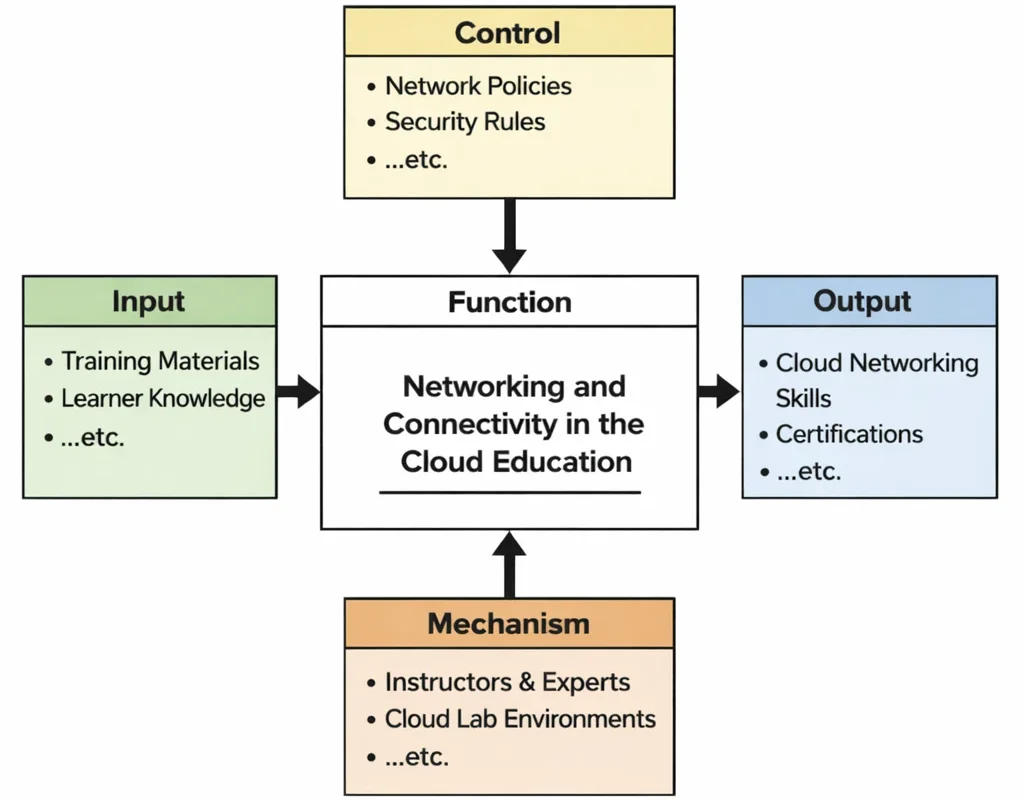
This IDEF0 (Input–Control–Output–Mechanism) diagram frames Networking and Connectivity in the Cloud Education as a practical transformation. Inputs (such as foundational networking knowledge, scenarios, and learning materials) flow into the central learning function. Controls (security and privacy expectations, networking standards, policies, and curriculum requirements) shape acceptable design choices and evaluation criteria. Mechanisms (instructors, labs, network tools, and cloud platforms) provide hands-on practice. Outputs include learners who can explain and configure cloud connectivity—covering virtual networks, subnets, routing, DNS, firewalls/security groups, load balancing, VPNs, and hybrid connectivity—while understanding latency, reliability, and governance trade-offs.
Networking and connectivity in the cloud form the critical infrastructure that enables seamless communication between cloud services, applications, and end-users. As organizations increasingly migrate to cloud computing environments, reliable and secure networking becomes essential for ensuring application performance and business continuity. This interconnected backbone supports various cloud service models, allowing for flexible deployments and robust scalability.
At the heart of this architecture lies an interplay between virtualization, distributed systems, and serverless computing. These technologies rely on optimized network performance to coordinate services and manage data flows. Emerging approaches such as edge computing further extend cloud capabilities to local devices, demanding low-latency connections and real-time responsiveness.
Networking in the cloud also supports continuous integration and delivery workflows through DevOps and Infrastructure as Code. These practices automate deployments and monitoring across distributed environments. Underpinning these operations are cloud-native networks designed to handle high availability, as detailed in performance tuning strategies.
Security is a core consideration. The expansion of digital boundaries increases vulnerabilities, necessitating advanced cybersecurity measures. Topics such as cloud security, cryptography, and application security are tightly integrated into cloud networking. Modern frameworks also leverage AI in cybersecurity to identify threats in real time.
The complexity of maintaining secure connectivity across private, public, and hybrid clouds is reflected in cloud deployment models. Each model poses distinct challenges in access control, encryption, and identity management, addressed by comprehensive security and compliance strategies. The rise of emerging technologies introduces further opportunities and risks that IT professionals must navigate.
Strong foundations in information technology and STEM disciplines are increasingly vital for those managing cloud infrastructure. Understanding protocols, topology, and bandwidth optimization is key to supporting services such as cloud storage and internet technologies. As organizations scale, their ability to maintain smooth connectivity hinges on these technical competencies.
Cloud networks must be designed to withstand evolving threats while meeting demands for speed and resilience. To address this, institutions emphasize cybersecurity awareness and enforce policies such as cybersecurity policy. Broader concerns over CPS security and integrated systems further reinforce the need for comprehensive networking strategies.
Ultimately, networking and connectivity in the cloud go beyond just routers and switches—they encompass the dynamic, adaptive systems that make modern computing possible. As future applications demand ever more agility and integration, cloud networking will remain central to technological advancement and innovation.

This image visualizes cloud networking as a bright central hub connecting distributed components—virtual private clouds, servers, monitoring panels, and application endpoints—through sweeping beams of data. The surrounding icons and technical labels suggest core cloud connectivity ideas such as segmented networks (VPCs), traffic distribution (load balancers), and multi-directional routing between services. Set against a stylized city-and-digital-grid backdrop, the illustration conveys scale and reach: cloud networks are designed to move data reliably across zones and regions, keep connections secure, and ensure users experience fast, stable access to applications and resources.
Building Cloud Systems: Cloud Connectivity Navigation
Discover how cloud networking establishes secure Virtual Private Cloud (VPC) perimeters, load-balanced application ingress gateways, and hybrid connectivity tunnels across the Cloud Computing cluster. Each card details network segmentation, traffic routing, edge acceleration, and hybrid transport protocols.
Cloud Systems Overview
Presents the macro architectural framework, detailing how physical software-defined networks (SDN), backbone fiber rings, and regional cloud gateways transport application traffic.
Layers of Cloud Services
Examines configuring custom virtual networks (VPCs) in IaaS, managed ingress route controllers in PaaS, and secure TLS API endpoints in SaaS applications.
Deployment Strategies
Explores hybrid cross-cloud networking, connecting on-premises data centers to public cloud subnets via IPSec VPNs, AWS Direct Connect, and Azure ExpressRoute.
Data in Distributed Systems
Details private storage endpoints (VPC Endpoints/PrivateLink), storage transfer gateway throughput, and secure transit encryption protocols for data backdoors.
Resource Abstraction
Covers virtual network interface cards (vNICs), Container Network Interfaces (CNI plugins in Kubernetes like Calico/Flannel), and software-defined overlay bridges.
Automated Delivery Systems
Details declarative networking code, using Terraform and CloudFormation to script VPCs, CIDR block allocations, subnets, route tables, and security group rules automatically.
Cloud Connectivity
Focuses on Virtual Private Clouds (VPCs), public/private subnets, Security Groups, Network ACLs, Layer 4/7 Load Balancers, Cloud CDNs, and dedicated hybrid circuits.
Scaling & Reliability
Analyzes multi-region DNS failover (Route 53), global traffic routing, load-balancer health checks, BGP path optimization, and DDoS mitigation at the edge.
Trust & Governance
Enforces zero-trust micro-segmentation, Web Application Firewall (WAF) rule sets, stateful security filtering, and flow-log network traffic auditing.
Serverless Execution
Explores connecting serverless FaaS functions securely to private database subnets within a VPC using managed elastic network interfaces (ENIs).
Edge & Distributed Futures
Examines 5G Mobile Edge Computing (MEC), network slicing, MQTT IoT transport protocols, and low-latency point-of-presence (PoP) edge routing.
Pillars of Cloud Networking & Connectivity
Software-Defined Networking (SDN) abstracts physical network hardware into programmable virtual cloud network architectures:
- Virtual Private Cloud (VPC) & Network Segmentation:
- Subnet Isolation: Dividing IP address space (CIDR blocks) into Public Subnets (internet-routable via Internet Gateways) and Private Subnets (isolated for internal application/database tiers behind NAT Gateways).
- Traffic Access Control: Dual-layer security enforcement using stateful Security Groups (instance-level filtering) and stateless Network ACLs (NACLs) (subnet-level filtering).
- Traffic Distribution & Edge Delivery:
- Layer 7 Application Load Balancers (ALB): Content-aware routing evaluating HTTP/HTTPS headers, paths, and hostnames to distribute traffic across target container groups.
- Layer 4 Network Load Balancers (NLB): Ultra-high performance transport-layer routing processing millions of TCP/UDP requests per second with ultra-low latency.
- Content Delivery Networks (CDNs): Global edge caching platforms (CloudFront, Cloudflare) serving static assets and terminating SSL/TLS sessions near end users to minimize network roundtrip latency.
- Hybrid Network Tunnels & Interconnects:
- IPSec VPN Tunnels: Encrypted site-to-site connections passing data over the public internet between on-premise routers and cloud Virtual Private Gateways.
- Dedicated Private Connections: Direct physical fiber circuits (AWS Direct Connect, Azure ExpressRoute) bypassing the public internet to deliver guaranteed 10Gbps+ bandwidth, zero latency jitter, and reduced data egress costs.
- VPC Peering & Transit Gateways: Hub-and-spoke virtual routers connecting thousands of independent VPCs and on-premises networks into a unified network fabric.
Why Study Networking and Connectivity in the Cloud
Mastering cloud networking concepts provides the foundation for designing secure, high-throughput distributed systems:
- Data Flow Understanding: Teaches engineers how data, DNS requests, and API payloads travel across global software-defined subnets and WAN backbones.
- Security Perimeter Design: Enables systems architects to build zero-trust isolation boundaries, preventing unauthorized lateral network movement during security breaches.
- High Industry Value: Expertise in cloud network engineering, hybrid interconnect routing, and BGP peering is essential across cloud architecture, SRE, and network security specialist roles.
Engineering FAQs: Cloud Networking & Connectivity
What is a Virtual Private Cloud (VPC), and why is it essential?
A VPC is a logically isolated virtual network allocated within a public cloud provider. It gives users complete control over IP address ranges, subnets, routing tables, and network gateways, establishing a private data center environment in the cloud.
What is the functional difference between Security Groups and Network ACLs?
Security Groups operate at the virtual machine/instance layer and are *stateful* (inbound allowed traffic automatically permits response outbound traffic). Network ACLs operate at the subnet boundary layer and are *stateless* (inbound and outbound rules must be explicitly defined for both directions).
How does a Site-to-Site VPN differ from AWS Direct Connect or Azure ExpressRoute?
A Site-to-Site VPN encrypts traffic over the public internet, offering lower cost but variable latency and bandwidth limits. Direct Connect and ExpressRoute supply dedicated physical fiber optic links directly from an on-premise data center to the cloud provider, delivering predictable latency and higher bandwidth.
What is the role of a NAT Gateway in a private subnet?
A Network Address Translation (NAT) Gateway allows instances in a private subnet to initiate outbound internet connections (e.g., to download OS software patches) while blocking unsolicited inbound connections from the open internet.
How does DNS Global Traffic Management (Route 53) support disaster recovery?
Global DNS services run automated health checks against regional application endpoints. If a primary cloud region fails health checks, DNS routing records dynamically update within seconds, shifting user traffic to an active standby region automatically.
Interactive Review & Problem Solving
Review Questions & Answers
1. What is cloud networking and how does it differ from traditional networking?
Answer: Cloud networking manages virtualized network resources delivered via software APIs over public or private cloud infrastructure. Unlike traditional networking dependent on physical switches and routers, cloud networking is fully software-defined (SDN), programmatic, and instantly scalable.
2. How do virtual networks operate within a cloud environment?
Answer: Virtual networks function by abstracting physical network interfaces into logical software overlays. They allow administrators to define custom IPv4/IPv6 CIDR blocks, private subnets, routing tables, and security firewalls through web consoles or IaC configuration code.
3. What role does software-defined networking (SDN) play in cloud connectivity?
Answer: SDN decouples the network control plane (management logic) from the underlying data plane (packet forwarding). This centralization allows cloud software to provision virtual routers, firewalls, and load balancers programmatically in seconds.
4. How is network security maintained in cloud environments?
Answer: Security is maintained using a defense-in-depth approach: stateful Security Groups, stateless NACLs, Web Application Firewalls (WAF), TLS 1.3 packet encryption in transit, private VPC endpoints, and automated flow-log security analytics.
5. What are the benefits of using load balancing in cloud connectivity?
Answer: Load balancers distribute incoming traffic across multiple target compute instances, eliminating single points of failure, enabling health-check auto-healing, performing SSL/TLS decryption offloading, and supporting auto-scaling pools.
6. How do cloud providers ensure high availability and redundancy in their networks?
Answer: Providers build redundant physical fiber rings connecting isolated Availability Zones (AZs) within each region, deploying redundant BGP edge routers, multi-path routing, and automatic failover links.
7. How does connectivity impact cloud performance and scalability?
Answer: Low-latency, high-bandwidth connections accelerate API request handling and database replication. Scalable ingress load balancers and CDN edge networks ensure application speed remains fast as user concurrency increases.
8. What challenges are associated with managing cloud network infrastructures?
Answer: Challenges include overlapping IP subnets in hybrid deployments, complex cross-region routing tables, cloud data egress bill management, and securing multi-tenant network perimeters against unauthorized lateral movement.
9. How do hybrid cloud environments manage connectivity between on-premise and cloud resources?
Answer: Using encrypted IPSec VPN tunnels or dedicated private fiber connections (AWS Direct Connect / Azure ExpressRoute) paired with Transit Gateways to route internal RFC 1918 private IP traffic seamlessly.
10. What future trends are shaping the evolution of cloud networking and connectivity?
Answer: 5G Mobile Edge Computing (MEC), AI-driven autonomous network routing, eBPF kernel network monitoring, zero-trust network access (ZTNA), and quantum-safe TLS encryption.
Thought-Provoking Architectural Questions
1. How can emerging networking technologies like SDN and NFV reshape cloud connectivity and improve operational agility?
Answer: SDN and Network Functions Virtualization (NFV) replace proprietary hardware appliances with virtualized software modules (virtual firewalls, routers, load balancers). This allows CI/CD pipelines to spin up complex, isolated network topologies programmatically in seconds.
2. What impact will 5G connectivity have on the future of cloud networking and data processing speeds?
Answer: 5G provides gigabit wireless throughput and sub-5ms latency via URLLC network slices. This allows mobile devices to stream raw sensor feeds directly to cellular tower Mobile Edge Computing (MEC) clusters for instant real-time cloud analysis.
3. How can organizations ensure robust data security and privacy in a multi-cloud networking environment?
Answer: Implement zero-trust network access (ZTNA), enforce mutual TLS (mTLS) authentication between cross-cloud microservices, use cloud-agnostic firewall management tools, and centralize identity controls using single sign-on (SSO).
4. What challenges do geographically distributed cloud data centers pose for network connectivity, and how can they be overcome?
Answer: Challenges include latency jitter, cross-border data transfer costs, and TCP packet loss over long WAN connections. Overcome by using global CDN edge networks, Anycast DNS routing, and dedicated cloud backbone transit networks.
5. How can automation and orchestration tools optimize the management of cloud networking infrastructures?
Answer: Tools like Terraform and Ansible codify network changes into Git repositories. Automated pipelines run security linters, verify CIDR block availability, and apply changes automatically, eliminating human network misconfiguration errors.
6. How do edge computing and cloud networking converge to support real-time data processing in critical applications?
Answer: Local edge gateways filter and process high-frequency telemetry near sensors, using low-latency MQTT connections locally while streaming compressed summary aggregates to central cloud VPCs asynchronously.
7. What role does artificial intelligence play in enhancing network performance and connectivity in cloud environments?
Answer: AIOps engines analyze VPC flow logs in real time to predict network congestion, dynamically adjust routing tables, identify anomalous DDoS traffic patterns, and automatically apply mitigate firewall rules.
8. How might quantum networking technologies influence the future of cloud connectivity and security?
Answer: Quantum Key Distribution (QKD) will provide physically tamper-proof cryptographic key exchange over fiber networks, protecting cloud backbones from quantum computer eavesdropping attacks.
9. What strategies can businesses adopt to balance cost and performance in designing cloud networking infrastructures?
Answer: Use VPC peering instead of expensive transit gateways for local region connections, compress inter-region data transfers, leverage CDN edge caching to reduce origin egress traffic, and place workloads in regions with lower egress rates.
10. How will regulatory changes and global data privacy laws affect the design of cloud networking infrastructures?
Answer: Strict laws force engineers to implement regional network boundaries, keeping citizen data packets locked inside specific localized geographic VPC subnets and blocking unencrypted cross-border transit.
11. What potential benefits and challenges could arise from the convergence of edge computing with cloud networking?
Answer: Benefits include sub-5ms responsiveness for robotics and autonomous vehicles. Challenges include managing thousands of physically insecure remote edge routers and maintaining synchronized security policies across remote locations.
12. How can predictive analytics transform the monitoring and management of cloud networking infrastructures?
Answer: By forecasting bandwidth consumption trends and interface saturation times, enabling automated pre-provisioning of network gateway throughput before performance degradation affects end users.
Numerical Engineering Problems & Solutions
Problem 1: Calculating Monthly Data Transfer Cost Savings
A cloud deployment transfers 50,000 GB of outbound data per month. Standard public internet egress costs $0.12 per GB. Implementing a direct cloud interconnect reduces egress rates to $0.08 per GB. Calculate the monthly cost savings and total annual savings.
A cloud deployment transfers 50,000 GB of outbound data per month. Standard public internet egress costs $0.12 per GB. Implementing a direct cloud interconnect reduces egress rates to $0.08 per GB. Calculate the monthly cost savings and total annual savings.
Solution:
- Cost difference per GB = $0.12 – $0.08 = $0.04/GB saved
- Monthly cost savings = 50,000 GB × $0.04 = $2,000/month
- Annual cost savings = $2,000 × 12 months = $24,000/year
Problem 2: Estimating Latency Reduction Percentage from Network Optimization
An un-optimized cloud application records a network latency of 200 ms. Deploying a Cloud CDN edge location near users reduces network roundtrip latency to 130 ms. Calculate absolute latency reduction in milliseconds and percentage latency speedup.
An un-optimized cloud application records a network latency of 200 ms. Deploying a Cloud CDN edge location near users reduces network roundtrip latency to 130 ms. Calculate absolute latency reduction in milliseconds and percentage latency speedup.
Solution:
- Latency reduction = 200 ms – 130 ms = 70 ms saved
- Percentage latency reduction = (70 ms / 200 ms) × 100 = 35.0%
Problem 3: Determining Throughput Improvement After Load Balancing
An un-balanced web server cluster caps application throughput at 500 Mbps. Deploying a Layer 4 Network Load Balancer (NLB) across 3 target nodes increases cluster throughput to 750 Mbps. Calculate the net throughput gain in Mbps and percentage throughput increase.
An un-balanced web server cluster caps application throughput at 500 Mbps. Deploying a Layer 4 Network Load Balancer (NLB) across 3 target nodes increases cluster throughput to 750 Mbps. Calculate the net throughput gain in Mbps and percentage throughput increase.
Solution:
- Throughput gain = 750 Mbps – 500 Mbps = 250 Mbps increase
- Percentage improvement = (250 Mbps / 500 Mbps) × 100 = 50.0%
Problem 4: Calculating Annual Cost of Redundant Network Connectivity
To guarantee 99.99% availability, an enterprise provisions a secondary backup IPSec VPN tunnel alongside its primary connection, costing $1,200 per month. Calculate the monthly and annual operational cost for the redundant network path.
To guarantee 99.99% availability, an enterprise provisions a secondary backup IPSec VPN tunnel alongside its primary connection, costing $1,200 per month. Calculate the monthly and annual operational cost for the redundant network path.
Solution:
- Monthly redundancy cost = $1,200/month
- Annual redundancy cost = $1,200 × 12 months = $14,400/year
Problem 5: Estimating Savings from Automated Network Monitoring
Manual network logging and troubleshooting costs an IT department $10,000 per year. Implementing automated AIOps network flow log analytics reduces labor monitoring expenses by 60%. Calculate annual savings and new annual monitoring cost.
Manual network logging and troubleshooting costs an IT department $10,000 per year. Implementing automated AIOps network flow log analytics reduces labor monitoring expenses by 60%. Calculate annual savings and new annual monitoring cost.
Solution:
- Annual cost savings = $10,000 × 0.60 = $6,000/year
- New annual monitoring cost = $10,000 – $6,000 = $4,000/year
Problem 6: Calculating the Cost Per Connection in a Cloud Network
An enterprise cloud network hub incurs a total monthly invoice of $8,000 while managing 400 active client IPSec VPN connections. Calculate monthly cost per connection and total annual cost per connection.
An enterprise cloud network hub incurs a total monthly invoice of $8,000 while managing 400 active client IPSec VPN connections. Calculate monthly cost per connection and total annual cost per connection.
Solution:
- Monthly cost per connection = $8,000 / 400 connections = $20 per connection
- Annual cost per connection = $20 × 12 months = $240 per connection per year
Problem 7: Estimating Redundancy Storage Overhead in a Cloud Network
A global network application replicates 100 TB of raw data synchronously across 3 independent regional availability zone storage nodes (total 300 TB). Cloud storage costs $0.05 per GB per month. Convert storage capacity to GB and calculate total monthly storage expense.
A global network application replicates 100 TB of raw data synchronously across 3 independent regional availability zone storage nodes (total 300 TB). Cloud storage costs $0.05 per GB per month. Convert storage capacity to GB and calculate total monthly storage expense.
Solution:
- Total effective storage = 100 TB × 3 copies = 300 TB
- Convert 300 TB to Gigabytes (1 TB = 1,000 GB): 300 × 1,000 GB = 300,000 GB
- Total monthly storage cost = 300,000 GB × $0.05/GB = $15,000/month
Problem 8: Determining the Increase in Network Utilization Efficiency
A cloud network interface operates at an average bandwidth utilization rate of 55%. Deploying dynamic WAN optimization and traffic shaping raises efficient bandwidth utilization to 75%. Calculate absolute percentage point increase and relative percentage improvement.
A cloud network interface operates at an average bandwidth utilization rate of 55%. Deploying dynamic WAN optimization and traffic shaping raises efficient bandwidth utilization to 75%. Calculate absolute percentage point increase and relative percentage improvement.
Solution:
- Absolute increase = 75% – 55% = 20 percentage points
- Relative percentage improvement = (20% / 55%) × 100 ≈ 36.36%
Problem 9: Calculating Bandwidth Requirement for a Cloud Application
A cloud application requires 200 Mbps of dedicated network bandwidth per 1,000 active concurrent users. Calculate total bandwidth required in Mbps and Gbps to support 5,000 active concurrent users.
A cloud application requires 200 Mbps of dedicated network bandwidth per 1,000 active concurrent users. Calculate total bandwidth required in Mbps and Gbps to support 5,000 active concurrent users.
Solution:
- Bandwidth multiplier = 5,000 users / 1,000 users = 5
- Total bandwidth required = 200 Mbps × 5 = 1,000 Mbps
- Convert Mbps to Gbps: 1,000 Mbps / 1,000 = 1.0 Gbps
Problem 10: Estimating Downtime Cost Reduction After Network Upgrades
Network downtime costs a business $5,000 per hour. The legacy infrastructure averages 10 hours of annual downtime ($50,000/year). Upgrading to redundant cloud VPC connections cuts annual downtime by 50% to 5 hours. Calculate financial savings and new annual downtime cost.
Network downtime costs a business $5,000 per hour. The legacy infrastructure averages 10 hours of annual downtime ($50,000/year). Upgrading to redundant cloud VPC connections cuts annual downtime by 50% to 5 hours. Calculate financial savings and new annual downtime cost.
Solution:
- Original annual downtime cost = 10 hours × $5,000 = $50,000
- Downtime hours eliminated = 10 hours × 0.50 = 5 hours saved
- Annual financial savings = 5 hours × $5,000 = $25,000 saved
- New annual downtime cost = 5 hours × $5,000 = $25,000
Problem 11: Calculating Average Monthly Data Usage per User
A cloud platform processes 200,000 GB of total network data egress per month across 10,000 active users. Calculate average monthly data consumption per user and annual data consumption per user.
A cloud platform processes 200,000 GB of total network data egress per month across 10,000 active users. Calculate average monthly data consumption per user and annual data consumption per user.
Solution:
- Monthly data usage per user = 200,000 GB / 10,000 users = 20 GB per user per month
- Annual data usage per user = 20 GB × 12 months = 240 GB per user per year
Problem 12: Break-Even Analysis for Upgrading Network Infrastructure
Upgrading to a high-speed direct interconnect circuit requires a $300,000 initial hardware setup cost. The new network connection saves $30,000 per month in reduced internet egress fees. Calculate the break-even payback period in months and net savings over a 3-year period (36 months).
Upgrading to a high-speed direct interconnect circuit requires a $300,000 initial hardware setup cost. The new network connection saves $30,000 per month in reduced internet egress fees. Calculate the break-even payback period in months and net savings over a 3-year period (36 months).
Solution:
- Payback break-even period = $300,000 / $30,000 = 10 months
- Total 36-month gross savings = 36 × $30,000 = $1,080,000
- Net savings after payback = $1,080,000 – $300,000 = $780,000
Cloud Networking — Summary & Wrap-Up
Networking and connectivity solutions in the cloud, including VPCs, Load Balancing and CDNs, and Hybrid Connectivity, are foundational for building secure, efficient, and scalable cloud architectures. VPCs provide isolated environments for hosting applications, load balancers and CDNs optimize traffic and content delivery, while hybrid connectivity ensures seamless integration of cloud and on-premises resources. Together, these technologies empower businesses to deliver high-performance, resilient, and secure services in a cloud-first world.