
Science — How to Use This Page
- If you enjoy laws, forces, and mathematical models, begin with Physics.
- If you are interested in matter, reactions, and materials, explore Chemistry.
- If you want to understand life, systems, and organisms, start with Biology.
- If you are curious about Earth systems and the environment, explore Earth Science and Environmental Science.
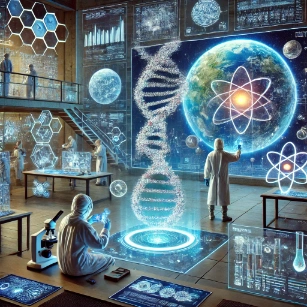
[This visually striking illustration depicts a futuristic science laboratory where researchers interact with holographic projections of DNA strands, atomic structures, and planetary data. Surrounded by digital interfaces and advanced analytical tools, the scientists collaborate in an immersive environment that merges biotechnology, quantum physics, and planetary science—symbolizing the interconnected frontiers of modern scientific discovery.]
Understanding Science — Different Ways of Thinking
- Physics seeks universal laws, often expressed through mathematical models and tested with precise measurement.
- Chemistry focuses on how matter transforms, linking structure, bonding, energy, and reaction pathways.
- Biology studies living systems that are adaptive and historical, where variation and context matter.
- Earth and Environmental Sciences examine large-scale systems—from climate to geology—using observation, field evidence, and simulation.
- Astronomy extends scientific reasoning beyond Earth, using light and radiation to understand distant objects we cannot directly access.
Learning Science — How It Is Learned How Science Is Studied at University
At university, science is studied as both knowledge and practice: you learn concepts, but you also learn how those concepts were earned and how they can fail. Early courses usually build foundations in mathematics, scientific writing, and core theories, while labs introduce measurement, uncertainty, and the discipline of keeping records that others can trust. As you progress, the emphasis shifts from “covering content” to learning how to investigate: designing experiments, choosing controls, reading journal articles critically, and using computation to analyze real data rather than tidy textbook numbers. Tutorials and problem sets train you to move between multiple representations—words, diagrams, graphs, and equations—because scientific understanding is often the ability to translate, not merely to memorize. Many programs include research-based projects where you experience the honest rhythm of science: ambiguity, troubleshooting, revising methods, and defending conclusions with evidence. If you approach university science with the mindset of apprenticeship—learning a craft of careful thinking—then lectures become maps, labs become training grounds, and assignments become practice in making claims that can survive scrutiny.
Explore Science Disciplines
Physics
Discover how forces, motion, energy, and fields govern the universe—from everyday mechanics to modern physics.Chemistry
Understand how matter is structured and how substances transform through reactions, bonding, and energy changes.Biology
Explore living systems—from cells and genetics to ecosystems and evolution.Earth Sciences
Study the processes that shape our planet, including geology, climate, oceans, and natural systems.Environmental Science
Examine sustainability challenges, human impact, and solutions for protecting ecosystems and resources.Application — Science in Action
- Design technologies that power modern life, from electronics to transportation systems
- Develop medical tools and treatments that improve health and extend life
- Understand and respond to environmental challenges such as climate change and resource depletion
- Build models that predict outcomes—from weather systems to disease spread
Micro Real-World Examples
- Why aircraft wings generate lift → Physics (fluid dynamics and pressure differences)
- Why batteries lose capacity over time → Chemistry (electrochemical reactions and material degradation)
- How vaccines train the immune system → Biology (immune response and cellular memory)
- Why earthquakes occur along fault lines → Earth Science (plate tectonics and stress accumulation)
- How renewable energy systems reduce emissions → Environmental Science (energy systems and sustainability)
Direction — Where Science Leads
From Subjects to Real-World Roles
- Physics → Modelling, simulation, and systems thinking → Careers in engineering, aerospace, robotics, and data science
- Chemistry → Materials design and transformation → Roles in pharmaceuticals, energy, manufacturing, and environmental analysis
- Biology → Understanding living systems → Pathways into medicine, biotechnology, healthcare, and research
- Earth Sciences → Large-scale systems and processes → Careers in geoscience, climate science, urban planning, and resource management
- Environmental Science → Sustainability and systems integration → Roles in policy, renewable energy, conservation, and environmental consulting
How to Think About Your Path
- Do you enjoy mathematical models and abstract reasoning?
- Do you prefer experiments and laboratory work?
- Are you drawn to living systems and complexity?
- Do you like working on large-scale systems such as climate or cities?
Perspective — Beyond the Classroom
Science — Review & Reflection
- What distinguishes scientific thinking from simply knowing facts?
- How do different scientific disciplines approach the same problem differently?
- Why is uncertainty an important part of scientific work?
- How does science connect to real-world decision-making?
- Which scientific discipline best matches your way of thinking, and why?
Frequently Asked Questions
What is the difference between science and engineering?
Science focuses on understanding how the world works, while engineering focuses on applying that understanding to design and build solutions.
Do I need to be good at mathematics to study science?
Mathematics is important, especially in physics and chemistry, but different fields use it in different ways. Biology and environmental science often rely more on conceptual understanding and data interpretation.
How do I choose between physics, chemistry, and biology?
Choose based on how you prefer to think: physics emphasizes models and equations, chemistry focuses on transformations of matter, and biology explores living systems and complexity.
Is science mainly about memorisation?
No. While some foundational knowledge is required, science is primarily about understanding relationships, applying concepts, and solving problems.
Can I combine different science disciplines?
Yes. Many modern fields—such as biotechnology, environmental engineering, and data science—combine multiple scientific disciplines.
Science within STEM
Science (You are here)
Understand the natural world through observation, models, and evidence-based reasoning.
Mathematics
Develop the language of science through equations, structures, and models that describe patterns and relationships.
Engineering
Apply scientific principles to design systems, machines, and solutions that work in the real world.
Information Technology
Use data, networks, and computation to extend scientific discovery and application.
Emerging Technologies
Explore how science drives innovation in areas such as AI, biotechnology, quantum computing, and sustainability.