
Lenz’s law explains the direction of induced current in electromagnetic induction. Faraday’s law tells us that a changing magnetic flux induces an emf, but Lenz’s law tells us which way the induced effect acts.
The central message is simple but profound: the induced current always acts in a direction that opposes the change in magnetic flux that produced it. If the magnetic flux through a coil is increasing, the induced current produces a magnetic field that resists that increase. If the magnetic flux is decreasing, the induced current produces a magnetic field that tries to maintain it.
This opposition is not a weakness in nature. It is the way electromagnetic induction protects energy conservation. If induced currents helped the change that created them, energy could appear from nowhere. Instead, an external source of work or energy is required, and that energy is converted into electrical energy, magnetic energy, heat, motion, or useful output.
Lenz’s law connects magnetic flux, induced emf, current direction, magnetic opposition, and energy conservation. It helps students understand generators, transformers, induction cooktops, eddy current braking, electric motors, magnetic damping, and many modern devices where fields and circuits interact.
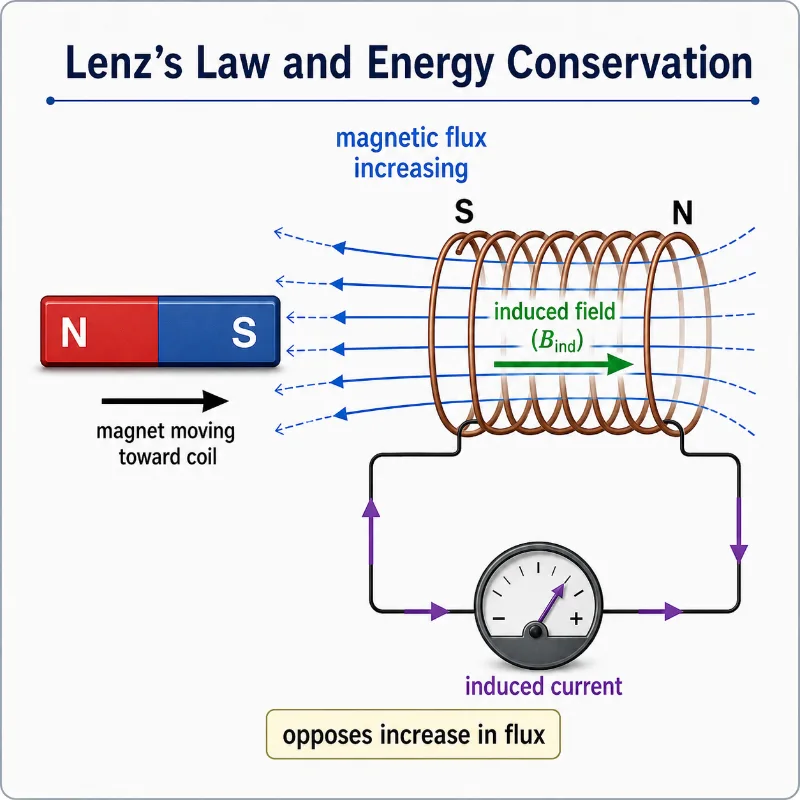
This corrected main picture illustrates Lenz’s law using a magnet whose S pole faces a coil and moves toward it. The magnetic flux through the coil increases toward the left, while the induced magnetic field inside the coil points to the right to oppose that increase. The diagram also shows an induced current in the external circuit and a meter deflection, helping students connect flux change, induced current, and energy conservation in one clear visual.
Electromagnetic Induction Learning Pathway
This page follows the study of magnetic flux and Faraday’s law. Once students understand that changing magnetic flux induces emf, the next question is: which direction does the induced current take? Lenz’s law answers that question by connecting induction with opposition and energy conservation.
Electricity and Magnetism
Provides the wider physics context for electric fields, circuits, magnetic fields, induction, electromagnetic waves, and electrical technologies.Electromagnetic Induction
Introduces how changing magnetic fields and changing currents produce induced emf, induced current, and practical energy conversion.Magnetic Flux and Faraday’s Law
Explains how magnetic flux is defined and why changing magnetic flux produces induced emf in a coil or circuit.Lenz’s Law and Energy Conservation
Explains the direction of induced current and why electromagnetic induction obeys energy conservation.Self-Inductance and Mutual Inductance
Shows how changing current can induce voltage in the same coil or in a neighbouring coil.Generators, Motors, and Transformers
Connects electromagnetic induction to machines that generate electricity, produce motion, and transform voltage.The Core Physical Idea
Lenz’s law states that the direction of an induced current is such that the magnetic field produced by the induced current opposes the change in magnetic flux that produced it.
This law works together with Faraday’s law. Faraday’s law gives the magnitude of the induced emf:
\( \varepsilon = -N\frac{\Delta\Phi}{\Delta t} \)
The negative sign is the mathematical trace of Lenz’s law. It tells us that the induced emf has a direction that opposes the change in flux.
If flux is increasing into a coil, the induced current creates a magnetic field that tries to reduce that increase. If flux is decreasing, the induced current creates a magnetic field that tries to maintain the original flux. The induced effect always responds to change, not merely to the presence of a magnet.
This is why Lenz’s law is often the most meaningful part of electromagnetic induction. It gives direction, but it also gives physical honesty: energy cannot be produced without an energy source.
Pictorial Illustration 1: Magnet Moving Toward a Coil
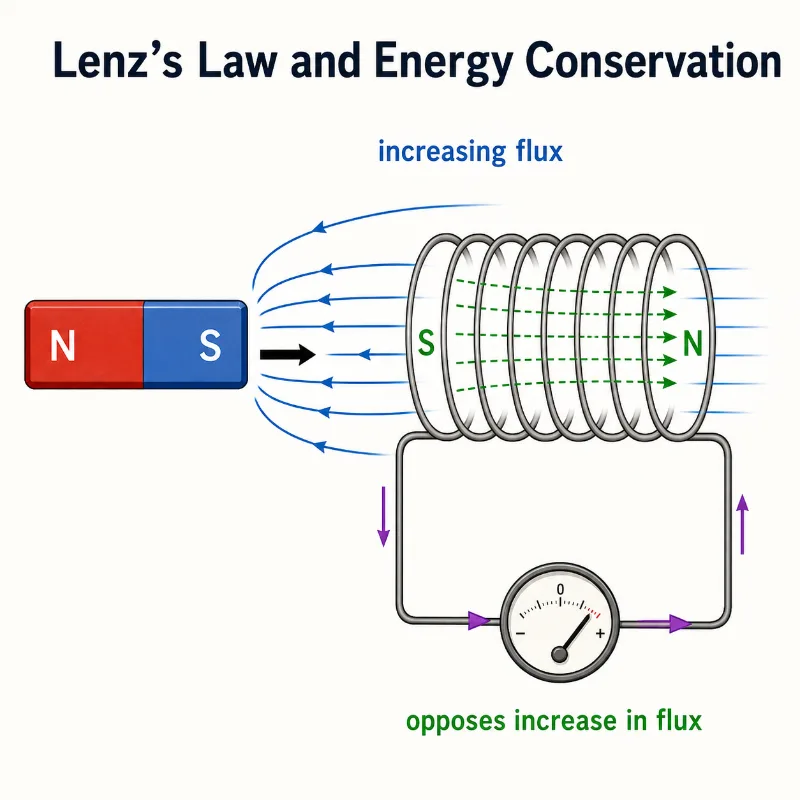
This corrected illustration shows the S pole of a magnet moving toward a coil. The external magnetic field through the coil points toward the S pole, so the magnetic flux through the coil increases in that direction. By Lenz’s law, the induced current produces a magnetic field in the opposite direction to resist the increase in flux. The diagram helps students connect magnetic field direction, induced current, and energy conservation.
Pictorial Illustration 2: Magnets Moving Toward and Away from a Coil Compare
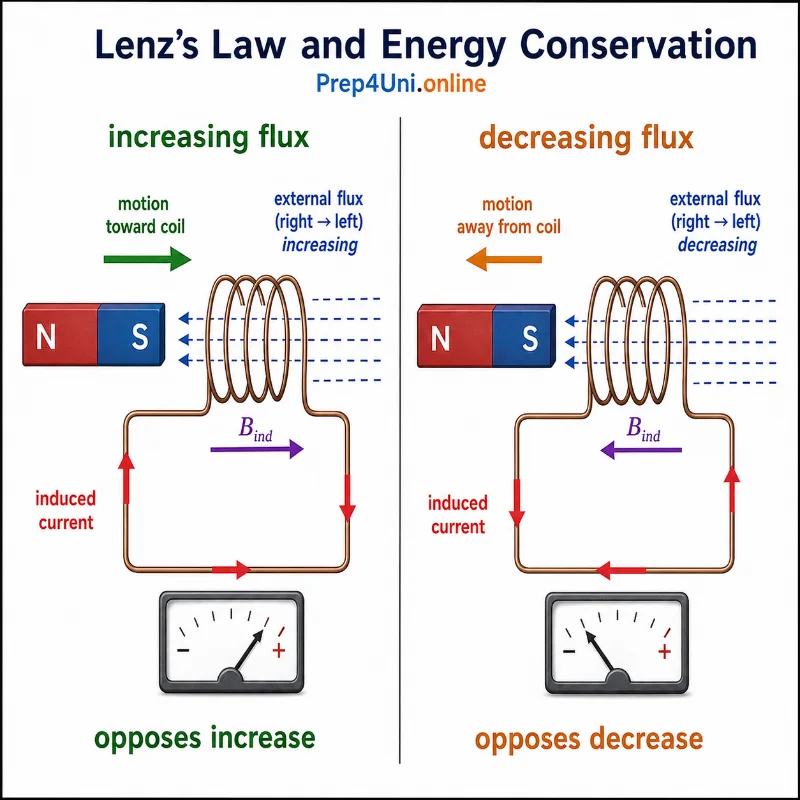
This corrected diagram compares two cases of Lenz’s law. In one case, a magnet moves toward a coil and the magnetic flux through the coil increases, so the induced current produces a magnetic field that opposes the increase. In the other case, the magnet moves away and the flux decreases, so the induced current reverses direction to oppose the decrease. The diagram helps students see that Lenz’s law is about opposing the change in flux, not simply opposing the magnet itself.
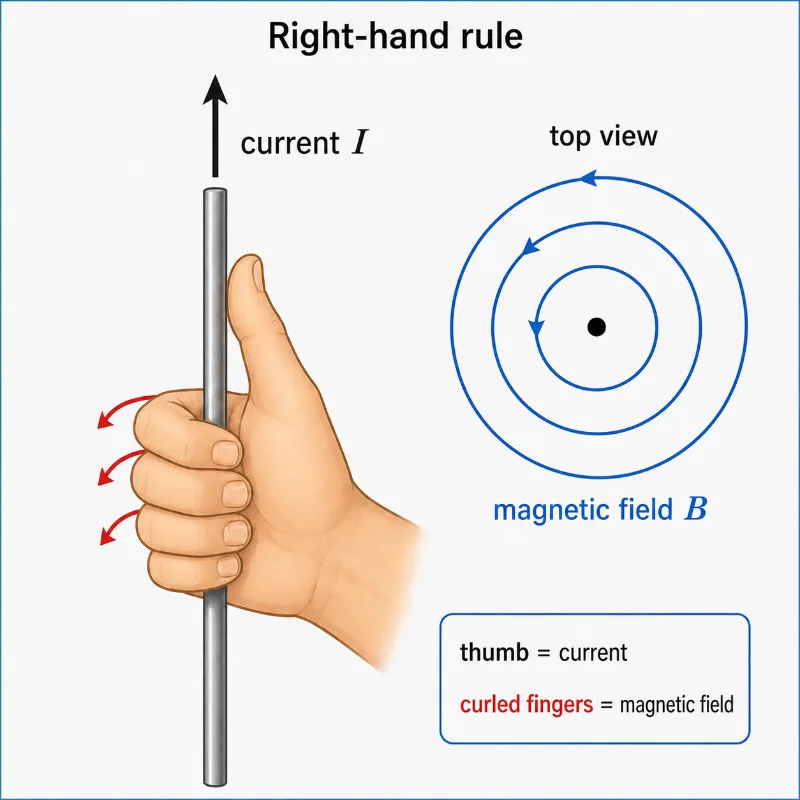
Pictorial Illustration 3: Induced Current Direction Using the Right-Hand Grip Rule
How Lenz’s Law Works Step by Step
Students often struggle with Lenz’s law because they try to guess the current direction too early. A better method is to work step by step. The direction of current is the last step, not the first.
Step 1: Identify the Original Magnetic Flux
Decide the direction of the magnetic flux passing through the coil before or during the change.Step 2: Decide Whether the Flux Is Increasing or Decreasing
Ask whether the magnetic flux through the coil is becoming larger, smaller, or changing direction.Step 3: Choose the Opposing Magnetic Field
The induced current must create a magnetic field that opposes the change in flux.Step 4: Use the Right-Hand Grip Rule
Use the required induced magnetic field to determine the direction of induced current around the coil.Opposing the Change, Not Opposing Everything
A common misunderstanding is that Lenz’s law says the induced current always opposes the magnet or always opposes motion. This is too simple. The induced current opposes the change in magnetic flux.
If a magnet approaches a coil, the flux through the coil may increase. The induced current then creates a field that resists that increase. This often appears as repulsion.
If the magnet moves away, the flux through the coil may decrease. The induced current then creates a field that resists that decrease. This can appear as attraction.
The same law can therefore produce different visible effects depending on whether flux is increasing or decreasing. The deeper idea is always opposition to change.
Pictorial Illustration 4: Opposing Increase and Opposing Decrease in Flux
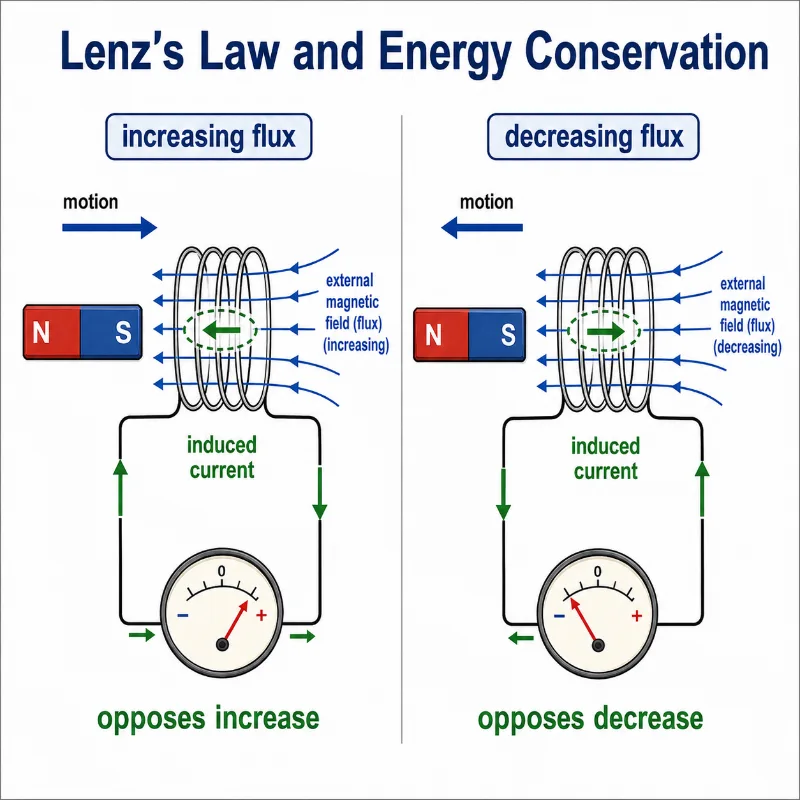
This corrected comparison diagram shows two Lenz’s law cases using horizontal magnets. In the left panel, the magnet moves toward the coil, the magnetic flux increases, and the induced current produces a magnetic field that opposes the increase. In the right panel, the magnet moves away from the coil, the magnetic flux decreases, and the induced current reverses direction to oppose the decrease. The opposite meter deflections help students see that reversing the flux change reverses the induced current direction.
Why Energy Conservation Requires Lenz’s Law
Lenz’s law is closely tied to conservation of energy. Imagine pushing a magnet toward a coil. The changing magnetic flux induces a current in the coil. That current produces its own magnetic field, which resists the motion of the magnet.
Because of this resistance, external work must be done to keep pushing the magnet. That work is not lost. It is converted into electrical energy in the circuit, magnetic energy in the field, heat in the wire, or other forms of energy.
If the induced current helped the magnet move, the magnet would accelerate, the flux would change faster, the induced current would grow, and the system could create energy without any external input. Such behaviour would violate energy conservation.
Lenz’s law prevents this impossible situation. It ensures that induced currents demand an energy source. The opposition we observe is the physical sign that energy is being transferred, not created freely.
Pictorial Illustration 5: Energy Conservation in Lenz’s Law
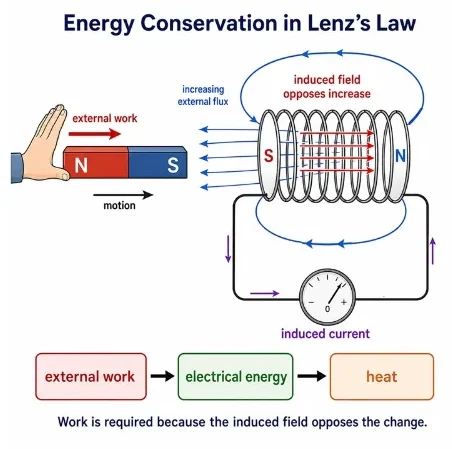
This corrected diagram shows the energy-conservation meaning of Lenz’s law. A magnet with its S pole facing the coil is pushed toward the coil, increasing the external magnetic flux through the coil. The induced current produces a magnetic field that opposes this increase, with field lines leaving the induced N end of the coil and returning to the induced S end. The work done in pushing the magnet is converted into electrical energy and finally into heat, showing that induction transfers energy rather than creating it from nothing.
Vector Field Topology: The Mathematical Invariance of the Minus Sign
At the school level, Lenz’s law is tracked as a descriptive rule to find arrow directions. At the university level, this conceptual opposition translates directly into the fundamental structural architecture of vector field calculus. When we look at the Maxwell-Faraday equation describing electromagnetic interactions point by point in space:
$$ \nabla \times \mathbf{E} = -\frac{\partial \mathbf{B}}{\partial t} $$The leading negative sign is the formal, coordinate-independent signature of Lenz’s law. This operator mapping dictates a strict geometric symmetry: a rising magnetic field vector must generate a curling induced electric field vector whose spatial orientation opposes that very change.
If this invariant sign were positive, the system would exhibit catastrophic positive feedback. A minor field fluctuation would trigger an accelerating circulation loop, driving fields to infinity and violating physical causality. The minus sign acts as a universal stabilization constraint, ensuring that all dynamic field variations in our universe function as stable, energy-conserving negative feedback systems.
The Electromechanical Link: Quantifying Lenz’s Mechanical Braking Force
To connect the abstract energy conservation of Lenz’s law with classical mechanics, we can track the explicit mechanical force vectors generated during induction events. Consider a square conductive loop of wire with width \(l\) and native resistance \(R\) being pulled horizontally at a constant velocity \(v\) out of a uniform magnetic field region (\(\mathbf{B}\)).
As the trailing edge leaves the field boundary, the enclosed magnetic flux decreases. According to Faraday’s law, this rate of change induces a scalar electromotive force:
$$ \varepsilon = Blv $$This induced emf drives a loop current governed by Ohm’s law: \(I = \frac{\varepsilon}{R} = \frac{Blv}{R}\). Because this induced current is physically moving through an active magnetic field domain, the wire segment experiences a classical vector Lorentz force:
$$ \mathbf{F}_{\text{magnetic}} = I(\mathbf{l} \times \mathbf{B}) $$Evaluating the cross-product direction reveals that the resulting vector points exactly counter to the loop’s velocity path. Substituting our current value reveals the quantitative mechanical drag expression:
$$ F_{\text{braking}} = \frac{B^2 l^2 v}{R} $$This proves that to maintain a steady speed, an external operator must apply a matching pull force, expending mechanical power:
$$ P_{\text{mechanical}} = F \cdot v = \frac{B^2 l^2 v^2}{R} $$This mechanical work is not lost; it matches the instantaneous electrical power dissipated as thermal heat inside the wire’s atomic lattice via Joule heating:
$$ P_{\text{electrical}} = I^2 R = \left(\frac{Blv}{R}\right)^2 R = \frac{B^2 l^2 v^2}{R} $$This mathematical bridge perfectly aligns mechanics with electrodynamics, showing that Lenz’s law is a predictable, quantifiable mechanical braking torque that protects the conservation of energy.
Key Equations and What They Mean
Faraday’s law for a coil is:
\( \varepsilon = -N\frac{\Delta\Phi}{\Delta t} \)
\( \varepsilon \) — Induced emf, measured in volts. It is the voltage produced by changing magnetic flux.
\( N \) — Number of turns in the coil. More turns usually produce a larger induced emf.
\( \Delta\Phi \) — Change in magnetic flux through one turn of the coil.
\( \Delta t \) — Time taken for the flux change. A shorter time gives a larger rate of change and therefore a larger induced emf.
The negative sign — The negative sign represents Lenz’s law. It shows that the induced emf acts in a direction that opposes the change in magnetic flux.
For many direction questions, the equation gives only part of the story. The magnitude of emf comes from the rate of change of flux, while the direction comes from Lenz’s law.
Worked Example
Problem: A coil has \( 100 \) turns. The magnetic flux through each turn increases from \( 0.010 \ \text{Wb} \) to \( 0.050 \ \text{Wb} \) in \( 0.20 \ \text{s} \). Find the magnitude of the induced emf and explain the direction of the induced effect using Lenz’s law.
Given: \( N = 100 \), initial flux \( \Phi_i = 0.010 \ \text{Wb} \), final flux \( \Phi_f = 0.050 \ \text{Wb} \), and \( \Delta t = 0.20 \ \text{s} \).
Method: Use the magnitude form of Faraday’s law:
\( |\varepsilon| = N\frac{|\Delta\Phi|}{\Delta t} \)
Solution:
\( \Delta\Phi = \Phi_f – \Phi_i \)
\( \Delta\Phi = 0.050 – 0.010 \)
\( \Delta\Phi = 0.040 \ \text{Wb} \)
For magnitude, use \( |\Delta\Phi| = 0.040 \ \text{Wb} \).
\( |\varepsilon| = 100\frac{0.040}{0.20} \)
\( |\varepsilon| = 100(0.20) \)
\( |\varepsilon| = 20 \ \text{V} \)
Interpretation: The magnetic flux is increasing because the magnet is moving toward the coil. By Lenz’s law, the induced current produces a magnetic field that opposes this increase in flux. The induced effect therefore resists the change rather than reinforcing it.
Worked Example Illustration
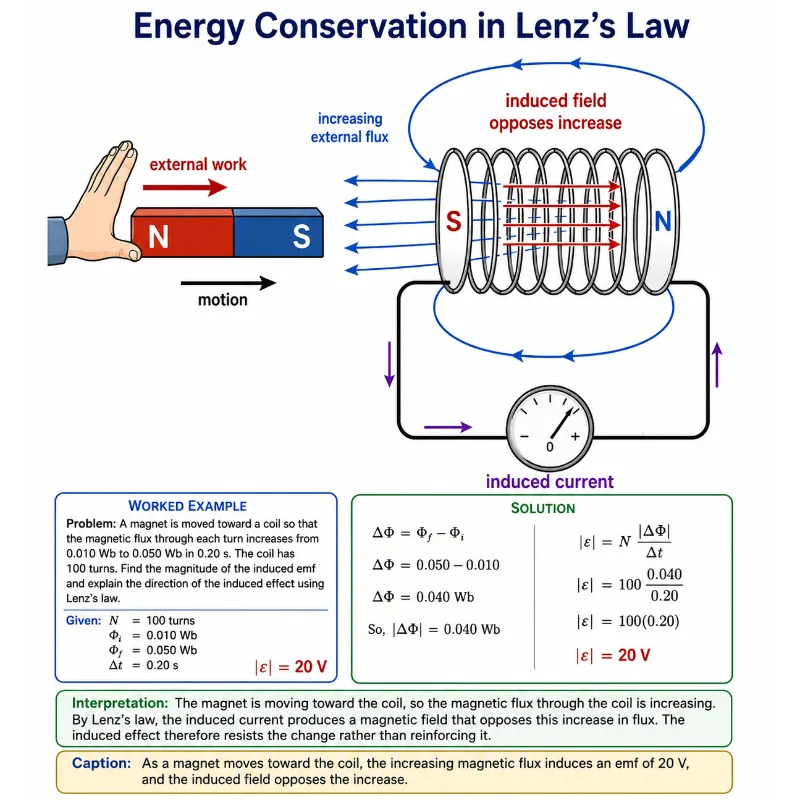
This worked-example illustration connects Faraday’s law with Lenz’s law. A magnet moves toward a 100-turn coil, causing the magnetic flux through each turn to increase from 0.010 Wb to 0.050 Wb in 0.20 s. The induced emf has a magnitude of 20 V. The induced magnetic field opposes the increase in flux, showing that electromagnetic induction follows energy conservation rather than creating energy freely.
What Students Usually Get Wrong
Lenz’s law is often misunderstood because students try to memorise current directions instead of reasoning from flux change. The safest approach is to ask what is changing, then decide what magnetic field would oppose that change.
Thinking Lenz’s Law Always Means Repulsion
Lenz’s law does not always produce repulsion. It opposes the change in magnetic flux, which may appear as repulsion or attraction depending on the situation.Forgetting That Flux Change Is the Key
The induced current responds to changing flux, not simply to the presence of a magnet or magnetic field.Choosing Current Direction Too Early
Students should first decide the required induced magnetic field, then use the right-hand grip rule to find current direction.Ignoring the Negative Sign in Faraday’s Law
The negative sign is not just decoration. It represents the opposition described by Lenz’s law.Thinking Energy Is Lost Without Explanation
The opposition in Lenz’s law shows that work must be done. Energy is converted into electrical energy, heat, motion, or stored magnetic energy.Where This Appears in Real Life
Lenz’s law appears wherever electromagnetic induction produces useful or noticeable effects. It explains why generators require mechanical input, why eddy current brakes slow motion, why induction cooktops heat metal pans, and why transformers transfer energy without creating it freely.
Electric Generators
When a generator supplies current, Lenz’s law explains why mechanical work is required to keep the generator turning.Eddy Current Braking
Moving conductors in magnetic fields can develop circulating currents that oppose motion, creating smooth non-contact braking.Induction Cooktops
Changing magnetic fields induce currents in suitable cookware. These currents oppose the changing field and convert electrical energy into heat.Transformers
Induced currents and voltages in transformer coils follow Lenz’s law, ensuring that energy transfer obeys conservation principles.Magnetic Damping
Induced currents can reduce unwanted motion in meters, instruments, and moving metal parts.Regenerative Braking
In electric vehicles and trains, motion can be converted back into electrical energy, with Lenz’s law explaining the opposing force during energy recovery.Real-World Illustration
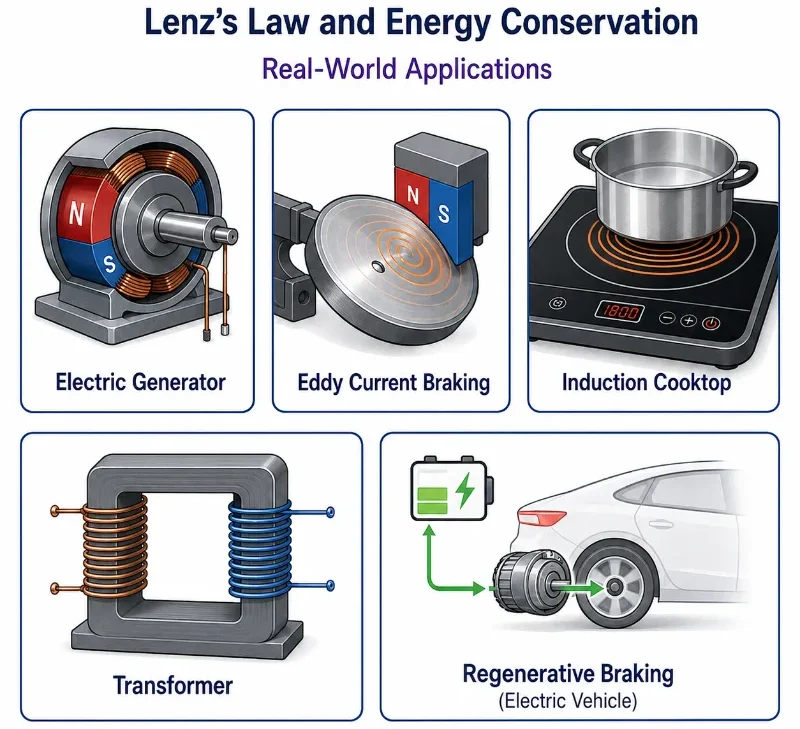
This illustration shows practical examples of Lenz’s law in action. Generators require mechanical work because induced currents oppose the motion that produces them. Eddy current brakes and regenerative braking use magnetic opposition to slow motion. Induction cooktops and transformers use changing magnetic fields while still obeying energy conservation.
Bridge to University Thinking
At university level, Lenz’s law becomes part of a deeper understanding of electromagnetic fields and energy flow. The induced electric field associated with changing magnetic flux has a direction that reflects energy conservation.
In electrical engineering, the same idea appears in back emf, transformer loading, inductive reactance, eddy current loss, magnetic damping, and electromagnetic braking. In each case, the system resists a change in a way that reveals how energy is being transferred.
Lenz’s law also prepares students to think beyond isolated formulas. It encourages them to ask: Where does the energy come from? Where does it go? What change is being resisted? These questions are central to engineering design and scientific reasoning.
Quick Interactive Check
Check Your Understanding of Lenz’s Law
Use these short questions to test whether you understand Lenz’s law as opposition to change in magnetic flux.
What does Lenz’s law tell us?
Your thinking prompt: Think about what direction information is missing from Faraday’s law.
Suggested answer: Lenz’s law tells us the direction of the induced current or induced emf. The induced effect opposes the change in magnetic flux.
If magnetic flux through a coil is increasing, what does the induced current do?
Your thinking prompt: Think about whether the induced field should help or resist the increase.
Suggested answer: The induced current produces a magnetic field that opposes the increase in magnetic flux.
If magnetic flux through a coil is decreasing, what does the induced current do?
Your thinking prompt: Think about how the coil responds to the loss of flux.
Suggested answer: The induced current produces a magnetic field that tries to maintain the original flux, opposing the decrease.
Why is Lenz’s law connected to energy conservation?
Your thinking prompt: Think about what would happen if the induced current helped the change instead of opposing it.
Suggested answer: If the induced current helped the change, energy could be created without work. By opposing the change, Lenz’s law ensures that external work or energy input is required.
Does Lenz’s law always mean the magnet is repelled?
Your thinking prompt: Think about the difference between opposing motion and opposing flux change.
Suggested answer: No. Lenz’s law opposes the change in magnetic flux. This may appear as repulsion in some cases and attraction in others.
Key takeaway: Lenz’s law gives the direction of electromagnetic induction by saying that the induced effect opposes the change in magnetic flux.
Review Questions and Answers
- What does Lenz’s law state?Answer: Lenz’s law states that the induced current flows in a direction such that its magnetic effect opposes the change in magnetic flux that produced it.
- What does the negative sign in Faraday’s law represent?Answer: The negative sign represents the direction of the induced emf, showing that the induced effect opposes the change in magnetic flux.
- Why does a magnet feel resistance when pushed toward a conducting coil?Answer: The changing magnetic flux induces a current in the coil. The magnetic field produced by this current opposes the change, so external work is needed to push the magnet.
- Does Lenz’s law always oppose the motion of a magnet?Answer: Not exactly. Lenz’s law opposes the change in magnetic flux. This may oppose motion in many cases, but the deeper rule is opposition to flux change.
- How does Lenz’s law support conservation of energy?Answer: It prevents induced currents from helping the change that produces them. This means energy cannot be created from nothing; external work or energy input is required.
- What rule can help determine the direction of induced current in a coil?Answer: The right-hand grip rule can be used after deciding the direction of the magnetic field that the induced current must produce.
- What happens when magnetic flux through a coil decreases?Answer: The induced current produces a magnetic field that tries to oppose the decrease and maintain the original flux.
- Give one real-world application of Lenz’s law.Answer: One example is eddy current braking, where induced currents oppose motion and produce a braking force without direct contact.
Thought-Provoking Questions and Answers
- Why is opposition in Lenz’s law not a sign of inefficiency?Suggested answer: The opposition shows that energy transfer is taking place. It is not merely a loss; it is the way nature ensures that energy is supplied, transformed, and conserved.
- Why would the universe be strange if Lenz’s law worked in the opposite direction?Suggested answer: If induced currents helped the change that produced them, small changes could grow without energy input. This would allow energy to appear from nowhere, violating conservation of energy.
- Why is Lenz’s law more than a current-direction rule?Suggested answer: It also explains why work is required in induction systems and how energy flows between motion, fields, circuits, and heat.
- How does Lenz’s law help engineers design safer braking systems?Suggested answer: Engineers can use induced currents to create forces that oppose motion without direct contact, producing smooth magnetic braking in trains, rides, and rotating machinery.
- Why is Lenz’s law useful when studying transformers?Suggested answer: It explains how induced currents and voltages respond to changing magnetic flux, and why transformer loading affects the primary circuit rather than producing energy freely.
Numerical Problems and Solutions
- A coil has \( 50 \) turns. The flux through each turn increases from \( 0.010 \ \text{Wb} \) to \( 0.030 \ \text{Wb} \) in \( 0.10 \ \text{s} \). Find the magnitude of the induced emf and state what the induced current does.Solution:\( \Delta\Phi = 0.030 – 0.010 = 0.020 \ \text{Wb} \)\( |\varepsilon| = N\frac{|\Delta\Phi|}{\Delta t} \)\( |\varepsilon| = 50\frac{0.020}{0.10} \)\( |\varepsilon| = 10 \ \text{V} \)Answer: The induced emf is \( 10 \ \text{V} \). Since the flux is increasing, the induced current produces a magnetic field that opposes the increase.
- A \( 200 \)-turn coil experiences a decrease in flux of \( 0.0060 \ \text{Wb} \) per turn in \( 0.030 \ \text{s} \). Find the magnitude of the induced emf.Solution:\( |\varepsilon| = N\frac{|\Delta\Phi|}{\Delta t} \)\( |\varepsilon| = 200\frac{0.0060}{0.030} \)\( |\varepsilon| = 200(0.20) \)\( |\varepsilon| = 40 \ \text{V} \)Answer: The induced emf is \( 40 \ \text{V} \). The induced current acts to oppose the decrease in flux.
- A magnet is moving away from a coil, causing the magnetic flux through the coil to decrease. In words, what kind of magnetic field does the coil produce?Solution:The coil produces an induced magnetic field that tries to maintain the original magnetic flux.Answer: The coil acts to oppose the decrease in flux. Depending on the pole facing the coil, this may make the coil attract the moving magnet.
- A coil has an induced emf of \( 15 \ \text{V} \) when the flux through each turn changes by \( 0.025 \ \text{Wb} \) in \( 0.50 \ \text{s} \). How many turns does the coil have?Solution:\( |\varepsilon| = N\frac{|\Delta\Phi|}{\Delta t} \)\( N = \frac{|\varepsilon|\Delta t}{|\Delta\Phi|} \)\( N = \frac{(15)(0.50)}{0.025} \)\( N = \frac{7.5}{0.025} \)\( N = 300 \)Answer: The coil has \( 300 \) turns.
Summary
Lenz’s law gives the direction of induced current in electromagnetic induction. It states that the induced current produces a magnetic effect that opposes the change in magnetic flux that created it.
This law is represented by the negative sign in Faraday’s law. Faraday’s law gives the size of the induced emf, while Lenz’s law explains its direction.
Lenz’s law is deeply connected to energy conservation. It ensures that induced currents do not create energy from nothing. Instead, external work or energy input is required, and that energy is converted into electrical energy, magnetic energy, heat, motion, or other useful forms.
Final takeaway: Lenz’s law is nature’s way of saying that electromagnetic induction must obey energy conservation.
Glossary
- Lenz’s Law
- The rule stating that an induced current flows in a direction such that its magnetic effect opposes the change in magnetic flux that produced it.
- Induced Current
- The current that flows in a closed circuit when an emf is induced by changing magnetic flux.
- Induced EMF
- The voltage produced when magnetic flux linked with a circuit changes.
- Magnetic Flux
- The effective amount of magnetic field passing through a surface.
- Flux Change
- The increase, decrease, or reversal of magnetic flux through a circuit or coil.
- Energy Conservation
- The principle that energy cannot be created or destroyed, only transferred or transformed.
- Right-Hand Grip Rule
- A rule used to relate current direction in a coil to the direction of the magnetic field produced by the coil.
- Eddy Currents
- Circulating currents induced in bulk conductors by changing magnetic flux.
- Magnetic Damping
- The reduction of motion or oscillation caused by induced currents opposing motion or flux change.
- Back EMF
- An induced emf that opposes the change or applied voltage that produces it, commonly important in motors and inductive circuits.
Frequently Asked Questions
What is Lenz’s law in simple terms?
Lenz’s law says that an induced current flows in a direction that opposes the change in magnetic flux that caused it.
Why does Lenz’s law oppose change?
It opposes change because energy must be conserved. If the induced current helped the change, energy could be created without work.
Is Lenz’s law part of Faraday’s law?
Lenz’s law is represented by the negative sign in Faraday’s law. Faraday’s law gives the induced emf, while Lenz’s law explains its direction.
Does Lenz’s law always repel a magnet?
No. Lenz’s law opposes the change in magnetic flux. This may appear as repulsion or attraction depending on whether the flux is increasing or decreasing.
Where is Lenz’s law used in real life?
Lenz’s law appears in generators, transformers, induction cooktops, eddy current brakes, magnetic damping, motors, and regenerative braking systems.
External References
- OpenStax University Physics: Lenz’s Law — A clear university-level explanation of Lenz’s law and the direction of induced current.
- PhET: Faraday’s Law Simulation — An interactive simulation showing how moving magnets and coils produce induced current.
- Physics LibreTexts: Lenz’s Law — Additional explanation of Lenz’s law, magnetic opposition, and energy conservation.