
Multiverse and Cosmic Inflation explores the absolute boundaries of theoretical physics and high-energy cosmology. Cosmic inflation models a phase of hyper-exponential metric expansion driven by a scalar field during the universe’s first fractions of a second. This mechanism establishes why the modern observable cosmos presents an exceptional degree of large-scale isotropy, why spatial geometry tracks as nearly flat (\(\Omega = 1\)), and how primordial subatomic quantum fluctuations were stretched into macroscale density perturbations.
Inflation integrates directly into the framework of the standard Big Bang Theory. Rather than replacing the Hot Big Bang configuration, inflation serves as a necessary initial expansion phase, establishing the high-energy initial boundary conditions required before the onset of the standard radiation-dominated cooling eras.
The primary empirical mechanism validating inflationary models is the spatial layout of the Cosmic Microwave Background. The CMB preserves minute temperature anisotropies tracking a scale-invariant power spectrum. These microscale variations represent primordial quantum fields stretched across cosmic horizons during the inflationary epoch, establishing the necessary seeds for the subsequent structure and evolution of the universe.
The concept of a multiverse arises as a direct mathematical consequence of eternal inflation variants. If the scalar field driving expansion rolls down its potential curve at varying rates, inflation can cease in localized pockets while continuing indefinitely in others. These stabilized zones form distinct, causally isolated bubble universes. While mathematically compelling, the multiverse hypothesis remains a theoretical extension that challenges contemporary boundaries of direct observational verification.
Consequently, physics students must distinguish between the relative empirical weights of these two regimes. Cosmic inflation stands as a well-tested scientific paradigm whose predictions match precise CMB data. The multiverse, conversely, sits at the boundary of physics, mathematical topology, and philosophy, demanding sophisticated testing methodologies to evaluate its physical validity. This boundary is further analyzed alongside models of dark energy, as both regimes implement negative-pressure stress-energy tensors to expand the fabric of spacetime.

Reflection: Evidence, Theory, and Speculation
Use this prompt to separate what inflation tries to explain from what the multiverse suggests more speculatively.
Why is cosmic inflation usually treated as a serious scientific model, while the multiverse is often treated more cautiously?
Your thinking prompt: Think about observable evidence, the CMB, early fluctuations, large-scale uniformity, and whether other universes can be directly tested.
Suggested reflection: Cosmic inflation helps explain observable features of our universe, such as its large-scale uniformity, near-flatness, and tiny early fluctuations seen through the CMB. The multiverse may arise from some inflationary models, but other universes would be extremely difficult or impossible to observe directly. This makes the multiverse more speculative than inflation itself.
Early Expansion and Theoretical Extensions
Multiverse and Cosmic Inflation explores how the earliest expansion of the universe may have shaped the conditions we observe today. This navigation section connects inflation, the Big Bang framework, the Cosmic Microwave Background, dark energy, and later structure formation within the wider Cosmology cluster.
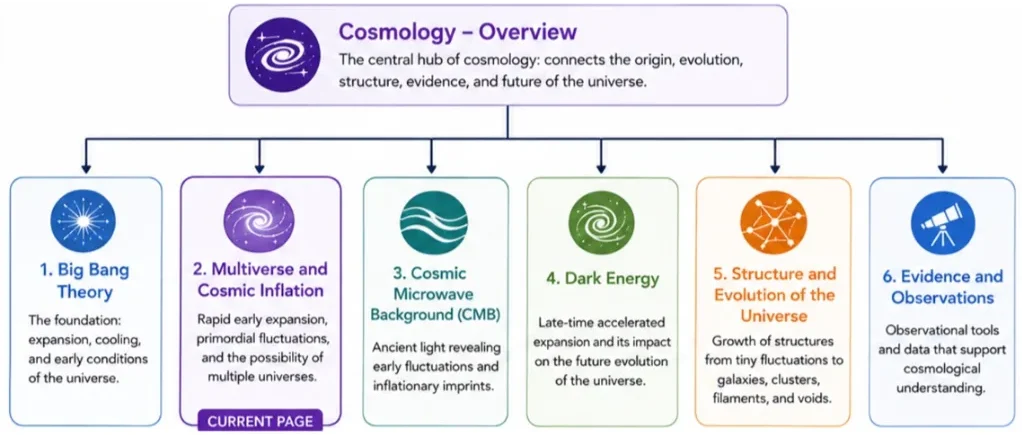
This image presents the Cosmology cluster as a hierarchical learning structure. Cosmology Overview appears as the central hub, with major topic pages arranged below it: Big Bang Theory, Multiverse and Cosmic Inflation, Cosmic Microwave Background, Dark Energy, Structure and Evolution of the Universe, and Evidence and Observations.
Cosmology – Overview
Connects early-universe theories to the wider study of cosmic origin, expansion, structure, evidence, and possible future evolution.Multiverse and Cosmic Inflation
Explores rapid early expansion, the origin of primordial fluctuations, and the speculative possibility that our observable universe may be part of a larger multiverse.Dark Energy
Provides a useful contrast between early rapid expansion during inflation and the later accelerated expansion observed in the modern universe.Cosmic Microwave Background (CMB)
Contains tiny temperature variations that may preserve imprints of early-universe fluctuations stretched across space by inflation.Big Bang Theory
Provides the broad framework of an expanding, cooling universe that inflationary models extend by describing an earlier rapid-expansion phase.Structure and Evolution of the Universe
Links tiny primordial fluctuations to later structure formation, showing how galaxies, clusters, filaments, and voids could grow over cosmic time.The Mathematical Mechanics of the Scalar Inflaton Field
To model a universe expanding exponentially, general relativity requires a stress-energy component whose negative pressure matches its energy density (\(P = -\rho c^2\)). This is achieved theoretically by introducing a scalar field called the </strong>inflaton</strong>, \(\phi\), governed by an associated potential energy curve, \(V(\phi)\). In a homogeneous FLRW background, the energy density \(\rho_\phi\) and pressure density \(P_\phi\) of the field are mapped by its kinetic and potential energy configurations:
$$\rho_\phi = \frac{1}{2c^2}\dot{\phi}^2 + V(\phi)$$$$P_\phi = \frac{1}{2c^2}\dot{\phi}^2 – V(\phi)$$To satisfy the inflationary condition where negative pressure drives exponential growth, the kinetic energy component must remain far smaller than the potential energy profile (\(\frac{1}{2}\dot{\phi}^2 \ll V(\phi)\)). This requirement is modeled via Slow-Roll Inflation. The dynamics of this field rolling down its potential curve are tracked by the scalar wave equation:
$$\ddot{\phi} + 3H(t)\dot{\phi} + \frac{dV(\phi)}{d\phi} = 0$$Where \(\ddot{\phi}\) represents the second time-derivative of the scalar field, and \(3H(t)\dot{\phi}\) functions as a friction term driven by metric space expansion. While the inflaton rolls slowly, the potential energy remains approximately constant, forcing the scale factor \(a(t)\) to expand exponentially over time:
$$a(t) = a_0 e^{Ht}$$Where \(H = \sqrt{\frac{8\pi G V(\phi)}{3}}\) defines the approximately invariant Hubble parameter during the inflationary epoch. When the field reaches the minimum of its potential curve, it oscillates rapidly, decaying its stored vacuum energy into standard high-energy particles and radiation through the Reheating Phase, transitioning the universe directly into the standard hot Big Bang regime.
Reflection: Why Add Inflation to the Big Bang Story?
Use this prompt to connect inflation with the problems it was designed to address.
If the Big Bang model already describes an expanding universe, why did cosmologists introduce inflation?
Your thinking prompt: Think about the horizon problem, flatness problem, missing relics, and the origin of tiny structure-forming fluctuations.
Suggested reflection: Inflation was introduced because the standard Big Bang model alone leaves some questions difficult to answer. Inflation helps explain why distant regions of the universe have similar temperatures, why space appears nearly flat, why certain exotic relics are not observed, and how tiny early fluctuations could become the seeds of cosmic structure.
Thermodynamic Phase Transitions and False Vacuum Decay
To fully map the transition from high-energy inflation to a standard radiation-dominated universe, cosmic models must analyze the microphysics of false vacuum decay. Early inflationary states assume the scalar inflaton field is trapped in a meta-stable local minimum of its potential energy density profile, $V(\phi)$. This high-energy configurations acts as an effective cosmological constant, driving exponential spacetime expansion while maintaining a constant energy density threshold. The transition to the true vacuum state—the global minimum—is governed by semi-classical tunneling mechanisms similar to phase transitions in condensed matter systems.
This decay process occurs via the stochastic nucleation of true vacuum bubbles within the inflating space. The mathematical probability of bubble nucleation per unit volume per unit time is dictated by the bubble action path integral framework:
$$Gamma = A e^{-B/\hbar}$$Within this formal structure, $B$ represents the four-dimensional Euclidean action of the instanton configuration that solves the classical equations of motion. Because the ambient space between newly formed bubbles continues to expand exponentially at a rate dictated by the higher energy density of the false vacuum, the bubbles themselves rarely collide. Instead, this dynamic establishes the physical framework for eternal inflation, wherein individual nucleated patches evolve into isolated pocket universes, each possessing unique localized gauge symmetries, vacuum expectation values, and varying effective physical laws.
The Multiverse Paradigm and Eternal Inflation
The multiverse hypothesis suggests that our observable universe may not be the whole of reality. In some versions, our universe is one region among many, each with different histories, conditions, or perhaps even different physical constants.
This paradigm arises from <strong>Eternal Inflation</strong> models. Because inflation is guided by a quantum scalar field, localized regions of space undergo quantum fluctuations (\(\Delta \phi\)) that can push the inflaton field backwards up its potential curve, causing inflation to continue indefinitely in those sectors. Pockets where the inflaton successfully rolls down to its minimum drop out of the inflationary phase, forming isolated bubble universes embedded within a continuously expanding cosmic background.
Reflection: Why Is the Multiverse Hard to Test?
Use this prompt to distinguish scientific modelling from direct observation.
Why is the multiverse harder to test than cosmic inflation?
Your thinking prompt: Think about what we can observe inside our universe, what lies beyond the observable horizon, and whether other universes could leave measurable evidence.
Suggested reflection: Inflation can be studied through features of our own universe, such as the CMB and large-scale structure. Other universes, if they exist, may be beyond our observable horizon and may not interact with us. This makes direct evidence for the multiverse much harder to obtain.
Observational Frontiers and Cosmic Relics
Cosmic inflation theory is evaluated using precise observational signatures. While direct visualization of pre-recombination eras is prevented by the optical limits of the CMB, inflation leaves clean tensor and scalar perturbation traces that modern arrays are actively engineered to isolate.
Scale-Invariant Fluctuations
Inflationary models predict a nearly scale-invariant spectrum of primordial density perturbations. High-resolution maps from the Planck satellite confirm this distribution pattern with exceptional statistical accuracy.Primordial B-Mode Polarization
Theoretical high-energy inflation models generate a background of primordial gravitational waves. These ripples in spacetime imprint a unique, curl-like polarization signature known as B-modes into the CMB light field.The Cosmological Horizon Limit
The finite speed of light prevents observers from capturing information beyond our localized particle horizon (\(d_H\)), leaving the verification of external bubble universes as a primary conceptual frontier.Reflection: Why Be Careful with CMB Anomalies?
Use this prompt to think about evidence and interpretation.
Why should unusual features in CMB maps be interpreted carefully before claiming new physics?
Your thinking prompt: Think about measurement uncertainty, foreground contamination, statistical chance, and independent confirmation.
Suggested reflection: CMB measurements are extremely precise but also difficult. Foreground radiation, instrument effects, statistical chance, and data processing can all create or exaggerate unusual patterns. Strong claims need independent evidence and careful testing.
Glossary of Key Inflation Terms
- Cosmic Inflation
- A brief period of hyper-exponential metric expansion in the very early universe that resolved the horizon, flatness, and monopole puzzles.
- Inflaton Field
- The scalar field hypothesized to have driven early cosmic inflation through its large potential energy density state.
- Reheating
- The phase transition at the end of inflation where the decaying inflaton field transferred its energy into hot Standard Model particles.
- Eternal Inflation
- An early-universe model where inflation continues indefinitely in a global background space while stopping in localized patches to form bubble universes.
External References
Anisotropy Signatures and Non-Gaussianity Thresholds
Because immediate observational access to adjacent pockets of a suspected multiverse remains inherently bounded by cosmic event horizons, verification algorithms must rely on indirect empirical relics written into our own observable sky. Quantum fluctuations of the inflaton field during the epoch of rapid expansion provide the structural seeds for all large-scale cosmic architecture. Standard single-field slow-roll inflation models predict that these primordial perturbations follow a nearly scale-invariant, highly Gaussian distribution.
To rigorously test extensions of this theory, astrophysics tracks non-Gaussianity metrics within the temperature fluctuations of the Cosmic Microwave Background (CMB). This parameter is mathematically modeled by evaluating the local bispectrum profile of primordial gravitational potentials:
$$B_\Phi(k_1, k_2, k_3) = f_{\text{NL}} \cdot F(k_1, k_2, k_3)$$The dimensionless scaling factor $f_{\text{NL}}$ serves as the primary gauge for measuring deviations from standard Gaussian constraints. If empirical data from satellite observatories isolates structured non-Gaussian features where $f_{\text{NL}} \gg 1$, it would strongly imply multi-field interactions, structural string-theory compactifications, or high-energy field variations during inflation. Furthermore, mapping these minor spatial imbalances allows researchers to rule out alternative cyclic or ekpyrotic models, reinforcing cosmic inflation as the definitive structural origin of the observable universe.
Conclusion
Cosmic inflation provides an elegant, mathematically sound mechanism that sets the precise initial parameters of the standard Big Bang model. By explaining the large-scale smoothness and flatness of space while detailing the quantum origin of modern galaxies, inflation bridges the gap between quantum mechanics and observational cosmology.
Frequently Asked Questions about Inflation and the Multiverse
What is the difference between the Big Bang and cosmic inflation?
The standard Big Bang model details how the universe expanded and cooled over a 13.8 billion-year history. Cosmic inflation is an extension describing a brief, rapid expansion phase that occurred during the first fraction of a second, setting the smooth initial conditions for the Big Bang.Can we prove the existence of the multiverse?
Direct proof is currently limited because other bubble universes would reside outside our causally connected particle horizon. Scientists investigate the multiverse indirectly by testing the specific inflationary models that predict it.Review Questions and Answers
- What are the horizon and flatness problems, and how does inflation solve them? Answer: The horizon problem asks why distant, unconnected patches of space share identical temperatures; the flatness problem asks why the universe tracks as geometrically flat. Inflation solves both by rapidly expanding a tiny, uniform, connected space, smoothing out any curvature and stretching the patch across the observable horizon.
- What occurs during the reheating phase of the early universe? Answer: Reheating marks the termination of cosmic inflation. The potential energy of the inflaton field decays, generating rapid particle creation that fills the newly expanded space with a hot, dense thermal plasma.
Comprehensive 6-Problem End-of-Chapter Bank
Quantitative and Exponential Problems
1. Exponential Scale Factor Configurations during Hyper-Expansion
During cosmic inflation, the scale factor increases exponentially according to the relationship \(a(t) \propto e^{Ht}\). If the invariant expansion rate parameter is \(H = 1.0 \times 10^{35}\,\text{s}^{-1}\) and the time interval spans exactly \(t = 1.0 \times 10^{-35}\,\text{s}\), calculate the corresponding scalar expansion factor.Click to expand solution
Evaluate the dimensionless exponent product inside the exponential scale function:
$$\text{Exponent} = H \cdot t = (1.0 \times 10^{35}\,\text{s}^{-1}) \times (1.0 \times 10^{-35}\,\text{s}) = 1.0$$
Now, resolve the exponential function using this calculated value:
$$\text{Expansion Factor} = e^{1.0} \approx 2.7183$$
The universe expands by a factor of approximately \(2.72\) during this specific time parameter.
2. Logarithmic Extraction of e-Folding and Doubling Milestones
Assume the cosmic scale factor expands uniformly by a total factor of exactly \(10^{26}\) during the inflationary epoch. Determine the number of doubling steps (\(n\)) necessary to generate this metric scale transformation.Click to expand solution
Set up the exponential base-2 doubling equation:
$$2^n = 10^{26}$$
Apply log transformations to isolate the variable \(n\):
$$n = \frac{\log_{10}(10^{26})}{\log_{10}(2)} = \frac{26}{0.30103} \approx 86.37$$
This scale expansion factor corresponds to approximately \(86.4\) volumetric doubling step intervals.
3. Metric Metric Scaling of Primordial Microstate Co-ordinates
A tiny causally connected patch of the primordial vacuum has a proper physical dimension size of \(d_i = 1.0 \times 10^{-26}\,\text{m}\). If this space undergoes an inflationary expansion phase scaling up by a factor of exactly \(10^{26}\), compute its final physical size (\(d_f\)).Click to expand solution
Multiply the initial spatial dimension by the linear expansion factor:
$$d_f = d_i \times \text{Expansion Factor}$$
Substitute the given scientific parameters:
$$d_f = (1.0 \times 10^{-26}\,\text{m}) \times 10^{26} = 1.0\,\text{meter}$$
The subatomic spatial coordinate patch is stretched out to a macroscopic length of exactly \(1.0\,\text{m}\).
4. Volumetric Energy Conversions under Invariant Field Densities
During cosmic inflation, the potential energy density of the inflaton field remains approximately constant (\(\rho_\phi = \text{constant}\)) as space expands. If scale factor growth increases the volume metric of a region by a factor of \(\kappa\), explain mathematically how the total energy contained within that section changes.Click to expand solution
The relationship mapping total energy \(E\) within a specific spatial boundary is given by:
$$E = \rho_\phi \times V$$
If the volume metric scales from \(V\) to \(\kappa V\) while the inflaton potential density remains fixed, the new integrated energy value is tracked as:
$$E_{\text{new}} = \rho_\phi \cdot (\kappa V) = \kappa(\rho_\phi V) = \kappa E_{\text{initial}}$$
Because the field density does not dilute as space expands, the total energy enclosed within the boundary grid increases by an exact factor of \(\kappa\). This energy is drawn directly from the gravitational potential of the expanding metric space.
5. Exponent Evaluations of Primordial Expansion Durations
An early-universe configuration models an inflationary phase lasting for a proper time duration of \(t = 1.0 \times 10^{-32}\,\text{s}\) under an expansion rate coefficient value of \(H = 1.0 \times 10^{35}\,\text{s}^{-1}\). Estimate the absolute magnitude of the exponential scaling factor component \(Ht\).Click to expand solution
Compute the scalar product of the expansion parameters:
$$Ht = (1.0 \times 10^{35}\,\text{s}^{-1}) \times (1.0 \times 10^{-32}\,\text{s}) = 10^3 = 1000$$
The dimensionless exponent component is exactly \(1000\), demonstrating that the scale factor expands by an enormous factor of \(e^{1000}\) during this tiny interval.
6. Wave-Mechanical Stretching of Primordial Wave Mechanics
Explain how microscopic subatomic quantum fluctuations are transformed into macroscopic, structure-forming density perturbations across cosmic dimensions during the inflationary epoch.Click to expand solution
In the early universe, fields experience continuous, microscale quantum variations governed by uncertainty principles. During inflation, the exponential stretching of the spatial metric occurs at a rate faster than the speed of light propagation across localized horizons. This rapid stretching pulls these microscale wave variations out to macroscopic coordinates before they can annihilate, freezing them into the large-scale geometry as stable, non-evolving density variations (\(\delta\)) that later seed galaxies and clusters.