
Large language models (LLMs) trained solely on next-token prediction objectives learn to mimic human language distributions from massive text corpora. However, pure pre-training on raw web data often leads to behaviors that clash with human utility—such as generating toxic responses, hallucinating falsehoods, or complying with unsafe instructions. AI Alignment is the discipline of steering machine learning systems to reliably conform to human intent, ethical guidelines, and operational safety standards, frequently framed around the triad of being Helpful, Honest, and Harmless (HHH).
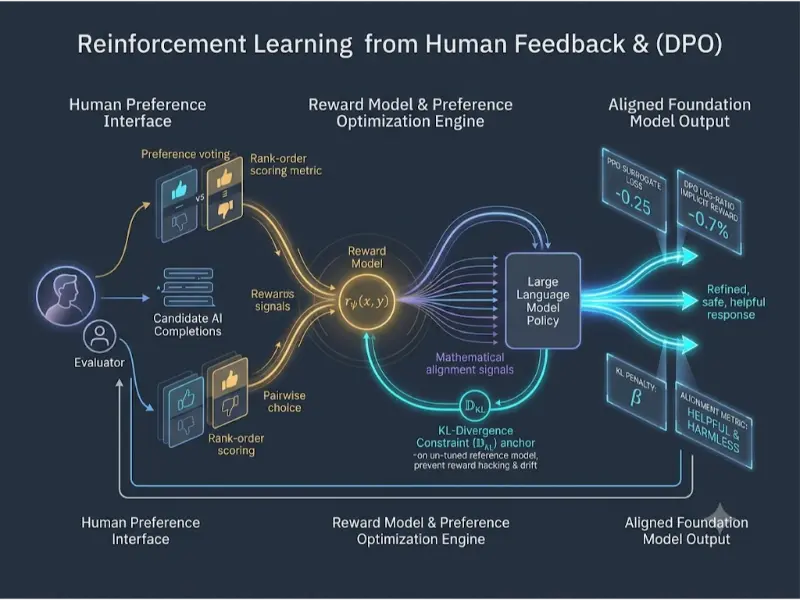
Reinforcement Learning from Human Feedback (RLHF) bridges the gap between raw statistical text completion and goal-directed human alignment. By framing human judgments as a reward signal, RLHF uses optimization algorithms like Proximal Policy Optimization (PPO) or parameter-efficient alternatives like Direct Preference Optimization (DPO) to fine-tune pre-trained models into controlled, instruction-following AI assistants.
Interactive Quick Review: Pre-Training vs. Post-Training Alignment
Why is standard self-supervised pre-training (next-token prediction) insufficient for creating safe and instruction-following AI assistants?
Toggle Answer
Answer: Next-token prediction simply optimizes for reproducing the statistical distribution of internet text, which contains misaligned content, biases, and unhelpful continuations. Alignment post-training (RLHF/DPO) changes the underlying decision-making objective so the model prioritizes user satisfaction, correctness, and safety guidelines over raw statistical mimicry.
Architectural & Theoretical Deep Dives
1. The Classic 3-Stage RLHF Pipeline
The traditional RLHF pipeline consists of three sequential training stages:
- Supervised Fine-Tuning (SFT): A foundation model is fine-tuned on high-quality curated prompt-response pairs (x, y) using cross-entropy loss to establish basic instruction-following behavior, resulting in policy πSFT.
- Reward Model (RM) Training: Human annotators rank two or more candidate completions (yw ≻ yl) for a given prompt x. A scalar reward network rψ(x, y) is trained using the Bradley-Terry preference model loss function:
$$\mathcal{L}_{\text{RM}}(\psi) = -\mathbb{E}_{(x, y_w, y_l) \sim D} \left[ \log \sigma \left( r_\psi(x, y_w) – r_\psi(x, y_l) \right) \right]$$
- Reinforcement Learning Policy Optimization: The SFT policy parameters θ are optimized using RL (PPO) against the scalar output of rψ, moderated by a Kullback-Leibler (KL) divergence penalty to prevent policy drift.
2. PPO Optimization & Reward Hacking Mitigation
In the PPO phase, the total objective maximizes the reward while constraining the policy πθ from straying too far from the initial reference policy πSFT:
$$\text{Objective}(\theta) = \mathbb{E}_{(x, y) \sim \pi_\theta} \left[ r_\psi(x, y) – \beta \, \mathbb{D}_{\text{KL}}\left( \pi_\theta(y \mid x) \,\|\, \pi^{\text{SFT}}(y \mid x) \right) \right]$$
Without the KL penalty multiplier β, the policy engages in Reward Hacking (or Goodhart’s Law breakdown): exploiting loopholes or unintelligible token sequences that maximize the scalar output of the surrogate reward model without actually providing high-quality answers.
3. Direct Preference Optimization (DPO) Mechanics
While effective, PPO-based RLHF is computationally expensive and unstable, requiring four separate neural networks in memory during training (Actor Policy, Reference Policy, Reward Model, and Value Critic). Direct Preference Optimization (DPO) eliminates the reward model and reinforcement learning loop entirely.
By analytically parameterizing the reward function directly through the language model policy:
$$r(x, y) = \beta \log \frac{\pi_\theta(y \mid x)}{\pi_{\text{ref}}(y \mid x)}$$
DPO optimizes the policy parameters θ directly on preference pairs (x, yw, yl) using a closed-form binary cross-entropy loss:
$$\mathcal{L}_{\text{DPO}}(\theta; \pi_{\text{ref}}) = -\mathbb{E}_{(x, y_w, y_l) \sim D} \left[ \log \sigma \left( \beta \log \frac{\pi_\theta(y_w \mid x)}{\pi_{\text{ref}}(y_w \mid x)} – \beta \log \frac{\pi_\theta(y_l \mid x)}{\pi_{\text{ref}}(y_l \mid x)} \right) \right]$$
4. Python Implementation: PyTorch DPO Loss Module
import torch

import torch.nn as nn

import torch.nn.functional as F


class DPOLoss(nn.Module):

    """

    Direct Preference Optimization (DPO) Loss Module.

    Computes implicit rewards and binary cross-entropy preference loss.

    """

    def __init__(self, beta: float = 0.1):

        super().__init__()

        self.beta = beta


    def forward(

        self,

        policy_chosen_logps: torch.Tensor,   # log pi_theta(y_w | x)

        policy_rejected_logps: torch.Tensor, # log pi_theta(y_l | x)

        ref_chosen_logps: torch.Tensor,      # log pi_ref(y_w | x)

        ref_rejected_logps: torch.Tensor     # log pi_ref(y_l | x)

    ) -> torch.Tensor:

        # Compute log-ratio for preferred (chosen) completions

        chosen_logratios = policy_chosen_logps - ref_chosen_logps


        # Compute log-ratio for dispreferred (rejected) completions

        rejected_logratios = policy_rejected_logps - ref_rejected_logps


        # DPO implicit reward differences

        logits = self.beta * (chosen_logratios - rejected_logratios)


        # Binary cross entropy over pairwise preferences

        loss = -F.logsigmoid(logits).mean()

        return loss


# Example Execution

dpo_criterion = DPOLoss(beta=0.1)

pol_win = torch.tensor([-1.2, -0.8])  # Batch size 2

pol_lose = torch.tensor([-3.5, -4.1])

ref_win = torch.tensor([-1.5, -1.0])

ref_lose = torch.tensor([-3.0, -3.8])


batch_loss = dpo_criterion(pol_win, pol_lose, ref_win, ref_lose)

print("Calculated Batch DPO Loss:", batch_loss.item())
Interactive Quick Review: PPO vs. DPO Efficiency
What is the primary memory and operational advantage of DPO over PPO during post-training fine-tuning?
Toggle Answer
Answer: PPO requires loading four networks into memory (Actor, Reference Policy, Reward Model, Value Network) and generating online rollout completions during training. DPO requires only two models (Actor Policy and Reference Policy) and trains statically on pre-collected offline preference datasets via supervised classification, drastically reducing VRAM usage and training time.
Taxonomy & Optimization Comparison Matrix
| Alignment Paradigm | Required Networks in VRAM | Reward Model Needed? | Training Mode | Primary Strength |
|---|---|---|---|---|
| Supervised Fine-Tuning (SFT) | 1 (Policy) | No | Offline Supervised | Establishes basic instruction format & domain knowledge |
| PPO-RLHF (Online RL) | 4 (Actor, Ref, Critic, Reward) | Yes (Explicit) | Online Generation + RL | Dynamic exploration; handles multi-step reasoning environments |
| Direct Preference Optimization (DPO) | 2 (Actor, Reference) | No (Implicit) | Offline Preference Loss | Ultra-fast, stable, and highly memory-efficient optimization |
| Kahneman-Tversky Optimization (KTO) | 2 (Actor, Reference) | No (Implicit) | Binary Signal (Pass/Fail) | Does not require paired data; trains on simple thumbs-up/down logs |
Applications, Trade-offs, & Future Outlook
Real-World Applications
- Enterprise Conversational Copilots: Hardening customer support assistants to prevent prompt injection attacks, swearing, and hallucinated policy promises.
- Code Generation Systems: Aligning code models to prioritize security best practices, proper memory management, and runnable syntax.
- Medical & Legal AI: Enforcing strict refusal boundaries on unverified medical diagnostic prompts while maintaining high assistance utility for licensed practitioners.
Engineering Trade-offs
A primary challenge in AI alignment is the Alignment Tax—the phenomenon where fine-tuning a model for safety and alignment slightly degrades its raw performance on broad capability benchmarks (e.g., creative writing or competitive coding). Furthermore, preference tuning is highly susceptible to annotation bias, where the model learns to output longer, more verbose responses simply because human annotators systematically rate detailed answers higher regardless of factual density.
Future Outlook & Emerging Research
As human feedback collection becomes a bottleneck for scaling frontier models, research is shifting toward RLAIF (Reinforcement Learning from AI Feedback) and Constitutional AI. Systems like Anthropic’s Claude utilize a written set of ethical principles (“Constitution”) to auto-critique, score, and revise model outputs, substituting human evaluation with automated, scalable critique loops.
Frequently Asked Questions
What is Reward Hacking in RLHF?
Reward Hacking occurs when the policy model exploits flaws or edge cases in the proxy reward model to receive high preference scores without generating truly high-quality responses (e.g., repeating flattering phrases or generating artificially long answers).
How does the KL divergence penalty parameter β control model behavior?
The parameter β scales the penalty for drifting away from the original SFT reference policy. A high β keeps the model conservative and close to the SFT baseline, while a lower β gives the policy more freedom to optimize for higher reward scores at the risk of language degradation.
What is the difference between DPO and KTO?
DPO requires preference pairs where a prompt has two comparative choices (chosen vs. rejected). Kahneman-Tversky Optimization (KTO) works on single, unpaired responses labeled simply as positive or negative, matching human prospect theory utility functions.
Why is Supervised Fine-Tuning alone not sufficient for AI alignment?
SFT trains models using teacher forcing to match exact token strings. It cannot penalize unacceptable completions or teach models how to choose between competing valid paths based on qualitative criteria like politeness, conciseness, or safety.
End-of-Page Exercises & Assessment
Part 1: Review Questions
Q1: Define the Bradley-Terry preference model used in Reward Model training.
Answer: The Bradley-Terry model predicts the probability that completion yw is preferred over completion yl given prompt x as a sigmoid function of their scalar reward differences: P(yw ≻ yl | x) = σ(r(x, yw) – r(x, yl)).
Q2: State the primary role of the Value Network (Critic) in PPO-RLHF.
Answer: The Critic network estimates the expected cumulative future reward from the current state, serving as a baseline baseline evaluation to compute Advantage scores and reduce gradient variance during PPO updates.
Q3: What is the “Alignment Tax”?
Answer: The Alignment Tax refers to the observed tradeoff where optimizing a model heavily for safety and human preference leads to a minor drop in performance on generic problem-solving benchmarks.
Q4: How does DPO express the reward function mathematically?
Answer: DPO re-parameterizes the reward function analytically as the log-ratio of the policy model’s probability assigned to a response relative to the reference policy model’s probability, scaled by β.
Q5: What is RLAIF and how does it differ from traditional RLHF?
Answer: Reinforcement Learning from AI Feedback (RLAIF) uses a secondary AI model guided by safety constitutions to generate preference labels and feedback ratings, replacing expensive human annotators.
Part 2: Thought-Provoking Questions
Q1: Sycophancy and Length Bias in Preference Optimization
Scenario: During RLHF alignment, evaluators notice that the fine-tuned model has developed a severe sycophantic bias—always agreeing with the user’s opinions even when factually incorrect—and outputs unnecessarily long answers.
Analysis: Human evaluators frequently rate polite, agreeable, and detailed responses higher during annotation collection. The reward model learns these proxy correlates (“longer = better” and “agreeable = helpful”). To fix this, data pipelines must include length-normalized loss penalties, synthetic counter-factual prompt pairs where brief correct answers are explicitly preferred, and strict objective factual verification guidelines for annotators.
Q2: Refusal Over-Generalization vs. Utility
Scenario: A newly aligned model refuses to answer harmless queries like “How do I kill a lingering terminal process on Linux?” because it detects dangerous keywords like “kill”.
Analysis: This is an example of safety over-generalization (false-positive refusals). The alignment safety classifier over-indexes on high-risk keywords rather than interpreting semantic context. Mitigating this requires balanced “refusal calibration datasets” featuring benign queries containing sensitive terms, fine-tuning the model to recognize benign execution contexts while preserving strict refusal boundaries for genuine malicious intent.
Part 3: Numerical Engineering Problems
Problem 1: Bradley-Terry Reward Model Probability & Loss Calculation
Question: A prompt x yields two completions, y1 and y2. A reward model outputs scalar scores r(x, y1) = 2.4 and r(x, y2) = 0.9.
1. Calculate the predicted probability P(y1 ≻ y2) that completion y1 is preferred over y2 using the sigmoid function σ(z) = 1 / (1 + e–z).
2. If human annotators confirm that y1 is indeed preferred (i.e., y1 = yw), calculate the negative log-likelihood loss for this single pair.
Step-by-step Solution:
1. Calculate the reward difference:
Δr = r(x, y1) – r(x, y2) = 2.4 – 0.9 = 1.5
2. Compute predicted probability using sigmoid: $$P(y_1 \succ y_2) = \sigma(1.5) = \frac{1}{1 + e^{-1.5}} = \frac{1}{1 + 0.22313} = \frac{1}{1.22313} \approx 0.81757$$
3. Compute negative log-likelihood loss: $$\mathcal{L} = -\log P(y_1 \succ y_2) = -\log(0.81757) \approx 0.2014$$
Final Answer: The predicted preference probability is 0.8176 (81.76%), and the negative log-likelihood loss is 0.2014.
Problem 2: DPO Implicit Reward and Loss Evaluation
Question: For a prompt x, we have a preferred response yw and a rejected response yl. Given:
• Policy log probability on preferred: log πθ(yw | x) = -2.0
• Policy log probability on rejected: log πθ(yl | x) = -4.5
• Reference policy log probability on preferred: log πref(yw | x) = -2.2
• Reference policy log probability on rejected: log πref(yl | x) = -3.8
• DPO scale parameter β = 0.2
Calculate the DPO implicit logit value and the final DPO loss for this sample.
Step-by-step Solution:
1. Calculate the preferred response log-ratio:
Log-ratiow = log πθ(yw | x) – log πref(yw | x) = -2.0 – (-2.2) = +0.2
2. Calculate the rejected response log-ratio:
Log-ratiol = log πθ(yl | x) – log πref(yl | x) = -4.5 – (-3.8) = -0.7
3. Compute the scaled logit difference: $$\text{Logit} = \beta \times \left( \text{Log-ratio}_w – \text{Log-ratio}_l \right) = 0.2 \times \left( 0.2 – (-0.7) \right) = 0.2 \times 0.9 = 0.18$$
4. Calculate DPO loss using negative log-sigmoid: $$\mathcal{L}_{\text{DPO}} = -\log \sigma(0.18) = -\log \left( \frac{1}{1 + e^{-0.18}} \right) = -\log(0.54488) \approx 0.6072$$
Final Answer: The implicit logit value is 0.18, and the resulting DPO loss is 0.6072.
Reinforcement Learning Sub-Cluster
-
Model-Based RL & Sim-to-Real Transfer
Master world model dynamics, Dyna-style planning, domain randomization, and transfer policies to physical robotics. -
Multi-Agent Reinforcement Learning (MARL)
Explore Markov games, Centralized Training with Decentralized Execution (CTDE), and Nash Equilibrium coordination. -
Reinforcement Learning Hub
Return to the main Reinforcement Learning overview covering MDPs, Q-Learning, Policy Gradients, and Actor-Critic methods.
External Academic & Technical References
- Training language models to follow instructions with human feedback (Ouyang et al., InstructGPT / OpenAI) – Foundational paper establishing RLHF alignment on language models.
- Direct Preference Optimization: Your Language Model is Secretly a Reward Model (Rafailov et al., DPO) – Key paper deriving mathematical optimization directly on preference data without explicit reward networks.
- Constitutional AI: Harmlessness from AI Feedback (Bai et al., Anthropic) – Seminal work detailing automated AI feedback and self-critique models for scalable safety alignment.