
Free energy in thermodynamics:

Free energy in thermodynamics helps answer one of the most practical questions in physics, chemistry, engineering, biology, and materials science: under given conditions, can a process happen naturally, and how much useful work might be available?
This page belongs to the Laws of Thermodynamics cluster within Thermodynamics. It builds on the Zeroth Law of Thermodynamics, the First Law of Thermodynamics, the Second Law of Thermodynamics, the Third Law of Thermodynamics, and Entropy in Thermodynamics.
The central idea is that not all energy stored in a system is equally available for useful work. Some energy may be tied up by entropy, temperature, pressure, volume, or equilibrium constraints. Free energy collects these competing effects into useful thermodynamic quantities.
Two free energies are especially important. Helmholtz free energy is most useful for systems at constant temperature and volume. Gibbs free energy is most useful for systems at constant temperature and pressure. Since many chemical, biological, atmospheric, and everyday processes occur under approximately constant pressure, Gibbs free energy is especially common in chemistry and life science.
What Free Energy Really Means
Free energy does not mean “free energy” in the sense of getting energy from nothing. The First Law of Thermodynamics still applies: energy is conserved.
In thermodynamics, free energy means energy that is available, under specified conditions, to drive change or perform useful work. It combines energy conservation from the First Law with entropy and direction from the Second Law of Thermodynamics.
A process may have plenty of energy present, but if the energy is too spread out or if entropy effects dominate, the process may not be able to deliver useful work. Free energy helps students understand this difference between energy quantity and energy usefulness.
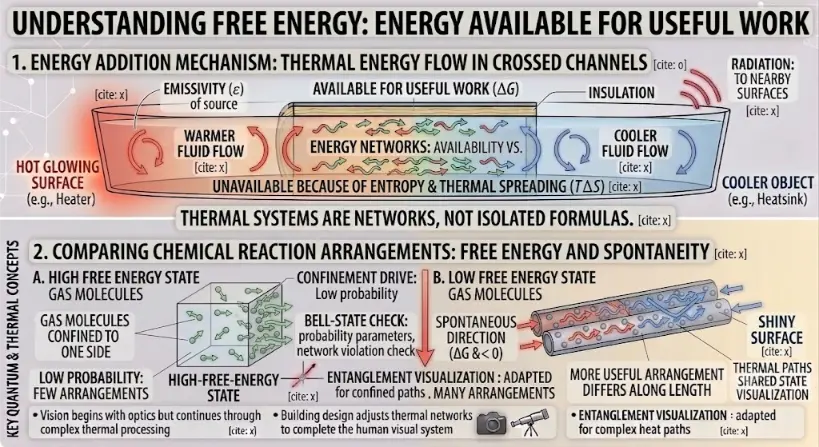
Conceptual visualization of free energy availability, comparing a non-contact thermal radiation mechanism with chemical state transformations. The top panel illustrates how available work (ΔG) and unavailable energy due to entropy (TΔS) are derived from complex crossed thermal network flows. The lower panels track spontaneity, demonstrating that physical systems spontaneously move from high-free-energy, low-probability (few-arrangement) states to low-free-energy, high-probability (many-arrangement) states, driving change based on energy availability.
The image is a comprehensive conceptual infographic titled “UNDERSTANDING FREE ENERGY: ENERGY AVAILABLE FOR USEFUL WORK,” set against a clean white background with subtle diagrammatic and network traces. It employs precise diagrammatic visualizations, soft glowing accents, and clear textual callouts, inspired by the structure of image_53.png. It is organized into two primary vertical panels, connected by a large horizontal conceptual title banner: “THERMAL SYSTEMS ARE NETWORKS, NOT ISOLATED FORMULAS”. integrated quantum concepts kets |k⟩ and citation brackets are integrated throughout all panels, making explicit the connection with microscopic probability states.
Part 1: Energy Addition Mechanism: Thermal Energy Flow in Crossed Channels
This upper panel provides a visual model of heat transfer mechanisms and energy availability networks, adapted from the crossed-flow concept in image_53.png:- Thermal Crossed Flow: A detailed cross-section diagram similar in layout to Section 1 of image_53.png is featured, but applied to a container metaphor for “ENERGY NETWORKS: AVAILABILITY VS. ENTROPY”. On the far left, a “HOT GLOWING SOURCE” emits a red-orange glow, with internal swirling red and orange arrows labeled “WARMER FLUID FLOW,” entering from the left and approaching a “COOLER OBJECT” (e.g., Heatsink). On the right, blue swirling arrows labeled “COOLER FLUID FLOW” are present.
- Energy Availability Split: Countless small, curved red and blue wave arrows, adapted from the flow and radiation metaphors of image_53.png, travel through a “THIN CONDUCTIVE WALL” into the container. The container metaphor itself is divided horizontally into two sections. The top section is labeled “AVAILABLE FOR USEFUL WORK (ΔG)”. The bottom section is labeled “UNAVAILABLE BECAUSE OF ENTROPY & THERMAL SPREADING (TΔS)”. Text callouts detail: “EMISSIVITY (ϵ) of source”, “INSULATION”, and “RADIATION: TO NEARBY SURFACES”, adapted to this non-contact context. integrated kets like |k⟩ and citation brackets suggest connections with microscopic states.
Part 2: Comparing Chemical Reaction Arrangements: Free Energy and Spontaneity
This lower panel directly tracks spontaneity and probability in different states, using visual comparisons between microscopic system arrangements. It is split vertically to show two sub-diagrams, Arranged in stacked formations adapted from Section 2 in image_53.png:- Section A: High Free Energy State: On the left, this section shows a magnified view of a gas box similar in layout to Section 2A in image_53.png. All gas molecules with small, co-directional green flow arrows are confined to one side, labeled “LOW PROBABILITY: FEW ARRANGEMENTS” and “HIGH-FREE-ENERGY STATE”. Callouts include: “CONFINEMENT DRIVE: Low probability”, “BELL-STATE CHECK: probability parameters, network violation check”, and adapted entanglement and shared state visualization concepts, making the connection with quantum probability states. A prominent red downward arrow connects to Section B, labeled “SPONTANEOUS DIRECTION (ΔG < 0)”.
- Section B: Low Free Energy State: On the right, this section shows a magnified view of two parallel gas boxes where gas has spread. Gas molecules are spread throughout the whole box, labeled “HIGH PROBABILITY: MANY ARRANGEMENTS” and “LOW-FREE-ENERGY STATE”. The second arrangement shows many more possible microscopic arrangements. Blue and red wave arrows show the efficient energy transfer and widespread possibilities. A prominent label states: “MORE USEFUL ARRANGEMENT DIFFERS ALONG LENGTH”, emphasizing how the second state allows for more complexity. Callouts repeat quantum concepts and summaries.
Why Free Energy Is Needed
The First Law tells us that energy is conserved:
ΔU = Q − W
The Second Law tells us that the total entropy of an isolated system does not decrease:
ΔStotal ≥ 0
However, many real systems are not isolated. They exchange heat, work, matter, or pressure-volume effects with their surroundings. Free energy gives a more convenient way to predict direction and equilibrium for systems held under common laboratory or engineering conditions.
| Condition | Useful Free Energy | Spontaneous Direction |
|---|---|---|
| Constant temperature and volume | Helmholtz free energy A | ΔA < 0 |
| Constant temperature and pressure | Gibbs free energy G | ΔG < 0 |
| Equilibrium at constant T, V | Helmholtz free energy | ΔA = 0 |
| Equilibrium at constant T, P | Gibbs free energy | ΔG = 0 |
Helmholtz Free Energy
Helmholtz free energy is defined as:
A = U − TS
Some textbooks use F instead of A, but A is often used to avoid confusion with force.
| Symbol | Meaning |
|---|---|
| A | Helmholtz free energy |
| U | Internal energy |
| T | Absolute temperature in kelvins |
| S | Entropy |
Helmholtz free energy is most useful when temperature and volume are held constant. Under these conditions, a process is thermodynamically favourable if:
ΔA < 0
At equilibrium:
ΔA = 0
The decrease in Helmholtz free energy represents the maximum useful work obtainable from a closed system at constant temperature and volume, under ideal reversible conditions.
Gibbs Free Energy
Gibbs free energy is defined as:
G = H − TS
Since enthalpy is:
H = U + PV
Gibbs free energy can also be written as:
G = U + PV − TS
| Symbol | Meaning |
|---|---|
| G | Gibbs free energy |
| H | Enthalpy |
| T | Absolute temperature in kelvins |
| S | Entropy |
| P | Pressure |
| V | Volume |
Gibbs free energy is especially useful when temperature and pressure are constant. Under these conditions, a process is thermodynamically favourable if:
ΔG < 0
At equilibrium:
ΔG = 0
If the only work other than pressure-volume work is useful non-expansion work, the decrease in Gibbs free energy gives the maximum non-expansion work available under ideal reversible conditions.
Helmholtz Versus Gibbs Free Energy
Helmholtz and Gibbs free energy are both thermodynamic potentials. They are not competing ideas. They are tools chosen according to the conditions of the system.
| Feature | Helmholtz Free Energy | Gibbs Free Energy |
|---|---|---|
| Common symbol | A or F | G |
| Definition | A = U − TS | G = H − TS |
| Best conditions | Constant temperature and volume | Constant temperature and pressure |
| Spontaneous criterion | ΔA < 0 | ΔG < 0 |
| Equilibrium criterion | ΔA = 0 | ΔG = 0 |
| Common use | Physics, statistical mechanics, fixed-volume systems | Chemistry, biology, phase equilibria, reactions at atmospheric pressure |
A useful memory is: use Helmholtz when T and V are controlled; use Gibbs when T and P are controlled.
Why the TS Term Matters
The term TS appears in both Helmholtz and Gibbs free energy. It represents the energy associated with entropy at a given temperature.
At higher temperature, entropy becomes more influential because T multiplies S. This is why some processes become favourable only at high temperature, while others become less favourable as temperature rises.
| Quantity | Role in Free Energy |
|---|---|
| Energy or enthalpy term | Represents stored energy or heat-related content of the system |
| Entropy term | Represents the effect of energy spreading and microscopic possibilities |
| Temperature | Controls how strongly entropy affects free energy |
This is one of the reasons free energy is so powerful. It does not merely ask whether energy is released. It asks how energy, entropy, and temperature together shape the direction of change.
Gibbs Free Energy Change
For many processes at constant temperature and pressure, the Gibbs free energy change is written as:
ΔG = ΔH − TΔS
Here, ΔH is enthalpy change, T is absolute temperature, and ΔS is entropy change.
| Condition | Meaning |
|---|---|
| ΔG < 0 | Process is thermodynamically favourable under constant T, P |
| ΔG = 0 | System is at equilibrium under constant T, P |
| ΔG > 0 | Process is not thermodynamically favourable in the forward direction under constant T, P |
The word “favourable” is often better than “automatic.” A negative ΔG means a process is thermodynamically allowed under the stated conditions, but it may still happen slowly if there is a large activation energy barrier.
Spontaneity Does Not Mean Speed
A common misunderstanding is that a spontaneous process must happen quickly. In thermodynamics, spontaneous means thermodynamically favourable, not necessarily fast.
For example, some reactions have negative ΔG but occur extremely slowly unless a catalyst is present. Diamond converting to graphite is often used as a classic example of a thermodynamically favourable but very slow process under ordinary conditions.
| Concept | What It Tells Us | What It Does Not Tell Us |
|---|---|---|
| ΔG | Whether a process is thermodynamically favourable | How fast the process occurs |
| Activation energy | How difficult it is to start the process | Whether the final state has lower free energy |
| Catalyst | Can speed up a process by lowering activation barrier | Does not change the equilibrium ΔG |
Free Energy and Equilibrium
At equilibrium, a system has no further tendency to change in the direction being considered under the specified constraints. For constant temperature and pressure, this condition is expressed as:
ΔG = 0
For constant temperature and volume, it is:
ΔA = 0
This does not mean the system is motionless at the microscopic level. Molecules may still collide, react, vibrate, diffuse, or exchange energy. Equilibrium means the macroscopic driving force for net change has vanished.
Free Energy Landscapes
Students may find it helpful to imagine a free energy landscape. A system tends to move from a higher-free-energy state toward a lower-free-energy state, much like a ball rolling downhill.
However, the analogy has limits. A system may be trapped in a local minimum if an energy barrier prevents it from reaching a lower state. This is why thermodynamics and kinetics must be considered together.
| Landscape Feature | Thermodynamic Meaning |
|---|---|
| High free energy | State has a tendency to change under given conditions |
| Downhill direction | Thermodynamically favourable direction |
| Local minimum | Metastable state |
| Lowest accessible minimum | Stable equilibrium state under the constraints |
| Barrier between states | Kinetic obstacle or activation energy |
Free Energy and Maximum Useful Work
Free energy is closely connected with useful work. Under ideal reversible conditions, the decrease in free energy represents the maximum work available under the specified constraints.
| Condition | Free Energy | Work Meaning |
|---|---|---|
| Constant T, V | Helmholtz free energy A | Maximum useful work from the system |
| Constant T, P | Gibbs free energy G | Maximum non-expansion work from the system |
| Real irreversible process | Actual useful work is less than ideal maximum | Some work potential is degraded by irreversibility |
This is why free energy is not only a mathematical convenience. It helps engineers and scientists estimate the useful work potential of batteries, chemical reactions, engines, fuel cells, biological processes, and phase changes.
Free Energy and the Second Law
Free energy criteria are convenient forms of the Second Law for systems under controlled conditions. Instead of calculating the entropy change of the entire universe, we can often use ΔG or ΔA for the system alone.
| Second Law View | Free Energy View |
|---|---|
| For an isolated system, ΔStotal ≥ 0 | At constant T, P, ΔG ≤ 0 |
| Entropy of the universe determines direction | Gibbs free energy of the system determines direction under constant T, P |
| Powerful but sometimes inconvenient | More convenient for reactions, phase changes, and open-to-surroundings processes |
This is the deep reason Gibbs free energy is so widely used. It packages both system and surroundings effects into a criterion that can be applied to the system under common conditions.
Free Energy and Chemical Reactions
In chemistry, Gibbs free energy is used to predict whether a reaction is thermodynamically favourable at constant temperature and pressure.
For a reaction:
ΔG = Gproducts − Greactants
| Value of ΔG | Reaction Meaning |
|---|---|
| ΔG < 0 | Forward reaction is thermodynamically favourable |
| ΔG = 0 | Reaction mixture is at equilibrium |
| ΔG > 0 | Forward reaction is not thermodynamically favourable under the stated conditions |
For standard conditions, the standard Gibbs free energy change may be written as:
ΔG° = ∑ ν Gf°(products) − ∑ ν Gf°(reactants)
Here, Gf° represents standard Gibbs free energy of formation, and ν represents stoichiometric coefficients.
Free Energy and Equilibrium Constants
Gibbs free energy connects directly to equilibrium. Under standard conditions, the relationship between standard Gibbs free energy change and the equilibrium constant is:
ΔG° = −RT ln K
Here, R is the gas constant, T is absolute temperature, and K is the equilibrium constant.
| Condition | Meaning |
|---|---|
| K > 1 | Products are favoured at equilibrium, so ΔG° < 0 |
| K = 1 | Reactants and products are balanced in the standard free-energy sense, so ΔG° = 0 |
| K < 1 | Reactants are favoured at equilibrium, so ΔG° > 0 |
This relationship is one of the most important bridges between thermodynamics and chemical equilibrium.
Free Energy and Batteries
Batteries convert chemical free energy into electrical work. When a battery powers a circuit, chemical reactions inside the battery move toward lower Gibbs free energy while delivering electrical energy to the external circuit.
For electrochemical cells, Gibbs free energy change is related to cell voltage by:
ΔG = −nFE
Here, n is the number of moles of electrons transferred, F is Faraday’s constant, and E is the cell potential.
A positive cell voltage corresponds to a negative Gibbs free energy change for the spontaneous cell reaction.
Free Energy in Biology
Biological systems depend on free energy. Cells maintain order, build molecules, transport ions, move muscles, copy genetic information, and repair themselves by coupling unfavourable processes to favourable ones.
For example, ATP hydrolysis releases free energy that can be coupled to cellular work. The cell does not violate the Second Law; it maintains local order by increasing entropy elsewhere through metabolism and heat release.
| Biological Process | Free Energy Role |
|---|---|
| ATP hydrolysis | Provides free energy for cellular work |
| Active transport | Uses free energy to move substances against concentration gradients |
| Muscle contraction | Converts chemical free energy into mechanical work |
| Protein folding | Depends on a free-energy landscape with stable and metastable structures |
| Metabolism | Couples favourable and unfavourable reactions in networks |
Free Energy and Phase Changes
Free energy also determines which phase of a substance is stable under given temperature and pressure. At equilibrium between phases, the Gibbs free energies of the phases are equal.
For example, at the melting point of a pure substance under fixed pressure:
Gsolid = Gliquid
Below the melting point, the solid phase has lower Gibbs free energy. Above the melting point, the liquid phase has lower Gibbs free energy.
| Condition | Stable Phase | Free Energy Meaning |
|---|---|---|
| Below melting point | Solid | Gsolid < Gliquid |
| At melting point | Solid and liquid coexist | Gsolid = Gliquid |
| Above melting point | Liquid | Gliquid < Gsolid |
Free Energy and Materials Science
Materials science uses free energy to understand phase stability, microstructure, crystallisation, alloy behaviour, defects, precipitation, magnetic ordering, and transformations between material phases.
A material may move toward lower free energy by forming crystals, separating into phases, changing composition, or developing a particular microstructure. However, kinetic barriers may slow or prevent the transformation.
Phase Diagrams
Phase boundaries can be understood as conditions where competing phases have equal free energy.Crystal Growth
Crystals form when the ordered phase has lower free energy than the disordered phase under given conditions.Alloy Design
Free energy helps predict whether elements mix, separate, precipitate, or transform into new phases.Nucleation
A new phase may be favourable overall but still require overcoming a free-energy barrier to begin forming.Metastable Materials
Materials can remain trapped in local free-energy minima, giving useful properties even when not at true equilibrium.Thermal Processing
Heat treatment changes free-energy landscapes and allows materials to transform toward desired microstructures.Applications of Free Energy
Free energy appears wherever systems change under thermal constraints. It is especially useful because it links energy, entropy, equilibrium, and useful work.
Chemical Spontaneity
Gibbs free energy predicts whether reactions are thermodynamically favourable at constant temperature and pressure.Equilibrium Calculations
The relationship ΔG° = −RT ln K connects free energy with equilibrium constants.Batteries and Fuel Cells
Electrochemical devices convert chemical free energy into electrical work.Biological Energy
Cells use free energy from metabolism to build molecules, move substances, contract muscles, and maintain order.Phase Transitions
Free energy determines which phase is stable and where phase coexistence occurs.Materials Engineering
Free-energy landscapes guide alloy design, crystallisation, precipitation, and microstructure control.Atmospheric and Climate Processes
Phase changes, moisture, pressure, temperature, and energy flows involve thermodynamic potentials.Thermal and Mechanical Systems
Free energy helps distinguish total energy from energy that can actually perform useful work under constraints.Challenges and Practical Limitations
Free energy is powerful, but real systems can be difficult to analyse. Calculating free energy accurately often requires reliable data for enthalpy, entropy, heat capacity, pressure, composition, and phase behaviour.
| Challenge | Why It Matters | Example |
|---|---|---|
| Thermodynamic data may be incomplete | Free-energy calculations depend on accurate material properties | New materials may lack reliable entropy or enthalpy data |
| Spontaneity does not mean speed | A favourable process may still be slow | Reaction needs a catalyst or nucleation site |
| Non-ideal behaviour | Real mixtures do not always behave like ideal systems | Electrolytes, polymers, alloys, and biological solutions |
| Changing conditions | ΔG depends on temperature, pressure, and composition | A reaction may be favourable at one temperature but not another |
| Metastability | Systems can remain trapped away from true equilibrium | Diamond, glasses, quenched alloys, and supercooled liquids |
| Complex systems | Many interacting reactions or phases may compete | Cells, batteries, atmospheres, and industrial reactors |
| Measurement difficulty | Free energy is often inferred indirectly | Equilibrium constants, calorimetry, and electrochemical measurements |
| Model limitations | Approximations may hide important microscopic effects | Nanoscale systems, interfaces, defects, and quantum materials |
The practical lesson is that free energy gives direction and limits, but real prediction also requires kinetics, transport processes, material data, geometry, and sometimes computation.
Future Directions and Emerging Trends
Free energy remains central to frontier science because many modern challenges involve controlling matter, energy, entropy, and useful work under complex conditions.
Computational Materials Discovery
Free-energy calculations help screen new alloys, battery materials, catalysts, and phase-stable compounds.Battery and Fuel Cell Design
Improved free-energy models support better voltage prediction, degradation analysis, and safer energy storage.Protein Folding and Biophysics
Free-energy landscapes help explain how biological molecules find stable structures and functional states.Climate and Atmospheric Modelling
Phase changes, humidity, aerosols, and heat transport depend on free-energy and equilibrium ideas.Nanoscale Thermodynamics
At small scales, surface energy, fluctuations, and interfaces can strongly affect free-energy behaviour.AI-Assisted Thermodynamic Modelling
Machine learning can help estimate missing thermodynamic data and explore complex free-energy landscapes.Sustainable Chemical Processes
Free-energy analysis helps identify reaction pathways that reduce waste, energy input, and unwanted by-products.Quantum and Low-Temperature Systems
Free-energy methods continue to support the study of superconductors, quantum materials, and cryogenic devices.These trends show why free energy is not only a classroom topic. It is a design language for future materials, biological systems, batteries, climate models, and sustainable technologies.
Connections with Wider Physics and Technology
Free energy connects the laws of thermodynamics with chemistry, biology, engineering, materials science, electrochemistry, climate systems, and statistical mechanics.
Thermodynamics
Free energy is one of the most useful tools for applying thermodynamic laws to real systems.Laws of Thermodynamics
Free energy combines energy conservation, entropy, temperature, pressure, and equilibrium into practical criteria.First Law of Thermodynamics
The First Law supplies the energy accounting needed to define internal energy and enthalpy.Second Law of Thermodynamics
The Second Law supplies the entropy and direction principles behind free-energy criteria.Third Law of Thermodynamics
The Third Law supports absolute entropy values used in free-energy calculations.Entropy in Thermodynamics
Entropy is the key term that turns energy into free energy through TS.Phase Equilibria and Phase Transitions
Phase stability and phase boundaries are governed by free-energy comparisons.Computational Thermodynamics
Modern simulations use free-energy models to predict materials, reactions, and phase behaviour.Learning Pathway Within the Laws of Thermodynamics
Free Energy in Thermodynamics is the final page in this Laws of Thermodynamics pathway. It shows how temperature, energy, entropy, and equilibrium become practical tools for prediction.
Zeroth Law of Thermodynamics
Learn how thermal equilibrium defines temperature and why thermometers work.First Law of Thermodynamics
Understand how energy is conserved as heat, work, and internal energy change in thermal systems.Second Law of Thermodynamics
Explore why heat flows naturally from hot to cold, why engines cannot be perfectly efficient, and how entropy gives processes direction.Third Law of Thermodynamics
Study what happens to entropy and material behaviour as temperature approaches absolute zero.Entropy in Thermodynamics
Learn how entropy connects energy spreading, probability, irreversibility, and natural change.Free Energy in Thermodynamics
Current page. See how Gibbs and Helmholtz free energy predict useful work, spontaneity, phase stability, and equilibrium.Quick Check: Free Energy in Thermodynamics
Quick Check: Gibbs and Helmholtz Free Energy
Q1. Which free energy is most useful at constant temperature and pressure?
Gibbs free energy G is most useful at constant temperature and pressure.
Q2. Which free energy is most useful at constant temperature and volume?
Helmholtz free energy A is most useful at constant temperature and volume.
Q3. What does ΔG < 0 mean at constant temperature and pressure?
It means the process is thermodynamically favourable in the forward direction under those conditions.
Q4. Does negative ΔG always mean a process is fast?
No. Negative ΔG means thermodynamic favourability, not speed. Kinetics and activation energy control how fast the process occurs.
Common Misunderstandings About Free Energy
Misunderstanding 1: Free Energy Means Energy from Nothing
Free energy does not violate energy conservation. It means energy available for useful work under specified thermodynamic constraints.
Misunderstanding 2: Negative ΔG Means Instant Reaction
Negative ΔG means a process is thermodynamically favourable. It may still occur slowly if the activation energy barrier is large.
Misunderstanding 3: Gibbs and Helmholtz Free Energy Are Interchangeable
They are related but used under different constraints. Gibbs free energy is best for constant T, P, while Helmholtz free energy is best for constant T, V.
Misunderstanding 4: Equilibrium Means Nothing Is Happening
At equilibrium, microscopic processes may continue, but there is no net macroscopic change in the direction being considered.
Misunderstanding 5: Enthalpy Alone Determines Spontaneity
A process is not determined by enthalpy alone. Entropy and temperature also matter through ΔG = ΔH − TΔS.
Key Terms
- Free energy
- A thermodynamic potential that measures useful work potential or direction of change under specified conditions.
- Helmholtz free energy
- The thermodynamic potential A = U − TS, most useful at constant temperature and volume.
- Gibbs free energy
- The thermodynamic potential G = H − TS, most useful at constant temperature and pressure.
- Enthalpy
- A thermodynamic state function defined as H = U + PV, useful for constant-pressure processes.
- Entropy
- A thermodynamic quantity related to energy spreading, microscopic possibilities, and irreversibility.
- Spontaneous process
- A process that is thermodynamically favourable under specified conditions, though not necessarily fast.
- Equilibrium
- A state in which there is no net thermodynamic driving force for change under the stated constraints.
- Metastable state
- A state that is not the lowest-free-energy state but persists because a barrier prevents transformation.
- Activation energy
- The energy barrier that affects the rate of a process but does not by itself determine the equilibrium free-energy difference.
- Equilibrium constant
- A quantity describing the composition of a reaction mixture at equilibrium, related to ΔG°.
- Standard Gibbs free energy change
- The Gibbs free energy change for a process under standard-state conditions.
- Non-expansion work
- Useful work other than pressure-volume expansion work, such as electrical work in a battery.
Frequently Asked Questions: Free Energy in Thermodynamics
What is free energy in thermodynamics?
Free energy is energy available to drive change or perform useful work under specified thermodynamic conditions.
Does free energy mean energy can be created from nothing?
No. Free energy does not violate the First Law. It describes useful energy availability, not energy creation.
What is Gibbs free energy?
Gibbs free energy is G = H − TS. It is especially useful for predicting spontaneity and equilibrium at constant temperature and pressure.
What is Helmholtz free energy?
Helmholtz free energy is A = U − TS. It is especially useful for systems at constant temperature and volume.
What does ΔG < 0 mean?
At constant temperature and pressure, ΔG < 0 means the process is thermodynamically favourable in the forward direction.
What does ΔG = 0 mean?
It means the system is at equilibrium under constant temperature and pressure.
What does ΔG > 0 mean?
It means the forward process is not thermodynamically favourable under the stated conditions, though the reverse process may be favourable.
Why does temperature matter in free energy?
Temperature multiplies the entropy term TS, so entropy becomes more influential at higher temperatures.
Can a spontaneous process be slow?
Yes. Spontaneity describes thermodynamic favourability, while speed depends on kinetics and activation barriers.
How does free energy relate to equilibrium constants?
For standard conditions, ΔG° = −RT ln K. This connects thermodynamic favourability with equilibrium composition.
How is free energy used in batteries?
Batteries convert chemical Gibbs free energy into electrical work. The relation ΔG = −nFE connects free energy with cell voltage.
Why should students learn free energy?
Free energy helps students understand reactions, batteries, phase changes, biological work, materials, equilibrium, and useful work in real systems.
Review Questions and Answers
- What does free energy mean in thermodynamics?Answer: Free energy means energy available to drive change or perform useful work under specified conditions.
- What is Helmholtz free energy?Answer: Helmholtz free energy is A = U − TS, useful for constant-temperature, constant-volume systems.
- What is Gibbs free energy?Answer: Gibbs free energy is G = H − TS, useful for constant-temperature, constant-pressure systems.
- What does ΔG < 0 indicate at constant temperature and pressure?Answer: It indicates that the process is thermodynamically favourable in the forward direction.
- What does ΔG = 0 indicate?Answer: It indicates equilibrium under constant temperature and pressure.
- Why is ΔG = ΔH − TΔS useful?Answer: It shows how enthalpy, entropy, and temperature combine to determine thermodynamic favourability.
- Why does negative ΔG not guarantee a fast process?Answer: Speed depends on kinetics and activation energy, not only on thermodynamic favourability.
- How does free energy relate to useful work?Answer: Under ideal reversible conditions, the decrease in free energy represents the maximum useful work available under the relevant constraints.
Thought-Provoking Questions and Answers
- Why is free energy a better guide than total energy for predicting change?Answer: Total energy may be conserved, but free energy accounts for entropy, temperature, pressure, and constraints that determine whether useful change can occur.
- Why does Gibbs free energy appear so often in chemistry and biology?Answer: Many chemical and biological processes occur at approximately constant temperature and pressure, making Gibbs free energy the most convenient criterion.
- How can a process be thermodynamically favourable but practically slow?Answer: The final state may have lower free energy, but an activation barrier may prevent the system from reaching it quickly.
- Why do living cells need free energy rather than just energy?Answer: Cells must perform organised work, such as building molecules and moving ions. Free energy describes the usable part of energy that can drive such processes.
- How does free energy explain phase stability?Answer: Under given conditions, the stable phase is the one with the lowest relevant free energy. Phase coexistence occurs when competing phases have equal free energy.
- What does free energy teach us about technological design?Answer: It shows that useful work depends not only on how much energy exists, but also on entropy, constraints, irreversibility, and the pathway available.
Numerical Problems and Solutions
- A reaction has ΔH = −80 kJ/mol, T = 300 K, and ΔS = −0.10 kJ/(mol·K). Find ΔG.Solution:
- Use ΔG = ΔH − TΔS.
- ΔG = −80 − (300)(−0.10).
- ΔG = −80 + 30.
- ΔG = −50 kJ/mol.
Answer: ΔG = −50 kJ/mol, so the reaction is thermodynamically favourable at this temperature. - A reaction has ΔH = 40 kJ/mol, ΔS = 0.20 kJ/(mol·K), and T = 400 K. Find ΔG.Solution:
- Use ΔG = ΔH − TΔS.
- ΔG = 40 − (400)(0.20).
- ΔG = 40 − 80.
- ΔG = −40 kJ/mol.
Answer: ΔG = −40 kJ/mol. The process is favourable at 400 K. - For a process, ΔG = 25 kJ/mol. Is the forward process thermodynamically favourable at constant temperature and pressure?Solution:
- At constant T, P, a process is favourable if ΔG < 0.
- Here, ΔG = 25 kJ/mol > 0.
Answer: No. The forward process is not thermodynamically favourable under these conditions. - A process has ΔA = −120 J at constant temperature and volume. What is the maximum useful work obtainable under ideal reversible conditions?Solution:
- At constant T, V, a decrease in Helmholtz free energy gives the maximum useful work.
- Maximum useful work obtainable is 120 J.
Answer: The maximum useful work is 120 J under ideal reversible conditions. - A reaction has ΔG° = −17.1 kJ/mol at 298 K. Estimate K using ΔG° = −RT ln K, with R = 8.314 J/(mol·K).Solution:
- Convert ΔG° = −17.1 kJ/mol = −17100 J/mol.
- Use ln K = −ΔG° / (RT).
- ln K = −(−17100) / ((8.314)(298)).
- ln K ≈ 6.90.
- K = e6.90 ≈ 990.
Answer: K ≈ 990, so products are strongly favoured under standard conditions. - A battery reaction transfers n = 2 moles of electrons per mole of reaction and has cell potential E = 1.10 V. Estimate ΔG = −nFE, using F = 96485 C/mol.Solution:
- Use ΔG = −nFE.
- ΔG = −(2)(96485)(1.10).
- ΔG ≈ −212267 J/mol.
- ΔG ≈ −212 kJ/mol.
Answer: ΔG ≈ −212 kJ/mol, indicating a favourable cell reaction under the stated conditions. - A process has ΔH = 60 kJ/mol and ΔS = 0.15 kJ/(mol·K). At what temperature does ΔG = 0?Solution:
- Set ΔG = ΔH − TΔS = 0.
- So, T = ΔH / ΔS.
- T = 60 / 0.15.
- T = 400 K.
Answer: ΔG = 0 at 400 K. Above this temperature, the positive entropy term may make the process favourable. - A system has U = 500 J, T = 300 K, and S = 1.2 J/K. Find the Helmholtz free energy A.Solution:
- Use A = U − TS.
- A = 500 − (300)(1.2).
- A = 500 − 360.
- A = 140 J.
Answer: The Helmholtz free energy is 140 J.
External References for Further Reading
The following references provide useful background on Gibbs free energy, Helmholtz free energy, spontaneity, equilibrium, and thermodynamic potentials.
- OpenStax Chemistry 2e: Free Energy — A clear introduction to Gibbs free energy, spontaneity, equilibrium, and temperature effects.
- OpenStax Biology 2e: Potential, Kinetic, Free, and Activation Energy — A useful biological explanation of free energy and activation energy.
- Chemistry LibreTexts: The Gibbs and Helmholtz Energy — A discussion of Gibbs and Helmholtz energy as thermodynamic potentials.
- Chemistry LibreTexts: Helmholtz Energy — A focused reference on Helmholtz free energy and constant-temperature, constant-volume conditions.
- Chemistry LibreTexts: Gibbs Free Energy — A supplementary explanation of Gibbs free energy and reaction spontaneity.
- Chemistry LibreTexts: The Gibbs-Helmholtz Equation — A deeper reference on Gibbs free energy and temperature dependence.
Why This Topic Matters
Free energy matters because it tells us what energy can actually do. A system may contain energy, but only part of that energy may be available for useful work under given conditions.
For students, free energy connects the First Law, Second Law, Third Law, entropy, equilibrium, phase change, chemical reactions, batteries, biology, and materials science. It is one of the most powerful unifying ideas in thermodynamics.
For modern technology, free energy helps guide battery design, fuel cells, sustainable chemistry, protein folding, materials discovery, phase diagrams, climate modelling, and energy conversion systems.
Summary
Free energy is a thermodynamic measure of useful work potential and direction of change under specified conditions.
Helmholtz free energy is defined as:
A = U − TS
It is most useful for constant-temperature, constant-volume systems. Gibbs free energy is defined as:
G = H − TS
It is most useful for constant-temperature, constant-pressure systems. At constant T, P, ΔG < 0 indicates a thermodynamically favourable process, ΔG = 0 indicates equilibrium, and ΔG > 0 indicates that the forward process is not favourable under the stated conditions.
The deeper message is that thermodynamics is not only about how much energy exists. It is also about how energy, entropy, temperature, pressure, and constraints determine what can happen and what useful work can be obtained.
Reflection Question
If free energy tells us which energy is available for useful work, how should scientists and engineers think differently about energy storage, batteries, biological systems, and sustainable technologies?