
Maxwell’s equations do more than summarise electricity and magnetism. They show how changing electric and magnetic fields can give rise to electromagnetic waves. This page focuses on that remarkable consequence: under the right conditions, electric and magnetic fields can regenerate one another and travel through space without needing wires, batteries, or a material medium.
This insight transformed physics. Light was no longer treated only as a topic in optics. It became part of electromagnetism. Radio waves, microwaves, infrared radiation, visible light, ultraviolet radiation, X-rays, and gamma rays could all be understood as members of one electromagnetic spectrum, differing mainly in wavelength and frequency.
The central idea is simple but powerful. A changing magnetic field can produce an electric field, while a changing electric field can produce a magnetic field. When this mutual field-changing process continues through space, an electromagnetic wave is formed. Such waves carry energy, momentum, and information from one place to another.
This page therefore builds on Maxwell’s equations, but it is not mainly a page about memorising the four equations. Its focus is on how those equations lead to wave motion, the speed of light, radiation, antennas, wireless communication, optics, and modern technologies that depend on electromagnetic signals.
For students, Maxwell’s equations and electromagnetic waves form a bridge between electromagnetic induction, field theory, light, communication systems, and the wider electromagnetic spectrum. They reveal that light, radio signals, Wi-Fi, radar, optical fibres, and many forms of radiation are not separate mysteries, but different expressions of the same electromagnetic structure.
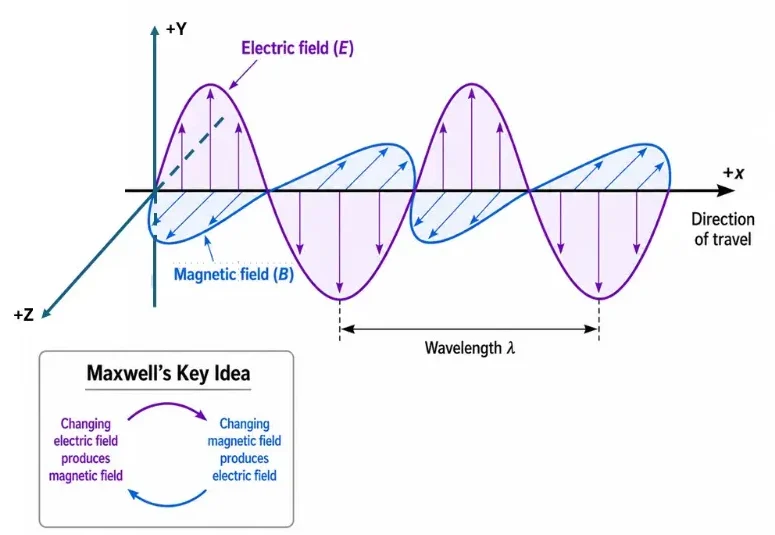
This illustration shows a travelling electromagnetic wave as predicted by Maxwell’s equations. The electric field oscillates vertically, while the magnetic field oscillates in a perpendicular direction, and both fields travel together in the positive x direction. The wavelength is marked between corresponding points on the wave. The inset summarises Maxwell’s key idea: a changing electric field produces a magnetic field, and a changing magnetic field produces an electric field. This helps students understand how electromagnetic waves can propagate through space without needing a physical medium.
Learning Pathway: From Maxwell’s Equations to Electromagnetic Waves
This page is the first terminal page in the Electromagnetic Waves cluster. It explains how Maxwell’s equations lead to the idea of electromagnetic waves, before later pages explore the spectrum, wave energy, momentum, polarisation, reflection, and transmission.
Electricity and Magnetism
Introduces the wider study of electric fields, magnetic fields, circuits, forces, induction, and electromagnetic wave behaviour.Electromagnetic Waves
Serves as the cluster overview for waves made of coupled electric and magnetic fields, including light, radio waves, and other forms of radiation.Maxwell’s Equations and Electromagnetic Waves
Explains how Maxwell’s equations predict waves that travel through space at the speed of light.Electromagnetic Spectrum
Organises electromagnetic waves by wavelength, frequency, and energy, from radio waves to gamma rays.Energy and Momentum in Electromagnetic Waves
Shows how electromagnetic waves carry energy, exert pressure, and transfer momentum through fields.Polarisation, Reflection, and Transmission
Explores how electromagnetic waves are oriented, redirected, absorbed, transmitted, or reflected by materials and surfaces.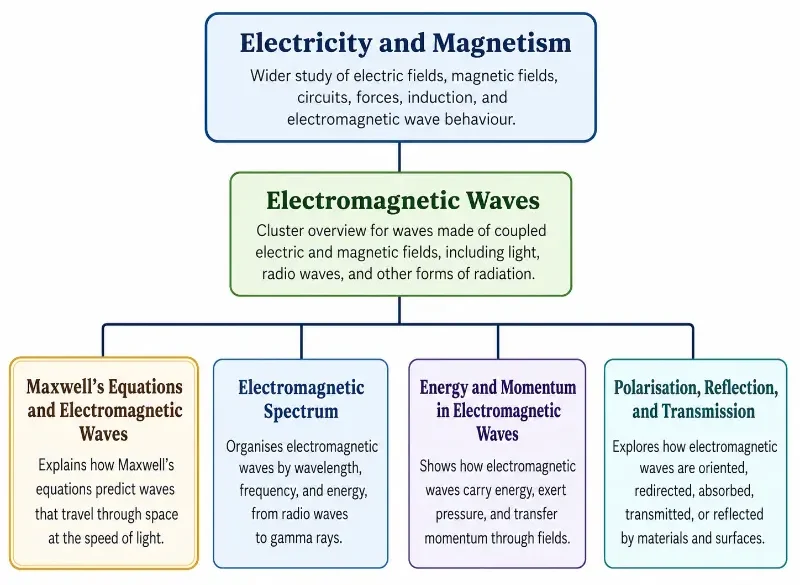
Core Physical Idea
Maxwell’s equations describe four connected facts about electric and magnetic fields:
- Electric charges produce electric fields.
- Magnetic field lines do not begin or end at isolated magnetic charges.
- Changing magnetic fields produce circulating electric fields.
- Electric currents and changing electric fields produce magnetic fields.
The third and fourth ideas are especially important for electromagnetic waves. Faraday’s Law says that a changing magnetic field can produce an electric field. The Ampère-Maxwell Law says that a changing electric field can produce a magnetic field. Together, they allow a self-sustaining wave to move through empty space.
This is why electromagnetic waves do not need a material medium. Sound needs air, water, or another medium because it is a vibration of matter. Electromagnetic waves are vibrations of fields, so they can travel through a vacuum.
Visual Guide to Maxwell’s Electromagnetic Wave Idea
The following illustrations move from Maxwell’s key field link to the structure of an electromagnetic wave, vacuum travel, the speed of light, antenna radiation, and modern communication. They are grouped together so that students can see the visual story before moving into the equations.
1. Maxwell’s Key Link Between Changing Fields
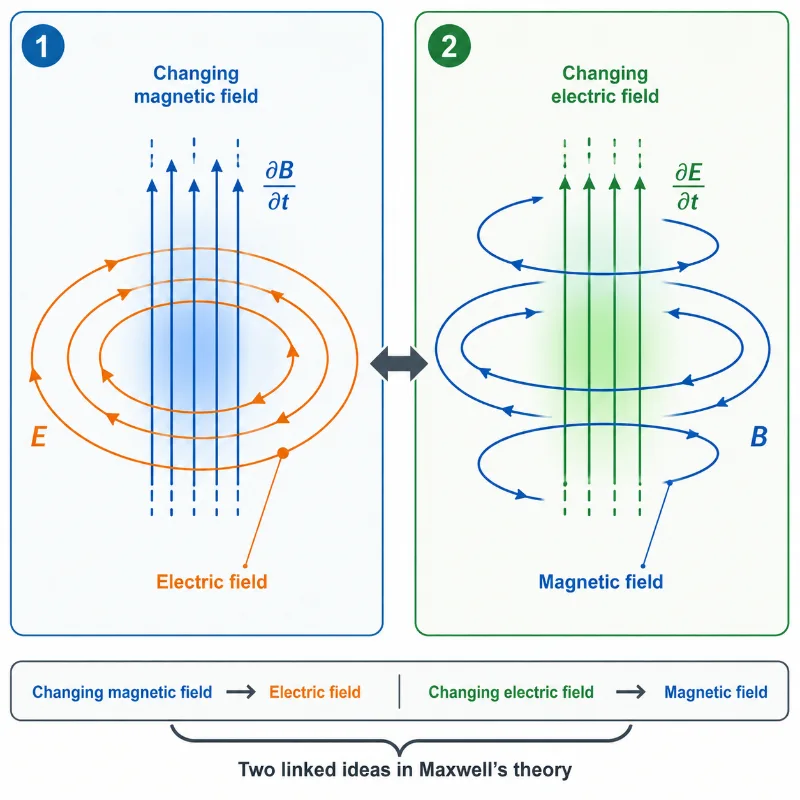
This illustration shows Maxwell’s key connection between changing fields. In the first panel, a changing magnetic field produces a circulating electric field. In the second panel, a changing electric field produces a magnetic field. Together, these two ideas explain how electric and magnetic fields are linked rather than separate. The picture prepares students to understand how electromagnetic waves can travel through space as self-sustaining patterns of changing fields.
2. Structure of an Electromagnetic Wave
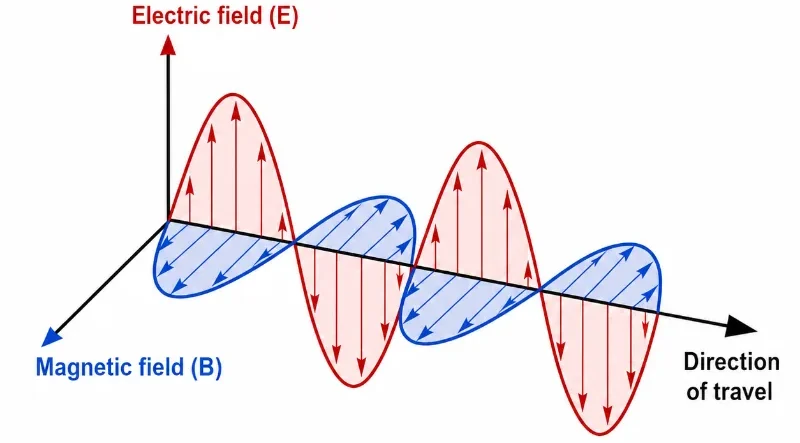
This illustration shows the structure of a plane electromagnetic wave in a simple 3D-style view. The electric field oscillates vertically, the magnetic field oscillates horizontally, and the wave travels forward in a direction perpendicular to both fields. The diagram helps students see that electromagnetic waves are transverse waves made of linked electric and magnetic field oscillations, with each part oriented at right angles to the others.
3. Electromagnetic Waves Can Travel Through Vacuum
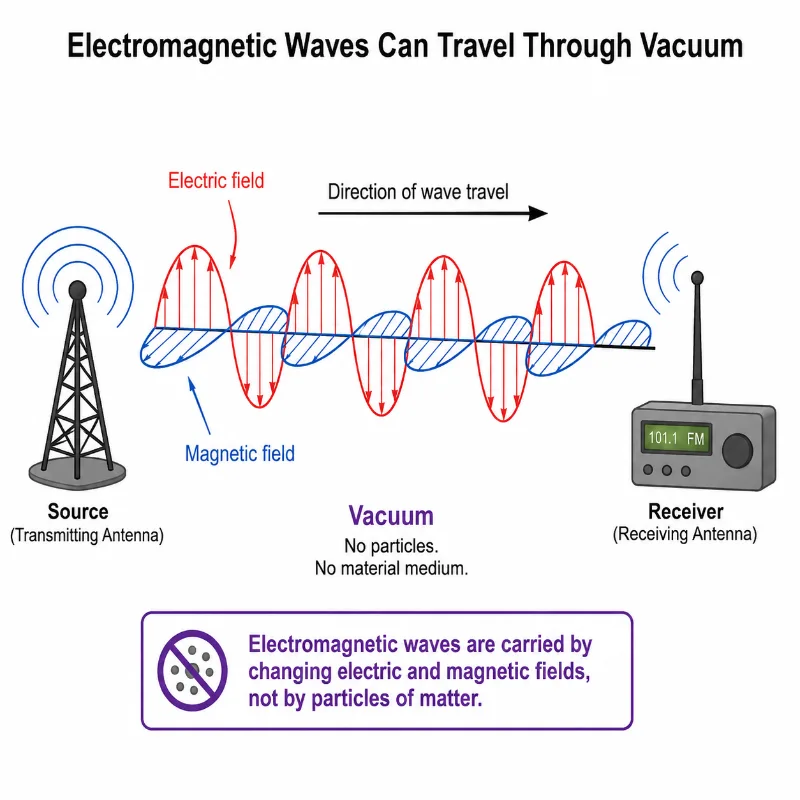
This illustration shows an electromagnetic wave travelling from a transmitting antenna to a receiving antenna through vacuum. The wave is shown as linked electric and magnetic field oscillations moving through space without air particles or any material medium. The picture helps students understand that electromagnetic waves are different from mechanical waves such as sound. They do not need matter to carry them, because changing electric and magnetic fields continually support the wave as it travels.
4. Maxwell Predicts the Speed of Light
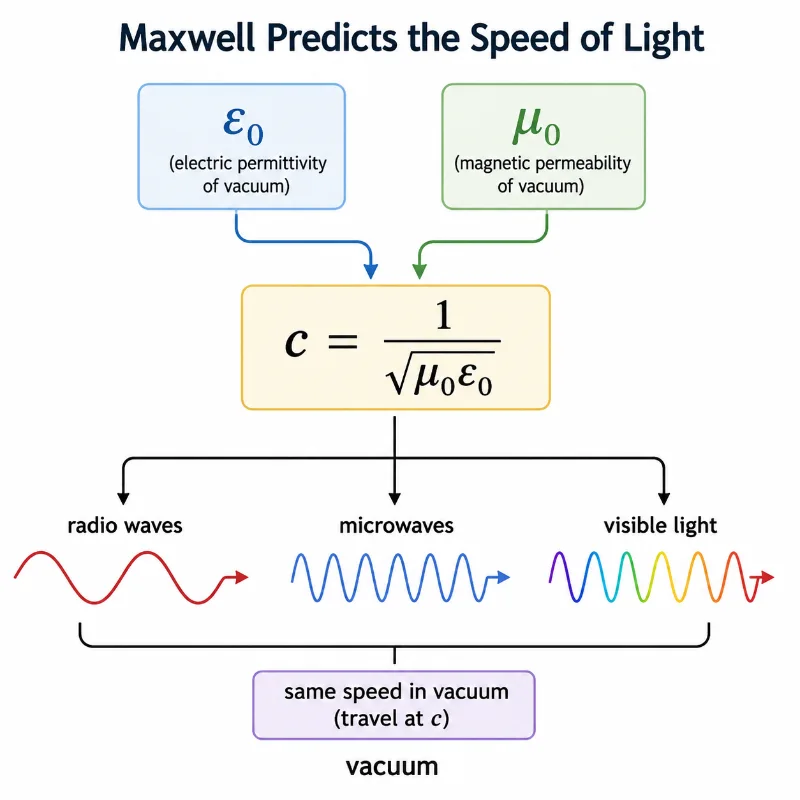
This illustration shows how Maxwell’s equations connect the electric permittivity of vacuum, \( \varepsilon_0 \), and the magnetic permeability of vacuum, \( \mu_0 \), to the wave speed \( c = \frac{1}{\sqrt{\mu_0\varepsilon_0}} \). The diagram also shows radio waves, microwaves, and visible light travelling at the same speed in vacuum. It helps students see why Maxwell’s prediction was so important: light is not separate from electricity and magnetism, but one form of electromagnetic wave.
5. Oscillating Charges Producing Electromagnetic Waves
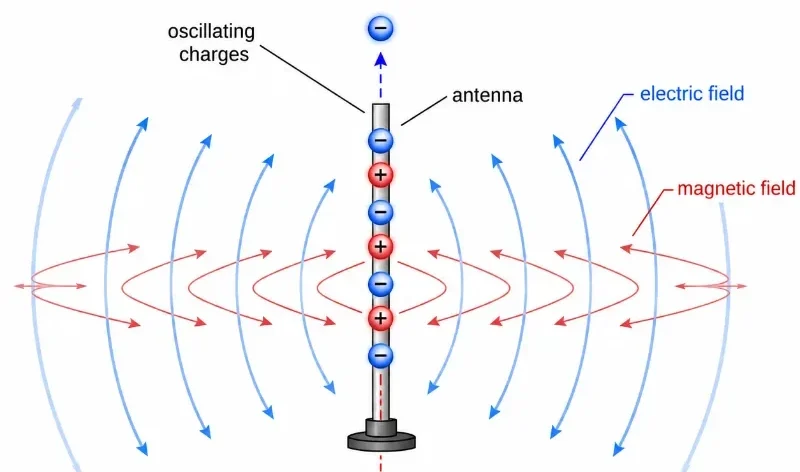
This illustration shows how oscillating charges in an antenna can produce electromagnetic waves. As charges move up and down, they create changing electric and magnetic fields around the antenna. These changing fields spread outward through space as an electromagnetic wave. The picture helps students understand why antennas are central to radio, television, Wi-Fi, mobile communication, and many other systems that send information using electromagnetic waves.
6. From Maxwell’s Equations to Modern Communication
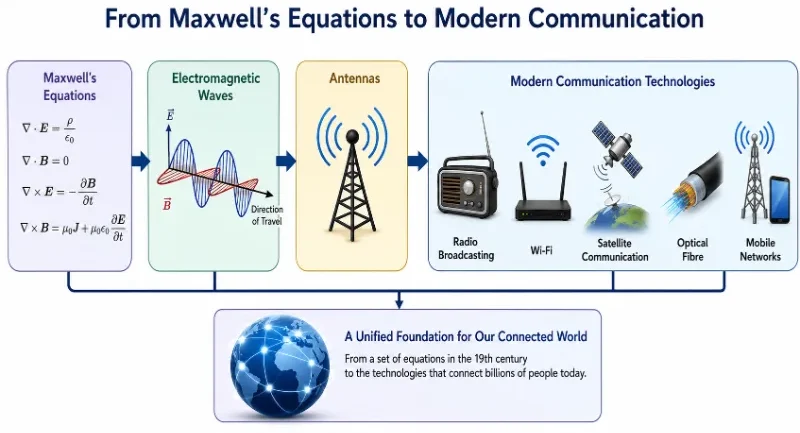
This illustration shows how Maxwell’s equations led to modern communication technologies. The pathway begins with Maxwell’s mathematical description of electric and magnetic fields, then moves to the prediction of electromagnetic waves and their transmission through antennas. These ideas later became the foundation for radio broadcasting, Wi-Fi, satellite communication, optical fibre systems, and mobile networks. The picture helps students see that Maxwell’s equations are not only abstract physics, but a scientific foundation for the connected world.
Maxwell’s Equations in Words
Electric Charges Produce Electric Fields
Positive and negative charges create electric fields. This is the field idea behind electrostatics and electric potential.Magnetic Field Lines Do Not End
Magnetic field lines form loops. A north pole and south pole are not isolated magnetic charges in classical electromagnetism.Changing Magnetic Fields Produce Electric Fields
This is the field version of electromagnetic induction. It explains why changing magnetic flux can induce emf.Changing Electric Fields Produce Magnetic Fields
Maxwell added this idea to complete the theory. It allows electromagnetic waves to travel through space.Key Equations: A First University-Level View
The equations below give a first university-style view of the field relationships behind electromagnetic waves. Students do not need to master every vector symbol immediately, but they should notice how charges, currents, changing fields, and wave propagation are connected.
\( \nabla \cdot \mathbf{E} = \frac{\rho}{\varepsilon_0} \) — Gauss’s Law for electricity. Electric charges act as sources or sinks of electric field.
\( \nabla \cdot \mathbf{B} = 0 \) — Gauss’s Law for magnetism. Magnetic field lines form closed loops; isolated magnetic monopoles are not part of classical electromagnetism.
\( \nabla \times \mathbf{E} = -\frac{\partial \mathbf{B}}{\partial t} \) — Faraday’s Law in differential form. A changing magnetic field produces a circulating electric field.
\( \nabla \times \mathbf{B} = \mu_0\mathbf{J} + \mu_0\varepsilon_0\frac{\partial \mathbf{E}}{\partial t} \) — Ampère-Maxwell Law. Electric current and changing electric field both produce magnetic field.
\( c = \frac{1}{\sqrt{\mu_0\varepsilon_0}} \) — Speed of electromagnetic waves in vacuum. Maxwell’s equations predict that electromagnetic waves travel at the speed of light.
\( E = cB \) — Relationship between electric and magnetic field amplitudes in a plane electromagnetic wave in vacuum. The electric field amplitude is \( c \) times the magnetic field amplitude.
\( \nabla^2\mathbf{E} = \mu_0\varepsilon_0\frac{\partial^2\mathbf{E}}{\partial t^2} \) — Wave equation for the electric field in free space. It shows that the electric field can propagate as a wave.
\( \nabla^2\mathbf{B} = \mu_0\varepsilon_0\frac{\partial^2\mathbf{B}}{\partial t^2} \) — Wave equation for the magnetic field in free space. It shows that the magnetic field also propagates as part of the same electromagnetic wave.
The Maxwell Correction: Displacement Current
Before Maxwell, Ampère’s Law connected magnetic fields with electric currents. This worked well for steady currents in wires, but it had a problem when applied to situations such as a charging capacitor. Current flows in the wires leading to the capacitor plates, but no ordinary conduction current crosses the gap between the plates.
Maxwell resolved this by recognising that a changing electric field can act as a source of magnetic field. This extra term is called the displacement current term. It does not mean charges are literally flowing through the empty gap. It means the changing electric field contributes to the magnetic field in the same mathematical role as current.
This correction was not merely a small technical adjustment. It completed the symmetry between changing electric and magnetic fields and allowed Maxwell’s equations to predict electromagnetic waves.
The Charging Capacitor Paradox: Visualizing Displacement Current
Before Maxwell’s intervention, Ampère’s Law stated that magnetic fields are formed strictly around moving physical electrical charges, like a current traveling through a standard metal wire. While this rule worked perfectly for closed, continuous circuits, Maxwell identified a major logical paradox when examining what happens inside a charging capacitor.
Imagine a simple circuit where a battery is pumping conventional conduction current (\(\mathbf{J}\)) into two parallel metal plates separated by an empty gap of vacuum. If you choose an imaginary surface that cuts through the wire, Ampère’s law correctly predicts a curling magnetic field wrapped around the wire. But what happens if you stretch that imaginary surface like a balloon so that it passes cleanly through the empty air gap between the two plates?
Inside the gap, zero physical charges are crossing from one side to the other. Conduction current drops to absolute zero (\(\mathbf{J} = 0\)). According to the old version of the law, the magnetic field inside the gap should instantly vanish. However, laboratory measurements proved that a real, curling magnetic field exists inside the gap during charging events.
Maxwell solved this spatial puzzle by noticing that as charges pile up on the plates, the electric field (\(\mathbf{E}\)) between them grows stronger. This changing electric field flux creates a phantom current profile across the emptiness, which he named the displacement current:
$$ \mathbf{J}_D = \varepsilon_0 \frac{\partial \mathbf{E}}{\partial t} $$By adding this displacement current term to the Ampère-Maxwell equation, he showed that magnetic fields don’t care if charges are moving through an actual wire or if an electric field is simply varying in intensity over time across a vacuum. This correction bridged the physical gap, proving that time-varying electric fields act as localized magnetic field generators.
The Physics of Co-Oscillation: Proving Why E and B Rise and Fall in Phase
When looking at standard three-dimensional wave diagrams, students often wonder about the specific timing of the wave. If Faraday’s Law states that an electric field is produced by a *change* in a magnetic field, shouldn’t the electric wave be shifted out of phase? Shouldn’t the electric field peak when the magnetic field is changing fastest (at zero)?
Surprisingly, Maxwell’s spatial derivative relationships show that in a traveling plane wave in a vacuum, the electric field (\(\mathbf{E}\)) and magnetic field (\(\mathbf{B}\)) are locked in perfect spatial and temporal alignment. They rise together, peak together, and cross the zero-line at the exact same instant. Let’s look at the underlying spatial calculus to see why this happens.
Consider a plane wave traveling along the \(x\)-axis, where the electric field oscillates purely along the \(y\)-direction (\(E_y = E_0 \sin(kx – \omega t)\)) and the magnetic field oscillates purely along the \(z\)-direction (\(B_z = B_0 \sin(kx – \omega t)\)). If we apply the spatial derivative component of Faraday’s Law to these perpendicular axes, the vector cross-product simplifies to a direct one-to-one slope relationship:
$$ \frac{\partial E_y}{\partial x} = -\frac{\partial B_z}{\partial t} $$Let’s take the derivatives of our sine wave functions to see how the calculus matches up:
- Taking the spatial derivative of the electric field along the travel axis yields: $$ \frac{\partial E_y}{\partial x} = k E_0 \cos(kx – \omega t) $$
- Taking the time derivative of the magnetic field yields: $$ -\frac{\partial B_z}{\partial t} = \omega B_0 \cos(kx – \omega t) $$
Setting these two results equal to each other shows a perfect mathematical convergence:
$$ k E_0 \cos(kx – \omega t) = \omega B_0 \cos(kx – \omega t) $$Because the \(\cos(kx – \omega t)\) term matches perfectly on both sides, it cancels out completely. This leaves us with a steady, fixed scale relationship between the peak amplitudes: \(k E_0 = \omega B_0\). Since wave velocity is defined as \(c = \frac{\omega}{k}\), rearranging this expression yields the classic amplitude rule:
$$ E_0 = c B_0 $$This formal calculus evaluation reveals a key insight for students: the spatial slope of the electric field wave is balanced by the temporal flip of the magnetic field wave. Because the trigonometric functions cancel out without any leftover phase angles, it proves that the fields must co-oscillate in perfect alignment to sustain their energy profile as they travel through the universe.
How Maxwell’s Equations Predict Electromagnetic Waves
In empty space, there may be no charges and no conduction currents. Even then, a changing electric field can produce a magnetic field, and a changing magnetic field can produce an electric field.
This mutual production creates a self-sustaining pattern. The electric field changes, producing a magnetic field. The magnetic field changes, producing an electric field. The fields move outward together as an electromagnetic wave.
Strictly speaking, an electromagnetic wave is not a simple sequence where one field appears first and then creates the other afterward. The electric and magnetic fields are linked parts of one changing field pattern. Maxwell’s equations describe how their space and time variations fit together so that the whole pattern travels as a wave.
The mathematics leads to a wave speed:
\( c = \frac{1}{\sqrt{\mu_0\varepsilon_0}} \)
When the known values of \( \mu_0 \) and \( \varepsilon_0 \) are inserted, the result is the speed of light. This was a major clue that light itself is an electromagnetic wave.
Worked Example: Relating Electric and Magnetic Field Strengths
Problem: An electromagnetic wave in vacuum has an electric field amplitude of \( 600 \ \text{V/m} \). Find the magnetic field amplitude.
Step 1: Use the field relationship for an electromagnetic wave in vacuum.
\( E = cB \)
Step 2: Rearrange for \( B \).
\( B = \frac{E}{c} \)
Step 3: Substitute values.
\( B = \frac{600}{3.0 \times 10^8} \)
\( B = 2.0 \times 10^{-6} \ \text{T} \)
Answer: The magnetic field amplitude is \( 2.0 \times 10^{-6} \ \text{T} \), or \( 2.0 \ \mu\text{T} \).
Worked Example Illustration
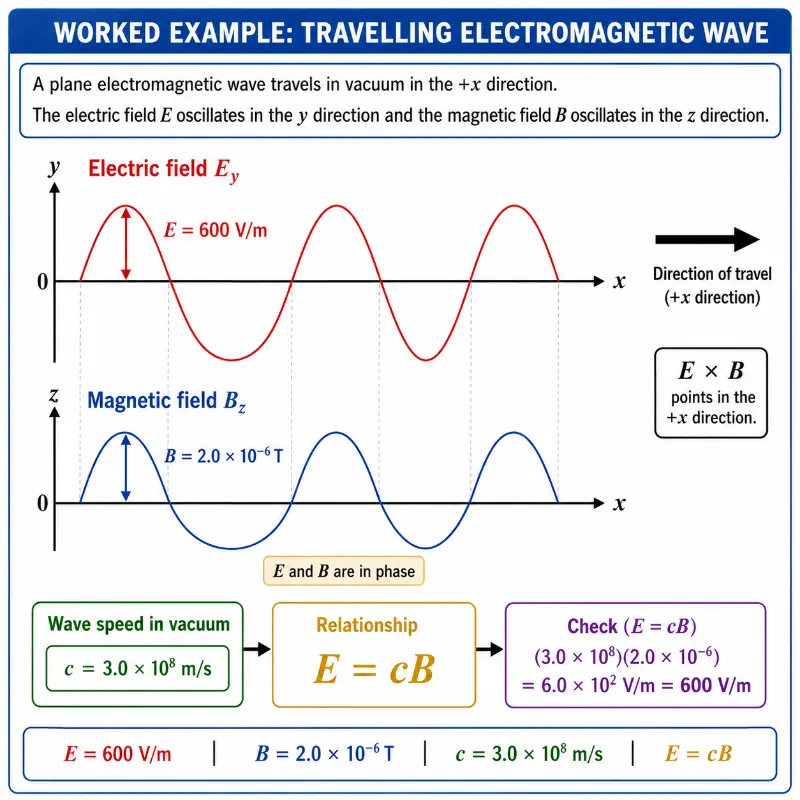
The infographic presents a simplified and technically clearer view of a travelling electromagnetic wave in vacuum. The upper plot shows the electric field Ey oscillating along the y direction, while the lower plot shows the magnetic field Bz oscillating along the z direction. Both waves travel in the +x direction and are aligned in phase, helping students see that the electric and magnetic fields rise, fall, and pass through zero together. The example uses E = 600 V/m, B = 2.0 × 10⁻⁶ T, and c = 3.0 × 10⁸ m/s to verify the relationship E = cB.
Common Misconceptions about Maxwell’s Equations and Electromagnetic Waves
Thinking Electromagnetic Waves Need Air
Electromagnetic waves do not need air or any material medium. They are travelling field disturbances and can move through vacuum.Thinking the Electric and Magnetic Fields Point in the Same Direction
In a simple plane electromagnetic wave, the electric field and magnetic field are perpendicular to each other and also perpendicular to the direction of travel.Thinking Maxwell’s Equations Are Only Abstract Mathematics
Maxwell’s equations describe real physical behaviour. They explain light, radio waves, antennas, induction, radiation, and much of modern communication technology.Thinking Only Currents Produce Magnetic Fields
Currents produce magnetic fields, but changing electric fields also produce magnetic fields. This was Maxwell’s crucial addition.Thinking Light Is Separate from Electricity and Magnetism
Maxwell’s theory showed that light is an electromagnetic wave. Visible light is only one part of the wider electromagnetic spectrum.Thinking the Magnetic Field Is Less Important
The electric and magnetic fields are both essential parts of an electromagnetic wave. They support one another as the wave travels.Practical Applications of Maxwell’s Equations and Electromagnetic Waves
Radio and Television Broadcasting
Antennas use oscillating currents to produce electromagnetic waves that carry sound, images, and information over long distances.Wi-Fi and Mobile Communication
Wireless networks use electromagnetic waves to transmit digital information between devices, routers, cell towers, and satellites.Radar Systems
Radar sends electromagnetic waves outward and detects reflected signals to locate aircraft, ships, vehicles, storms, and other objects.Optical Fibre Communication
Light waves carry information through optical fibres, enabling high-speed internet and long-distance communication.Medical Imaging and Treatment
Different parts of the electromagnetic spectrum are used in imaging, diagnosis, therapy, and medical sensing.Antennas and Wave Engineering
Maxwell’s equations guide the design of antennas, waveguides, microwave circuits, shielding, and many communication systems.Real-World Illustration
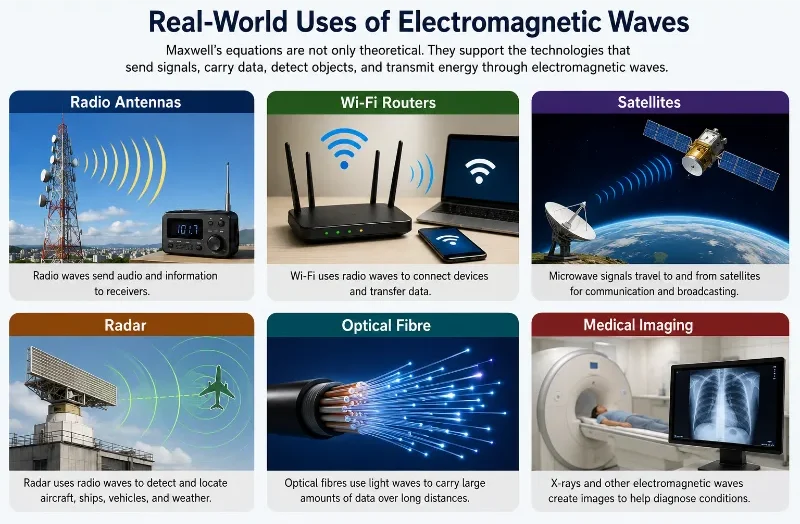
This illustration shows several real-world uses of electromagnetic waves. Radio antennas transmit signals to receivers, Wi-Fi routers send data using radio waves, satellites relay microwave signals across long distances, and radar systems use reflected waves to detect aircraft, ships, vehicles, or weather patterns. Optical fibre carries information as pulses of light through thin glass fibres, while medical imaging uses high-energy electromagnetic waves such as X-rays to create internal images of the body. The picture helps students see that Maxwell’s equations are not only theoretical physics, but the foundation of technologies that send signals, carry data, detect objects, transmit energy, and improve modern life.
Bridge to University Thinking
At school level, Maxwell’s equations may first appear as four separate statements. At university level, they become a unified field theory. Students learn to express them in differential and integral forms, derive wave equations from them, and apply them to materials, boundaries, antennas, radiation, and optical systems.
The topic also prepares students for advanced areas such as special relativity, quantum optics, photonics, electromagnetic compatibility, plasma physics, microwave engineering, and communication theory. Maxwell’s equations remain one of the most successful and widely used structures in physics.
A useful way to remember the deeper idea is this: Maxwell’s equations do not merely describe fields sitting in space. They describe fields that can change, propagate, carry energy, and connect distant systems.
Quick Interactive Check
Quick Check: Maxwell’s Equations and EM Waves
1. What did Maxwell’s equations predict about light?
A. Light is a mechanical vibration of air
B. Light is an electromagnetic wave
C. Light is only a particle stream
D. Light cannot travel through vacuum
Answer: B. Maxwell’s equations predict waves made of electric and magnetic fields travelling at the speed of light, showing that light is electromagnetic.
2. In a plane electromagnetic wave, how are \( \mathbf{E} \), \( \mathbf{B} \), and the direction of travel arranged?
A. All point in the same direction
B. \( \mathbf{E} \) and \( \mathbf{B} \) are perpendicular to each other and to the direction of travel
C. \( \mathbf{E} \) is always zero
D. \( \mathbf{B} \) points backward only
Answer: B. The electric field, magnetic field, and direction of propagation are mutually perpendicular in a simple plane electromagnetic wave.
3. Which Maxwell equation shows that changing magnetic fields produce electric fields?
A. Gauss’s Law for electricity
B. Gauss’s Law for magnetism
C. Faraday’s Law
D. Coulomb’s Law
Answer: C. Faraday’s Law states that a changing magnetic field produces a circulating electric field.
4. Why was Maxwell’s displacement current idea important?
A. It removed magnetic fields from physics
B. It showed that changing electric fields can produce magnetic fields
C. It proved that light needs air
D. It made electric charge disappear
Answer: B. Maxwell’s displacement current term showed that changing electric fields can produce magnetic fields, completing the wave-producing link.
5. What is the speed of electromagnetic waves in vacuum?
A. The speed of sound
B. The speed of light
C. The speed of moving charges in a wire
D. Zero
Answer: B. Electromagnetic waves travel in vacuum at \( c \), the speed of light.
Review Questions and Answers
Review Questions
1. What are Maxwell’s equations?
Maxwell’s equations are four equations that describe how electric and magnetic fields are produced and how they change. They connect charges, currents, electric fields, magnetic fields, and electromagnetic waves.
2. Why are Maxwell’s equations important?
They unify electricity and magnetism into one theory and predict electromagnetic waves. They explain light, radio waves, antennas, induction, and many modern communication technologies.
3. What is an electromagnetic wave?
An electromagnetic wave is a travelling disturbance made of oscillating electric and magnetic fields. These fields are perpendicular to each other and to the direction of travel.
4. Why can electromagnetic waves travel through vacuum?
They are oscillations of electric and magnetic fields, not vibrations of matter. Therefore, they do not require air or any material medium.
5. What is displacement current?
Displacement current is Maxwell’s term for the magnetic-field-producing effect of a changing electric field. It completes the Ampère-Maxwell Law.
6. What is the relationship between \( E \) and \( B \) in a plane electromagnetic wave in vacuum?
The relationship is \( E = cB \), where \( c \) is the speed of light in vacuum.
7. What does \( c = \frac{1}{\sqrt{\mu_0\varepsilon_0}} \) mean?
It shows that the speed of electromagnetic waves in vacuum is determined by the electric and magnetic constants of free space.
8. How are antennas related to electromagnetic waves?
Antennas use oscillating charges and currents to produce electromagnetic waves. They can also receive waves by converting changing fields into electrical signals.
Thought-Provoking Questions and Answers
Deeper Thinking
1. Why was it revolutionary to show that light is an electromagnetic wave?
It connected optics with electricity and magnetism. Light was no longer treated as a separate phenomenon, but as one form of electromagnetic radiation.
2. Why does the ability of waves to travel through vacuum matter for astronomy?
Most of space is nearly empty. If electromagnetic waves needed a material medium, light from stars and galaxies could not reach us across space. Astronomy depends on electromagnetic waves travelling through vacuum.
3. Why is displacement current more than a mathematical fix?
It reveals that changing electric fields are physically important sources of magnetic fields. Without this idea, Maxwell’s equations would not fully predict self-propagating electromagnetic waves.
4. How do Maxwell’s equations support modern wireless communication?
They explain how oscillating currents in antennas produce electromagnetic waves, how waves propagate, and how receiving antennas convert changing fields back into electrical signals.
5. Why is it useful to describe waves using fields rather than only rays?
Field descriptions explain wave behaviour such as polarisation, interference, diffraction, reflection, radiation, and energy transfer. Rays are useful approximations, but fields give the deeper physics.
Numerical Problems and Solutions
Practice Problems
1. An electromagnetic wave has electric field amplitude \( E = 900 \ \text{V/m} \). Find the magnetic field amplitude in vacuum.
Use \( E = cB \).
\( B = \frac{E}{c} = \frac{900}{3.0 \times 10^8} \)
\( B = 3.0 \times 10^{-6} \ \text{T} \)
Answer: \( 3.0 \times 10^{-6} \ \text{T} \), or \( 3.0 \ \mu\text{T} \).
2. An electromagnetic wave has magnetic field amplitude \( B = 4.0 \times 10^{-7} \ \text{T} \). Find the electric field amplitude in vacuum.
Use \( E = cB \).
\( E = (3.0 \times 10^8)(4.0 \times 10^{-7}) \)
\( E = 120 \ \text{V/m} \)
Answer: \( 120 \ \text{V/m} \).
3. A radio wave has frequency \( 100 \ \text{MHz} \). Find its wavelength in vacuum.
Use \( c = f\lambda \).
\( f = 100 \ \text{MHz} = 1.00 \times 10^8 \ \text{Hz} \)
\( \lambda = \frac{c}{f} = \frac{3.0 \times 10^8}{1.00 \times 10^8} \)
\( \lambda = 3.0 \ \text{m} \)
Answer: \( 3.0 \ \text{m} \).
4. A microwave has wavelength \( 0.030 \ \text{m} \). Find its frequency in vacuum.
Use \( c = f\lambda \).
\( f = \frac{c}{\lambda} = \frac{3.0 \times 10^8}{0.030} \)
\( f = 1.0 \times 10^{10} \ \text{Hz} \)
Answer: \( 1.0 \times 10^{10} \ \text{Hz} \), or \( 10 \ \text{GHz} \).
5. Use \( c = \frac{1}{\sqrt{\mu_0\varepsilon_0}} \), with \( \mu_0 = 4\pi \times 10^{-7} \ \text{H/m} \) and \( \varepsilon_0 = 8.85 \times 10^{-12} \ \text{F/m} \), to estimate \( c \).
\( c = \frac{1}{\sqrt{\mu_0\varepsilon_0}} \)
\( \mu_0\varepsilon_0 \approx (4\pi \times 10^{-7})(8.85 \times 10^{-12}) \)
\( \mu_0\varepsilon_0 \approx 1.11 \times 10^{-17} \)
\( c \approx \frac{1}{\sqrt{1.11 \times 10^{-17}}} \)
\( c \approx 3.0 \times 10^8 \ \text{m/s} \)
Answer: The estimated wave speed is \( 3.0 \times 10^8 \ \text{m/s} \).
6. A visible light wave has frequency \( 5.0 \times 10^{14} \ \text{Hz} \). Find its wavelength in vacuum.
Use \( c = f\lambda \).
\( \lambda = \frac{c}{f} = \frac{3.0 \times 10^8}{5.0 \times 10^{14}} \)
\( \lambda = 6.0 \times 10^{-7} \ \text{m} \)
Answer: \( 6.0 \times 10^{-7} \ \text{m} \), or \( 600 \ \text{nm} \).
Summary
Maxwell’s equations unify electricity and magnetism. They show that charges produce electric fields, magnetic field lines form closed loops, changing magnetic fields produce electric fields, and currents plus changing electric fields produce magnetic fields.
Their most powerful prediction is the existence of electromagnetic waves. These waves consist of oscillating electric and magnetic fields that travel through space at the speed of light. This showed that light itself is an electromagnetic wave.
Maxwell’s equations are central to physics and engineering because they explain electromagnetic radiation, antennas, communication systems, optics, radio waves, microwaves, light, and many modern technologies.
Glossary
- Maxwell’s Equations
- Four equations that describe how electric and magnetic fields are produced and how they change.
- Electric Field
- A field that describes the force experienced by electric charge.
- Magnetic Field
- A field associated with magnets, currents, and changing electric fields.
- Electromagnetic Wave
- A travelling wave made of oscillating electric and magnetic fields.
- Displacement Current
- A term introduced by Maxwell to describe the magnetic-field-producing effect of a changing electric field.
- Speed of Light
- The speed at which electromagnetic waves travel in vacuum, approximately \( 3.0 \times 10^8 \ \text{m/s} \).
- Plane Wave
- An ideal wave in which fields are uniform across planes perpendicular to the direction of travel.
- Transverse Wave
- A wave in which the oscillations are perpendicular to the direction of travel.
- Antenna
- A device that transmits or receives electromagnetic waves using oscillating charges and currents.
- Electromagnetic Radiation
- Energy carried through space by electromagnetic waves.
Frequently Asked Questions
FAQ: Maxwell’s Equations and Electromagnetic Waves
1. What did Maxwell discover?
Maxwell showed that electricity and magnetism form one unified electromagnetic theory. His equations predicted electromagnetic waves travelling at the speed of light.
2. Are electromagnetic waves made of matter?
No. Electromagnetic waves are oscillations of electric and magnetic fields, not vibrations of material particles.
3. Why can light travel through space?
Light is an electromagnetic wave. Since electromagnetic waves do not require a material medium, light can travel through the vacuum of space.
4. What is the role of changing fields in electromagnetic waves?
A changing electric field produces a magnetic field, and a changing magnetic field produces an electric field. This mutual support allows the wave to propagate.
5. Are radio waves and light the same kind of thing?
Yes. Radio waves and visible light are both electromagnetic waves. They differ mainly in wavelength, frequency, and energy.
6. Why is \( E = cB \) useful?
It links the electric and magnetic field amplitudes in a plane electromagnetic wave in vacuum. If one field is known, the other can be calculated.
7. What is the displacement current term?
It is Maxwell’s addition to Ampère’s Law showing that a changing electric field can produce a magnetic field.
8. Why are Maxwell’s equations important in technology?
They guide the design of antennas, radio systems, fibre-optic communication, radar, microwave devices, shielding, sensors, and many electromagnetic technologies.