
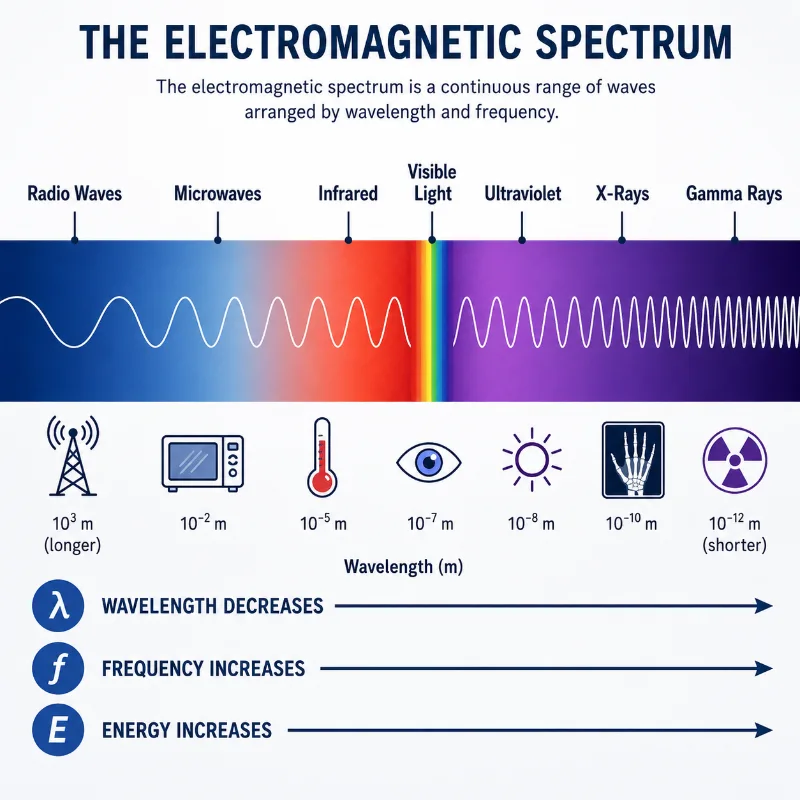
This infographic shows the electromagnetic spectrum arranged as a continuous scale from radio waves, microwaves, infrared, visible light, ultraviolet, X-rays, to gamma rays. As the scale moves from left to right, wavelength decreases while frequency and photon energy increase. The narrow visible light band is shown as only a small part of the full spectrum, helping students understand that human vision detects just one limited region of electromagnetic radiation.
Learning Pathway
Electricity and Magnetism
Introduces the larger field of electric charges, electric fields, magnetic fields, circuits, induction, and electromagnetic waves.
Electromagnetic Waves
Brings together changing electric and magnetic fields to explain waves that travel through space without needing a material medium.
Maxwell’s Equations and Electromagnetic Waves
Explains how Maxwell’s equations predict self-sustaining electromagnetic waves travelling through vacuum at the speed of light.
Electromagnetic Spectrum
Shows how electromagnetic waves form one continuous family, from long-wavelength radio waves to high-energy gamma rays.
Energy and Momentum in Electromagnetic Waves
Examines how electromagnetic waves carry energy, exert radiation pressure, and transfer momentum to matter.
Polarisation, Reflection, and Transmission
Explores how electromagnetic waves are oriented, reflected, transmitted, filtered, absorbed, and controlled by materials.
Core Physical Idea
Pictorial Illustration 1: One Family of Electromagnetic Waves
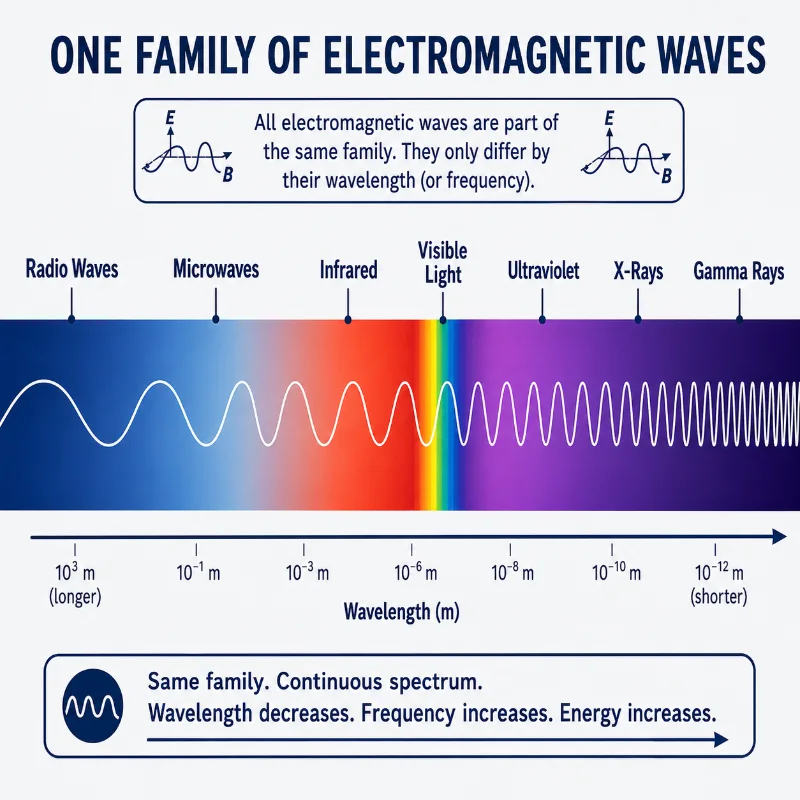
This illustration presents the electromagnetic spectrum as one continuous family of waves rather than as separate unrelated categories. Radio waves, microwaves, infrared, visible light, ultraviolet, X-rays, and gamma rays are shown along a smooth scale, with the wave pattern becoming shorter in wavelength from left to right. The narrow visible light band appears as only one small part of the full spectrum. The picture helps students understand that all regions of the electromagnetic spectrum share the same underlying wave nature, even though they interact with matter in different ways.
Key Equations and What They Mean
This equation connects wave speed, frequency, and wavelength. In vacuum, electromagnetic waves travel at speed \( c \), so a higher frequency must correspond to a shorter wavelength.
This equation gives the energy of one photon of electromagnetic radiation. The symbol \( h \) is Planck’s constant, and \( f \) is frequency. Higher-frequency radiation has higher photon energy.
This form combines \( c = f\lambda \) with \( E = hf \). It shows that photon energy is inversely proportional to wavelength. Short-wavelength radiation has high photon energy.
This rearranged form is useful when wavelength is known and frequency needs to be calculated.
This rearranged form is useful when frequency is known and wavelength needs to be calculated.
The Spectrum from Radio Waves to Gamma Rays
Radio Waves
Radio waves have the longest wavelengths in the electromagnetic spectrum. They are used in radio broadcasting, television signals, mobile communication, navigation, and astronomy. Their long wavelengths allow them to travel over large distances and interact with large antennas.
Microwaves
Microwaves have shorter wavelengths than radio waves. They are used in microwave ovens, radar, satellite communication, Wi-Fi, mobile networks, and remote sensing. Their wavelengths are useful for communication systems and for detecting objects or surfaces.
Infrared Radiation
Infrared radiation lies beyond the red end of visible light. It is strongly associated with thermal radiation and is used in thermal cameras, remote controls, night vision systems, astronomy, and heat transfer studies.
Visible Light
Visible light is the small part of the electromagnetic spectrum that the human eye can detect. It includes the colours from violet to red. Although visible light feels special to us, physically it is only a narrow window within the much wider electromagnetic spectrum.
Ultraviolet Radiation
Ultraviolet radiation has shorter wavelengths and higher frequencies than visible light. It is involved in fluorescence, sterilisation, atmospheric chemistry, and sun exposure effects. Its higher photon energy allows it to affect some chemical bonds.
X-Rays
X-rays have very short wavelengths and high photon energies. They can pass through soft tissue more easily than through bone, which makes them useful in medical imaging. They are also used in materials analysis, security scanning, and crystallography.
Gamma Rays
Gamma rays have the shortest wavelengths and highest photon energies in the electromagnetic spectrum. They are produced in nuclear processes, high-energy particle interactions, and extreme cosmic events. They are important in medicine, astrophysics, and nuclear science.
Pictorial Illustration 2: Wavelength, Frequency, and Energy Trends
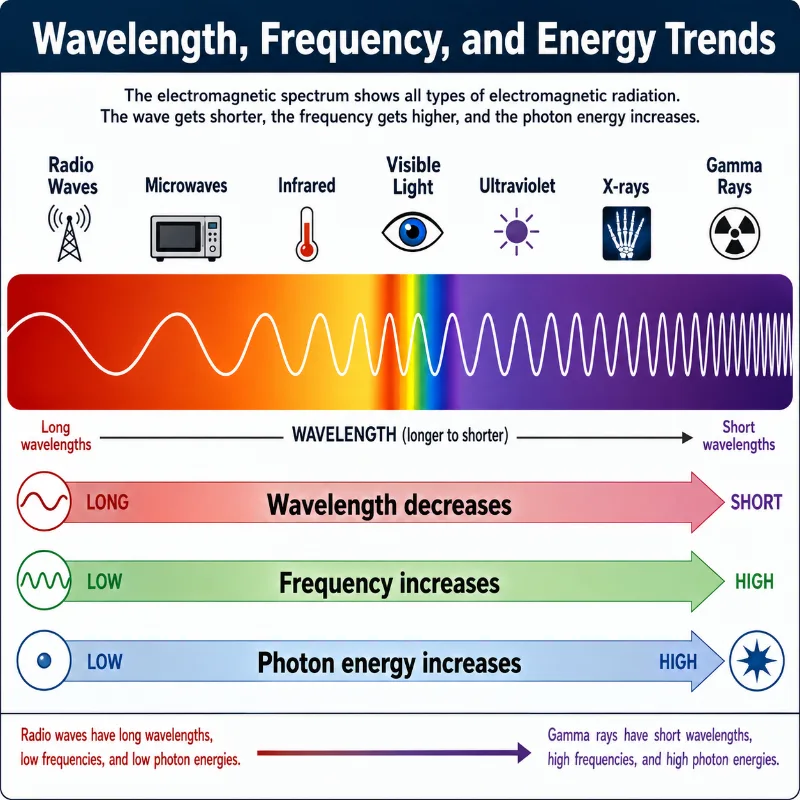
This illustration shows the main trends across the electromagnetic spectrum. Radio waves appear on the long-wavelength, low-frequency, low-energy side, while gamma rays appear on the short-wavelength, high-frequency, high-energy side. Three arrows highlight the key pattern: wavelength decreases, frequency increases, and photon energy increases from left to right. The picture helps students remember the spectrum by focusing on physical trends rather than memorising the names of separate regions.
The Quantum Transition: Quantifying Photon Energy with Planck’s Relation
$$ E = hf $$
- \(E\): Represents the localized energy packed inside a single individual photon, measured in Joules (\(\text{J}\)) or electron-volts (\(\text{eV}\)).
- \(f\): Represents the traditional frequency of the wave, tracking how many cycles oscillate per second (\(\text{Hz}\)).
- \(h\): Represents Planck’s constant (\(6.626 \times 10^{-34}\text{ J}\cdot\text{s}\)). This tiny number acts as the universal gear ratio of our cosmos, dictating exactly how much energy is tied to a unit of wave frequency.
$$ E = \frac{hc}{\lambda} $$
The Mechanics of Ionization: Shifting from Non-Ionizing to Ionizing Radiation
- The Non-Ionizing Region (Radio to Visible Light): Photons in these bands carry very low energy (ranging from micro-electron-volts up to about \(3\text{ eV}\) for violet light). When a visible light or microwave photon hits a molecule, it lacks the energy to snap chemical bonds or dislodge electrons. Instead, it merely causes the molecules to rotate, vibrate, or bump into one another, which manifests safely as thermal heat.
- The Ionizing Region (Ultraviolet, X-Rays, and Gamma Rays): As frequencies cross into the upper end of the ultraviolet band, individual photon energies soar past the \(10\text{ eV}\) threshold. When an X-ray or gamma-ray photon collides with matter, it hits with enough concentrated energy to blast tightly bound inner electrons clean out of their atomic orbitals.
Why Frequency Changes Matter
Visible Light: A Small Human Window
Pictorial Illustration 3: Visible Light as a Tiny Window
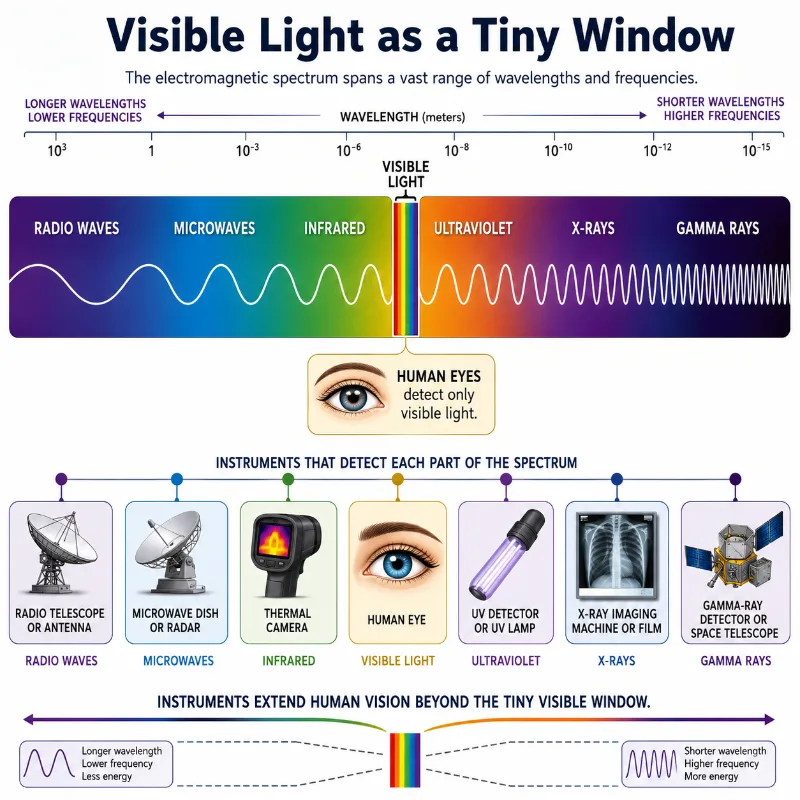
This illustration shows the full electromagnetic spectrum as a wide continuous band, with visible light highlighted as a very narrow colourful region. Human eyes detect only this small visible window, while instruments such as radio telescopes, microwave dishes, thermal cameras, ultraviolet detectors, X-ray imaging systems, and gamma-ray space telescopes detect radiation beyond ordinary sight. The picture helps students understand that the universe contains much more electromagnetic information than the human eye can see directly.
Absorption, Transmission, and Detection
Absorption
Absorption occurs when matter takes in energy from electromagnetic radiation. This may warm the material, excite electrons, trigger chemical changes, or affect molecular motion.
Transmission
Transmission occurs when radiation passes through a material. Glass transmits much visible light, while some medical X-rays pass through soft tissue more easily than through denser structures.
Reflection
Reflection occurs when radiation bounces from a surface. Mirrors reflect visible light, metal surfaces reflect many radio waves and microwaves, and radar systems depend on reflected electromagnetic waves.
Detection
Detection occurs when a device converts incoming electromagnetic radiation into a measurable signal. Antennas, cameras, thermal sensors, X-ray detectors, and telescopes all detect different regions of the spectrum.
Worked Example
Worked Example Illustration
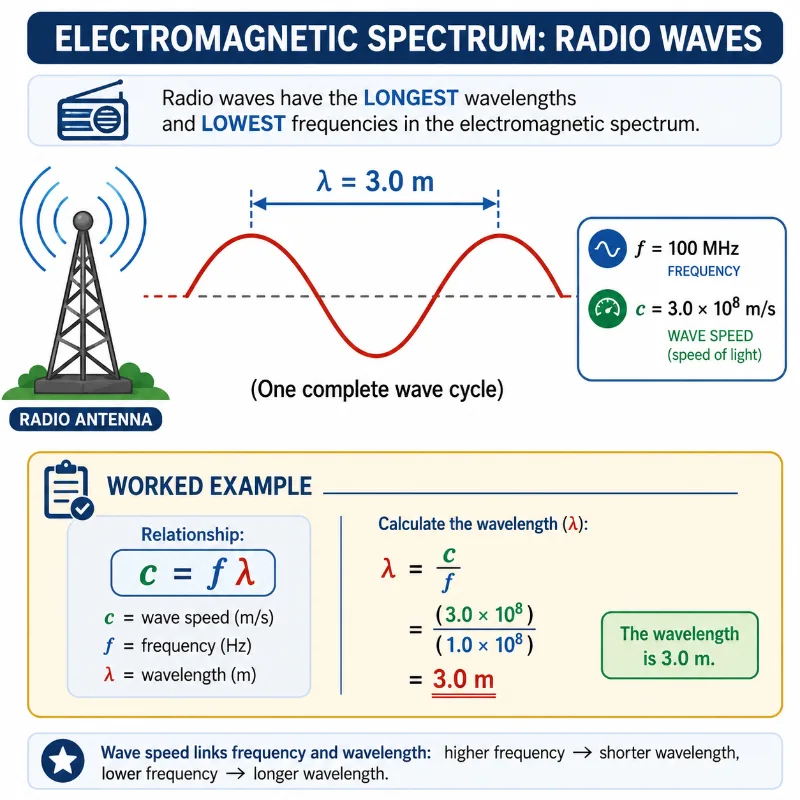
This worked example illustration shows a radio antenna emitting a radio wave with one complete wave cycle marked clearly. The wave is labelled with frequency \( f = 100 \ \text{MHz} \), wave speed \( c = 3.0 \times 10^8 \ \text{m/s} \), and wavelength \( \lambda = 3.0 \ \text{m} \). The calculation area shows how the relationship \( c = f\lambda \) can be rearranged to find \( \lambda = \frac{c}{f} \). The picture helps students connect frequency, wavelength, and wave speed in a practical electromagnetic spectrum example.Common Misconceptions about the Electromagnetic Spectrum
Misconception 1: Visible Light Is the Main Part of the Spectrum
Visible light is important to human experience, but it is only a tiny part of the electromagnetic spectrum. Most electromagnetic radiation is invisible to the human eye.
Misconception 2: Radio Waves and Light Are Completely Different Things
Radio waves and visible light are both electromagnetic waves. They differ mainly in wavelength, frequency, and photon energy.
Misconception 3: Higher Frequency Means Higher Speed
In vacuum, all electromagnetic waves travel at the same speed \( c \). Higher frequency means shorter wavelength and higher photon energy, not higher speed in vacuum.
Misconception 4: All Radiation Is Equally Dangerous
Radiation risk depends on type, intensity, energy, exposure time, distance, and shielding. Radio waves, visible light, ultraviolet radiation, X-rays, and gamma rays do not all affect matter in the same way.
Misconception 5: Spectrum Categories Have Perfectly Sharp Boundaries
The named regions of the spectrum are convenient classifications. Their boundaries are approximate and may vary slightly across fields and applications.
Misconception 6: Invisible Radiation Cannot Be Measured
Many forms of electromagnetic radiation are invisible to humans but can be measured by instruments such as antennas, infrared sensors, ultraviolet detectors, X-ray detectors, and radio telescopes.
Practical Applications of the Electromagnetic Spectrum
Communication
Radio waves and microwaves are used in broadcasting, mobile networks, Wi-Fi, Bluetooth, satellite links, and navigation systems because they can carry information over distance.
Heating and Thermal Imaging
Microwaves can transfer energy to food, while infrared radiation is used in thermal cameras, heat sensors, night vision systems, and studies of heat loss in buildings.
Medicine
Visible light, infrared radiation, ultraviolet radiation, X-rays, and gamma rays all have medical uses, including imaging, diagnosis, sterilisation, monitoring, and some forms of treatment.
Astronomy
Astronomers study the universe across the electromagnetic spectrum. Radio, infrared, visible, ultraviolet, X-ray, and gamma-ray observations reveal different physical processes.
Security and Inspection
X-rays and other electromagnetic methods are used in luggage scanning, industrial inspection, material testing, and quality control.
Environmental and Earth Observation
Satellites use visible, infrared, microwave, and other regions of the spectrum to monitor clouds, vegetation, oceans, land surfaces, weather, and climate-related patterns.
Real-World Illustration
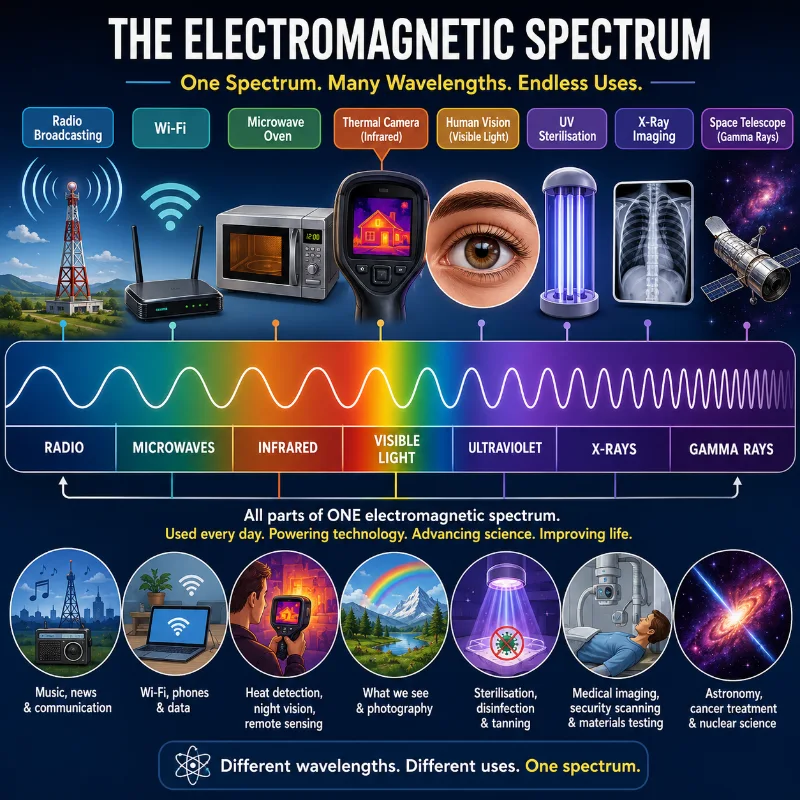
This illustration shows how the electromagnetic spectrum appears in daily life and science. Radio waves support broadcasting, microwaves are used in Wi-Fi and microwave ovens, infrared radiation enables thermal imaging, visible light allows human vision, ultraviolet radiation is used for sterilisation, X-rays support medical imaging and inspection, and gamma rays help scientists study energetic processes in space. The picture helps students connect classroom physics with communication, cooking, seeing, diagnosing disease, monitoring materials, and observing the universe.
Bridge to University Thinking
From Waves to Photons
Students first learn wavelength and frequency, then later connect frequency to photon energy using \( E = hf \).
From Colour to Spectroscopy
Visible colour becomes part of a wider method for identifying atoms, molecules, stars, gases, and materials by studying the radiation they emit or absorb.
From Simple Signals to Communication Systems
Radio and microwave waves become the foundation for modulation, antennas, bandwidth, data transmission, and wireless networks.
From Images to Physical Probes
X-rays, infrared imaging, ultraviolet analysis, and radio astronomy show how different wavelengths reveal different layers of reality.
Quick Interactive Check
Quick Check: Electromagnetic Spectrum
Review Questions and Answers
The electromagnetic spectrum is the complete range of electromagnetic waves, arranged by wavelength, frequency, and energy.
The usual order is radio waves, microwaves, infrared radiation, visible light, ultraviolet radiation, X-rays, and gamma rays.
They are related by \( c = f\lambda \) for electromagnetic waves in vacuum.
Wavelength decreases when frequency increases, assuming the wave speed remains fixed.
Gamma radiation has much higher frequency, and photon energy is given by \( E = hf \).
Visible light covers only the range of wavelengths that the human eye can detect. Many other wavelengths exist outside human vision.
Microwaves can carry information and are suitable for radar, satellite links, Wi-Fi, mobile communication, and other wireless systems.
X-rays can pass through soft tissue more easily than through denser structures such as bone, producing contrast in medical images.
No. The boundaries are approximate and may vary depending on the field or application.
Different regions of the spectrum reveal different physical processes in space, such as cold gas, warm dust, stars, hot plasma, and high-energy events.
Thought-Provoking Questions and Answers
They behave differently because their wavelengths, frequencies, and photon energies are different. These differences affect how they interact with matter.
Visible light feels normal to humans because our eyes detect it, but physically it is only one narrow band within a much larger electromagnetic spectrum.
Different wavelengths interact differently with the electrons and molecules inside a material. A material may allow one range of frequencies to pass while absorbing another.
Different regions of the electromagnetic spectrum reveal different information. Radio, infrared, visible, ultraviolet, X-ray, and gamma-ray observations show different parts of the universe.
Classical physics describes electromagnetic radiation as waves, while quantum physics describes radiation energy in photons. The spectrum connects both views through wavelength, frequency, and energy.
Numerical Problems and Solutions
\( \lambda = \frac{c}{f} \)
\( \lambda = \frac{3.0 \times 10^8}{6.0 \times 10^{14}} \)
\( \lambda = 5.0 \times 10^{-7} \ \text{m} \)
The wavelength is \( 5.0 \times 10^{-7} \ \text{m} \), or \( 500 \ \text{nm} \).
\( f = \frac{c}{\lambda} \)
\( f = \frac{3.0 \times 10^8}{0.030} \)
\( f = 1.0 \times 10^{10} \ \text{Hz} \)
The frequency is \( 1.0 \times 10^{10} \ \text{Hz} \).
\( f = \frac{c}{\lambda} \)
\( f = \frac{3.0 \times 10^8}{2.0} \)
\( f = 1.5 \times 10^8 \ \text{Hz} \)
The frequency is \( 1.5 \times 10^8 \ \text{Hz} \), or \( 150 \ \text{MHz} \).
\( E = hf \)
\( E = (6.63 \times 10^{-34})(5.0 \times 10^{14}) \)
\( E = 3.315 \times 10^{-19} \ \text{J} \)
The photon energy is approximately \( 3.3 \times 10^{-19} \ \text{J} \).
\( f = \frac{c}{\lambda} \)
\( f = \frac{3.0 \times 10^8}{1.0 \times 10^{-10}} \)
\( f = 3.0 \times 10^{18} \ \text{Hz} \)
The frequency is \( 3.0 \times 10^{18} \ \text{Hz} \), which lies in the X-ray region.
Photon energy is proportional to frequency: \( E = hf \).
Since \( 8.0 \times 10^{14} \ \text{Hz} \) is greater than \( 2.0 \times 10^{12} \ \text{Hz} \), the radiation with frequency \( 8.0 \times 10^{14} \ \text{Hz} \) has greater photon energy.
Summary
Glossary
Frequently Asked Questions
The electromagnetic spectrum is the full range of electromagnetic waves, from long-wavelength radio waves to short-wavelength gamma rays.
The main regions are radio waves, microwaves, infrared radiation, visible light, ultraviolet radiation, X-rays, and gamma rays.
In vacuum, all electromagnetic waves travel at the same speed, \( c = 3.0 \times 10^8 \ \text{m/s} \). In materials, their speeds may differ.
Gamma rays have the highest photon energies because they have the highest frequencies.
The human eye detects visible light, but instruments can detect many other forms of electromagnetic radiation, including radio waves, infrared radiation, ultraviolet radiation, X-rays, and gamma rays.
Different wavelengths and frequencies interact with matter differently. This makes some regions useful for communication, others for heating, imaging, sensing, or scientific analysis.
The word radiation simply means energy travelling outward. Different types of radiation have different energies and effects. Risk depends on frequency, intensity, exposure, and context.
It connects physics with communication engineering, optics, astronomy, remote sensing, medical imaging, quantum physics, materials science, and many modern technologies.