
Electromagnetic waves do not merely travel through space as invisible patterns of electric and magnetic fields. They also carry energy and momentum. This means that light, radio waves, microwaves, infrared radiation, ultraviolet radiation, X-rays, and gamma rays can transfer energy to matter and can even exert a small pressure when they are absorbed or reflected.
This idea may feel surprising at first because electromagnetic waves have no material substance in the ordinary sense. A beam of sunlight has no solid surface. A radio wave cannot be held in the hand. Yet electromagnetic waves can warm objects, charge solar cells, move electrons in antennas, transfer power in communication systems, and push gently on reflective surfaces.
The energy in an electromagnetic wave is stored in its electric and magnetic fields. The flow of that energy is described by the Poynting vector. The momentum carried by the wave explains radiation pressure, the tiny but real pressure exerted by electromagnetic radiation.
For students, this page helps connect wave equations to physical effects. An electromagnetic wave is not only a moving diagram of electric and magnetic fields. It is a carrier of energy, direction, power, pressure, and information.
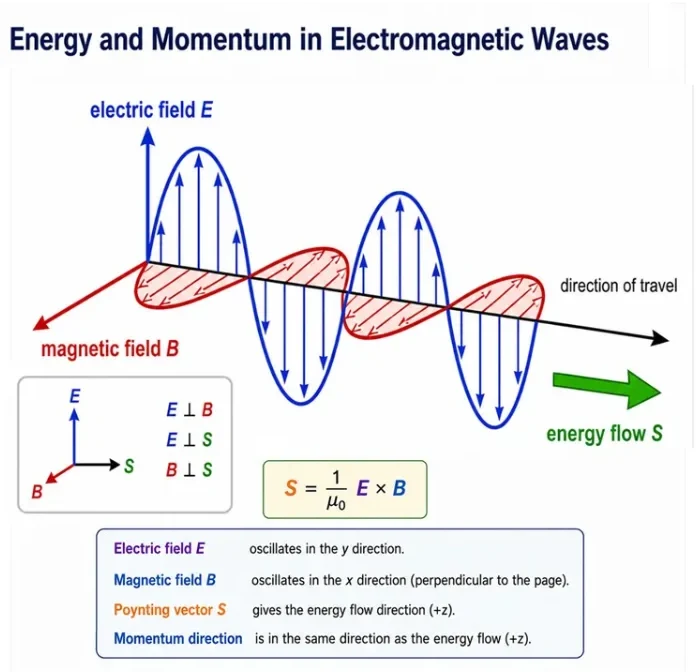
This illustration shows an electromagnetic wave travelling through space with the electric field oscillating in one direction and the magnetic field oscillating perpendicular to it. The diagram also shows the direction of travel and the direction of energy flow, represented by the Poynting vector. A small inset highlights that the electric field, magnetic field, and energy flow are mutually perpendicular. The picture helps students understand that electromagnetic waves are not only oscillating fields, but also carriers of energy and momentum.
Learning Pathway
This page belongs to the Electromagnetic Waves cluster. It follows naturally from Maxwell’s equations and the electromagnetic spectrum, then prepares students to understand radiation pressure, solar energy, antennas, optical power, and wave-matter interaction.
Electricity and Magnetism
Introduces the wider physics of electric fields, magnetic fields, circuits, induction, and electromagnetic waves.Electromagnetic Waves
Explains how changing electric and magnetic fields travel together as waves through space.Maxwell’s Equations and Electromagnetic Waves
Shows how Maxwell’s equations predict electromagnetic waves travelling through vacuum at the speed of light.Electromagnetic Spectrum
Arranges radio waves, microwaves, infrared, visible light, ultraviolet, X-rays, and gamma rays into one continuous electromagnetic family.Energy and Momentum in Electromagnetic Waves
Explains how electromagnetic waves carry energy, transfer momentum, exert radiation pressure, and deliver power across space.Polarisation, Reflection, and Transmission
Explores how electromagnetic waves are oriented, reflected, transmitted, filtered, and controlled by materials and surfaces.Core Physical Idea
The central idea is that electromagnetic fields store energy. When the fields vary in space and time as a wave, that energy can move through space. The direction of energy flow is linked to the directions of the electric and magnetic fields.
For a plane electromagnetic wave in vacuum, the electric field \( \vec{E} \), magnetic field \( \vec{B} \), and direction of travel are mutually perpendicular. The energy flow points in the direction of \( \vec{E} \times \vec{B} \). This direction is described by the Poynting vector.
If a wave carries energy in a particular direction, it also carries momentum in that direction. When the wave is absorbed, reflected, or scattered by matter, it can transfer some of that momentum to the object. The result is radiation pressure.
Pictorial Illustration 1: Energy Flow in an Electromagnetic Wave
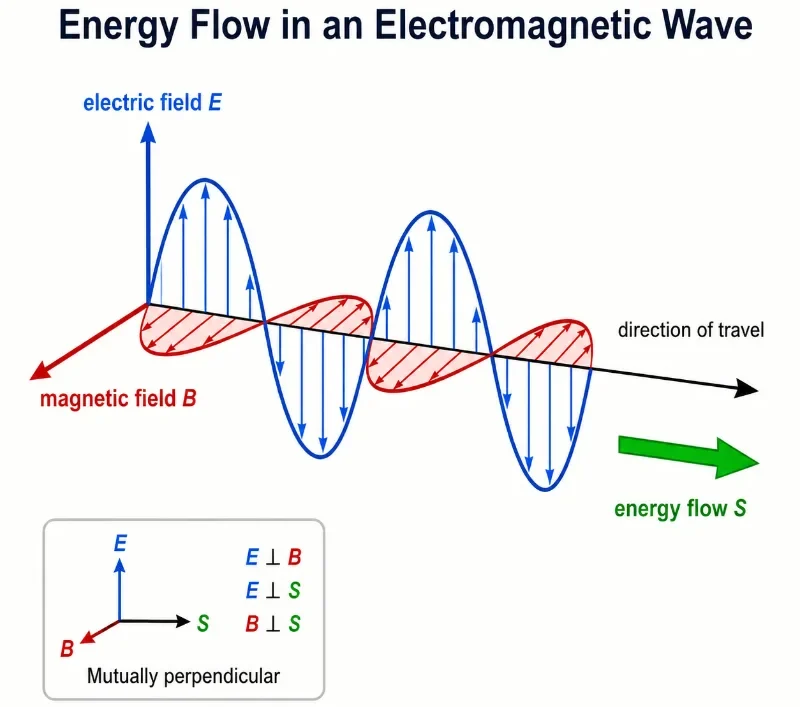
This illustration shows a plane electromagnetic wave with its electric field \( \vec{E} \) oscillating vertically and its magnetic field \( \vec{B} \) oscillating horizontally. The direction of travel is shown along the wave path, while the Poynting vector \( \vec{S} \) points forward to indicate the direction of electromagnetic energy flow. The picture helps students see that the electric field, magnetic field, and energy flow are mutually perpendicular, with energy moving in the same direction as the wave.Key Equations and What They Mean
\( u_E = \frac{1}{2}\varepsilon_0 E^2 \)
This equation gives the energy density stored in the electric field. The symbol \( u_E \) is electric field energy per unit volume, \( \varepsilon_0 \) is the permittivity of free space, and \( E \) is the electric field strength.
\( u_B = \frac{B^2}{2\mu_0} \)
This equation gives the energy density stored in the magnetic field. The symbol \( u_B \) is magnetic field energy per unit volume, \( B \) is the magnetic field strength, and \( \mu_0 \) is the permeability of free space.
\( u = u_E + u_B \)
The total electromagnetic energy density is the sum of the electric field energy density and the magnetic field energy density.
\( \vec{S} = \frac{1}{\mu_0}\vec{E} \times \vec{B} \)
This is the Poynting vector. It gives the rate of electromagnetic energy flow per unit area. Its direction is the direction in which electromagnetic energy travels.
\( I = \langle S \rangle \)
Intensity is the time-averaged magnitude of the Poynting vector. It tells us how much electromagnetic power crosses each square metre of area.
\( I = \frac{1}{2}c\varepsilon_0 E_0^2 \)
For a sinusoidal plane wave in vacuum, this gives the average intensity in terms of the peak electric field amplitude \( E_0 \).
\( I = \frac{1}{2}\frac{c}{\mu_0}B_0^2 \)
This gives the average intensity in terms of the peak magnetic field amplitude \( B_0 \).
\( p = \frac{U}{c} \)
An amount of electromagnetic energy \( U \) carries momentum \( p \) when it is absorbed. This shows that electromagnetic radiation can transfer momentum to matter.
\( p_{\text{rad}} = \frac{I}{c} \)
This is the radiation pressure on a perfect absorber. The pressure is the intensity divided by the speed of light.
\( p_{\text{rad}} = \frac{2I}{c} \)
This is the radiation pressure on a perfect reflector. Reflection reverses the direction of the wave’s momentum, so the pressure is twice that for complete absorption.
Energy Stored in Electric and Magnetic Fields
An electromagnetic wave contains both electric field energy and magnetic field energy. The electric field contributes energy density \( u_E \), while the magnetic field contributes energy density \( u_B \). In a plane electromagnetic wave travelling through vacuum, these two contributions are equal on average.
This equality is important because it shows that the electric and magnetic parts of the wave are not separate passengers travelling side by side. They are linked parts of one electromagnetic process. As the wave moves, energy is shared between the fields and flows forward through space.
The stronger the electric and magnetic fields, the greater the energy carried by the wave. This is why intensity depends on field amplitude. A brighter beam of light or a stronger radio signal carries more energy per unit time across a given area.
Pictorial Illustration 2: Electric and Magnetic Field Energy
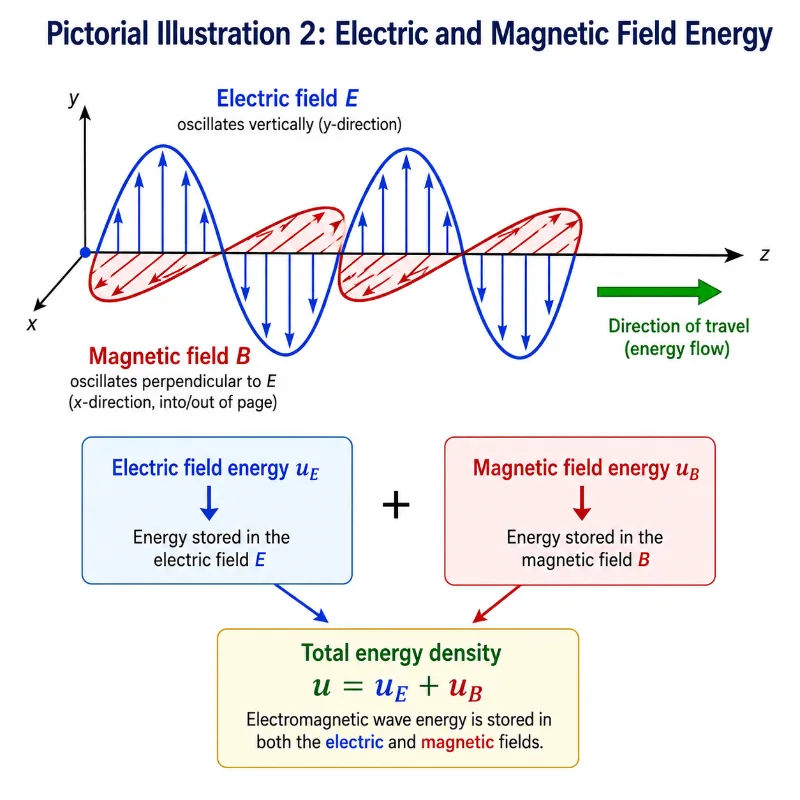
This illustration shows an electromagnetic wave travelling through space with the electric field and magnetic field labelled clearly. The diagram separates the wave’s energy into two parts: electric field energy \( u_E \) and magnetic field energy \( u_B \). These two contributions combine to give the total electromagnetic energy density \( u = u_E + u_B \). The picture helps students understand that the energy of an electromagnetic wave is not carried by matter, but is stored in its electric and magnetic fields.
The Poynting Vector: Direction and Rate of Energy Flow
The Poynting vector is one of the most important ideas in electromagnetic wave physics. It tells us both the direction and rate of electromagnetic energy flow. Its magnitude has units of watts per square metre, the same as intensity.
The equation \( \vec{S} = \frac{1}{\mu_0}\vec{E} \times \vec{B} \) contains a cross product. This matters because the direction of \( \vec{S} \) is perpendicular to both \( \vec{E} \) and \( \vec{B} \). For a plane wave, that direction is the direction in which the wave travels.
In practical terms, the Poynting vector helps answer the question: Where is electromagnetic energy going? It is used in optics, antenna design, microwave engineering, solar energy, laser safety, wireless power, and many areas of electromagnetic field theory.
Direction
The direction of the Poynting vector shows the direction in which electromagnetic energy flows.Magnitude
The magnitude of the Poynting vector gives power flow per unit area, measured in \( \text{W/m}^2 \).Time Average
For oscillating waves, the time average of the Poynting vector gives the wave intensity.Physical Meaning
The Poynting vector turns the abstract idea of electromagnetic fields into a measurable flow of energy.Vector Field Continuity: Deriving Local Power Flow via the Poynting Theorem
To understand how an electromagnetic wave delivers energy across a vacuum at the university level, we cannot look at the fields as stationary clouds. We must use vector calculus to track how energy moves through a given volume of space. This conservation framework is governed by the Poynting Theorem, which serves as the local energy balance sheet for electrodynamics:
$$ -\frac{\partial u}{\partial t} = \nabla \cdot \mathbf{S} + \mathbf{J} \cdot \mathbf{E} $$To make sense of this differential expression without getting lost in the operators, let’s unpack exactly how each term tells a piece of a continuous physical story:
- The left term, \(\frac{\partial u}{\partial t}\), measures how fast the total stored field energy density (the combined electric and magnetic energy at a single point) is dropping over time.
- The vector term, \(\nabla \cdot \mathbf{S}\) (the divergence of the Poynting vector), calculates the rate at which electromagnetic power is actively streaming out through the boundary surface of that spatial point.
- The work term, \(\mathbf{J} \cdot \mathbf{E}\), tracks the real mechanical power transferred from the field to any local material charges, causing currents (\(\mathbf{J}\)) to flow.
When a wave travels through a pure vacuum where there are no free charges present (\(\mathbf{J} = 0\)), the equation simplifies beautifully to \(-\frac{\partial u}{\partial t} = \nabla \cdot \mathbf{S}\). This tells us that energy cannot vanish into nothingness. If the field energy drops in a region of empty space, it is because a directional cross-product flux—the Poynting vector \(\mathbf{S} = \frac{1}{\mu_0}(\mathbf{E} \times \mathbf{B})\)—is physically carrying that power forward into the next coordinate block.
The Electrodynamic Mechanism: How Fields Generate Radiation Pressure Forces
The statement that an electromagnetic wave carries momentum can feel abstract because light does not possess rest mass. However, university physics clarifies this by looking at how the fields interact with individual charges. Radiation pressure is not a magic force; it is the direct result of a classical Lorentz force acting on the electrons within an illuminated surface.
Let’s track this mechanical process step by step as an incoming electromagnetic wave hits a conductive plate:
- Step 1: The Electric Drive. As the wave arrives, its oscillating electric field vector (\(\mathbf{E}\)) exerts an immediate force on the surface electrons (\(\mathbf{F}_E = q\mathbf{E}\)). This forces the electrons to shake up and down along the same line as the electric field axis, establishing an instantaneous drift velocity (\(\mathbf{v}\)).
- Step 2: The Magnetic Push. Because those electrons are now moving particles, they immediately become vulnerable to the wave’s matching magnetic field vector (\(\mathbf{B}\)). The moving charges experience a magnetic Lorentz force given by the vector cross-product: $$ \mathbf{F}_B = q(\mathbf{v} \times \mathbf{B}) $$
- Step 3: The Forward Acceleration. Because the electric field, magnetic field, and wave direction are all mutually perpendicular, applying the right-hand rule to this cross-product reveals that the resulting force vector \(\mathbf{F}_B\) points directly forward along the wave’s path of travel.
This electron push is the physical cause of radiation pressure. By averaging this microscopic Lorentz force over an entire surface, engineers find that the total momentum (\(\mathbf{p}\)) delivered to an absorbing material scales uniformly with the total energy deposited (\(\mathbf{p} = \frac{U}{c}\)). This explicit mechanical mechanism helps students understand that light pressure is a natural, predictable outcome of vector forces working together.
Intensity: Power per Unit Area
Intensity tells us how much electromagnetic power passes through each square metre. A high-intensity wave transfers more energy per second through a given area than a low-intensity wave.
For sunlight, intensity helps describe how much solar power reaches a surface. For lasers, intensity helps determine how concentrated the beam energy is. For radio antennas, intensity relates to signal strength. For medical imaging, intensity must be controlled carefully because electromagnetic radiation interacts with tissue.
Intensity is not the same as total power. A source may emit a large total power, but the intensity at a distant point may be small if the energy spreads over a large area.
Pictorial Illustration 3: Intensity as Power Spread over Area
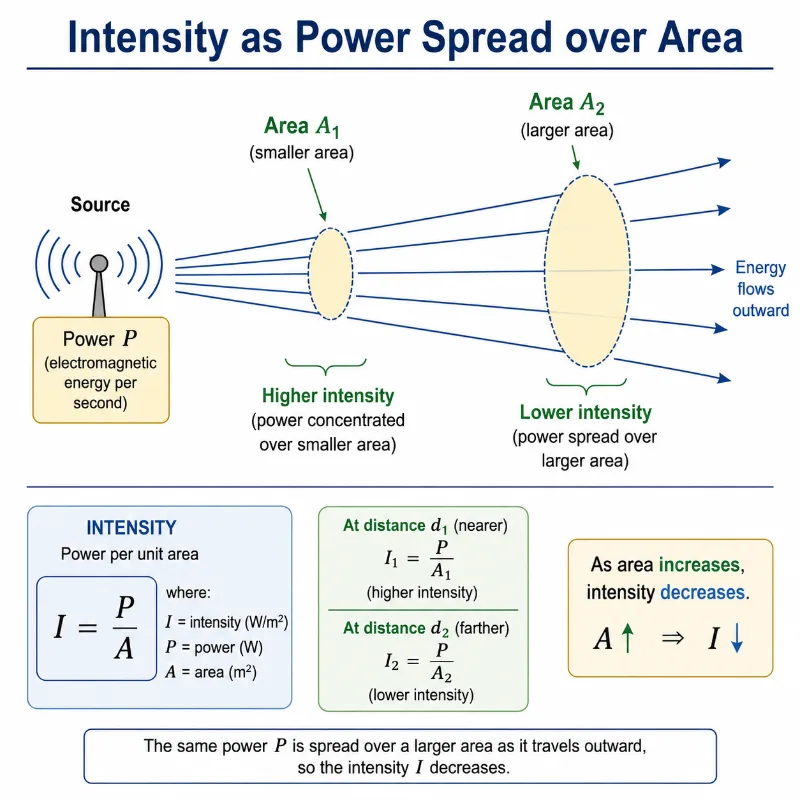
This illustration shows electromagnetic energy spreading outward from a source. Near the source, the same power passes through a smaller area, so the intensity is higher. Farther away, the energy is spread over a larger area, so the intensity is lower. The diagram uses the relationship \( I = \frac{P}{A} \) to show that intensity depends on both the power carried by the wave and the area over which that power is distributed.Momentum in Electromagnetic Waves
Electromagnetic radiation carries momentum. This does not mean that the wave has ordinary mass like a stone or a ball. It means that the wave can transfer momentum when it interacts with matter.
When electromagnetic radiation is absorbed, the receiving object gains energy and momentum. When radiation is reflected, the momentum change is larger because the direction of the wave is reversed. This is why a perfectly reflecting surface experiences twice the radiation pressure of a perfectly absorbing surface under the same intensity.
This effect is usually very small in everyday life. We do not feel sunlight pushing strongly on our bodies because the pressure is tiny. However, the effect is real and measurable. In space, where there is little friction, radiation pressure can gradually influence the motion of dust particles, satellites, and solar sails.
Absorption
When radiation is absorbed, the object receives energy and momentum from the wave.Reflection
When radiation is reflected, the wave’s momentum changes direction, producing a larger momentum transfer.Radiation Pressure
Radiation pressure is the small pressure exerted by electromagnetic radiation on a surface.Space Applications
In space, small radiation pressures can accumulate over long times and become useful for spacecraft control.Pictorial Illustration 4: Momentum Transfer and Radiation Pressure
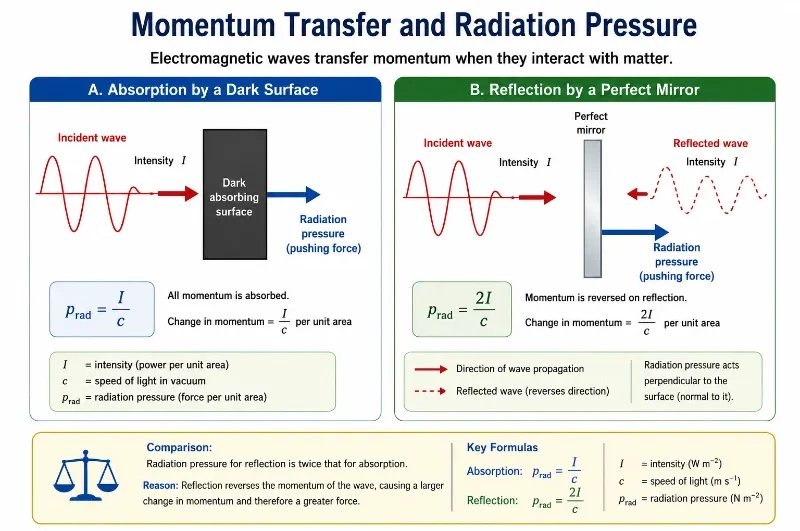
This illustration compares momentum transfer from electromagnetic waves in two cases. In the first panel, a wave is absorbed by a dark surface, producing radiation pressure \( p_{\text{rad}} = \frac{I}{c} \). In the second panel, a wave is reflected by a mirror, producing radiation pressure \( p_{\text{rad}} = \frac{2I}{c} \). The picture helps students understand why reflection transfers more momentum than absorption: the reflected wave reverses direction, causing a larger change in momentum.Radiation Pressure in Space
Radiation pressure is extremely small, but space is a place where small forces can matter. A spacecraft far from atmospheric drag can be affected by the steady pressure of sunlight. Over time, even a tiny continuous push can change motion.
Solar sails use this idea. A large lightweight reflective sail can receive momentum from sunlight. The force is small, but it does not require conventional fuel once the spacecraft is in space. This makes solar sailing an important example of electromagnetic momentum becoming engineering practice.
Radiation pressure also matters in astrophysics. Light from stars can push on dust grains. Intense radiation near hot stars, accretion discs, or energetic cosmic sources can influence the motion of surrounding matter.
Pictorial Illustration 5: Solar Sail Driven by Light Pressure
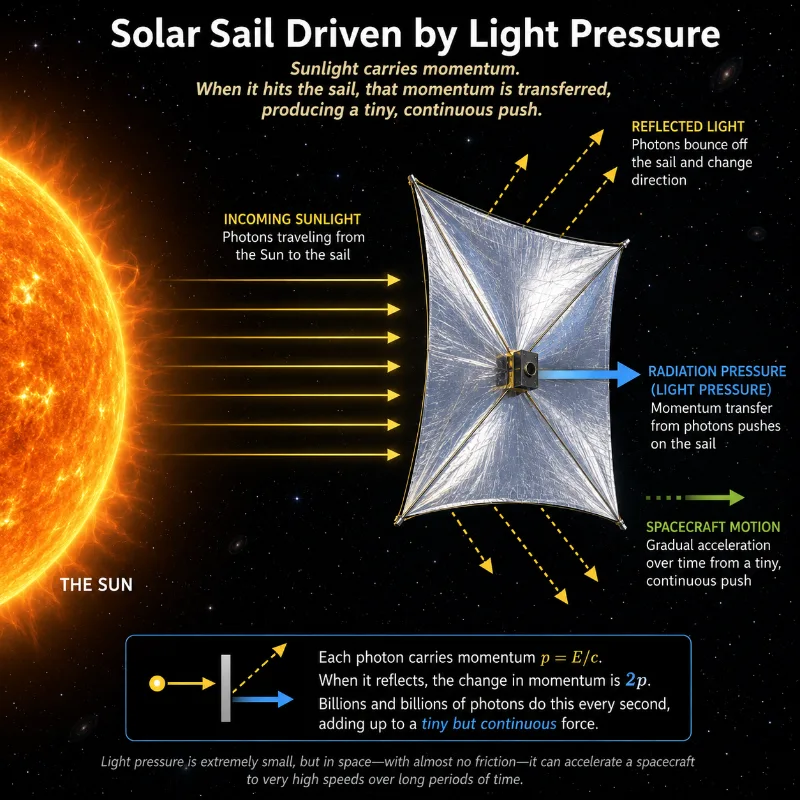
This illustration shows sunlight travelling from the Sun and striking a reflective solar sail in space. Incoming sunlight transfers momentum to the sail, while reflected light changes direction and increases the momentum transfer. The radiation pressure is very small, but in space a continuous push can gradually accelerate a spacecraft over time. The picture helps students understand how electromagnetic waves carry momentum and how light pressure can become useful in space travel.
Worked Example
Problem: An electromagnetic wave in vacuum has a peak electric field amplitude \( E_0 = 600 \ \text{V/m} \). Estimate its average intensity using \( I = \frac{1}{2}c\varepsilon_0 E_0^2 \), where \( c = 3.0 \times 10^8 \ \text{m/s} \) and \( \varepsilon_0 = 8.85 \times 10^{-12} \ \text{F/m} \).
Step 1: Write the equation.
\( I = \frac{1}{2}c\varepsilon_0 E_0^2 \)
Step 2: Substitute the values.
\( I = \frac{1}{2}(3.0 \times 10^8)(8.85 \times 10^{-12})(600)^2 \)
Step 3: Calculate the square of the electric field amplitude.
\( 600^2 = 360000 \)
Step 4: Calculate the intensity.
\( I \approx 4.8 \times 10^2 \ \text{W/m}^2 \)
Answer: The average intensity is approximately \( 480 \ \text{W/m}^2 \).
Worked Example Illustration
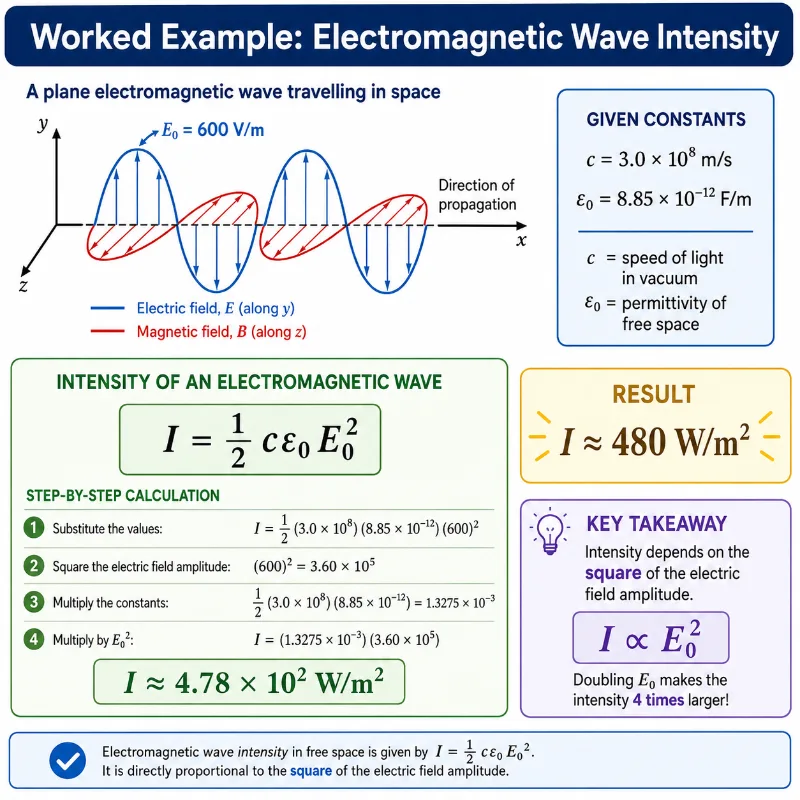
This worked example illustration shows how to calculate the average intensity of an electromagnetic wave from its peak electric field amplitude. The wave has \( E_0 = 600 \ \text{V/m} \), with \( c = 3.0 \times 10^8 \ \text{m/s} \) and \( \varepsilon_0 = 8.85 \times 10^{-12} \ \text{F/m} \). Using \( I = \frac{1}{2}c\varepsilon_0 E_0^2 \), the calculation gives \( I \approx 480 \ \text{W/m}^2 \). The picture also highlights the key idea that intensity is proportional to the square of the electric field amplitude, so doubling \( E_0 \) makes the intensity four times larger.Common Misconceptions about Energy and Momentum in Electromagnetic Waves
Energy and momentum in electromagnetic waves can seem strange because the wave does not need a material medium. These misconceptions often arise when students imagine waves only as vibrations of matter.
Misconception 1: Electromagnetic Waves Carry No Energy Because They Are Not Matter
Electromagnetic waves carry energy in their electric and magnetic fields. Sunlight warming a surface is a familiar example of energy transfer by electromagnetic radiation.Misconception 2: Momentum Requires Ordinary Mass
Electromagnetic radiation can carry momentum even though photons have no rest mass. The momentum becomes evident when radiation is absorbed or reflected.Misconception 3: Radiation Pressure Is Too Small to Matter
Radiation pressure is tiny in ordinary situations, but it can matter in space, in precision experiments, and in systems with intense light.Misconception 4: Intensity Depends Only on Frequency
Wave intensity depends on field amplitude and energy flow. Photon energy depends on frequency, but total intensity also depends on how many photons or how much field energy passes through an area each second.Misconception 5: Reflection and Absorption Produce the Same Pressure
A reflecting surface experiences greater radiation pressure than an absorbing surface because reflection reverses the wave’s momentum.Misconception 6: The Poynting Vector Is Only a Mathematical Decoration
The Poynting vector has direct physical meaning. It describes the direction and rate of electromagnetic energy flow.Practical Applications
The energy and momentum carried by electromagnetic waves appear in many technologies. Some applications use energy transfer, others depend on power flow, and others take advantage of momentum transfer.
Solar Panels
Solar panels convert electromagnetic energy from sunlight into electrical energy. Their operation depends on how much radiation energy reaches the surface.Wireless Communication
Radio and microwave signals carry energy from transmitting antennas to receiving antennas, where the wave energy drives tiny electric currents.Lasers
Laser beams concentrate electromagnetic energy into narrow, controlled paths. Their intensity is important in medicine, manufacturing, measurement, and communications.Microwave Heating
Microwave ovens transfer electromagnetic energy to food, where molecular motion increases and thermal energy rises.Optical Fibres
Optical fibres guide light energy through glass strands, allowing information to be transmitted over long distances.Solar Sails
Solar sails use radiation pressure from sunlight to produce a small continuous force on a spacecraft.Remote Sensing
Satellites measure electromagnetic radiation reflected or emitted by Earth to study land, oceans, clouds, vegetation, and temperature.Astronomy
Astronomers measure electromagnetic energy from stars, galaxies, and cosmic events to infer temperature, composition, motion, and power output.Real-World Illustration
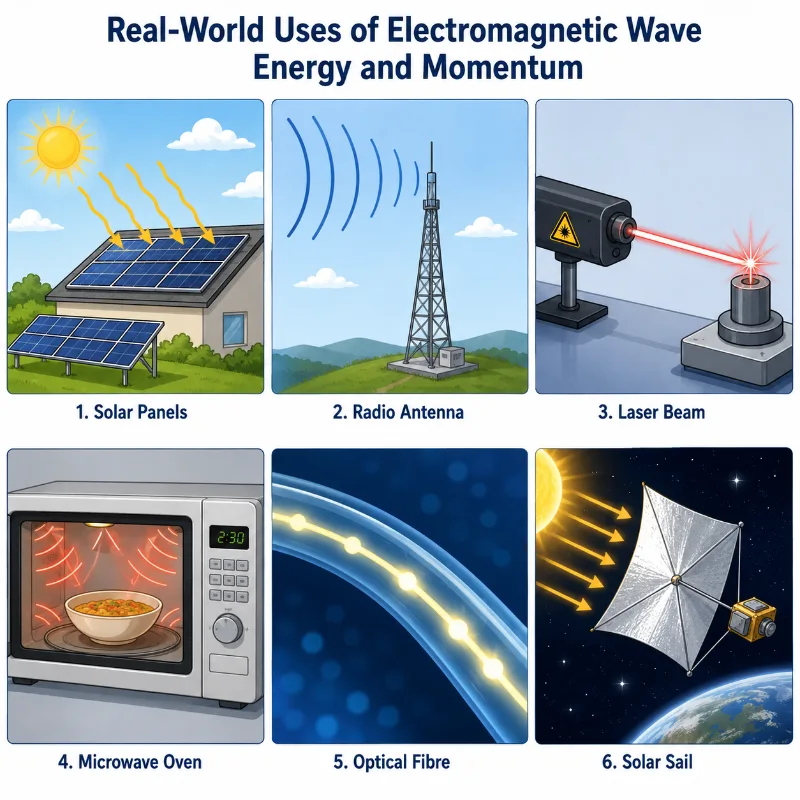
This illustration shows six real-world examples of electromagnetic wave energy and momentum. Solar panels receive energy from sunlight, radio antennas receive wave energy from broadcast signals, laser beams deliver concentrated electromagnetic energy, microwave ovens transfer energy to food, optical fibres guide light signals, and solar sails use radiation pressure from sunlight to produce a small continuous push. The picture helps students connect the physics of electromagnetic energy flow and momentum transfer with everyday technologies and space applications.
Bridge to University Thinking
At school level, students often learn that electromagnetic waves transfer energy. At university level, this idea becomes more precise. Energy density, intensity, the Poynting vector, radiation pressure, and field momentum are treated quantitatively.
The Poynting vector becomes especially important because it links fields to power flow. Instead of saying only that a wave carries energy, students learn to calculate how much energy crosses a surface each second and in what direction.
This topic also connects classical electromagnetism to quantum physics. In the classical picture, energy is described by fields and intensity. In the quantum picture, electromagnetic radiation is made of photons, each carrying energy and momentum. Both pictures are useful in different contexts.
From Field Strength to Energy Density
Electric and magnetic field amplitudes become measurable stores of electromagnetic energy per unit volume.From Brightness to Intensity
Brightness becomes a quantitative power flow per unit area, measured in watts per square metre.From Wave Direction to Poynting Vector
The direction of wave travel becomes linked to \( \vec{E} \times \vec{B} \), the direction of electromagnetic energy flow.From Light Pressure to Space Propulsion
Radiation pressure becomes a practical idea in solar sails and precision spacecraft dynamics.Quick Interactive Check
Quick Check: Energy and Momentum in Electromagnetic Waves
1. Where is the energy of an electromagnetic wave stored?
A. Only in air molecules
B. In the electric and magnetic fields
C. Only in the direction of travel
D. Only in the source after the wave leaves
Answer: B. Electromagnetic wave energy is stored in the electric and magnetic fields.
2. What does the Poynting vector describe?
A. The mass of a photon
B. The colour of visible light only
C. The direction and rate of electromagnetic energy flow
D. The number of electrons in an atom
Answer: C. The Poynting vector gives the direction and rate of electromagnetic energy flow per unit area.
3. Which surface experiences greater radiation pressure under the same intensity?
A. A perfect absorber
B. A perfect reflector
C. A surface with no interaction
D. A surface outside the path of the wave
Answer: B. A perfect reflector experiences twice the pressure of a perfect absorber because the wave’s momentum reverses direction.
4. What happens to wave intensity if the electric field amplitude is doubled?
A. The intensity becomes half as large
B. The intensity stays the same
C. The intensity doubles
D. The intensity becomes four times larger
Answer: D. Intensity is proportional to the square of the electric field amplitude, so doubling \( E_0 \) makes the intensity four times larger.
Review Questions and Answers
1. What carries the energy in an electromagnetic wave?
The energy is carried by the electric and magnetic fields of the wave.
2. What is energy density?
Energy density is the amount of energy stored per unit volume.
3. What is the Poynting vector?
The Poynting vector describes the direction and rate of electromagnetic energy flow per unit area.
4. What are the units of intensity?
Intensity is measured in watts per square metre, \( \text{W/m}^2 \).
5. Why does intensity depend on the square of field amplitude?
Energy density depends on \( E^2 \) and \( B^2 \), so stronger fields increase energy flow rapidly.
6. Do electromagnetic waves carry momentum?
Yes. Electromagnetic waves carry momentum and can transfer it when they are absorbed or reflected.
7. What is radiation pressure?
Radiation pressure is the pressure exerted by electromagnetic radiation when it transfers momentum to a surface.
8. Why is radiation pressure greater for reflection than absorption?
Reflection reverses the direction of the wave’s momentum, so the momentum change is larger.
9. Why is radiation pressure hard to notice in everyday life?
It is usually extremely small compared with ordinary mechanical forces.
10. Why is radiation pressure useful in space?
In space, there is little resistance, so even a small continuous force can gradually change the motion of an object.
Thought-Provoking Questions and Answers
1. Why is sunlight able to warm a surface even though it travels through empty space?
Sunlight is electromagnetic radiation. It carries energy in its electric and magnetic fields, so it can transfer energy to matter when absorbed.
2. Why does a stronger electromagnetic wave usually carry more energy?
The energy density depends on the square of the field amplitude. Larger electric and magnetic fields mean more stored energy and greater energy flow.
3. Why can electromagnetic radiation exert pressure without being a material wind?
It carries momentum. When radiation is absorbed or reflected, that momentum changes, producing a force on the surface.
4. Why is a mirror pushed more strongly by light than a perfect black absorber under the same intensity?
A black absorber receives the incoming momentum. A mirror reverses the direction of the radiation, causing a larger momentum change and therefore a larger pressure.
5. Why is the Poynting vector important beyond classroom physics?
It provides a way to calculate real electromagnetic power flow in antennas, lasers, solar panels, microwave systems, optical fibres, and many engineering devices.
Numerical Problems and Solutions
Problem 1: An electromagnetic wave has peak electric field amplitude \( E_0 = 400 \ \text{V/m} \). Estimate its average intensity in vacuum using \( I = \frac{1}{2}c\varepsilon_0 E_0^2 \).
Solution:
\( I = \frac{1}{2}c\varepsilon_0 E_0^2 \)
\( I = \frac{1}{2}(3.0 \times 10^8)(8.85 \times 10^{-12})(400)^2 \)
\( 400^2 = 160000 \)
\( I \approx 2.1 \times 10^2 \ \text{W/m}^2 \)
The average intensity is approximately \( 210 \ \text{W/m}^2 \).
Problem 2: Sunlight has intensity \( I = 1400 \ \text{W/m}^2 \) at the top of Earth’s atmosphere. Estimate the radiation pressure on a perfect absorber.
Solution:
\( p_{\text{rad}} = \frac{I}{c} \)
\( p_{\text{rad}} = \frac{1400}{3.0 \times 10^8} \)
\( p_{\text{rad}} \approx 4.7 \times 10^{-6} \ \text{Pa} \)
The radiation pressure is approximately \( 4.7 \times 10^{-6} \ \text{Pa} \).
Problem 3: For the same sunlight intensity \( I = 1400 \ \text{W/m}^2 \), estimate the radiation pressure on a perfect reflector.
Solution:
\( p_{\text{rad}} = \frac{2I}{c} \)
\( p_{\text{rad}} = \frac{2(1400)}{3.0 \times 10^8} \)
\( p_{\text{rad}} \approx 9.3 \times 10^{-6} \ \text{Pa} \)
The radiation pressure is approximately \( 9.3 \times 10^{-6} \ \text{Pa} \).
Problem 4: A laser beam has intensity \( 500 \ \text{W/m}^2 \) and falls on an area of \( 0.20 \ \text{m}^2 \). How much power reaches the area?
Solution:
\( I = \frac{P}{A} \)
\( P = IA \)
\( P = (500)(0.20) \)
\( P = 100 \ \text{W} \)
The power reaching the area is \( 100 \ \text{W} \).
Problem 5: A pulse of electromagnetic radiation transfers \( 60 \ \text{J} \) of energy to a perfect absorber. Estimate the momentum delivered.
Solution:
\( p = \frac{U}{c} \)
\( p = \frac{60}{3.0 \times 10^8} \)
\( p = 2.0 \times 10^{-7} \ \text{kg m/s} \)
The delivered momentum is \( 2.0 \times 10^{-7} \ \text{kg m/s} \).
Problem 6: A wave has intensity \( 300 \ \text{W/m}^2 \). What intensity would it have if its electric field amplitude were tripled?
Solution:
Intensity is proportional to the square of electric field amplitude.
If \( E_0 \) becomes \( 3E_0 \), then intensity becomes \( 3^2 = 9 \) times larger.
\( I_{\text{new}} = 9(300) = 2700 \ \text{W/m}^2 \)
The new intensity is \( 2700 \ \text{W/m}^2 \).
Summary
Electromagnetic waves carry energy in their electric and magnetic fields. The electric field energy density is \( u_E = \frac{1}{2}\varepsilon_0 E^2 \), and the magnetic field energy density is \( u_B = \frac{B^2}{2\mu_0} \).
The Poynting vector \( \vec{S} = \frac{1}{\mu_0}\vec{E} \times \vec{B} \) describes the direction and rate of electromagnetic energy flow. Its time-averaged magnitude is the intensity of the wave.
Electromagnetic waves also carry momentum. When radiation is absorbed or reflected, it can transfer momentum to matter and produce radiation pressure.
Although radiation pressure is very small in everyday situations, it is real and important in space science, solar sails, astrophysics, precision measurements, and high-intensity optical systems.
Glossary
Electromagnetic energy: Energy stored and carried by electric and magnetic fields.
Energy density: Energy stored per unit volume.
Electric field energy density: The energy per unit volume stored in an electric field, given by \( u_E = \frac{1}{2}\varepsilon_0 E^2 \).
Magnetic field energy density: The energy per unit volume stored in a magnetic field, given by \( u_B = \frac{B^2}{2\mu_0} \).
Poynting vector: A vector that describes the direction and rate of electromagnetic energy flow per unit area.
Intensity: The average power carried by a wave per unit area, measured in \( \text{W/m}^2 \).
Momentum: A measure of motion that electromagnetic radiation can carry and transfer to matter.
Radiation pressure: The pressure exerted by electromagnetic radiation when it transfers momentum to a surface.
Perfect absorber: An ideal surface that absorbs all incident radiation.
Perfect reflector: An ideal surface that reflects all incident radiation, producing a larger momentum change than absorption.
Frequently Asked Questions
1. Do electromagnetic waves really carry energy?
Yes. Electromagnetic waves carry energy in their electric and magnetic fields.
2. What is the Poynting vector?
The Poynting vector describes the direction and rate of electromagnetic energy flow per unit area.
3. What is intensity?
Intensity is the average power carried by a wave per unit area.
4. Do electromagnetic waves carry momentum?
Yes. Electromagnetic waves carry momentum and can transfer it when they are absorbed or reflected.
5. What is radiation pressure?
Radiation pressure is the pressure exerted by electromagnetic radiation when it transfers momentum to matter.
6. Why is radiation pressure greater for reflection than absorption?
Reflection reverses the direction of the radiation’s momentum, producing a larger momentum change than absorption.
7. Why do solar sails work?
Solar sails work because sunlight carries momentum. When sunlight reflects from the sail, it produces a small continuous force.
8. Is radiation pressure important on Earth?
It is usually very small compared with ordinary forces, but it can be important in precision experiments, high-intensity beams, and space environments.