
Atoms do not exist as silent, isolated objects. They constantly interact with electromagnetic radiation, including visible light, ultraviolet radiation, infrared radiation, microwaves, and X-rays. When radiation encounters an atom, it may be absorbed, emitted, or scattered depending on the photon energy and the internal structure of the atom.
These interactions occur because electrons in atoms can occupy only certain allowed energy levels. If the energy of incoming radiation matches the difference between two levels, the atom may absorb the photon and become excited. When an excited atom returns to a lower energy state, it can emit radiation with a specific energy and wavelength.
This simple idea explains why atoms produce discrete spectra, why spectroscopy can identify elements, and why lasers can generate controlled beams of light. It also provides the foundation for many applications in physics, chemistry, astronomy, engineering, medicine, materials science, and quantum technology.
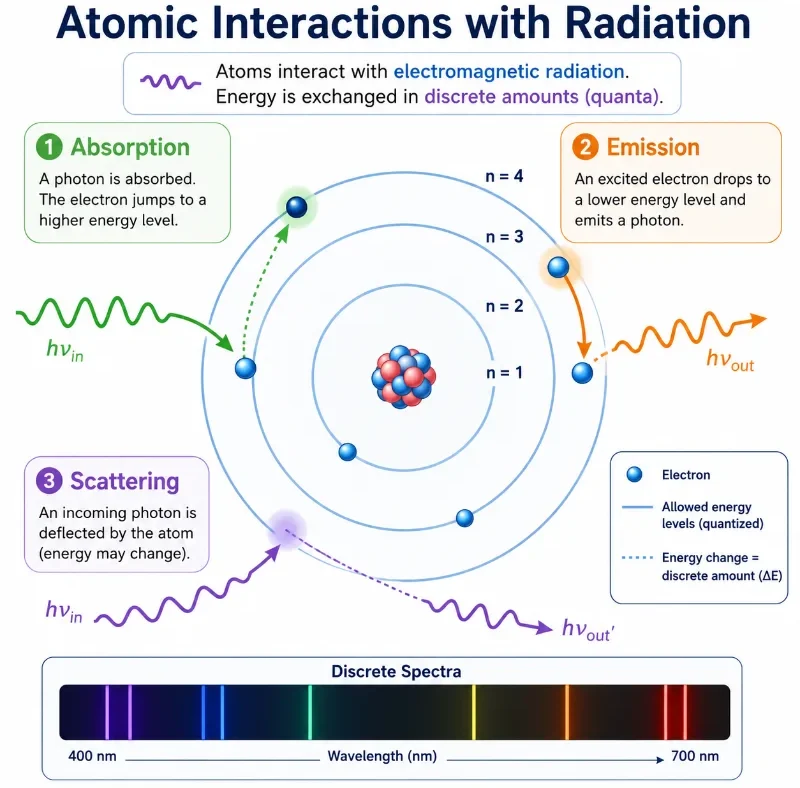
This diagram illustrates how atoms exchange energy with electromagnetic radiation. Incoming photons may be absorbed, causing electrons to move to higher energy levels. Excited electrons may later emit photons as they return to lower levels. Photons may also be scattered by atoms, changing direction and sometimes energy. The discrete spectral lines at the bottom show that atoms absorb and emit radiation only at specific wavelengths, revealing the quantised structure of atomic energy levels.
Key Idea: Atoms Exchange Energy in Steps
Atoms do not usually absorb or emit radiation in arbitrary amounts. Because their electron energy levels are quantised, they exchange energy in specific steps.
This is why atomic spectra appear as sharp lines rather than smooth bands. Each line is evidence of a particular energy transition inside the atom.
Explore the Atomic Physics Cluster
Atomic physics is best studied through its core components, from foundational structural models to quantum layouts and spectral observations. Explore the complete cluster pathway below:
Atomic Physics Hub
Explore an overarching roadmap tracking how microscopic electron quantization dictates modern spectroscopic metrics and quantum technology arrays.Structure of the Atom
Explains how atoms are organised, including the nucleus, electron orbitals, and the historical evolution from planetary to quantum wave mechanics.Quantum Numbers and Electron Configuration
Describes how electrons are structurally arranged within shells using specific quantum values, governing periodic element trends.Atomic Spectra and Energy Transitions
Explores how electrons drop or leap between discrete orbits, yielding sharp emission and absorption lines that map chemical identities.Atomic Interactions with Radiation
Current page. Examines how atoms absorb, emit, scatter, and respond to photons through processes such as excitation, ionisation, fluorescence, and stimulated emission.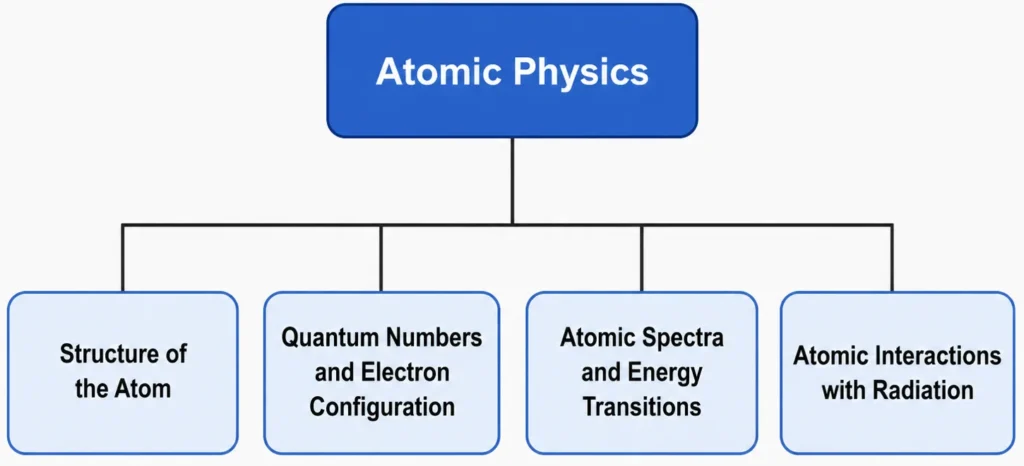
What Atomic Interactions with Radiation REALLY Are
At its core, atomic interactions with radiation involve the exchange of energy between photons and electrons. This exchange does not occur in a continuous way. Instead, it happens in discrete packets of energy, governed by quantum rules. A photon is either absorbed as a whole or not absorbed at all—there is no partial absorption of its energy.
When the energy of an incoming photon matches the difference between two allowed energy levels in an atom, an electron can move to a higher state. This is absorption. When an electron later falls to a lower energy level, it emits a photon with precisely that energy. This is emission. Because atomic energy levels are quantised, atoms interact with radiation in highly selective and predictable ways.
Atoms can also scatter radiation rather than simply absorb or emit it. In some cases, the photon changes direction without changing energy. In other cases, the photon may lose or gain energy during the interaction, revealing useful information about atomic structure, motion, and internal processes. Taken together, absorption, emission, and scattering show how matter and light influence one another at the most fundamental level.
The Evolutionary Path: History, System Barriers, and Foundry Paradigms
The development of radiation interaction profiles elevated atomic modeling from mere passive structural observations into high-precision electron-beam mapping and active quantum control loops.
The Historical Journey
The active mapping of light-matter fields began in 1859 when Gustav Kirchhoff and Robert Bunsen established that line spectra are unique chemical hallmarks of specific gaseous elements. In 1900, Max Planck resolved the blackbody spectrum mismatch by proposing that energy transitions operate in fixed packets (quanta), a framework Albert Einstein extended in 1905 to detail the photoelectric mechanism. By 1913, Niels Bohr matched these discrete jumps directly to quantized planetary electron orbits. The paradigm shifted completely in 1917, when Einstein calculated the thermodynamic math confirming stimulated emission, laying the ground layout for the invention of the microwave MASER in 1953 and optical LASER facilities in 1960.
Contemporary Technical Hurdles
The primary technical barrier to constructing ultra-stable atomic gas sensors is managing **spontaneous phase fluctuations and external magnetic Doppler shift parameters**. When trying to lock an atom into a precise, targeted radiation excitation track, ambient temperature changes drive chaotic atomic collisions. These particle velocities warp the relative path index seen by the tracking photons, broadening sharp absorption lines into wide, blurry profiles. To isolate these sensitive quantum values, modern laboratories must deploy advanced magneto-optical trap hardware to freeze atomic movement before launching radiation tracking scripts.
Future Paradigms: Cavity Quantum Electrodynamics and Single-Atom Foundries
Modern electronics processing bypasses human overlay errors by shifting to sub-nanometer atomic growth systems and software-controlled tunable matrices:
- Cavity QED Nanophotonic Integration Foundries: To achieve absolute efficiency during atom-photon field interactions, modern research facilities embed single neutral atoms straight inside microscopic photonic crystal cavities. By trapping light waves between mirrors separated by sub-micron dimensions, engineers force single photons to interact repeatedly with the captured electron, establishing solid-state platforms for secure quantum cryptography routing.
- Super-Resolution Attosecond Laser Trapping Tracks: Next-generation diagnostic cleanrooms use specialized attosecond pulse trains operating within extreme ultraviolet windows. Because these laser bursts operate on timescales matching internal electron travel speeds, technicians can directly track electron density shifts during high-energy ionizing collisions without triggering遠far-field wavefront distortion.
Core Types of Atomic Interaction with Radiation
Atomic interactions with radiation can be grouped into several fundamental processes, each governed by energy conservation and quantum principles.
Absorption
An atom absorbs a photon when the photon’s energy matches the gap between two energy levels. The electron moves to a higher energy state, storing the absorbed energy within the atom.Spontaneous Emission
An excited electron naturally returns to a lower energy level, emitting a photon without external influence. This process produces the characteristic spectral lines of atoms.Stimulated Emission
An incoming photon can trigger an excited electron to drop to a lower level, emitting a second photon identical to the first. This principle is the basis of laser technology.Elastic Scattering
The photon interacts with the atom but does not change energy. Only its direction may change. This is seen in processes such as Rayleigh scattering.Inelastic Scattering
The photon transfers part of its energy to the atom, resulting in a change in wavelength. This provides information about atomic structure and motion.Energy Matching and Photon Interaction
When atoms interact specifically with electromagnetic radiation, the interaction is governed by a simple but powerful condition:
$$E_{\text{photon}} = h\nu = \Delta E$$
This condition applies to photon-based processes such as absorption and emission. A photon can only be absorbed if its energy exactly matches the difference between two allowed energy levels in the atom. If the energy does not match, the photon will not be absorbed and may instead pass through or be scattered.
However, atomic excitation is not limited to photon absorption. Atoms can also be excited through collisions with energetic particles such as electrons. In such cases, energy is transferred directly through impact rather than through photons.
Example: Gas Discharge (Neon Lamp or Hydrogen Discharge Tube)
In a gas discharge tube, an electric current accelerates free electrons. These high-energy electrons collide with atoms, transferring energy and exciting their electrons to higher energy levels:
$$\text{Electron collision} \;\rightarrow\; \text{Atomic excitation}$$
After excitation, the atom is unstable. The electron eventually returns to a lower energy level, emitting a photon:
$$\text{De-excitation} \;\rightarrow\; \text{Photon emission}$$
The emitted photon still satisfies:
$$E_{\text{photon}} = \Delta E$$
even though the excitation was not caused by a photon. This is why gas discharge tubes produce bright, discrete spectral lines characteristic of each element.
This example shows an important principle: although excitation can occur through more than one mechanism, the emitted radiation always reflects the quantised energy structure of the atom.
Concept Check: Does Excitation Always Require Photon Absorption?
Atoms can become excited in more than one way. Sometimes an atom absorbs a photon whose energy exactly matches the gap between two allowed energy levels. At other times, an energetic particle, such as an electron, collides with the atom and transfers energy directly.
Which statement is most accurate?
A. Atoms can only become excited by absorbing photons.
B. Atoms can be excited by photon absorption or by particle collisions.
C. Emitted photons can have any energy after an atom is excited.
D. Gas discharge tubes produce continuous spectra because energy levels are continuous.
The correct answer is B. Atoms may be excited by absorbing photons, but they may also be excited through collisions with energetic particles such as electrons.
The key point is this: even when excitation happens through collision, the photon emitted during de-excitation still reflects the atom’s quantised energy levels. That is why gas discharge tubes produce discrete spectral lines.
Modern Relevance of Atomic Interactions with Radiation
Atomic interactions with radiation underpin many modern technologies and scientific methods, enabling precise control and measurement of energy at the atomic scale.
Laser Technology
Stimulated emission produces coherent, monochromatic light used in fibre-optic communication, precision surgery, barcode scanning, and industrial cutting.Spectroscopy
Absorption and emission processes allow scientists to identify elements by their spectral fingerprints, from laboratory analysis to detecting elements in distant stars.Medical Applications
Radiation interactions enable imaging techniques such as MRI and PET scans, as well as targeted treatments like radiation therapy for cancer.Astrophysics
Analysis of light from stars and galaxies reveals composition, temperature, velocity (via Doppler shift), and physical conditions across the universe.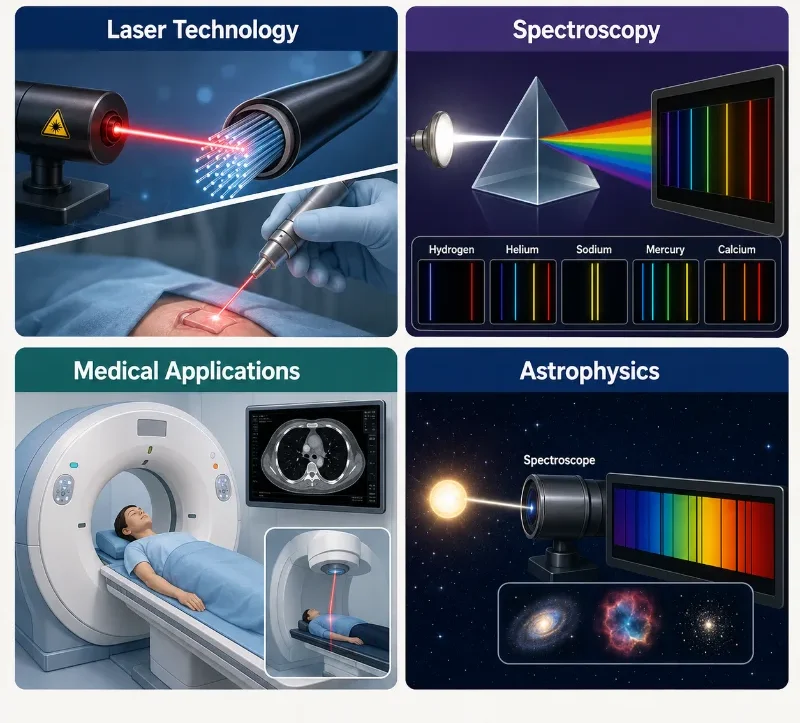
This illustration presents four major applications of atomic interactions with radiation. It shows how laser technology uses stimulated emission to produce coherent light for communication, surgery, scanning, and industrial work. It highlights spectroscopy as a method of identifying elements through their unique spectral fingerprints. It also shows medical applications such as imaging and cancer treatment, where radiation–matter interactions are essential. Finally, it includes astrophysics, where the analysis of starlight reveals the composition, temperature, motion, and physical conditions of celestial objects. The image helps students see how atomic-scale interactions between light and matter lead to powerful tools in science, medicine, engineering, and astronomy.
Why Study Atomic Interactions with Radiation
Atomic interactions with radiation form the foundation for understanding how light exchanges energy with matter. This topic connects quantum theory with real-world observation, showing how photons are absorbed, emitted, or scattered by atoms. It helps students understand why atoms produce discrete spectra, how light can reveal hidden structure, and why modern technologies such as lasers, spectroscopy, medical imaging, optical communication, and quantum sensors are possible.
Foundation of Spectroscopy
Understanding atomic interactions with radiation explains how light reveals the composition and structure of matter. When atoms absorb or emit photons at specific wavelengths, they produce spectral fingerprints that can identify elements in laboratories, stars, galaxies, materials, and environmental samples.Bridge Between Light and Matter
This topic shows how electromagnetic radiation interacts with quantised atomic energy levels. It helps students understand how photons transfer energy to electrons, why only certain transitions are allowed, and how microscopic quantum rules produce visible effects.Key to Laser Technology
Lasers depend on controlled atomic or electronic transitions, especially stimulated emission. By studying how atoms emit radiation in coordinated ways, students can understand how coherent light is produced for communication, surgery, manufacturing, scanning, research, and precision measurement.Essential for Medical Imaging and Treatment
Many medical technologies rely on radiation interacting with atoms and molecules in the body. Imaging, diagnosis, radiation therapy, laser treatment, and spectroscopic analysis all depend on understanding how matter absorbs, emits, scatters, or responds to radiation.Powerful Tool for Astronomy
Atomic interactions with radiation allow scientists to study distant stars and galaxies without visiting them. By analysing spectral lines, astronomers can determine chemical composition, temperature, density, velocity, and physical conditions across the universe.Basis of Quantum Measurement
Radiation is often used to probe atomic systems. When light interacts with atoms, it can reveal energy levels, transition probabilities, magnetic effects, electric-field effects, and quantum states. This makes atom-light interaction central to experimental quantum physics.Foundation for Sensors and Precision Instruments
Atomic systems respond sensitively to light, magnetic fields, electric fields, motion, and gravity. These responses support quantum sensors, atomic clocks, magnetometers, interferometers, and other precision instruments used in science, engineering, navigation, and measurement.Preparation for Advanced Physics and Technology
Studying atomic interactions with radiation prepares students for deeper topics such as quantum mechanics, quantum optics, photonics, condensed matter physics, spectroscopy, materials science, and quantum technology. It shows how abstract quantum ideas become practical tools.Frequently Asked Questions: Atomic Interactions with Radiation
1. What determines whether a photon is absorbed by an atom?
A photon is absorbed only if its energy matches the difference between two allowed energy levels in the atom.
Concept: Atomic energy levels are quantised. This means an electron cannot absorb just any amount of energy. The photon energy must satisfy:
$$E_{\text{photon}} = h\nu = \Delta E$$
Illustration: Think of an atom like a staircase, not a ramp. An electron can move from one step to another only if the photon provides exactly the right amount of energy for that step.
2. Why do atoms emit specific wavelengths of light?
Atoms emit specific wavelengths because electrons fall between discrete energy levels. Each transition releases a photon with a precise energy.
Concept: The emitted photon carries away the energy difference between the upper and lower levels:
$$E_{\text{photon}} = E_{\text{high}} – E_{\text{low}}$$
Illustration: Each atom has its own set of “musical notes.” When its electrons move between levels, the atom emits light at particular wavelengths, like a musical instrument producing certain tones.
3. What is the difference between absorption, emission, and scattering?
Absorption occurs when an atom takes in a photon and an electron moves to a higher energy level. Emission occurs when an excited electron falls to a lower level and releases a photon. Scattering occurs when radiation is redirected by an atom, sometimes with a change in energy.
Concept: Absorption and emission involve energy transfer between photons and atomic energy levels, while scattering often involves the redirection of light.
Illustration: Absorption is like catching a ball, emission is like throwing a ball, and scattering is like a ball bouncing off a surface in a new direction.
4. What is the difference between spontaneous and stimulated emission?
Spontaneous emission occurs naturally when an excited electron returns to a lower energy level. Stimulated emission occurs when an incoming photon triggers an excited atom to emit another photon with the same energy, phase, and direction.
Concept: Stimulated emission is the key process behind laser operation because it produces coordinated photons.
Illustration: Spontaneous emission is like one person clapping randomly. Stimulated emission is like one clap triggering another clap in perfect timing, producing a coordinated rhythm.
5. Why are atomic spectra useful for identifying elements?
Each element has a unique arrangement of energy levels. Because of this, each element absorbs and emits a unique set of wavelengths.
Concept: Atomic spectra act like fingerprints. Hydrogen, helium, sodium, calcium, and other elements each produce distinctive spectral patterns.
Illustration: Just as a fingerprint can identify a person, a spectrum can identify an element. This allows scientists to detect elements in stars, laboratory samples, flames, gases, and distant galaxies.
6. Why do gas discharge tubes produce bright coloured lines?
In a gas discharge tube, fast-moving electrons collide with gas atoms and excite their electrons to higher energy levels. When the excited electrons fall back down, they emit photons at specific wavelengths.
Concept: The colour depends on the atom’s energy-level structure. Neon, hydrogen, mercury, and sodium all emit different patterns of light.
Illustration: A neon lamp glows because electricity excites neon atoms, and the atoms release energy as visible light when they return to lower energy states.
7. How do lasers depend on atomic interactions with radiation?
Lasers depend on stimulated emission, where an incoming photon causes an excited atom or material system to emit another photon with matching properties.
Concept: Laser light is coherent, meaning its photons are highly coordinated in phase, direction, and frequency.
Illustration: Ordinary light is like a crowd walking in many directions. Laser light is like a marching band moving together in step. This is why lasers can be focused into narrow, powerful beams.
8. What is ionisation, and how is it related to radiation?
Ionisation occurs when an atom gains enough energy to lose an electron completely. High-energy radiation or energetic particle collisions can cause ionisation.
Concept: If the energy supplied is greater than the binding energy of an electron, the electron can escape from the atom.
Illustration: Excitation is like moving an electron to a higher floor inside a building. Ionisation is like giving it enough energy to leave the building entirely.
9. What is fluorescence?
Fluorescence occurs when a material absorbs radiation, often ultraviolet light, and then emits light at a longer wavelength, usually in the visible region.
Concept: The absorbed energy raises electrons to excited states. Some energy may be lost internally before light is emitted, so the emitted photon often has lower energy than the absorbed photon.
Illustration: A fluorescent marker or security ink may absorb invisible ultraviolet light and then glow visibly. The material converts one form of radiation into another that our eyes can see.
10. How do magnetic and electric fields affect atomic spectra?
Magnetic and electric fields can shift or split atomic energy levels. This changes the spectral lines emitted or absorbed by atoms.
Concept: Splitting caused by a magnetic field is known as the Zeeman effect. Splitting caused by an electric field is known as the Stark effect.
Illustration: A single spectral line can split into several closely spaced lines when the atom is placed in an external field. This allows scientists to measure magnetic or electric fields indirectly by studying light.
11. How are atomic interactions with radiation used in astronomy?
Astronomers study the light from stars and galaxies to identify the atoms present, measure temperature, estimate density, and detect motion through Doppler shifts.
Concept: Since atoms produce characteristic spectral lines, starlight carries information about the matter that emitted or absorbed it.
Illustration: Even though we cannot collect a physical sample from a distant star, its spectrum can reveal whether it contains hydrogen, helium, sodium, calcium, iron, or other elements.
12. Why is this topic important for modern technology?
Atomic interactions with radiation support many technologies, including lasers, spectroscopy, fibre-optic communication, medical imaging, radiation detection, quantum sensors, atomic clocks, and materials analysis.
Concept: These technologies rely on controlling or measuring how atoms absorb, emit, scatter, or respond to radiation.
Illustration: A barcode scanner, a fibre-optic internet connection, a spectrometer, a laser surgery device, and a telescope studying starlight all depend in some way on the interaction between radiation and matter.
Mini Case Study: Laser Systems and Controlled Radiation Emission
Lasers (Light Amplification by Stimulated Emission of Radiation) are one of the most important applications of atomic interactions with radiation. They rely on precise control of electron transitions within atoms or molecules to produce highly coherent and monochromatic light.
How a Laser Works
In a laser system, atoms are first excited to higher energy levels using an external energy source (called pumping). This excitation is often achieved through electrical discharge, optical pumping, or chemical reactions rather than direct photon absorption.
Once excited, electrons do not remain in higher energy levels indefinitely. They eventually return to lower energy levels, emitting photons:
$$E_{\text{photon}} = \Delta E$$
If a photon of the correct energy interacts with an excited atom, it can trigger stimulated emission, producing a second photon identical to the first. This leads to amplification of light.
Multiple Possible Transitions
An important feature of atomic systems is that an electron at a higher energy level does not have only one possible path downward. For example, an electron at n = 4 can transition to:
- n = 3
- n = 2
- n = 1
Each transition produces a photon with a different energy and wavelength. This raises a key question: which transition does the electron choose?
How Specific Laser Light Is Produced
In ordinary conditions, all possible transitions may occur, producing multiple wavelengths. However, laser systems are designed to favour one specific transition over others. This is achieved through:
- Metastable States: Certain energy levels have longer lifetimes, allowing electrons to accumulate before transitioning.
- Population Inversion: More atoms are maintained in an excited state than in lower states, increasing the probability of a specific transition.
- Optical Cavity: Mirrors reflect photons back and forth, reinforcing a particular wavelength through repeated stimulated emission.
As a result, one transition dominates, producing nearly monochromatic light.
Role of Material Selection
Different laser materials have different energy level structures. This determines which wavelengths can be produced. Examples include:
- Helium–Neon Laser: Produces red light (632.8 nm) from specific atomic transitions.
- Nd:YAG Laser: Emits infrared light (1064 nm) based on transitions in neodymium ions.
- Semiconductor Lasers: Use band transitions in solids to produce a range of wavelengths used in communication and electronics.
By choosing different materials, engineers can design lasers to produce specific wavelengths suited for particular applications.
Why This Matters
This case study highlights a key idea: while atoms allow many possible transitions, practical systems are engineered to control which transitions dominate. This selective control of energy levels is what makes lasers precise, powerful, and widely useful.
It also reinforces a central concept in atomic physics: the energy of emitted radiation is always determined by the difference between quantised energy levels, regardless of how the atom was excited. In this way, lasers transform the many possible quantum transitions of atoms into a controlled and highly focused beam of light.
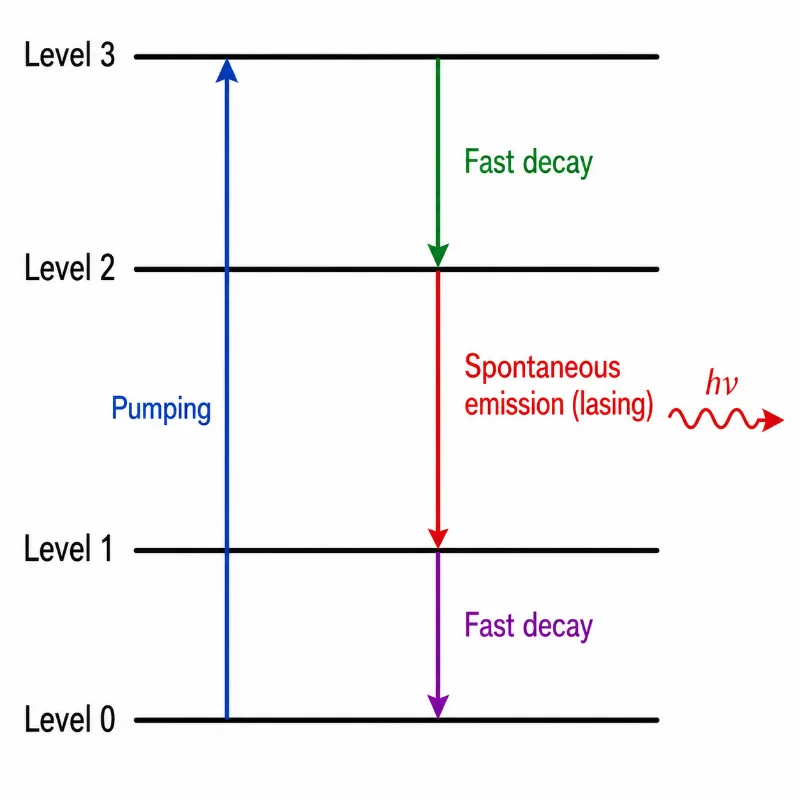
This diagram illustrates a simplified laser energy-level process. Energy is first supplied to pump electrons from Level 0 to Level 3. The electrons then rapidly decay to Level 2, often a relatively long-lived metastable level. The transition from Level 2 to Level 1 can produce the laser photon, with energy determined by the gap between those two levels. Finally, electrons rapidly decay from Level 1 back to Level 0, allowing the cycle to continue. In practice, real laser materials may contain several possible upper and lower laser levels. Different pairs of levels can produce photons with different energies and wavelengths. Laser design therefore involves choosing a material, pumping method, and optical cavity that favour one desired transition through stimulated emission, so that a specific wavelength becomes dominant.
Concept Check: Which Transition Produces the Laser Light?
In the simplified laser energy-level diagram, electrons are first pumped from Level 0 to Level 3. They then decay quickly to Level 2. The important laser transition occurs when electrons move from Level 2 to Level 1, releasing photons with a specific energy.
Which statement best explains why the Level 2 to Level 1 transition is important?
A. It pumps electrons from the ground state to the highest energy level.
B. It produces the photon whose energy determines the laser wavelength.
C. It returns electrons directly from Level 3 to Level 0.
D. It prevents electrons from emitting any radiation.
The correct answer is B. The Level 2 to Level 1 transition produces the photon associated with the laser output. Its energy is determined by the difference between those two levels:
$$E_{\text{photon}} = E_2 – E_1 = h\nu$$
This energy difference determines the frequency and wavelength of the laser light. In real laser materials, there may be several possible pairs of upper and lower laser levels, so the material and optical cavity are designed to favour one desired transition.
Common Misconceptions in Atomic Interactions with Radiation
Atomic interactions with radiation involve subtle distinctions between absorption, emission, and other excitation processes. Misunderstanding these ideas can lead to incorrect reasoning in both conceptual and calculation-based questions.
“All Excitation Is Caused by Photons”
A common misconception is that atoms are excited only by absorbing photons. In reality, excitation can also occur through collisions with energetic electrons or atoms. However, when the atom returns to a lower energy level, it still emits photons with energies determined by the energy level differences.“Any Photon Can Be Absorbed”
Students often think that atoms absorb incoming light continuously. In fact, absorption occurs only when \(E_{\text{photon}} = \Delta E\). If the photon energy does not match an allowed transition, it will not be absorbed and may pass through or be scattered.“Emission Depends on How the Atom Was Excited”
The method of excitation (photon absorption, collision, or heating) does not determine the energy of emitted light. Emission depends only on the energy difference between levels: \(E_{\text{photon}} = \Delta E\). This is why spectral lines are the same regardless of how atoms are excited.“Stimulated Emission Produces Random Light”
In stimulated emission, the emitted photon is not random. It has the same energy, phase, direction, and frequency as the incoming photon. This is why lasers produce highly coherent light.“Electrons Choose Only One Transition Path”
An excited electron can transition to multiple lower energy levels, producing photons of different energies. Laser systems work by engineering conditions so that one transition dominates, rather than assuming only one possible path exists.“Scattering and Absorption Are the Same”
Absorption involves a photon being completely taken in by the atom, while scattering involves the photon continuing to exist but possibly changing direction or energy. These are fundamentally different processes.“Higher Intensity Means Higher Energy Photons”
Intensity refers to the number of photons, not their individual energy. Photon energy depends only on frequency: \(E = h\nu\). A beam can be very intense but still consist of low-energy photons.“All Emitted Light Is Visible”
Atomic transitions can produce radiation across the entire electromagnetic spectrum, including ultraviolet and infrared. Visible light corresponds only to a specific range of energy differences.“Population Inversion Means All Atoms Are Excited”
Population inversion does not require all atoms to be in excited states. It only requires that more atoms are in excited states than in lower states, enabling stimulated emission to dominate.“Photon Energy Can Be Partially Absorbed”
A photon is either fully absorbed or not absorbed at all. Energy transfer occurs in discrete packets, not in fractions. Partial absorption does not occur in atomic transitions.Key Terms
- Absorption
- The quantum process where an atom takes in an entire photon, moving an electron to a higher energy shell.
- Elastic scattering
- A radiation interaction where a photon changes its trajectory upon hitting an atom while maintaining its initial energy.
- Fluorescence
- The multi-step emission mechanism where an atom absorbs high-frequency photons and subsequently drops down to emit lower-energy light.
- Inelastic scattering
- An interaction where a photon hits an atom and shifts direction while exchanging a portion of its initial energy parameters.
- Ionisation
- The threshold effect where an atom gains sufficient external energy to fully eject an electron from its bound state.
- Metastable state
- An excited atomic energy level holding an extended lifetime, allowing electrons to pool before collapsing down.
- Population inversion
- An engineered energetic layout where more atoms occupy an upper excited state than lower baseline containment layers.
- Photon energy equation
- $$E_{\text{photon}} = h\nu = \Delta E$$ The mathematical statement detailing that photon exchanges correspond strictly to discrete energy transitions.
- Spontaneous emission
- The natural, un-triggered decay of an excited electron to a lower energy shell, releasing a photon randomly.
- Stimulated emission
- The trigger mechanism where an incoming photon induces an excited atom to collapse down, emitting a second twin photon in perfect sync.
- Stark effect
- The energetic splitting and distortion of atomic spectral lines inside an external electric field layer.
- Zeeman effect
- The physical splitting of atomic energy states and their matching spectral lines when exposed to an external magnetic field.
Review Questions and Answers
- What are atomic interactions with radiation?Answer: Atomic interactions with radiation refer to the ways atoms exchange energy with electromagnetic radiation such as visible light, ultraviolet radiation, infrared radiation, microwaves, and X-rays. These interactions include absorption, emission, scattering, excitation, ionisation, fluorescence, and stimulated emission.
- Why do atoms absorb only certain photon energies?Answer: Atoms absorb only certain photon energies because their electrons can occupy only specific allowed energy levels. A photon can be absorbed only when its energy matches the difference between two allowed levels: \(E_{\text{photon}} = h\nu = \Delta E\). If the photon energy does not match an allowed transition, the photon may pass through the atom or be scattered instead of absorbed.
- What is absorption in atomic physics?Answer: Absorption occurs when an atom takes in a photon and one of its electrons moves from a lower energy level to a higher energy level. This can happen only when the photon energy matches the energy gap between those two levels.
- What is emission in atomic physics?Answer: Emission occurs when an excited electron returns from a higher energy level to a lower energy level. The atom releases the energy difference as a photon: \(E_{\text{photon}} = E_{\text{high}} – E_{\text{low}}\). This process produces light with a specific wavelength and frequency.
- Why do atoms produce discrete spectra?Answer: Atoms produce discrete spectra because electron energy levels are quantised. Since only certain transitions are allowed, atoms emit or absorb only specific photon energies. These specific energies appear as sharp spectral lines rather than a continuous band.
- What is scattering?Answer: Scattering occurs when radiation interacts with an atom and is redirected. In some cases, the photon changes direction without changing energy. In other cases, energy may be exchanged, causing a change in wavelength or frequency. Scattering helps scientists study atomic structure, particle motion, and material properties.
- What is the difference between spontaneous emission and stimulated emission?Answer: Spontaneous emission occurs when an excited atom naturally releases a photon without being triggered by another photon. Stimulated emission occurs when an incoming photon causes an excited atom to emit a second photon with the same energy, direction, and phase. Stimulated emission is the key process behind laser operation.
- Why is stimulated emission important for lasers?Answer: Stimulated emission allows one photon to trigger the production of another identical photon. This creates light amplification. When many atoms emit photons in a coordinated way, the result is coherent, monochromatic, and highly directional laser light.
- What is population inversion?Answer: Population inversion occurs when more atoms or electrons are maintained in an excited state than in a lower energy state. This is unusual because systems normally have more particles in lower energy states. Population inversion is necessary for sustained laser action because it increases the probability of stimulated emission.
- What is a metastable state?Answer: A metastable state is an excited energy level where electrons can remain longer than they would in ordinary excited states. This longer lifetime allows excited atoms to accumulate, helping to create population inversion in laser systems.
- Why does a laser produce one dominant wavelength?Answer: A laser produces one dominant wavelength because the laser material, metastable energy levels, population inversion, and optical cavity are designed to favour one particular transition. Although many transitions may be possible in principle, the laser system reinforces one selected transition through repeated stimulated emission.
- What role does the optical cavity play in a laser?Answer: The optical cavity usually contains two mirrors that reflect photons back and forth through the gain medium. This repeated passage stimulates more emissions of the same wavelength. One mirror is partially reflective, allowing part of the amplified light to escape as the laser beam.
- How are atomic interactions with radiation used in spectroscopy?Answer: Spectroscopy studies how atoms absorb and emit radiation. Since each element has a unique pattern of energy levels, each element produces a unique spectral fingerprint. This allows scientists to identify elements in laboratory samples, stars, galaxies, gases, and materials.
- How are atomic interactions with radiation used in astronomy?Answer: Astronomers analyse light from stars and galaxies to determine chemical composition, temperature, density, and motion. Spectral lines reveal which elements are present, while shifts in those lines can show whether an object is moving toward or away from Earth.
- Why are atomic interactions with radiation important in medicine?Answer: Medical imaging, laser treatment, radiation therapy, and spectroscopic analysis all depend on how radiation interacts with atoms and molecules in the body. These interactions allow doctors and scientists to image tissues, analyse samples, target treatments, and use light or radiation in controlled ways.
Thought-Provoking Questions and Answers
- If atoms are too small to see directly, how can light reveal their internal structure?Answer: Light reveals atomic structure because atoms absorb and emit photons only at specific energies. These energies correspond to transitions between quantised energy levels. By studying the wavelengths in an atomic spectrum, scientists can infer the hidden energy structure inside the atom.
- Why is an atomic spectrum often compared to a fingerprint?Answer: Each element has its own unique arrangement of energy levels, so each element absorbs and emits a unique set of wavelengths. This makes its spectrum distinctive, much like a fingerprint. Scientists can therefore identify elements by comparing observed spectral lines with known reference spectra.
- Why does quantum theory make light-matter interaction more selective than everyday intuition might suggest?Answer: In everyday life, energy often seems to vary smoothly. In atomic physics, however, electrons can occupy only certain allowed states. This means atoms cannot absorb arbitrary photon energies. Quantum theory therefore makes atomic interaction with radiation highly selective, because only certain energy exchanges are permitted.
- How can the same basic process explain both neon signs and starlight?Answer: Both neon signs and starlight involve atoms emitting photons after excitation. In a neon sign, electrical energy excites gas atoms. In stars, high temperatures and radiation fields excite atoms. In both cases, electrons return to lower energy levels and emit light at characteristic wavelengths.
- Why is stimulated emission such a powerful idea?Answer: Stimulated emission is powerful because it turns atomic emission from a random process into a coordinated one. Instead of photons being emitted in different directions and phases, stimulated emission can produce photons that move together with the same energy, direction, and phase. This makes lasers possible.
- If an atom has many possible transitions, why does a laser not emit all wavelengths equally?Answer: A real laser is engineered to favour one transition. The laser medium, pumping method, metastable state, population inversion, and optical cavity all help reinforce one selected wavelength. Other transitions may be possible, but the favoured transition becomes dominant because it is repeatedly amplified.
- How does the idea of energy matching help explain why some materials are transparent while others absorb light?Answer: A material absorbs light strongly when photon energies match allowed transitions in its atoms, molecules, or electronic structure. If visible photons do not match available transitions, the material may transmit the light and appear transparent. This is why different materials interact with different wavelengths in different ways.
- How can scattering reveal information that absorption alone cannot?Answer: Scattering can reveal how atoms, molecules, or particles are arranged, how they move, and how they interact with radiation. Changes in the direction, intensity, frequency, or polarisation of scattered light can provide information about structure, motion, temperature, and material properties.
- Why is it important that atomic clocks rely on highly stable atomic transitions?Answer: Stable atomic transitions provide a natural reference that is far more reliable than ordinary mechanical clocks. Because the same type of atom has the same transition frequency under controlled conditions, atomic clocks can measure time with extraordinary precision. This precision supports GPS, telecommunications, navigation, and fundamental physics experiments.
- How does the study of atomic interactions with radiation prepare students for quantum technology?Answer: Quantum technologies depend on controlling states, transitions, photons, coherence, and measurement. Atomic interactions with radiation introduce these ideas in a concrete way. By studying absorption, emission, lasers, spectroscopy, and atomic control, students build the foundation for understanding quantum sensors, quantum communication, quantum computing, and precision measurement.
- What does the existence of spectral lines suggest about the nature of reality at small scales?Answer: Spectral lines suggest that nature at small scales is not continuous in the classical sense. Atomic systems have discrete allowed states, and energy is exchanged in definite amounts. This reveals one of the central ideas of quantum physics: microscopic systems follow rules that are different from everyday intuition.
- Why might controlling atom-light interactions be one of the most important skills in future technology?Answer: Many future technologies will depend on controlling information, energy, and measurement at very small scales. Atom-light interactions allow scientists and engineers to manipulate quantum states, build precise sensors, create stable clocks, transmit information through photons, and design new optical and quantum devices.
Comprehensive Numerical Problems with Solutions
- An electron trapped inside a hydrogen atom rests at excited shell level \(n = 2\). Evaluate whether an incoming monochromatic photon holding exactly 2.00 eV of discrete energy can trigger an orbital absorption jump.Solution:1. Compute the strict allowed transition gap from the baseline shell to the next immediate energetic layer (\(n = 3\)):$$E_2 = -3.40\text{ eV}, \quad E_3 = -1.51\text{ eV}$$$$\Delta E = E_3 – E_2 = -1.51\text{ eV} – (-3.40\text{ eV}) = 1.89\text{ eV}$$2. Quantum light-matter absorption dictates that an incoming photon must hit the system with an exact energy value matching a specific structural shell gap (\(E_{\text{photon}} = \Delta E\)). Because the incoming packet holds 2.00 eV, it fails to find an allowed coordinate match (2.00 eV ≠ 1.89 eV).Answer: No absorption occurs; the unaligned photon passes through or scatters.
- An electron drops down along an atomic relaxation track originating from quantum shell \(n = 4\) down to target layer \(n = 2\). Calculate the precise energy value of the discharged emission photon.Solution:Calculate the absolute energetic span separate the two locked structural coordinates:$$E_4 = -0.85\text{ eV}, \quad E_2 = -3.40\text{ eV}$$$$\Delta E = E_4 – E_2 = -0.85\text{ eV} – (-3.40\text{ eV}) = 2.55\text{ eV}$$Answer: The emitted photon carries exactly 2.55 eV of quantum energy.
- A monochromatic photon generated via atomic gas de-excitation registers a packet energy value of 2.55 eV. Find its operational wave frequency.Solution:1. Convert the input energy value to uniform base Joules:$$E = 2.55 \times 1.602 \times 10^{-19}\text{ J/eV} \approx 4.0851 \times 10^{-19}\text{ J}$$2. Deploy the foundational Planck relationship to isolate the frequency variable (\(\nu\)):$$E = h\nu \Rightarrow \nu = \frac{E}{h}$$$$\nu = \frac{4.0851 \times 10^{-19}\text{ J}}{6.626 \times 10^{-34}\text{ J}\cdot\text{s}} \approx 6.1652 \times 10^{14}\text{ Hz}$$Answer: The photon wave frequency calculates to approximately 6.17 × 10¹⁴ Hz.
- Calculate the precise spatial wavelength of a photon released during an electronic drop matching a net energy translation parameter of 2.55 eV. Use the composite index proxy \(hc = 1240\text{ eV}\cdot\text{nm}\).Solution:Isolate the spatial wavelength coordinate variable straight from the composite photon expression:$$E = \frac{hc}{\lambda} \Rightarrow \lambda = \frac{hc}{E}$$$$\lambda = \frac{1240\text{ eV}\cdot\text{nm}}{2.55\text{ eV}} \approx 486.27\text{ nm}$$Answer: The emitted photon wavelength monitors at approximately 486.3 nm (resolving as blue-green light).
Conclusion on Atomic Interactions with Radiation
Atomic interactions with radiation reveal how energy is exchanged at the quantum level. Through absorption, emission, and scattering, atoms interact with light in precise and predictable ways. These processes not only explain atomic spectra but also underpin many technologies that shape modern science and engineering.
By understanding these interactions, students gain insight into the fundamental relationship between light and matter, forming a key foundation for further study in physics and related disciplines.
Reflection Question
If a photon does not match any energy difference in an atom, what will most likely happen to it, and why?