

Epistemological Reflection: Gravitational Invariants vs. Direct Detection
The theoretical necessity for dark matter is verified through multi-scale, independent gravitational observables that cannot be explained via baryonic mass profiles under General Relativity.
1. Galactic Kinematics: In spiral galaxies, outer rotational velocities remain flat (\(v(r) = \sqrt{G M(r)/r} \approx \text{constant}\)), demonstrating that the enclosed mass \(M(r)\) scales linearly with radius \(r\), implying an extensive, non-luminous halo.
2. Relativistic Lensing: Weak and strong lensing observations measure the total integrated curvature of spacetime along the line of sight, mapping mass concentrations that directly correlate with dark matter distributions and frequently decouple from baryonic gas centers during cluster mergers (e.g., the Bullet Cluster).
3. Cosmological Constraints: The ratio of the acoustic peaks in the CMB angular power spectrum precisely dictates the ratio of baryonic to non-baryonic matter. Without pressureless dark matter acting as a gravitational sink prior to recombination, the observed amplitude of matter perturbations (\(\sigma_8\)) could not have grown into the modern cosmic web within the age of the universe.
Tensor Fields, Gravitational Anomalies, and Spacetime Boundaries
Extreme Gravity and Dark Matter – Unified Framework
Synthesizes the global interplay between pressureless non-baryonic matter fields, localized strong-field General Relativity, and the emergence of macroscopic cosmic architecture.Dark Matter Halos & Kinematics
Delineates the diffuse, extended distributions of collisionless mass fields mapped via galactic rotation curve invariants, weak/strong gravitational lensing fields, and primordial acoustic oscillations.Relativistic Black Holes
Examines the ultimate consequence of localized gravitational collapse, where mass-energy overcomes degeneracy pressure to form point-like or ring singularities within the framework of the Schwarzschild and Kerr metrics.Event Horizons and Causal Singularities
Contrasts the extensive, diffuse spatial configuration of dark matter halos with the sharply defined topological boundaries of event horizons (\(R_s = 2GM/c^2\)) and the breakdown of smooth spacetime manifolds at singular coordinates.Hawking Radiation and Thermodynamics
Juxtaposes the purely kinematic, non-dissipative nature of dark matter fields against the semi-classical quantum field theory of black holes, exploring event horizon entropy (\(S_{\text{BH}} = k_B A / 4\ell_P^2\)), temperature, and evaporation dynamics via Bogoliubov transformations.Coupled Black Hole–Dark Matter Dynamics
Investigates the general relativistic interactions where supermassive black holes (SMBHs) undergo adiabatic accretion of surrounding dark matter spikes, modifying local halo profiles and generating testable gravitational wave and indirect annihilation signatures.Table of Contents
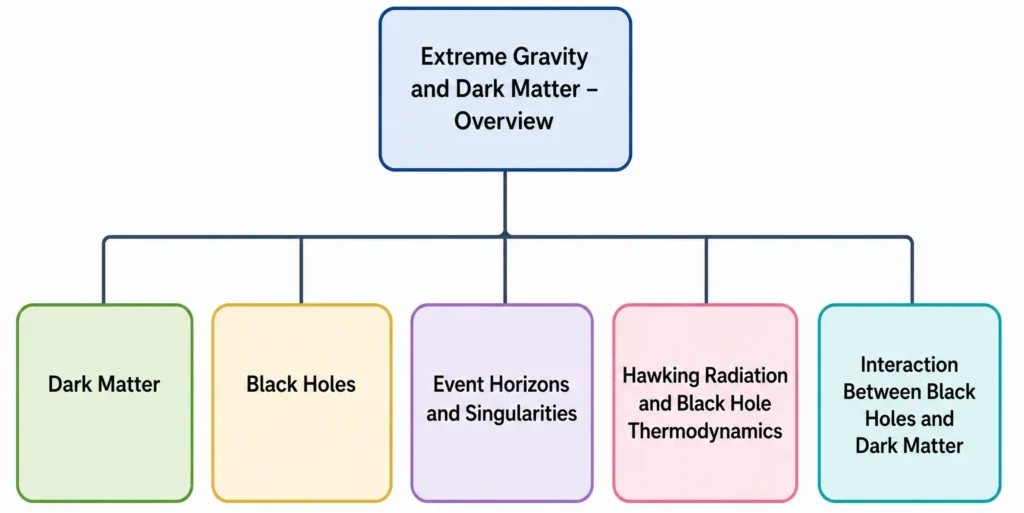
This structural diagram delineates the topological layout of the Extreme Gravity and Dark Matter curriculum cluster. The "Extreme Gravity and Dark Matter Overview" serves as the root organizational node, distributing structural links across five specialized sub-modules: Dark Matter Halos & Kinematics, Relativistic Black Holes, Event Horizons and Causal Singularities, Hawking Radiation and Thermodynamics, and Coupled Black Hole–Dark Matter Dynamics. This conceptual mapping ensures students grasp the underlying theoretical relationships balancing diffuse mass halos against localized relativistic singularities and quantum thermodynamic systems.
Empirical Pillars of Non-Baryonic Mass Distributions
Galactic Kinematics & Rotation Curves
Gravitational Lensing Metrics
Anisotropies in the Cosmic Microwave Background
Hierarchical Large-Scale Structure Formation
The Bullet Cluster (1E 0657-558) as a Direct Proof
Epistemological Reflection: Evaluating the Robustness of Indirect Evidence
Cosmological Nucleosynthesis & Baryonic Density Thresholds
The Deuterium Bottleneck & Density Sensitivity
Analytical Reflection: The Nucleosynthesis Boundary
1. Helium-4 Overproduction (\(Y_p\)): A higher baryonic density shifts the nuclear statistical equilibrium threshold to an earlier epoch, accelerating the fusion of free neutrons into stable Helium-4 kernels before they can decay. This would drive the cosmic Helium-4 mass fraction (\(Y_p\)) far above the observed primordial limit of \(\sim 24.5\%\), contradicting multi-wavelength spectroscopic datasets from metal-poor H II regions.
2. Deuterium Destruction: The increased nuclear reaction rate would fuse almost all primordial Deuterium into Helium, dropping the modern \(\text{D}/\text{H}\) ratio to near zero. Because stellar nucleosynthesis can only destroy Deuterium rather than create it, the significant quantities of Deuterium observed in high-redshift gas systems could not exist.
Therefore, the total baryon budget is chemically locked by primordial abundances. Spacetime curvature anomalies must be resolved by introducing a non-baryonic mass field that remains completely inert within thermonuclear reaction fields.
Theoretical Candidates for Non-Baryonic Matter
1. Weakly Interacting Massive Particles (WIMPs)
2. Axions
3. Sterile Neutrinos
4. Massive Compact Halo Objects (MACHOs)
5. Primordial Black Holes (PBHs)
Alternative Gravitational Frameworks
Modified Newtonian Dynamics (MOND)
Emergent & Entropic Gravity
Experimental and Observational Detection Strategies
| Strategy | Physical Mechanism | Primary Observational Facilities |
|---|---|---|
| Direct Detection | Measures the nuclear recoil energy (\(E_R = \frac{\mu^2 v^2}{m_N}(1-\cos\theta)\)) produced when an ambient halo WIMP scatters off an atomic nucleus inside an ultra-pure detector target. | Deep underground laboratories: LUX-ZEPLIN (LZ), XENONnT, PandaX, SuperCDMS. |
| Indirect Detection | Searches for stable Standard Model products (such as \(\gamma\)-rays, \(\nu\), or \(\bar{p}\)) generated by the self-annihilation (\(\chi\chi \rightarrow \text{SM}\)) or decay of dark matter particles in regions with dense halos. | Fermi Gamma-ray Space Telescope, IceCube Neutrino Observatory, High Altitude Water Cherenkov (HAWC). |
| Collider Production | Attempts to produce dark matter particles via high-energy baryonic collisions (\(\text{pp} \rightarrow \chi\bar{\chi} + X\)). Because dark matter leaves the detector unseen, its presence is inferred by measuring missing transverse energy (\(\mathbf{p}_{\text{T}}^{\text{miss}}\)). | Large Hadron Collider (LHC) via the ATLAS and CMS experiments. |
Deconstructing Pedagogical Misconceptions
Misconception: Dark Matter and Dark Energy Share an Identity
Misconception: Dark Matter is an Ad-Hoc Cosmological Epicycle
Misconception: Dark Matter Can Be Explained via Unresolved Baryonic Matter
Misconception: The Lack of Direct Detection Disproves Its Existence
Advanced Analytical Frontiers
- Exploring the Invisible Universe
- Students study how astronomers use inverse mathematical methods and statistical shear maps to accurately reconstruct non-visible mass profiles, learning to model physical systems from indirect evidence.
- Cosmic Web Topology
- Dark matter simulations demonstrate how small primordial fluctuations develop under gravity into complex structures, allowing students to study non-linear dynamics and computational fluid mechanics.
- Bridges to High-Energy Physics
- Resolving the particle nature of dark matter links cosmic structures to quantum field theories, challenging students to integrate general relativistic cosmology with particle physics extensions.
Conclusion
Glossary of Invariant Terminology
- Dark Matter
- A non-baryonic, collisionless mass density field (\(w \approx 0\)) that interacts via gravity but does not emit or absorb electromagnetic radiation.
- Navarro-Frenk-White (NFW) Profile
- An empirical spatial distribution model for dark matter halos derived from N-body cosmological simulations.
- Keplerian Decay
- The characteristic drop-off in orbital velocity (\(v \propto r^{-1/2}\)) seen in systems where mass is heavily concentrated at the center.
- Gravitational Lensing Shear
- The systematic distortion and stretching of background galaxy images caused by the curvature of spacetime around foreground mass distributions.
- Acoustic Oscillations
- Sound waves driven by the competition between gravitational compression and radiation pressure inside the primordial plasma.
- Ram-Pressure Stripping
- The hydrodynamic resistance and stripping experienced by a gas cloud as it passes through a high-density medium.
- Thermal Relic Abundance
- The stable density of a particle species left behind after its expansion rate outpaces its interaction rate in the early universe.
- Strong CP Problem
- The theoretical puzzle in quantum chromodynamics of why strong interactions do not violate charge-parity symmetry.
- Sterile Neutrino
- A right-handed neutrino candidate that does not participate in Standard Model weak gauge interactions.
- Microlensing
- A temporary astronomical brightening caused by the gravitational lensing effect of a small foreground compact object.
- Primordial Black Hole
- A non-stellar black hole formed from ultra-dense space-time perturbations shortly after the Big Bang.
- Missing Transverse Momentum (\(\mathbf{p}_{\text{T}}^{\text{miss}}\))
- An experimental metric in collider physics that quantifies the net momentum imbalance pointing to non-interacting particles.
- Modified Newtonian Dynamics (MOND)
- An alternative gravity theory that modifies Newton’s laws below a specific acceleration threshold (\(a_0\)).
Academic & Observational Resources
Frequently Asked Questions: Advanced Cosmological Paradigms
What is the formal physical definition of dark matter?
Dark matter is classified as a non-baryonic, non-dissipative, and collisionless form of matter characterized by an equation of state parameter \(w \approx 0\). It remains decoupled from the electromagnetic gauge boson (\(\gamma\)), exhibiting no measurable cross-section for emission, absorption, or scattering of electromagnetic radiation. Its existence is rigorously verified through its contributions to the cosmic stress-energy tensor (\(T_{\mu\nu}\)), which dictates the curvature of local and global spacetime metrics.
What independent empirical pillars support the dark matter hypothesis?
The existence of non-baryonic matter is constrained by four primary observational pillars:
1. Galactic Kinematics: Flat rotation curves (\(v \approx \text{constant}\) at large radii \(r\)) demonstrating an enclosed mass profile \(M(r) \propto r\) that requires an extended, non-luminous halo.
2. Gravitational Lensing Metrics: Weak and strong lensing shear maps that reconstruct total integrated mass densities (\(\Sigma\")), revealing severe baryonic mass deficits and spatial de-coupling during cluster mergers (e.g., the Bullet Cluster).
3. Primordial Acoustics: The relative peak heights of the Cosmic Microwave Background (CMB) temperature anisotropy power spectrum, which lock the cold dark matter density parameter to \(\Omega_c h^2 \approx 0.120\).
4. Cosmic Web Topology: The linear and non-linear regimes of structural growth, which require pressureless dark matter potential wells to bypass photon drag prior to recombination (\(z \approx 1100\)).
How do the thermodynamic and kinematic signatures of dark matter and dark energy diverge?
Dark matter and dark energy represent distinct components of the cosmological fluid inventory with opposite equations of state. Dark matter (\(w \approx 0\)) acts as an attractive gravitational source that clusters locally under Jeans instability, slowing down the cosmic expansion rate. Dark energy acts as a smooth, spatially homogeneous component with a negative pressure equation of state (\(w \approx -1\), equivalent to a Cosmological Constant \(\Lambda\)) that generates a repulsive gravitational effect, driving the contemporary late-time accelerated expansion of the spacetime metric.
What are the primary particle candidates proposed to resolve the dark matter puzzle?
Theoretical extensions to the Standard Model propose candidates across vast mass scales:
• WIMPs (Weakly Interacting Massive Particles): Hypothesized weak-scale particles (\(m_\chi \sim 10 \, \text{GeV} - 10 \, \text{TeV}\)) whose thermal relic abundance naturally matches \(\Omega_c\) via the "WIMP Miracle."
• Axions: Ultra-light pseudo-Nambu-Goldstone bosons (\(m_a \sim 10^{-6} \, \text{eV} - 10^{-3} \, \text{eV}\)) designed to resolve the Strong CP Problem in quantum chromodynamics (QCD).
• Sterile Neutrinos: Right-handed leptons (\(m_\nu \sim \text{keV}\)) that mix with active neutrinos, serving as a viable warm dark matter (WDM) candidate.
• Primordial Black Holes (PBHs): Non-stellar general-relativistic singularities formed via the direct gravitational collapse of high-density primordial perturbations prior to Big Bang Nucleosynthesis (BBN).
What experimental methodologies are deployed to detect non-gravitational dark matter interactions?
Physicists utilize a three-pronged complementary detection strategy:
1. Direct Detection: Operating ultra-pure cryogenic or liquid noble gas targets (e.g., LZ, XENONnT) in deep underground laboratories to measure low-energy nuclear recoils from ambient halo particles.
2. Indirect Detection: Employing space and ground-based observatories (e.g., Fermi-LAT, IceCube) to monitor cosmic regions of high density for the stable Standard Model products (\(\gamma\)-rays, neutrinos, antiprotons) of dark matter annihilation or decay.
3. Collider Production: Utilizing high-energy hadron accelerators (such as the Large Hadron Collider) to produce dark matter particles via \(\text{pp}\) collisions, tracking their production through missing transverse momentum (\(\mathbf{p}_{\text{T}}^{\text{miss}}\)) signatures.
How does dark matter dictate the hierarchical evolution of cosmic architecture?
Because dark matter is pressureless and decoupled from the primordial radiation field, it was unaffected by radiation pressure in the early universe. Consequently, dark matter perturbations (\(\delta_c\)) began growing linearly via gravitational instability during the radiation-dominated era, well before baryonic matter could decouple from photons. These collapsing halos established the initial gravitational potential wells. Post-recombination, baryonic gas fell into these pre-existing wells, cooling and condensing to instantiate the first stars, galaxies, and the broader filamentary nodes of the cosmic web.
What is the precise mass-energy inventory of the modern universe?
According to constraints derived from \(\Lambda\text{CDM}\) cosmic microwave background profiling, the total mass-energy density parameter (\(\Omega_0 = 1\)) is distributed as follows:
• Dark Energy (\(\Omega_\Lambda\)): \(\sim 68.3\%\)
• Cold Dark Matter (\(\Omega_c\)): \(\sim 26.8\%\)
• Baryonic Matter (\(\Omega_b\)):* \(\sim 4.9\%\)
This demonstrates that approximately \(\sim 84.5\%\) of the total matter field in the universe is non-baryonic and non-luminous.
Why is mastering the dark matter paradigm essential for university-level physics?
Analyzing dark matter provides students with a foundational framework for modern research, bridging the gaps between general relativity, quantum field theory, and observational astrophysics. It introduces core concepts in statistical mechanics (thermal freeze-out models), fluid dynamics (Jeans mass equations), particle physics extensions (supersymmetry, axion mechanics), and advanced computational techniques (N-body cosmic simulations), preparing undergraduates for rigorous theoretical and experimental physics pathways.
Dark Matter: Academic Assessment & Quantitative Analysis
- What is the formal physical definition of non-baryonic cold dark matter (\(\text{CDM}\)), and why does it serve as a cornerstone in precision cosmology?
Analytical Response: Cold Dark Matter is defined as a non-baryonic, non-dissipative, and collisionless fluid characterized by a pressureless dust equation of state (\(w \equiv p/\rho \approx 0\)). It is decoupled from the electromagnetic gauge boson (\(\gamma\)), yielding an upper bound on its self-interaction cross-section per unit mass (\(\sigma/m < 0.1 \, \text{cm}^2/\text{g}\)). It serves as a cornerstone in cosmology because its inclusion in the stress-energy tensor (\(T_{\mu\nu}\)) provides the invariant mass density parameter (\(\Omega_c \approx 0.268\)) required to break degeneracies across galactic kinematics, gravitational lensing metrics, and early-universe acoustic fluctuations. - By what mechanism do astrophysicists isolate the presence of dark matter fields from baryonic distributions using invariant gravitational observables?
Analytical Response: Physicists isolate dark matter by measuring spatial offsets between dynamically inferred gravitational mass and baryonic mass centers. Total mass distributions are mapped by inverting the gravitational lens equation to calculate the projected surface mass density \(\Sigma(\vec{\theta})\) from background galaxy shear profiles. Concurrently, baryonic mass is mapped via X-ray bremsstrahlung radiation (gas plasma) and optical photometry (stellar profiles). Systems like the Bullet Cluster (1E 0657-558) show a direct spatial separation between the collisionless lensing centroids and the ram-pressure-stripped baryonic gas, proving that gravity tracks a distinct non-baryonic mass field. - How does cold dark matter modify the primordial Jeans mass (\(M_J\)) threshold to allow hierarchical structure formation?
Analytical Response: In the pre-recombination era (\(z > 1100\)), radiation pressure locks baryonic matter to photons, driving the baryonic Jeans mass to extremely high levels (\(M_J \sim 10^{16} \, M_\odot\)) and preventing gravitational collapse. Because cold dark matter is collisionless, its sound speed is negligible (\(c_s \approx 0\)), dropping its Jeans mass threshold to \(M_J \sim 10^{-6} \, M_\odot\). This allowed dark matter density perturbations (\(\delta_c \equiv \delta\rho_c/\rho_c\)) to collapse linearly during the radiation-dominated era. This formed the initial potential wells into which baryonic matter fell after decoupling, initiating hierarchical structure formation. - Delineate how the relativistic deflection angle \(\vec{\alpha}\) maps dark matter distribution within a galaxy cluster without depending on luminous tracers.
Analytical Response: In strong field environments, the relativistic deflection angle is a function of the local gravitational potential gradient along the null geodesic path \(z\):
\[\vec{\alpha}(\vec{\theta}) = \frac{4G}{c^2} \int \vec{\nabla}_\perp \Phi(\vec{\theta}, z) \, dz\]
By measuring the non-local distortions, arcs, and Einstein rings of high-redshift background sources, the lens equation maps the absolute curvature of the intervening spacetime metric. This allows physicists to compute the total mass distribution directly from the stress-energy tensor without relying on any assumptions about the light output or thermodynamic state of the matter field. - Contrast the fundamental particle properties of Weakly Interacting Massive Particles (WIMPs) with those of QCD axions.
Analytical Response: WIMPs and QCD axions sit at opposite ends of the particle mass spectrum and operate via distinct physical mechanisms:
• WIMPs: Heavy thermal relics (\(m_\chi \sim 10 \, \text{GeV} – 10 \, \text{TeV}\)) that interact via gravity and the weak force, achieving their expected relic density (\(\Omega_c\)) via freeze-out annihilation mechanics in the early universe.
• Axions: Ultra-light pseudo-Nambu-Goldstone bosons (\(m_a \sim 10^{-6} \, \text{eV} – 10^{-3} \, \text{eV}\)) produced non-thermally via vacuum misalignment. They act as a cold, coherent wave field that can resolve the Strong CP Problem by dynamically setting the QCD vacuum angle \(\theta\) to zero. - How do cosmological N-body simulations translate linear perturbation theory into the non-linear regime of dark matter halo distribution?
Analytical Response: N-body simulations discretize the primordial dark matter fluid into billions of self-gravitating particles. They initialize these particles using linear perturbation states generated from the Cosmic Microwave Background power spectrum (e.g., via the Zel’dovich approximation). As the universe expands, the simulation computes the non-linear gravitational force vector \(\vec{F}_{ij} = -G \sum \frac{m_i m_j}{\mathbf{r}_{ij}^2}\hat{\mathbf{r}}_{ij}\) using Particle-Mesh or Tree algorithms. This transitions the system from smooth linear density fields into the non-linear regime, resolving the virialized halos, extended filaments, and sub-halo mass functions that define the modern cosmic web. - What kinematic diagnostics are used to verify that spiral galaxies are embedded in extended Navarro-Frenk-White (NFW) dark matter halos?
Analytical Response: The primary diagnostic is the long-baseline rotation curve, constructed by measuring the Doppler shifting of emission lines—such as the 21cm neutral hydrogen (\(H\,\text{I}\)) line or the \(H\alpha\) hydrogen line—out to several times the optical radius. If mass tracked the visible stellar disk, tangential velocities would show Keplerian decay (\(v \propto r^{-1/2}\)). Instead, observed velocity profiles remain flat or rise slightly (\(v \approx \text{constant}\)). This requires an enclosed mass profile that increases linearly with radius (\(M(r) \propto r\)), which matches the density profile of an extended NFW dark matter halo:
\[\rho(r) = \frac{\rho_0}{\frac{r}{r_s}\left(1+\frac{r}{r_s}\right)^2}\] - Explain how the matter power spectrum \(P(k)\) quantifies the influence of dark matter on the large-scale structure of the cosmos.
Analytical Response: The matter power spectrum \(P(k)\) is the Fourier transform of the spatial two-point correlation function, tracking density perturbation amplitudes across inverse spatial scales \(k \equiv 2\pi/x\). Cold dark matter sets the position and shape of the turnover point in \(P(k)\), which marks the transition from the radiation-dominated era to the matter-dominated era. Because dark matter is collisionless, it preserves structure across small scales (high \(k\)). This prevents the sharp exponential damping (Silk damping) that occurs in baryonic fluids, establishing the primary physical mechanism that shapes the cosmic web. - Why does the low interaction cross-section of dark matter particles create significant signal-to-noise challenges in direct detection experiments?
Analytical Response: Direct detection experiments search for a tiny nuclear recoil energy signature (\(E_R \sim 1 – 100 \, \text{keV}\)) generated by elastic scattering between an ambient halo particle and a target nucleus. Because the expected weak interaction cross-section is incredibly small (\(\sigma_{\text{SI}} < 10^{-47} \, \text{cm}^2\)), the predicted event rate is fewer than one interaction per ton of target material per year. This tiny signal rate is easily overwhelmed by background noise from environmental radioactivity, alpha decays, and cosmic-ray muons, requiring experiments to operate deep underground within ultra-pure liquid xenon or argon shielding environments. - How will next-generation space-based observatories refine constraints on the self-interaction cross-section (\(\sigma/m\)) of dark matter?
Analytical Response: Next-generation space observatories will use high-resolution, wide-field weak lensing surveys to map thousands of merging galaxy clusters. By measuring the distribution of dark matter halos relative to stars and gas across many collisions, researchers can detect subtle lag vectors or tidal stripping events. These spatial variations allow physicists to place tight constraints on the dark matter self-interaction cross-section per unit mass (\(\sigma/m\)), helping determine whether dark matter is purely collisionless or governed by hidden self-interacting dark sector forces.
Dark Matter: High-Level Analytical & Theoretical Research Inquiries
- How would verifying a non-zero self-interaction cross-section (\(\sigma/m > 0\)) modify the core assumptions of the standard \(\Lambda\text{CDM}\) cosmological model?
Analytical Response: Finding a non-zero self-interaction cross-section (\(\sigma/m \sim 0.1 – 1.0 \, \text{cm}^2/\text{g}\)) would replace the cold, collisionless assumption of \(\Lambda\text{CDM}\) with a Self-Interacting Dark Matter (SIDM) framework. This interaction would enable heat transfer from the energetic outer regions of dark matter halos into their dense centers, transforming steep central density profiles (cusps) into flat, constant-density cores. Resolving this “cusp-core problem” would explain sub-galactic mass distributions without requiring complex baryonic feedback models, indicating the presence of a dark gauge sector governed by unique forces. - What theoretical insights can be extracted if indirect detection experiments confirm an anomalous positron or gamma-ray excess at the GeV scale?
Analytical Response: A confirmed anomalous gamma-ray or positron excess—such as the Galactic Center Excess observed by the Fermi-LAT telescope—would provide concrete evidence of dark matter self-annihilation (\(\chi\bar{\chi} \rightarrow \text{SM}\)) or decay within high-density regions. This signature would pinpoint the dark matter particle mass scale and isolate its preferred decay channels into Standard Model particles (such as \(b\bar{b}\) quarks or \(\tau^+\tau^-\\) leptons). Measuring this thermal cross-section would validate freeze-out models and link cosmological dark matter halos directly to high-energy particle physics. - In what ways do null results in supersymmetry (SUSY) searches at the Large Hadron Collider impact theoretical models for dark matter candidates?
Analytical Response: The lack of new physics signatures or sparticles at the LHC has heavily constrained traditional Weakly Interacting Massive Particle (WIMP) models, such as the lightest supersymmetric particle (LSP) neutralino (\(\chi_0^1\)). This lack of discovery has ruled out large areas of natural weak-scale SUSY parameter space, forcing theorists to pivot away from simple WIMP models. Research has shifted toward alternative particle models, including ultra-light QCD axions, Dark Photon vectors, Strongly Interacting Massive Particles (SIMPs), and Feebly Interacting Massive Particles (FIMPs), changing our understanding of how dark matter interacts beyond gravity. - How does the dark matter density parameter (\(\Omega_c\)) alter the evolution of the deceleration parameter (\(q(a)\)) across different cosmic epochs?
Analytical Response: The deceleration parameter \(q(a) \equiv -\ddot{a}a/\dot{a}^2\) is governed by the cosmic fluid components via the acceleration equation:
\[q(a) = \frac{1}{2} \sum \Omega_i(a)(1 + 3w_i) = \frac{1}{2}\left[\Omega_b(a) + \Omega_c(a) – 2\Omega_\Lambda(a)\right]\]
During the matter-dominated epoch (\(z \sim 1000 \rightarrow 1\)), the high density of pressureless dark matter (\(w=0\)) kept the deceleration parameter positive (\(q > 0\)), slowing down the expansion of the metric and allowing structure to form. As the universe expanded, the dark matter density diluted (\(\rho_c \propto a^{-3}\)), allowing the cosmological constant (\(\Omega_\Lambda\), \(w=-1\)) to dominate. This transitioned the system to a negative deceleration parameter (\(q < 0\)) at a deceleration-acceleration transition redshift of \(z_{\text{da}} \approx 0.6\), shaping the long-term expansion profile of the universe. - How can multi-field inflation models generate primordial isocurvature perturbations, and how are these checked using CMB metrics?
Analytical Response: Standard single-field inflation produces purely adiabatic perturbations, where the ratio of dark matter to radiation density is uniform throughout space (\(\delta(\rho_c/\rho_\gamma) = 0\)). Multi-field inflation models can generate primordial isocurvature perturbations, creating spatial variations in the local dark matter-to-baryon ratio without altering the initial spatial curvature (\(\delta S_{c\gamma} \equiv \frac{\delta\rho_c}{\rho_c} – \frac{3\delta\rho_\gamma}{4\rho_\gamma} \neq 0\)). These variations leave distinct signatures in the low-multipole (\(\ell < 100\)) temperature and polarization anisotropies of the CMB. High-precision measurements from the Planck satellite constrain the isocurvature fraction to \(< 1\%\), ruling out many complex multi-field inflation models. - What mathematical limitations must alternative gravity models overcome to replicate cosmological lensing metrics without invoking an explicit dark matter field?
Analytical Response: To match observations without adding mass fields, alternative gravity models must modify the geometry tensor (\(G_{\mu\nu}\)) in the Einstein field equations. They must generate identical null geodesic deflections to match weak and strong lensing fields while reproducing observed baryonic distributions. This requires introducing multiple scalar, vector, and tensor fields (such as in TeVeS or MOG) to amplify gravitational fields in low-acceleration regimes (\(a \le a_0\)) and mimic non-local gravitational anomalies. However, these models struggle to remain self-consistent when scaling from isolated galaxies to cluster mergers and early-universe acoustic oscillations. - Could discovering a dark matter sector with complex internal forces lead to the formation of dark atomic structures?
Analytical Response: If dark matter contains multiple particle species charged under hidden gauge symmetries (such as an unconfined dark electromagnetism \(U(1)_D\)), it could form complex, bound configurations known as dissipative or “atomic” dark matter. If these particles can emit dark photons (\(\gamma_D\)), they can cool radiatively, allowing dark matter fields to condense into high-density dark disks or compact structures within standard halos. This complex framework could generate localized dark substructures, altering star formation rates and leaving distinct micro-lensing signatures that can be tested by modern surveys. - How do supermassive black holes dynamically alter the central density profiles of dark matter halos over cosmic time?
Analytical Response: Supermassive black holes (SMBHs) at the centers of galaxies modify surrounding dark matter distributions through dynamic relaxation and adiabatic growth. The black hole’s strong gravitational potential pulls dark matter inward, turning a standard central halo profile into a high-density “dark matter spike” (\(\rho(r) \propto r^{-\gamma}\)). Concurrently, during major galaxy mergers, binary SMBH systems can eject nearby dark matter particles via gravitational slingshot interactions, flattening the central density profile into a core. Modeling these competing dynamical mechanisms is essential for predicting indirect dark matter annihilation signals from galactic cores. - Why do MOND models struggle to explain the mass profiles of massive galaxy clusters, and what does this reveal about alternative gravity theories?
Analytical Response: Modified Newtonian Dynamics (MOND) successfully explains flat rotation curves in isolated galaxies by altering accelerations below \(a_0 \approx 1.2 \times 10^{-10} \, \text{m/s}^2\). However, when applied to massive galaxy clusters, the acceleration fields in the central regions remain well above this MOND threshold (\(a \gg a_0\)). Consequently, the theory reverts to standard Newtonian dynamics, which cannot account for the observed high velocity dispersions and strong lensing profiles. To match cluster data, MOND models must still assume a significant amount of unseen mass—such as \(2 \, \text{eV}\) sterile neutrinos—demonstrating that alternative gravity theories cannot completely eliminate the need for a non-baryonic mass field on macro cosmological scales. - How can cross-correlating gravitational wave signatures with electromagnetic datasets help test exotic dark matter models?
Analytical Response: Cross-correlating gravitational wave events with electromagnetic observations (multi-messenger astrophysics) allows researchers to test exotic dark matter models like Primordial Black Holes (PBHs) or ultra-light boson clouds. For instance, an unexpected population of sub-solar mass black hole mergers (\(M < 1 \, M_\odot\)) detected by LIGO-Virgo-KAGRA would point directly to a primordial origin, since stellar evolution cannot produce objects below the Chandrasekhar limit. Additionally, measuring precise arrival time variations between gravitational waves and gamma-ray bursts across cosmic distances places tight bounds on any violation of Lorentz invariance, checking whether dark matter couples to alternative spacetime metrics. - How do research funding bodies balance investments between targeted direct detection experiments and broad astronomical surveys?
Analytical Response: Funding organizations balance scientific risk and reward by distributing resources across complementary discovery tracks. Targeted direct detection experiments (such as liquid noble gas chambers) offer high return potential, as a confirmed nuclear recoil would directly identify the dark matter particle, though they run the risk of yielding null results if cross-sections are suppressed. Conversely, broad astronomical surveys (such as Euclid or the Vera C. Rubin Observatory) present lower risk; even if they do not identify the dark matter particle, they generate valuable datasets that map dark matter distributions, refine cosmic expansion metrics, and advance fields across observational astrophysics and data science. - How do international data-sharing protocols accelerate the discovery timeline for global dark matter research collaborations?
Analytical Response: International data-sharing protocols speed up discoveries by standardizing and aggregating enormous datasets across global networks. Combining data from underground detectors, space observatories, and particle colliders allows researchers to rule out instrument-specific anomalies and perform joint statistical analyses that enhance discovery sensitivity. Open-science repositories and unified computing grids enable theoretical modeling and simulation groups to test new particle candidates against multi-messenger constraints in real time, accelerating the global effort to resolve the particle nature of dark matter.
Numerical Problems and Solutions: Advanced Kinematics & Cosmological Analytics
-
A spiral galaxy exhibits a flat rotation curve with stars orbiting at a tangential velocity of \(v = 200\,\text{km/s}\) at a galactocentric radius of \(r = 5.0 \times 10^{20}\,\text{m}\). Under the assumption of a spherically symmetric mass distribution, calculate the total enclosed dynamically active mass (\(M_{\text{enc}}\)).
Solution:
Convert the tangential velocity to SI units: \(v = 2.0 \times 10^5\,\text{m/s}\). Equating the centripetal acceleration to the localized Newtonian gravitational field strength gives: \[\frac{v^2}{r} = \frac{G M_{\text{enc}}}{r^2}\]Isolating the enclosed mass variable yields:\[M_{\text{enc}} = \frac{v^2 r}{G}\]Substitute the invariant values (\(G \approx 6.674 \times 10^{-11}\,\text{m}^3\,\text{kg}^{-1}\,\text{s}^{-2}\)):\[M_{\text{enc}} = \frac{(2.0 \times 10^5\,\text{m/s})^2 \cdot (5.0 \times 10^{20}\,\text{m})}{6.674 \times 10^{-11}\,\text{m}^3\,\text{kg}^{-1}\,\text{s}^{-2}} \approx 2.997 \times 10^{41}\,\text{kg}\] -
An astrophysical survey identifies the integrated visible baryonic mass (stars, gas clouds, and dust) enclosed within the galactocentric radius of the aforementioned system to be \(M_{\text{bary}} = 5.0 \times 10^{40}\,\text{kg}\). Using the total dynamic mass derived in Problem 1, determine the absolute non-baryonic dark matter fraction (\(f_{\text{DM}}\)) of this galaxy.
Solution:
The dark matter mass component (\(M_{\text{DM}}\)) within this domain is isolated by subtracting the baryonic mass profile from the total integrated dynamic mass: \[M_{\text{DM}} = M_{\text{enc}} - M_{\text{bary}} = 3.0 \times 10^{41}\,\text{kg} - 5.0 \times 10^{40}\,\text{kg} = 2.5 \times 10^{41}\,\text{kg}\] The corresponding dark matter mass fraction relative to the total gravitational mass budget is: \[f_{\text{DM}} = \frac{M_{\text{DM}}}{M_{\text{enc}}} = \frac{2.5 \times 10^{41}\,\text{kg}}{3.0 \times 10^{41}\,\text{kg}} \approx 0.833 \quad (83.3\%)\] -
Assuming a local, highly smooth dark matter distribution within a sub-galactic filament characterized by an average mass density of \(\rho_{\text{DM}} = 5.0 \times 10^{-22}\,\text{kg/m}^3\), compute the total integrated mass contained within a spatial volume element of \(V = 1.0 \times 10^{60}\,\text{m}^3\).
Solution:
For a non-dissipative, spatially uniform density profile, the integrated mass is evaluated using the simple volume integral: \[M = \int_V \rho_{\text{DM}} \, dV = \rho_{\text{DM}} V\] \[M = (5.0 \times 10^{-22}\,\text{kg/m}^3) \cdot (1.0 \times 10^{60}\,\text{m}^3) = 5.0 \times 10^{38}\,\text{kg}\] -
A massive virially relaxed galaxy cluster is determined via weak gravitational lensing analysis to possess a total integrated mass-energy budget of \(M_{\text{tot}} = 1.0 \times 10^{45}\,\text{kg}\). If precision multi-wavelength spectroscopic observations constrain the total baryonic fraction (consisting of both the interstellar medium and galactic stars) to exactly 15%, isolate the absolute mass of the dark matter component.
Solution:
Since the cosmological fluid in this system is composed entirely of baryonic and non-baryonic components (\(\Omega_m = \Omega_b + \Omega_c\)), the dark matter fraction corresponds to \(f_{\text{DM}} = 1.00 - 0.15 = 0.85\). The absolute non-baryonic mass is: \[M_{\text{DM}} = f_{\text{DM}} M_{\text{tot}} = 0.85 \cdot (1.0 \times 10^{45}\,\text{kg}) = 8.5 \times 10^{44}\,\text{kg}\] -
Evaluate the localized gravitational binding force operating between two isolated, highly virialized dark matter overdensities, each packing an integrated mass of \(M = 1.0 \times 10^{40}\,\text{kg}\), when their respective centers of mass are separated by a cosmic distance of \(r = 1.0 \times 10^{21}\,\text{m}\).
Solution:
Applying Newton's universal law of gravitation between two point-like or spherically symmetric masses: \[F = \frac{G M^2}{r^2}\] \[F = \frac{(6.674 \times 10^{-11}\,\text{m}^3\,\text{kg}^{-1}\,\text{s}^{-2} ) \cdot (1.0 \times 10^{40}\,\text{kg})^2}{(1.0 \times 10^{21}\,\text{m})^2} \approx 6.674 \times 10^{27}\,\text{N}\] -
A disk galaxy is observed to have a perfectly flat rotation curve (\(v(r) = v_{\text{c}} = 250\,\text{km/s} = \text{constant}\)) spanning across its outer gaseous boundaries. Analytically demonstrate why this specific velocity profile requires the presence of a non-luminous dark matter halo.
Solution:
The classical centripetal velocity relation requires \(v(r) = \sqrt{\frac{G M(r)}{r}}\). For the velocity to remain independent of the radius (\(v(r) = v_{\text{c}}\)), we square and rearrange the terms: \[v_{\text{c}}^2 = \frac{G M(r)}{r}\]Isolating the enclosed mass profile yields:\[M(r) = \frac{v_{\text{c}}^2}{G} \cdot r\]Differentiating the enclosed mass with respect to the radius yields the mass gradient:\[\frac{dM}{dr} = \frac{v_{\text{c}}^2}{G} = \text{constant}\]For a spherically symmetric halo, \(\frac{dM}{dr} = 4\pi r^2 \rho(r)\). Equating the expressions isolated for density shows:\[4\pi r^2 \rho(r) = \frac{v_{\text{c}}^2}{G}\]Solving explicitly for the density function:\[\rho(r) = \frac{v_{\text{c}}^2}{4\pi G r^2} \propto r^{-2}\]Because the visible baryonic matter density decays exponentially (\(\rho_{\text{bary}} \propto e^{-r/R_d}\)), the observed flat profile can only be sustained by an invisible, extended matter distribution whose density drops off much more gradually as \(r^{-2}\). -
Calculate the relativistic or classical orbital kinetic energy (\(E_k\)) of a main-sequence star with mass \(M_\star = 2.0 \times 10^{30}\,\text{kg}\) traveling at a dynamically verified velocity of \(v = 200\,\text{km/s}\) within a deep dark matter potential well.
Solution:
Given that \(v \ll c\), we deploy the classical kinetic energy expression: \[E_k = \frac{1}{2} M_\star v^2\] Convert velocity to standard metric base units: \(v = 2.0 \times 10^5\,\text{m/s}\). \[E_k = 0.5 \cdot (2.0 \times 10^{30}\,\text{kg}) \cdot (2.0 \times 10^5\,\text{m/s})^2 = 4.0 \times 10^{40}\,\text{J}\] -
According to the \(\Lambda\text{CDM}\) framework, if pressureless non-baryonic cold dark matter is responsible for exactly 85% of the total un-decoupled matter content (\(\Omega_m\)) of the universe, formulate the corresponding analytical percentage attributed to visible baryonic matter.
Solution:
The total matter density fraction is normalized as follows: \[f_{\text{bary}} + f_{\text{DM}} = 1.00\]Isolating the baryonic fraction yields:\[f_{\text{bary}} = 1.00 - 0.85 = 0.15 \quad (15.0\%)\] -
A spherical dark matter halo exhibits a uniform density of \(\rho_0 = 1.0 \times 10^{-22}\,\text{kg/m}^3\) and extends to a cutting-off virial radius of \(R = 1.0 \times 10^{21}\,\text{m}\). Compute the total integrated mass bounded within this volume.
Solution:
The volume of a three-dimensional spherical manifold is modeled by \(V = \frac{4}{3}\pi R^3\). \[V = \frac{4}{3}\pi \cdot (1.0 \times 10^{21}\,\text{m})^3 \approx 4.1887 \times 10^{63}\,\text{m}^3\] The integrated mass of the halo configuration is evaluated as: \[M = \rho_0 V = (1.0 \times 10^{-22}\,\text{kg/m}^3) \cdot (4.1887 \times 10^{63}\,\text{m}^3) \approx 4.19 \times 10^{41}\,\text{kg}\] -
A Weakly Interacting Massive Particle (WIMP) candidate is modeled to have a rest mass-energy equivalent to \(E = 100\,\text{GeV}\). Convert this particle energy profile into standard SI units (Joules).
Solution:
Using the elementary electronvolt conversion scale where \(1\,\text{eV} = 1.6022 \times 10^{-19}\,\text{J}\): \[100\,\text{GeV} = 100 \times 10^9\,\text{eV} = 1.0 \times 10^{11}\,\text{eV}\] \[E = (1.0 \times 10^{11}\,\text{eV}) \cdot (1.6022 \times 10^{-19}\,\text{J/eV}) = 1.6022 \times 10^{-8}\,\text{J}\] -
Estimate the gravitational potential energy (\(U_g\)) of a highly coupled galactic core system with mass \(M_{\text{gal}} = 1.0 \times 10^{42}\,\text{kg}\) interacting with its enveloping dark matter halo mass distribution (\(M_{\text{halo}} = 1.0 \times 10^{42}\,\text{kg}\)) at an effective interaction scale length of \(r = 1.0 \times 10^{21}\,\text{m}\).
Solution:
The classical gravitational potential energy of a bounded system is defined as: \[U_g = -\frac{G M_{\text{gal}} M_{\text{halo}}}{r}\] \[U_g = -\frac{(6.674 \times 10^{-11}\,\text{m}^3\,\text{kg}^{-1}\,\text{s}^{-2}) \cdot (1.0 \times 10^{42}\,\text{kg}) \cdot (1.0 \times 10^{42}\,\text{kg})}{1.0 \times 10^{21}\,\text{m}} \approx -6.674 \times 10^{52}\,\text{J}\] The absolute magnitude of this gravitational potential binding energy configuration is \(6.67 \times 10^{52}\,\text{J}\).