
Calculus plays a central role in shaping our understanding of continuous change, and it forms the analytical backbone of numerous disciplines in science, engineering, and economics. For students beginning their academic journey in Mathematics, mastering calculus is key to unlocking the tools necessary for analyzing motion, growth, and accumulation. It bridges the conceptual foundations of Pure Mathematics with the practical applications seen in Applied Mathematics and beyond.
The conceptual threads of calculus are woven through many fields. In Mathematical Physics, differential equations derived from calculus model forces, fields, and waves. Disciplines like Statistics and Inferential Statistics rely on integration and limit theory for probability distributions and data analysis. Even the structure of Topology and Geometry is often approached with tools drawn from calculus.
Specialized domains such as Engineering Mathematics employ calculus to describe and predict behavior in real-world systems, from mechanical forces to electrical circuits. Students pursuing Actuarial Science will encounter calculus in modeling risk and uncertainty, notably in areas like Actuarial Risk Modeling and Life Insurance. Even financial fields like Investment and Portfolio Management use differential equations to optimize asset growth and manage volatility.
The study of calculus also enhances students’ capacity to engage with more abstract mathematical concepts. Understanding Number Theory or Algebra in depth often depends on mathematical maturity developed through calculus. Moreover, rigorous branches like Mathematical Analysis formally establish the foundations of limits, continuity, and convergence. Whether analyzing population growth in Descriptive Statistics or modeling dynamic systems in Operations Research, calculus enables structured approaches to change over time.
The reach of calculus extends even into the applied sciences and technologies. Students exploring Physical Technologies and disciplines such as Aerospace and Aeronautical Engineering depend heavily on calculus to model airflow, trajectory, and thermal behavior. Within this space, fields like Aero Control Systems and Robotics and Aero Materials Science illustrate the value of precise quantitative modeling. Meanwhile, the growing importance of computation has led to innovations in Computational Mathematics, where algorithms harness calculus for numerical solutions.
A solid grasp of calculus opens up a wide spectrum of pathways. It supports both the theoretical exploration of Mathematics and the applied reasoning needed in industries like insurance, aerospace, and finance. As such, studying calculus is not just about learning techniques—it is about acquiring a mindset capable of analyzing systems that evolve and interact dynamically across time and space.
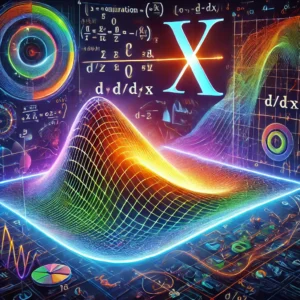
A vivid, high-contrast illustration representing core ideas in calculus. A glowing 3D surface plot rises from a grid, while surrounding chalkboard elements show common symbols and formulas—limits, differential operators (d/dx), integrals, and axis labels—alongside a bold “X” to suggest variables. Circular graphs and color gradients evoke data, optimization, and rate-of-change concepts. The image conveys the breadth of modern calculus: analyzing functions, finding slopes and areas, modeling motion, and extending to multivariable surfaces. Its energetic palette signals discovery and problem-solving, making it a fitting hero visual for a Calculus page aimed at students preparing for university mathematics and STEM degrees.
Pure Mathematics – Overview
Frames all mathematical study through abstraction, rigorous logical structures, and formal proof systems.
Calculus
Explores rates of continuous change and accumulation through limits, derivatives, and integral operations.
Mathematical Analysis
Provides rigorous axiomatic foundations ensuring the logical validity of limits, sequences, and calculus operations.
Algebra
Supplies symbolic tools, functions, and algebraic structures used in evaluating differentiation and integration.
Geometry
Connects calculus to curves, surfaces, coordinates, and spatial interpretations of dynamic physical change.
Topology
Extends differential calculus into continuous abstract spaces without relying on rigid Euclidean coordinates.
Number Theory
Intersects with calculus in analytic number theory to analyze prime number distribution via complex integration.
Core Concepts & Key Domains in Calculus
Calculus explores how quantities change and accumulate over time or space. Through differentiation, it measures instantaneous rates of change and tangents to curves, while integration computes areas, volumes, and accumulated values. By generalizing these principles to multivariable functions, calculus addresses complex systems in higher dimensions, broadening its applicability across STEM disciplines.
1. Differential Calculus: Focuses on instantaneous rates of change and curve tangents. The fundamental tool is the derivative, which measures how a function output changes relative to input variations. Key techniques include the chain rule, implicit differentiation, and optimization methods used to identify function local maxima, minima, and inflection points across physics and economics.
2. Integral Calculus: Deals with quantity accumulation, computing continuous areas under curves and total net change. Indefinite integrals calculate antiderivatives, whereas definite integrals compute bounded values. The Fundamental Theorem of Calculus links differentiation and integration as inverse mathematical operations. Applications range from computing physical work to calculating probability distribution areas.
3. Multivariable & Vector Calculus: Extends single-variable calculus to functions of several variables in higher-dimensional space. Key tools include partial derivatives, multiple integrals, and vector operators (gradient, divergence, curl). It provides the mathematical language for modeling fluid mechanics, thermodynamics, electromagnetism, and machine learning loss function optimization.
About This Interactive Simulator:
This simulator demonstrates the Geometric Derivative Tangent Line & Instantaneous Rate of Change for a continuous function f(x) = 0.25 x3 – x. Users can adjust the evaluation point (x0) to observe how the secant line approaches the true tangent line slope f‘(x0).
- Solid Blue Line: Continuous Function Curve f(x) = 0.25 x3 – x
- Dashed Red Line: Tangent Line evaluated at current coordinate point (x0, f(x0))
- Evaluation Point Slider (x0): Shifts the differentiation position along the curve to observe positive, zero, and negative local derivative slopes
Calculus: Derivative Tangent Line & Rate of Change Simulator
Applications of Calculus
Calculus serves as an indispensable quantitative toolkit across primary scientific and industrial domains:
1. Physics & Classical Mechanics: Describing particle motion, acceleration, planetary trajectories via Newton's laws of motion, and electromagnetic field interactions via Maxwell's equations.
2. Aerospace & Structural Engineering: Modeling aerodynamic fluid velocity vectors over wing profiles, determining optimal bridge load distributions, and computing heat dissipation in nuclear power components.
3. Economics & Actuarial Finance: Maximizing corporate profit functions, evaluating marginal cost/revenue rates, pricing financial derivatives, and computing present values for continuous cash flows.
4. Artificial Intelligence & Data Science: Training deep neural network parameters using backpropagation and gradient descent optimization over high-dimensional error loss surfaces.
5. Medicine & Epidemiology: Modeling tumor cellular growth rates, predicting epidemic disease spread via differential SIR models, and calculating pharmacokinetic drug absorption rates.
Emerging Trends, Challenges & Future Directions
The study and application of calculus continue to evolve alongside digital transformations:
Emerging Trends:
• Computational Calculus: Automating complex Symbolic and Numerical integration using Python libraries (SymPy, SciPy) and high-speed GPU parallel hardware.
• Fractional Calculus: Extending derivative operators to non-integer fractional orders to model memory effects in complex viscoelastic polymers and porous materials.
• Quantum Calculus Algorithms: Applying multivariable calculus operators to describe complex wave function phases in quantum computing architectures.
Key Challenges:
• Abstraction Barrier: Connecting informal geometric intuition regarding limits and continuous change to formal, rigorous epsilon-delta proofs.
• Computational Scaling: Solving high-dimensional non-linear partial differential equations across fine grid meshes in real-time engineering simulations.
Why Study Calculus?
Mastering calculus sharpens logical analytical reasoning, equips students with quantitative problem-solving capabilities, and builds an essential mathematical foundation for advanced studies in data science, engineering, physics, and finance.
Is Calculus Right For You?
Explore career pathways, check your fit, and assess your skills — before you commit to a degree.
Frequently Asked Questions
What is Calculus and why is it so important in mathematics?
Calculus is the branch of mathematics that studies change and accumulation. Differential calculus focuses on rates of change and slopes of curves, while integral calculus focuses on areas, totals, and accumulated quantities. Together they provide a language for describing motion, growth, decay, optimisation, and many processes in science, engineering, and economics. Because so many modern models depend on change over time or space, calculus becomes a core tool in advanced study.
What is the difference between differential and integral calculus?
Differential calculus studies how a quantity changes at a point using derivatives, which measure slopes or instantaneous rates of change. Integral calculus studies how a quantity accumulates over an interval using integrals, which measure areas under curves or total amounts. The Fundamental Theorem of Calculus links the two ideas by showing that differentiation and integration are inverse processes in a precise sense.
Why are limits and continuity so central in Calculus?
Limits provide a precise way to talk about what happens as a variable approaches a particular value, even when the function is not well defined at that point. Continuity expresses the idea that small changes in input produce small changes in output. Derivatives and integrals are defined using limits, so understanding limits and continuity is essential for making calculus rigorous and avoiding hidden assumptions in calculations.
Where does Calculus appear in physics, engineering, and economics?
In physics, calculus describes motion, forces, energy, waves, electricity, and fields through differential equations. In engineering, it underpins stress analysis, fluid flow, heat transfer, control systems, and signal processing. In economics and finance, calculus is used to model marginal cost and revenue, optimise production and pricing, and analyse continuous-time models of growth, interest, and risk. Many real-world models are built from differential and integral equations.
Which core Calculus topics should students know before entering university?
Before university, students should be comfortable with limits and continuity, differentiation rules (including chain rule, product and quotient rules), derivatives of common functions, curve sketching, basic optimisation problems, definite and indefinite integrals, standard integration techniques, and simple applications such as areas, volumes of revolution, and average values. Familiarity with sequences and series, including geometric series and Taylor series, is also very helpful for deeper university-level calculus and analysis.
What are common difficulties students face when learning Calculus?
Many students can apply rules mechanically but struggle to interpret what derivatives and integrals mean. Others find limits and infinity counterintuitive, or have gaps in algebra and functions that make calculations harder. A key challenge is moving from viewing calculus as a list of formulas to seeing it as a coherent way to model change and accumulation. Working with graphs, units, and real examples often helps connect the symbolic work to concrete meaning.
How does Calculus connect to more advanced topics like real analysis and differential equations?
Introductory calculus provides computational tools for differentiation and integration. Real analysis then revisits these ideas with full logical detail, proving theorems about limits, continuity, differentiability, and convergence. Differential equations extend calculus to situations where the derivative of a function is given and we want to recover the function itself. These subjects build on basic calculus but emphasise structure, proof, and a deeper understanding of why the methods work.
How can pre-university students study Calculus effectively and prepare for university-level work?
Effective study combines three elements: fluent algebraic skills, clear geometric intuition, and growing comfort with definitions and logical reasoning. Students should practise many problems, including word problems that require translating a situation into a function or equation. Drawing graphs, checking units, and explaining the meaning of each derivative or integral in words all help. Exploring extension topics such as parametric curves, polar coordinates, or simple differential equations can ease the transition to university-level calculus and analysis.
Comprehensive Practice & Knowledge Self-Assessment Module
Section 1: Foundational Review Questions & Answers
- What is the fundamental difference between differential and integral calculus?
Answer: Differential calculus measures instantaneous rates of change and curve tangents using derivatives, whereas integral calculus computes total continuous accumulation and area under curves using integrals. - What does the Fundamental Theorem of Calculus state?
Answer: It establishes that differentiation and integration are inverse operations, proving that if F'(x) = f(x), then ∫ab f(x) dx = F(b) - F(a). - What is the geometric meaning of the derivative f'(x)?
Answer: It represents the slope of the tangent line to the graph of y = f(x) at any point x, corresponding to the instantaneous rate of output change. - Why are limits essential in defining derivatives and integrals?
Answer: Limits provide the rigorous mathematical framework to evaluate instantaneous rates of change (as Δx → 0) and infinite Riemann sum accumulations (as n → ∞) without dividing by zero. - What is the chain rule in differential calculus?
Answer: A formula for calculating the derivative of a composite function f(g(x)), given by d/dx [f(g(x))] = f'(g(x)) · g'(x). - How does multivariable calculus generalize single-variable differentiation?
Answer: It uses partial derivatives to measure function rates of change along individual coordinate axes while holding other independent variables constant. - What is an inflection point on a function curve?
Answer: A point where the concavity of the curve changes direction (from concave up to concave down, or vice versa), corresponding to f''(x) = 0 or undefined. - What is the difference between definite and indefinite integrals?
Answer: An indefinite integral represents a family of antiderivative functions (plus constant C), whereas a definite integral evaluates over interval [a, b] to yield a scalar value.
Section 2: Analytical & Thought-Provoking Questions
- How does L'Hôpital's Rule resolve indeterminate limit forms like 0/0 or ∞/∞?
Answer: By replacing the ratio of two differentiable functions f(x)/g(x) with the ratio of their derivatives f'(x)/g'(x) as x approaches a limit point. - Why does the Mean Value Theorem guarantee the existence of a point matching average speed?
Answer: For a continuous and differentiable function over [a, b], there exists at least one c ∈ (a, b) where instantaneous derivative f'(c) equals average slope [f(b) - f(a)] / (b - a). - How do gradient descent algorithms in machine learning leverage multivariable calculus?
Answer: They compute the negative gradient vector -∇L of a high-dimensional loss surface, iteratively adjusting model weights in the direction of steepest loss decrease. - Why does Taylor series expansion allow non-linear functions to be approximated locally by polynomials?
Answer: Taylor series represent infinitely differentiable functions as infinite polynomial sums constructed from higher-order derivative values evaluated at a single point. - How does integration by parts derive from the product rule of differentiation?
Answer: Integrating both sides of d/dx [uv] = u'v + uv' yields uv = ∫ v du + ∫ u dv, rearranging to ∫ u dv = uv - ∫ v du. - Why must improper integrals with infinite bounds be evaluated using limit limits?
Answer: Infinity is a limiting concept rather than a real scalar number; thus ∫a∞ f(x) dx must be defined as limt → ∞ ∫at f(x) dx. - How does Stokes' Theorem generalize the Fundamental Theorem of Calculus to higher-dimensional vector fields?
Answer: It equates the surface integral of the curl of a vector field over surface S to the line integral of the vector field around boundary curve ∂S.
Section 3: Numerical Problems & Solutions
Problem 1: Derivative Calculation via Power & Chain Rule
Find the derivative of f(x) = (3x2 + 2x)4.
Solution:
Apply the Chain Rule: d/dx [u4] = 4u3 · u' where u = 3x2 + 2x.
Derivative of inner term u' = 6x + 2.
f'(x) = 4(3x2 + 2x)3 · (6x + 2) = 8(3x + 1)(3x2 + 2x)3.
Key Formula Callout: The Fundamental Theorem of Calculus
∫ab f(x) dx = F(b) - F(a) | d/dx [∫ax f(t) dt] = f(x)
Problem 2: Definite Integral Area Evaluation
Evaluate ∫13 (2x + 5) dx.
Solution:
Find antiderivative: F(x) = x2 + 5x.
Evaluate at upper limit b = 3: F(3) = (3)2 + 5(3) = 9 + 15 = 24.
Evaluate at lower limit a = 1: F(1) = (1)2 + 5(1) = 1 + 5 = 6.
Subtract bounds: F(3) - F(1) = 24 - 6 = 18.
Problem 3: Integration by Parts Calculation
Evaluate ∫ x ex dx.
Solution:
Use Integration by Parts formula: ∫ u dv = uv - ∫ v du.
Let u = x ⇒ du = dx.
Let dv = ex dx ⇒ v = ex.
Apply formula: ∫ x ex dx = x ex - ∫ ex dx = x ex - ex + C = ex(x - 1) + C.
Problem 4: Function Optimization Maxima Finding
Find local critical points and determine maximum for f(x) = -x2 + 6x + 2.
Solution:
Take first derivative: f'(x) = -2x + 6.
Set f'(x) = 0 ⇒ -2x + 6 = 0 ⇒ 2x = 6 ⇒ x = 3.
Take second derivative: f''(x) = -2.
Since f''(3) = -2 < 0, x = 3 is a local maximum.
Maximum function value: f(3) = -(3)2 + 6(3) + 2 = -9 + 18 + 2 = 11.
Problem 5: L'Hôpital's Rule Indeterminate Limit Evaluation
Evaluate limx → 0 [(ex - 1) / x].
Solution:
Direct substitution yields 0/0 (indeterminate form).
Apply L'Hôpital's Rule: limx → 0 [ d/dx(ex - 1) / d/dx(x) ].
Derivative of numerator = ex; Derivative of denominator = 1.
Limit = limx → 0 [ex / 1] = e0 / 1 = 1.
Problem 6: Partial Derivative Calculation
Find partial derivative ∂f/∂x for multivariable function f(x, y) = 3x2y + 4y3 + 2x.
Solution:
Treat y as a constant scalar value and differentiate relative to x:
∂/∂x [3x2y] = 6xy.
∂/∂x [4y3] = 0 (constant term relative to x).
∂/∂x [2x] = 2.
Partial derivative ∂f/∂x = 6xy + 2.
Problem 7: Average Value of a Continuous Function
Find the average value favg of f(x) = 3x2 over interval [0, 2].
Solution:
Formula: favg = [1 / (b - a)] ∫ab f(x) dx.
1 / (2 - 0) = 0.5.
∫02 3x2 dx = [x3]02 = 23 - 03 = 8.
favg = 0.5 × 8 = 4.