
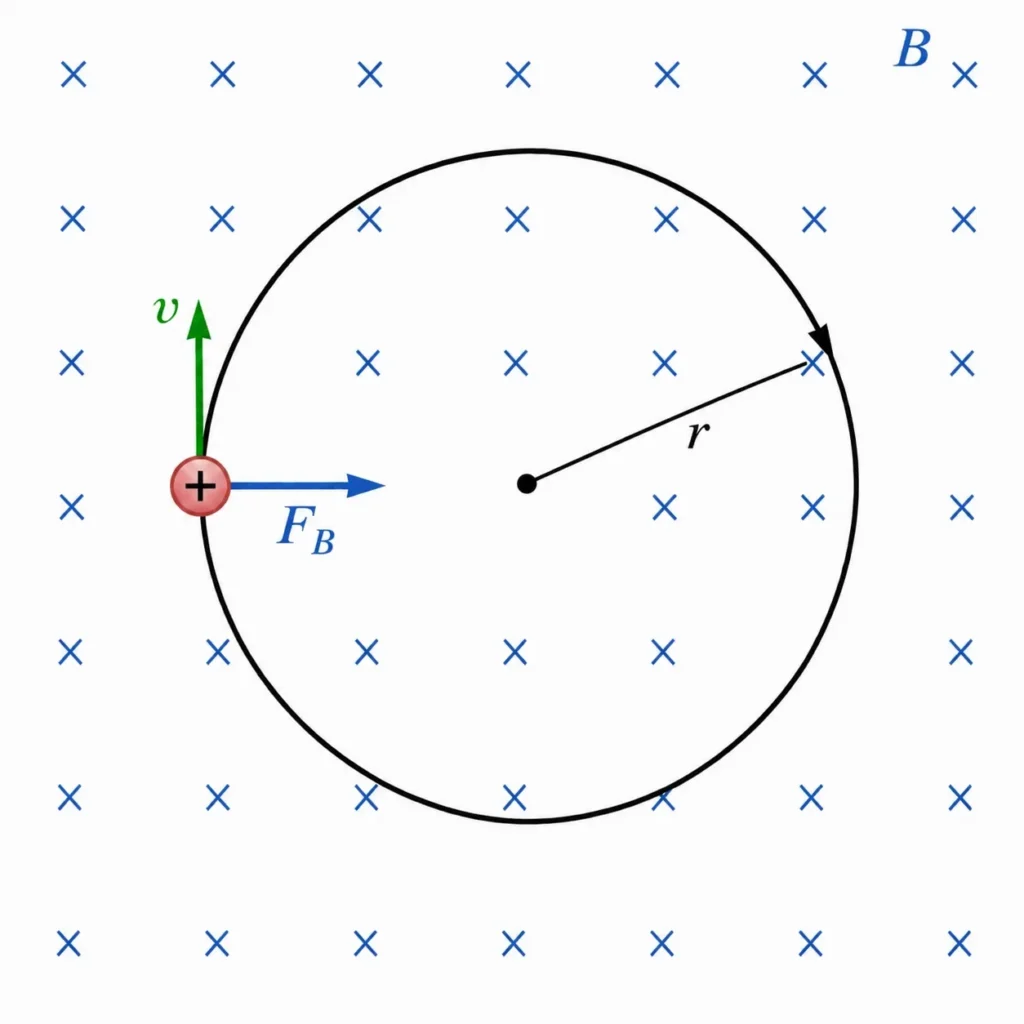
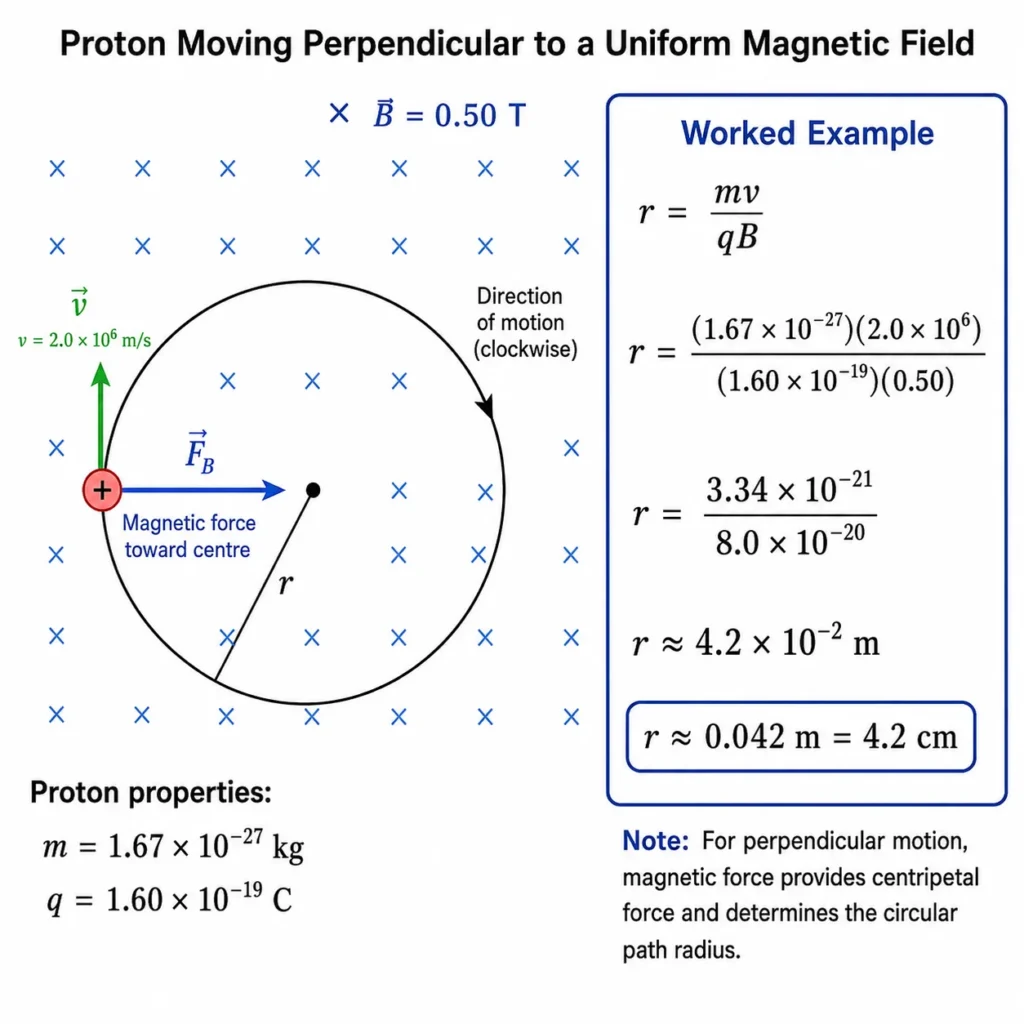
This diagram shows a positively charged particle moving into a uniform magnetic field and curving into a circular path. The particle’s velocity is tangent to the path, while the magnetic force acts perpendicular to the motion and points toward the centre of the circle. Because the force continually changes the direction of motion without directly speeding the particle up or slowing it down, the particle follows circular motion. The labelled radius helps students connect magnetic force with the centripetal force needed to keep the particle moving in a circle.
Magnetic Fields Learning Pathway
Electricity and Magnetism Context
Provides the global parent context for understanding charge distributions, vector field equations, electric circuits, induction, and Maxwellian wave mechanics.Magnetic Fields Parent Hub
Introduces how magnetic fields modify spatial boundaries to exert forces, guide moving charges, and interact with conductors.Magnetic Force on Moving Charges
Quantifies the velocity-dependent mechanical force vectors experienced by point charges navigating external magnetic flux distributions.Magnetic Force on Current Wires
Extends the individual force on moving charges to bulk conductors carrying collective streams of moving charge carriers.Motion of Charges in Fields
Models the circular, helical, or curved trajectories that result from a constant, velocity-dependent perpendicular magnetic deflection.Hall Effect and Magnetic Measurement
Analyzes the cross-boundary charge separation that occurs inside solid-state conductors, converting magnetic field metrics into measurable Hall voltages.The Core Physical Idea
Circular Orbit Mechanics
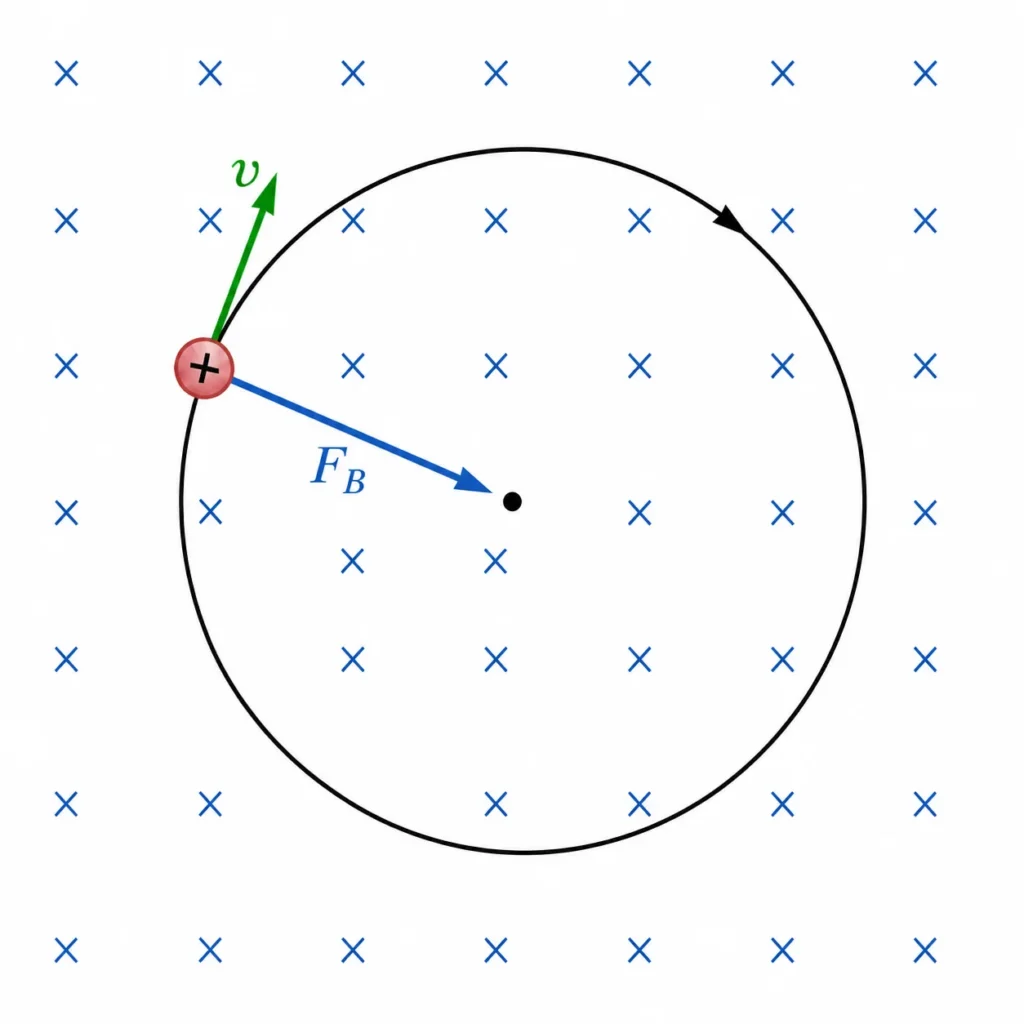
This illustration shows a positive charge moving in a circular path inside a uniform magnetic field. The velocity arrow is tangent to the circular path, while the magnetic force points inward toward the centre of the circle. This helps students see that the magnetic force is a directional effect: it acts perpendicular to both the motion of the charge and the magnetic field.
Evaluating Spatial Path Symmetries
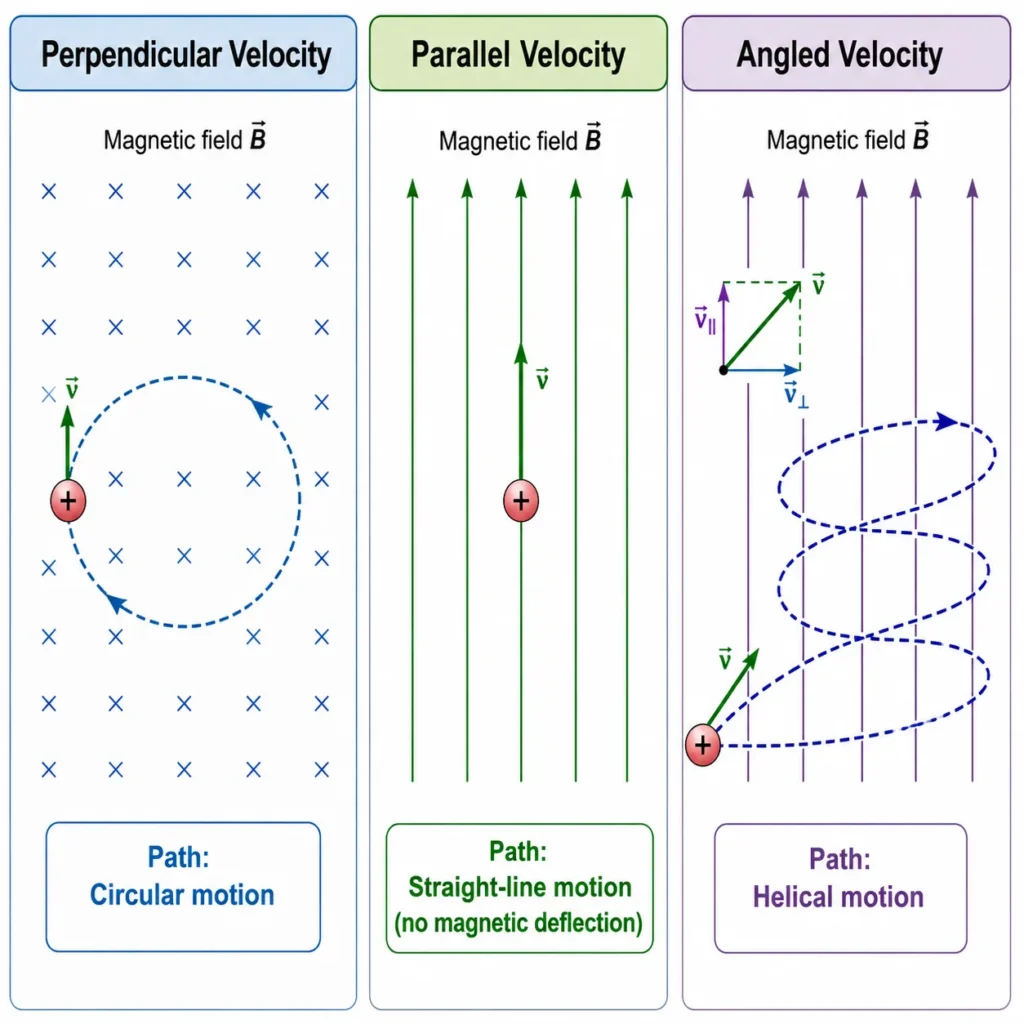
This illustration compares three ways a charged particle can move in a magnetic field. When the velocity is perpendicular to the field, the magnetic force bends the particle into circular motion. When the velocity is parallel to the field, there is no magnetic deflection and the particle continues in a straight line. When the velocity is angled, the perpendicular component causes circular motion while the parallel component carries the particle along the field, producing a helical path.
Trajectory Scale Dependencies
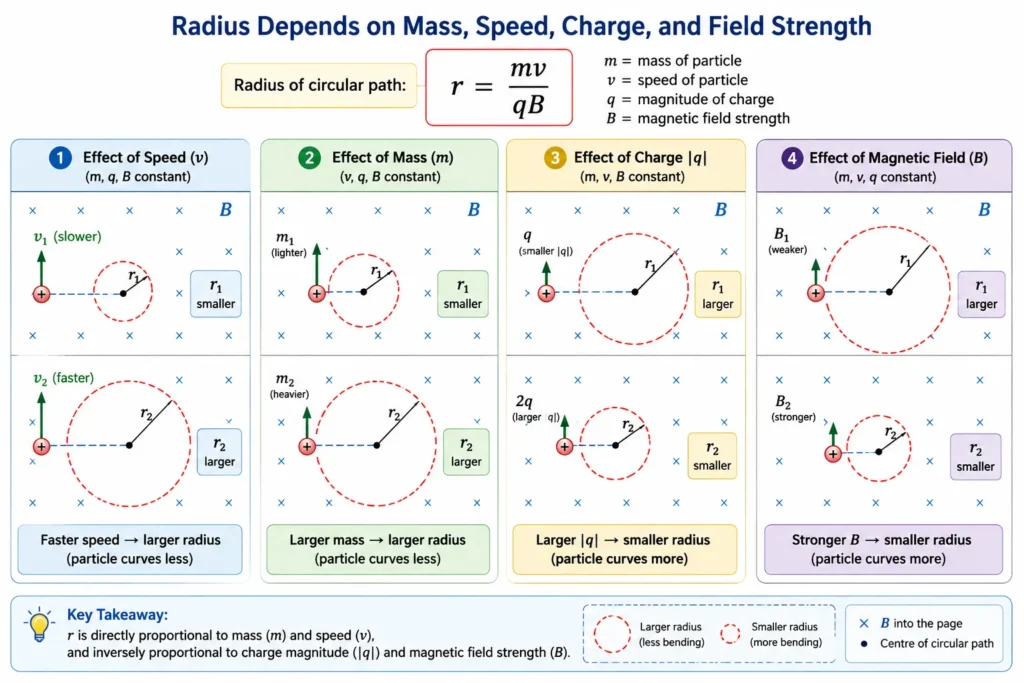
This infographic explains how the circular path radius of a charged particle in a magnetic field depends on the equation r = mv/(qB). It compares how changing speed, mass, charge magnitude, and magnetic field strength affects the radius of curvature. Faster or heavier particles follow larger-radius paths because they are harder to bend. Particles with larger charge magnitude or particles moving in stronger magnetic fields follow smaller-radius paths because the magnetic force bends them more tightly.
How the Path Depends on Direction of Motion
Perpendicular Launch Heading
When the velocity vector cuts perfectly perpendicular across the field lines, the mechanical deflection acts as a constant centripetal constraint, forcing the particle into a pure circular orbit.Parallel Trajectory Heading
If the velocity aligns perfectly parallel or anti-parallel to the field line vectors, the cross-product drops to zero. The particle experiences zero magnetic force and continues moving in a straight line.Oblique Angled Trajectory
When entering at an arbitrary angle, the perpendicular velocity component drives cross-field circular tracking, while the parallel velocity component maintains uniform linear drift, resulting in a helical path.Charge Parity Splitting
Because the direction of the Lorentz cross-product depends directly on the sign of the charge, positive ions and negative electrons turn in opposite directions, splitting their trajectories.The Primary Pillar to Remember
A uniform magnetic field cannot perform mechanical work or alter a particle’s scalar speed; it acts strictly as a geometric steering mechanism that bends the trajectory vector into circular or helical paths.
Key Equations and What They Mean
Advanced Mathematical Rigor: Helical Pitch Derivations and Non-Uniform Fields
Technical Case Studies: Applied Particle Steering
Analytical Diagnostics: Mass Spectrometer Filtering
Mass spectrometers exploit the radius equation to identify unknown chemical compounds. Samples are ionized and accelerated into a chamber containing a uniform magnetic field. As the ions cross the field, the perpendicular Lorentz force bends them into circular paths. Because the orbital radius tracks the particle’s mass-to-charge ratio (r = mv / qB), ions of different masses separate into distinct trajectories, landing at different locations on a detector plate to reveal the exact isotopic composition of the sample.Subatomic Physics: Circular Accelerator Guidance
High-energy synchrotrons and cyclotrons use powerful electromagnets to guide subatomic particles along controlled paths. As particle beams accelerate toward the speed of light, their momentum increases rapidly. To maintain a constant orbital path radius within the ring structure, automated control systems scale the magnetic flux density B upward in perfect synchronization with the particle momentum (B = mv / qr), keeping the beam safely centered within the accelerator ring.Worked Example
Proton Orbit Diagnostics
Common Conceptual Misconceptions
The Linear Tangent Trap
Misconception: The charged particle moves along the exact vector line of the magnetic force, flying directly toward the center of the circle. Reality: The force vector is purely centripetal, acting perpendicular to the instantaneous velocity. This continuously alters the heading of the velocity vector, drawing the charge along a circular orbit rather than pulling it inward.The Speed Acceleration Fallacy
Misconception: A particle traveling inside a circular magnetic field layout experiences a continuous increase in linear speed over time. Reality: Static magnetic forces perform zero work. The force vector modifies only the geometric direction of the particle’s velocity vector, leaving its linear speed and total kinetic energy completely unchanged.Evolution of Deflection Trajectories: History, Challenges, and Frontiers
To fully appreciate the physics of charged-particle trajectories, it is valuable to examine how our understanding developed historically, the high-energy engineering obstacles faced by modern researchers, and the industrial frameworks defining tomorrow’s frontier systems.
Historical Epochs: From Cathode Ray Tubes to the Cyclotron Breakthrough
The systematic study of charged-particle paths began in the late 19th century through experimental work with cathode ray streams inside early vacuum tubes. In 1897, British physicist J.J. Thomson utilized perpendicular electric and magnetic fields to precisely deflect these rays, allowing him to compute the mass-to-charge ratio of the electron and prove it was a discrete subatomic particle. This breakthrough fundamentally launched the field of experimental particle physics. A major mechanical milestone occurred in 1932, when Ernest O. Lawrence realized that because the classical cyclotron frequency equation remains completely independent of path radius and velocity, moving point charges could be accelerated outward along an expanding spiral path using a constant, alternating voltage frequency. This invention—the cyclotron—earned Lawrence the Nobel Prize and laid the foundational architecture for modern circular accelerator rings.
Contemporary Engineering Challenges: Relativistic Mass Scaling and Synchrotron Radiation Loss
Scaling trajectory control systems up to extreme high-energy regimes introduces severe mechanical and relativistic complications. When particles are accelerated to near-light speeds, their effective momentum increases nonlinearly due to relativistic effects. This mass scaling breaks the classical cyclotron resonance frequency, causing the particles to fall out of synchronization with fixed-frequency accelerating fields. To resolve this, modern synchrocyclotrons must dynamically adjust the driving RF field frequencies in real time to match the shifting mass properties of the beam. Furthermore, any charged particle forced along a curved path by a magnetic field experiences centripetal acceleration, which causes it to continuously emit electromagnetic energy known as synchrotron radiation. This energy drain causes severe power losses in high-energy beams, requiring massive electricity networks and active cooling systems to keep the steering mechanics stable.
Future Horizons: Laser-Wakefield Acceleration and Cosmic Plasma Trajectories
The next frontier in electrodynamic path control aims to bypass the physical scale limitations of traditional metallic radiofrequency cavities using Laser-Plasma Wakefield Acceleration (LWFA). By firing ultra-short, high-power laser pulses through a gas target, researchers generate dense plasma waves that trap and accelerate electrons over fractions of a millimeter—effectively shrinking multi-kilometer accelerator capabilities down to tabletop dimensions. In space physics and astrophysics, these trajectory principles are vital for exploring extreme cosmic environments. Scientists utilize magnetohydrodynamic models to map how cosmic rays spiral along converging magnetic field lines around spinning neutron stars and black hole accretion disks, unlocking new data about the high-energy magnetic architecture of the universe.
Bridge to University Thinking
Quick Interactive Check
Quick Check: Motion of Charges in Magnetic Fields
Review Questions and Answers
- State the core algebraic formula governing the orbital radius of a charged particle moving perpendicular to a uniform magnetic field.Answer: The trajectory radius is defined by the expression: r = mv / qB.
- Explain why the orbital period of a particle in a uniform magnetic field is independent of its linear speed.Answer: While a faster particle travels along a larger circle, its increased speed matches the expanded orbital distance perfectly. The velocity parameter cancels out completely during derivation, leaving the period dependent solely on the particle’s mass-to-charge ratio and the field strength (T = 2πm / qB).
- What occurs to a moving charge if its velocity vector is oriented perfectly parallel to the magnetic field lines?Answer: The magnetic force drops to exactly zero. The particle experiences zero deflection and continues moving forward in a straight line at a constant velocity.
- Why do positive ions and negative electrons track opposite orbital paths when entering the same magnetic field volume?Answer: The direction of the Lorentz force vector depends directly on the sign of the charge. As a result, negative charges turn in a direction exactly 180 degrees opposite to positive charges under identical field conditions.
Thought-Provoking Questions and Answers
- Why can a static magnetic field continuously bend a particle’s trajectory vector without performing work or altering its kinetic energy?Suggested answer: Mechanical work requires a force component to act parallel to the direction of motion. Because the magnetic force vector is derived from a cross-product, it projects strictly perpendicular to the velocity vector at every point along the path. The vector mechanical power expression vanishes identically (P = F · v = 0), performing zero work and keeping the linear speed constant.
- How do planetary magnetic fields trap dangerous solar wind particles, and what visible atmospheric phenomena does this interaction produce?Suggested answer: When high-energy cosmic protons and electrons stream toward Earth, they encounter the geomagnetic field. The oblique entry angle forces them into helical orbits that spiral along the field lines, trapping them within the Van Allen radiation belts. As these trapped particles plunge toward the dense upper atmosphere near the poles, they collide with gas molecules, exciting them to emit colorful light displays known as auroras.
Numerical Problems and Solutions
- An ion with a mass of 2.0 × 10⁻²⁶ kg and an absolute charge of 1.60 × 10⁻¹⁹ C enters a uniform 0.20 T magnetic field at a linear speed of 3.0 × 10⁵ m/s. If its path runs perpendicular to the field lines, calculate the resulting orbital radius.Solution: Apply the foundational path radius equation:$$r = \frac{mv}{qB} \Rightarrow r = \frac{(2.0 \times 10^{-26}\text{ kg})(3.0 \times 10^5\text{ m/s})}{(1.60 \times 10^{-19}\text{ C})(0.20\text{ T})}$$ $$r = \frac{6.0 \times 10^{-21}}{3.2 \times 10^{-20}} = 0.1875\text{ m}$$Answer: The orbital path radius measures approximately 0.19 m.
- A specialized test particle is tracking a steady circular path inside a uniform magnetic field. If the ambient magnetic flux density B is precisely doubled while keeping the particle’s speed constant, determine the modification to the path radius.Solution: Analyze the algebraic proportions within the core expression:$$r = \frac{mv}{qB} \Rightarrow r \propto \frac{1}{B}$$Because the orbital radius scales inversely with the magnetic flux density, doubling the field strength cuts the denominator value in half.Answer: The path radius is cut exactly in half, producing a loop that is twice as tight.
- An electron moves exactly parallel to the uniform flux lines of a 2.5 T magnetic array. Calculate the net force acting on the electron and describe its resulting trajectory path.Solution: Evaluate the angular components within the Lorentz equation:$$F = qvB\sin\theta \quad (\text{where } \theta = 0^{\circ} \Rightarrow \sin(0^{\circ}) = 0)$$ $$F = qvB(0) = 0\text{ N}$$Answer: The net magnetic force is exactly zero, so the electron continues along its original straight line at a constant velocity.
Summary
Authoritative External References
- OpenStax University Physics Vol 2: Motion of a Charged Particle in a Magnetic Field — Peer-reviewed university textbook covering microscopic Lorentz derivations, circular orbits, and helical pitch mechanics.
- OpenStax College Physics: Magnetic Effects and Charged Particles — Direct introduction to trajectory radius equations, geometric angular dependencies, and industrial applications.
- The Feynman Lectures on Physics, Vol. II, Chapter 13: Magnetostatics — Caltech’s premier physics portal exploring Lorentz cross-products, cyclotron frequencies, and vector field calculus configurations.