
The magnetic force on moving charges represents the foundational microscopic mechanism governing all magnetostatic phenomena. While an electric field establishes a conservative scalar energy landscape that exerts forces on charges independent of their mechanical state, a magnetic field interacts exclusively with charges that possess a non-zero velocity vector relative to the field coordinates. The resulting interaction abstracts space into a multi-dimensional vector landscape where forces act purely sideways to the particle’s instantaneous trajectory.
This behavior marks a major conceptual shift from simple Newtonian mechanics. Instead of applying linear accelerations along a field vector, a magnetic field acts as a directional steering mechanism. It explains why cosmic radiation curves away from planetary surfaces, how high-energy particle beams are guided through subatomic colliders, and how solid-state semiconductors isolate majority charge carriers. By mapping these orthogonal interactions, university students transition from basic force calculations to advanced vector kinematics and multi-dimensional electrodynamics.
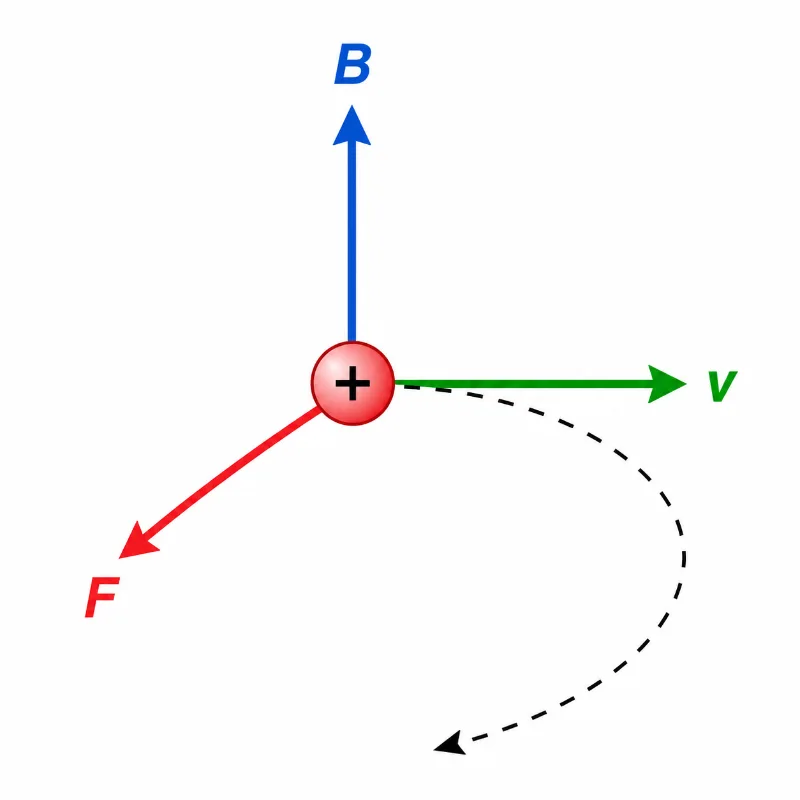
This illustration shows a positive charge moving through a magnetic field. The velocity arrow, magnetic field arrow, and magnetic force arrow point in mutually perpendicular directions. The diagram helps students see that magnetic force does not push the charge forward along its motion. Instead, it acts sideways, changing the direction of the particle’s motion and allowing magnetic fields to bend charged-particle paths.
Magnetic Fields Learning Pathway
Electricity and Magnetism Context
Provides the global parent context for understanding charge distributions, vector field equations, electric circuits, induction, and Maxwellian wave mechanics.
Magnetic Fields Parent Hub
Introduces how magnetic fields modify spatial boundaries to exert forces, steer moving charges, and support solid-state instrumentation networks.
Magnetic Force on Moving Charges
Explains how a charged particle moving through a magnetic field experiences a sideways force depending on charge, speed, field strength, and angle.
Magnetic Force on Current Wires
Extends the force on moving charges to a wire carrying many moving charges, leading to the collective force used in motors and loudspeakers.
Motion of Charges in Magnetic Fields
Shows how magnetic force can produce circular, helical, or curved paths for charged particles moving through magnetic fields.
Hall Effect and Magnetic Measurement
Analyzes the cross-boundary charge separation that occurs inside solid-state conductors, converting magnetic field metrics into measurable Hall voltages.
The Core Physical Idea
Velocity, Magnetic Field, and Force Geometry
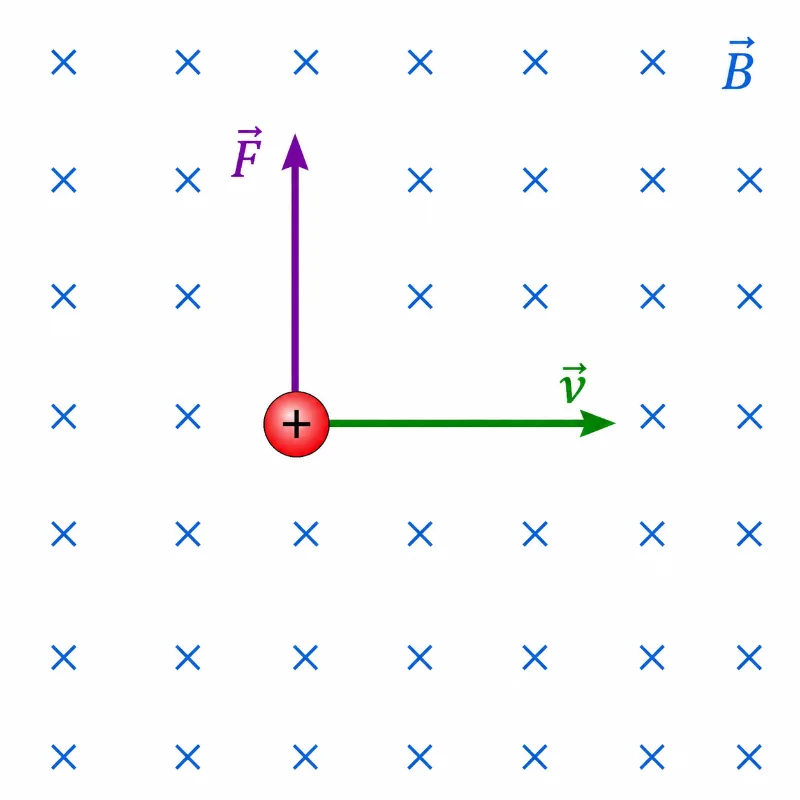
This diagram shows a positive charge moving to the right through a uniform magnetic field directed into the page, represented by blue crosses. The velocity arrow v points right, while the magnetic force arrow F points upward. The illustration helps students see that magnetic force is a directional effect: it acts perpendicular to both the motion of the charge and the magnetic field.
Evaluating Angle Dependencies
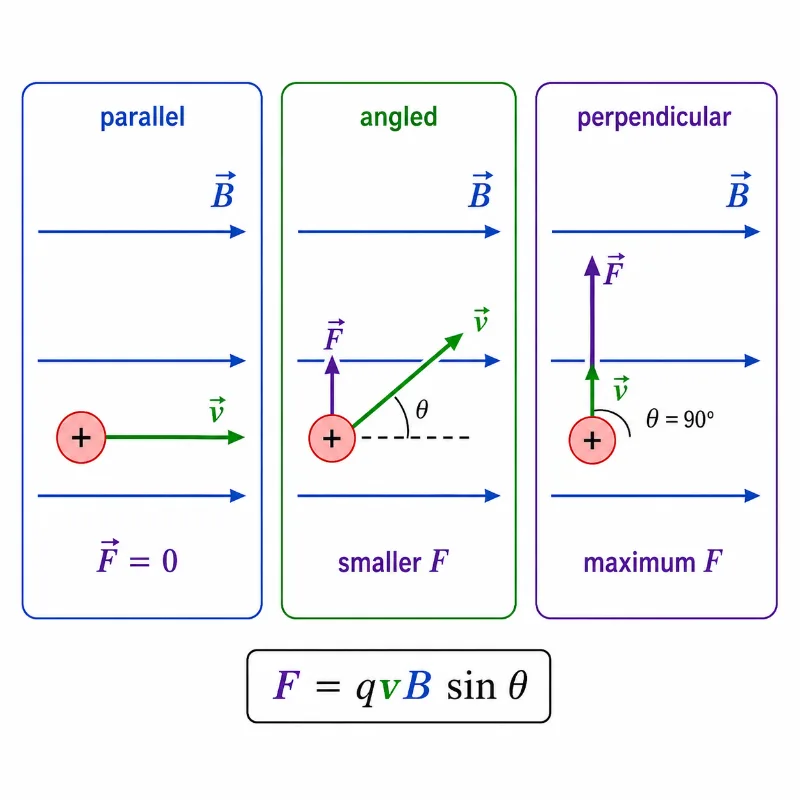
This illustration compares three cases for a positive charge moving in a magnetic field. In the first case, the velocity is parallel to the field, so the magnetic force is zero. In the second case, the velocity is at an angle to the field, so only the perpendicular part of the motion contributes and the force is smaller. In the third case, the velocity is perpendicular to the field, so the magnetic force is maximum. The diagram helps students understand the role of the sin θ term in the equation F = qvB sin θ.
Charge Sign Trajectory Splits
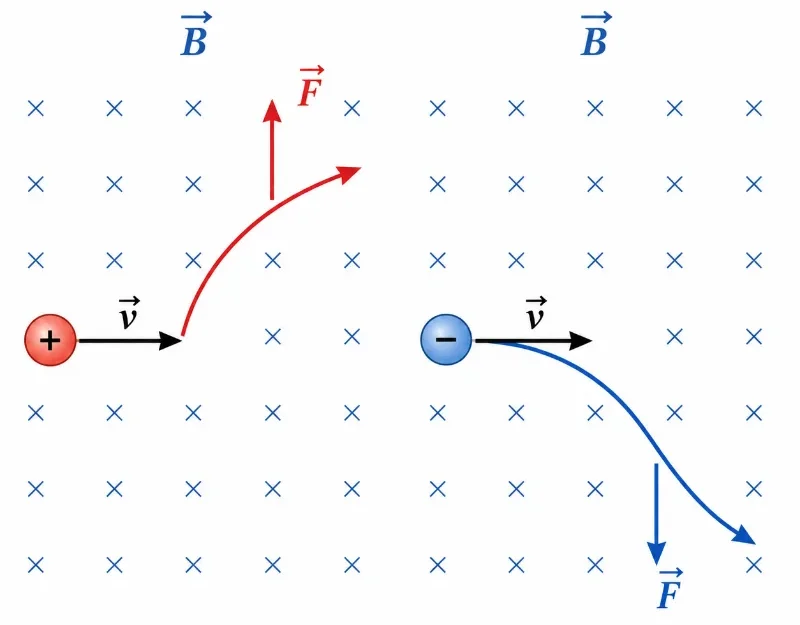
This illustration compares a positive charge and a negative charge entering the same uniform magnetic field with the same initial velocity. The magnetic field is directed into the page, and both particles move horizontally at first. The positive charge curves upward, while the negative charge curves downward, showing that the magnetic force reverses direction when the sign of the charge changes. The diagram helps students see that the right-hand rule gives the force direction for a positive charge, while a negative charge experiences the opposite deflection.
Determining the Vector Direction Matrix
Instantaneous Velocity (v)
Tracks the exact directional heading of the particle at a given instant. The magnetic force depends entirely on this active motion vector, not just its spatial position.
Magnetic Flux Vector (B)
Maps the direction of local magnetic influence. By universal rule, external field lines flow out from the North pole face and enter the South pole face.
Orthogonal Force Vector (F)
Calculates the resulting mechanical deflection. The force vector projects at a strict right angle to the plane formed by the velocity and field vectors.
Charge Sign Parity
Determines the absolute vector heading. The standard right-hand rule defines the path for positive charges; negative charges deflect in the exact opposite direction.
The Primary Pillar to Remember
A static magnetic field exerts an exclusively perpendicular deflection force on moving charges, altering their geometric direction without performing work or changing their scalar speed.
Advanced Mathematical Rigor: Cross-Products and Zero-Work Vector Proofs
Technical Case Studies: Applied Particle Steering
Chemical Fingerprinting: Mass Spectrometry Diagnostics
Mass spectrometers vaporize and ionize complex chemical samples before accelerating them into a uniform magnetic field. As the ions cross the field, the perpendicular Lorentz force bends their trajectories into circular paths. Because the orbital radius depends directly on the particle’s mass-to-charge ratio (r = mv / qB), ions of different masses land at distinct positions on a detector plate, allowing scientists to identify trace elements and analyze complex molecular structures with high precision.
Planetary Defense: The Van Allen Radiation Belts
Earth’s liquid iron core generates a massive planetary magnetic field that protects the biosphere from dangerous solar wind radiation. When high-energy cosmic protons and electrons stream toward Earth, they encounter this geomagnetic field and experience intense Lorentz forces (F = q(v × B)). The perpendicular force traps the charged particles, forcing them into helical orbits that bounce harmlessly between the poles within the Van Allen radiation belts, shielding the planet from cosmic radiation.
Evolution of Deflection Theory: History and Future Frontiers
Historical Epochs: From J.J. Thomson’s Cathode Rays to Modern Synchrotrons
Future Horizons: Magnetohydrodynamic Fusion Plasma Containment
Numerical Problems and Solutions
-
An isolated alpha particle carrying a charge value q = 2.0 × 10⁻⁶ C enters a uniform 0.30 T magnetic field at a speed of 4.0 × 10⁵ m/s. If the velocity vector is perpendicular to the field lines, calculate the resulting force.Solution: Apply the perpendicular Lorentz force magnitude formula:$$F = qvB \Rightarrow F = (2.0 \times 10^{-6}\text{ C})(4.0 \times 10^5\text{ m/s})(0.30\text{ T}) = 0.24\text{ N}$$Interpretation: The field exerts a continuous mechanical force of 0.24 N on the particle, deflecting its path perpendicular to its velocity vector.
-
An electron carrying a charge value e = -1.60 × 10⁻¹⁹ C travels perfectly parallel to the field lines of a 1.5 T magnetic array. Determine the total deflection force.Solution: Evaluate using the angle-dependent equation:$$F = qvB\sin\theta \quad (\text{where } \theta = 0^{\circ} \Rightarrow \sin(0^{\circ}) = 0)$$ $$F = qvB(0) = 0\text{ N}$$Interpretation: The net force drops to exactly zero. Because the electron moves parallel to the field lines, the vector cross-product vanishes, producing no path deflection.
-
A proton carrying a charge value q = 1.60 × 10⁻¹⁹ C moves at a speed of 2.0 × 10⁶ m/s at an angle of 30° relative to a uniform 0.50 T magnetic field. Calculate the force magnitude.Solution: Deploy the general angle-dependent formula:$$F = qvB\sin\theta \Rightarrow F = (1.60 \times 10^{-19}\text{ C})(2.0 × 10^6\text{ m/s})(0.50\text{ T})\sin(30^{\circ})$$ $$F = (1.60 \times 10^{-19})(2.0 × 10^6)(0.50)(0.5) = 8.0 \times 10^{-14}\text{ N}$$Answer: The proton experiences a mechanical deflection force of 8.0 times 10-14 N.
Common Conceptual Misconceptions
The Kinetic Acceleration Myth
Misconception: A powerful magnetic field can be used to speed up a charged particle, increasing its kinetic energy.
Reality: Static magnetic forces perform zero work (P = F · v = 0). The force vector acts strictly perpendicular to motion, changing the particle’s direction while leaving its speed completely unchanged.
The Electron Direction Error
Misconception: Electrons and protons entering the same magnetic field with the same velocity vector deflect along identical paths.
Reality: They deflect in opposite directions. Because the force vector depends directly on the charge sign, negative electrons curve opposite to positive protons, and their smaller mass causes them to bend much more sharply.
Bridge to University Thinking
Quick Interactive Check
Quick Check: Magnetic Force on Moving Charges
Review Questions and Answers
- State the definitive vector cross-product equation for the magnetic force on a moving charge.Answer: The interaction is defined by the vector cross-product relation: F = q(v × B).
- What occurs to the mechanical force magnitude if a particle moves perfectly parallel to the magnetic field vector?Answer: The force drops to exactly zero because the angle θ is 0 degrees, making sin(0°) = 0 and reducing the cross-product to zero.
- Why does the absolute charge sign matter when using direction rules?Answer: The force direction depends directly on the vector sign of the charge q. As a result, negative charges experience a deflection force directed exactly 180 degrees opposite to positive charges under identical field conditions.
- Does a static magnetic field perform mechanical work on a moving point charge?Answer: No. Because the force vector is always strictly perpendicular to the velocity vector, their dot product vanishes identically (P = F · v = 0), performing zero work and leaving the particle’s speed constant.
Thought-Provoking Questions and Answers
- Why does an electric field alter a particle’s scalar speed while a static magnetic field can only alter its geometric direction?Suggested answer: An electric field exerts a force (F = qE) that acts parallel to the field vectors, allowing it to perform work and change the particle’s speed. A magnetic field exerts a cross-product force (F = qv × B) that is strictly perpendicular to the particle’s velocity vector at every point, which performs zero work and changes only its direction of motion.
- How do velocity selectors isolate a specific particle velocity out of a mixed beam without filtering by mass or charge?Suggested answer: Velocity selectors align an electric field and a magnetic field perpendicularly so they exert equal, opposing forces on passing charges (qE = qvB). Because both force expressions depend linearly on the charge magnitude q, the charge cancels out completely, leaving the velocity ratio (v = E/B) as the sole filtering metric.
Summary
Authoritative External References
- OpenStax University Physics Vol 2: Motion of a Charged Particle in a Magnetic Field — Peer-reviewed textbook analyzing cross-product mechanics, zero-work integrals, and cyclotron frequency equations.
- OpenStax College Physics: Force on a Moving Charge in a Magnetic Field — Comprehensive guide detailing angle dependencies, right-hand rules, and velocity selector setups.
- The Feynman Lectures on Physics, Vol. II, Chapter 13: Magnetostatics — Caltech’s premier physics portal exploring Lorentz force vectors, particle kinematics, and vector field calculus equations.