
Cloud robotics extends computational capability beyond the physical body of a robot. Traditional robotic systems perform perception, planning, and control entirely onboard. However, modern robots increasingly rely on distributed computing architectures in which data processing, learning, and coordination occur across edge devices and centralized cloud infrastructure.
This paradigm allows robotic systems to access large-scale machine learning models, share knowledge across fleets, and utilize computational resources that far exceed onboard hardware limitations. As robotics systems grow in complexity, the ability to distribute computation across networks becomes essential for scalability and intelligence.
At the same time, cloud-connected robotics introduces new engineering challenges, including communication latency, reliability of network connections, and cybersecurity risks. Designers must therefore balance the benefits of distributed intelligence with the constraints of real-time physical control.
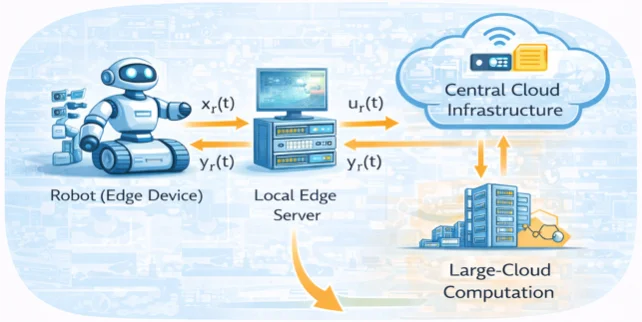
This diagram illustrates the layered architecture commonly used in cloud robotics systems. The physical robot acts as an edge device that collects sensor data and executes actuator commands. Nearby edge servers process data with low latency, performing tasks such as preprocessing, inference, and local control assistance. More computationally intensive operations—such as large-scale machine learning, global fleet coordination, and data storage—are handled by centralized cloud infrastructure. Communication between these layers enables robots to access powerful computational resources while maintaining local control for time-critical operations.
Interactive Quick Review: Cloud Robotics & Edge Fundamentals
Test your understanding of distributed computing architectures and edge-cloud separation before exploring latency modeling equations:
1. What is the fundamental purpose of extending computational capability via cloud robotics beyond a robot's physical body?
Answer: To allow robotic systems to access large-scale machine learning models, share knowledge across fleets, and utilize computing resources that far exceed onboard hardware limitations.
2. Why are time-critical control loops typically executed locally rather than in the central cloud?
Answer: Because communication delay across public networks introduces phase lag into feedback control loops, which can lead to oscillation or instability if relied upon for high-speed tasks.
Glossary of Cloud Robotics and Distributed Intelligence
Key technical terminology defining modern networked robotic systems and cyber-physical architectures:
Cloud Robotics Architecture
Cloud robotics organizes intelligence across a hierarchical, three-tier cyber-physical topology:
- Robot (Physical Edge Node): Houses low-latency microcontrollers, real-time operating systems (RTOS), joint servos, and primary proprioceptive sensors executing high-rate inner loops (\(500\text{ Hz}\)–\(2\text{ kHz}\)).
- Local Edge Server (Fog Layer): On-premise server racks or cellular Multi-access Edge Computing (MEC) units executing perception feature extraction, dense local SLAM, and tactical trajectory optimization (\(20\text{–}100\text{ Hz}\)).
- Central Cloud Infrastructure: Remote hyper-scale data centers providing elastic GPU computing for offline deep reinforcement learning, long-term semantic map aggregation, and fleet-wide task dispatching.
Let \(\mathbf{x}_r(t) \in \mathbb{R}^n\) denote the internal state of the robot, \(\mathbf{u}_r(t) \in \mathbb{R}^m\) be actuator control commands, and \(\mathbf{y}_r(t) \in \mathbb{R}^p\) represent sensor observations streaming across the network interface.
Latency Constraints and Closed-Loop Stability
Network transport delay represents the fundamental physical barrier to offloading real-time feedback loops. Consider a continuous-time tracking error \(\mathbf{e}(t) = \mathbf{x}_d(t) - \mathbf{x}(t)\). Under pure network transport dead-time \(\tau\), the delayed control law becomes:
$$\mathbf{u}(t) = \mathbf{K} \mathbf{e}(t - \tau)$$In the Laplace frequency domain, time delay introduces a non-minimum phase exponential lag operator \(e^{-s\tau}\). The phase margin \(\Phi_m\) degrades linearly with delay and loop crossover frequency \(\omega_c\):
$$\Delta \phi = -\omega_c \cdot \tau$$When phase lag \(\Delta \phi\) exceeds the system's phase margin, the closed-loop system experiences harmonic limit cycles and divergence. Consequently, inner-loop joint torque and attitude regulation must execute strictly on onboard microcontrollers.
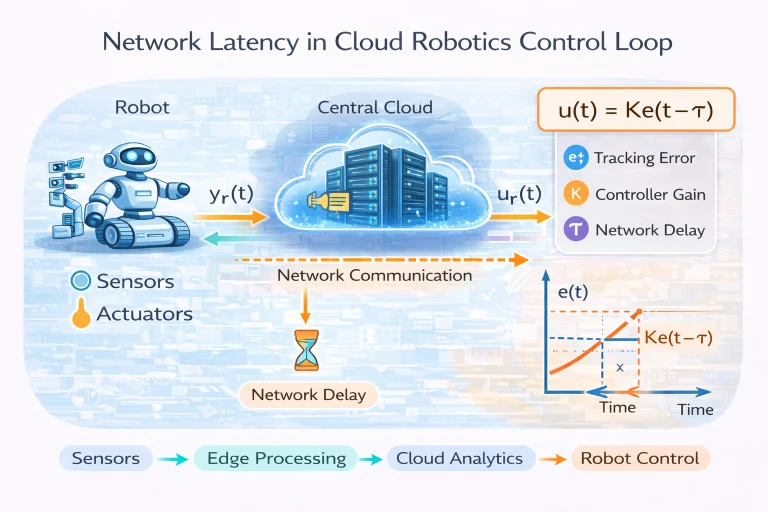
This diagram illustrates how communication delay affects feedback control in cloud robotics systems. Sensor measurements from the robot are transmitted across a network to a cloud server where control computations are performed. The resulting control command is then returned to the robot. Because the communication path introduces delay, the controller acts on outdated information, represented mathematically as the delayed error term \(e(t - \tau)\). When the delay becomes too large relative to the control cycle, the feedback loop may lose stability or produce oscillatory behavior.
Edge Computing and Offloading Boundaries
Edge computing places computational resources close to physical operations, establishing an intermediate latency tier:
$$T_e \ll T_c$$Where \(T_e\) is round-trip edge latency (typically \(2\text{–}10\text{ ms}\) over local 5G or industrial Wi-Fi 6), and \(T_c\) is WAN cloud latency (typically \(50\text{–}150\text{ ms}\)). Tasks are partitioned based on their execution deadlines and bandwidth requirements:
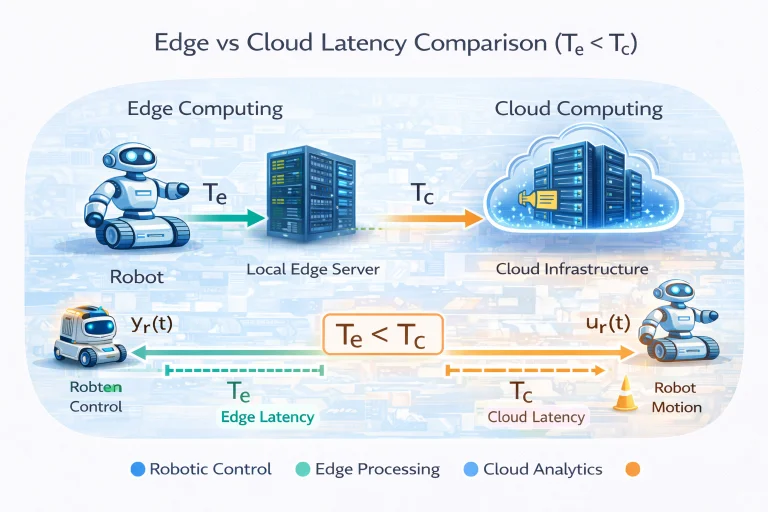
This diagram compares communication latency between edge computing and cloud computing in robotic systems. When computation occurs at a nearby edge server, data travels only a short distance, producing a relatively small round-trip delay represented by \(T_e\). In contrast, cloud computation requires transmitting data across wider networks to distant data centers, producing a larger delay \(T_c\). For this reason, robotic systems execute time-critical perception and planning on the edge while utilizing the cloud for big-data training and fleet intelligence.
Cloud & Edge Robotics Challenges and Engineering Solutions
Deploying distributed cloud-edge robotics architectures introduces complex cyber-physical failure modes. Below are four key engineering bottlenecks and their corresponding technical solutions:
The Challenge: Wireless channels suffer from multi-path fading and interference, causing packet delivery times to fluctuate. In feedback control, variable time delays destroy system phase margins and can induce oscillatory limit cycles.
- Smith Predictors & State Observers: Executing an onboard dynamic simulation model that estimates real-time robot states, buffering against delayed or dropped cloud command packets.
- Time-Triggered Networking (TTN) & TSN: Deploying IEEE 802.1Qbv Time-Sensitive Networking over industrial Wi-Fi/5G URLLC to guarantee dedicated communication time-slots for control packets.
- Graceful Degradation Fallbacks: Structuring controllers to automatically switch to onboard sensor-based velocity limiting and emergency stop maneuvers when packet loss persists beyond a critical timeout threshold.
The Challenge: A fleet of 50 robots streaming raw 4K camera streams and dense 3D LiDAR point clouds can generate hundreds of megabits per second, quickly congesting local wireless access points and inflating cloud storage costs.
- Edge Feature Extraction: Running lightweight convolutional backbones on edge devices to convert raw multi-megabyte images into low-dimensional semantic embeddings (\(< 10\text{ KB}\)) prior to cloud transmission.
- Octree Spatial Downsampling: Filtering raw 3D LiDAR point clouds locally into multi-resolution voxel grids, transmitting only newly observed spatial points.
- Dynamic Adaptive Streaming: Adjusting telemetry upload rates based on instantaneous vehicle speed and localization confidence metrics.
The Challenge: When robots share learning parameters across public networks, adversarial actors can inject corrupted gradients (model poisoning) or reverse-engineer private map details from uploaded neural weights.
- Byzantine-Tolerant Aggregation: Using robust aggregation rules (such as Krum or coordinate-wise trimmed mean) instead of simple averaging to identify and discard adversarial gradient outliers.
- Differential Privacy (DP-SGD): Injecting calibrated Gaussian noise into model weight updates at the edge, mathematically preventing gradient inversion attacks while preserving overall learning utility.
- Zero-Knowledge Identity Verification: Authenticating model weight updates using cryptographic signatures on edge hardware security modules (HSMs).
The Challenge: Network-connected robots expose API endpoints and communication buses. A compromised cloud server or man-in-the-middle exploit allows an attacker to inject dangerous motion commands directly into physical hardware.
- Hardware Safety Interlocks & Control Barrier Functions (CBFs): Implementing an independent onboard watchdog controller that validates all incoming cloud commands against kinematic safety envelopes, overriding commands that would cause collisions.
- Mutual TLS (mTLS) Encryption: Encapsulating all ROS 2 / DDS telemetry inside end-to-end encrypted tunnels using TLS 1.3 with certificate rotation.
- Zero-Trust Microsegmentation: Isolating the robot's drive motor buses from network-facing computers through physical hardware boundaries and CAN-gateway firewalls.
Distributed Perception and Federated Fleet Learning
Cloud-connected fleets collaborate to train neural networks without sharing raw video feeds. In a Federated Learning framework, each robot \(i \in \{1, \dots, N\}\) trains an onboard model on local data to obtain parameter vector \(\boldsymbol{\theta}_i\). A central parameter server computes the aggregated global model:
$$\boldsymbol{\theta}_{\text{global}} = \sum_{i=1}^N \frac{n_i}{n} \boldsymbol{\theta}_i$$Where \(n_i\) is the number of training samples processed by robot \(i\), and \(n = \sum n_i\). When data distributions are uniform, this reduces to the standard parameter average \(\boldsymbol{\theta}_{\text{global}} = \frac{1}{N} \sum_{i=1}^N \boldsymbol{\theta}_i\).
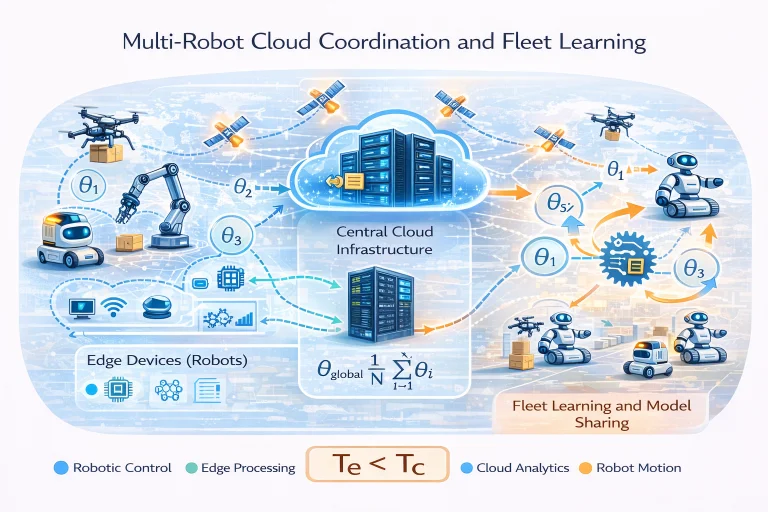
This diagram illustrates how multiple robots collaborate through cloud infrastructure to improve shared machine learning models. Each robot collects local observations and updates its internal parameters \(\boldsymbol{\theta}_1, \boldsymbol{\theta}_2, \dots\). These weights are transmitted to a central server where they are aggregated into a unified model \(\boldsymbol{\theta}_{\text{global}}\) and redistributed to the entire fleet.
Multi-Robot Task Allocation (MRTA) Optimization
Cloud infrastructure coordinates fleets by solving combinatorial assignment problems across \(m\) robots and \(n\) tasks. Let \(C_{ij}\) represent the cost (travel distance, time, or energy) of assigning robot \(r_i\) to task \(t_j\). The centralized task allocation problem is formulated as a binary integer program:
$$\min \sum_{i=1}^m \sum_{j=1}^n C_{ij} x_{ij}$$ $$\text{subject to} \quad \sum_{i=1}^m x_{ij} = 1 \quad \forall j \in \{1, \dots, n\}, \quad \sum_{j=1}^n x_{ij} \le 1 \quad \forall i \in \{1, \dots, m\}$$Where \(x_{ij} \in \{0, 1\}\) denotes the binary assignment variable. Centralized servers solve these assignment matrices using the Hungarian algorithm or interior-point linear programming solvers.
Cybersecurity and Cyber-Physical Threat Topologies
Connecting physical actuators to networks introduces attack vectors that can cause physical damage. A defense-in-depth architecture secures all three layers of the cloud robotics stack:
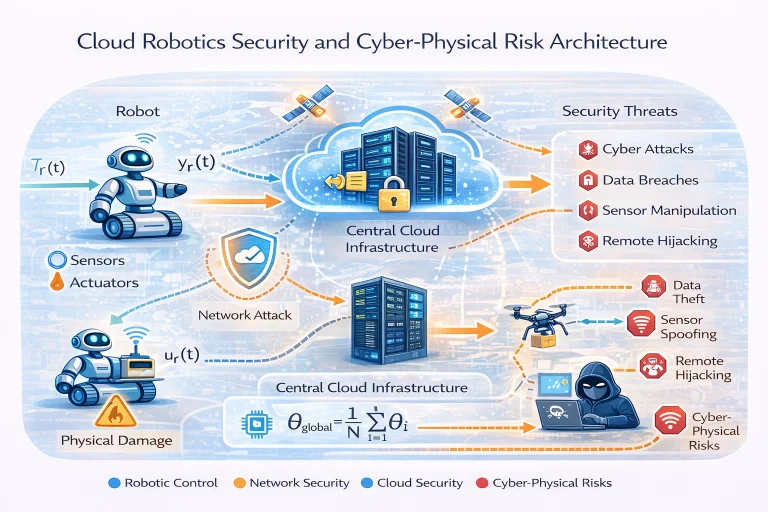
This diagram highlights security risks in cloud robotics architectures. When communication channels are compromised, malicious actors can intercept telemetry, spoof sensor feeds, or inject unauthorized control commands. Because physical robots operate in real-world spaces, cyber attacks can cause hardware collisions and equipment damage. Strong authentication, transport encryption, and hardware interlocks are required to maintain operational safety.
🎯 Career Guidance Tool Is Cloud Robotics & Edge Intelligence Right For You?Explore distributed robotics engineering pathways, edge AI careers, and cloud fleet automation architecture. | Explore Career Options → |
Interactive Quick Review: Latency, Edge Computing & Fleet Learning
Reinforce key concepts regarding communication delay, edge latency advantages, and federated model sharing before reviewing the FAQ:
1. How does communication delay (\(\tau\)) affect linear feedback control systems in cloud robotics?
Answer: It introduces phase lag into the system, which can reduce phase margin and lead to oscillation or instability if the controller acts on outdated error information (\(u(t) = K e(t - \tau)\)).
2. Why is edge computing preferred over distant cloud computing for moderate-speed feedback processes?
Answer: Because placing computational resources physically closer to the robot results in lower round-trip latency (\(T_e \ll T_c\)), preserving feedback loop stability.
Frequently Asked Questions about Cloud Robotics and Edge Intelligence
What is cloud robotics, and why is it needed when robots have onboard computers?
Cloud robotics extends a robot's computing capabilities by connecting edge devices to centralized cloud infrastructure and local edge servers. While onboard computers handle immediate local control, the cloud provides massive storage, heavy machine learning training, and global fleet coordination that exceed physical onboard hardware weight and power limits.
How does network latency affect the stability of cloud-controlled robots?
Network delay (\(\tau\)) introduces phase lag into closed-loop feedback systems. When control inputs rely on delayed error measurements (\(u(t) = K e(t - \tau)\)), high delay can erode stability margins, causing oscillations or catastrophic system instability in fast-moving physical maneuvers.
What is the difference between edge computing and cloud computing in robotic architectures?
Edge computing places servers physically close to the robot to ensure low latency (\(T_e \ll T_c\)), making it suitable for sensor preprocessing, local planning, and moderate-speed control. Cloud computing involves distant data centers that handle high-latency, high-computation tasks like global map building and fleet-wide model aggregation.
How do robotic fleets share machine learning models without compromising data privacy?
Fleets utilize federated learning approaches, where individual robots train models locally on their own sensor data and transmit only the learned model parameters (\(\boldsymbol{\theta}_i\)) to a central server, which aggregates them into a global model (\(\boldsymbol{\theta}_{\text{global}}\)) without exposing raw sensor logs.
End-of-Page Exercises: Review, Thought-Provoking & Engineering Problems
Section 1: Foundational Review Questions & Answers
1. What is the fundamental architecture difference between traditional onboard robotics and cloud robotics?
Answer: Traditional robotics performs all perception, planning, and control onboard, whereas cloud robotics distributes data processing, machine learning, and fleet coordination across edge devices, local servers, and central cloud infrastructure.
2. How does communication delay (\(\tau\)) mathematically manifest in a delayed feedback control law?
Answer: Through the control input equation \(u(t) = K e(t - \tau)\), where control actions rely on error measured at time \(t - \tau\).
3. Why is edge computing utilized in modern robotic architectures?
Answer: To place computational resources physically closer to the robot, achieving lower round-trip latency (\(T_e \ll T_c\)) compared to distant cloud data centers.
4. How do cloud-connected robots share and aggregate perception models across multi-robot fleets?
Answer: By transmitting locally trained model parameters (\(\boldsymbol{\theta}_i\)) to a central server that computes an aggregated global model (\(\boldsymbol{\theta}_{\text{global}} = \frac{1}{N} \sum \boldsymbol{\theta}_i\)) without sharing raw sensor data.
5. How is multi-robot task allocation formulated as an optimization problem in cloud infrastructure?
Answer: By minimizing the total assignment cost function \(\min \sum \sum C_{ij}x_{ij}\) subject to binary task-robot assignment constraints.
6. What are the key cybersecurity concerns when control signals traverse public networks in cloud robotics?
Answer: Data encryption in transit, device authentication, distributed trust against corrupted models, and vulnerability to Denial-of-Service (DoS) network attacks.
7. What hybrid operational balance is achieved in automated warehouse robotics using edge intelligence?
Answer: Low-level motion control executes locally for stability, edge servers handle real-time obstacle detection and map updates, and the cloud computes high-level fleet coordination and task scheduling.
8. What engineering trade-offs govern the design of cloud robotics systems?
Answer: Latency vs computational power, centralization vs robustness, bandwidth usage vs model accuracy, and security vs system complexity.
9. How does edge computing integrate with real-time embedded systems?
Answer: By ensuring deterministic task scheduling, predictable timing, and low-latency processing for time-critical sensor fusion and local path planning.
10. Why is communication delay particularly detrimental to high-speed joint torque regulation?
Answer: Because high-speed torque regulation demands sub-millisecond response times and deterministic execution that network jitter cannot reliably guarantee.
Section 2: Analytical & Thought-Provoking Questions
1. How does variable network jitter in 5G wireless links compromise closed-loop stability in cloud-controlled manipulators?
Answer: Wireless jitter creates non-uniform time delays, causing unpredictable shifts in phase margin that can destabilize continuous-time feedback loops and induce chaotic oscillations.
2. What privacy risks arise when federated learning parameter aggregation servers are intercepted?
Answer: Even without raw video streams, gradient inversion attacks can reconstruct training images and physical environment maps directly from mathematical model weight updates.
3. How can a multi-robot cloud fleet safely maintain operations during a central cloud blackout?
Answer: By executing graceful degradation: robots immediately fall back to local sensor-based SLAM, local edge server coordination, and peer-to-peer ad-hoc mesh networks.
4. What ethical and legal liabilities emerge if a cyber-attack on a cloud robotics fleet causes a collision?
Answer: Liability is partitioned across multiple entities—the cloud provider (network uptime), software developers (security vulnerabilities), and the fleet operator (monitoring protocols).
5. How do bandwidth bottlenecks limit streaming uncompressed camera feeds from thousands of robots?
Answer: Thousands of high-resolution feeds saturate local wireless access points and cloud ingest pipelines, necessitating edge-side image compression and semantic feature extraction.
6. In what ways does edge computing blur the boundary between embedded systems and server administration?
Answer: Edge nodes run containerized microservices (Docker/Kubernetes) on factory floors while interfacing directly with low-level CAN buses and hard real-time motor controllers.
7. How can distributed ledger technologies secure multi-robot model aggregation against Byzantine attacks?
Answer: Cryptographic consensus algorithms verify model parameter updates across distributed nodes, filtering out malicious or poisoned weights before global aggregation.
8. What challenges do heterogeneous robot fleets present for centralized cloud task optimization?
Answer: Varying kinematics, sensor capabilities, and battery capacities make assignment cost matrices non-uniform, turning task allocation into complex multi-objective optimization.
9. How does caching at local edge servers mitigate intermittent cloud disconnection?
Answer: Pre-fetching high-definition local maps and navigation policies onto edge nodes allows robots to maintain uninterrupted mission execution during network dropouts.
10. What thermodynamic limitations restrict placing high-performance GPUs directly on small robots?
Answer: Server-grade GPUs draw hundreds of watts and dissipate intense heat, overwhelming battery capacities and exceeding passive cooling limits in compact mobile robots.
11. How do zero-trust network architectures protect cloud robotics control planes?
Answer: By requiring continuous mTLS authentication, tokenized session verification, and micro-segmentation, preventing a compromised robot from laterally accessing the broader fleet.
12. How does parallel cloud simulation accelerate deep reinforcement learning convergence?
Answer: Cloud clusters run thousands of physics simulator instances concurrently, gathering millions of experience transitions per hour to train robust policies rapidly.
Section 3: Numerical Engineering Problems & Solutions
A cloud-connected robotic joint controller utilizes the delayed feedback control law \(u(t) = K \cdot e(t - \tau)\). If the proportional controller gain is set to \(K = 25.0\text{ Nm/rad}\) and the tracking error measured at time \(t - \tau\) is \(e(t - \tau) = 0.12\text{ rad}\), calculate the resulting control command input \(u(t)\).
Delayed control law formula: $$u(t) = K \cdot e(t - \tau)$$ Substitute numerical values: $$u(t) = 25.0\text{ Nm/rad} \times 0.12\text{ rad} = 3.00\text{ Nm}$$ Final Answer: Resulting control command input is \(3.00\text{ Nm}\).
A centralized cloud server aggregates learned model parameters (\(\boldsymbol{\theta}_i\)) from a fleet of \(N = 4\) autonomous delivery robots. The submitted parameter vectors are \(\boldsymbol{\theta}_1 = \begin{bmatrix} 1.2 & 3.4 \end{bmatrix}^T\), \(\boldsymbol{\theta}_2 = \begin{bmatrix} 1.6 & 3.8 \end{bmatrix}^T\), \(\boldsymbol{\theta}_3 = \begin{bmatrix} 1.0 & 3.0 \end{bmatrix}^T\), and \(\boldsymbol{\theta}_4 = \begin{bmatrix} 1.4 & 3.4 \end{bmatrix}^T\). Calculate the aggregated global model parameter vector \(\boldsymbol{\theta}_{\text{global}}\).
Federated averaging formula: $$\boldsymbol{\theta}_{\text{global}} = \frac{1}{N} \sum_{i=1}^N \boldsymbol{\theta}_i$$ Sum parameter components: $$\theta_{\text{global}, 1} = \frac{1.2 + 1.6 + 1.0 + 1.4}{4} = \frac{5.2}{4} = 1.30$$ $$\theta_{\text{global}, 2} = \frac{3.4 + 3.8 + 3.0 + 3.4}{4} = \frac{13.6}{4} = 3.40$$ Final Answer: Aggregated global model parameter vector is \(\begin{bmatrix} 1.30 & 3.40 \end{bmatrix}^T\).
An automated warehouse robot measures a round-trip cloud latency of \(T_c = 120.0\text{ ms}\) and a local on-premise edge server latency of \(T_e = 15.0\text{ ms}\). Calculate the latency reduction factor achieved by utilizing edge computing.
Latency reduction ratio: $$\text{Factor} = \frac{T_c}{T_e}$$ Substitute values: $$\text{Factor} = \frac{120.0\text{ ms}}{15.0\text{ ms}} = 8.0$$ Final Answer: Edge computing provides an \(8.0\times\) latency reduction.
A cloud dispatch server assigns \(m = 3\) robots to \(n = 3\) tasks. The cost matrix \(C_{ij}\) is given by: $$C = \begin{bmatrix} 4 & 8 & 5 \\ 9 & 3 & 7 \\ 6 & 2 & 6 \end{bmatrix}$$ If the optimal binary assignment specifies \(x_{11} = 1\), \(x_{22} = 1\), and \(x_{33} = 1\) (with all other \(x_{ij} = 0\)), calculate the total assignment cost \(J\).
Cost objective function: $$J = \sum_{i=1}^3 \sum_{j=1}^3 C_{ij} x_{ij} = C_{11} + C_{22} + C_{33}$$ Substitute matrix values: $$J = 4 + 3 + 6 = 13$$ Final Answer: Total minimum assignment cost is \(13\).
A fleet of \(N = 20\) warehouse mobile robots continuously streams compressed camera imagery to a local edge node. Each robot generates an uplink data rate of \(R = 4.50\text{ Mbps}\). Calculate the total aggregate bandwidth required at the edge ingest port in \(\text{Mbps}\) and Megabytes per second (\(\text{MB/s}\)). (\(1\text{ Byte} = 8\text{ bits}\)).
Total bandwidth in Megabits per second: $$\text{Rate}_{\text{Mbps}} = N \times R = 20 \times 4.50\text{ Mbps} = 90.0\text{ Mbps}$$ Convert to Megabytes per second: $$\text{Rate}_{\text{MB/s}} = \frac{90.0\text{ Mbps}}{8} = 11.25\text{ MB/s}$$ Final Answer: Ingest bandwidth required is \(90.0\text{ Mbps}\) (\(11.25\text{ MB/s}\)).
An edge compute node must process visual control frames within a deadline of \(T_{\text{deadline}} = 20.0\text{ ms}\). Telemetry ingestion takes \(3.20\text{ ms}\), neural network inference takes \(9.50\text{ ms}\), and trajectory generation takes \(2.80\text{ ms}\). Calculate total processing time and determine the remaining timing slack budget.
Calculate total processing duration: $$T_{\text{total}} = 3.20\text{ ms} + 9.50\text{ ms} + 2.80\text{ ms} = 15.50\text{ ms}$$ Calculate remaining slack: $$T_{\text{slack}} = T_{\text{deadline}} - T_{\text{total}} = 20.0\text{ ms} - 15.50\text{ ms} = 4.50\text{ ms}$$ Final Answer: Total processing time is \(15.50\text{ ms}\), leaving a slack budget of \(4.50\text{ ms}\).
A wireless control channel exhibits an independent packet loss probability of \(p = 0.05\) (\(5.0\%\)) per communication step. Calculate the probability that a sequence of 3 consecutive control packets are all delivered successfully.
Single-packet success probability: $$P_{\text{success}} = 1 - p = 1 - 0.05 = 0.95$$ Three consecutive successes: $$P(3) = (P_{\text{success}})^3 = (0.95)^3 = 0.857375 \Rightarrow 85.74\%$$ Final Answer: Probability of 3 consecutive successful transmissions is approximately \(85.74\%\).
A fleet of \(50\) autonomous rovers streams telemetry data at a rate of \(2.0\text{ MB}\) per robot per minute. Calculate the total cloud storage capacity required to store complete telemetry across a \(24\text{-hour}\) operating shift in Gigabytes (\(\text{GB}\)).
Data rate per robot per hour: $$\text{Rate}_{\text{robot}} = 2.0\text{ MB/min} \times 60\text{ min/h} = 120.0\text{ MB/h}$$ Fleet rate per hour: $$\text{Rate}_{\text{fleet}} = 50 \times 120.0\text{ MB/h} = 6{,}000.0\text{ MB/h} = 6.00\text{ GB/h}$$ Total daily storage: $$\text{Storage} = 6.00\text{ GB/h} \times 24\text{ h} = 144.0\text{ GB}$$ Final Answer: Total daily telemetry storage required is \(144.0\text{ GB}\).
Training an autonomous navigation policy locally on a single onboard edge computer requires \(T_{\text{local}} = 160.0\text{ hours}\). By offloading training to a cloud cluster with \(N = 32\) parallel simulation environments operating at a parallel scaling efficiency factor of \(\eta = 0.85\), calculate the accelerated training duration.
Effective cluster speedup factor: $$\text{Speedup} = N \times \eta = 32 \times 0.85 = 27.20$$ Accelerated training time: $$T_{\text{cloud}} = \frac{T_{\text{local}}}{\text{Speedup}} = \frac{160.0\text{ hours}}{27.20} \approx 5.882\text{ hours}$$ Final Answer: Accelerated cloud training completes in approximately \(5.88\text{ hours}\).
An edge server executes three periodic control tasks:
- Task 1 (Pose Ingest): \(C_1 = 2.0\text{ ms}, T_1 = 10.0\text{ ms}\)
- Task 2 (Obstacle Segmentation): \(C_2 = 4.0\text{ ms}, T_2 = 20.0\text{ ms}\)
- Task 3 (Local Path Planner): \(C_3 = 5.0\text{ ms}, T_3 = 50.0\text{ ms}\)
Compute utilization ratios: $$U_1 = \frac{2.0}{10.0} = 0.20, \quad U_2 = \frac{4.0}{20.0} = 0.20, \quad U_3 = \frac{5.0}{50.0} = 0.10$$ Sum total utilization: $$U = U_1 + U_2 + U_3 = 0.20 + 0.20 + 0.10 = 0.50 \Rightarrow 50.0\%$$ Check schedulability: $$U = 0.50 \le 1.0 \quad (\text{Guaranteed schedulable})$$ Final Answer: Total processor utilization is \(50.0\%\), confirming real-time feasibility.
An autonomous mobile robot communicates with an on-premise edge antenna across a physical direct distance of \(d = 45.0\text{ meters}\). Given electromagnetic wave propagation velocity \(c = 3.0 \times 10^8\text{ m/s}\), calculate the one-way time-of-flight (ToF) radio propagation delay in microseconds (\(\mu\text{s}\)).
Time-of-flight formula: $$t_{\text{prop}} = \frac{d}{c} = \frac{45.0\text{ m}}{3.0 \times 10^8\text{ m/s}} = 1.50 \times 10^{-7}\text{ seconds}$$ Convert to microseconds (\(1\text{ s} = 10^6\text{ }\mu\text{s}\)): $$t_{\text{prop}} = 1.50 \times 10^{-7} \times 10^6 = 0.150\text{ }\mu\text{s}$$ Final Answer: One-way RF propagation delay is \(0.15\text{ }\mu\text{s}\).
A robot transmits a preprocessed perception feature packet of size \(S = 64\text{ Kilobytes}\) (\(64 \times 1024\text{ Bytes}\)) across a wireless uplink bandwidth of \(B = 50.0\text{ Mbps}\). Calculate the serialization delay \(t_{\text{tx}}\) in milliseconds.
Convert packet size to Megabits: $$S_{\text{bits}} = 64 \times 1024 \times 8 = 524{,}288\text{ bits} \approx 0.524288\text{ Megabits}$$ Compute transmission serialization delay: $$t_{\text{tx}} = \frac{S_{\text{bits}}}{B} = \frac{0.524288\text{ Mb}}{50.0\text{ Mbps}} \approx 0.0104857\text{ seconds}$$ Convert to milliseconds: $$t_{\text{tx}} = 0.0104857\text{ s} \times 1000\text{ ms/s} \approx 10.49\text{ ms}$$ Final Answer: Packet transmission serialization delay is approximately \(10.49\text{ ms}\).
Cloud Robotics and Edge Intelligence — Summary & Wrap-Up
Cloud Robotics and Edge Intelligence transcend physical hardware limitations by distributing perception, training, and fleet coordination across edge nodes and centralized data centers. By mastering latency constraints, edge computing trade-offs, federated model sharing, distributed task allocation, and robust cybersecurity architectures, robotics engineers unlock scalable, highly collaborative autonomous systems capable of transforming modern automation.
Explore Robotics Software and Infrastructure
Cloud robotics operates alongside several complementary technologies that form the software infrastructure of modern robotic systems.
Robot Operating System (ROS and ROS 2)
ROS provides the publish-subscribe middleware communication framework enabling distributed robotic software components to exchange telemetry and commands across heterogeneous compute networks.
Robotics Simulation Platforms
Physics-accurate simulation environments allow distributed algorithms and multi-robot fleet policies to be exhaustively validated at scale before physical deployment.
Robotics Middleware and Distributed Systems
Middleware architectures deliver the underlying data distribution service (DDS) and inter-process transport layers essential for reliable multi-agent coordination.
Real-Time Embedded Systems in Robotics
Embedded microcontrollers execute deterministic, sub-millisecond control loops that guarantee physical robot stability independent of external network availability.
Robotic Digital Twin Systems and Simulation
Digital twin environments maintain bidirectional, synchronized virtual counterparts of operational physical fleets, enabling real-time diagnostic telemetry and predictive maintenance.