
Thermal radiation is heat transfer by electromagnetic waves. Unlike conduction and convection, it does not require a material medium. This is why sunlight can travel across space to warm the Earth, why a hot stove can be felt without touching it, and why a glowing furnace radiates heat across a room.
This page belongs to the Heat Transfer cluster within Thermodynamics. It builds on Heat Conduction and Heat Convection, and it prepares students for Thermal Resistance, Heat Exchangers, and Combined Heat Transfer.
The central idea is that all objects with temperature above absolute zero emit electromagnetic radiation. The hotter an object is, the more thermal radiation it emits. At ordinary temperatures, much of this radiation is infrared and invisible to human eyes. At very high temperatures, objects may begin to glow red, orange, yellow, or white because they emit visible light as well.
Thermal radiation is essential in solar energy, climate science, ovens, furnaces, spacecraft thermal control, infrared cameras, building design, fire safety, engines, heat shields, and high-temperature industrial systems.
What Thermal Radiation Really Is
Thermal radiation is electromagnetic energy emitted because of the thermal motion and microscopic energy states of matter. It can travel through air, transparent materials, or vacuum. This makes it different from conduction, which needs matter, and convection, which needs a moving fluid.
| Heat-Transfer Mode | Needs Matter? | Main Mechanism | Example |
|---|---|---|---|
| Conduction | Yes | Microscopic interactions inside matter | Heat moving through a metal rod |
| Convection | Yes, a fluid | Bulk fluid motion plus heat transfer | Warm air rising from a heater |
| Radiation | No | Electromagnetic waves | Sunlight travelling through space |
Thermal radiation is not limited to visibly glowing objects. A person, a wall, a road, a cup of tea, and a machine casing all emit thermal radiation. Most of it is invisible infrared radiation.
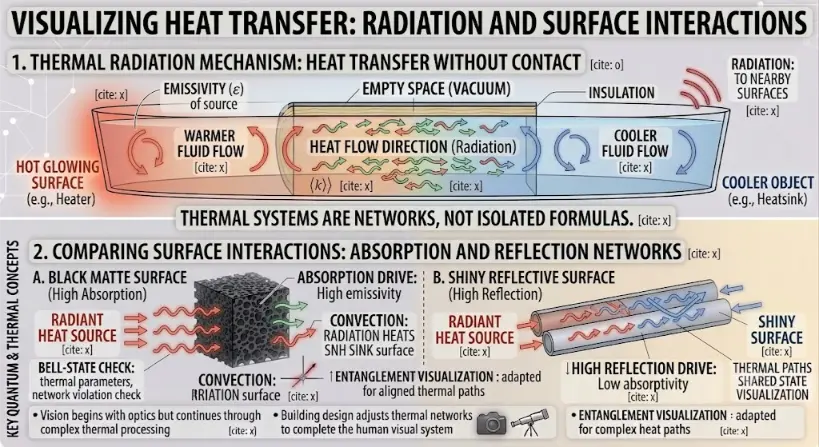
Advanced visualization of thermal radiation, comparing the basic mechanism of non-contact heat transfer through a vacuum with the varied interactions of radiant energy on different surface types. The top panel illustrates a natural, multi-mode radiation loop driven by emissivity and temperature gradients. The lower panels demonstrate engineered surface interactions, highlighting high absorptivity for heat capture and high reflection for heat shielding.
The image is a comprehensive multi-panel scientific educational infographic illustration titled “VISUALIZING HEAT TRANSFER: RADIATION AND SURFACE INTERACTIONS,” set against a clean white background with subtle geometric and network traces. It adopts a diagrammatic style with soft glowing accents and clear textual labels, linked by a large central horizontal title banner adapted from image_49.png, highlighting the core concept: “THERMAL SYSTEMS ARE NETWORKS, NOT ISOLATED FORMULAS”.
Part 1: Thermal Radiation Mechanism: Heat Transfer Without Contact
This upper panel provides a visual model of natural thermal radiation through a vacuum, demonstrating it as a multi-mode loop:- Source and Target Surfaces: On the far left, a detailed “HOT GLOWING SURFACE (e.g., Heater)” emits a strong, soft red-orange glow. Its internal structure reveals swirling red and orange arrows, labeled “WARMER FLUID FLOW”. On the right, a “COOLER OBJECT (e.g., Heatsink)” has blue swirling arrows, labeled “COOLER FLUID FLOW”, similar in concept to the fluids in Section 1 of image_49.png.
- Radiation Loop and Space: The central area is labeled “EMPTY SPACE (VACUUM)” and contains a detailed “HEAT FLOW DIRECTION (Radiation)” visualization. Countless small, curved blue and red wave arrows, adapted from the heat flow arrows of image_49.png, travel from the hot source surface to the cooler target object.
- Verification and Quantum Context: Callouts include “EMISSIVITY (ϵ) of source”, “INSULATION”, and “RADIATION: TO NEARBY SURFACES”, adapted to the non-contact context. Quantum kets like |k⟩ and citation brackets are integrated into the diagrammatic flow, suggesting a connection between the macroscopic fluid flow and microscopic concepts, as seen in image_49.png.
Part 2: Comparing Surface Interactions: Absorption and Reflection Networks
This lower panel illustrates engineered surface interactions with radiation using two distinct sub-diagrams, arranged in stacked formations adapted from Section 2 of image_49.png:- Sub-Diagram A: Black Matte Surface (High Absorption): On the left, this section shows a magnified dark, porous-looking surface structure, similar to the complex matrix of image_49.png. A prominent “RADIANT HEAT SOURCE” with red arrows is to its left. Large red wave arrows approach the surface. Most waves are absorbed, with small green flow arrows and a red infrared emission wave arrow, labeled “CONVECTION: RADIATION HEATS SINK surface”, demonstrating efficient capture and re-emission. Callouts include: “ABSORPTION DRIVE: High emissivity”, “BELL-STATE CHECK: thermal parameters, network violation check”, and adapted entanglement and shared state visualization concepts.
- Sub-Diagram B: Shiny Reflective Surface (High Reflection): On the right, this section shows two parallel surfaces, one with “RADIANT HEAT SOURCE” entering from the left and a “SHINY SURFACE” entering from the right. A prominent label states: “HIGH REFLECTION DRIVE: Low absorptivity”, emphasizing efficient shielding. Red wave arrows bounce off, and blue wave arrows show the efficient energy transfer. Callouts repeat quantum concepts and summaries.
- Summaries and Context: Bullet points at the bottom reiterate summaries from image_49.png: “Vision begins with optics but continues through complex thermal processing” and “Building design adjusts thermal networks to complete the human visual system”. Small icons of a camera and a telescope are present.
Why Thermal Radiation Does Not Need a Medium
Conduction needs particles to pass energy from one region to another. Convection needs fluid motion to carry energy. Radiation is different because electromagnetic waves can travel through vacuum.
This is why the Sun can warm the Earth even though space between them contains no ordinary conducting or convecting material. Radiation carries energy across the gap.
| Situation | Which Heat-Transfer Mode Matters Most? | Reason |
|---|---|---|
| Sun warming Earth | Radiation | Energy travels through space |
| Metal spoon in soup | Conduction | Heat moves through the solid spoon |
| Fan cooling a hot surface | Convection | Moving air carries heat away |
| Hot furnace wall felt from a distance | Radiation and convection | Radiant heat travels across space, while air may also move |
Thermal Radiation and the Electromagnetic Spectrum
Thermal radiation is part of the electromagnetic spectrum. At ordinary temperatures, most objects emit mainly infrared radiation. As temperature increases, the emitted radiation becomes stronger and shifts toward shorter wavelengths.
| Temperature Situation | Radiation Behaviour | Common Example |
|---|---|---|
| Human body temperature | Mainly infrared radiation | Detected by thermal cameras |
| Warm building wall | Infrared emission | Thermal imaging of heat loss |
| Red-hot metal | Infrared plus visible red light | Heated metal in a forge |
| White-hot object | Broad visible and infrared emission | Very hot furnace or filament |
| Sun’s surface | Strong visible and infrared emission | Solar radiation reaching Earth |
This connection between temperature and wavelength is one reason thermal radiation links thermodynamics with Electromagnetic Waves, optics, astronomy, climate science, and modern sensing technologies.
Blackbody Radiation
A blackbody is an ideal object that absorbs all radiation incident on it and emits the maximum possible thermal radiation for its temperature. Real objects are not perfect blackbodies, but the blackbody model is extremely useful.
A blackbody is not necessarily black in appearance at all temperatures. The word “black” means that it is an ideal absorber. When very hot, a blackbody can glow visibly.
| Blackbody Feature | Meaning |
|---|---|
| Perfect absorber | Absorbs all incident radiation |
| Perfect emitter | Emits the maximum radiation possible at a given temperature |
| Ideal model | Used to compare real surfaces |
| Temperature-dependent spectrum | Emission pattern depends strongly on absolute temperature |
Stefan-Boltzmann Law
The Stefan-Boltzmann law gives the total radiant power emitted by an ideal blackbody:
Q̇ = σAT4
Here, Q̇ is radiant power, σ is the Stefan-Boltzmann constant, A is surface area, and T is absolute temperature in kelvins.
| Symbol | Meaning | Common Unit |
|---|---|---|
| Q̇ | Radiant power emitted | W |
| σ | Stefan-Boltzmann constant | W/(m2·K4) |
| A | Emitting surface area | m2 |
| T | Absolute temperature | K |
The T4 dependence is very important. If absolute temperature increases, radiation emission increases very strongly. This is why radiation becomes especially important in furnaces, engines, fires, spacecraft, and high-temperature equipment.
Radiation from Real Surfaces and Emissivity
Real surfaces usually emit less radiation than a perfect blackbody at the same temperature. This is described by emissivity, represented by ϵ.
For a real surface, the emitted radiant power is often written as:
Q̇ = ϵσAT4
| Emissivity Value | Meaning | Example Surface Type |
|---|---|---|
| ϵ = 1 | Ideal blackbody emitter | Perfect theoretical emitter |
| ϵ close to 1 | Strong emitter | Matte black surface, rough oxidised surface |
| ϵ much less than 1 | Weak emitter | Polished shiny metal surface |
Emissivity depends on surface material, roughness, colour, coating, oxidation, wavelength, temperature, and viewing direction. A surface that looks shiny often has low emissivity and reflects much of the incident radiation.
Net Radiation Exchange with Surroundings
A surface both emits and absorbs radiation. The net radiation heat transfer depends on the difference between what it emits and what it receives from its surroundings.
For a surface exchanging radiation with large surroundings, a common simplified expression is:
Q̇net = ϵσA(Ts4 – Tsur4)
Here, Ts is the surface temperature and Tsur is the surroundings temperature. Both must be in kelvins.
| Condition | Net Radiation Result |
|---|---|
| Ts > Tsur | Surface loses net energy by radiation |
| Ts < Tsur | Surface gains net energy by radiation |
| Ts = Tsur | No net radiation exchange, though emission and absorption still occur |
This is similar in spirit to other heat-transfer modes: net heat transfer occurs because of a temperature difference. However, radiation depends on fourth powers of absolute temperatures, not simply a linear temperature difference.
Absorptivity, Reflectivity, and Transmissivity
When radiation reaches a surface, three things may happen. Some may be absorbed, some reflected, and some transmitted through the material.
For incident radiation:
α + ρ + τ = 1
Here, α is absorptivity, ρ is reflectivity, and τ is transmissivity.
| Property | Symbol | Meaning | Example |
|---|---|---|---|
| Absorptivity | α | Fraction of incident radiation absorbed | Dark surface absorbing sunlight |
| Reflectivity | ρ | Fraction of incident radiation reflected | Shiny foil reflecting heat radiation |
| Transmissivity | τ | Fraction of incident radiation transmitted | Glass transmitting visible light |
Opaque materials do not transmit radiation through their thickness, so τ = 0, and the relation becomes α + ρ = 1.
Kirchhoff’s Law of Thermal Radiation
Kirchhoff’s law of thermal radiation states that, at thermal equilibrium, a good absorber is also a good emitter for the same wavelength and direction.
In simplified form:
ϵ = α
This helps explain why matte black surfaces both absorb and emit thermal radiation strongly, while polished reflective surfaces often absorb and emit weakly.
| Surface Type | Absorption Behaviour | Emission Behaviour |
|---|---|---|
| Matte black surface | Strong absorber | Strong emitter |
| Polished metal surface | Weak absorber | Weak emitter |
| White painted surface | Often reflects visible sunlight strongly | May still emit infrared radiation well, depending on coating |
| Selective coating | Designed to absorb or emit selected wavelengths | Used in solar collectors and thermal control |
Wien’s Displacement Law
Wien’s displacement law describes how the peak wavelength of blackbody radiation changes with temperature:
λmaxT = b
where b ≈ 2.90 × 10⁻³ m·K.
As temperature increases, the peak wavelength becomes shorter. This explains why cooler objects emit mainly infrared radiation, while very hot objects can emit visible light.
| Object | Temperature Character | Peak Radiation Region |
|---|---|---|
| Human body | Warm, not glowing visibly | Infrared |
| Hot stove element | High temperature | Infrared and sometimes visible red |
| Sun | Very hot surface | Visible and infrared region |
View Factor
Not all radiation leaving one surface reaches another surface. The fraction that does depends on geometry, orientation, distance, and obstruction. This geometric relationship is described by the view factor, often represented by F.
| Geometry Situation | Radiation Exchange Effect |
|---|---|
| Two large parallel plates close together | Strong view of each other |
| Small object far from a surface | Small fraction of radiation reaches the target |
| Surface partly blocked by another object | Radiation exchange is reduced |
| Object inside a large enclosure | Most emitted radiation eventually reaches enclosure surfaces |
View factors are important in furnaces, spacecraft, building radiation exchange, solar receivers, thermal imaging, and radiation shields.
Radiation Heat Transfer Between Surfaces
Radiation exchange between two real surfaces can become mathematically complex because each surface emits, absorbs, and reflects radiation. However, the main idea remains clear: net radiation depends on temperature, emissivity, area, and geometry.
For ideal black surfaces with a simple view factor, a simplified expression is:
Q̇ = σA1F12(T14 – T24)
Here, F12 is the view factor from surface 1 to surface 2.
Real surfaces require emissivity corrections, but the simplified formula shows the main physics: hotter surfaces radiate strongly, and geometry controls how much radiation reaches the other surface.
Solar Radiation
Solar radiation is one of the most important examples of thermal radiation. The Sun emits electromagnetic radiation that travels through space and reaches Earth. Some is reflected, some is absorbed by the atmosphere, and some reaches land, oceans, buildings, plants, and solar panels.
| Solar Radiation Interaction | Effect | Example |
|---|---|---|
| Absorption | Surface gains thermal energy | Dark road warming in sunlight |
| Reflection | Radiation is redirected | Bright roof reflecting sunlight |
| Transmission | Radiation passes through material | Visible light passing through window glass |
| Conversion | Radiation becomes useful energy | Solar photovoltaic or solar thermal system |
Solar radiation connects heat transfer with renewable energy, architecture, climate, agriculture, optics, and environmental engineering.
Radiation and the Greenhouse Effect
The greenhouse effect involves radiation balance. The Earth absorbs incoming solar radiation and emits infrared radiation back toward space. Greenhouse gases absorb and re-emit some infrared radiation, influencing the temperature of the lower atmosphere and surface.
| Radiation Process | Role in Earth’s Energy Balance |
|---|---|
| Incoming solar radiation | Provides energy to Earth |
| Reflection by clouds, ice, and bright surfaces | Returns some solar energy to space |
| Absorption by land and ocean | Warms the surface |
| Infrared emission by Earth | Carries energy back toward space |
| Absorption and re-emission by greenhouse gases | Affects surface and atmospheric temperature |
This topic shows that thermal radiation is not only an engineering idea. It is also central to climate, weather, planetary science, and environmental policy.
Radiation Shields and Insulation
Radiation shields reduce heat transfer by reflecting radiation or by placing low-emissivity surfaces between hot and cold regions. They are used in spacecraft, cryogenic storage, furnaces, buildings, and thermal packaging.
| Radiation Control Method | How It Works | Example |
|---|---|---|
| Reflective surface | Reflects incident radiation | Shiny foil insulation |
| Low-emissivity coating | Emits less thermal radiation | Low-E window coating |
| Multiple radiation shields | Reduce net exchange through repeated reflection and absorption | Spacecraft multilayer insulation |
| Surface colour and finish | Controls absorption and emission | White roof coating or black solar absorber |
Radiation insulation differs from ordinary conduction insulation. A thick foam layer slows conduction and convection through trapped air, while a reflective foil layer mainly reduces radiation exchange.
Thermal Radiation in Space
In space, radiation is often the dominant way objects gain or lose heat because there is almost no air for convection. Spacecraft receive radiation from the Sun, reflect some radiation, absorb some radiation, and emit infrared radiation to space.
Spacecraft thermal control uses surface coatings, radiators, insulation blankets, heaters, louvers, and careful orientation to manage temperature.
| Space Thermal Issue | Radiation Role |
|---|---|
| Solar heating | Sunlight warms exposed surfaces |
| Deep-space cooling | Surfaces radiate infrared energy away |
| No ordinary convection | Heat cannot be removed by air flow |
| Surface coatings | Control absorption and emission |
| Radiator panels | Reject waste heat by infrared radiation |
Thermal Imaging and Infrared Cameras
Infrared cameras detect thermal radiation emitted by objects. They can estimate surface temperature patterns by measuring infrared emission, but the result depends strongly on emissivity, reflections, distance, atmosphere, and calibration.
| Thermal Imaging Use | What It Detects |
|---|---|
| Building inspection | Heat leaks, missing insulation, thermal bridges |
| Electrical maintenance | Overheated connections and components |
| Medical screening | Surface temperature patterns |
| Wildlife observation | Warm bodies against cooler backgrounds |
| Firefighting | Hot spots and hidden heat sources |
Thermal imaging is powerful, but it does not “see heat” directly. It detects radiation and converts it into an image using assumptions about surface properties.
Radiation with Conduction and Convection
In many real systems, radiation acts together with conduction and convection. A hot pipe conducts heat through its wall, loses heat to air by convection, and emits radiation to nearby surfaces. A building roof absorbs solar radiation, conducts heat through layers, and exchanges heat with air by convection.
| System | Conduction | Convection | Radiation |
|---|---|---|---|
| Hot pipe | Through pipe wall and insulation | Outer surface to air | Outer surface to surroundings |
| Building roof | Through roof layers | Air over roof surface | Solar absorption and infrared emission |
| Electronic device | Through chip and casing | Air or liquid cooling | Surface radiation to enclosure |
| Furnace | Through walls and refractories | Hot gases moving inside | Strong radiation from flames and hot surfaces |
This is why the later page on Combined Heat Transfer is important. Radiation rarely acts alone in everyday engineering systems.
Everyday Examples of Thermal Radiation
Sunlight Warming Skin
Solar radiation travels through space and air before being absorbed by the skin.Feeling Heat Near a Stove
A hot stove radiates infrared energy that can be felt without touching the surface.Thermal Camera Image
Infrared radiation from surfaces is detected and converted into a temperature-like image.Campfire Warmth
Radiation from flames and hot embers warms people nearby even before the air fully heats.Cool Night Sky Effect
Surfaces can radiate energy toward the colder sky and cool below surrounding air temperature.Shiny Emergency Blanket
Reflective material reduces radiation heat loss from the body.Applications of Thermal Radiation
Thermal radiation is important wherever heat must travel across space, through transparent media, from hot surfaces, or between surfaces without direct contact.
Solar Energy
Solar thermal collectors and photovoltaic panels depend on absorbing radiation from the Sun.Climate Science
Earth’s energy balance depends on incoming solar radiation and outgoing infrared radiation.Spacecraft Thermal Control
Spacecraft use radiation surfaces, coatings, and insulation blankets to control temperature.Furnaces and High-Temperature Systems
Radiation becomes very strong at high temperatures and often dominates heat transfer.Thermal Imaging
Infrared cameras use emitted radiation to reveal temperature patterns and hidden heat sources.Building Design
Roof colour, window coatings, shading, and radiant barriers affect heat gain and heat loss.Fire Safety
Radiant heat from flames can ignite nearby materials and endanger people at a distance.Medical and Biological Systems
Radiation heat exchange affects human comfort, infrared therapy, and surface temperature measurement.Challenges and Practical Limitations
Thermal radiation is powerful, but it can be difficult to analyse accurately. Real surfaces are not perfect blackbodies, and radiation depends on wavelength, direction, geometry, surface condition, and temperature.
| Challenge | Why It Matters | Example |
|---|---|---|
| Emissivity uncertainty | Surface radiation depends strongly on emissivity | Thermal camera reading on shiny metal |
| Temperature in kelvins | Radiation equations use absolute temperature | Stefan-Boltzmann law calculations |
| Fourth-power dependence | Small temperature changes can strongly affect radiation at high temperature | Furnace heat transfer |
| Geometry and view factors | Not all emitted radiation reaches the target surface | Radiation exchange inside complex equipment |
| Spectral behaviour | Properties may change with wavelength | Glass transmits visible light but may block some infrared |
| Surface ageing | Oxidation, dirt, and coatings can change emissivity | Old metal roof or furnace surface |
| Combined heat transfer | Conduction and convection may occur at the same time | Hot machine casing in air |
| Atmospheric effects | Radiation can be absorbed, scattered, or emitted by gases and particles | Infrared sensing over long distances |
The practical lesson is that radiation is simple in ideal formulas but subtle in real systems. Surface properties and geometry often matter as much as temperature.
Future Directions and Emerging Trends
Thermal radiation remains important in modern science and engineering because it offers ways to harvest, control, reflect, detect, and emit energy without contact.
Radiative Cooling Materials
Special surfaces can emit infrared radiation to the sky while reflecting sunlight, helping passive cooling.Advanced Solar Absorbers
Selective coatings aim to absorb sunlight strongly while reducing unwanted thermal emission.Spacecraft Thermal Coatings
New coatings help control absorption of sunlight and emission of infrared radiation in space.Infrared Sensing and Imaging
Better detectors improve thermal cameras, medical imaging, security systems, and industrial inspection.Smart Windows
Window coatings can control solar gain, infrared emission, and building energy use.High-Temperature Energy Systems
Thermal radiation modelling supports furnaces, concentrated solar power, turbines, and reactors.Thermal Metamaterials
Engineered surfaces may guide, emit, or reflect radiation in unusual and useful ways.AI-Assisted Radiation Design
Optimisation tools can help design surfaces, coatings, and enclosures with desired radiation behaviour.Connections with Wider Physics and Technology
Thermal radiation connects thermodynamics with electromagnetic waves, optics, astronomy, climate science, materials, energy systems, and thermal design.
Thermodynamics
Thermal radiation is one of the main ways energy is transferred because of temperature differences.Heat Transfer
Radiation is one of the three major heat-transfer modes, alongside conduction and convection.Thermal Resistance
Radiation can be represented using an effective thermal resistance when radiation exchange is linearised.Combined Heat Transfer
Most real systems combine radiation with conduction through solids and convection with fluids.Electromagnetic Waves
Thermal radiation is electromagnetic radiation emitted because of temperature.Light and Optics
Infrared radiation, visible glow, absorption, reflection, transmission, and spectra connect heat transfer with optics.Learning Pathway Within Heat Transfer
Thermal Radiation is the third step in the Heat Transfer pathway. After learning how heat moves through materials and moving fluids, students now study heat transfer by electromagnetic waves.
Heat Conduction
Learn how heat moves through materials by molecular interactions, electron motion, and temperature gradients.Heat Convection
Study how fluids transfer heat through natural motion, forced flow, boundary layers, and mixing.Thermal Radiation
Current page. Explore how heat travels by electromagnetic waves, even through empty space.Thermal Resistance
Learn how resistance models help analyse heat flow through layers, walls, insulation, interfaces, and cooling paths.Heat Exchangers
See how devices transfer heat between fluids in engines, power plants, HVAC systems, refrigeration, and industry.Combined Heat Transfer
Understand how conduction, convection, and radiation work together in real thermal systems.Quick Check: Thermal Radiation
Quick Check: Radiation, Temperature, and Surfaces
Q1. What makes thermal radiation different from conduction and convection?
Thermal radiation transfers heat by electromagnetic waves and does not require matter. It can travel through vacuum.
Q2. Why does the Sun warm the Earth through space?
The Sun emits electromagnetic radiation that travels through space and is absorbed by Earth’s atmosphere, land, oceans, and living systems.
Q3. What does emissivity describe?
Emissivity describes how effectively a real surface emits thermal radiation compared with an ideal blackbody at the same temperature.
Q4. Why must radiation temperatures be measured in kelvins?
Radiation equations such as the Stefan-Boltzmann law use absolute temperature, so temperatures must be measured in kelvins.
Common Misunderstandings About Thermal Radiation
Misunderstanding 1: Only Glowing Objects Radiate Heat
All objects above absolute zero emit thermal radiation. Most ordinary objects emit mainly infrared radiation, which humans cannot see.
Misunderstanding 2: Radiation Needs Air to Travel
Thermal radiation does not need air. It can travel through vacuum, which is why solar energy reaches Earth from space.
Misunderstanding 3: Shiny Surfaces Are Always Cold
A shiny surface may reflect radiation and emit weakly, but its actual temperature depends on all energy gains and losses, including conduction and convection.
Misunderstanding 4: Colour Alone Determines Thermal Radiation
Colour matters for visible light, but thermal radiation often occurs in infrared wavelengths. Surface coating, emissivity, wavelength, and temperature all matter.
Misunderstanding 5: Thermal Cameras Measure Temperature Directly
Thermal cameras detect infrared radiation and estimate temperature using assumptions about emissivity, reflections, atmosphere, and calibration.
Key Terms
- Thermal radiation
- Heat transfer by electromagnetic waves emitted because of temperature.
- Blackbody
- An ideal object that absorbs all incident radiation and emits the maximum possible thermal radiation at a given temperature.
- Stefan-Boltzmann law
- The law stating that blackbody radiation power is proportional to surface area and the fourth power of absolute temperature.
- Emissivity
- A measure of how effectively a real surface emits thermal radiation compared with a blackbody.
- Absorptivity
- The fraction of incident radiation absorbed by a surface.
- Reflectivity
- The fraction of incident radiation reflected by a surface.
- Transmissivity
- The fraction of incident radiation transmitted through a material.
- Infrared radiation
- Electromagnetic radiation with wavelengths longer than visible red light, often associated with thermal emission at ordinary temperatures.
- Wien’s displacement law
- The law relating the peak wavelength of blackbody radiation to absolute temperature.
- View factor
- A geometric factor describing what fraction of radiation leaving one surface reaches another surface.
- Radiation shield
- A surface or layer designed to reduce radiation heat transfer.
- Greenhouse effect
- A radiation-balance process in which gases absorb and re-emit infrared radiation, influencing planetary surface temperature.
Frequently Asked Questions: Thermal Radiation
What is thermal radiation?
Thermal radiation is heat transfer by electromagnetic waves emitted because of temperature.
Does thermal radiation need a medium?
No. Thermal radiation can travel through vacuum, unlike conduction and convection.
Why does the Sun heat the Earth?
The Sun emits electromagnetic radiation that travels through space and is absorbed by Earth’s surface, oceans, atmosphere, and living systems.
What is infrared radiation?
Infrared radiation is electromagnetic radiation beyond visible red light. Many ordinary warm objects emit most of their thermal radiation in the infrared region.
What is a blackbody?
A blackbody is an ideal absorber and emitter of radiation. It emits the maximum possible thermal radiation at a given temperature.
What is emissivity?
Emissivity is a measure of how effectively a real surface emits thermal radiation compared with an ideal blackbody.
What does the Stefan-Boltzmann law show?
It shows that emitted thermal radiation increases with surface area and the fourth power of absolute temperature.
Why are shiny surfaces often used as radiation shields?
Shiny low-emissivity surfaces reflect much incident radiation and emit less thermal radiation than high-emissivity surfaces.
How is thermal radiation related to climate?
Climate depends on the balance between incoming solar radiation, reflected radiation, absorbed energy, and outgoing infrared radiation from Earth.
Why does radiation become important at high temperature?
Radiation increases strongly with absolute temperature because of the T4 dependence in the Stefan-Boltzmann law.
How is thermal radiation used in thermal cameras?
Thermal cameras detect infrared radiation emitted by surfaces and convert it into a temperature-like image.
Why should students learn thermal radiation?
Thermal radiation helps students understand solar energy, climate, furnaces, spacecraft, building heat gain, fire safety, infrared sensing, and combined heat transfer.
Review Questions and Answers
- What is thermal radiation?Answer: Thermal radiation is heat transfer by electromagnetic waves emitted because of temperature.
- How is radiation different from conduction and convection?Answer: Radiation does not require a material medium. Conduction needs matter, and convection needs a moving fluid.
- What kind of radiation do ordinary warm objects mostly emit?Answer: Ordinary warm objects mostly emit infrared radiation.
- What is a blackbody?Answer: A blackbody is an ideal object that absorbs all incident radiation and emits the maximum possible thermal radiation for its temperature.
- What does emissivity measure?Answer: Emissivity measures how effectively a real surface emits radiation compared with an ideal blackbody.
- What is the Stefan-Boltzmann law for a real surface?Answer: A common form is Q̇ = ϵσAT4.
- Why must T be in kelvins in radiation equations?Answer: Radiation laws use absolute temperature, so T must be measured in kelvins.
- What is a view factor?Answer: A view factor describes the fraction of radiation leaving one surface that reaches another surface.
Thought-Provoking Questions and Answers
- Why is thermal radiation especially important in space?Answer: Space has almost no air for convection, so spacecraft mainly gain and lose heat by radiation.
- Why can a shiny metal surface confuse a thermal camera?Answer: Shiny metal may have low emissivity and may reflect infrared radiation from other objects, so the camera may not measure its true temperature accurately.
- Why does radiation become more dominant in furnaces than in ordinary room-temperature situations?Answer: Radiation increases with the fourth power of absolute temperature, so high-temperature surfaces emit very strongly.
- Why can a white roof reduce building heat gain?Answer: A bright roof can reflect more incoming solar radiation, reducing the amount of energy absorbed by the building.
- Why is the phrase “radiant heat” useful but incomplete?Answer: It reminds us that heat can be transferred by radiation, but the full analysis also requires temperature, emissivity, wavelength, area, geometry, and surroundings.
- What does thermal radiation teach about invisible energy transfer?Answer: It shows that energy can move across space without visible motion, contact, or flowing fluid, often through invisible infrared waves.
Numerical Problems and Solutions
- A blackbody surface has area A = 2.0 m2 and temperature T = 400 K. Estimate its emitted power using Q̇ = σAT4, with σ = 5.67 × 10⁻⁸ W/(m2·K4).Solution:
- Use Q̇ = σAT4.
- T4 = 4004 = 2.56 × 10¹⁰.
- Q̇ = (5.67 × 10⁻⁸)(2.0)(2.56 × 10¹⁰).
- Q̇ ≈ 2903 W.
Answer: The emitted power is approximately 2.90 kW. - A real surface has emissivity ϵ = 0.75, area 1.5 m2, and temperature 500 K. Find its emitted radiation power.Solution:
- Use Q̇ = ϵσAT4.
- T4 = 5004 = 6.25 × 10¹⁰.
- Q̇ = (0.75)(5.67 × 10⁻⁸)(1.5)(6.25 × 10¹⁰).
- Q̇ ≈ 3987 W.
Answer: The emitted radiation power is approximately 3.99 kW. - A surface at 350 K radiates to large surroundings at 300 K. The surface has ϵ = 0.90 and A = 1.0 m2. Estimate the net radiation heat loss.Solution:
- Use Q̇net = ϵσA(Ts4 – Tsur4).
- 3504 ≈ 1.50 × 10¹⁰.
- 3004 = 8.10 × 10⁹.
- Difference = 6.91 × 10⁹.
- Q̇net ≈ (0.90)(5.67 × 10⁻⁸)(1.0)(6.91 × 10⁹).
- Q̇net ≈ 353 W.
Answer: The net radiation heat loss is approximately 353 W. - A surface absorbs 70%, reflects 20%, and transmits the rest of the incident radiation. Find the transmissivity.Solution:
- Use α + ρ + τ = 1.
- τ = 1 – α – ρ.
- τ = 1 – 0.70 – 0.20 = 0.10.
Answer: The transmissivity is 0.10, or 10%. - A blackbody has temperature T = 5800 K. Estimate the peak wavelength using λmaxT = 2.90 × 10⁻³ m·K.Solution:
- Use λmax = (2.90 × 10⁻³) ⁄ T.
- λmax = (2.90 × 10⁻³) ⁄ 5800.
- λmax ≈ 5.0 × 10⁻⁷ m.
Answer: The peak wavelength is approximately 5.0 × 10⁻⁷ m, or 500 nm, in the visible region. - A surface receives 900 W/m2 of radiation over an area of 3.0 m2. If its absorptivity is 0.60, how much power is absorbed?Solution:
- Incident power = (900)(3.0) = 2700 W.
- Absorbed power = α × incident power.
- Absorbed power = (0.60)(2700) = 1620 W.
Answer: The surface absorbs 1620 W. - A surface has emissivity 0.20. Compared with a blackbody at the same area and temperature, what fraction of radiation does it emit?Solution:
- Emissivity is the ratio of real-surface emission to blackbody emission at the same temperature.
- An emissivity of 0.20 means the surface emits 20% of the blackbody value.
Answer: It emits 20% of the blackbody radiation for the same area and temperature. - A blackbody radiation power increases when temperature changes from 300 K to 600 K. By what factor does the emitted power increase, assuming area stays the same?Solution:
- For a blackbody, Q̇ ∝ T4.
- Temperature ratio = 600 ⁄ 300 = 2.
- Power ratio = 24 = 16.
Answer: The emitted power increases by a factor of 16.
External References for Further Reading
The following references provide useful background on thermal radiation, heat-transfer mechanisms, blackbody radiation, and radiation heat-transfer equations.
- OpenStax University Physics: Mechanisms of Heat Transfer — A clear overview of conduction, convection, and radiation.
- OpenStax College Physics: Radiation — A student-friendly explanation of radiation heat transfer and the Stefan-Boltzmann law.
- NASA Glenn Research Center: Heat Transfer — A concise engineering-oriented introduction to heat-transfer mechanisms.
- Engineering ToolBox: Radiation Heat Transfer — A practical reference on radiation heat-transfer equations and surface properties.
Why This Topic Matters
Thermal radiation matters because heat can move without contact and without fluid motion. This makes it essential in space, solar energy, climate science, furnaces, fires, high-temperature equipment, building design, and infrared sensing.
For students, thermal radiation expands the idea of heat transfer beyond touching objects and moving fluids. It shows that temperature, electromagnetic waves, surface properties, and geometry all shape the movement of thermal energy.
For modern technology, thermal radiation is important in solar panels, radiative cooling materials, spacecraft thermal control, low-emissivity windows, thermal cameras, fire protection, high-temperature manufacturing, and sustainable building design.
Summary
Thermal radiation is heat transfer by electromagnetic waves. It can travel through vacuum, so it is the only heat-transfer mode that does not require matter.
For an ideal blackbody, emitted radiation is described by the Stefan-Boltzmann law:
Q̇ = σAT4
For a real surface:
Q̇ = ϵσAT4
Thermal radiation depends strongly on absolute temperature, surface area, emissivity, absorptivity, reflectivity, wavelength, and geometry. It is central to solar energy, climate, space systems, furnaces, buildings, fire safety, thermal imaging, and combined heat-transfer analysis.
Reflection Question
If thermal radiation can both overheat a building under sunlight and cool a surface by emitting infrared energy to the sky, how should engineers design surfaces that absorb, reflect, and emit radiation intelligently?