Prepare for University Studies & Career Advancement
Plasma Oscillations: Natural Rhythms of Charged Particles
Plasma oscillations represent the fundamental, high-frequency electrostatic rhythms executed spontaneously by mobile charged particles within an ionized medium. They reveal why a plasma is far more complex than a simple collection of isolated, non-interacting particles. Instead, plasma operates as a deeply integrated, self-consistent collective system: when an external influence or localized thermal perturbation shifts the internal charge distribution, the electron and ion populations respond in a tightly coordinated fashion to counteract the disturbance.
The basic physical mechanics behind this rhythm are elegant: because free electrons are thousands of times lighter than positive ions, any localized perturbation shifts the electron population while leaving the heavy ion background practically frozen in space. This slight shift instantly breaks macroscopic neutrality, creating a sharp space-charge imbalance. This charge separation sets up an electrostatic restoring electric field that pulls the displaced electrons back toward equilibrium. Because the mobile electrons possess mechanical inertia, they do not simply stop at the neutral baseline; they overshoot the equilibrium position, triggering a continuous back-and-forth oscillation.
For university-level physics and engineering students, mastering plasma oscillations provides a vital conceptual window. It highlights one of the most stark differences separating ordinary neutral gases from true plasma systems. While particles inside an ordinary gas communicate exclusively through localized, short-range mechanical collisions, plasma particles communicate across vast distances through self-induced electric fields, organizing separate charges into a single, unified harmonic system.
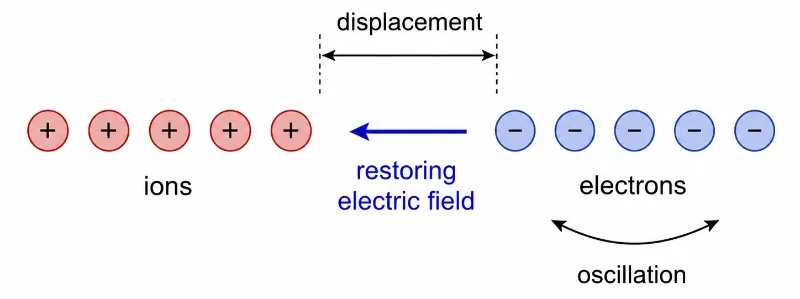
When electrons are displaced from the ion background, a restoring electric field pulls them back and can produce oscillation.
This diagram introduces the basic idea of plasma oscillation. Positive ions are shown on one side, while electrons are displaced to the other side. The separation of charge creates a restoring electric field that pulls the electrons back toward the ion background. The curved arrow indicates that the electrons can move back and forth, producing a collective oscillation in the plasma.
Learning Pathway
This page belongs to the Plasma Physics cluster under the global Electricity and Magnetism core curriculum. It builds directly upon the spatial screening rules of Debye Shielding, exploring what happens when those screened electronic charges are dynamic, and prepares the analytical groundwork needed to comprehend high-field Magnetic Confinement trap mechanics.
Provides the global parent context for understanding charge distributions, vector field equations, electric circuits, induction, and Maxwellian wave mechanics.
Introduces the collective macroscopic behavior of fully or partially ionized gases interacting recursively with self-consistent electromagnetic fields.
Analyzes how external vector fields bend single-particle paths into localized helical orbits to lock high-energy fusion fuels inside magnetic bottles.
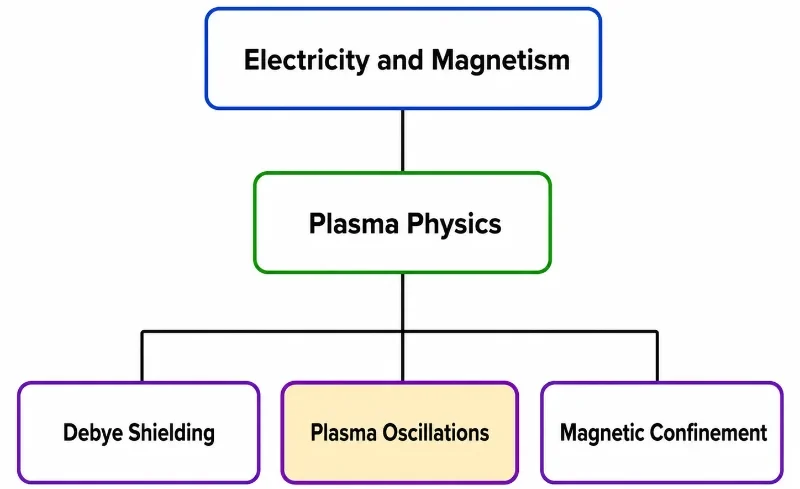
Plasma Oscillations is part of the Plasma Physics cluster under Electricity and Magnetism, alongside Debye Shielding and Magnetic Confinement.
This simple tree chart shows the learning pathway for the Plasma Oscillations page. Electricity and Magnetism appears as the parent topic, Plasma Physics appears as the cluster hub, and the three related subpages are shown below: Debye Shielding, Plasma Oscillations, and Magnetic Confinement. The Plasma Oscillations node is highlighted to show the current page location within the cluster.
What Plasma Oscillations Really Are
A plasma oscillation is a massive, collective back-and-forth motion of charge carriers orchestrated entirely by an internal, self-induced restoring electric field. In a standard electron plasma oscillation, the high-frequency movement is driven exclusively by the electrons, while the much heavier, massive positive ions remain as a stationary, uniform background due to their large mechanical inertia on these ultra-short time scales.
This fluid-like behavior does not imply that each individual electron is tracking an isolated, independent trajectory. Rather, the entire free electron population shifts as a collective macroscopic sheet relative to the static ion landscape. This physical displacement forces a local charge separation, which generates an internal electric field that pulls the electrons back. The system forms a perfect natural harmonic oscillator: the self-consistent electric field provides the restoring force, while the collective electron mass supplies the inertia.
The Four Stages of the Harmonic Cycle
The continuous progression of an electron plasma oscillation can be broken down into four distinct thermodynamic phases:
1. Quasi-Neutral Base
The plasma rests in a globally balanced equilibrium state, where the negative electron and positive ion charge densities perfectly cancel on average.
2. Coordinated Displacement
An external perturbation or thermal wave shifts a section of the mobile electron population away from the fixed, heavy ion hubs.
3. Electrostatic Reset
The sudden separation of charge generates an intense internal electric field, creating a powerful restoring force that pulls the electrons back toward equilibrium.
4. Inertial Overshoot
Because the accelerating electrons possess mass and inertia, they carry momentum straight past the neutral point, building up an opposite charge imbalance and sustaining the cycle.
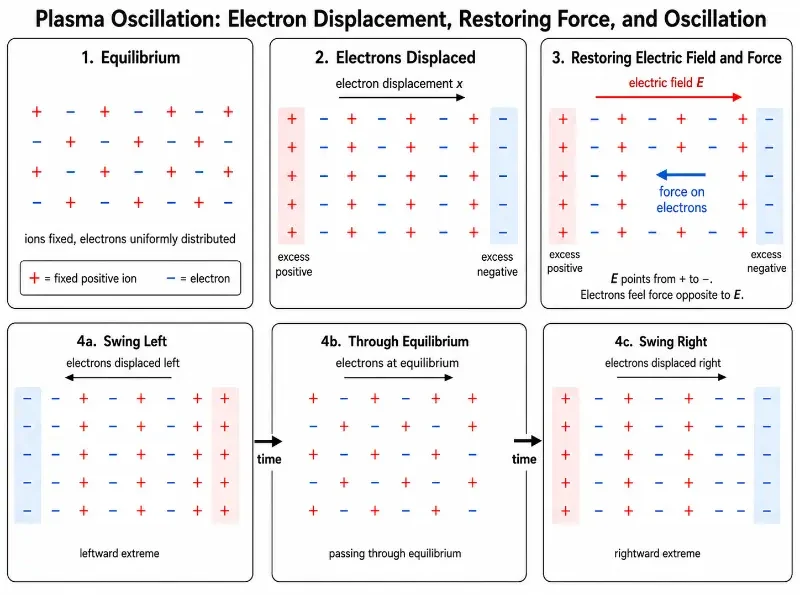
Plasma oscillation begins when electrons are displaced from the fixed positive ion background. The resulting charge separation creates an electric field that pulls the electrons back, causing them to pass through equilibrium and oscillate collectively.
This six-panel illustration explains plasma oscillation as a step-by-step process. At equilibrium, positive ions remain fixed while electrons are uniformly distributed, so the plasma is neutral overall. When the electrons are displaced slightly to one side, one edge becomes excess positive and the opposite edge becomes excess negative. This charge separation creates an electric field from the positive side toward the negative side. Because electrons carry negative charge, the force on them is opposite to the electric field, pulling them back toward equilibrium. The lower panels show the continuing motion: electrons swing left, pass through equilibrium, and swing right, forming a collective to-and-fro oscillation around the fixed ion background.
The Mathematical Formulation of Plasma Frequency
The natural angular frequency at which a cold, uniform plasma electron population oscillates when perturbed from equilibrium is defined as the electron plasma frequency:
This fundamental formula quantifies the angular frequency in radians per second. To extract the ordinary cyclical frequency in Hertz, the relationship scales by a factor of 2π:
To safely translate the plasma frequency equation across lab problem sheets, each variable block must be rigorously defined:
ωpe
The electron plasma angular frequency, establishing the intrinsic temporal response rate of the ionized medium in radians per second.
ne
The electron number density, tracking the absolute volume concentration of free electrons per cubic meter.
e
The elementary charge constant, valued at approximately 1.602 × 10⁻¹⁹ Coulombs, squaring its impact on the internal restoring force.
ε0
The permittivity of free space, measuring the electrostatic compliance of the background vacuum environment.
me
The rest mass of an electron (9.109 × 10⁻³¹ kg). Its tiny inertia is the explicit physical reason plasma rhythms are exceptionally rapid.
The Nonlinear Influence of Electron Densities
The mathematical structure of the frequency equation reveals that the collective rhythm scales in direct proportion to the square root of the electron density parameter:
$$\omega_{\mathrm{pe}}\propto \sqrt{n_e}$$
This square-root relationship indicates that while raising the electron concentration increases the internal electrostatic restoring force—speeding up the system’s global rhythm—the scaling behavior is fundamentally non-linear. For example, quadrupling the electron density multiplies the final oscillation frequency by a factor of exactly two. This exact mathematical dependence underpins ionospheric radio communication, laser-plasma interactions, satellite telemetry, and diagnostics.
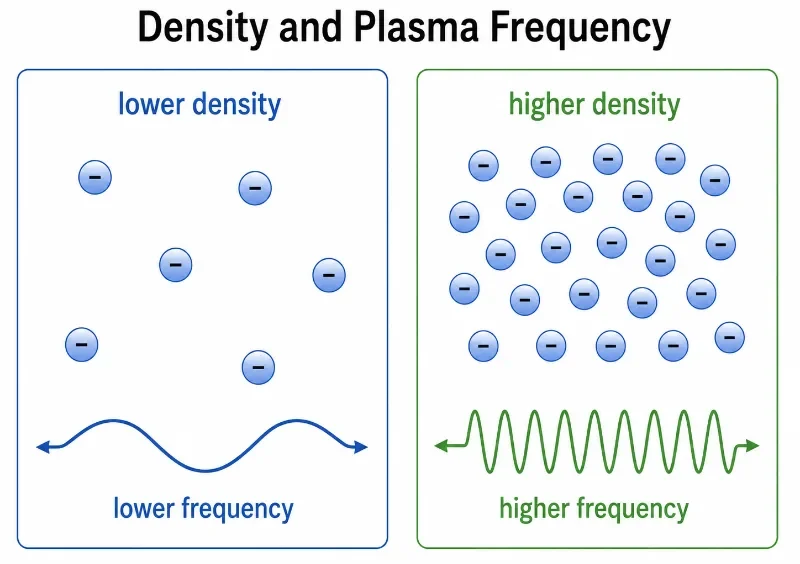
A denser plasma has a higher natural plasma frequency because more mobile electrons respond collectively to electric disturbances.
This diagram compares how electron density affects plasma frequency. The left panel shows a lower-density plasma with fewer electrons and a slower oscillation pattern. The right panel shows a higher-density plasma with more electrons and a faster oscillation pattern. The picture helps students see the key idea that increasing electron density raises the natural frequency of plasma oscillations.
The Spatiotemporal Duality: Shielding and Oscillations
Debye shielding and plasma oscillations are two sides of the same physical coin. Both phenomena arise from the identical underlying property of ionized matter: the capacity of mobile charges to react dynamically to electrostatic imbalances. The critical distinction lies in their physical dimensions. Debye shielding handles the spatial profile, determining the exact sub-millimeter distance boundary across which a steady-state electric field can penetrate before being screened out. Plasma oscillations handle the temporal profile, defining the ultra-fast frequency at which the plasma reacts over time to clear that disturbance. Together, the Debye length and plasma frequency provide the absolute spatiotemporal bounds that define the physics of the ionized state.
Debye Shielding Profile
Governs the spatial matrix, tracking the precise radial distance over which static potentials are screened.
Plasma Oscillation Profile
Governs the temporal matrix, mapping out the precise real-time frequency at which charges respond to an imbalance.
The Debye Length Limit
The characteristic metric setting the spatial thickness of shielding boundaries and edge sheaths.
The Plasma Frequency Limit
The characteristic clock rate setting the internal response time of the mobile electron population.
Transitioning from Local Oscillations to Electrostatic Waves
When a localized plasma oscillation couples with internal thermal pressure gradients, it can propagate through space as a coherent electrostatic wave. These longitudinal plasma waves are known as Langmuir waves. In a cold plasma, the oscillation remains strictly localized at the native plasma frequency, unable to transmit information through space because its group velocity is zero. However, when thermal electron motion is factored into the fluid equations, the localized oscillation develops a distinct dispersion relation—allowing density variations and electric fields to travel through the plasma as real, information-carrying waves.
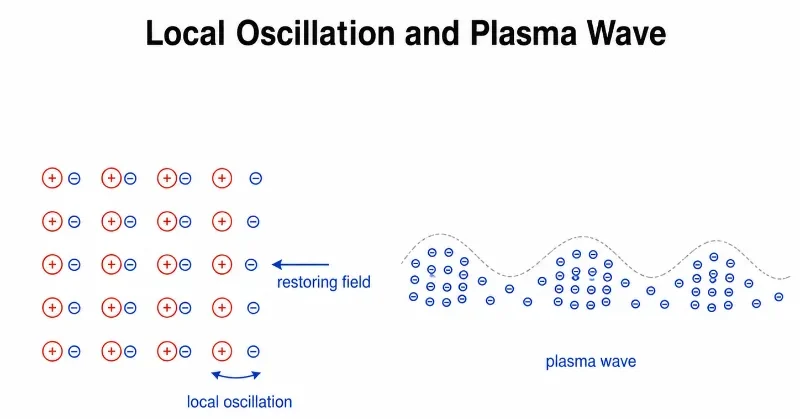
A local displacement of electrons creates a restoring electric field, and repeated collective motion can appear as a plasma wave.
This diagram shows how a local electron oscillation can be related to a larger plasma wave. On the left, positive ions are shown as the nearly fixed background, while electrons are slightly displaced from their balanced positions. The restoring electric field points back toward the ion background, showing why the electrons are pulled back after being displaced. On the right, the plasma wave is represented as alternating dense and sparse regions of electron density. The ions are not shown in the wave pattern to keep the picture simple; the main idea is that the electron population can vary collectively in space while the heavier ion background changes much more slowly.
The Operational Significance of the Plasma Frequency Limit
The electron plasma frequency is a critical operational limit in plasma engineering and space science, dictating how electromagnetic waves interact with an ionized medium:
Radio Wave Cut-off and Reflection
When an incoming radio wave has a frequency below the local plasma frequency, the free electrons move fast enough to completely shield out the wave’s electric field, reflecting the radio signal back. This is why the Earth’s ionosphere reflects low-frequency shortwave radio signals back to the surface, enabling long-range over-the-horizon communication.
High-Frequency Transparency
If the incoming wave’s frequency exceeds the plasma frequency, the electrons cannot move fast enough to screen the rapid oscillations. The plasma becomes transparent, allowing the wave to pass through cleanly. This explains why high-frequency satellite communications and GPS signals easily pierce the ionosphere to reach ground stations.
Spacecraft Telemetry Blackout
During atmospheric re-entry, hypersonic spacecraft generate an ultra-dense plasma sheath around their hulls. If the plasma frequency of this dense shield exceeds the transmission frequency of the vehicle’s radios, all telemetry signals are blocked, causing a communications blackout until the vehicle slows down.
Worked Examples with Step-by-Step Solutions
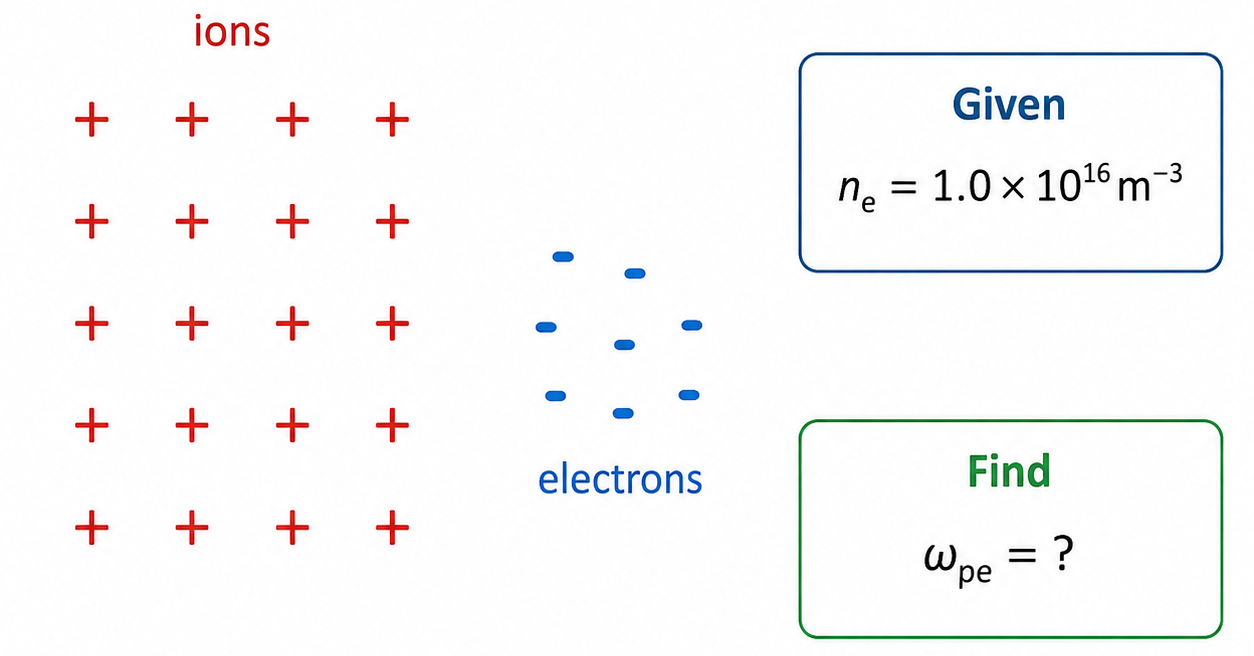
Worked Example 1: Calculating the Electron Plasma Frequency Problem: An interstellar plasma cloud possesses an electron density ne = 1.0 × 10¹⁶ m-3. Estimate the native electron plasma angular frequency of the cloud. Solution: Apply the standard electron plasma frequency equation:
Answer: The electron plasma angular frequency is approximately 5.64 × 10⁹ rad/s.
A simple question-only illustration for a worked example on plasma frequency, showing a small electron displacement from the ion background together with the given electron density and the unknown plasma frequency.
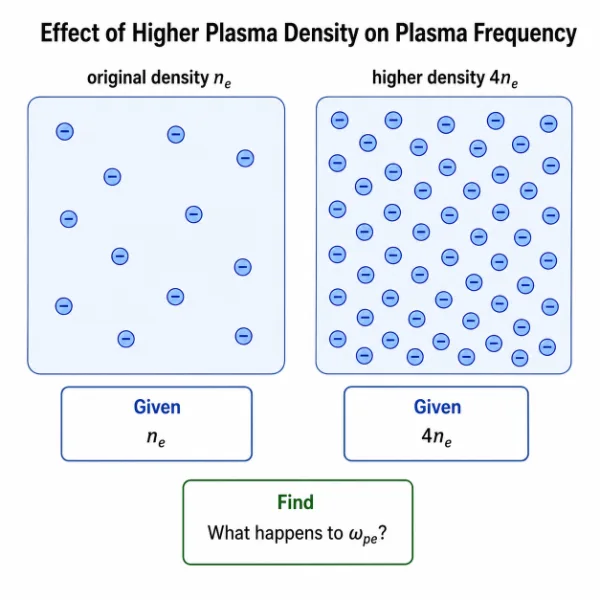
Worked Example 2: Proportional Density Shifts Problem: If a laboratory discharge plasma is compressed such that its free electron density becomes exactly four times larger, calculate the resulting shift in its natural plasma frequency. Solution: Isolate the functional scaling relationship between the plasma frequency and density:
$$\omega_{\mathrm{pe}}\propto\sqrt{n_e}$$
Substitute the density multiplier factor of 4 into the scalar relationship:
Answer: The collective plasma frequency doubles exactly, accelerating the temporal response rate of the medium.
When electron density increases from n_e to 4n_e, students are asked to predict what happens to the plasma frequency.
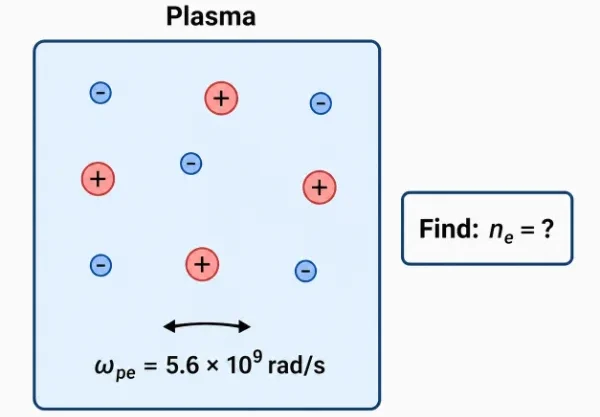
Worked Example 3: Extracting Density from Frequency Diagnostics Problem: A microwave interferometer diagnostic reads an internal plasma angular frequency of exactly ωpe = 5.64 × 10⁹ rad/s. Calculate the free electron density of the target plasma. Solution: Rearrange the core plasma frequency equation to isolate the electron density parameter ne:
Answer: The absolute electron density of the target plasma measures approximately 1.0 × 10¹⁶ electrons per cubic meter.
Given the plasma frequency, students are asked to find the electron density of the plasma.
Real-World Systems Characterized by Plasma Rhythms
Collective electrostatic oscillations determine the electronic signatures and communication limits of cosmic systems and industrial electronics alike:
The Planetary Ionosphere
The solar-ionized upper atmosphere maintains a distinct plasma frequency layer that reflects terrestrial shortwave radio transmissions while remaining transparent to high-frequency satellite telemetry.
Hypersonic Aerospace Vehicles
Spacecraft executing atmospheric re-entry compress the surrounding air into an ultra-dense plasma envelope, blocking telemetry signals and causing temporary communication blackouts.
Microwave Plasma Probes
Diagnostic teams use microwave cutoff and laser interferometry to measure internal plasma frequencies, mapping core densities inside fusion tokamaks non-invasively.
Laser-Plasma Wakefields
High-power laser pulses fired into a plasma produce moving density wakes at the plasma frequency, forming strong electric fields that accelerate electron beams over short distances.
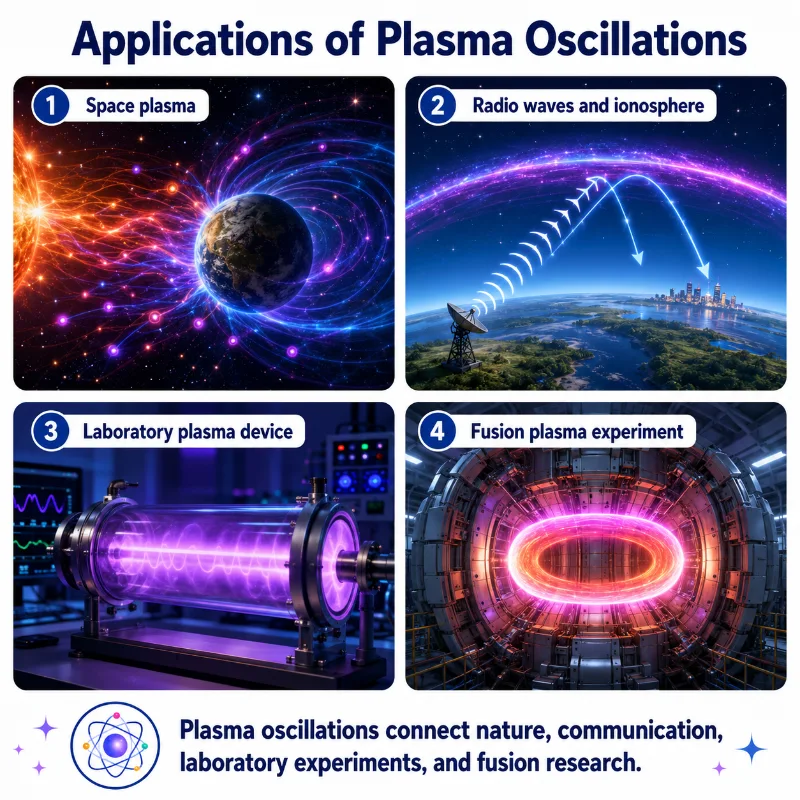
Artist’s impressions of how plasma oscillations appear in nature, communication systems, laboratory studies, and fusion research.
This artist’s-impression infographic introduces several important applications of plasma oscillations. It shows that plasma oscillations are not limited to theory, but appear in space plasma, affect the interaction of radio waves with the ionosphere, support diagnostics and control in laboratory plasma devices, and contribute to the study of high-energy fusion plasmas. The picture helps students connect the idea of collective charged-particle motion with both natural phenomena and advanced scientific research.
Common Conceptual Misconceptions
The Isolated Collision Fallacy
Misconception: Plasma oscillations are driven by individual electrons colliding with individual ions, bouncing back and forth like billiard balls. Reality: The oscillation is a fluid-like, collective phenomenon driven by long-range electrostatic fields generated by the displacement of the entire electron population relative to the ion background.
The Zero-Inertia Mistake
Misconception: Displaced electrons accelerate back to equilibrium under the induced electric field and instantly come to rest at the neutral point. Reality: Because electrons possess mass, they build up momentum during the return phase. This mechanical inertia forces them to overshoot equilibrium, sustaining the harmonic oscillation cycle.
Quick Check: Basic Idea
Quick Check: Basic Idea
1. What is displaced in the simplest electron plasma oscillation?
The electron population is displaced slightly relative to the heavier ion background.
2. What creates the restoring force?
The restoring force comes from the electric field produced by charge separation.
3. Why do electrons overshoot the neutral position?
Electrons have inertia, so they continue moving past the neutral position after being pulled back by the field.
4. Why are ions often treated as fixed in a simple electron plasma oscillation?
Ions are much heavier than electrons, so they move much less during the ultra-short time scale of fast electron oscillations.
Quick Check: Equation and Meaning
Quick Check: Equation and Meaning
1. What does ne represent in the plasma frequency equation?
It represents the electron number density, or the absolute volume concentration of free electrons per unit volume.
2. If ne increases, what happens to ωpe?
The plasma frequency increases because the angular rate scales non-linearly with density: ωpe ∝ √ne.
3. What is the explicit operational difference between ωpe and fpe?
ωpe is the angular frequency evaluated in radians per second, while fpe is ordinary cyclical frequency measured in Hertz. They are related by the factor 2π.
4. Why does electron mass appear inside the denominator of the radical?
Numerical Practice
Numerical Practice: Plasma Oscillations
1. If the local electron density is increased by a factor of exactly 9, determine what happens to the core value of ωpe.
Since ωpe ∝ √ne, raising the density by a factor of 9 increases the plasma frequency by a factor of √9 = 3.
2. If a plasma probe measures an internal angular frequency of ωpe = 6.0 × 10⁹ rad/s, calculate its ordinary frequency fpe.
3. If an expanding plasma column dilutes such that its electron density drops to one-quarter of its original value, what happens to ωpe?
Extracting the radical value shows that the plasma frequency scales down to √(1/4) = 1/2 of its baseline rate.
Glossary
Plasma oscillation: A collective, longitudinal harmonic back-and-forth motion executed by mobile charge carriers in plasma, driven by self-consistent restoring electric fields.
Electron plasma frequency: The natural characteristic frequency at which a displaced electron population oscillates against a stationary ion background.
Electron density (ne): The quantitative parameter tracking the total number of free electrons per unit volume within the medium.
Restoring electric field: The internal electrostatic field generated by a space-charge separation that pulls mobile charges back toward equilibrium.
Angular frequency (ω): Rotational frequency measured in radians per second, linked to cyclical frequency by the factor 2π.
Langmuir wave: A longitudinal plasma wave driven by collective electron density variations and electrostatic fields propagating through space.
Quasi-neutrality: The structural condition where the volume concentrations of negative and positive charge centers balance over large spatial dimensions.
Charge separation: A localized spatial mismatch creating an imbalance between positive and negative charge densities.
Plasma wave: A macro-scale wave phenomenon involving the coordinated collective motion of charged particles and electromagnetic fields.
Debye shielding: The spatial screening of electric fields inside an ionized medium, driven by the dynamic rearrangement of mobile space-charges.
PPPL PlasmaWiki: Plasma Frequency — Gives a concise definition of plasma frequency as the natural frequency of charged-particle oscillation in plasma.
Summary
Plasma oscillations demonstrate that an ionized medium operates as a collective electrical system. When a perturbation shifts the free electron population away from the ion background, the resulting charge separation generates an internal electric field. This field acts as a restoring force that pulls the electrons back, and their mechanical inertia causes them to overshoot equilibrium, sustaining a natural harmonic cycle.
This natural clock rate is governed by the electron plasma frequency formula:
This frequency scales with the square root of the electron density and is exceptionally rapid because of the tiny inertia of the electron. This concept connects the physics of Debye shielding, Langmuir waves, radio wave reflection, atmospheric re-entry blackouts, and non-invasive microwave diagnostics, demonstrating that a plasma is a highly dynamic, coordinated electromagnetic medium.
Reflection Question
If a plasma maintains nearly perfect electrostatic neutrality when averaged over large spatial scales, why can an extremely small localized displacement of electrons still generate an intense electric field capable of driving high-frequency harmonic oscillations across the entire medium?