
Magnetic confinement is the method of using magnetic fields to guide, shape, and hold plasma. Since plasma contains charged particles, its electrons and ions respond strongly to magnetic fields. Instead of moving freely in straight lines, charged particles tend to spiral around magnetic field lines. This gives scientists a way to control extremely hot plasma without letting it touch ordinary material walls directly.
This idea is especially important in fusion research. Fusion plasma can become far hotter than any solid container can survive. Magnetic confinement therefore acts like an invisible cage: not a solid wall, but a carefully arranged field structure that keeps charged particles circulating within a chosen region for long enough to study, heat, and possibly use for energy production.
For students, magnetic confinement connects many earlier ideas in electricity and magnetism: the magnetic force on moving charges, circular motion, field-line geometry, plasma behaviour, and energy confinement. It also shows why plasma physics is not only about particles, but about fields, motion, stability, and geometry working together.
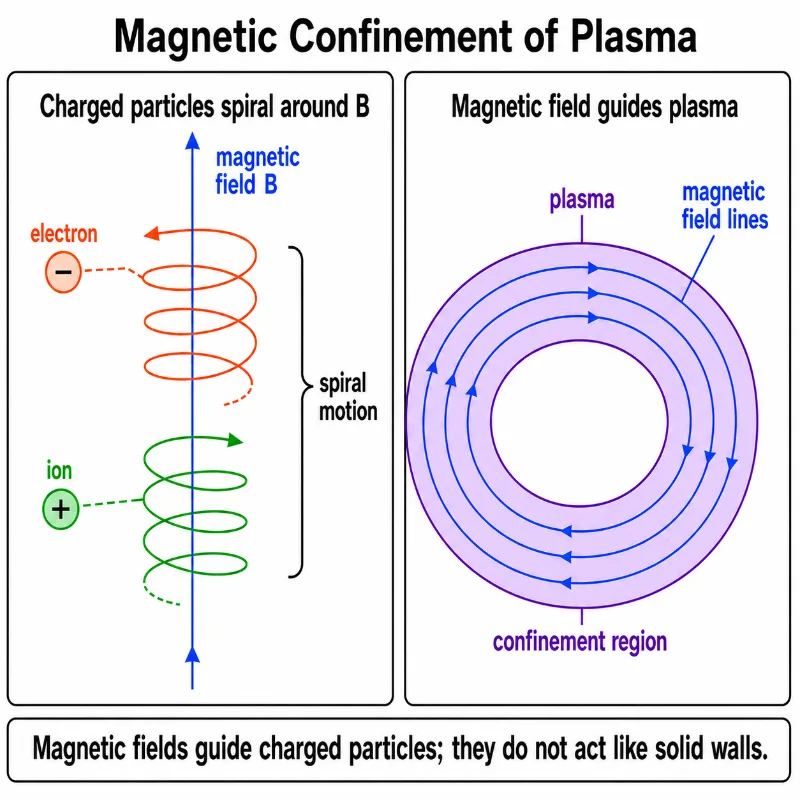
This diagram introduces magnetic confinement using two textbook-style panels. The left panel shows an electron and an ion spiralling around a magnetic field line, illustrating how charged particles are guided by magnetic fields rather than stopped by solid walls. The right panel shows a toroidal plasma confinement region with magnetic field lines flowing consistently around the plasma. The picture helps students see that magnetic confinement depends on controlled field geometry, charged-particle motion, and the guiding effect of magnetic fields.
Learning Pathway
This page belongs to the Plasma Physics cluster under Electricity and Magnetism. It follows Debye shielding and plasma oscillations by showing how magnetic fields can guide charged particles and help confine hot plasma in space-physics, laboratory, and fusion contexts.
Electricity and Magnetism
Start from electric charge, electric fields, magnetic fields, currents, forces, waves, and electromagnetic interactions.Plasma Physics
Study ionised gases whose electrons and ions move collectively under electric and magnetic fields.Debye Shielding: How Plasma Screens Electric Fields
Learn how plasma rearranges its charged particles to reduce electric fields over a characteristic distance called the Debye length.Plasma Oscillations: Natural Rhythms of Charged Particles
Explore how displaced electrons can oscillate collectively against the heavier ion background.Magnetic Confinement: Holding Plasma with Magnetic Fields
See how magnetic fields guide charged particles and help confine hot plasma in fusion and space-physics contexts.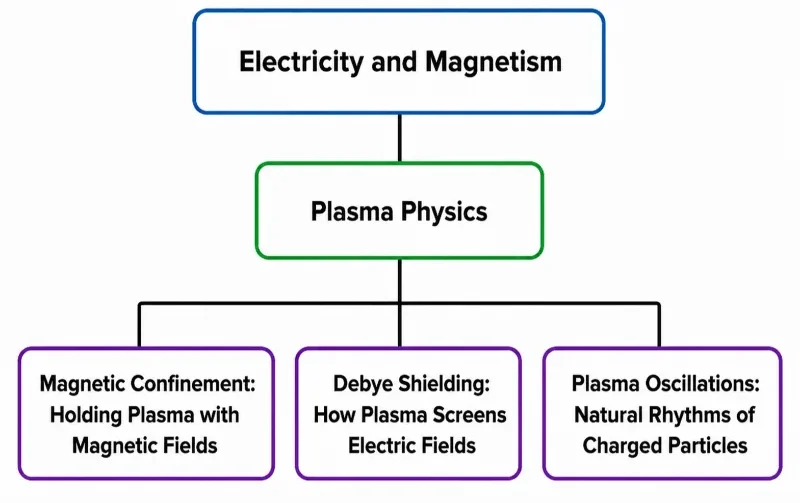
This hierarchy chart shows Plasma Physics within Electricity and Magnetism, with the three subpages reordered as Magnetic Confinement, Debye Shielding, and Plasma Oscillations.
This simple hierarchy chart presents the Plasma Physics cluster within the wider Electricity and Magnetism section of Prep4Uni.online. Electricity and Magnetism appears as the parent area, followed by Plasma Physics as the cluster hub. The three child pages are shown in a reordered sequence: Magnetic Confinement: Holding Plasma with Magnetic Fields, Debye Shielding: How Plasma Screens Electric Fields, and Plasma Oscillations: Natural Rhythms of Charged Particles. The chart helps students see that plasma physics connects magnetic control of plasma, electric-field screening, and collective charged-particle motion.
What Magnetic Confinement Really Means
Magnetic confinement means using magnetic fields to restrict the motion of charged particles in plasma. A charged particle moving across a magnetic field experiences a magnetic force. This force bends the particle’s path, making it spiral around the magnetic field line instead of travelling freely across it.
However, magnetic confinement does not mean that particles are frozen in place. A magnetic field strongly affects motion across the field, but particles can still move along the field line. This is why the shape of the magnetic field matters. Good confinement requires a field geometry that keeps particles from quickly streaming away.
In fusion devices, the goal is to hold a hot plasma long enough and densely enough for fusion reactions to occur. This requires strong magnetic fields, careful plasma shaping, heating systems, stability control, and methods for managing heat and particles near the edge of the plasma.
The Magnetic Force on Charged Particles
The magnetic part of the Lorentz force is:
\[
\mathbf{F}=q(\mathbf{v}\times\mathbf{B})
\]
Here, \( q \) is the particle charge, \( \mathbf{v} \) is the particle velocity, and \( \mathbf{B} \) is the magnetic field. The cross product means that the force is perpendicular to both the particle velocity and the magnetic field.
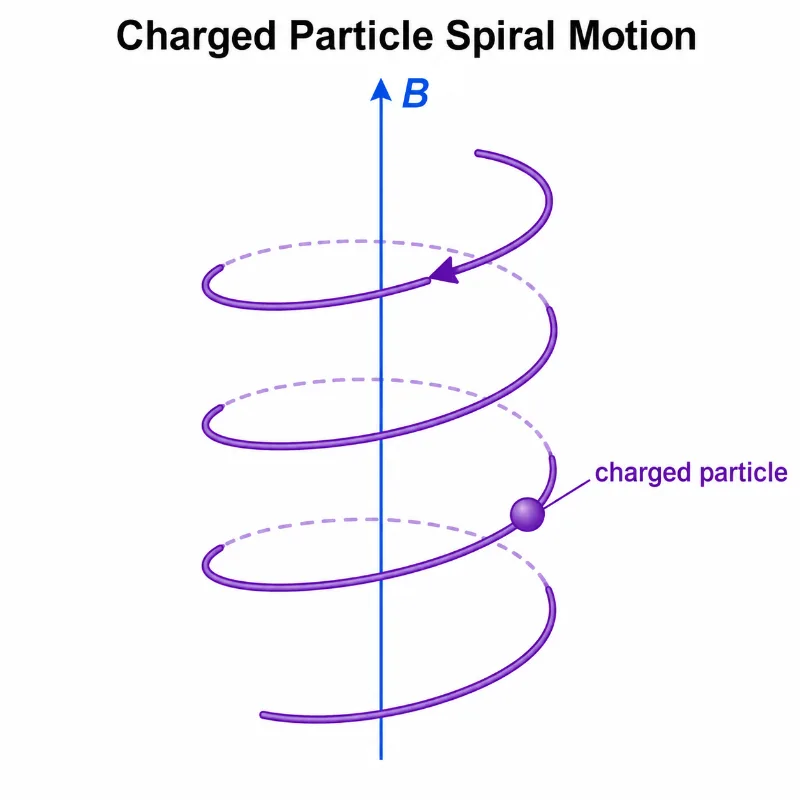
Only the part of the velocity perpendicular to the magnetic field is bent into circular motion. The part of the velocity parallel to the magnetic field continues along the field line. The combined motion is a spiral, or helix, around the field line.
Reading the Magnetic Force Equation
\( q \)
The electric charge of the particle. Ions and electrons curve in opposite directions because their charges have opposite signs.\( \mathbf{v} \)
The velocity of the charged particle. The component perpendicular to \( \mathbf{B} \) produces circular motion.\( \mathbf{B} \)
The magnetic field. Stronger magnetic fields bend charged-particle motion more tightly.\( \mathbf{F} \)
The magnetic force. It changes the direction of motion but does no work by itself because it is perpendicular to velocity.Cross Product
The symbol × means the force direction is found using a right-hand-rule relationship.
Helical Motion
A charged particle usually spirals around the field line while also moving along it.Gyration Around Magnetic Field Lines
When a charged particle moves with velocity perpendicular to a uniform magnetic field, it undergoes circular motion. The radius of this circular motion is called the Larmor radius, or gyroradius:
\[
r_L=\frac{m v_\perp}{|q|B}
\]
Here, \( m \) is the particle mass, \( v_\perp \) is the component of velocity perpendicular to the magnetic field, \( |q| \) is the magnitude of charge, and \( B \) is the magnetic field strength.
This equation gives an important confinement idea: stronger magnetic fields produce smaller gyroradii, so charged particles are more tightly tied to magnetic field lines. Faster particles and heavier particles have larger gyroradii, making them harder to bend.
Cyclotron Frequency
The angular frequency of circular motion in a magnetic field is called the cyclotron frequency:
\[
\omega_c=\frac{|q|B}{m}
\]
This tells us how quickly a charged particle rotates around a magnetic field line. Electrons rotate much faster than ions in the same magnetic field because electrons are much lighter.
Cyclotron motion is important in plasma heating, magnetic confinement, particle accelerators, ion traps, space plasma, and many diagnostic techniques.
Illustration: Charged Particle Spiral Motion
Why a Straight Magnetic Field Is Not Enough
A straight magnetic field can make particles spiral, but it does not by itself trap them forever. Since particles can still move along the field line, they may escape from the ends of the field region.
This is why confinement devices usually use more complex magnetic geometry. Field lines may be arranged in closed paths, twisted around a torus, or shaped to reduce particle losses and improve stability.
This is also why magnetic confinement is a geometry problem as much as a force problem. The field must not only be strong; it must be arranged in a way that keeps the plasma from quickly escaping.
Magnetic Mirrors
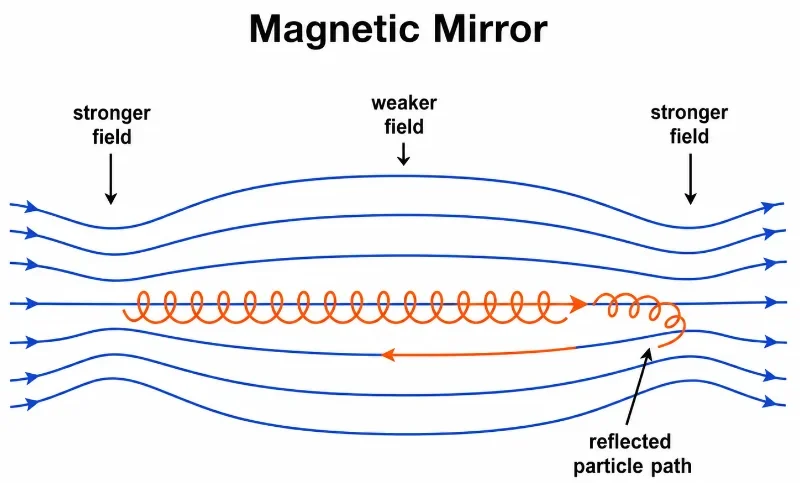
A magnetic mirror uses stronger magnetic fields at the ends of a confinement region. Some charged particles moving toward the stronger field region can be reflected back, helping to confine them between two mirror points.
The mirror idea helps students see that magnetic fields can affect not only circular motion, but also motion along non-uniform field lines. However, magnetic mirrors have particle-loss challenges because not all particles are reflected.
Magnetic mirror machines are historically important and still useful for understanding plasma confinement, space plasma, and magnetic trapping.
Illustration: Magnetic Mirror
Tokamak Confinement
A tokamak confines plasma in a torus, or doughnut-shaped region. Strong external coils produce a toroidal magnetic field around the long way of the torus. A plasma current also helps produce a poloidal magnetic field around the shorter cross-section. Together, these fields form helical magnetic field lines that wrap around the plasma.
This helical field structure helps reduce particle losses and keeps the plasma away from the chamber walls. Tokamaks are among the most studied magnetic-confinement devices for fusion research.
In a tokamak, confinement is not achieved by one simple magnetic field alone. It requires a combination of magnetic coils, plasma current, plasma shaping, heating, feedback control, and edge-management systems.
Stellarator Confinement
A stellarator also confines plasma in a toroidal region, but it uses carefully shaped external coils to create twisted magnetic fields. Unlike a basic tokamak, a stellarator does not rely on a large plasma current in the same way to create the twisting field geometry.
This makes stellarators attractive for steady-state operation, although their coil shapes and magnetic geometry can be more complex. Stellarators show students that there is more than one way to design a magnetic cage for plasma.
Both tokamaks and stellarators use the same basic physical principle: charged particles are guided by magnetic fields. Their engineering solutions, however, differ in how the needed field geometry is produced.
Tokamak and Stellarator Comparison
Tokamak
Uses a toroidal chamber, strong magnetic coils, and plasma current to help create helical magnetic field lines.Stellarator
Uses complex external coils to create twisted magnetic fields without relying on the same large induced plasma current.Shared Aim
Both designs try to keep hot plasma confined long enough for useful fusion conditions to be studied or achieved.Field Geometry
Both depend on carefully shaped magnetic field lines, not simply on magnetic field strength alone.Illustration: Tokamak and Stellarator
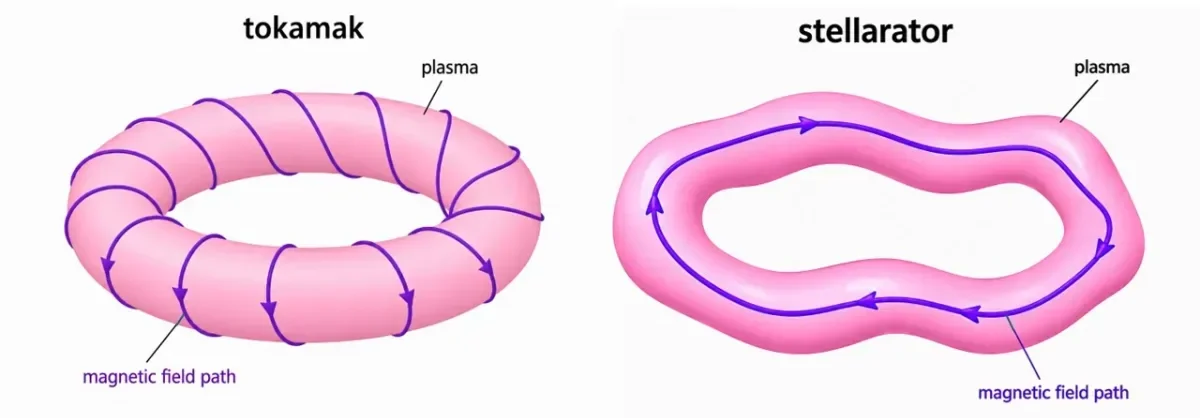
This comparison diagram shows the difference between a tokamak and a stellarator in a simple visual form. The tokamak is shown as a smooth torus with a magnetic field path winding around the plasma, like a helical path around a doughnut-shaped ring. The stellarator is shown as a more twisted toroidal plasma shape, with a magnetic field path following the distorted geometry. The picture helps students see that both devices use magnetic fields to guide and confine plasma, but their field geometries are arranged differently.
Energy Confinement Time
A key quantity in fusion research is confinement time. Energy confinement time describes how long energy remains in the plasma before being lost:
\[
\tau_E=\frac{\text{energy stored in plasma}}{\text{rate of energy loss}}
\]
A longer confinement time means the plasma holds onto its energy more effectively. This matters because fusion requires high temperature, sufficient density, and enough confinement time for reactions to occur at a useful rate.
Magnetic confinement is therefore not only about keeping particles inside a region. It is also about keeping energy in the plasma long enough to support fusion conditions.
Plasma Pressure and Magnetic Pressure
A hot plasma has pressure because its particles move rapidly. The magnetic field also has an effective pressure. A useful comparison is the plasma beta:
\[
\beta=\frac{\text{plasma pressure}}{\text{magnetic pressure}}
\]
A higher beta means the plasma pressure is large compared with the magnetic pressure. In confinement design, high plasma pressure is desirable for fusion performance, but it must be balanced against stability and magnetic-field limits.
Students should treat beta as a measure of how strongly the plasma pushes against the magnetic field structure that confines it.
Why Plasma Escapes
Perfect confinement is impossible in real devices. Plasma can lose particles and energy through collisions, turbulence, radiation, instabilities, transport across field lines, and interactions near the plasma edge.
The goal of confinement research is to understand and reduce these losses. Better confinement means better control of temperature, density, particle flow, and heat transport.
This is why magnetic confinement combines physics and engineering. Scientists must understand particle motion and plasma waves, while engineers must build magnets, vacuum systems, heating systems, cooling systems, materials, and control systems that can operate under extreme conditions.
Common Magnetic-Confinement Challenges
End Losses
In open field-line systems, particles may stream out along field lines unless reflection or closure is used.Cross-Field Transport
Collisions and turbulence can move particles and energy across magnetic field lines.Plasma Instabilities
A confined plasma can develop waves or distortions that reduce confinement or damage the device.Edge Heat Loads
Even well-confined plasma sends heat and particles toward boundary regions that must be managed.Magnet Engineering
Strong magnets require careful design, cooling, structural support, and control.Material Limits
Walls and internal components must survive heat, radiation, particle bombardment, and electromagnetic forces.Worked Example 1: Larmor Radius of an Ion
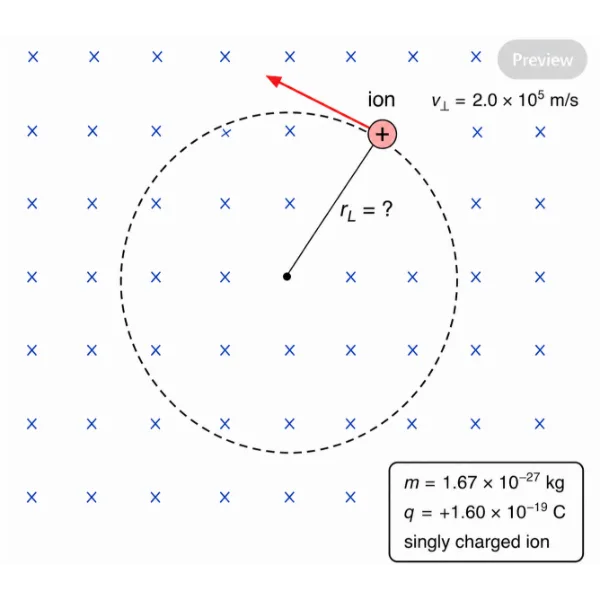
Problem: A singly charged ion has mass \( 1.67\times10^{-27} \ \text{kg} \), perpendicular speed \( 2.0\times10^5 \ \text{m/s} \), and moves in a magnetic field of \( 1.0 \ \text{T} \). Estimate its Larmor radius.
Solution:
Use:
\[
r_L=\frac{m v_\perp}{|q|B}
\]
Substitute \( m=1.67\times10^{-27} \ \text{kg} \), \( v_\perp=2.0\times10^5 \ \text{m/s} \), \( |q|=1.60\times10^{-19} \ \text{C} \), and \( B=1.0 \ \text{T} \).
\[
r_L=\frac{(1.67\times10^{-27})(2.0\times10^5)}{(1.60\times10^{-19})(1.0)}
\]
\[
r_L\approx2.1\times10^{-3} \ \text{m}
\]
Answer: The Larmor radius is approximately \( 2.1 \ \text{mm} \).
Worked Example 2: Effect of Stronger Magnetic Field
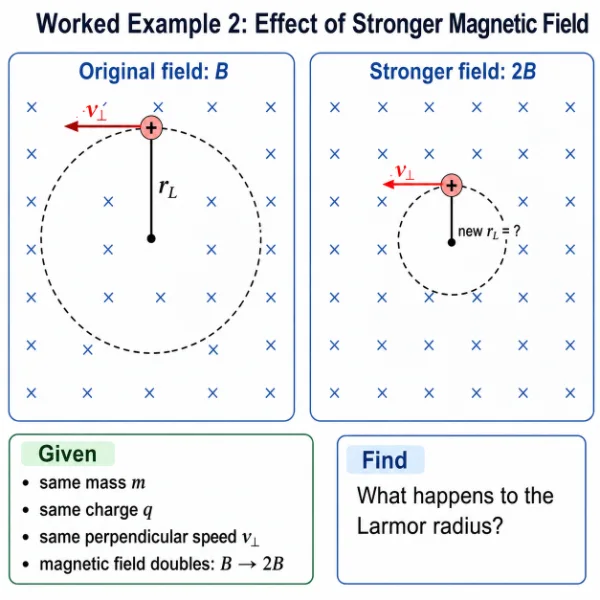
Problem: If the magnetic field strength is doubled while the particle mass, charge, and perpendicular speed stay the same, what happens to the Larmor radius?
Solution:
From:
\[
r_L=\frac{m v_\perp}{|q|B}
\]
the Larmor radius is inversely proportional to magnetic field strength:
\[
r_L\propto\frac{1}{B}
\]
If \( B \) doubles:
\[
r_L \rightarrow \frac{r_L}{2}
\]
Answer: The Larmor radius becomes half as large. A stronger magnetic field ties the particle more tightly to the field line.
Worked Example 3: Cyclotron Frequency
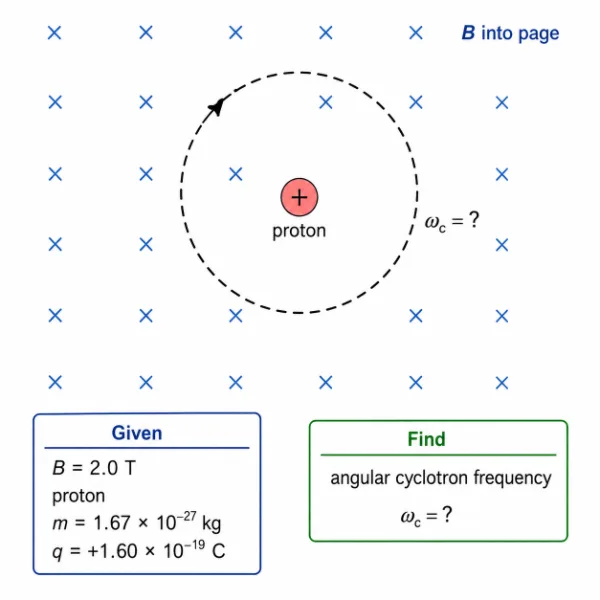
Problem: Estimate the angular cyclotron frequency of a proton in a magnetic field of \( 2.0 \ \text{T} \).
Solution:
Use:
\[
\omega_c=\frac{|q|B}{m}
\]
Substitute \( |q|=1.60\times10^{-19} \ \text{C} \), \( B=2.0 \ \text{T} \), and \( m=1.67\times10^{-27} \ \text{kg} \).
\[
\omega_c=\frac{(1.60\times10^{-19})(2.0)}{1.67\times10^{-27}}
\]
\[
\omega_c\approx1.9\times10^8 \ \text{rad/s}
\]
Answer: The proton’s angular cyclotron frequency is approximately \( 1.9\times10^8 \ \text{rad/s} \).
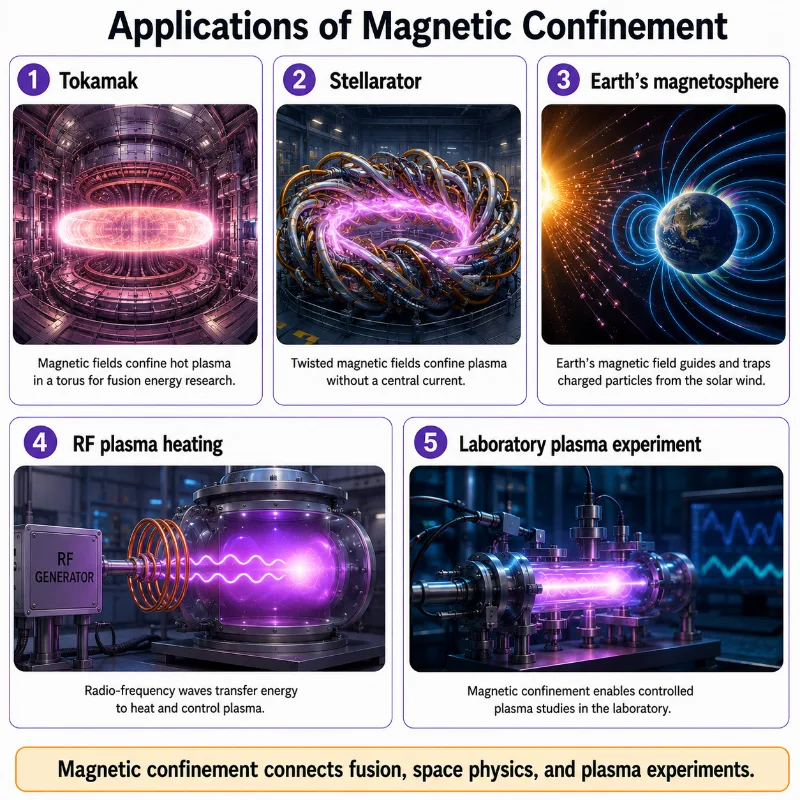
Applications of Magnetic Confinement
Magnetic confinement is most strongly associated with fusion research, but the underlying ideas also appear in space plasma, laboratory plasma devices, particle control, and plasma diagnostics.
Fusion Research
Tokamaks and stellarators use magnetic fields to confine hot plasma for controlled fusion experiments.Space Plasma
Earth’s magnetic field guides charged particles in the magnetosphere and helps form radiation belts and auroral processes.Plasma Heating
Cyclotron motion is used in radio-frequency heating methods that transfer energy to charged particles.Particle Control
Magnetic fields guide and shape charged-particle motion in many laboratory and accelerator systems.Plasma Diagnostics
Understanding charged-particle motion helps scientists interpret measurements of plasma temperature, density, and field structure.Advanced Energy Research
Magnetic confinement supports long-term research into clean, high-density energy sources based on fusion reactions.Illustration: Applications of Magnetic Confinement
Common Mistakes
Thinking Magnetic Fields Are Solid Walls
Magnetic fields guide charged particles, but they do not behave like physical containers.Forgetting Motion Along Field Lines
A magnetic field bends motion across the field, but particles can still move along the field direction.Ignoring Field Geometry
Confinement depends strongly on the shape and closure of magnetic field lines, not only on field strength.Assuming Stronger Field Solves Everything
Stronger fields reduce gyroradius, but stability, heating, edge losses, materials, and engineering still matter.Confusing Tokamaks and Stellarators
Both are toroidal confinement devices, but they create their magnetic geometry in different ways.Thinking Confinement Means No Losses
Real plasmas always lose some particles and energy through transport, turbulence, radiation, and edge interactions.Quick Check: Magnetic Confinement
Quick Check: Magnetic Confinement
1. Why can magnetic fields help confine plasma?
Plasma contains charged particles. Magnetic fields bend their motion and make them spiral around field lines, reducing free motion across the field.
2. Does a magnetic field stop particle motion along the field line?
No. A magnetic field mainly affects motion perpendicular to the field. Particles can still move along the magnetic field line.
3. Why is field geometry important in confinement?
If field lines lead particles out of the device, the plasma will escape. Good confinement needs magnetic geometry that keeps particles circulating within the plasma region.
4. What is the Larmor radius?
The Larmor radius is the radius of the circular part of a charged particle’s spiral motion around a magnetic field line.
Quick Check: Devices and Geometry
Quick Check: Devices and Geometry
1. What shape is the plasma region in a tokamak?
A tokamak confines plasma in a torus, which is a doughnut-shaped region.
2. Why are helical field lines useful?
Helical field lines wrap around the plasma in two directions, helping particles remain within the toroidal confinement region instead of quickly drifting away.
3. How does a stellarator differ from a basic tokamak?
A stellarator uses carefully shaped external coils to create twisted magnetic fields, while a tokamak uses magnetic coils together with plasma current to help create the required field geometry.
Numerical Practice
Numerical Practice: Magnetic Confinement
1. If a particle’s perpendicular speed doubles while \( B \) stays the same, what happens to its Larmor radius?
Since \( r_L=\frac{m v_\perp}{|q|B} \), the Larmor radius is proportional to \( v_\perp \). If \( v_\perp \) doubles, \( r_L \) also doubles.
2. If the magnetic field becomes 4 times stronger, what happens to \( r_L \), assuming all other quantities remain constant?
The Larmor radius is inversely proportional to \( B \). If \( B \) becomes 4 times stronger, \( r_L \) becomes one-quarter as large.
3. If an electron and proton have the same perpendicular speed in the same magnetic field, which has the larger Larmor radius?
The proton has the larger Larmor radius because it has a much greater mass. Since \( r_L \propto m \), heavier particles curve less tightly for the same speed and magnetic field.
Review Questions and Answers
Review Questions: Magnetic Confinement
1. Why can plasma not simply be held in an ordinary container at fusion temperatures?
Fusion plasma can be far hotter than any ordinary material wall can withstand. Magnetic fields help keep the plasma away from direct wall contact.
2. What does the magnetic force do to a charged particle’s motion?
It bends the particle’s path perpendicular to the magnetic field, often producing spiral motion around magnetic field lines.
3. Why do tokamaks use a toroidal shape?
The toroidal shape helps create closed magnetic paths so particles do not simply stream out of the ends of a straight magnetic field region.
4. Why is confinement time important?
A longer confinement time means energy remains in the plasma longer, helping maintain the conditions needed for fusion reactions.
5. Why is magnetic confinement difficult?
It is difficult because real plasma can lose energy through turbulence, radiation, collisions, instabilities, and edge interactions, while the device must also handle extreme heat and magnetic forces.
Thought-Provoking Questions
Thought-Provoking Questions
1. Why is magnetic confinement better described as guiding plasma rather than locking it in place?
Magnetic fields do not stop all motion. They guide charged particles along field structures and reduce cross-field motion, but particles and energy can still move, drift, and escape through several processes.
2. Why does fusion research require both physics and engineering?
The physics explains particle motion, stability, heating, and confinement. Engineering is needed to build magnets, vacuum systems, materials, diagnostics, cooling systems, and control systems that survive extreme conditions.
3. Why might stronger magnetic fields help but not completely solve the confinement problem?
Stronger fields reduce gyroradius, but confinement also depends on turbulence, instabilities, heating, geometry, edge losses, materials, and device control.
4. What makes magnetic confinement a good example of field thinking?
The plasma is not controlled mainly by direct contact. It is shaped and guided by invisible electromagnetic fields, so understanding the field geometry is essential to understanding the system.
Glossary
Magnetic confinement: The use of magnetic fields to guide and restrict the motion of charged particles in plasma.
Larmor radius \( r_L \): The radius of the circular part of a charged particle’s spiral motion around a magnetic field line.
Cyclotron frequency \( \omega_c \): The angular frequency at which a charged particle rotates around a magnetic field line.
Tokamak: A toroidal magnetic-confinement device that uses magnetic coils and plasma current to help confine plasma.
Stellarator: A toroidal magnetic-confinement device that uses complex external coils to create twisted magnetic field lines.
Toroidal field: A magnetic field directed around the long way of a torus.
Poloidal field: A magnetic field directed around the short cross-section of a torus.
Helical field line: A magnetic field line that wraps around the plasma in a twisted path.
Confinement time: A measure of how long particles or energy remain in the plasma before being lost.
Plasma beta \( \beta \): A comparison between plasma pressure and magnetic pressure.
External References
ITER: What Is a Tokamak? — A clear explanation of how tokamaks use strong magnetic fields to confine plasma in a toroidal device.
U.S. Department of Energy: DOE Explains Tokamaks — A student-friendly overview of tokamak magnetic fields and fusion confinement.
IAEA: Magnetic Fusion Confinement with Tokamaks and Stellarators — A useful comparison of two major magnetic-confinement approaches.
EUROfusion: Fusion on Earth — Explains why magnetic confinement is needed when plasma temperatures are too high for material containers.
Princeton Plasma Physics Laboratory: Tokamak Experimental Science — Describes tokamak research and magnetic confinement in a leading plasma-physics laboratory.
Summary
Magnetic confinement uses magnetic fields to guide charged particles in plasma. Because electrons and ions are charged, they spiral around magnetic field lines rather than moving freely across them. This makes magnetic fields powerful tools for controlling plasma motion.
The central physics comes from the magnetic force \( \mathbf{F}=q(\mathbf{v}\times\mathbf{B}) \), the Larmor radius \( r_L=\frac{m v_\perp}{|q|B} \), and the cyclotron frequency \( \omega_c=\frac{|q|B}{m} \). These ideas explain why stronger magnetic fields bend charged particles more tightly.
Real confinement, however, requires more than a strong field. Particles can move along magnetic field lines, so field geometry matters. Tokamaks and stellarators use toroidal, twisted magnetic structures to keep plasma circulating within a controlled region.
For students, magnetic confinement is a vivid example of field-based control. It connects charged-particle motion, plasma behaviour, fusion research, magnetic geometry, stability, engineering design, and the challenge of holding matter under extreme conditions.
Reflection Question
If magnetic fields do not act like solid walls, what makes them useful for holding plasma that is too hot for ordinary material containers?