Prepare for University Studies & Career Advancement
Debye Shielding: How Plasma Screens Electric Fields
Debye shielding represents one of the most vital foundational milestones in plasma physics, clearly demonstrating why an ionised medium cannot be treated simply as an ordinary gas with random charges mixed in. Within a true plasma continuum, free electrons and positive ions possess high thermal mobility, allowing them to rapidly redistribute their positions in response to internal or external electrostatic potentials. When a stray test charge or electric disturbance is introduced, the surrounding mobile particles instantly rearrange their spatial coordinates, creating a local space-charge cloud that screens the electric field of that disturbance over a remarkably short distance.
This screening action does not imply that the electric field magically vanishes at a specific boundary. Instead, it serves as a direct manifestation of collective plasma dynamics. Lighter, highly mobile electrons shift almost instantly, followed by slower structural adjustments from the heavier ions, establishing a localized shielding cloud directly around the electrostatic anomaly. Beyond a specific characteristic distance known as the Debye length, the long-range Coulomb potential of the original disturbance decays exponentially, dropping to near-zero far more rapidly than it ever would in an empty vacuum.
For undergraduate physics and aerospace engineering students, mastering Debye shielding is an essential prerequisite gateway concept. It provides the exact mathematical and physical rules explaining how an ultra-dense sea of un-bound charges can remain macroscopically neutral (quasi-neutral) on large scales while simultaneously supporting severe, localized electric imbalances. Furthermore, this screening framework serves as the primary stepping stone before analyzing collective plasma oscillations, boundary sheath formations, and high-field magnetic confinement vectors inside fusion reactors.
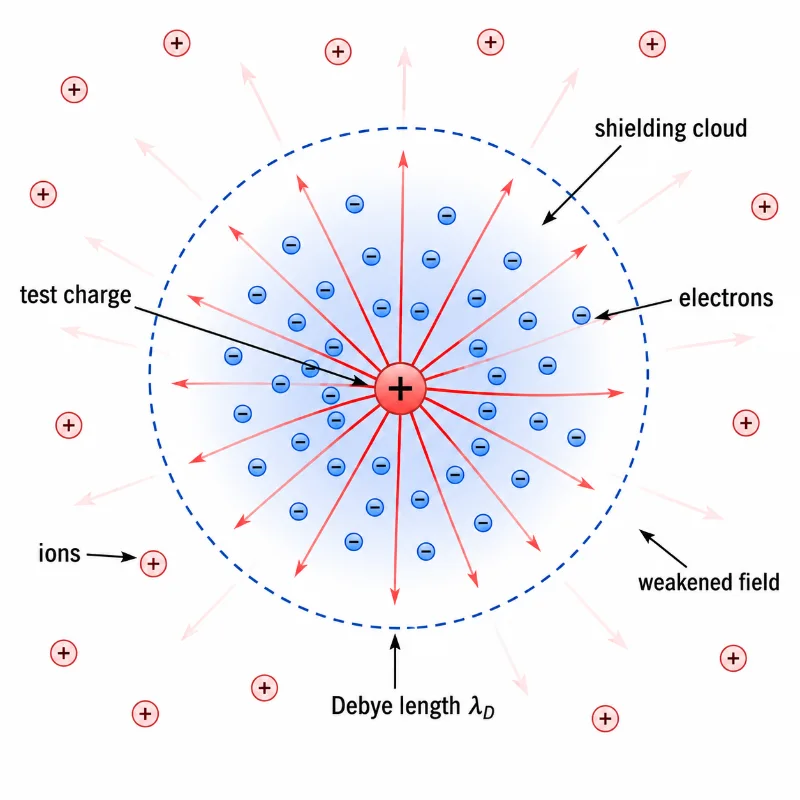
Debye shielding occurs when mobile charged particles in a plasma rearrange around a disturbance, reducing its electric field over the Debye length.
This diagram shows a positive test charge placed inside a plasma. Electrons gather more densely around the positive charge, forming a shielding cloud, while ions remain more widely distributed farther away. The electric field lines are strongest near the test charge and become weaker with distance. The dashed circle marks the Debye length λD, the characteristic distance over which the plasma screens the electric field. The picture helps students see that plasma responds collectively: its mobile charged particles rearrange to reduce the long-range effect of an electric disturbance.
Learning Pathway
This module belongs to the Plasma Physics cluster under the global Electricity and Magnetism core curriculum. It details the electrostatic screening mechanics of free fluids, establishing the localized coordinate bounds necessary before advancing to dynamic electron wave rhythms and magnetic tracking paths.
Provides the global parent context for understanding charge distributions, vector field equations, electric circuits, induction, and Maxwellian wave mechanics.
Introduces the collective macroscopic behavior of fully or partially ionized gases interacting recursively with self-consistent electromagnetic fields.
Debye Shielding Mechanics
Examines how localized thermal charge distributions dynamically neutralize electrostatic disturbances over distinct sub-millimeter length scales.
Analyzes how external vector fields bend single-particle paths into localized helical orbits to lock high-energy fusion fuels inside magnetic bottles.
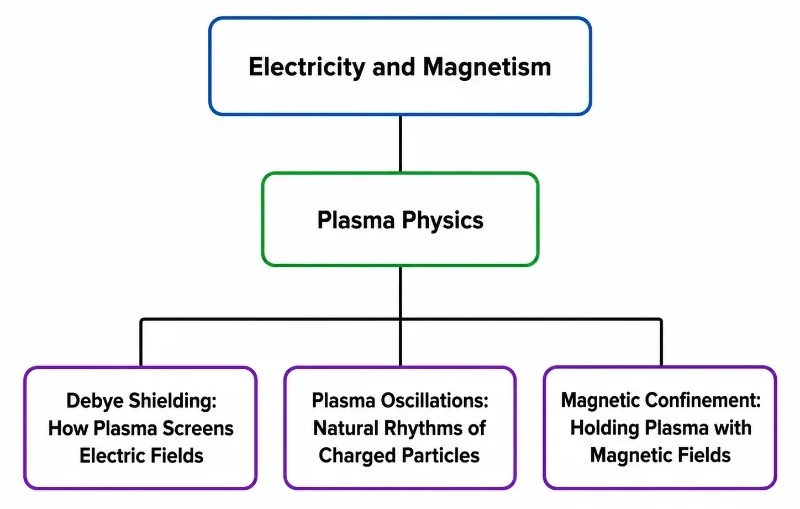
Plasma Physics sits within Electricity and Magnetism and connects Debye shielding, plasma oscillations, and magnetic confinement as three key learning pathways.
This simple hierarchy chart shows Plasma Physics as a sub-cluster within the wider Electricity and Magnetism section. The top node is Electricity and Magnetism, followed by Plasma Physics as the cluster hub. The three child pages are Debye Shielding: How Plasma Screens Electric Fields, Plasma Oscillations: Natural Rhythms of Charged Particles, and Magnetic Confinement: Holding Plasma with Magnetic Fields. The chart helps students see how plasma physics connects electric-field screening, collective charged-particle motion, and magnetic control of plasma.
The Physics of Debye Screening
In an absolute vacuum space, the electric potential fields mapped around a point mass charge decrease gently based on a straightforward spatial inverse-distance curve. When that identical point charge is submerged within an active plasma environment, the background charges react dynamically. A positive point charge quickly draws surrounding thermal electrons closer to its coordinates, while repelling neighboring heavy ions outward. This space-charge redistribution screens the anomaly, transforming the plain vacuum potential profile down to a tightly bounded, exponentially decaying distribution described by the screened Coulomb potential formula:
Where q represents the source charge magnitude, r tracks the radial separation distance, and λD defines the Debye length parameter. This identity reveals that once the radial tracking distance exceeds a few multiples of the Debye scale (r >> λD), the numerator’s exponential decay term drops toward zero, isolating the rest of the bulk plasma from the original electric disturbance completely.
Deconstructing the Debye Length Equation
The standard mathematical expression isolating the characteristic electron screening scale inside an isotropic plasma is expressed as:
To safely translate this relation across laboratory problem sheets, each individual thermodynamic variable block must be precisely mapped:
Debye Length (λD)
The definitive spatial radius parameter tracking the exact distance over which an electrostatic potential drop decays by a factor of 1/e.
Vacuum Permittivity (ε0)
The universal electrostatic constant setting field flux lines in space, holding a value of approximately 8.854 × 10⁻¹² F/m.
Boltzmann Constant (kB)
The fundamental thermal scaling bridge that converts absolute temperature kelvin metrics straight into mechanical joule energy units.
Electron Temperature (Te)
Tracks the average thermal kinetic energy of the electron distribution. Higher values mean faster thermal velocities, allowing electrons to resist electrostatic trapping and expanding the shielding cloud radius.
Electron Density (ne)
The total volume concentration of free electrons per cubic meter. Dense systems provide a greater abundance of nearby screening charges, compressing the shielding radius down to shorter distances.
Elementary Charge (e)
The absolute electric charge quantum carried by an electron or proton, valued at approximately 1.602 × 10⁻¹⁹ C.
The Delicate Balance of Thermal Agitation and Electrostatics
At its structural core, the final dimension of a Debye shielding cloud is determined by a continuous thermodynamic tug-of-war between two competing physical mechanisms: electrostatic attraction forces and thermal kinetic dispersion forces. The electrostatic potential lines seek to pull opposing charges into a tight, highly packed shell around the central disturbance. Conversely, the high thermal kinetic energy of the electrons (represented by the kBTe numerator) acts to scatter them away, resisting localization.
If the plasma temperature increases while density remains fixed, the electrons gain speed and break free from tight confinement, expanding the final shielding radius outwards. If the particle density grows instead, the influx of nearby charge carriers provides more efficient screening, compressing the required shielding distance. This dynamic balance means that a gas cannot be considered a true plasma unless its physical dimensions are large enough to let this collective shielding behavior fully manifest.
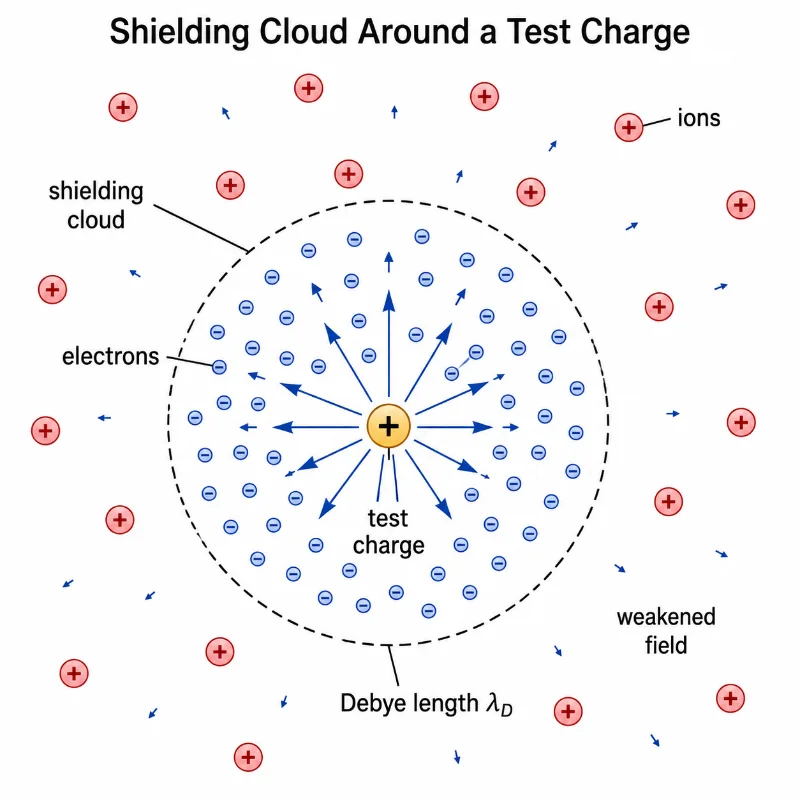
A positive test charge in plasma attracts nearby electrons, forming a shielding cloud that weakens the electric field beyond the Debye length.
This diagram shows Debye shielding around a positive test charge in plasma. Electrons cluster more densely near the test charge, while positive ions remain farther away and more widely distributed. The electric field arrows are stronger near the central charge and weaker outside the shielding region. The dashed circle marks the Debye length λD, the characteristic distance over which the plasma screens the electric field. The picture helps students see how mobile charged particles rearrange collectively to reduce the long-range electric influence of a disturbance.
Evolution of Screening Physics: History, Challenges, and Frontiers
To understand how shielding theory evolved from simple electrolytic chemistry into an exact plasma metric, we must evaluate its history, contemporary engineering challenges, and future industrial frontiers.
Historical Epochs: From Debye-Hückel Electrolytes to Tonks-Langmuir Plasma Limits
The mathematical foundation of electrostatic shielding was originally established in 1923 by Dutch physicist Peter Debye and German physicist Erich Hückel. They developed this statistical model to explain the behavior of dissociated ions moving within liquid electrolytic chemical solutions. In 1929, American physics pioneers Lewi Tonks and Irving Langmuir adapted these chemical screening equations to gaseous states, proving that high-temperature ionized media behave identically when managing internal charge separations. This transition successfully expanded Debye’s molecular chemistry model into a fundamental criterion for defining gaseous plasmas, demonstrating that a collection of ionized gas particles can only be classified as a true plasma if its physical volume is large enough to contain many Debye shielding lengths.
Contemporary Engineering Challenges: Boundary Sheath Failures and Non-Equilibrium Diagnostics
While applying ideal, isotropic Debye equations to a uniform bulk plasma is analytically simple, managing shielding behaviors near material interfaces presents severe engineering challenges. When a plasma encounters a solid boundary—such as a tokamak wall, a spacecraft fuselage, or a diagnostic probe—electrons strike the surface much faster than heavy ions due to their extreme mobility. This creates a highly non-uniform charge layer known as a plasma sheath. Inside this narrow sheath region, quasi-neutrality breaks down completely, generating intense localized electric fields. If these fields exceed critical thresholds, they can trigger violent electrical arcing that can melt reactor components or cause sensor breakdown, making the engineering of these sheath zones a massive hurdle for modern reactor design.
Future Technological Horizons: Quantum Debye Lengths and Nanoscale Semiconductor Etching
Today, the foundational metrics of Debye shielding are expanding into quantum scales and sub-micron industrial manufacturing. In next-generation extreme ultraviolet (EUV) plasma lithography, semiconductor manufacturers use high-density laser-produced plasmas to etch microchips at atomic scales. Optimizing these processes requires manipulating the local Debye length of the plasma sheath to control the energy and direction of ions striking the silicon wafer with nanometer precision. Concurrently, astrophysicists use advanced Debye sphere models to simulate dusty space plasmas within planetary rings and comet tails, where highly charged cosmic dust grains collect individual shielding clouds, altering our understanding of how cosmic matter clusters across the universe.
Defining the Limits of Macroscopic Quasi-Neutrality
The condition of quasi-neutrality forms a core defining pillar of plasma physics. It states that on a global macroscopic scale, a plasma remains almost completely neutral, maintaining an equal balance of negative and positive charge centers on average. This large-scale balance can be written as:
$$n_e \approx \langle Z \rangle n_i$$
Where ne is the electron number density, ni is the ion number density, and ⟨Z⟩ tracks the average ionic charge state. While local charge separations can still occur due to thermal fluctuations or external disturbances, Debye shielding ensures that these imbalances remain tightly confined. For a collection of ionized particles to exhibit true collective plasma properties rather than behaving like a simple gas, the global physical dimension L of the system must satisfy the scale requirement:
$$L \gg \lambda_D$$
If the physical boundaries of the system are smaller than or comparable to this shielding length, the internal mobile charges cannot gather in sufficient numbers to effectively mask electric fields, causing the medium to behave simply as a non-neutral stream of isolated charges.
The Topology of the Debye Sphere
To ensure that electrostatic shielding remains a predictable, smooth collective behavior rather than a series of chaotic individual particle collisions, the local plasma must contain a vast number of mobile charge carriers within its active screening zone. This geometric volume is called the Debye sphere—a sphere whose radius is exactly equal to one Debye length. The total number of electrons enclosed inside this shielding sphere is quantified by the plasma parameter:
$$N_D = \frac{4}{3}\pi n_e \lambda_D^3$$
For the continuum fluid models of plasma physics to remain valid, the system must satisfy the collective plasma criterion:
$$N_D \gg 1$$
When this condition is met, the collective shielding response is driven smoothly by thousands of cooperative particle movements rather than being dominated by localized, individual particle pairings. This state is known as a weakly coupled plasma, defining the behavior of most space plasmas and laboratory fusion experiments.
What Debye Shielding Does Not Mean
To avoid serious diagnostic and analytical errors on university problem sheets, students must carefully avoid four common conceptual traps:
It Does Not Destroy Charge
The original test charge or external electrostatic disturbance is never destroyed or altered. The surrounding plasma simply redistributes its space-charge cloud to neutralize the long-range electric flux fields outside the sphere.
It Does Not Guarantee Absolute Neutrality
Quasi-neutrality is a large-scale statistical average. High-intensity local charge separations and electric fields can and do exist continuously within plasma waves, sheath boundaries, and near electrical probes.
It Is Not an Insulating Barrier
Unlike the rigid, fixed valence electrons that block current inside solid dielectric insulators, plasma shielding is a dynamic, fluid phenomenon driven entirely by the free, un-bound motion of highly mobile charges.
It Is Not a Universal Fixed Length
The Debye length is not a fundamental physical constant. It changes dynamically across space and time, shifting whenever local electron temperatures, plasma densities, or ionic charge states vary.
The Boundary Physics of Plasma Sheaths
The mechanics of Debye shielding become critically important when analyzing how plasmas interact with solid material walls, structural limiters, or diagnostic collection plates. Because free electrons are incredibly light compared to heavy ions, their thermal velocity is orders of magnitude higher at a given plasma temperature. Consequently, when an unmagnetized plasma first contacts a solid material surface, electrons strike the wall much faster, rapidly depositing a net negative charge on the surface.
This negative surface accumulation sets up a localized electric potential drop that retards further electron impact while accelerating positive ions toward the wall. This narrow boundary region of charge separation is called a plasma sheath. The thickness of this electrostatic sheath layer scales directly with the local Debye length, forming a protective barrier that balances the net particle loss to ensure the bulk plasma farther from the wall remains safely quasi-neutral.
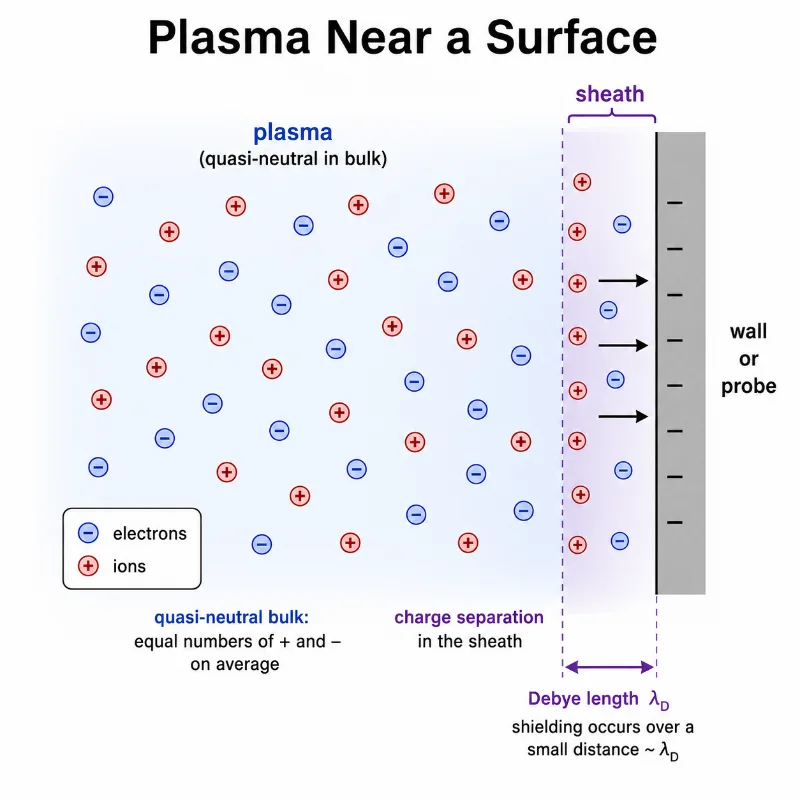
Near a wall or probe, plasma may form a sheath where charge separation and electric fields appear over a distance related to the Debye length.
This diagram shows plasma near a material surface such as a wall or probe. In the bulk plasma, electrons and ions are mixed in nearly equal numbers on average, so the region is quasi-neutral. Near the surface, a thin sheath forms where charge separation and electric fields become important. The Debye length λD marks the small characteristic distance over which shielding occurs. The picture helps students understand why Debye shielding matters not only around isolated charges, but also near boundaries in plasma devices, probes, spacecraft surfaces, and plasma-processing systems.
Worked Examples with Step-by-Step Solutions
Worked Example 1: Calculating the Electron Debye Length Problem: A laboratory gas discharge plasma operates with an electron temperature Te = 1.0 × 10⁵ K and an electron density ne = 1.0 × 10¹⁶ m-3. Calculate the characteristic electron Debye length of the system. Solution: Apply the standard electron Debye shielding equation:
Answer: The electron Debye length measures approximately 2.18 × 10⁻⁴ m (or about 0.22 mm).
Worked Example 2: Density Inversion Scales Problem: If a cosmic plasma stream compresses such that its electron number density increases by a factor of exactly 100 while maintaining a constant electron temperature, calculate the proportional shift in the Debye length. Solution: Isolate the functional relationship between the Debye length and the electron number density:
$$\lambda_D \propto \frac{1}{\sqrt{n_e}}$$
Substitute the density multiplier factor of 100 into the scalar relationship:
Answer: The Debye length decreases by a factor of exactly 10. Denser plasma environments provide a higher concentration of charge carriers, compressing the electrostatic shielding zone.
Worked Example 3: Core Temperature Scaling Effects Problem: In a tokamak fusion auxiliary heating phase, the electron temperature scales upward by a factor of exactly 4 while core particle density remains constant. Determine what happens to the internal Debye length. Solution: Map out the direct relationship linking the shielding scale to the thermal kinetic parameter:
$$\lambda_D \propto \sqrt{T_e}$$
Substitute the temperature scaling factor of 4 into the proportionality expression:
$$\lambda’_D = \sqrt{4}\lambda_D = 2\lambda_D$$
Answer: The system’s Debye length doubles exactly. Raising the thermal kinetic energy increases electron velocities, allowing them to spread farther and widening the shielding zone.
Industrial and Cosmic Systems Driven by Shielding Mechanics
Electrostatic screening profiles dictate the operational boundaries of deep-space exploration vehicle systems and nanoscale processing chips alike:
Cosmic Deep-Space Plasmas
Debye shielding regulates how spacecraft hulls interact with high-velocity streams inside the solar wind and planetary magnetospheres, screening electric imbalances to shield onboard instruments from damage.
Controlled Fusion Tokamaks
High-temperature burning cores are analyzed as collective charged fluids where Debye shielding limits the range of electrostatic disruptions, keeping core conditions stable.
Advanced Boundary Probes
Langmuir diagnostic devices rely on calculating precise sheath boundaries to measure electron density and local core temperatures accurately without disrupting the bulk plasma fluid.
Cosmic dust grains suspended within interstellar planetary rings collect local negative surface charges, wrapping themselves in individual Debye spheres that dictate how cosmic dust clusters over time.
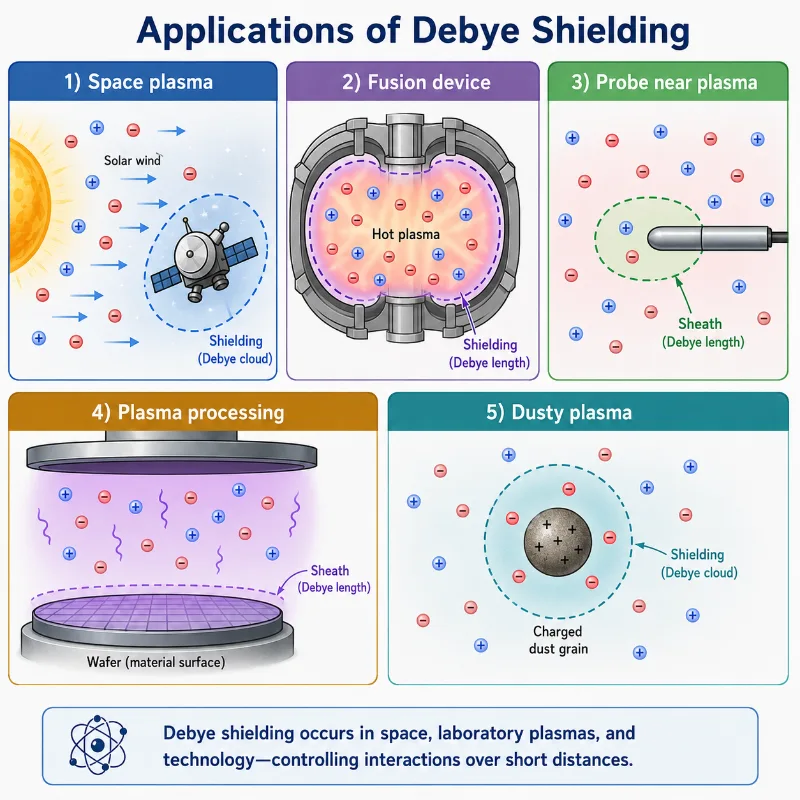
Debye shielding appears in space, fusion devices, plasma probes, plasma processing, and dusty plasma because mobile charged particles screen electric disturbances over short distances.
This infographic shows five important applications of Debye shielding. In space plasma, shielding clouds form around charged objects such as spacecraft moving through the solar wind. In fusion devices, Debye shielding helps describe how hot plasma screens electric disturbances. Near plasma probes, sheath regions form over distances related to the Debye length. In plasma processing, shielding affects how charged particles interact with material surfaces. In dusty plasma, charged dust grains are surrounded by shielding clouds that influence how they interact with nearby particles. The image helps students see Debye shielding as a practical plasma concept used in nature, laboratories, and technology.
Quick Check: Meaning of Debye Shielding
Quick Check: Meaning of Debye Shielding
1. What is Debye shielding?
Debye shielding is the process by which mobile charged particles in a plasma rearrange to reduce the electric field of a charge or disturbance over a characteristic distance.
2. What is the Debye length?
The Debye length λD is the approximate distance over which an electric disturbance is screened in a plasma.
3. Does Debye shielding mean the electric field becomes zero everywhere?
No. It means the electric field is weakened over distance. Local electric fields can still exist, especially near disturbances, boundaries, and sheaths.
4. Why is Debye shielding a collective effect?
It involves the rearrangement of many electrons and ions, not just the interaction between two isolated charged particles.
Quick Check: Debye Length
Quick Check: Debye Length
1. What happens to the Debye length when electron density increases?
The Debye length decreases. A denser plasma usually screens electric fields over a shorter distance.
2. What happens to the Debye length when electron temperature increases?
The Debye length increases. Hotter electrons spread the shielding response over a larger distance.
3. Why should the plasma size be much larger than the Debye length?
If the system size is much larger than λD, the plasma can behave as a quasi-neutral medium over large scales.
Numerical Practice
Numerical Practice: Debye Shielding
1. If a plasma becomes 9 times denser while temperature stays the same, how does λD change?
Since λD ∝ 1/√ne, increasing density by 9 makes λD smaller by √9=3. The Debye length becomes one-third of its original value.
2. If the electron temperature becomes 16 times larger while density stays the same, how does λD change?
Since λD ∝ √Te, increasing temperature by 16 makes λD increase by √16=4. The Debye length becomes 4 times larger.
3. A plasma has λD = 0.50 mm. If its density increases by a factor of 25, what is the new Debye length, assuming temperature is unchanged?
The Debye length decreases by √25=5. The new value is 0.50 mm / 5 = 0.10 mm.
Review Questions and Answers
Review Questions: Debye Shielding
1. Why does a plasma screen electric fields?
A plasma screens electric fields because its electrons and ions can move and rearrange around electric disturbances, reducing the field at larger distances.
2. Why does higher density usually reduce the Debye length?
A denser plasma has more charged particles available nearby to rearrange and screen the disturbance, so the shielding occurs over a shorter distance.
3. Why does higher electron temperature usually increase the Debye length?
Hotter electrons have more thermal energy and spread out more easily, so the shielding cloud extends over a larger distance.
4. What is quasi-neutrality?
Quasi-neutrality means that over distances much larger than the Debye length, the plasma has nearly equal positive and negative charge densities.
5. Why is Debye shielding important near probes and walls?
Near probes and walls, charged particles respond differently, forming sheath regions where electric fields and charge separation become important.
Thought-Provoking Questions
Thought-Provoking Questions
1. Why is Debye shielding evidence that plasma behaves collectively?
Because the response to one disturbance involves many charged particles rearranging together. This shows that plasma behaviour cannot always be understood by studying isolated particle pairs alone.
2. How can plasma be almost neutral and still contain electric fields?
Plasma can be quasi-neutral over large distances while still having local electric fields near disturbances, boundaries, waves, probes, and sheaths.
3. Why might Debye shielding matter for spacecraft moving through plasma?
A spacecraft surface can charge relative to the surrounding plasma. Debye shielding and sheath formation affect how that charge influences nearby particles and electric fields.
4. Why is the Debye length not just a mathematical detail?
It tells us the physical scale over which plasma screens electric fields, which affects diagnostics, boundaries, space plasma, fusion systems, and plasma technologies.
Glossary
Debye shielding: The electrostatic screening of ambient electric fields inside an ionized medium, driven by the dynamic rearrangement of mobile space-charges.
Debye length (λD): The characteristic spatial scale tracking the distance over which an electrostatic potential drop decays exponentially to 1/e of its unshielded value.
Plasma: An ionized state of fluid matter containing un-bound electrons and ion populations that exhibit self-consistent, collective responses to electromagnetic forces.
Quasi-neutrality: The structural condition where the volume concentrations of negative and positive charge centers balance perfectly when averaged over system dimensions much larger than the Debye length.
Shielding cloud: The localized spatial distribution of balancing charges that aggregates around a localized electric anomaly to screen its external lines of flux.
Electron density (ne): The volumetric concentration tracking the total number of free electrons per unit volume within the plasma matrix.
Electron temperature (Te): A thermodynamic measurement tracking the average thermal kinetic energy of the free electron population.
Debye sphere: A sphere whose radius is exactly equal to one local Debye length, defining the volume enclosing the collective population of charges responsible for the shielding response.
Plasma sheath: A narrow non-neutral boundary layer forming spontaneously where an active plasma meets a solid material surface, characterized by strong potential gradients.
Collective behaviour: Coordinated macroscopic phenomena emerging from long-range multi-particle interactions through shared fields, distinct from individual binary collisions.
Debye shielding explains how plasma screens electric fields. When a charge or electric disturbance appears, mobile electrons and ions rearrange around it, reducing its electric influence over a characteristic distance called the Debye length. The Debye length depends mainly on electron temperature and electron density. Higher temperature usually increases the Debye length, while higher density usually decreases it. This makes the Debye length a practical measure of how effectively a plasma screens electric disturbances.
Debye shielding also explains why plasma can be quasi-neutral over large scales while still allowing local electric fields near charges, surfaces, probes, sheaths, and waves. This idea is essential for understanding space plasma, fusion devices, plasma diagnostics, plasma processing, and the broader collective behaviour of ionised gases.
Reflection Question
If a plasma dynamically alters its internal spatial coordinates to actively screen electric fields, how does this dynamic, collective rearrangement reframe your fundamental perception of electrostatic forces compared to classical static point charges interacting across an empty vacuum?