Prepare for University Studies & Career Advancement
Charge Conservation and Continuity
Charge conservation is one of the quiet foundations of electrodynamics. It says that electric charge is not created from nothing and does not vanish into nothing. Charge may move, spread, gather, separate, recombine, or flow through a circuit, but the net amount of charge is accounted for.
The continuity equation gives this principle a local mathematical form. Instead of saying only that total charge is conserved somewhere in a large system, it says something sharper: at every small region of space, any decrease in charge density must be explained by charge flowing out, and any increase must be explained by charge flowing in.
In electrodynamics, this idea is not an optional extra. It connects charge density, current density, Maxwell’s equations, circuit laws, capacitor charging, plasma motion, and the consistency of the whole electromagnetic field theory.
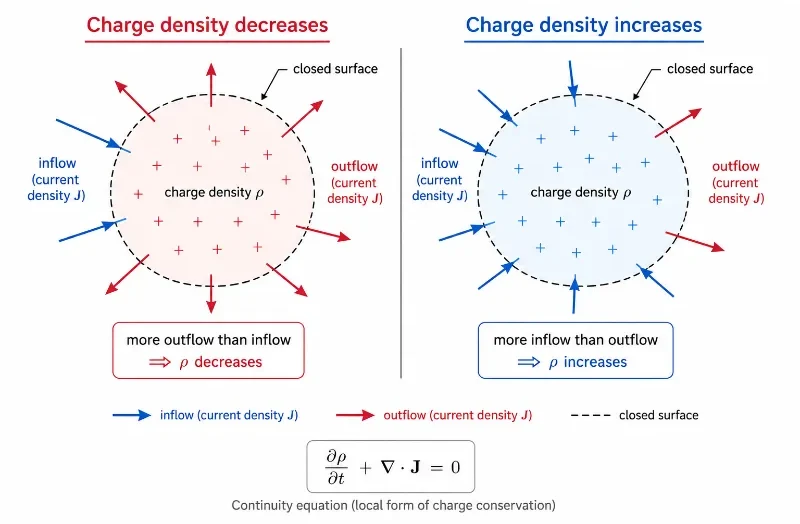
A closed surface enclosing a small volume helps illustrate the continuity equation: if more charge flows out than in, the charge density inside decreases; if more charge flows in than out, the charge density inside increases.
This illustration explains the local meaning of charge conservation using two side-by-side panels. In each panel, a dashed closed surface encloses a small volume of space containing charge density \( \rho \). Blue arrows represent inflow of current density \( \mathbf{J} \), and red arrows represent outflow. In the left panel, more current leaves the enclosed volume than enters it, so the charge density inside decreases. In the right panel, more current enters the enclosed volume than leaves it, so the charge density inside increases. The diagram helps students see that charge inside a small region does not change randomly. Any change in the amount of charge within a closed surface enclosing a volume must be explained by net current crossing the boundary. The continuity equation shown below summarises this idea in mathematical form: \( \frac{\partial \rho}{\partial t} + \nabla \cdot \mathbf{J} = 0 \).
Where This Page Fits in Electrodynamics
Electrodynamics studies electric and magnetic fields when charges move and fields change with time. Charge conservation and the continuity equation provide the accounting rule that keeps the field laws physically consistent.
Introduces electric charge, electric fields, magnetic fields, circuits, induction, electromagnetic waves, and the broader structure of classical electromagnetism.
Develops the field-law view of electromagnetism, where charge, current, changing electric fields, and changing magnetic fields are connected in space and time.
Shows why electric and magnetic fields are deeply connected when motion, reference frames, and spacetime symmetry are taken seriously.
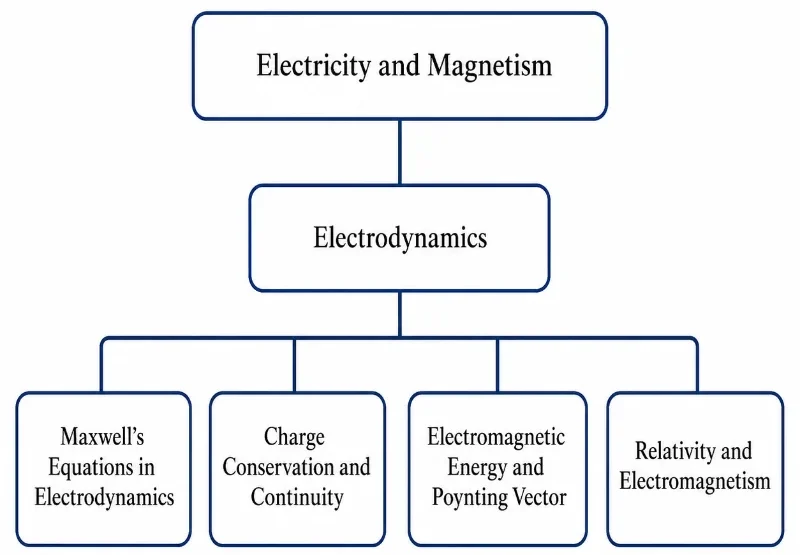
This hierarchy chart shows Electrodynamics as a sub-cluster of Electricity and Magnetism, with four connected pages on field laws, charge conservation, electromagnetic energy flow, and relativity.
This simple tree chart presents the page hierarchy for the Electrodynamics cluster within the wider Electricity and Magnetism section of Prep4Uni.online. Electricity and Magnetism appears as the parent node, Electrodynamics appears as the sub-cluster node, and four child pages are shown beneath it: Maxwell’s Equations in Electrodynamics, Charge Conservation and Continuity, Electromagnetic Energy and Poynting Vector, and Relativity and Electromagnetism. The chart helps students understand where the Charge Conservation and Continuity page fits within the broader learning pathway.
What Charge Conservation Really Means
Charge conservation means that the net electric charge of an isolated system remains constant. A positive charge and a negative charge may meet and neutralise each other, but this does not mean charge has disappeared. It means the positive and negative contributions now add to a smaller net value in that region.
In everyday electrical systems, charge conservation is often hidden because electrons are tiny and move through conductors collectively. A wire may appear unchanged even while enormous numbers of electrons drift through it. A capacitor may appear still, even while charge builds up on its plates. A circuit junction may look like a small point, but the current entering and leaving it must still satisfy charge accounting.
This is why charge conservation is more than a statement about total charge. It is also a statement about movement. When charge density changes at one location, the missing or added charge must be explained by current.
The Continuity Equation: The Local Accounting Rule
The continuity equation expresses charge conservation at each point in space:
Here, \( \rho \) is charge density, measured in coulombs per cubic metre, and \( \mathbf{J} \) is current density, measured in amperes per square metre. The term \( \frac{\partial \rho}{\partial t} \) describes how quickly charge density changes with time at a point. The term \( \nabla \cdot \mathbf{J} \) describes whether current is spreading out of that point or converging into it.
The equation says that these two effects must balance. If current spreads outward from a small region, the charge density there must decrease. If current converges into a small region, the charge density there must increase. If there is no local build-up or depletion of charge, then the current flow must be divergence-free.
Reading the Equation Physically
The continuity equation becomes easier when it is read as a physical sentence rather than as a symbol pattern.
\( \frac{\partial \rho}{\partial t} > 0 \)
Charge density is increasing at that point. More charge is arriving than leaving, so current is effectively converging into the region.
\( \frac{\partial \rho}{\partial t} < 0 \)
Charge density is decreasing at that point. More charge is leaving than arriving, so current is effectively spreading outward.
\( \nabla \cdot \mathbf{J} > 0 \)
Current density has positive divergence. Current flows outward from the region, causing local charge density to fall.
\( \nabla \cdot \mathbf{J} < 0 \)
Current density has negative divergence. Current flows inward toward the region, causing local charge density to rise.
\( \nabla \cdot \mathbf{J} = 0 \)
There is no net local spreading or gathering of current. In a steady conductor, this often corresponds to no charge accumulation.
Integral Form of Charge Conservation
The same idea can be written for a whole volume \( V \) bounded by a closed surface \( S \):
The left side gives the rate of change of total charge inside the volume. The right side gives the negative of the net outward current through the closed surface. The minus sign is important. If more current flows outward than inward, the charge inside the volume decreases.
This form is often more intuitive than the differential form. Imagine drawing an invisible closed surface around a small part of a circuit, a section of plasma, or a region between capacitor plates. If charge inside that surface changes, there must be a net current across the boundary.
From Integral Form to Differential Form
The integral form applies to a whole region. The differential form applies at a point. The bridge between them is the divergence theorem:
The continuity equation is closely connected to Maxwell’s equations. Two equations are especially important here: Gauss’s law for electric fields and the Ampère–Maxwell law.
This result is powerful. It shows that Maxwell’s equations are not merely compatible with charge conservation. Their structure requires it.
Relativistic Covariance: The Four-Vector Continuity Expression
While the standard continuity expression \(\frac{\partial \rho}{\partial t} + \nabla \cdot \mathbf{J} = 0\) elegantly balances local parameters, it treats time and three-dimensional space as separate arenas. When we transition into Einsteinian special relativity, time and space merge into a single four-dimensional continuum known as spacetime. To satisfy this symmetry, the separate scalar charge density \(\rho\) and the vector current density \(\mathbf{J}\) must consolidate into a single geometric object called the Four-Current Vector (\(J^\mu\)):
Where \(c\) represents the speed of light in a vacuum, scaling the coordinates so they match in units. By using this four-vector notation alongside the spacetime four-gradient operator (\(\partial_\mu = \left(\frac{1}{c}\frac{\partial}{\partial t}, \nabla\right)\)), the entire continuity equation compresses into a completely covariant, single-expression statement:
$$ \partial_\mu J^\mu = 0 $$
Deep Concept: The Invariance of Global Total Charge
Spacetime Volume Transformations
This relativistic formulation reveals a remarkable feature of our universe. When an observer accelerates to near-light speed, lengths contract along the axis of motion, causing a localized volume element to shrink. To keep the calculated charge density consistent across reference frames, the measured density \(\rho\) must scale up by the Lorentz factor (\(\gamma\)).
Because density increases by the exact same ratio that volume contracts, integrating the charge over space yields a vital invariant: the absolute net charge of a particle is entirely independent of its velocity. This stands in stark contrast to classical momentum or kinetic energy, which change drastically as reference frames shift.
The Deep Root of Conservation: Noether’s Theorem and Global Gauge Symmetry
In basic physics courses, charge conservation is usually presented as an observational fact—something we accept simply because laboratory tests show it to be true. However, at the university level, students discover that conservation laws are never arbitrary; they are the direct mathematical consequence of symmetries embedded within the laws of nature. This profound link is governed by Noether’s Theorem.
Noether’s Theorem states that for every continuous mathematical symmetry in a physical system, there exists a corresponding conserved quantity. For instance, the fact that physics experiments yield identical results yesterday, today, and tomorrow (time translation symmetry) directly dictates the conservation of energy. Similarly, the fact that turning an apparatus in space does not alter the physics laws (rotational symmetry) dictates the conservation of angular momentum.
Electric charge conservation springs from a more abstract symmetry known as Global \(\text{U}(1)\) Gauge Invariance. In quantum field theory, matter is described by complex-valued wavefunctions. If you shift the phase angle of a charged particle’s wavefunction globally by an arbitrary phase value \(e^{i\alpha}\):
$$ \psi \rightarrow \psi’ = e^{i\alpha}\psi $$
The observable probabilities, energy states, and field equations remain completely unchanged. When you apply this phase invariance constraint to the mathematical Lagrangian of the field system, Noether’s theorem outputs a conserved mathematical current. In our universe, that invariant current is the exact electrodynamic current density four-vector (\(J^\mu\)) that populates our continuity equation. This proves that charge conservation is not a happy coincidence, but a mathematical necessity required to preserve the phase symmetry of space and matter.
Why Maxwell’s Displacement Current Matters
Before Maxwell’s correction, Ampère’s law related magnetic circulation only to conduction current. That worked well for steady currents in wires, but it created a problem for changing electric fields, especially in a charging capacitor.
In a charging capacitor, conduction current flows in the wires, but no ordinary conduction current crosses the insulating gap between the plates. Yet the magnetic field around the circuit cannot suddenly depend on which surface we choose for calculation.
Maxwell solved this by adding the displacement current term:
This term allows a changing electric field to act as a source of magnetic field. It also keeps the Ampère–Maxwell law consistent with charge conservation. Without it, the mathematical structure of electrodynamics would not properly account for charge that accumulates on capacitor plates while current continues in the circuit.
Suggested Illustration: Continuity in a Charging Capacitor
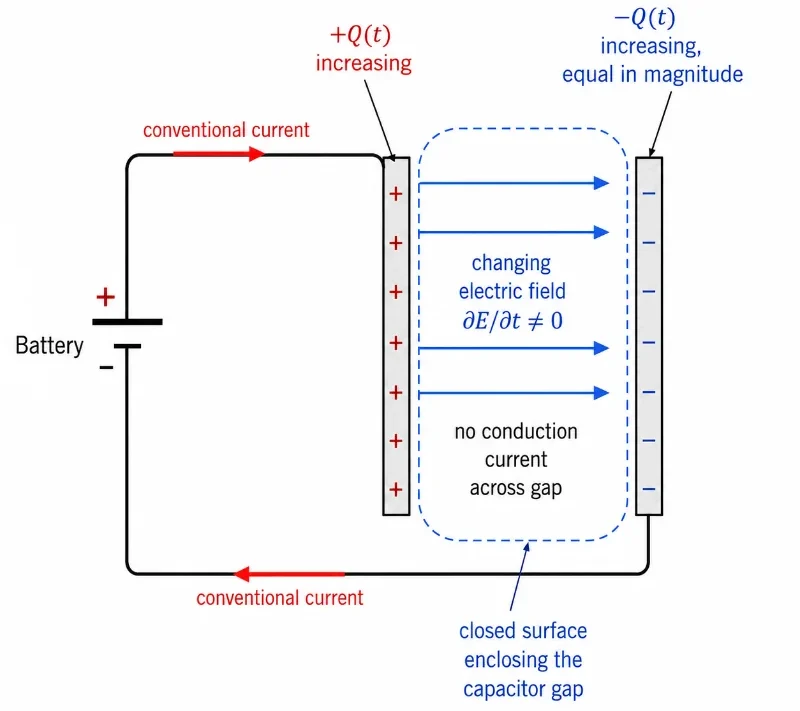
A charging capacitor shows how charge conservation remains valid even though no conduction current crosses the gap between the plates.This illustration shows continuity in a charging capacitor circuit. One capacitor plate is connected to the positive terminal of the battery and becomes increasingly positively charged, while the other plate is connected to the negative terminal and becomes increasingly negatively charged. Conventional current flows through the external wires, but no conduction current crosses the gap between the capacitor plates. Instead, a changing electric field develops across the gap, pointing from the positive plate toward the negative plate. The dashed closed surface enclosing the capacitor gap helps students see how electrodynamics accounts for current continuity and charge conservation even where ordinary charge carriers do not physically cross the space between the plates.
Steady Current and Kirchhoff’s Current Law
In a steady current situation, charge density at a circuit junction does not keep increasing or decreasing. Therefore:
\[
\frac{\partial \rho}{\partial t} = 0
\]
The continuity equation becomes:
\[
\nabla \cdot \mathbf{J} = 0
\]
For a circuit junction, this leads to Kirchhoff’s current law:
\[
\sum I_{\text{in}} = \sum I_{\text{out}}
\]
This law is often taught as a circuit rule, but it has a deeper field meaning. It is the steady-current version of local charge conservation. Current cannot pile up indefinitely at an ordinary junction. What enters must leave, unless charge is accumulating there.
Worked Example 1: Charge Leaving a Region
Problem: A closed region contains charge. The net outward current through its boundary is \( 3.0 \ \text{A} \). At what rate is the charge inside the region changing?
Solution:
Use the integral form:
\[
\frac{dQ}{dt} = -I_{\text{out}}
\]
Substitute \( I_{\text{out}} = 3.0 \ \text{A} \):
\[
\frac{dQ}{dt} = -3.0 \ \text{C/s}
\]
The charge inside the region decreases at \( 3.0 \ \text{C/s} \).
Worked Example 2: Current at a Junction
Problem: At a circuit junction, currents of \( 2.0 \ \text{A} \) and \( 1.5 \ \text{A} \) enter. A current of \( 2.2 \ \text{A} \) leaves through one branch. What current must leave through the remaining branch if charge is not accumulating?
Solution:
For steady current:
\[
\sum I_{\text{in}} = \sum I_{\text{out}}
\]
The total current entering is:
\[
2.0 + 1.5 = 3.5 \ \text{A}
\]
So the remaining outgoing current is:
\[
I = 3.5 – 2.2 = 1.3 \ \text{A}
\]
The missing branch carries \( 1.3 \ \text{A} \) outward.
Worked Example 3: Interpreting Divergence of Current Density
Problem: At a certain point in space, the divergence of current density is \( \nabla \cdot \mathbf{J} = 4.0 \ \text{C m}^{-3}\text{s}^{-1} \). What is \( \frac{\partial \rho}{\partial t} \)?
The charge density is decreasing at that point. The positive divergence means current is spreading out from the region.
Common Misconceptions
Misconception 1: Current Uses Up Charge
A current does not normally consume charge. In a closed circuit, charge carriers move through the circuit while energy is transferred from the source to the load.
Misconception 2: Charge Conservation Means Charge Cannot Move
Conservation does not mean stillness. It means that when charge moves from one place to another, the total account must still balance.
Misconception 3: A Capacitor Gap Breaks Charge Conservation
A capacitor gap does not allow ordinary conduction current through the dielectric, but charge builds up on the plates and the changing electric field must be included in the electrodynamic description.
Misconception 4: Kirchhoff’s Current Law Is Only a Circuit Trick
Kirchhoff’s current law is a special steady-current case of the continuity equation. It is rooted in local charge conservation.
Misconception 5: The Continuity Equation Applies Only to Wires
The equation applies to charge and current density in general. It can describe conductors, plasmas, beams of charged particles, semiconductors, and field-theory situations.
Quick Check: Charge Conservation
Quick Check: Charge Conservation
1. What does charge conservation mean?
Charge conservation means that net electric charge is not created or destroyed. Charge may move, accumulate, separate, or recombine, but the net charge must still be accounted for.
2. If more current leaves a region than enters it, what happens to the charge inside?
The charge inside the region decreases. Net outward current removes charge from the region.
3. Why does a steady circuit junction obey \( \sum I_{\text{in}} = \sum I_{\text{out}} \)?
In a steady situation, charge does not keep accumulating at the junction. Therefore, the total current entering must equal the total current leaving.
Quick Check: The Continuity Equation
Quick Check: The Continuity Equation
1. What does \( \rho \) represent in the continuity equation?
The symbol \( \rho \) represents electric charge density, or charge per unit volume.
2. What does \( \mathbf{J} \) represent?
The symbol \( \mathbf{J} \) represents current density. It describes how much electric current flows through a unit area and in what direction.
3. What does positive \( \nabla \cdot \mathbf{J} \) mean physically?
Positive \( \nabla \cdot \mathbf{J} \) means current is spreading outward from a region. Therefore, charge density in that region decreases.
4. What equation expresses local charge conservation?
The local charge conservation equation is \( \frac{\partial \rho}{\partial t} + \nabla \cdot \mathbf{J} = 0 \).
Thought-Provoking Questions
Thought-Provoking Questions
1. Why is charge conservation more than a rule for circuits?
Charge conservation is more than a circuit rule because it applies locally to fields and currents in space. Circuit laws are simplified versions of a deeper field principle.
2. Why would electrodynamics be inconsistent without the displacement current term?
Without the displacement current term, the magnetic field around a charging capacitor would depend incorrectly on the surface chosen for calculation. Maxwell’s added term keeps the field law consistent with charge conservation.
3. Why is the continuity equation called a local law?
It is called local because it applies at each point in space. It does not merely say that total charge is conserved overall; it explains how charge density and current density must balance point by point.
Numerical Practice
Numerical Practice
1. A closed surface has a net outward current of \( 0.80 \ \text{A} \). What is the rate of change of charge inside the surface?
Using \( \frac{dQ}{dt} = -I_{\text{out}} \), we get \( \frac{dQ}{dt} = -0.80 \ \text{C/s} \). The charge inside decreases at \( 0.80 \ \text{C/s} \).
2. Currents of \( 4.0 \ \text{A} \) and \( 2.5 \ \text{A} \) enter a junction. One outgoing branch carries \( 3.0 \ \text{A} \). What current leaves through the second outgoing branch?
Total entering current is \( 4.0 + 2.5 = 6.5 \ \text{A} \). Therefore, the second outgoing branch carries \( 6.5 – 3.0 = 3.5 \ \text{A} \).
3. At a point, \( \frac{\partial \rho}{\partial t} = 6.0 \ \text{C m}^{-3}\text{s}^{-1} \). What is \( \nabla \cdot \mathbf{J} \)?
From \( \frac{\partial \rho}{\partial t} + \nabla \cdot \mathbf{J} = 0 \), we get \( \nabla \cdot \mathbf{J} = -6.0 \ \text{C m}^{-3}\text{s}^{-1} \). Current is converging into the region.
4. At a point, \( \nabla \cdot \mathbf{J} = -2.4 \ \text{C m}^{-3}\text{s}^{-1} \). Is charge density increasing or decreasing?
Since \( \frac{\partial \rho}{\partial t} = -\nabla \cdot \mathbf{J} \), we get \( \frac{\partial \rho}{\partial t} = 2.4 \ \text{C m}^{-3}\text{s}^{-1} \). Charge density is increasing.
Review Questions and Answers
Review Questions and Answers
1. State the continuity equation for electric charge.
The continuity equation is \( \frac{\partial \rho}{\partial t} + \nabla \cdot \mathbf{J} = 0 \).
2. What physical principle does the continuity equation express?
It expresses conservation of electric charge in local form.
3. Why is there a minus sign in \( \frac{dQ}{dt} = -I_{\text{out}} \)?
The minus sign means that outward current reduces the charge remaining inside the region.
4. How is Kirchhoff’s current law related to the continuity equation?
Kirchhoff’s current law is the steady-current circuit version of the continuity equation. If charge does not accumulate at a junction, current entering must equal current leaving.
5. Why is the displacement current term important in Maxwell’s equations?
It allows changing electric fields to contribute to magnetic fields and keeps the Ampère–Maxwell law consistent with charge conservation, especially in situations such as charging capacitors.
Glossary
Charge conservation: The principle that net electric charge is not created or destroyed in an isolated system.
Charge density \( \rho \): The amount of electric charge per unit volume.
Current density \( \mathbf{J} \): A vector describing electric current per unit area and its direction of flow.
Continuity equation: The equation \( \frac{\partial \rho}{\partial t} + \nabla \cdot \mathbf{J} = 0 \), expressing local conservation of charge.
Divergence: A mathematical measure of how much a vector field spreads outward from a point or converges inward toward it.
Integral form: A form of a physical law applied to an extended region, surface, or boundary.
Differential form: A local form of a physical law applied point by point in space.
Conduction current: Current produced by the motion of charge carriers through a material, such as electrons moving in a wire.
Displacement current: The effect of a changing electric field acting as a source of magnetic field in Maxwell’s correction to Ampère’s law.
Kirchhoff’s current law: The circuit rule stating that total current entering a junction equals total current leaving it, provided charge is not accumulating there.
Charge conservation says that electric charge must always be accounted for. The continuity equation turns this principle into a local field law by linking charge density and current density:
This equation says that charge density changes only when current flows into or out of a region. In steady circuits, it leads naturally to Kirchhoff’s current law. In full electrodynamics, it is tied deeply to Maxwell’s equations, especially Gauss’s law and the Ampère–Maxwell law.
For students, the key lesson is simple but powerful: current is not merely charge in motion. It is charge accounting in motion. Wherever charge moves, gathers, or spreads, the continuity equation keeps the electromagnetic story honest.
Reflection Question
If charge conservation is already familiar from simple circuits, why does electrodynamics need a local equation like \( \frac{\partial \rho}{\partial t} + \nabla \cdot \mathbf{J} = 0 \) instead of relying only on the statement “charge is conserved”?