Prepare for University Studies & Career Advancement
Electromagnetic Energy and Poynting Vector
Electromagnetic energy is not only carried by moving charges. In electrodynamics, energy can be stored in electric and magnetic fields, transferred through space, and delivered to matter. This page explains how field energy is described, how it flows, and why the Poynting vector is one of the most important ideas in understanding electromagnetic power transfer.
In simple circuit language, we often say that energy travels from a battery through wires to a resistor, lamp, motor, or device. Electrodynamics gives a deeper picture. The energy is associated with the electromagnetic fields around the circuit. The wires guide the process, but the fields carry the energy flow.
The central idea is that electric and magnetic fields are not merely forces waiting to act on charges. They also possess energy. When these fields change or interact, that energy can move from one place to another.
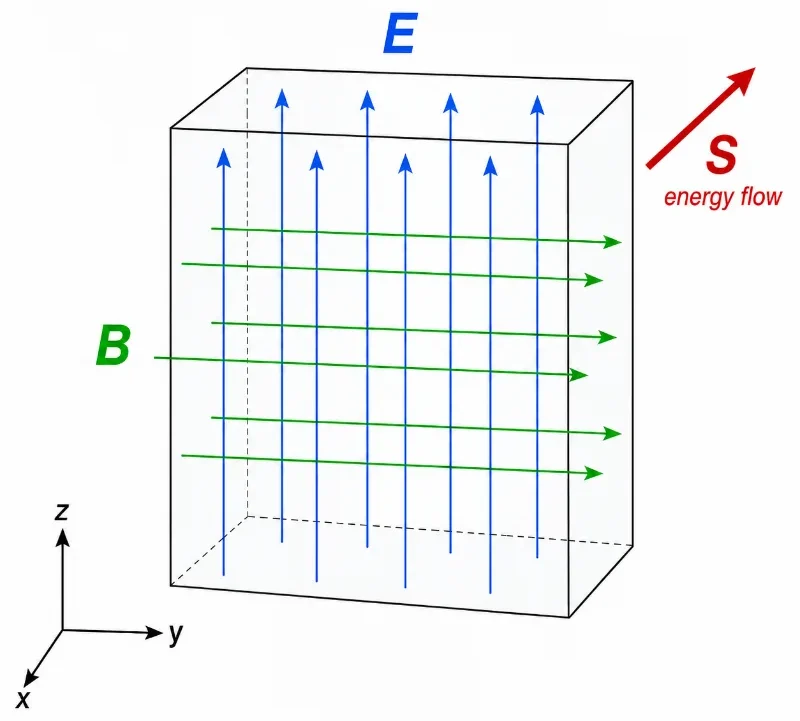
The Poynting vector shows the direction of electromagnetic energy flow, determined by the combined orientation of the electric field and magnetic field.
This illustration shows electromagnetic energy flow in a region of space. The blue arrows represent the electric field E, while the green arrows represent the magnetic field B. The red arrow labelled S represents the Poynting vector, which points in the direction of electromagnetic energy transfer. The diagram helps students see that electromagnetic energy flow is not determined by the electric field alone or the magnetic field alone. Instead, the direction of energy flow comes from the combined field relationship represented by the cross product E × B.
Where This Page Fits in Electrodynamics
The Electrodynamics cluster studies how electric and magnetic fields behave when charges move and fields change with time. This page focuses on the energy side of that story: where electromagnetic energy is stored, how it flows, and how it is transferred to matter.
Introduces electric charge, electric fields, magnetic fields, circuits, induction, electromagnetic waves, and the broader structure of classical electromagnetism.
Connects charge, current, changing fields, Maxwell’s equations, energy transfer, and relativistic structure into one field-based view of electromagnetism.
Shows how electric and magnetic fields are connected through motion, reference frames, and the spacetime structure of electromagnetism.
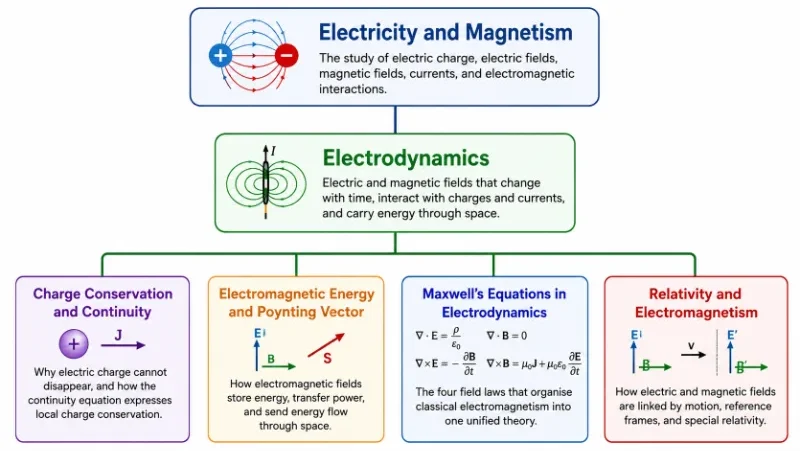
This hierarchy chart shows Electrodynamics as a sub-cluster of Electricity and Magnetism, with four connected pages on charge conservation, electromagnetic energy flow, Maxwell’s equations, and relativity.
This chart presents the Electrodynamics cluster within the wider Electricity and Magnetism section of Prep4Uni.online. Electricity and Magnetism appears as the parent area, followed by Electrodynamics as the cluster hub. The four child pages are shown in reordered sequence: Charge Conservation and Continuity, Electromagnetic Energy and Poynting Vector, Maxwell’s Equations in Electrodynamics, and Relativity and Electromagnetism. The chart helps students see how the Electrodynamics pathway connects local charge conservation, field energy flow, the four Maxwell field laws, and the relativistic relationship between electric and magnetic fields.
What Electromagnetic Energy Really Is
In mechanics, we often associate energy with visible motion, height, compression, or heat. In electromagnetism, energy can also exist in fields. A charged capacitor stores energy in its electric field. An inductor stores energy in its magnetic field. A travelling electromagnetic wave carries energy through space. A circuit transfers energy from a source to a load through the surrounding electromagnetic field.
This field-based view can feel surprising because fields are not solid objects. Yet they are physically real in their effects. They exert forces, store energy, transmit signals, and deliver power. When a light bulb glows, a motor turns, or an antenna radiates, the energy transfer is described most deeply by electromagnetic fields.
The Poynting vector gives this idea a precise mathematical form. It tells us how much electromagnetic energy flows through a unit area per unit time, and in what direction.
Energy Stored in Electric Fields
An electric field stores energy. In empty space or air, the electric field energy density is:
\[ u_E = \frac{1}{2}\varepsilon_0 E^2 \]
Here, \( u_E \) is the electric energy density, \( \varepsilon_0 \) is the permittivity of free space, and \( E \) is the magnitude of the electric field.
This equation says that stronger electric fields store more energy per unit volume. The dependence on \( E^2 \) is important: doubling the electric field makes the stored electric energy density four times larger.
Energy Stored in Magnetic Fields
A magnetic field also stores energy. In empty space or air, the magnetic field energy density is:
\[ u_B = \frac{1}{2\mu_0}B^2 \]
Here, \( u_B \) is the magnetic energy density, \( \mu_0 \) is the permeability of free space, and \( B \) is the magnitude of the magnetic field.
This equation appears naturally in inductors, electromagnets, transformers, motors, generators, and electromagnetic waves. Whenever a magnetic field is built up, energy is stored in that field.
Total Electromagnetic Energy Density
When electric and magnetic fields both exist, the total electromagnetic energy density is:
\[ u = \frac{1}{2}\varepsilon_0 E^2 + \frac{1}{2\mu_0}B^2 \]
This is energy per unit volume. It tells us how much electromagnetic energy is present in a small region of space because of the fields there.
This idea is useful in many settings. Between capacitor plates, most of the stored energy is electric. Around an inductor, much of the stored energy is magnetic. In an electromagnetic wave, electric and magnetic field energy travel together.
The Poynting Vector
The Poynting vector describes electromagnetic energy flow:
The vector \( \mathbf{S} \) points in the direction of electromagnetic energy transfer. Its magnitude gives the rate of energy flow per unit area, measured in watts per square metre.
The cross product matters. The energy flow direction is perpendicular to both \( \mathbf{E} \) and \( \mathbf{B} \). In a travelling electromagnetic wave, if the electric field points upward and the magnetic field points sideways, the Poynting vector points in the direction the wave carries energy.
Reading the Poynting Vector Physically
\( \mathbf{E} \)
The electric field helps determine how charges would be pushed and how electric field energy is stored in space.
\( \mathbf{B} \)
The magnetic field helps determine magnetic force effects and how magnetic field energy is stored in space.
\( \mathbf{E} \times \mathbf{B} \)
The cross product gives the direction in which electromagnetic energy flows through space.
\( \mathbf{S} \)
The Poynting vector gives electromagnetic power flow per unit area. Its unit is \( \text{W/m}^2 \).
Power Flow Through a Surface
If \( \mathbf{S} \) gives power flow per unit area, then the total electromagnetic power crossing a surface is found by integrating \( \mathbf{S} \) over that surface:
\[ P = \int_S \mathbf{S} \cdot d\mathbf{A} \]
The dot product \( \mathbf{S} \cdot d\mathbf{A} \) measures the amount of energy flow passing through each small patch of surface. If \( \mathbf{S} \) points through the surface, energy crosses it. If \( \mathbf{S} \) is parallel to the surface, little or no energy crosses that patch.
This surface view is powerful because it allows us to analyse energy transfer into a device, out of a source, across a boundary, or through space.
Poynting Theorem: Energy Conservation for Fields
Poynting theorem is the electromagnetic version of energy conservation. In one common differential form, it may be written as:
This equation says that electromagnetic energy is locally conserved. The energy density \( u \) inside a region can change, energy can flow out through the Poynting vector, and fields can do work on charges through the term \( \mathbf{J} \cdot \mathbf{E} \).
A useful way to read the equation is:
\( \frac{\partial u}{\partial t} \)
The rate at which electromagnetic energy density changes at a point.
\( \nabla \cdot \mathbf{S} \)
The net spreading outward of electromagnetic energy flow from a point.
\( -\mathbf{J} \cdot \mathbf{E} \)
The rate at which electromagnetic fields transfer energy to matter, such as charges in a resistor.
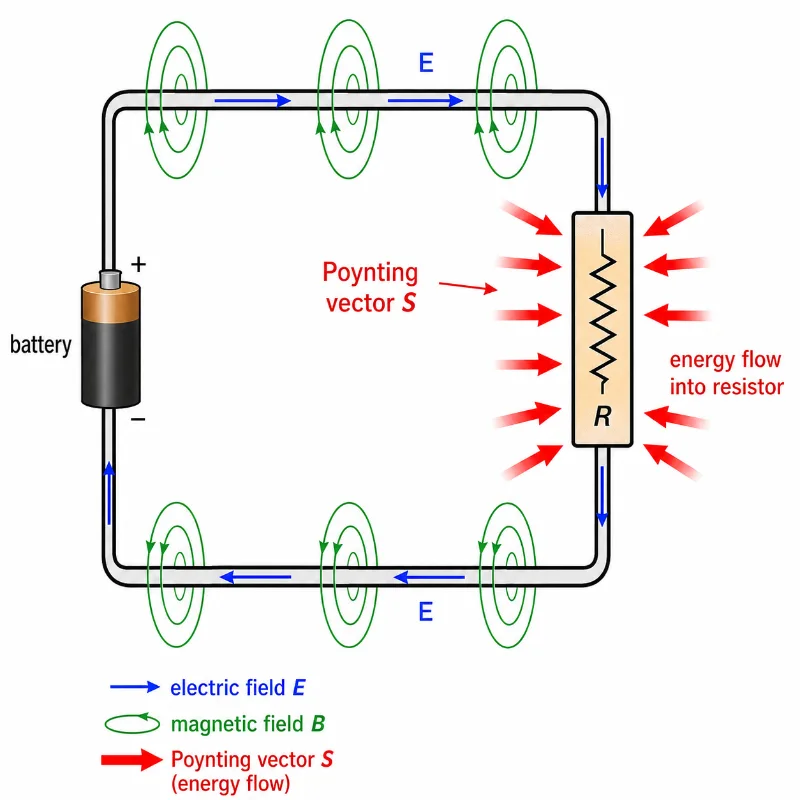
In the field view of a circuit, electromagnetic energy flows through the surrounding space and enters the resistor, rather than being best imagined as travelling only inside the metal wires.
This illustration shows a simple battery-resistor circuit from the perspective of electromagnetic energy flow. Blue arrows along the wires represent the electric field, while green loops around the wires represent the magnetic field. Red arrows labelled as the Poynting vector show electromagnetic energy flowing from the surrounding space into the resistor. The diagram helps students see that the resistor receives energy through the electromagnetic field configuration around the circuit, not merely as something moving inside the metal wire like water in a pipe. It introduces the deeper electrodynamic idea that the fields guide and carry energy to the place where it is converted into heat.
Why Energy Flow Is Not Just “Inside the Wire”
In elementary circuit language, it is natural to say that current carries energy through the wire. This is useful at first, but it is incomplete. Electrons in a metal drift slowly, yet electrical energy can be delivered to a device very quickly after a circuit is completed.
The field view resolves this puzzle. The changing electromagnetic field configuration spreads through the circuit, and energy flow is described by the Poynting vector. The wire guides the fields, but the electromagnetic energy flow is associated with the surrounding electric and magnetic fields.
This does not mean wires are unimportant. Wires provide conducting boundaries, allow charges to redistribute, shape the electric field, and support current. But the deeper energy-transfer story belongs to the fields.
Electromagnetic Energy in a Capacitor
A charged capacitor stores energy mainly in the electric field between its plates. For a parallel-plate capacitor, the field between the plates is nearly uniform, so the energy is concentrated in the gap.
The total energy stored in a capacitor may be written as:
\[ U = \frac{1}{2}CV^2 \]
This circuit formula agrees with the field view. The energy is not stored “on” the plates as a mysterious substance. It is stored in the electric field created between the plates.
Electromagnetic Energy in an Inductor
An inductor stores energy mainly in its magnetic field. When current increases through a coil, the magnetic field strengthens and energy is stored. When the current decreases, the magnetic field weakens and energy can be returned to the circuit.
The total energy stored in an inductor is:
\[ U = \frac{1}{2}LI^2 \]
This formula gives the circuit-level expression, while the field-level interpretation says that the energy is stored in the magnetic field surrounding and passing through the coil.
Electromagnetic Waves and Energy Transport
In an electromagnetic wave, electric and magnetic fields travel together. The wave carries energy through space, and the Poynting vector points in the direction of propagation.
For a plane wave in empty space, the electric field, magnetic field, and energy flow direction are mutually perpendicular. The wave does not need a material medium. Its energy is carried by the fields themselves.
This page mentions electromagnetic waves because they are an important example of energy flow. However, the main focus here is broader than waves: the Poynting vector also helps explain energy transfer in circuits, capacitors, inductors, antennas, and near-field systems.
Advanced Case Study: Visualizing Power Flow Inside a Coaxial Cable
To break free from the introductory misconception that power flows “inside the bulk metal of a wire,” university physics standardizes the mathematical analysis of a classic DC coaxial cable system. Imagine an ideal cylindrical coaxial cable carrying a steady direct current \(I\) from a battery to a load resistance, maintaining a static potential difference \(V\) between its inner conductor (radius \(a\)) and outer shield (inner radius \(b\)).
Let us analyze the localized vector field configurations present strictly inside the empty insulating dielectric material gap separating the two conductors:
The Radial Electric Field: Gauss’s Law dictates that the potential difference establishes a radial electric field pointing from the center outward: $$ \mathbf{E} = \frac{V}{\ln(b/a)} \frac{1}{r} \hat{\mathbf{r}} $$
The Azimuthal Magnetic Field: Ampère’s Law dictates that the current flowing through the inner core establishes a wrapping, circular magnetic field: $$ \mathbf{B} = \frac{\mu_0 I}{2\pi r} \hat{\boldsymbol{\phi}} $$
Now, apply the cross-product definition of the Poynting vector (\(\mathbf{S} = \frac{1}{\mu_0}\mathbf{E} \times \mathbf{B}\)) to determine the exact trajectory of power flow. Since the unit vectors cross via \(\hat{\mathbf{r}} \times \hat{\boldsymbol{\phi}} = \hat{\mathbf{z}}\), the energy flow points entirely down the length of the cable parallel to the tracks:
To find the total power passing through the cross-section of the insulating gap, integrate this energy flux vector over the entire area of the dielectric ring boundary from radius \(a\) to \(b\):
$$ P = \int_a^b S \cdot (2\pi r \, dr) = \int_a^b \frac{VI}{2\pi \ln(b/a) r^2} \cdot 2\pi r \, dr = \frac{VI}{\ln(b/a)} \int_a^b \frac{1}{r} \, dr $$
$$ P = \frac{VI}{\ln(b/a)} \cdot \left[ \ln(r) \right]_a^b = \frac{VI}{\ln(b/a)} \cdot \ln(b/a) = VI $$
This calculation proves that 100% of the electrical power delivered from the battery source to the resistive load travels exclusively through the empty, non-conductive dielectric space between the tracks. The metal wires do not carry the power internally; they serve purely as geometric boundaries that anchor and shape the fields in the space around them.
Beyond Energy: Electromagnetic Field Momentum and Radiation Pressure
Because time-varying electromagnetic fields carry energy through space via the Poynting vector, Einstein’s relativistic mass-energy equivalence dictates that they must also carry a corresponding linear physical momentum. Even in a pure vacuum devoid of any mass carriers, an electromagnetic field distribution possesses a distinct momentum density vector (\(\mathbf{g}\)), which tracks proportionally as a direct scalar modification of the Poynting flux vector:
This field momentum is as physically real as the mechanical momentum stored in a moving train. When a traveling wave pulse encounters a boundary surface (such as light hitting a mirror or a radio signal striking a metal satellite dish), the wave reflects or absorbs, changing its momentum vector.
To satisfy the global conservation of momentum, this field momentum shift must exert an immediate mechanical force on the boundary surface’s atomic lattice. This macro-scale pushing force per unit area is called radiation pressure (\(P_{\text{rad}}\)). For a plane wave normally incident upon a perfectly absorbing surface, the pressure tracks via:
$$ P_{\text{rad}} = \frac{\langle S \rangle}{c} $$
Where \(\langle S \rangle\) represents the time-averaged magnitude of the Poynting vector. While this pressure value is incredibly tiny in everyday environments, it acts as the primary driving force behind long-range cosmological phenomena, including the trajectory adjustments of solar sails in space exploration and the outward push of stellar gases that prevents gravity from collapsing active stars.
Worked Example 1: Electric Field Energy Density
Problem: An electric field has magnitude \( E = 2.0 \times 10^4 \ \text{V/m} \). Estimate the electric energy density in air, using \( \varepsilon_0 = 8.85 \times 10^{-12} \ \text{F/m} \).
The electric field energy density is approximately \( 1.8 \times 10^{-3} \ \text{J/m}^3 \).
Worked Example 2: Magnetic Field Energy Density
Problem: A magnetic field has magnitude \( B = 0.020 \ \text{T} \). Estimate the magnetic energy density, using \( \mu_0 = 4\pi \times 10^{-7} \ \text{H/m} \).
The magnetic energy density is approximately \( 160 \ \text{J/m}^3 \).
Worked Example 3: Direction of the Poynting Vector
Problem: At a certain point, the electric field points in the \( +x \)-direction and the magnetic field points in the \( +y \)-direction. What is the direction of electromagnetic energy flow?
Therefore, the electromagnetic energy flow points in the \( +z \)-direction.
Worked Example 4: Power Through an Area
Problem: A uniform electromagnetic energy flux has magnitude \( S = 500 \ \text{W/m}^2 \) and passes perpendicularly through an area of \( 0.20 \ \text{m}^2 \). What power crosses the area?
Solution:
For perpendicular flow:
\[ P = SA \]
Substitute:
\[ P = 500 \times 0.20 \]
\[ P = 100 \ \text{W} \]
The power crossing the area is \( 100 \ \text{W} \).
Common Misconceptions
Misconception 1: Energy Travels Only Inside Wires
Wires guide charges and shape fields, but the deeper electrodynamic description places energy flow in the electromagnetic fields around the circuit.
Misconception 2: Electric and Magnetic Fields Only Exert Forces
Fields do exert forces, but they also store energy and transport energy.
Misconception 3: The Poynting Vector Applies Only to Light
The Poynting vector is important for electromagnetic waves, but it also applies to circuits, antennas, capacitors, inductors, and near-field energy transfer.
Misconception 4: Energy Density Means Total Energy
Energy density is energy per unit volume. Total energy is found by integrating energy density over a volume.
Misconception 5: A Resistor Receives Energy Only Through Its Ends
In the field view, electromagnetic energy can flow into the resistor through the surrounding space and its surface, not merely through the wire ends.
Quick Check: Field Energy
Quick Check: Field Energy
1. Where is the energy mainly stored in a charged parallel-plate capacitor?
The energy is mainly stored in the electric field between the plates.
2. Where is energy mainly stored in an inductor?
The energy is mainly stored in the magnetic field associated with the current in the inductor.
3. What happens to electric field energy density if \( E \) is doubled?
Since \( u_E = \frac{1}{2}\varepsilon_0 E^2 \), doubling \( E \) makes the electric field energy density four times larger.
Quick Check: Poynting Vector
Quick Check: Poynting Vector
1. What does the Poynting vector represent?
The Poynting vector represents electromagnetic power flow per unit area and points in the direction of electromagnetic energy transfer.
2. What is the formula for the Poynting vector in empty space?
The Poynting vector is \( \mathbf{S} = \frac{1}{\mu_0}\mathbf{E} \times \mathbf{B} \).
3. If \( \mathbf{E} \) points upward and \( \mathbf{B} \) points to the right, how do you find the direction of \( \mathbf{S} \)?
Use the right-hand rule for \( \mathbf{E} \times \mathbf{B} \). The result gives the direction of electromagnetic energy flow.
Thought-Provoking Questions
Thought-Provoking Questions
1. Why is it incomplete to say that electrical energy travels only inside wires?
That statement ignores the role of electromagnetic fields. Wires guide charges and shape fields, but the Poynting vector shows that electromagnetic energy flow is associated with the fields around the circuit.
2. Why does the Poynting vector depend on both \( \mathbf{E} \) and \( \mathbf{B} \), rather than on only one field?
Electromagnetic energy flow is a combined field effect. The electric and magnetic fields together determine the direction and rate of energy transfer through \( \mathbf{E} \times \mathbf{B} \).
3. Why does Poynting theorem resemble a continuity equation?
It has the form of a local conservation law. The change in field energy density is balanced by energy flow and energy transfer to matter, just as charge conservation balances charge density change and current flow.
Numerical Practice
Numerical Practice
1. An electric field has magnitude \( 1.0 \times 10^5 \ \text{V/m} \). Estimate \( u_E \) using \( \varepsilon_0 = 8.85 \times 10^{-12} \ \text{F/m} \).
Using \( u_E = \frac{1}{2}\varepsilon_0 E^2 \), we get \( u_E = \frac{1}{2}(8.85 \times 10^{-12})(1.0 \times 10^5)^2 = 4.43 \times 10^{-2} \ \text{J/m}^3 \).
2. A magnetic field has magnitude \( 0.010 \ \text{T} \). Estimate \( u_B \) using \( \mu_0 = 4\pi \times 10^{-7} \ \text{H/m} \).
Using \( u_B = \frac{B^2}{2\mu_0} \), we get \( u_B = \frac{(0.010)^2}{2(4\pi \times 10^{-7})} \approx 39.8 \ \text{J/m}^3 \).
3. A uniform energy flux of \( 250 \ \text{W/m}^2 \) crosses an area of \( 0.40 \ \text{m}^2 \) perpendicularly. What power crosses the area?
For perpendicular flow, \( P = SA = 250 \times 0.40 = 100 \ \text{W} \).
4. If \( \mathbf{E} \) points in the \( +y \)-direction and \( \mathbf{B} \) points in the \( +z \)-direction, what is the direction of \( \mathbf{S} \)?
Since \( \hat{\mathbf{y}} \times \hat{\mathbf{z}} = \hat{\mathbf{x}} \), the Poynting vector points in the \( +x \)-direction.
Review Questions and Answers
Review Questions and Answers
1. What is electromagnetic energy density?
Electromagnetic energy density is the amount of energy stored in electric and magnetic fields per unit volume.
2. Write the total electromagnetic energy density in empty space.
The total electromagnetic energy density is \( u = \frac{1}{2}\varepsilon_0 E^2 + \frac{1}{2\mu_0}B^2 \).
3. What is the Poynting vector?
The Poynting vector describes electromagnetic energy flow per unit area and points in the direction of electromagnetic power transfer.
4. What is the unit of the Poynting vector?
The unit is watts per square metre, \( \text{W/m}^2 \).
5. What does \( \mathbf{J} \cdot \mathbf{E} \) represent in Poynting theorem?
It represents the rate at which electromagnetic fields do work on charges per unit volume, transferring energy from fields to matter.
6. Why is the Poynting vector useful in circuit analysis?
It reveals how electromagnetic energy flows through the fields around a circuit, giving a deeper explanation of how power reaches components such as resistors, motors, and lamps.
Glossary
Electromagnetic energy: Energy associated with electric and magnetic fields.
Energy density: Energy per unit volume, often measured in joules per cubic metre.
Electric field energy density: The energy stored per unit volume in an electric field, given by \( u_E = \frac{1}{2}\varepsilon_0 E^2 \) in empty space.
Magnetic field energy density: The energy stored per unit volume in a magnetic field, given by \( u_B = \frac{1}{2\mu_0}B^2 \) in empty space.
Poynting vector: A vector \( \mathbf{S} = \frac{1}{\mu_0}\mathbf{E} \times \mathbf{B} \) that describes electromagnetic energy flow per unit area.
Power flux: The rate of energy transfer per unit area, measured in watts per square metre.
Poynting theorem: The local conservation law for electromagnetic energy, linking field energy density, energy flow, and work done on charges.
Field energy: Energy stored in a field rather than in a visibly moving object.
Electromagnetic power transfer: The movement of energy from one region to another through electric and magnetic fields.
\( \mathbf{J} \cdot \mathbf{E} \): The rate per unit volume at which electromagnetic fields transfer energy to moving charges.
Electromagnetic fields do more than exert forces. They store energy, move energy, and transfer energy to matter. Electric fields store energy through \( u_E = \frac{1}{2}\varepsilon_0 E^2 \), magnetic fields store energy through \( u_B = \frac{1}{2\mu_0}B^2 \), and together they give the total electromagnetic energy density.
shows the direction and rate of electromagnetic energy flow. It is useful not only for light and electromagnetic waves, but also for circuits, capacitors, inductors, antennas, resistors, and power-transfer systems.
The most important lesson is that energy in electrodynamics is a field story. Wires, devices, and charges matter greatly, but the electromagnetic fields provide the deeper map of how energy moves.
Reflection Question
If electromagnetic energy can flow through the space around a circuit, rather than only inside the wires, how should this change the way we imagine a battery delivering power to a lamp or resistor?