Prepare for University Studies & Career Advancement
Relativity and Electromagnetism
Relativity and electromagnetism are deeply connected. At first, electric fields and magnetic fields may seem like two different kinds of physical influence. Electric fields act on charges whether they are moving or not, while magnetic fields act especially on moving charges. Special relativity shows a deeper idea: electric and magnetic fields are linked aspects of one electromagnetic field.
This page explains how motion, reference frames, charge density, current, electric fields, and magnetic fields fit together. It shows why magnetism is not merely an added topic after electricity, but part of the same relativistic structure of classical electrodynamics.
The central lesson is simple but powerful: what one observer describes mainly as an electric effect, another moving observer may describe partly as a magnetic effect. The physical event is the same, but the field description depends on the observer’s frame of reference.
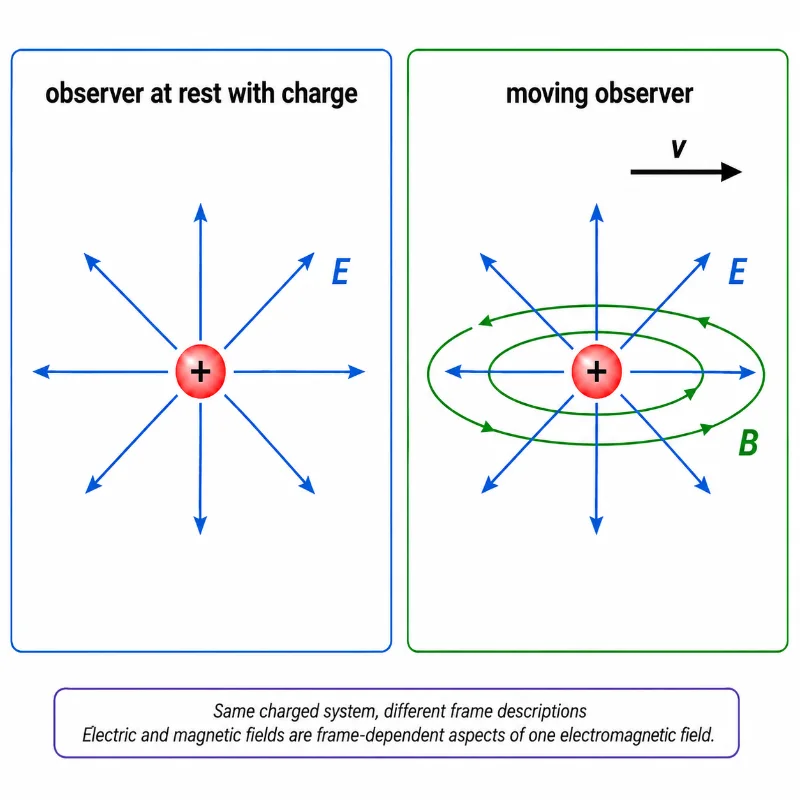
A stationary charge may be described mainly by an electric field in its rest frame, while a moving observer may describe the same charged system using both electric and magnetic field effects.
This illustration shows how electric and magnetic fields can depend on the observer’s frame of reference. In the left panel, an observer at rest with a positive charge sees radial electric field arrows spreading outward from the charge. In the right panel, a moving observer views the same charged system differently: the charge is associated with both electric field arrows and magnetic field loops. The velocity arrow indicates relative motion between frames. The picture helps students understand a key idea in relativity and electromagnetism: electric and magnetic fields are not completely separate objects, but frame-dependent aspects of one electromagnetic field.
Where This Page Fits in Electrodynamics
The Electrodynamics cluster studies electric and magnetic fields when charges move, currents flow, and fields change with time. This page completes the cluster by showing why electric and magnetic fields are naturally connected through special relativity.
Introduces electric charge, electric fields, magnetic fields, circuits, induction, electromagnetic waves, and the broader structure of classical electromagnetism.
Connects charge, current, changing fields, Maxwell’s equations, energy transfer, and relativistic structure into one field-based view of electromagnetism.
Explains the four field laws that govern electric fields, magnetic fields, charge, current, induction, and displacement current.
Relativity and Electromagnetism
Shows how electric and magnetic fields are connected through motion, reference frames, and the spacetime structure of electromagnetism.
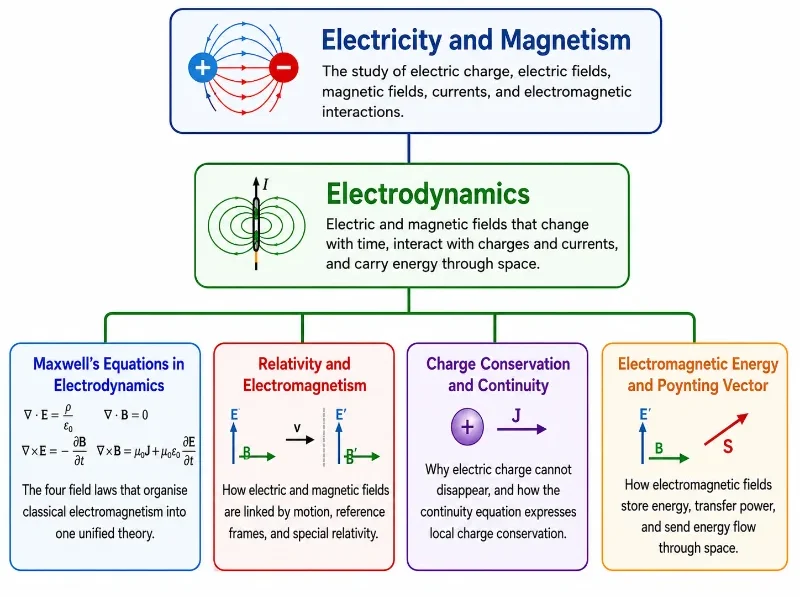
This hierarchy chart shows Electrodynamics within Electricity and Magnetism, with the child pages rearranged to highlight Maxwell’s equations, relativity, charge conservation, and electromagnetic energy flow.
This chart presents the Electrodynamics cluster within the wider Electricity and Magnetism section of Prep4Uni.online. Electricity and Magnetism appears as the parent area, followed by Electrodynamics as the cluster hub. The four child pages are shown in an interchanged order: Maxwell’s Equations in Electrodynamics, Relativity and Electromagnetism, Charge Conservation and Continuity, and Electromagnetic Energy and Poynting Vector. The chart helps students see that Electrodynamics connects the four field laws, the relativistic relationship between electric and magnetic fields, local charge conservation, and the flow of electromagnetic energy through space.
What Relativity and Electromagnetism Really Means
Special relativity began partly from a puzzle about electromagnetism. Maxwell’s equations predicted electromagnetic waves travelling at a fixed speed \( c \). But if observers move relative to one another, how can the speed of light remain the same for all inertial observers?
Einstein’s answer was not to change Maxwell’s equations, but to change our understanding of space and time. Time intervals, lengths, simultaneity, energy, momentum, electric fields, and magnetic fields must all be understood in a way that remains consistent across inertial frames.
In this view, electromagnetism is not simply electricity plus magnetism. It is a single relativistic field theory whose electric and magnetic parts can mix when viewed from different frames of reference.
Why Motion Changes the Field Description
A stationary charge produces an electric field. If another observer moves relative to that charge, the charge is no longer stationary in that observer’s frame. A moving charge is a current, and currents are associated with magnetic fields.
This does not mean that the physical situation has changed into a different event. The same charge is being described from a different frame. What changes is how the electromagnetic field is separated into electric and magnetic parts.
This is one reason magnetism can be described as a relativistic effect of electricity. The statement must be used carefully, because magnetic fields are fully real and measurable. But relativity explains why electric and magnetic fields are linked rather than independent.
Electric and Magnetic Fields as One Electromagnetic Field
In non-relativistic introductory physics, we often treat \( \mathbf{E} \) and \( \mathbf{B} \) as separate fields. This is useful for learning, but it is not the deepest view.
In special relativity, \( \mathbf{E} \) and \( \mathbf{B} \) are parts of a single electromagnetic field. Different inertial observers may divide that field into electric and magnetic components differently.
Electric Field View
A charge at rest creates an electric field. A nearby test charge feels an electric force due to this field.
Magnetic Field View
A moving charge or current produces magnetic effects. A moving test charge may experience a magnetic force.
Relativistic Field View
Electric and magnetic fields are connected parts of one electromagnetic field, and their measured values depend on the observer’s motion.
The Lorentz Force Law
The force on a charge in electric and magnetic fields is described by the Lorentz force law:
Here, \( q \) is the charge, \( \mathbf{u} \) is the velocity of the charge, \( \mathbf{E} \) is the electric field, and \( \mathbf{B} \) is the magnetic field.
The electric part \( q\mathbf{E} \) acts on the charge whether the charge is moving or not. The magnetic part \( q\mathbf{u} \times \mathbf{B} \) depends on the charge’s velocity. This already hints that motion and electromagnetic force are closely connected.
Reference Frames and Observers
A reference frame is a viewpoint from which position, time, motion, fields, and forces are measured. In special relativity, inertial frames move at constant velocity relative to one another.
Two observers in different inertial frames may disagree about lengths, time intervals, simultaneity, charge density, current density, and the separate values of \( \mathbf{E} \) and \( \mathbf{B} \). However, they must agree on the physical outcome when the laws are applied correctly.
This is why relativity is not about “anything goes.” It is about finding laws that remain consistent when observers are moving relative to one another.
Illustration: Same Charge, Two Frames
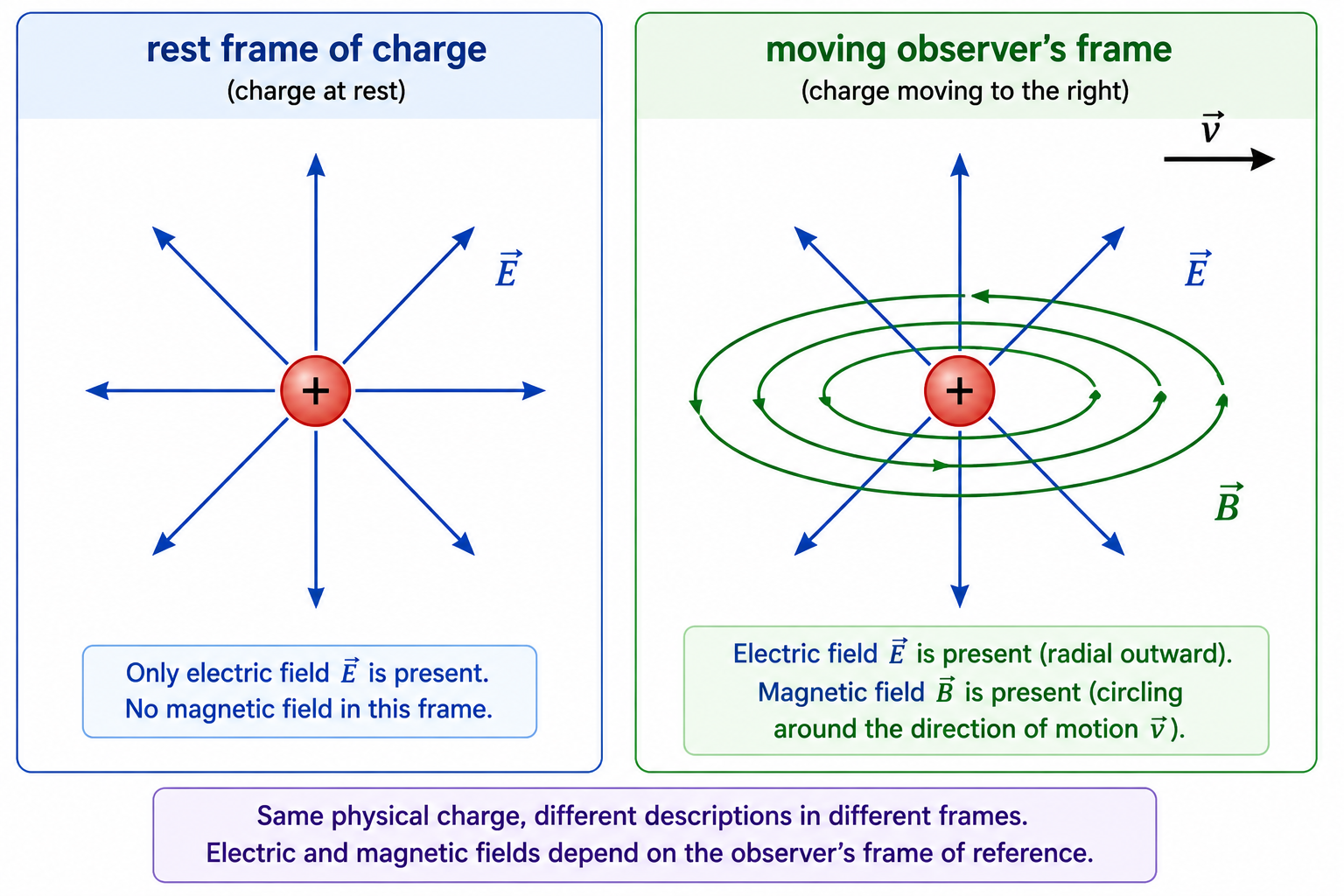
The same charged system can be described differently in different frames: at rest it appears mainly electric, while in a moving frame both electric and magnetic field effects appear.
This illustration compares how the same positive charge is described in two reference frames. In the left panel, the rest frame of the charge shows radial electric field arrows spreading outward, with no magnetic field shown. In the right panel, the moving observer’s frame shows the same charge with both electric field arrows and magnetic field loops. The velocity arrow indicates relative motion, while the magnetic field loops are drawn in one consistent circulation direction around the motion. The diagram helps students understand that electric and magnetic fields are frame-dependent aspects of one electromagnetic field, not completely separate physical objects.
How a Current-Carrying Wire Reveals Relativity
A current-carrying wire is one of the clearest conceptual bridges between magnetism and relativity. In the laboratory frame, the positive ions in the metal lattice are nearly stationary, while electrons drift through the wire. The wire is usually electrically neutral overall.
A nearby moving charge can experience a magnetic force due to the current in the wire. In another frame, where the moving charge is momentarily at rest, the explanation can involve a different balance of charge density because lengths along the direction of motion are measured differently.
This does not make magnetism an illusion. It shows that electric and magnetic explanations can transform into one another across frames while describing the same physical interaction.
Length Contraction and Charge Density
Special relativity says that lengths measured along the direction of relative motion are contracted. This can affect measured charge density because density depends on how much charge is counted per unit length or volume.
If a row of moving charges is observed from another frame, the spacing between those charges may be measured differently. This changes the observed charge density. A difference in charge density can create an electric field in one frame where another frame gives a magnetic explanation.
This is one of the most important lessons in relativity and electromagnetism: fields and sources are frame-dependent, but the physical interaction remains consistent.
Advanced Analytical Bridge: Deriving Magnetism via Length Contraction (Purcell’s Thought Experiment)
To appreciate why magnetism is structurally defined as a relativistic manifestation of electrostatics, university physics introduces Purcell’s Thought Experiment. Consider a long, straight copper wire carrying a steady line current. In the Laboratory Frame (Frame \(S\)), the wire is completely electrically neutral. The stationary positive copper ions have a linear charge density \(\lambda_+\), and the drifting conduction electrons have a negative linear charge density \(\lambda_-\), such that:
Now, place a positive test charge \(q\) outside the wire, moving parallel to it at a constant velocity \(v\). In this Lab Frame, because the wire is macroscopically neutral, the electrostatic field is exactly zero (\(\mathbf{E} = 0\)). However, due to the motion of the electrons, a wrapping magnetic field \(\mathbf{B}\) exists, exerting a classic Lorentz deflection force drawing the charge toward the wire.
Let us change our perspective to the Rest Frame of the moving test charge (Frame \(S’\)). In this frame, the test charge is stationary (\(u’ = 0\)), meaning it can experience absolutely zero magnetic force (\(q\mathbf{u}’ \times \mathbf{B}’ = 0\)). Yet, the physical deflection must still happen. How does relativity explain this force?
The answer lies in Lorentz Length Contraction. In the transition from Frame \(S\) to Frame \(S’\):
The positive copper ions, which were stationary in the lab, are now moving backward at velocity \(-v\). Their space intervals contract, packing them closer together and driving up their linear charge density to: $$ \lambda’_+ = \gamma \lambda_+ $$
The conduction electrons, depending on their drift velocity, undergo a different relative frame shift, causing their spatial intervals to expand compared to the ions, yielding a lower negative charge density magnitude: $$ \lambda’_- < \gamma |\lambda_-| $$
Because the two densities no longer balance out, the wire becomes <strong>electrostatically charged</strong> in the moving test charge’s frame (\(\lambda’_{\text{net}} > 0\)). This positive line charge creates a real, radial electrostatic field (\(\mathbf{E}’\)) that pulls the stationary particle toward the wire.
The physical deflection is identical in both frames. What the lab observer attributes to a magnetic force, the moving charge attributes entirely to a coulombic electric force born from relativistic length contraction.
Geometric Bedrocks: The Electromagnetic Spacetime Invariants
While field transformations prove that separate \(\mathbf{E}\) and \(\mathbf{B}\) field profiles shift fluidly depending on your velocity vector, electrodynamics is not arbitrary. The mathematical architecture of special relativity locks down two structural quantities that are completely Lorentz Invariant—meaning every inertial observer in the universe will calculate the exact same numerical scalar output, regardless of their speed:
These two invariants dictate strict geometric rules for how fields can mix across space and time:
The Physical Rules of Field Invariance
Topological Limits of Reference Frames
Rule 1: Orthogonality is Absolute. If the electric and magnetic fields are perfectly perpendicular to each other in one frame (\(\mathbf{E} \cdot \mathbf{B} = 0\)), such as inside a traveling light wave, they will remain perfectly perpendicular to each other in all inertial frames. You can never accelerate fast enough to alter this angle.
Rule 2: Magnitude Dominance Cannot Flip. If a region of space is purely electric in the rest frame (\(E > 0, B = 0\)), the term \(E^2 – c^2B^2\) outputs a positive value. This means that no matter how fast an observer travels past that charge, they will always measure a non-zero electric field component; the electric field can never be fully transformed away or overpowered by the induced magnetic field.
Rule 3: Light Wave Symmetry. For a plane wave in a vacuum, \(E = cB\) and \(\mathbf{E} \cdot \mathbf{B} = 0\), causing both invariants to evaluate to exactly zero. This confirms that a light wave maintains its balanced, self-sustaining profile across all reference frames, preserving the structural constant \(c\).
Field Transformations: The Central Mathematical Idea
When moving from one inertial frame to another, electric and magnetic fields transform. The exact formulas depend on the direction of relative motion and on the chosen sign convention. A common compact way to express the idea is:
These equations show the main idea: components parallel to the relative motion behave differently from components perpendicular to it, and the electric and magnetic fields can mix under a change of inertial frame.
For this introductory page, the important lesson is not to memorise every transformation formula. The important lesson is that \( \mathbf{E} \) and \( \mathbf{B} \) are linked by the geometry of spacetime.
Illustration: Field Transformation Between Frames
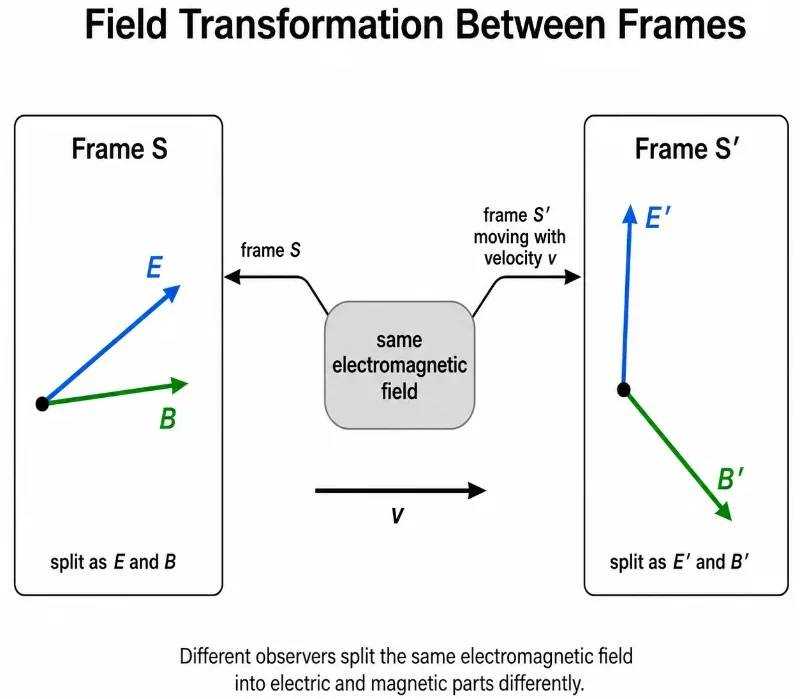
Changing reference frame does not remove the electromagnetic field. It changes how the same field is split into electric and magnetic parts.
This illustration explains how the electromagnetic field is described in different reference frames. A neutral grey block in the centre represents the same underlying electromagnetic field. From this central field, one arrow points to Frame S and another points to Frame S′, which is moving relative to Frame S with velocity v. In the left panel, Frame S shows the field split into a blue electric field component E and a green magnetic field component B. In the right panel, Frame S′ shows the same underlying field split differently into E′ and B′. The diagram helps students see that changing the observer’s frame does not make the electromagnetic field disappear. Instead, it changes how the same field is decomposed into electric and magnetic parts.
What Stays the Same Across Frames?
Although the separate electric and magnetic fields may change between inertial frames, some combinations remain invariant. These quantities help reveal the deeper unity of the electromagnetic field.
Two important electromagnetic invariants are:
\[ \mathbf{E} \cdot \mathbf{B} \]
and
\[ E^2 – c^2B^2 \]
Different observers may measure different \( \mathbf{E} \) and \( \mathbf{B} \), but they agree on these invariant combinations. This is similar in spirit to how observers may disagree about time and distance separately, while agreeing on the spacetime interval.
Maxwell’s Equations and Special Relativity
Maxwell’s equations fit naturally with special relativity. In fact, the constant speed \( c \) appearing in electromagnetic waves was one of the clues that space and time had to be rethought.
In vacuum, Maxwell’s equations lead to electromagnetic waves travelling at:
\[ c = \frac{1}{\sqrt{\mu_0\varepsilon_0}} \]
This is the speed of light in vacuum. Special relativity makes this speed a fundamental limit and a shared constant for all inertial observers.
The agreement between Maxwell’s equations and special relativity is one of the great unifications in physics. It shows that electromagnetism is already a relativistic theory.
Four-Current and Charge Conservation
Charge density and current density are also connected by relativity. In ordinary vector notation, charge conservation is written as:
In relativistic language, charge density and current density are combined into a four-current. This shows that charge and current are not unrelated quantities. They are different parts of one spacetime object.
This is why the earlier page on Charge Conservation and Continuity fits naturally before this page. Local charge conservation is not only a circuit rule; it is part of the relativistic structure of electrodynamics.
Electromagnetic Field Tensor: The Advanced View
At a higher university level, electric and magnetic fields are combined into one mathematical object called the electromagnetic field tensor. This tensor packages \( \mathbf{E} \) and \( \mathbf{B} \) into a form that transforms cleanly under Lorentz transformations.
Students do not need tensor calculus to understand the basic message. The field tensor is mentioned here because it reveals the deeper architecture: electric and magnetic fields are not separate ingredients placed side by side; they are components of one relativistic field.
This idea prepares students for advanced electrodynamics, particle physics, plasma physics, accelerator physics, and quantum field theory.
Energy, Momentum, and Relativity
Electromagnetic fields carry not only energy but also momentum. This matters in radiation pressure, antennas, optical tweezers, solar sails, and light-matter interactions.
The earlier page on Electromagnetic Energy and Poynting Vector describes energy flow using:
Relativity adds a deeper layer: energy and momentum are themselves linked as parts of spacetime physics. Electromagnetic waves carry energy and momentum in a way fully consistent with special relativity.
Common Misconceptions
Misconception 1: Magnetism Is Fake
Magnetism is not fake. It is a real measurable field effect. Relativity explains why magnetic and electric descriptions are linked across frames.
Misconception 2: Relativity Only Matters Near Light Speed
Relativistic corrections are largest near light speed, but the structure of electromagnetism is relativistic even when everyday speeds are small.
Misconception 3: Electric and Magnetic Fields Are Completely Separate
They are often introduced separately, but special relativity shows that they are connected components of one electromagnetic field.
Misconception 4: Changing Frames Changes Reality
Changing frames changes the description, not the physical event. Properly transformed descriptions agree on observable outcomes.
Misconception 5: Maxwell’s Equations Needed to Be Replaced by Relativity
Maxwell’s equations were not discarded. Instead, they became one of the strongest clues pointing toward special relativity.
Worked Example 1: Magnetic Force on a Moving Charge
Problem: A charge \( q = 2.0 \times 10^{-6} \ \text{C} \) moves at \( 3.0 \times 10^5 \ \text{m/s} \) perpendicular to a magnetic field of \( 0.20 \ \text{T} \). What is the magnetic force magnitude?
Solution:
For perpendicular motion:
\[ F = q u B \]
Substitute:
\[ F = (2.0 \times 10^{-6})(3.0 \times 10^5)(0.20) \]
\[ F = 0.12 \ \text{N} \]
The magnetic force magnitude is \( 0.12 \ \text{N} \).
Worked Example 2: Why Magnetic Force Depends on Motion
Problem: A charged particle is at rest in a region where \( \mathbf{B} \neq 0 \) but \( \mathbf{E} = 0 \). Does it feel a magnetic force?
If the particle is at rest, \( \mathbf{u} = 0 \). Since \( \mathbf{E} = 0 \):
\[ \mathbf{F} = q(0 + 0 \times \mathbf{B}) = 0 \]
So the particle feels no magnetic force while at rest. This illustrates why magnetic effects are closely tied to motion.
Worked Example 3: Interpreting a Frame Change
Problem: In one frame, a charge is at rest and produces only an electric field. In another frame, the charge is moving. What new field effect may appear in the second frame?
Solution:
A moving charge is a current. Since currents are associated with magnetic fields, the moving observer may describe the same physical situation using both electric and magnetic field effects.
The important point is not that the first observer is right and the second is wrong. Both descriptions can be correct when the fields are transformed properly between frames.
Worked Example 4: Electromagnetic Wave Speed
Problem: Maxwell’s equations predict that electromagnetic waves in vacuum travel at \( c = \frac{1}{\sqrt{\mu_0\varepsilon_0}} \). Why was this important for special relativity?
Solution:
The formula gives a fixed wave speed determined by constants of free space. Since this speed matches the speed of light, Maxwell’s theory implied that light is an electromagnetic wave.
Special relativity made this speed a fundamental constant for all inertial observers. This helped unify electromagnetism with the structure of space and time.
Quick Check: Frames and Fields
Quick Check: Frames and Fields
1. What does special relativity show about electric and magnetic fields?
It shows that electric and magnetic fields are connected parts of one electromagnetic field. Different moving observers may split the field into electric and magnetic parts differently.
2. If a charge is stationary in one frame but moving in another, what kind of field effect may appear in the moving description?
A magnetic field effect may appear because a moving charge is equivalent to a current in that observer’s frame.
3. Does changing reference frame change the physical event itself?
No. Changing frames changes the description of the event, not the event itself. Correctly transformed descriptions must agree on physical outcomes.
Quick Check: Lorentz Force
Quick Check: Lorentz Force
1. What is the Lorentz force law?
The Lorentz force law is \( \mathbf{F} = q(\mathbf{E} + \mathbf{u} \times \mathbf{B}) \), describing the force on a charge in electric and magnetic fields.
2. Which part of the Lorentz force depends directly on the charge’s velocity?
The magnetic part \( q\mathbf{u} \times \mathbf{B} \) depends directly on the charge’s velocity.
3. Can a charge at rest feel a magnetic force?
A charge at rest does not feel a magnetic force because \( \mathbf{u} = 0 \), so \( q\mathbf{u} \times \mathbf{B} = 0 \).
Thought-Provoking Questions
Thought-Provoking Questions
1. Why is it misleading to say that magnetism is only an illusion?
Magnetic fields are real and measurable. Relativity does not make magnetism unreal; it explains why magnetic and electric field descriptions are connected across moving frames.
2. Why did Maxwell’s equations help lead to special relativity?
Maxwell’s equations predict electromagnetic waves travelling at a fixed speed \( c \). This helped motivate a new understanding of space and time in which the speed of light is the same for all inertial observers.
3. Why are electric and magnetic fields better understood as parts of one electromagnetic field?
Because different inertial observers can measure different electric and magnetic components for the same physical situation. The unified electromagnetic field is the deeper object behind these frame-dependent descriptions.
Numerical Practice
Numerical Practice
1. A charge \( 1.5 \times 10^{-6} \ \text{C} \) moves at \( 2.0 \times 10^5 \ \text{m/s} \) perpendicular to a magnetic field of \( 0.30 \ \text{T} \). Find the magnetic force magnitude.
For perpendicular motion, \( F = quB = (1.5 \times 10^{-6})(2.0 \times 10^5)(0.30) = 9.0 \times 10^{-2} \ \text{N} \).
2. A charge \( 3.0 \times 10^{-6} \ \text{C} \) is at rest in an electric field of \( 400 \ \text{N/C} \). What is the electric force magnitude?
For the electric force, \( F = qE = (3.0 \times 10^{-6})(400) = 1.2 \times 10^{-3} \ \text{N} \).
3. If \( \mathbf{u} \) is parallel to \( \mathbf{B} \), what is the magnetic part of the Lorentz force?
If \( \mathbf{u} \) is parallel to \( \mathbf{B} \), then \( \mathbf{u} \times \mathbf{B} = 0 \). The magnetic force is zero.
4. If \( E = 0 \) and \( B = 0.50 \ \text{T} \), can a charge at rest feel a force?
No. If the charge is at rest, \( \mathbf{u} = 0 \), so the magnetic force is zero. Since \( E = 0 \), the total Lorentz force is also zero.
Review Questions and Answers
Review Questions and Answers
1. What is the main connection between relativity and electromagnetism?
Special relativity shows that electric and magnetic fields are connected parts of one electromagnetic field, and their measured components depend on the observer’s frame of reference.
2. Why can a moving charge be associated with a magnetic field?
A moving charge constitutes a current, and currents are associated with magnetic fields.
3. What does it mean for electric and magnetic fields to transform between frames?
It means that observers moving relative to one another may measure different electric and magnetic field components for the same physical situation.
4. What is the role of \( c \) in both Maxwell’s equations and special relativity?
Maxwell’s equations predict electromagnetic waves travelling at \( c = \frac{1}{\sqrt{\mu_0\varepsilon_0}} \). Special relativity treats \( c \) as the same speed of light in vacuum for all inertial observers.
5. What is one reason a current-carrying wire helps illustrate relativity?
A current-carrying wire involves moving charges. Different observers may explain the force near the wire using different electric and magnetic field descriptions, linked by relativity.
6. What are electromagnetic invariants?
They are combinations of electric and magnetic fields, such as \( \mathbf{E} \cdot \mathbf{B} \) and \( E^2 – c^2B^2 \), that remain the same for all inertial observers.
Glossary
Special relativity: The theory describing space, time, motion, energy, and momentum for observers moving at constant velocity relative to one another.
Reference frame: A viewpoint or coordinate system from which positions, times, velocities, fields, and forces are measured.
Inertial frame: A reference frame moving at constant velocity, with no acceleration.
Electric field \( \mathbf{E} \): A field that exerts force on electric charge and represents the electric part of the electromagnetic field.
Magnetic field \( \mathbf{B} \): A field associated with moving charges, currents, magnets, and changing electric fields.
Lorentz force: The force on a charge in electric and magnetic fields, given by \( \mathbf{F} = q(\mathbf{E} + \mathbf{u} \times \mathbf{B}) \).
Length contraction: The relativistic effect in which lengths along the direction of motion are measured shorter by a relatively moving observer.
Field transformation: The change in measured electric and magnetic field components when moving from one inertial frame to another.
Electromagnetic invariant: A combination of electric and magnetic fields that remains the same under Lorentz transformations.
Electromagnetic field tensor: An advanced relativistic object that combines electric and magnetic fields into one unified mathematical structure.
OpenStax: Magnetic Fields Produced by Currents — Includes discussion linking current, magnetic fields, Maxwell’s equations, and the relativistic connection between electric and magnetic fields.
Relativity and electromagnetism are inseparable in modern physics. Maxwell’s equations predicted electromagnetic waves travelling at a fixed speed \( c \), and special relativity made that speed fundamental for all inertial observers.
Electric and magnetic fields are not completely independent. A field that appears mainly electric in one frame may appear as a combination of electric and magnetic effects in another frame. This does not make either description false. It shows that \( \mathbf{E} \) and \( \mathbf{B} \) are frame-dependent parts of one electromagnetic field.
The Lorentz force law describes how fields act on charges, while field transformations show how different observers relate their measurements of \( \mathbf{E} \) and \( \mathbf{B} \). Charge conservation, current density, field energy, and electromagnetic waves all fit naturally into this relativistic structure.
For students, the key lesson is that magnetism is not an isolated extra force added to electricity. It is part of the same spacetime story. Electromagnetism is already a relativistic theory.
Reflection Question
If two observers moving relative to each other can describe the same electromagnetic situation using different mixtures of electric and magnetic fields, what does that suggest about the deeper unity of electricity, magnetism, space, and time?