
Medical and surgical robotics represents one of the most demanding applications of robotic engineering. Unlike industrial systems designed primarily for cycle throughput and rigid repetition, surgical robots operate inside human anatomical structures — an environment that is compliant, dynamically shifting, highly vascularized, and unforgiving of positional or force overshoot.
These systems combine high-bandwidth precision mechatronics, bilateral teleoperation, multi-modal intraoperative imaging, and human–robot collaborative control to augment surgical dexterity. Rather than automating clinical decision-making, surgical platforms function as deterministic motion translators: filtering physiological hand tremor, executing non-linear spatial scaling, enforcing active virtual constraints, and restoring micro-wrist degrees of freedom within confined, minimally invasive surgical corridors.
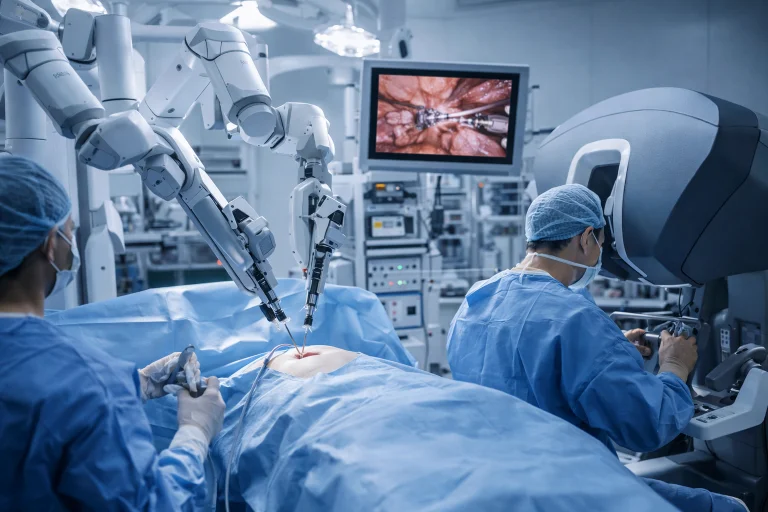
In robotic-assisted minimally invasive surgery (RAMIS), a surgeon operates a master console featuring articulated haptic input devices and a stereoscopic high-definition display. Master hand kinematics are translated via real-time embedded controllers into drive signals for patient-side slave manipulators. By decoupling the physician from direct physical instrument contact, surgical robotics effectively eliminates physiological tremor (8–12 Hz band), compensates for fulcrum inversion effects at the incision port, and scales down macroscopic hand excursions to sub-millimeter tissue interventions, minimizing patient trauma and accelerating post-operative recovery.
Interactive Quick Review: Medical Robotics & Teleoperation
Test your understanding of motion translation and minimally invasive surgery principles before exploring mathematical kinematics and dynamics:
1. What is the primary role of a surgical robot in robotic-assisted minimally invasive procedures?
Answer: Rather than operating autonomously, the robot acts as an active motion translator that eliminates hand tremor, scales displacement inputs, cancels the mechanical fulcrum inversion effect, and provides dexterous multi-DOF articulated instrument access inside small bodily incisions.
2. What frequency range characterizes physiological human hand tremor in surgical environments?
Answer: Involuntary human physiological hand tremor occurs predominantly within the 8–12 Hz frequency band, which real-time digital low-pass or adaptive notch filters isolate and attenuate without introducing excessive phase delay.
Glossary of Key Terminology
Foundational engineering terminology defining teleoperation, surgical biomechanics, and safety-critical medical robotics:
Precision Kinematics, Fulcrum Inversion, and Tremor Attenuation
Laparoscopic interventions require surgical tools to enter the patient's body cavity via a fixed abdominal or thoracic incision, known as a trocar port. In conventional manual laparoscopy, this constraint imposes a mechanical fulcrum: moving the surgeon's hand to the left forces the tool tip inside the patient to move to the right, while pivoting upward forces the tool tip downward. Robotic surgical architectures mathematically invert this fulcrum mapping within the kinematics engine, restoring natural, intuitive hand-eye coordination.
To achieve high-precision tracking, let:
- \(\mathbf{x}(t) \in \mathbb{R}^3\): actual Cartesian position of the surgical tool tip in the patient coordinate frame
- \(\mathbf{x}_d(t) \in \mathbb{R}^3\): desired tool position commanded by the surgeon through the master interface
- \(\mathbf{e}(t) = \mathbf{x}_d(t) - \mathbf{x}(t)\): dynamic Cartesian tracking error
Under closed-loop computed torque control, the tracking error dynamics are governed by:
$$\mathbf{M}_x(\mathbf{q}) \ddot{\mathbf{e}}(t) + \mathbf{K}_v \dot{\mathbf{e}}(t) + \mathbf{K}_p \mathbf{e}(t) = \mathbf{0}$$where \(\mathbf{M}_x(\mathbf{q})\) is the Cartesian inertia matrix of the slave manipulator, and \(\mathbf{K}_p, \mathbf{K}_v > 0\) are positive-definite proportional and derivative gain matrices selected to guarantee asymptotic convergence (\(\lim_{t \to \infty} \|\mathbf{e}(t)\| = 0\)) with sub-millimeter steady-state accuracy.
A critical stage of motion synthesis is the attenuation of physiological tremor. Hand micro-movements are modeled as an intentional low-frequency trajectory \(\mathbf{x}_{\text{intent}}(t)\) corrupted by high-frequency additive tremor \(\boldsymbol{\eta}_{\text{tremor}}(t)\):
$$\mathbf{x}_m(t) = \mathbf{x}_{\text{intent}}(t) + \sum_{k} A_k \sin(2\pi f_k t + \phi_k)$$where \(f_k \in [8, 12]\text{ Hz}\). A digital zero-phase Butterworth or infinite impulse response (IIR) low-pass filter with a sharp cutoff at \(f_c \approx 3\text{ to }5\text{ Hz}\) isolates \(\mathbf{x}_{\text{intent}}(t)\). Feedback control paradigms of this nature are detailed in Advanced Control Systems in Robotics.
Bilateral Teleoperation, Motion Scaling, and Passivity Control
Surgical robotic manipulators function as teleoperated bilateral systems, coupling the surgeon's hands at the master console to the patient-side slave manipulator across a digital communications bridge.
Let \(\mathbf{x}_m(t), \dot{\mathbf{x}}_m(t) \in \mathbb{R}^3\) denote the master console handle position and velocity, and \(\mathbf{x}_s(t), \dot{\mathbf{x}}_s(t) \in \mathbb{R}^3\) denote the slave tool tip state. Master-to-slave motion scaling is expressed by:
$$\dot{\mathbf{x}}_s(t) = \alpha \, \dot{\mathbf{x}}_m(t) \quad \Rightarrow \quad \mathbf{x}_s(t) = \alpha \, \mathbf{x}_m(t) + \mathbf{x}_0$$where \(\alpha \in (0, 1]\) is a programmable motion reduction scalar (typically set between \(0.1\) and \(0.33\), corresponding to \(10:1\) or \(3:1\) scaling). This scaling allows large, ergonomically comfortable surgeon hand displacements to execute micro-dissections on microscopic capillary networks.
When haptic force reflection is implemented, the interaction force \(\mathbf{F}_t(t)\) measured at the slave instrument tip via multi-axis strain gauges is scaled and rendered back to the surgeon's fingers via master haptic motors:
$$\mathbf{F}_h(t) = \beta \, \mathbf{F}_t(t)$$where \(\beta > 0\) is the force reflection gain. In delicate procedures such as retinal surgery, where biological interaction forces fall below human sensory perception (\(F_t < 10\text{ mN}\)), \(\beta\) may be configured significantly greater than unity (\(\beta \gg 1\)) to magnify imperceptible tactile cues.
However, bilateral teleoperation loops subject to transmission delay \(T_d\) can become active and unstable, potentially causing violent oscillations inside the patient. Stability is formally evaluated using passivity theory. Defining the system as a 2-port network with input power \(P_{\text{in}}(t) = \mathbf{F}_h^T(t) \dot{\mathbf{x}}_m(t) - \mathbf{F}_t^T(t) \dot{\mathbf{x}}_s(t)\), the system remains passive and unconditionally stable if and only if:
$$\int_0^t \left( \mathbf{F}_h^T(\tau) \dot{\mathbf{x}}_m(\tau) - \mathbf{F}_t^T(\tau) \dot{\mathbf{x}}_s(\tau) \right) d\tau + E(0) \ge 0 \quad \forall t \ge 0$$To enforce passivity across variable network latency or high-stiffness tissue contact, systems employ scattering matrices or Time-Domain Passivity Control (TDPC) with variable energy dampers that dissipate excess energy generated by communication phase delays.
Safety-Critical State Boundaries and Active Virtual Constraints
Unlike industrial manipulators operating within isolated safety enclosures, surgical robots operate in direct physical engagement with living organs. Safety architectures must enforce deterministic constraints directly in software and hardware.
Tissue mechanics dictate maximum tolerable contact forces to prevent tissue ischemia, tearing, or vessel puncture:
$$\|\mathbf{F}(t)\| \le F_{\text{max}}$$Furthermore, Cartesian velocities are dynamically clamped to prevent high-impulse impact during accidental operator slips:
$$\|\mathbf{v}_{\text{tool}}(t)\| \le v_{\text{safe}}$$To protect critical anatomical structures (e.g., the carotid artery or spinal cord), systems implement Active Virtual Fixtures. An allowable spatial domain \(\Omega_{\text{safe}} \subset \mathbb{R}^3\) is constructed from segmented pre-operative imaging. The boundary is modeled as an energy potential field. When the tool position \(\mathbf{p}_{\text{tool}}\) approaches the boundary \(\partial\Omega_{\text{safe}}\), a non-linear repulsive force \(\mathbf{F}_{\text{fixture}}\) is reflected back to the master handle while simultaneously modifying the slave trajectory:
$$\mathbf{F}_{\text{fixture}} = \begin{cases} \mathbf{0}, & \text{if } d(\mathbf{p}_{\text{tool}}, \partial\Omega) > d_{\text{thresh}} \\ -k_{\text{fix}} \left( d_{\text{thresh}} - d(\mathbf{p}_{\text{tool}}, \partial\Omega) \right) \mathbf{n}_{\text{surf}}, & \text{if } d(\mathbf{p}_{\text{tool}}, \partial\Omega) \le d_{\text{thresh}} \end{cases}$$where \(k_{\text{fix}}\) represents the boundary compliance stiffness, \(d(\cdot)\) is the minimum Euclidean distance to the prohibited anatomy, and \(\mathbf{n}_{\text{surf}}\) is the surface normal pointing inward toward the safe zone.
Multi-Modal Image Registration and Navigation (SE(3) Kinematics)
Robotic surgical guidance maps high-resolution pre-operative volumetric scans (CT, MRI) and intraoperative real-time visual feeds (endoscopy, fluoroscopy, ultrasound) into the physical reference frame of the patient-side manipulator.
Let \(\mathbf{T}_{B}^{A} \in SE(3)\) represent a homogeneous transformation matrix mapping a 3-D point in frame \(B\) to frame \(A\):
$$\mathbf{T}_{B}^{A} = \begin{bmatrix} \mathbf{R}_{B}^{A} & \mathbf{p}_{B}^{A} \\ \mathbf{0}_{1 \times 3} & 1 \end{bmatrix} \in \mathbb{R}^{4 \times 4}$$where \(\mathbf{R}_{B}^{A} \in SO(3)\) is the orthonormal rotation matrix and \(\mathbf{p}_{B}^{A} \in \mathbb{R}^3\) is the translation vector.
To map an anatomical target identified in pre-operative CT imaging (\(\mathbf{p}_{\text{CT}}\)) into the physical robot tool coordinate frame (\(\mathbf{p}_{\text{tool}}\)), a closed kinematic calibration chain must be resolved:
$$\tilde{\mathbf{p}}_{\text{tool}} = \mathbf{T}_{\text{base}}^{\text{tool}} \, \mathbf{T}_{\text{tracker}}^{\text{base}} \, \mathbf{T}_{\text{patient}}^{\text{tracker}} \, \mathbf{T}_{\text{CT}}^{\text{patient}} \, \tilde{\mathbf{p}}_{\text{CT}}$$where \(\tilde{\mathbf{p}} = [x, y, z, 1]^T\) denotes the homogeneous coordinate representation.
System accuracy depends on solving the point-cloud-to-surface registration problem and the hand-eye calibration problem:
$$\mathbf{A} \mathbf{X} = \mathbf{X} \mathbf{B}$$where \(\mathbf{A}\) represents relative camera movements, \(\mathbf{B}\) represents relative robot end-effector poses, and \(\mathbf{X} = \mathbf{T}_{\text{cam}}^{\text{tool}}\) is the unknown invariant calibration matrix. Sensor architectures enabling this precision are analyzed in Sensors and Perception in Robotics.
Remote Center of Motion (RCM) Mechanics & Multi-DOF Wrist Architecture
Standard 6-DOF industrial articulated arms cannot safely execute minimally invasive surgery without risking severe abdominal wall trauma. To pivot safely about the trocar port, surgical arms must enforce a kinematic constraint known as the Remote Center of Motion (RCM).
The RCM ensures that the tool shaft maintains zero lateral displacement at the patient's incision point:
$$\mathbf{v}_{\text{trocar}} = \mathbf{J}_{\text{trocar}}(\mathbf{q}) \dot{\mathbf{q}} = \mathbf{0}$$This behavior is achieved through two distinct approaches:
- Mechanically Constrained RCM: Parallelogram linkage mechanisms physically force the instrument shaft to pivot around a fixed point in free space, guaranteeing geometric safety regardless of software failure.
- Software-Enforced Kinematic RCM: A kinematically redundant manipulator (e.g., 7 or 8 DOF) solves the inverse kinematics using null-space projection: $$\dot{\mathbf{q}} = \mathbf{J}^{\dagger} \dot{\mathbf{x}}_{\text{task}} + (\mathbf{I} - \mathbf{J}^{\dagger} \mathbf{J}) \dot{\mathbf{q}}_0$$ where the secondary null-space projection vector \(\dot{\mathbf{q}}_0\) continuously minimizes the distance between the instrument axis and the trocar fulcrum.
At the distal end of the instrument, multi-DOF articulating wrists overcome the limitation of straight laparoscopic shafts. Miniature cable-driven mechanisms provide pitch, yaw, and continuous roll dexterity at the tool tip, yielding up to 7 internal degrees of freedom inside a compact working envelope.
Engineering Challenges & Technical Solutions
Medical and surgical robotics requires solving intricate multidisciplinary trade-offs where biological variability intersects with rigid mechanical tolerances:
The Challenge: Pre-operative CT/MRI volumetric scans depict static anatomy. Once incisions are made, tissues deform significantly under tool contact, respiratory motion, fluid evacuation, and CO2 insufflation, causing rigid \(SE(3)\) registrations to drift out of alignment.
- GPU-Accelerated Finite Element Models: Real-time non-linear FEM mesh models predict organ compliance and deformation fields continuously under tool contact loads.
- Dynamic Intraoperative Surface Registration: High-speed 3D stereoscopic point cloud matching and intraoperative ultrasound streams update non-rigid transformation models dynamically during the procedure.
The Challenge: Reflecting measured tissue resistance back to the surgeon's hands establishes a continuous bilateral physical energy loop. Network latency and processing delay (\(T_d > 10\text{ ms}\)) introduce phase lag, converting passive energy dissipation into active oscillations that could lacerate delicate tissue.
- Time-Domain Passivity Observers & Controllers (PO/PC): Embedded monitors calculate net system energy accumulation in real time, injecting adaptive software damping to dissipate excess energy before instability can occur.
- Wave-Variable Transformations: Encoding velocity and force control signals as wave variables ensures that communication latency acts purely as a passive transmission line, maintaining unconditional stability regardless of delay magnitude.
The Challenge: Articulated wrists inside 5-mm instrument tips are driven by long, thin tungsten cables running along the shaft. Elastic cable elongation (\(\Delta L = F / k_{\text{cable}}\)) and capstan friction around pulleys produce nonlinear angular hysteresis between motor encoders and the actual tool tip.
- Distal Fiber-Optic Shape Sensing: Embedding optical Fiber Bragg Grating (FBG) arrays directly within the instrument wrist provides real-time multi-core strain feedback, measuring the true physical deflection independent of cable compliance.
- Feedforward Elastic Compensation Models: Real-time kinematic algorithms solve inverse hysteresis models based on cable tension to pre-compensate motor drive angles.
The Challenge: Electrocautery cutting produces surgical smoke, while blood splatter can coat optical lenses, obscuring the visual field and degrading real-time feature tracking for AR navigation.
- Automated Smoke Evacuation & Lens Washing: Integrated pneumatic flush channels cycle saline and air bursts across the lens without requiring instrument withdrawal.
- Multi-Spectral Neural De-Smoking: Deep convolutional inpainting filters process the live stereoscopic stream at 60 FPS, restoring obscured vascular margins in software.
Interactive Quick Review: Haptics, Safety & Coordinate Transformation
Reinforce key concepts regarding force reflections, image frame registration, and workspace envelope boundaries before reviewing the FAQ:
1. How does motion scaling (\(\alpha < 1\)) assist surgeons during microsurgical procedures?
Answer: It scales down macroscopic hand excursions into minute, stable instrument displacements (\(\mathbf{x}_s = \alpha \mathbf{x}_m\)), enabling sub-millimeter positional control inside fragile anatomical structures like retinal veins or neural sheaths.
2. What coordinate transformation (\(\mathbf{T}_{\text{cam}}^{\text{tool}}\)) is required to position a robotic instrument using vision?
Answer: The homogeneous camera-to-tool transformation matrix (\(\mathbf{T}_{\text{cam}}^{\text{tool}} \in SE(3)\)), resolved via hand-eye calibration, which maps detected target pixel vectors \(\tilde{\mathbf{p}}_{\text{cam}}\) directly into physical robot coordinates \(\tilde{\mathbf{p}}_{\text{tool}} = \mathbf{T}_{\text{cam}}^{\text{tool}} \tilde{\mathbf{p}}_{\text{cam}}\).
External References and Further Reading
To explore surgical robotics research, clinical trial specifications, and regulatory frameworks, consult the following authoritative sources:
- Intuitive Surgical – da Vinci Surgical System Research – Clinical documentation, mechanical design principles, and technical architectures for multi-arm laparoscopic platforms.
- IEEE Transactions on Biomedical Engineering – Peer-reviewed research on surgical haptics, tissue biomechanics, real-time registration, and passivity control.
- US FDA – Medical Device Regulation for Computer-Assisted Surgery – Regulatory standards, software verification criteria, and IEC 62304/ISO 14971 risk management guidelines for robotic surgical systems.
Frequently Asked Questions about Medical and Surgical Robotics
Are clinical surgical robots fully autonomous or teleoperated?
Commercial clinical surgical platforms operate as deterministic, teleoperated master–slave systems. The human surgeon retains ultimate authority over every millimeter of instrument displacement. While machine learning and automation execute micro-tasks in research settings (such as autonomous soft-tissue suturing), clinical devices act exclusively as active motion translators to ensure safety and regulatory compliance under FDA and CE guidelines.
How do surgical robots eliminate physiological hand tremor during delicate operations?
Control systems sample surgeon hand positions at high update frequencies (typically \(1\text{ kHz}\)) and process the signal through digital filters. Because involuntary human physiological tremor concentrates between 8 and 12 Hz, real-time low-pass or adaptive notch filters isolate and discard these micro-oscillations while transmitting voluntary low-frequency surgical commands (\(< 3\text{ Hz}\)) with negligible phase delay.
What is the difference between motion scaling (\(\alpha\)) and force scaling (\(\beta\))?
Motion scaling (\(\alpha\)) attenuates tool displacement relative to surgeon hand excursion (\(\mathbf{x}_s = \alpha \mathbf{x}_m\)), enabling ultra-delicate macroscopic-to-microscopic positional reduction. Force scaling (\(\beta\)) adjusts physical forces measured at the distal tool tip before reflecting them to the master console handles (\(\mathbf{F}_h = \beta \mathbf{F}_t\)), either attenuating high forces to protect surgeon stamina or amplifying sub-threshold micro-forces for tactile perception.
What failsafe mechanisms protect the patient during power or hardware failure?
Surgical robots use fail-safe electromagnetic joint brakes, hardware watchdog interlocks, and redundant dual-channel control electronics. In the event of a power outage or critical sensor failure, spring-loaded electromagnetic brakes engage within milliseconds, locking all manipulator joints in place to prevent drift or gravity-induced tissue trauma.
End-of-Page Exercises: Review, Thought-Provoking & Engineering Problems
Section 1: Foundational Review Questions & Answers
1. How does a teleoperated master–slave system function in surgical robotics?
Answer: The surgeon manipulates master console handles equipped with sensors and force-feedback motors. The real-time control system processes, scales, and filters these inputs, generating actuator commands for patient-side slave robotic manipulators that execute the motions within the patient's anatomy.
2. What is tracking error \(\mathbf{e}(t)\) in surgical tool positioning?
Answer: The instantaneous vector difference between the commanded target position and actual instrument tip position: \(\mathbf{e}(t) = \mathbf{x}_d(t) - \mathbf{x}(t)\).
3. What mathematical formula defines motion scaling between master handle and slave instrument?
Answer: \(\mathbf{x}_s(t) = \alpha \mathbf{x}_m(t) + \mathbf{x}_0\), where \(\alpha < 1\) scales down macroscopic master hand motion to achieve microscopic precision at the slave tool tip.
4. How is haptic force feedback reflected to the surgeon's hand?
Answer: Via bilateral control algorithms utilizing the scaling relationship \(\mathbf{F}_h(t) = \beta \mathbf{F}_t(t)\), where slave tip force sensor data is converted into torque commands applied to the master console handles.
5. What force condition protects tissue against mechanical tearing or puncture?
Answer: The constraint \(\|\mathbf{F}(t)\| \le F_{\text{max}}\), where applied contact force must remain strictly below the ultimate shear or compressive stress threshold of the specific organ tissue.
6. How is image coordinate target \(\tilde{\mathbf{p}}_{\text{image}}\) mapped into physical tool coordinate \(\tilde{\mathbf{p}}_{\text{tool}}\)?
Answer: Via homogeneous transformation matrix multiplication: \(\tilde{\mathbf{p}}_{\text{tool}} = \mathbf{T}_{\text{cam}}^{\text{tool}} \tilde{\mathbf{p}}_{\text{image}}\), where \(\mathbf{T}_{\text{cam}}^{\text{tool}} \in SE(3)\) is obtained through hand-eye extrinsic calibration.
7. What mathematical condition ensures the surgical tool stays within safe anatomical regions?
Answer: The spatial boundary set constraint \(\mathbf{p}_{\text{tool}} \in \Omega_{\text{safe}}\), which is enforced via software bounding boxes or active repulsive virtual fixtures.
8. Name three common medical imaging modalities integrated into robotic surgery navigation.
Answer: High-definition stereoscopic 3-D endoscopy, intraoperative ultrasound (US), and pre-operative computed tomography (CT) or magnetic resonance imaging (MRI).
9. What mechanical limitation of traditional laparoscopy is solved by robotic wrist articulation?
Answer: The loss of distal pitch and yaw degrees of freedom caused by pivoting straight rigid instruments through a fixed abdominal incision fulcrum.
10. Why does medical robotics prioritize low cognitive load and deterministic latency?
Answer: To prevent surgeon mental fatigue during lengthy procedures, preserve hand-eye coordination, and eliminate sensory phase lag that could trigger dynamic instabilities or accidental tissue trauma.
Section 2: Analytical & Thought-Provoking Questions
1. Why is force feedback (haptics) exponentially more difficult to stabilize in teleoperated surgical systems than visual feedback?
Answer: Bilateral haptic feedback establishes a bidirectional physical energy exchange between master console, controller, slave robot, and viscoelastic tissue. Any communication delay or computational latency introduces phase lag that transforms passive dissipation into active mechanical energy, causing dangerous limit-cycle oscillations that could lacerate patient tissue. Visual feedback, by contrast, operates as a unidirectional feed where moderate latency causes operator hesitation, but not physical instability.
2. How do virtual safety boundaries (“virtual fixtures”) prevent accidental arterial punctures during cranial or spinal surgery?
Answer: Virtual fixtures define explicit geometric envelopes (\(\Omega_{\text{safe}}\)) mapped from pre-operative segmented volumetric scans. As the tool approaches critical structures such as the internal carotid artery, the system projects high-stiffness repulsive forces into the master haptic console while projecting slave joint velocities into the null-space of the boundary normal, rendering the prohibited boundary impenetrable.
3. Why is sub-millimeter registration accuracy between pre-operative CT scans and real-time intraoperative patient pose challenging to maintain?
Answer: Pre-operative CT imaging captures static, rigid anatomy prior to surgical intervention. Once incisions are made and pneumoperitoneum is established, internal organs deform under gravity, vascular pressure, fluid displacement, and mechanical tool retraction. Rigid transformation models (\(\mathbf{T}_{\text{CT}}^{\text{patient}} \in SE(3)\)) fail under such continuous deformation, requiring continuous biomechanical Finite Element Modeling (FEM) combined with real-time intraoperative surface tracking.
4. What trade-offs arise when miniaturizing multi-joint articulated wristed instruments for pediatric or neonatal robotic surgery?
Answer: Miniaturizing tool diameters down to 3 mm or 5 mm requires ultra-fine actuation cables and miniature pulley systems. Thinner cables exhibit higher elastic compliance (\(\Delta L = F / k\)) and lower yield strength, reducing maximum tool tip grip force and degrading joint position accuracy due to non-linear friction and capstan hysteresis.
5. How does time delay in long-distance telesurgery (trans-oceanic remote operations) alter the control architecture?
Answer: When transmission latency exceeds 100 ms, closed-loop bilateral teleoperation can become unstable and induces the “move-and-wait” operator pattern. Control architectures must transition to passive wave-variable formulations or supervisory semi-autonomous control, where low-level sub-tasks (such as suture knot completion) are executed autonomously by the slave controller using local sensory loops.
6. Should AI algorithms be permitted to autonomously execute suturing or tissue cutting without real-time human confirmation?
Answer: Autonomous execution can enhance repeatability and reduce operator fatigue during repetitive suturing. However, unmodeled biomechanical variations — such as unexpected vessel bifurcations or tissue tearing — pose critical risks. Current consensus requires a “human-on-the-loop” paradigm, where autonomous execution is permitted only within tightly constrained boundaries under continuous, instant human override capability.
7. How does physiological organ movement (such as heartbeats or lung ventilation) affect motion tracking during robotic cardiac surgery?
Answer: High-frequency cardiac contractions (1–2 Hz) prevent steady manual intervention on a beating heart. Advanced robotic platforms use predictive ECG-synchronized visual tracking to command slave arms to match organ trajectory precisely. This cancels out relative tissue velocity, presenting the surgeon with a stabilized, visually stationary operative field.
8. Why is cable stretch compensation essential in cable-driven laparoscopic robotic end-effectors?
Answer: Actuators located outside the patient rely on long drive cables running along the instrument shaft to actuate the distal wrist. Tensile stress introduces mechanical stretch (\(\Delta L = F / k\)), causing deviation between proximal motor encoder readings and actual distal tool orientation. Without model-based feedforward stretch and friction compensation, distal grip force and spatial orientation cannot be precisely regulated.
9. How do augmented reality (AR) overlays in surgical consoles improve anatomical awareness without causing visual clutter?
Answer: AR systems project semi-transparent 3-D reconstructions of segmented tumor margins and subterranean blood vessels onto the real-time endoscopic view. To avoid cognitive overload, graphics pipelines employ distance-based opacity blending, depth-cued alpha rendering, and gaze-contingent filtering that dynamically reveal anatomy only when tools enter the relevant vicinity.
10. What ethical and safety considerations govern the sterilization and usage cycling of multi-use robotic surgical tools?
Answer: Miniaturized cable-pulley mechanisms experience micro-fretting, cable strand fatigue, and joint friction changes across high-temperature autoclave cycles. To eliminate catastrophic in-vivo cable failure, surgical instruments integrate cryptographic memory chips that strictly enforce manufacturer-validated cycle limits (e.g., maximum 10 to 20 procedures) before permanently retiring the tool.
11. How does Master–Slave workspace indexing (“clutching”) allow surgeons to navigate large patient anatomical areas using small master handles?
Answer: Master handles have a constrained mechanical workspace compared to the patient's internal anatomy. Clutching mimics lifting and repositioning a computer mouse: a foot pedal disengages software coordinate coupling, allowing the surgeon to reposition the master handles into an ergonomic configuration while the slave manipulators remain locked in position.
12. In what way does tactile force magnification assist surgeons performing delicate ophthalmic micro-surgeries?
Answer: Peeling an internal limiting membrane from the human retina involves interaction forces below \(10\text{ mN}\), well under the human finger mechanoreceptor threshold (\(\sim 100\text{ mN}\)). By setting the bilateral force scaling factor \(\beta \gg 1\) (e.g., \(\beta = 50\)), the system amplifies imperceptible sub-millinewton forces into perceptible tactile signals, preventing retinal perforation.
Section 3: Numerical Engineering Problems & Solutions
A microsurgical teleoperated robot is configured with a motion scaling factor of \(\alpha = 0.20\) (\(5:1\) motion reduction). During a delicate retinal membrane manipulation, the surgeon moves the master console handle by a distance of \(x_m = 15.0\text{ mm}\). Calculate the resulting physical displacement \(x_s\) of the slave surgical tool tip inside the ocular cavity.
1. Motion scaling mapping: $$x_s = \alpha \, x_m$$ 2. Substitute numerical parameters: $$x_s = 0.20 \times 15.0\text{ mm} = 3.0\text{ mm}$$ Final Answer: The slave surgical tool tip moves by exactly \(3.0\text{ mm}\) (\(3,000\text{ }\mu\text{m}\)).
A surgical end-effector equipped with an optical fiber Bragg grating (FBG) micro-force sensor records a liver capsule probing resistance of \(F_t = 0.08\text{ N}\) (\(80\text{ mN}\)). To enhance tactile discrimination, the bilateral haptic controller executes a force reflection scaling gain of \(\beta = 2.50\). Calculate the force \(F_h\) delivered by the master console haptic actuators to the surgeon's hand.
1. Force reflection relationship: $$F_h = \beta \, F_t$$ 2. Substitute measured values: $$F_h = 2.50 \times 0.08\text{ N} = 0.20\text{ N} \quad (200\text{ mN})$$ Final Answer: The reflected haptic force felt by the surgeon is \(0.20\text{ N}\) (\(200\text{ mN}\)).
During automated suture knot tensioning, an embedded sensor monitors thread tension. The instantaneous measured force applied to an arterial wall is \(F(t) = 1.45\text{ N}\). Biomechanical guidelines mandate a peak allowable force threshold of \(F_{\text{max}} = 1.80\text{ N}\). Verify whether safety condition \(F(t) \le F_{\text{max}}\) is satisfied, and calculate the remaining safety force margin \(\Delta F_{\text{margin}}\).
1. Safety check: $$1.45\text{ N} \le 1.80\text{ N} \Rightarrow \text{Condition is satisfied}$$ 2. Calculate remaining safety force margin: $$\Delta F_{\text{margin}} = F_{\text{max}} - F(t) = 1.80\text{ N} - 1.45\text{ N} = 0.35\text{ N}$$ Final Answer: The safety condition is satisfied with a force margin of \(0.35\text{ N}\) (\(350\text{ mN}\)).
An optical tracker records a commanded tool tip coordinate \(\mathbf{x}_d = [12.40, 8.50, 45.10]^T\text{ mm}\) and actual tool tip position \(\mathbf{x} = [12.25, 8.60, 44.90]^T\text{ mm}\). Calculate the Cartesian tracking error components \([e_x, e_y, e_z]^T\) and determine the 3-D Euclidean tracking error magnitude \(\|\mathbf{e}(t)\|\).
1. Determine Cartesian error components: $$\mathbf{e}(t) = \mathbf{x}_d(t) - \mathbf{x}(t) = \begin{bmatrix} 12.40 - 12.25 \\ 8.50 - 8.60 \\ 45.10 - 44.90 \end{bmatrix} = \begin{bmatrix} 0.15 \\ -0.10 \\ 0.20 \end{bmatrix}\text{ mm}$$ 2. Calculate Euclidean magnitude: $$\|\mathbf{e}(t)\| = \sqrt{(0.15)^2 + (-0.10)^2 + (0.20)^2} = \sqrt{0.0225 + 0.0100 + 0.0400} = \sqrt{0.0725} \approx 0.2693\text{ mm}$$ Final Answer: Tracking error vector is \([0.15, -0.10, 0.20]^T\text{ mm}\), with a magnitude of \(\approx 0.27\text{ mm}\) (\(269.3\text{ }\mu\text{m}\)).
A safety control loop enforces a tool velocity threshold \(v_{\text{safe}} = 25.0\text{ mm/s}\). An operator movement commands a tool displacement of \(\Delta x = 3.60\text{ mm}\) over a time step \(\Delta t = 0.10\text{ s}\). Calculate instantaneous velocity \(v(t)\), determine whether \(|v(t)| \le v_{\text{safe}}\) is breached, and find the velocity clamping factor \(\gamma\).
1. Calculate instantaneous velocity: $$v(t) = \frac{\Delta x}{\Delta t} = \frac{3.60\text{ mm}}{0.10\text{ s}} = 36.0\text{ mm/s}$$ 2. Check limit: $$36.0\text{ mm/s} > 25.0\text{ mm/s} \Rightarrow \text{Safety limit breached}$$ 3. Clamping attenuation factor: $$\gamma = \frac{v_{\text{safe}}}{v(t)} = \frac{25.0}{36.0} \approx 0.6944$$ Final Answer: Commanded velocity is \(36.0\text{ mm/s}\), breaching the safety limit and requiring scaling by \(\gamma \approx 0.694\) to enforce \(25.0\text{ mm/s}\).
An endoscopic visual tracker identifies a tumor centroid at homogeneous pixel coordinates \(\tilde{\mathbf{p}}_{\text{image}} = [100, 50, 1]^T\). The camera-to-robot coordinate frame calibration matrix is: $$\mathbf{T}_{\text{cam}}^{\text{tool}} = \begin{bmatrix} 0.05 & 0.00 & 12.0 \\ 0.00 & 0.05 & 8.0 \\ 0.00 & 0.00 & 1.0 \end{bmatrix}$$ Calculate the physical coordinates \(\mathbf{p}_{\text{tool}} = [x_{\text{tool}}, y_{\text{tool}}]^T\) in millimeters in the robot workspace.
1. Matrix-vector multiplication: $$\tilde{\mathbf{p}}_{\text{tool}} = \mathbf{T}_{\text{cam}}^{\text{tool}} \tilde{\mathbf{p}}_{\text{image}} = \begin{bmatrix} 0.05 & 0.00 & 12.0 \\ 0.00 & 0.05 & 8.0 \\ 0.00 & 0.00 & 1.0 \end{bmatrix} \begin{bmatrix} 100 \\ 50 \\ 1 \end{bmatrix}$$ $$x_{\text{tool}} = (0.05 \times 100) + (0.00 \times 50) + (12.0 \times 1) = 5.0 + 0 + 12.0 = 17.0\text{ mm}$$ $$y_{\text{tool}} = (0.00 \times 100) + (0.05 \times 50) + (8.0 \times 1) = 0 + 2.5 + 8.0 = 10.5\text{ mm}$$ Final Answer: Physical robot workspace coordinates are \(x_{\text{tool}} = 17.0\text{ mm}\) and \(y_{\text{tool}} = 10.5\text{ mm}\).
A surgeon's hand tremor is recorded at frequency \(f_{\text{tremor}} = 10.0\text{ Hz}\). Calculate the angular frequency \(\omega_{\text{tremor}}\) in radians per second. If a second-order Butterworth low-pass filter with cutoff frequency \(f_c = 3.0\text{ Hz}\) is applied, calculate the theoretical amplitude attenuation factor \(|H(f)|\) at \(10.0\text{ Hz}\): $$|H(f)| = \frac{1}{\sqrt{1 + (f / f_c)^4}}$$
1. Calculate angular frequency: $$\omega_{\text{tremor}} = 2\pi f_{\text{tremor}} = 2 \times \pi \times 10.0 \approx 62.83\text{ rad/s}$$ 2. Evaluate transfer function magnitude: $$|H(10)| = \frac{1}{\sqrt{1 + (10.0 / 3.0)^4}} = \frac{1}{\sqrt{1 + (3.333)^4}} = \frac{1}{\sqrt{1 + 123.46}} = \frac{1}{\sqrt{124.46}} \approx 0.0896$$ Final Answer: Angular frequency is \(62.83\text{ rad/s}\); the filter attenuates tremor amplitude to \(\approx 8.96\%\) (a \(20.9\text{ dB}\) attenuation).
A rigid manual laparoscopy instrument permits a maximum wrist pitch deflection of \(\theta_{\text{manual}} = 30^\circ\). An articulated robotic wrist increases deflection to \(\theta_{\text{robot}} = 75^\circ\). Calculate the absolute angular range increase \(\Delta \theta\) and the percentage increase in wrist pitch articulation.
1. Absolute deflection increase: $$\Delta \theta = 75^\circ - 30^\circ = 45^\circ$$ 2. Percentage expansion: $$\% \text{ Gain} = \frac{75^\circ - 30^\circ}{30^\circ} \times 100 = \frac{45^\circ}{30^\circ} \times 100 = 150\%$$ Final Answer: Angular range increases by \(45^\circ\), representing a \(150\%\) expansion in wrist articulation capability.
A telesurgical fiber link operates with a one-way communication latency \(T_{\text{delay}} = 15.0\text{ ms}\) (\(0.015\text{ s}\)). If the slave surgical tool travels at a constant velocity \(v = 20.0\text{ mm/s}\), calculate the uncompensated spatial tracking lag \(\Delta x_{\text{lag}}\) caused by transmission delay.
1. Position lag formula: $$\Delta x_{\text{lag}} = v \times T_{\text{delay}}$$ 2. Substitute parameters: $$\Delta x_{\text{lag}} = 20.0\text{ mm/s} \times 0.015\text{ s} = 0.30\text{ mm} \quad (300\text{ }\mu\text{m})$$ Final Answer: Latency induces an uncompensated spatial position lag of \(0.30\text{ mm}\) (\(300\text{ }\mu\text{m}\)).
A cable-driven articulating wrist utilizes a tungsten cable with axial stiffness \(k_{\text{cable}} = 120.0\text{ N/mm}\). During an arterial clamping action, the drive motor pulls the cable with a tensile load of \(F = 18.0\text{ N}\). Calculate the resulting elastic cable elongation \(\Delta L\) in millimeters and micrometers.
1. Hooke's Law elongation: $$\Delta L = \frac{F}{k_{\text{cable}}}$$ 2. Substitute numerical parameters: $$\Delta L = \frac{18.0\text{ N}}{120.0\text{ N/mm}} = 0.15\text{ mm} = 150\text{ }\mu\text{m}$$ Final Answer: Cable tension causes an elongation of \(0.15\text{ mm}\) (\(150\text{ }\mu\text{m}\)).
A medical-grade 3-D stereoscopic camera runs at an acquisition rate of \(60\text{ FPS}\). Calculate the frame integration interval \(\Delta t_{\text{frame}}\) in milliseconds. If the visual pipeline requires 2 complete frames for image de-warping and stereo disparity matching, compute the base visual pipeline latency \(T_{\text{proc}}\).
1. Frame interval: $$\Delta t_{\text{frame}} = \frac{1}{\text{FPS}} = \frac{1}{60}\text{ s} \approx 0.01667\text{ s} = 16.67\text{ ms}$$ 2. Two-frame buffering latency: $$T_{\text{proc}} = 2 \times 16.67\text{ ms} = 33.33\text{ ms}$$ Final Answer: Frame integration time is \(16.67\text{ ms}\), resulting in a pre-display visual processing latency of \(33.33\text{ ms}\).
A robotic grasper jaw applies a normal gripping force of \(F = 2.40\text{ N}\) across an anatomical contact area measuring \(2.0\text{ mm} \times 3.0\text{ mm}\). Calculate the contact area \(A\) in \(\text{mm}^2\) and \(\text{m}^2\), and compute the mechanical contact stress (pressure) \(P\) in kilopascals (\(\text{kPa}\)).
1. Calculate contact surface area: $$A = 2.0\text{ mm} \times 3.0\text{ mm} = 6.0\text{ mm}^2 = 6.0 \times 10^{-6}\text{ m}^2$$ 2. Compute tissue pressure in Pascals (\(\text{N/m}^2\)): $$P = \frac{F}{A} = \frac{2.40\text{ N}}{6.0 \times 10^{-6}\text{ m}^2} = 400,000\text{ Pa} = 400.0\text{ kPa}$$ Final Answer: Contact area is \(6.0\text{ mm}^2\), generating a tissue contact pressure of \(400\text{ kPa}\) (\(0.40\text{ N/mm}^2\)).
Medical and Surgical Robotics — Summary & Wrap-Up
Medical and surgical robotics bridges high-performance control theory, mechanical precision, and clinical healthcare. By integrating bilateral teleoperation architectures, passivity controllers, 8–12 Hz physiological tremor filters, remote centers of motion (RCM), and multi-modal \(SE(3)\) image registrations, surgical robotic systems empower clinical practitioners to conduct sub-millimeter tissue interventions safely. These platforms minimize patient invasiveness, reduce hospital recovery times, and establish reproducible technical precision in complex medical procedures.
Interdisciplinary Connections Across Robotics Domains
Medical and surgical robotics represents one of the most demanding applications of robotic technology. These systems operate in clinical environments where precision, reliability, and safety are essential. Robotic platforms assist surgeons in performing minimally invasive procedures, support rehabilitation therapies, and enable advanced diagnostic imaging. Although healthcare robotics focuses on medical practice, many of the underlying technologies are shared with other applied robotics domains.
Because medical robots interact directly with patients and healthcare professionals, careful attention must be given to safety, transparency, and ethical responsibility. These issues are explored in Human–Robot Interaction and Ethics, which examines how engineers design robotic systems that can operate safely and responsibly alongside people.
Robotics designed for assistance and everyday interaction is discussed in Service Robotics, where machines support tasks such as healthcare assistance, hospitality services, and public infrastructure maintenance. Many of these systems share human-centered design principles with medical robotics.
In contrast, robotic automation in manufacturing environments focuses on precision production and high-speed assembly. These technologies are explored in Industrial Robotics Systems and Cobots, where collaborative robots and automated systems enhance productivity in factories.
Robotics technologies also support large-scale operations beyond healthcare. Autonomous sensing and automation used in farming are discussed in Agricultural Robotics, while robotic fleet coordination and automated transport systems are examined in Warehouse Logistics and Autonomous Mobile Robots (AMRs).
Mobility technologies extend robotics into transportation and environmental monitoring systems. Ground-based autonomous navigation is presented in Autonomous Ground Vehicles, while aerial robotic platforms used for inspection and surveying are discussed in Aerial Robotics and UAV Systems.
Students who wish to understand the broader engineering principles behind these technologies — including perception systems, motion planning, and intelligent control — can explore the Robotics Hub, which connects these diverse applications through the scientific foundations of modern robotics.