
Service robots are autonomous or semi-autonomous systems designed to assist humans in non-industrial environments. Unlike factory robots operating in structured, isolated industrial workcells, service robots function in dynamic, human-centered spaces such as homes, hospitals, hotels, corporate offices, and public transit facilities.
To operate effectively alongside people, these platforms must integrate perception, autonomous navigation, compliant manipulation, human–robot interaction (HRI), and real-time decision-making while maintaining safety, operational reliability, and social acceptability. Service robotics therefore combines mechanical design, artificial intelligence, distributed computing, and human factors engineering.
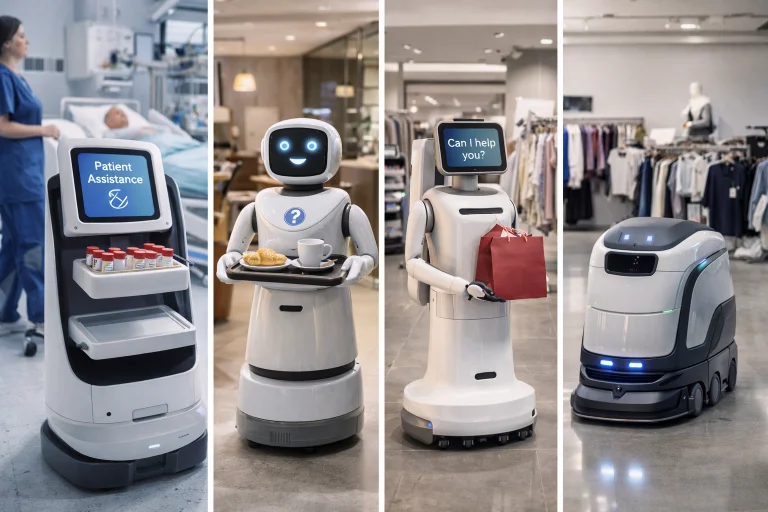
This overview illustrates autonomous service systems deployed across human-centered domains. In healthcare facilities, delivery robots transport pharmaceuticals, laboratory specimens, and sterile supplies, alleviating staff workload. In hospitality venues, service units manage contactless room deliveries and customer reception. In retail centers and airports, autonomous platforms guide visitors and execute automated sanitation passes using ultraviolet or scrub mechanisms. These platforms combine multi-modal perception suites, obstacle-avoidance algorithms, compliant chassis dynamics, and natural user interfaces to operate safely around pedestrians.
Interactive Quick Review: Service Robotics & Core Architecture
Test your understanding of human-centered environments and functional subsystems before exploring navigation safety constraints:
1. How do service robots differ fundamentally from industrial factory robots?
Answer: Factory robots operate in structured, controlled, and isolated industrial settings designed for repetition and speed, whereas service robots function in dynamic, unstructured, human-centered spaces like homes, hospitals, and public facilities.
2. What equation governs how a service robot updates its internal system state estimate over discrete time steps?
Answer: The state transition dynamic model: \(x_{k+1} = f(x_k, u_k)\), where current state and control inputs determine the next state, corrected by sensor measurements \(y_k\).
Glossary of Key Terminology
Essential definitions governing service robotics, human-aware navigation, reliability modeling, and physical compliance:
Core Functional Architecture & State Transition Dynamics
A service robot integrates several interacting hardware and software subsystems that allow it to perceive surroundings, make decisions, and execute physical motions:
- Perception Module: RGB-D vision cameras, ultrasonic rangefinders, and planar/3D LiDAR scanners measuring environmental distances.
- Localization & Mapping: Real-time SLAM estimation algorithms tracking robot coordinates inside dynamic floorplans.
- Task Planning Subsystem: Finite state machines or behavior trees scheduling actions and goal targets.
- Manipulation Hardware: Multi-DOF compliant manipulator arms and soft grippers for object retrieval.
- Human–Robot Interface: Speech recognition, graphical touchscreens, LED light rings, and wireless IoT bridges.
- Mobility Chassis: Differential drive, omnidirectional mecanum wheels, or legged locomotion platforms.
Let the system be parameterized by:
- \(\mathbf{x}(t) \in \mathbb{R}^n\): State vector containing position, velocity, heading, and battery charge.
- \(\mathbf{u}(t) \in \mathbb{R}^m\): Actuator control inputs (wheel torques, steering angles).
- \(\mathbf{y}(t) \in \mathbb{R}^p\): Sensor observations from LiDAR, encoders, and cameras.
The robot updates its state estimate across discrete time steps \(k\) using dynamic state-space models:
$$\mathbf{x}_{k+1} = \mathbf{f}(\mathbf{x}_k, \mathbf{u}_k) + \mathbf{w}_k$$where \(\mathbf{w}_k\) represents process disturbance noise. Incoming observations \(\mathbf{y}_k = \mathbf{h}(\mathbf{x}_k) + \mathbf{v}_k\) correct this estimate through recursive state estimators (such as Extended Kalman Filters or particle filters), as detailed in Sensors and Perception in Robotics.
Navigation Constraints in Human-Centered Environments
Navigating crowded hallways, hospital wards, and hotel lobbies requires strict adherence to spatial clearance constraints. Let \(\mathbf{p}_r(t) = [x_r, y_r]^T\) denote the 2D Cartesian position of the robot, \(\mathbf{p}_h(t) = [x_h, y_h]^T\) denote the estimated position of a nearby pedestrian, and \(d_{\text{safe}}\) denote the minimum allowable safety clearance buffer:
$$\|\mathbf{p}_r(t) - \mathbf{p}_h(t)\| = \sqrt{(x_r - x_h)^2 + (y_r - y_h)^2} \ge d_{\text{safe}}$$If the Euclidean separation drops below \(d_{\text{safe}}\), the robot's local trajectory generator must decelerate, yield, or replan around the human's projected trajectory. Trajectory synthesis techniques for collision avoidance are covered in depth in Path Planning Algorithms for Robots.
Human–Robot Interaction & Probabilistic Speech Decoding
Service robots communicate through speech, visual display cues, and non-verbal gestures. In acoustic speech recognition, noisy microphone audio signals \(s\) are mapped into candidate command interpretations \(k\) using maximum a posteriori (MAP) Bayesian decision rules:
$$a = \arg\max_{k} P(k \mid s) = \arg\max_{k} \frac{P(s \mid k) P(k)}{P(s)}$$where \(P(s \mid k)\) represents acoustic model likelihood, \(P(k)\) denotes the language prior, and \(a\) is the winning command executed by the robot. Ethical implications, social compliance, and user transparency are explored in Human–Robot Interaction and Ethics.
Energy Management & Reliability Formulations
Service robots rely on onboard rechargeable battery banks. System autonomy is constrained by total energy capacity \(E\) (in Watt-hours) and instantaneous power draw \(P(t)\) (in Watts), spanning locomotion motors, onboard computers, and sensors:
$$t_{\text{op}} = \frac{E}{P_{\text{avg}}}$$For fleet maintenance, component reliability is characterized using exponential failure models governed by constant failure rate \(\lambda\). The Mean Time Between Failures (\(\text{MTBF}\)) and survival probability \(R(t)\) over operational mission window \(t\) are defined as:
$$\text{MTBF} = \frac{1}{\lambda}, \quad R(t) = e^{-\lambda t}$$Engineering Challenges & Technical Solutions
Operating autonomous service machines in human spaces introduces non-deterministic operational, mechanical, and safety challenges:
The Challenge: When navigating dense pedestrian corridors (such as hospital main lobbies or airport terminals), traditional static obstacle inflation bubbles classify every nearby human as an impassable boundary. This causes the path planner to decide that all paths are blocked, causing the robot to freeze indefinitely.
- Interactive Reciprocal Velocity Obstacles (RVO): Modeling cooperative collision avoidance by assuming pedestrians dynamically yield space as the robot exhibits intentional forward trajectories.
- Social Force Motion Planners: Incorporating attractive goal vectors and repulsive pedestrian potential fields that allow the robot to fluidly merge with pedestrian walking streams.
The Challenge: Public environments suffer from severe acoustic reverberation, background HVAC rumble, rolling cart clatter, and overlapping conversational chatter. General speech models experience severe decoding errors in these environments.
- Beamforming Microphone Arrays: Using multi-microphone circular arrays with adaptive delay-and-sum beamforming to isolate acoustic voice sources spatially.
- Multi-Modal Intent Disambiguation: Combining speech recognition with touchscreen confirmation prompts and face-tracking camera gaze analysis.
The Challenge: Wheeled delivery robots cannot physically actuate building elevator buttons, open fire doors, or cross heavy security turnstiles.
- IoT Middleware Bridging: Integrating robots with building automation systems via standard protocols (MQTT, BACnet, WebSockets) to command elevator car dispatches wirelessly.
- Ultra-Wideband (UWB) Beaconing: Supplementing wheel odometry with indoor RF beacons to maintain localization across elevator transitions where LiDAR features degrade.
The Challenge: Unintended collisions with frail hospital patients, children, or elderly users must never exceed physiological biomechanical injury thresholds: \(F \le F_{\max}\).
- Series Elastic Actuation (SEA): Integrating mechanical compliance springs directly between actuator gearboxes and output linkages to absorb physical impact shocks passively.
- Dual-Channel Safety PLCs: Utilizing certified safety PLCs wired to redundant optoelectronic tactile bumpers to execute category-3 emergency stop cutoffs within milliseconds.
Interactive Quick Review: Collision Forces, Reliability & Speech Probabilities
Reinforce key concepts regarding MTBF calculations, safe collision constraints, and Bayesian speech recognition before reviewing the FAQ:
1. How is Mean Time Between Failures (MTBF) derived from the system failure rate (\(\lambda\))?
Answer: MTBF is the reciprocal of the system failure rate: \(\text{MTBF} = 1 / \lambda\), representing expected operational operating hours between breakdowns.
2. What is the safety constraint governing physical contact force between a service robot and a human?
Answer: The applied physical collision force must remain less than or equal to the maximum allowable safe contact threshold: \(F \le F_{\max}\).
External References and Further Reading
To explore service robot architectures, mobile robot navigation safety standards, and assistive healthcare robotics, consult the following authoritative sources:
- International Federation of Robotics (IFR) - Service Robots Statistics – Global market reports, classification standards, and application trends for professional and domestic service robots.
- ISO 13482:2014 - Safety Requirements for Personal Care Robots – International safety standard governing mobile servant robots, physical assistant robots, and person carrier robots.
- IEEE Transactions on Robotics (T-RO) – Peer-reviewed research covering human-robot proxemics, safe navigation in crowded environments, and domestic manipulation.
Frequently Asked Questions about Service Robots
What distinguishes a professional service robot from a domestic service robot?
Professional service robots are deployed for commercial, institutional, or municipal applications requiring high reliability and specialized payloads—such as hospital delivery, surgical assistance, building security, and airport sanitation. Domestic service robots operate in private residential spaces performing everyday household chores, including automated floor cleaning, lawn mowing, and eldercare companionship.
How do service robots maintain safe navigation around unpredictable humans?
Service robots combine LiDAR, depth cameras, and tactile bumpers with real-time dynamic path planners. They continuously evaluate minimum safe separation bounds (\(\|\mathbf{p}_r(t) - \mathbf{p}_h(t)\| \ge d_{\text{safe}}\)) and predict human motion trajectories, slowing down, yielding right-of-way, or replanning routes dynamically.
What role does mechanical compliance play in human-safe robotics?
Rigid unyielding linkages transfer high shock forces during unexpected collisions. Mechanical compliance incorporates elastic springs, flexible chassis bumpers, or series elastic actuators (SEAs) that yield mechanically upon contact, absorbing kinetic energy and ensuring contact forces remain below safety bounds: \(F \le F_{\max}\).
How do automatic speech recognition systems evaluate ambiguous voice commands?
Speech systems employ Bayesian maximum a posteriori (MAP) decoding models to compute the conditional probability of candidate phrases given observed acoustic signals: \(a = \arg\max_k P(k \mid s)\). Selecting the candidate with the highest posterior probability resolves acoustic uncertainty.
Why is high Mean Time Between Failures (MTBF) vital for healthcare robots?
In hospitals, service robots transport urgent medications, blood samples, and sterile surgical trays. An unexpected mid-hallway system failure (low MTBF) disrupts hospital logistics, strands critical supplies, and increases nurse workload.
How do service robots handle task allocation when multiple requests arrive simultaneously?
Task planners evaluate multi-objective combinatorial optimization routines (such as minimizing total task completion time \(\min \sum T_i\)) subject to priority weighting, battery state, transit distances, and delivery deadlines.
End-of-Page Exercises: Review, Thought-Provoking & Engineering Problems
Section 1: Foundational Review Questions & Answers
1. What equation models the discrete-time state transition dynamic update for a service robot?
Answer: \(x_{k+1} = f(x_k, u_k)\).
2. What inequality expresses the minimum safe separation distance between a robot and a human?
Answer: \(\|\mathbf{p}_r(t) - \mathbf{p}_h(t)\| \ge d_{\text{safe}}\).
3. How does speech recognition select the most probable spoken command?
Answer: By maximizing conditional probability: \(a = \arg\max_k P(k \mid s)\).
4. What objective function is commonly used in task scheduling optimization?
Answer: Minimizing total completion time: \(\min \sum_i T_i\).
5. What formula estimates battery operating duration \(t_{\text{op}}\)?
Answer: \(t_{\text{op}} = E / P\), dividing battery capacity in Watt-hours by average power draw in Watts.
6. How is Mean Time Between Failures (MTBF) calculated from failure rate \(\lambda\)?
Answer: \(\text{MTBF} = 1 / \lambda\).
7. What physical constraint limits impact forces during human-robot contact?
Answer: \(F \le F_{\max}\).
8. Name four primary application sectors for service robotics.
Answer: Healthcare logistics, hospitality delivery, domestic cleaning, and public sanitation.
9. What is mechanical compliance in the context of safety design?
Answer: The structural ability of the robot's linkages, joints, or chassis to yield elastically during physical impact, attenuating force spikes.
10. Name six fundamental university subjects recommended for service robotics study.
Answer: Mobile kinematics, feedback control, human–robot interaction, embedded systems, probability/estimation, and software architecture.
Section 2: Analytical & Thought-Provoking Questions
1. Why do service robots operating in crowded human spaces require probabilistic social proxemics rather than rigid geometric safety boundaries?
Answer: Rigid geometric inflation circles treat humans like static walls, triggering the "freezing robot" problem where all potential paths are blocked. Social proxemics model personal space as probabilistic dynamic cost surfaces, enabling the robot to negotiate right-of-way and navigate naturally without startling pedestrians.
2. What ethical dilemmas emerge when an eldercare robot must choose between user privacy and reporting an emergency?
Answer: Continuous visual and acoustic monitoring needed to detect slips or falls risks violating privacy. Transmitting telemetry or video feeds to family or caregivers without immediate user consent forces an engineering trade-off between physical safety and individual privacy rights.
3. How does anthropomorphism in service robot design influence human trust and safety expectations during unexpected failures?
Answer: Anthropomorphic traits (expressive faces, eyes, synthesized human voices) lead people to overestimate a machine's cognitive capabilities. When unexpected software faults occur, users experience severe trust loss and may fail to take evasive action because they misattribute human judgment to the machine.
4. Why is battery energy management in service robots a non-linear optimization problem rather than a simple linear division?
Answer: Instantaneous power draw fluctuates non-linearly with payload mass, floor friction, floor carpet drag, acceleration profiles, and onboard GPU perception loads. Simple linear divisions (\(E / P_{\text{avg}}\)) ignore Peukert capacity losses and transient current spikes, risking unexpected battery depletion before reaching docking bays.
5. What challenges arise when deploying speech recognition models trained on clean audio into public hospital corridors?
Answer: Clinical corridors feature acoustic reverberation, medical equipment alarms, PA announcements, and HVAC noise. These environmental factors degrade signal-to-noise ratios, reducing conditional probabilities \(P(k \mid s)\) and triggering command execution errors.
6. How can decentralized multi-robot task allocation prevent single-point bottlenecks in large hotel delivery fleets?
Answer: Centralized allocators create single-point failure vulnerabilities; if network links go down, all operations stall. Decentralized consensus protocols allow units to bid on deliveries peer-to-peer based on battery state and proximity, maintaining fleet functionality during network outages.
7. In what way does legal liability complicate deployment models for autonomous delivery robots on public sidewalks?
Answer: Public sidewalks mix pedestrians, pets, cyclists, and mobility scooters. When collisions occur, determining whether liability falls on the hardware fabricator, software developer, fleet contractor, or pedestrian remains an evolving legal challenge across regulatory jurisdictions.
8. Why do hospital delivery robots require tamper-evident physical security mechanisms in addition to software access controls?
Answer: While software credentials (NFC badges, PIN codes) prevent unauthorized opening, hospital units transit public hallways. Hardened, tamper-evident motorized latches are necessary to secure controlled pharmaceuticals, narcotics, or patient specimens against physical theft.
9. How does multimodal feedback enhance human-robot situational awareness?
Answer: Relying on a single output modality (like a display screen) fails if a pedestrian is looking away. Combining directional turn-signal LEDs, audible chimes, and screen graphics communicates navigational intent clearly, reducing path confusion.
10. What are the economic and social trade-offs of substituting human concierges with autonomous robotic receptionists?
Answer: Robots offer 24/7 availability, multilingual capabilities, and lower operating costs, but lack emotional empathy and nuanced problem-solving for distressed guests.
11. How can digital twin simulation accelerate regulatory safety certification for service robots entering healthcare markets?
Answer: Regulatory certification (such as ISO 13482) requires testing thousands of failure modes and collision scenarios. Validated digital twin platforms run millions of automated virtual stress tests to demonstrate safety compliance before physical hardware testing begins.
12. Why do service robots operating in multi-floor buildings require specialized elevator and automatic door integration protocols?
Answer: Mobile bases cannot physically actuate standard elevator buttons or pull open heavy doors. Wireless IoT middleware bridges allow platforms to interface with building management systems, commanding elevator calls and monitoring door states for multi-floor navigation.
Section 3: Numerical Engineering Problems & Solutions
A service robot maintains a minimum safe separation distance \(d_{\text{safe}} = 0.9\text{ meters}\). LiDAR perception measures the relative position vector to a nearby human as \(\mathbf{p}_r - \mathbf{p}_h = [0.50, 0.40]^T\text{ meters}\). Calculate the Euclidean distance \(\|\mathbf{p}_r - \mathbf{p}_h\|\) and verify whether the safety constraint \(\|\mathbf{p}_r - \mathbf{p}_h\| \ge d_{\text{safe}}\) is satisfied.
1. Square the relative Cartesian coordinate components: $$(0.50)^2 + (0.40)^2 = 0.25 + 0.16 = 0.41\text{ m}^2$$ 2. Calculate the Euclidean norm: $$\|\mathbf{p}_r - \mathbf{p}_h\| = \sqrt{0.41} \approx 0.6403\text{ meters}$$ 3. Evaluate against the safety threshold: $$0.6403\text{ m} < 0.90\text{ m} \quad (\text{Safety Constraint Violated})$$ Final Answer: The measured distance is \(0.64\text{ meters}\), which violates the \(0.9\text{ m}\) safety clearance.
A hospital delivery robot is equipped with a lithium-ion battery pack with capacity \(E = 600\text{ Wh}\). Under full nominal payload, the robot draws an average power consumption \(P = 150\text{ W}\). Calculate the estimated operating duration \(t_{\text{op}} = E / P\) in hours. If a dispatch mission requires \(4.5\text{ hours}\) of continuous operation, calculate the required battery capacity in Watt-hours.
1. Compute operating duration: $$t_{\text{op}} = \frac{E}{P} = \frac{600\text{ Wh}}{150\text{ W}} = 4.0\text{ hours}$$ 2. Compute required capacity for a 4.5-hour mission: $$E_{\text{req}} = P \times t_{\text{req}} = 150\text{ W} \times 4.5\text{ h} = 675\text{ Wh}$$ Final Answer: Nominal operating runtime is \(4.0\text{ hours}\); supporting a 4.5-hour mission requires \(675\text{ Wh}\).
A commercial sanitation robot operating in an airport terminal has a specified Mean Time Between Failures (\(\text{MTBF}\)) of \(800\text{ hours}\). Calculate the system failure rate \(\lambda = 1 / \text{MTBF}\) in failures per hour. Determine the probability of zero failures over a standard 40-hour operational week using the exponential reliability model \(R(t) = e^{-\lambda t}\). (Given: \(e^{-0.05} \approx 0.95123\)).
1. Calculate failure rate: $$\lambda = \frac{1}{\text{MTBF}} = \frac{1}{800} = 0.00125\text{ failures/hour}$$ 2. Evaluate the reliability exponent for \(t = 40\text{ hours}\): $$\lambda t = 0.00125 \times 40 = 0.05$$ 3. Compute survival probability: $$R(40) = e^{-0.05} \approx 0.95123 \quad (95.12\%)$$ Final Answer: Failure rate is \(0.00125\text{ failures/hour}\), yielding a 40-hour operational reliability of \(95.12\%\).
A service robot receives an ambiguous voice instruction. Speech processing decodes three candidate interpretations: \(k_1\) ("Go to kitchen"), \(k_2\) ("Clean kitchen"), and \(k_3\) ("Stop"). The conditional probabilities given acoustic signal \(s\) are \(P(k_1 \mid s) = 0.25\), \(P(k_2 \mid s) = 0.65\), and \(P(k_3 \mid s) = 0.10\). Apply the Bayesian decision rule \(a = \arg\max_k P(k \mid s)\) to determine the executed command.
1. Evaluate candidate probabilities: $$\max \{P(k_1 \mid s), P(k_2 \mid s), P(k_3 \mid s)\} = \max \{0.25, 0.65, 0.10\} = 0.65$$ 2. Identify the corresponding decision: $$a = k_2$$ Final Answer: The robot selects \(k_2\) ("Clean kitchen") with a conditional probability of \(0.65\).
A hospital service robot is assigned four sequential tasks with durations: \(T_1 = 12\text{ min}\), \(T_2 = 25\text{ min}\), \(T_3 = 18\text{ min}\), and \(T_4 = 30\text{ min}\). Calculate the baseline completion time \(\sum T_i\). If route optimization reduces total travel duration by \(15\%\), calculate the updated completion time.
1. Sum baseline task durations: $$\sum_{i=1}^4 T_i = 12 + 25 + 18 + 30 = 85\text{ minutes}$$ 2. Apply the 15% optimization reduction: $$T_{\text{opt}} = 85 \times (1 - 0.15) = 85 \times 0.85 = 72.25\text{ minutes}$$ Final Answer: Baseline completion time is \(85\text{ minutes}\), reducing to \(72.25\text{ minutes}\) after optimization.
A compliant robotic arm contacts a human user. Safety standards set the maximum allowable impact force at \(F_{\max} = 50.0\text{ N}\). If the arm's series elastic compliance acts as a linear spring with stiffness \(k_{\text{arm}} = 25,000\text{ N/m}\), calculate the maximum allowable structural yielding deflection \(\delta_{\max} = F_{\max} / k_{\text{arm}}\) in millimeters.
1. Compute yielding deflection in meters: $$\delta_{\max} = \frac{F_{\max}}{k_{\text{arm}}} = \frac{50.0\text{ N}}{25,000\text{ N/m}} = 0.002\text{ meters}$$ 2. Convert to millimeters: $$\delta_{\max} = 0.002\text{ m} \times 1000\text{ mm/m} = 2.0\text{ mm}$$ Final Answer: Maximum allowable structural yielding deflection is \(2.0\text{ mm}\).
A mobile service robot navigates a hallway with discrete-time dynamics \(x_{k+1} = x_k + 0.5 u_k\). At time step \(k = 0\), position is \(x_0 = 3.0\text{ meters}\) and control input is \(u_0 = 4.0\text{ m/s}\). Calculate position \(x_1\) at step 1, and position \(x_2\) if the subsequent control input is \(u_1 = 2.0\text{ m/s}\).
1. Compute position at step 1: $$x_1 = x_0 + 0.5 u_0 = 3.0 + (0.5 \times 4.0) = 3.0 + 2.0 = 5.0\text{ meters}$$ 2. Compute position at step 2: $$x_2 = x_1 + 0.5 u_1 = 5.0 + (0.5 \times 2.0) = 5.0 + 1.0 = 6.0\text{ meters}$$ Final Answer: Position is \(5.0\text{ m}\) at step 1 and \(6.0\text{ m}\) at step 2.
A hotel operates a fleet of \(N = 5\) identical room-service delivery robots. Each individual unit operates with availability probability \(P_{\text{robot}} = 0.90\) (\(90\%\)). Assuming independent failure modes, calculate the probability that all 5 robots are operational concurrently, and the probability that at least 1 robot remains available for service.
1. Probability of all 5 robots operating: $$P(\text{all operational}) = (0.90)^5 = 0.59049 \quad (59.05\%)$$ 2. Probability that all 5 robots fail simultaneously: $$P(\text{all fail}) = (1 - 0.90)^5 = (0.10)^5 = 0.00001$$ 3. Probability that at least one robot is active: $$P(\text{at least 1 available}) = 1 - 0.00001 = 0.99999 \quad (99.999\%)$$ Final Answer: Probability that all 5 are active is \(59.05\%\); overall fleet availability (at least 1 active) is \(99.999\%\).
A service robot's LiDAR detects an obstacle point at Cartesian coordinates \(x = 1.2\text{ m}\), \(y = 0.9\text{ m}\), and \(z = 0.0\text{ m}\) relative to its base. Calculate the planar radial distance \(r = \sqrt{x^2 + y^2}\). If the robot's emergency braking threshold is \(r_{\text{brake}} = 1.6\text{ meters}\), evaluate whether emergency braking must be triggered.
1. Calculate radial distance: $$r = \sqrt{(1.2)^2 + (0.9)^2} = \sqrt{1.44 + 0.81} = \sqrt{2.25} = 1.50\text{ meters}$$ 2. Compare with braking threshold: $$1.50\text{ m} < 1.60\text{ m} \quad (\text{Emergency Threshold Exceeded})$$ Final Answer: The radial distance is \(1.50\text{ meters}\), which is within the 1.6 m limit, triggering emergency braking.
A facilities coordinator evaluates assignment costs for 2 cleaning robots (Robot A, Robot B) across 2 work zones (Zone 1, Zone 2). Transit times are:
- Robot A: Zone 1 = \(8\text{ min}\); Zone 2 = \(15\text{ min}\)
- Robot B: Zone 1 = \(12\text{ min}\); Zone 2 = \(6\text{ min}\)
1. Cost for Allocation 1: $$C_1 = 8 + 6 = 14\text{ minutes}$$ 2. Cost for Allocation 2: $$C_2 = 15 + 12 = 27\text{ minutes}$$ 3. Evaluate the minimum: $$\min(14, 27) = 14\text{ minutes}$$ Final Answer: Allocation 1 requires \(14\text{ minutes}\), providing the optimal assignment.
A domestic floor scrubber operates in Eco-mode drawing \(P_{\text{eco}} = 80\text{ W}\) from a \(E = 320\text{ Wh}\) battery. In Turbo mode, power draw increases by \(75\%\). Calculate Turbo power draw \(P_{\text{turbo}}\) and determine the percentage reduction in runtime between Eco and Turbo modes.
1. Compute Turbo power draw: $$P_{\text{turbo}} = 80\text{ W} \times 1.75 = 140\text{ W}$$ 2. Calculate operating durations: $$t_{\text{eco}} = \frac{320\text{ Wh}}{80\text{ W}} = 4.0\text{ hours}$$ $$t_{\text{turbo}} = \frac{320\text{ Wh}}{140\text{ W}} \approx 2.2857\text{ hours}$$ 3. Calculate runtime reduction percentage: $$\% \text{ Drop} = \frac{4.0 - 2.2857}{4.0} \times 100 \approx 42.86\%$$ Final Answer: Turbo power draw is \(140\text{ W}\), resulting in a \(42.86\%\) reduction in runtime.
An indoor service robot estimates distance to an IoT Wi-Fi access point using the log-distance path-loss model: \(\text{RSSI} = -10 n \log_{10}(d) + A\). The path-loss exponent is \(n = 2.5\), the reference power at 1 meter is \(A = -40\text{ dBm}\), and the observed signal is \(\text{RSSI} = -70\text{ dBm}\). Calculate the estimated distance \(d = 10^{(A - \text{RSSI}) / (10n)}\) in meters.
1. Compute the exponent numerator: $$A - \text{RSSI} = -40 - (-70) = 30\text{ dBm}$$ 2. Compute the exponent denominator: $$10n = 10 \times 2.5 = 25$$ 3. Calculate distance: $$d = 10^{30 / 25} = 10^{1.2} \approx 15.8489\text{ meters}$$ Final Answer: Estimated distance to the access point is \(\approx 15.85\text{ meters}\).
Service Robots — Summary & Wrap-Up
Service robots represent the expansion of autonomous systems from isolated industrial enclosures into human-centered operational spaces. By integrating multi-modal perception, human-aware navigation constraints (\(\|\mathbf{p}_r - \mathbf{p}_h\| \ge d_{\text{safe}}\)), probabilistic speech interpretation (\(a = \arg\max_k P(k \mid s)\)), battery energy scheduling (\(t_{\text{op}} = E / P\)), and compliant mechanical design (\(F \le F_{\max}\)), these platforms combine artificial intelligence, electromechanical design, and safety engineering to assist people across healthcare, hospitality, retail, and domestic environments.
Human-Centered Robotics in Diverse Application Domains
Service robotics focuses on systems designed to assist humans in shared, everyday spaces. From hotel room-delivery units to hospital transport platforms and autonomous floor scrubbers, these machines operate alongside pedestrians, requiring strict attention to safety boundaries, usability, and intuitive communication interfaces.
Because service robots share physical space with humans, establishing transparent ethical boundaries and certified safety protocols is essential. These principles are examined in Human–Robot Interaction and Ethics, exploring how robots operate responsibly in domestic and public spaces.
Autonomous service platforms also rely heavily on underlying mobility systems to negotiate indoor and outdoor corridors. Ground-based navigation systems are detailed in Autonomous Ground Vehicles, while airborne inspection systems are explored in Aerial Robotics and UAV Systems.
Robotic technologies also support critical interventions in medical and industrial facilities. High-precision surgical instruments and assistive systems are covered in Medical and Surgical Robotics, while collaborative manipulators used on assembly lines are presented in Industrial Robotics Systems and Cobots.
In agriculture and logistics, autonomous platforms automate repetitive handling and field tasks. Field scouting and automated crop management are explored in Agricultural Robotics.
To review the underlying mechanical, perceptual, and control disciplines governing intelligent autonomous machines, visit the central Robotics Hub.