
Human–Robot Interaction (HRI) studies how robots and humans share physical and cognitive spaces when working or operating in the same environment. Unlike fully isolated industrial systems, collaborative robots, service robots, and autonomous platforms operate near or directly alongside people. This proximity introduces new technical requirements: safety constraints, force limits, communication protocols, transparency, and ethical decision-making.
HRI therefore sits at the intersection of mechanical design, control systems, perception, artificial intelligence, and human factors engineering. It is not merely about making robots intelligent—it is about ensuring that this intelligence behaves safely, predictably, and responsibly when interacting with people.
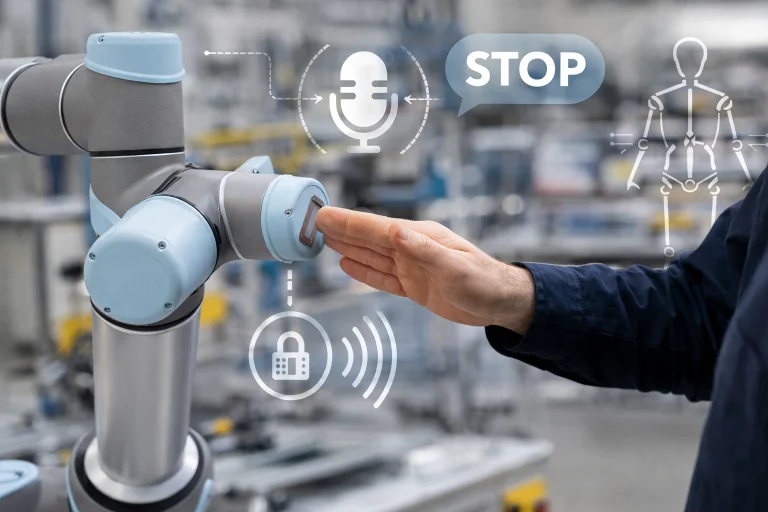
Human–Robot Interaction explores how robots and humans safely share the same workspace while performing tasks together. Collaborative robots must regulate contact forces, motion speed, and separation distance to prevent injury, while perception systems detect nearby people in real time. Communication methods such as voice commands and gesture recognition allow humans to instruct robots naturally without complex control interfaces. At the same time, ethical design principles—such as transparency, accountability, and fairness—guide how intelligent robotic systems make decisions when interacting with people in workplaces, healthcare environments, and service settings.
Interactive Quick Review: HRI & Safety Fundamentals
Test your understanding of collaborative workspaces and physical interaction safety before exploring biomechanical force equations:
1. What is the primary operational difference between collaborative robots (cobots) and traditional industrial robots regarding human proximity?
Answer: Unlike traditional industrial robots that operate inside isolated safety cages, collaborative robots share physical and cognitive workspaces directly alongside human workers, requiring built-in safety, force constraints, and physical compliance.
2. Why is Human–Robot Interaction considered an interdisciplinary engineering field rather than solely a robotics control problem?
Answer: Because ensuring safe, predictable, and responsible behavior requires integrating mechanical design, control theory, real-time perception, artificial intelligence, biomechanics, cognitive psychology, and human factors engineering.
Glossary of Human–Robot Interaction & Ethics
Key foundational terminology defining collaborative robotics, biomechanical safety standards, and socio-technical ethics:
Physical Safety and Biomechanical Force Limits
When robots interact physically with humans, contact forces must remain within strict biomechanical safety boundaries. Under ISO/TS 15066, collaborative operations define two primary contact scenarios:
- Quasi-Static Contact: Clamping or crushing contact where a body part is trapped between the robot moving part and a fixed workspace fixture.
- Transient Contact: Dynamic impact where the body part is free to recoil or deflect away after being struck.
The fundamental physical safety inequality is:
$$F \leq F_{\text{safe}}$$Where \(F\) is the measured contact force and \(F_{\text{safe}}\) is the allowable biomechanical threshold defined for the specific anatomical region. Similarly, contact pressure \(P\) must satisfy:
$$P = \frac{F}{A} \leq P_{\text{safe}}$$Where \(A\) is the effective contact surface area. Mechanical compliance, discussed in actuation and mechanical design, minimizes peak impact forces by prolonging collision deceleration times.
A collaborative manipulator joint experiences an unexpected collision during an assembly task, applying a transient contact force of \(F = 120.0\text{ N}\) against an operator's forearm. The ISO/TS 15066 safety threshold for forearm transient contact is \(F_{\text{safe}} = 140.0\text{ N}\). Evaluate compliance and determine the remaining safety margin.
Velocity and Kinetic Energy Constraints
In collaborative robotics, the severity of a potential impact is directly determined by the translational kinetic energy of the moving robot structure:
$$E = \frac{1}{2} m v^2$$Where \(m\) is the effective moving mass of the manipulator (accounting for inertia along the collision vector) and \(v\) is instantaneous velocity. Because kinetic energy scales quadratically with velocity, reducing speed produces dramatic exponential reductions in collision energy.
A cobot arm has an effective moving mass of \(m = 5.0\text{ kg}\) traveling at \(v_1 = 1.0\text{ m/s}\). When a safety LiDAR detects a worker stepping into the collaborative workspace, the controller slows the arm by \(50\%\) to \(v_2 = 0.50\text{ m/s}\). Calculate the kinetic energy before and after deceleration, and state the energy reduction factor.
HRI Challenges and Engineering Solutions
Deploying robots into shared human spaces introduces severe socio-technical, biomechanical, and algorithmic bottlenecks. Below are four primary technical challenges and their engineering mitigation frameworks:
The Challenge: Fixed safety LiDARs and overhead cameras suffer from line-of-sight occlusions caused by pillars, tooling fixtures, and workers' own bodies. When a human enters an occluded blind zone, a fast-moving robot may fail to detect proximity, risking unmitigated high-energy impacts.
- Capacitive & Piezoelectric Electronic Skin (e-Skin): Covering the robot chassis in flexible, tactile sensor arrays that detect pre-contact proximity (within \(5\text{–}10\text{ cm}\)) and distributed contact forces across the entire surface area.
- Distributed Multi-View Sensor Fusion: Integrating overlapping time-of-flight (ToF) cameras and safety LiDARs, computing dynamic occupancy voxel grids that conservatively assume occluded space is occupied by a human.
- Dual-Channel Safety-Rated Torque Limiters: Implementing hardware-level PL-d/Cat 3 certified joint torque limiters that bypass software to dump motor current within \(5\text{ ms}\) of impact detection.
The Challenge: Industrial factory floors exhibit acoustic noise levels exceeding \(80\text{ dB}\), while healthcare and public spaces involve overlapping conversations. Single-microphone voice recognition pipelines suffer from severe word-error-rate (WER) spikes and false command triggers.
- Deep Neural Beamforming Microphone Arrays: Using circular 8-channel microphone arrays with adaptive MVDR (Minimum Variance Distortionless Response) beamforming to steer acoustic focus toward the speaker while suppressing background ambient noise.
- Visual Speech Recognition (Lip-Reading VSR): Fusing facial landmark tracking with audio streams to correlate lip movements with acoustic tokens, ensuring voice commands are executed only when the user is looking directly at the robot.
- Hierarchical Confidence Gating: Enforcing strict execution probability thresholds (\(P_{\text{min}} \geq 0.85\)) for critical actuation, automatically demanding verbal confirmation when acoustic clarity is degraded.
The Challenge: Workers sharing space with cobots often develop automation complacency, falsely assuming the robot will always avoid them. Conversely, abrupt or unpredictable robot motions cause human anxiety, while hyper-realistic humanoid faces trigger the uncanny valley effect, eroding collaborative trust.
- Projected Augmented Reality (AR) & Intent Visualizers: Using floor-projected laser paths or LED light bands on the robot arm to visibly display the planned trajectory envelope and impending turn directions to surrounding workers.
- Human-Like Minimum-Jerk Motion Profiles: Smoothing trajectory acceleration curves using biological 5th-order polynomial splines that mimic human reaching motions, making machine movements intuitively predictable.
- Non-Anthropomorphic Functional Industrial Design: Favoring clean, friendly, mechanical aesthetics over deceptive humanoid appearances, setting clear cognitive expectations regarding the robot's capabilities.
The Challenge: Continuous workplace monitoring via cameras and microphones creates severe employee privacy concerns. Furthermore, if computer vision and gesture recognition models are trained on narrow demographics, they exhibit bias against elderly or disabled movement profiles. When autonomous decisions cause injury, assigning liability becomes complex.
- On-Device Edge Tokenization & Skeleton Extraction: Processing raw video entirely within local edge hardware, extracting anonymized 3D joint skeleton vectors (\(\mathbf{k}\)) and immediately discarding raw image frames from RAM.
- Federated Demographic Fine-Tuning: Training gesture models across diverse populations using federated learning, auditing models to ensure equal false-negative rates across varying age groups, ethnicities, and physical mobilities.
- Cryptographic Black-Box Event Data Recorders (EDRs): Logging synchronized sensor telemetry, controller states, and human presence flags into tamper-proof write-once memory to facilitate clear legal liability audits.
Perception for Safe Workspace Separation
To operate collaboratively without triggering emergency stops, robots continuously track human coordinates and maintain dynamic separation buffers:
$$\|\mathbf{x}_r(t) - \mathbf{x}_h(t)\| \geq d_{\text{safe}}$$Where \(\mathbf{x}_r(t)\) is robot position, \(\mathbf{x}_h(t)\) is estimated human position, and \(d_{\text{safe}}\) is the dynamic safe separation distance defined under ISO 13855:
$$d_{\text{safe}} = v_h \cdot T_r + v_r \cdot T_r + \frac{v_r^2}{2 a_r} + C$$- \(v_h\): Human approach velocity (standardized at \(1.6\text{ m/s}\) for hand/body motions).
- \(v_r\): Current velocity of the robotic manipulator (\(\text{m/s}\)).
- \(T_r\): Sensor processing latency and braking system reaction delay (\(\text{s}\)).
- \(a_r\): Maximum deceleration rate of the robot braking system (\(\text{m/s}^2\)).
- \(C\): Static safety intrusion distance buffer (\(\text{m}\)).
Gesture Recognition and Acoustic Voice Interfaces
Natural human interfaces bypass complex pendant programmers through visual gesture tracking and acoustic natural language processing.
Gesture Keypoint Estimation
Computer vision backbones extract 2D or 3D anatomical joint coordinates \(\mathbf{k} = \begin{bmatrix} k_1 & k_2 & \dots & k_n \end{bmatrix}^T\). A classification function \(g = f(\mathbf{k})\) maps joint vectors into operational command states (e.g., pause, push, retract). Accuracy is governed by keypoint Euclidean distance metrics:
$$d(\mathbf{k}_a, \mathbf{k}_b) = \sqrt{(x_b - x_a)^2 + (y_b - y_a)^2 + (z_b - z_a)^2}$$Acoustic Speech Recognition & Gating
Voice recognition decodes acoustic waveform observations \(\mathbf{x}\) into word sequence hypotheses \(\hat{w}\) via Bayes' optimal decision rule:
$$\hat{w} = \arg\max_w P(w \mid \mathbf{x}) = \arg\max_w \frac{P(\mathbf{x} \mid w) P(w)}{P(\mathbf{x})}$$To avoid dangerous false actuations in noisy environments, critical robot commands execute only when conditional confidence exceeds a programmed safety gate \(P_{\text{min}}\):
$$\text{Execute}(\hat{w}) \iff P(\hat{w} \mid \mathbf{x}) \geq P_{\text{min}}$$Impedance and Compliance Control
Traditional industrial robots employ rigid position control, driving through obstacles to reach planned waypoints. Collaborative robots utilize mechanical impedance control, establishing an artificial spring-damper dynamic relationship between external contact forces \(\mathbf{F}\) and positional tracking error:
$$\mathbf{F} = \mathbf{K}(\mathbf{x}_d - \mathbf{x}) + \mathbf{B}(\dot{\mathbf{x}}_d - \dot{\mathbf{x}}) + \mathbf{M}(\ddot{\mathbf{x}}_d - \ddot{\mathbf{x}})$$- \(\mathbf{K}\): Virtual stiffness matrix (\(\text{N/m}\)), defining resistance to displacement.
- \(\mathbf{B}\): Virtual damping matrix (\(\text{N}\cdot\text{s/m}\)), governing energy dissipation.
- \(\mathbf{M}\): Apparent virtual mass matrix (\(\text{kg}\)).
- \(\mathbf{x}_d, \mathbf{x}\): Desired and actual Cartesian positions of the end-effector.
Setting \(\mathbf{K}\) low allows an operator to push the robot arm out of the way effortlessly during collaborative manual guidance. To prevent unstable oscillations, damping is critically tuned:
$$B_{\text{crit}} = 2 \sqrt{M \cdot K}$$Ethical Decision-Making & Risk Optimization
Autonomous systems operating around humans must navigate moral and ethical trade-offs. In multi-agent scenarios, trajectory planners solve constrained multi-objective optimization problems that balance task efficiency with human psychological comfort and physical risk:
$$\min_{\mathbf{u}} \sum_{i=1}^N w_i C_i(\mathbf{x}_r, \mathbf{x}_{h,i}) + \lambda \|\mathbf{u}\|^2$$Where \(C_i\) represents the localized collision risk or perceived vulnerability penalty for person \(i\), \(w_i\) is an ethical equity weighting factor protecting vulnerable users (e.g., pediatric, geriatric, or disabled patients), and \(\mathbf{u}\) is actuation effort.
🎯 Career Guidance Tool Is Human–Robot Interaction & Robotics Ethics Right For You?Explore collaborative robotics engineering, HRI safety certification, assistive technology design, and AI ethics compliance pathways. | Explore Career Options → |
Interactive Quick Review: Perception, Compliance & Explainability
Reinforce key concepts regarding compliance control, separation distances, and explainable AI policies before reviewing the FAQ:
1. How does mechanical compliance or lower stiffness (\(K\)) improve physical safety during human–robot contact?
Answer: By lowering the virtual stiffness matrix \(\mathbf{K}\) in the impedance control law (\(\mathbf{F} = \mathbf{K}\Delta\mathbf{x} + \mathbf{B}\Delta\dot{\mathbf{x}}\)), the robot yields compliantly when external force is applied, attenuating impact spikes and preventing crushing injuries.
2. Why is transparency and explainability critical when robots utilize reinforcement learning policies (\(\pi(a \mid s)\))?
Answer: Because reinforcement learning models function as high-dimensional black boxes; explainable interfaces communicate the underlying rationale for why action \(a\) was chosen, building appropriate human trust and preventing automation complacency.
External References and Further Reading
To explore authoritative engineering standards, academic research, and ethical frameworks in human–robot interaction, consult the following sources:
- ISO/TS 15066: Robots and Robotic Devices — Collaborative Robots – The international engineering safety specification defining biomechanical force and pressure limits for collaborative robotic systems.
- IEEE Transactions on Human-Machine Systems – Publishes peer-reviewed scientific research on cognitive ergonomics, multi-modal human–robot interfaces, and shared workspace control.
- MIT Press - Human–Robot Interaction: An Introduction – A foundational academic textbook covering the behavioral, computational, and ethical dimensions of robots interacting with people.
Frequently Asked Questions about Human–Robot Interaction and Ethics
What is Human–Robot Interaction (HRI), and why is it distinct from standard industrial robotics?
HRI is an interdisciplinary field studying how robots and humans communicate and share physical workspaces. Standard industrial robots operate behind locked safety cages at high speeds; HRI focuses on collaborative robots (cobots) that work directly alongside humans, necessitating built-in force regulation, collision detection, and intuitive communication interfaces.
What is the ISO/TS 15066 standard, and how does it protect human workers?
ISO/TS 15066 is an international safety specification for collaborative robotics. It establishes quantitative biomechanical thresholds for maximum allowable contact forces (\(F_{\text{safe}}\)) and pressures across 29 specific human anatomical regions, ensuring that accidental contact remains strictly non-injurious.
How does impedance control differ from traditional stiff position control?
Traditional position control drives a robot toward setpoint coordinates regardless of external resistance, which can crush objects or injure people. Impedance control (\(F = K\Delta x + B\Delta v\)) regulates the relationship between force and displacement, causing the robot to behave like a compliant spring-damper that yields safely upon contact.
Why does reducing cobot speed significantly lower the risk of injury?
Because kinetic energy scales quadratically with velocity (\(E = \frac{1}{2}mv^2\)). Halving a robot's speed reduces its kinetic impact energy by \(75\%\), significantly lowering impact forces and giving real-time safety perception systems more time to trigger soft stops.
End-of-Page Exercises: Review, Thought-Provoking & Engineering Problems
Section 1: Foundational Review Questions & Answers
1. Why is human–robot proximity a major engineering challenge compared to traditional isolated automation?
Answer: Proximity eliminates physical safety barriers, requiring robots to actively regulate contact forces, kinetic energy, separation distances, and communication in real time to prevent human injury.
2. What fundamental condition must be satisfied for safe physical human–robot contact under ISO/TS 15066?
Answer: The contact force exerted by the robot must not exceed the biomechanical safety threshold for that specific body region (\(F \leq F_{\text{safe}}\)).
3. How does kinetic energy mathematically depend on robot velocity during a moving collision?
Answer: Kinetic energy scales quadratically with velocity (\(E = \frac{1}{2}mv^2\)), meaning small reductions in speed yield large reductions in collision impact energy.
4. What sensing technologies are commonly used to maintain the minimum safe separation distance (\(d_{\text{safe}}\))?
Answer: 3D depth cameras, safety LiDAR scanners, multi-zone time-of-flight (ToF) sensors, and computer vision human tracking algorithms.
5. How do computer vision systems represent human body posture for gesture recognition?
Answer: By extracting anatomical joint keypoint coordinates into a numerical vector \(\mathbf{k} = \begin{bmatrix} k_1 & k_2 & \dots & k_n \end{bmatrix}^T\) and mapping them through a classifier function \(g = f(\mathbf{k})\).
6. What role does the probability confidence threshold (\(P_{\text{min}}\)) play in voice-controlled robotics?
Answer: It prevents the robot from executing misunderstood audio instructions; if the acoustic model's word probability \(P(w \mid x)\) falls below \(P_{\text{min}}\), the robot rejects the command or requests clarification.
7. In the impedance control equation \(F = K\Delta x + B\Delta v\), what physical property does the matrix \(K\) represent?
Answer: The stiffness matrix \(\mathbf{K}\) represents virtual structural rigidity, determining how strongly the robot resists displacement when subjected to external contact force.
8. What is the definition of a policy function \(\pi(a \mid s)\) in reinforcement learning for HRI?
Answer: A probabilistic mapping defining the probability of a robot choosing action \(a\) when observing environmental and human state \(s\).
9. What are four primary ethical considerations when designing autonomous human-facing robots?
Answer: Data privacy in sensory monitoring, algorithmic bias across demographics, legal accountability for autonomous decisions, and equitable distribution of automation benefits and physical risks.
10. How do collaborative robots in manufacturing combine physical compliance with visual detection?
Answer: They use visual sensors to automatically decelerate when a worker approaches, while maintaining low-stiffness impedance control to yield harmlessly if accidental physical contact occurs.
Section 2: Analytical & Thought-Provoking Questions
1. How does the "uncanny valley" psychological phenomenon affect human trust and cooperation with humanoid service robots?
Answer: Near-human appearances with subtle behavioral or mechanical flaws evoke strong feelings of revulsion and distrust. In collaborative tasks, non-anthropomorphic or functional industrial designs often establish clearer expectations and higher team trust.
2. What legal challenges arise when allocating liability if an autonomous learning cobot causes injury?
Answer: When robots learn online, behaviors emerge dynamically from environmental interaction, complicating proof of whether an accident stemmed from manufacturing defects, sensor failure, biased training datasets, or human operator error.
3. How can continuous visual and audio monitoring by home robots violate privacy, and how can edge computing mitigate this?
Answer: Streaming raw home video and speech to the cloud risks data breaches. Processing sensory feeds locally on embedded edge hardware—extracting anonymized joint skeletons and text tokens while immediately discarding raw video—protects personal privacy.
4. Why is there an inherent engineering tension between high manufacturing throughput and collaborative safety?
Answer: Throughput favors maximum velocity and high stiffness (\(\mathbf{K}\)), whereas safety mandates low kinetic energy and yielding compliance. Systems resolve this via hybrid controllers that operate quickly when workers are distant, but drop speed and stiffness when humans enter proximity.
5. How can algorithmic bias in gesture recognition disproportionately endanger disabled or elderly users?
Answer: Vision models trained on young, able-bodied adults may fail to recognize the slower kinematics, tremors, or postural asymmetries of elderly or stroke patients, leading to missed emergency stop gestures or misinterpreted requests for assistance.
6. In emergency scenarios, should an autonomous robot prioritize obeying a direct human command or its ethical safety override?
Answer: Non-maleficence overrides user autonomy: certified robotics safety standards mandate that a robot must refuse any direct user command if executing that instruction would violate physical force thresholds or endanger human life.
7. How does the concept of "shared autonomy" balance human decision-making with robotic automated control?
Answer: Shared autonomy blends human strategic cognitive intent with robotic execution: the human provides high-level navigational or task goals, while the autonomous system manages obstacle avoidance, physical stabilization, and tremor compensation.
8. Why is explainable AI (XAI) crucial for preventing automation complacency among human factory workers?
Answer: Complacency arises when workers assume cobots are infallible. Clear intent displays, trajectory projection, and confidence readouts keep operators aware of the robot's sensing boundaries, sustaining vigilant situational awareness.
9. How can social robots in educational settings avoid fostering unhealthy emotional attachments in young children?
Answer: Designers must avoid deceptive claims of human emotion, clearly communicating the robot's artificial nature and framing the machine as a supportive educational tool rather than a substitute human peer.
10. How does physical occlusion in cluttered workspaces challenge separation distance enforcement?
Answer: Moving fixtures or carried objects create blind spots where sensors lose sight of workers. Safe HRI architectures fuse multiple sensor viewpoints and enforce conservative speed limits whenever occluded volume borders the tool path.
11. How does the ethical principle of "fair distribution of risks and benefits" apply to warehouse AMRs?
Answer: While autonomous mobile robots enhance enterprise efficiency, poorly paced routing schedules can impose extreme ergonomic stress on human pickers. Ethical design structures fleet dispatching around sustainable human physical health.
12. Why must HRI communication protocols incorporate multi-modal feedback?
Answer: Relying on a single sensory channel is unsafe in noisy industrial settings where acoustic alarms can be drowned out, or visual warnings missed due to distraction. Multi-modal cues (light, sound, haptic) ensure safety messages are received reliably.
Section 3: Numerical Engineering Problems & Solutions
A collaborative robotic manipulator accidentally contacts a technician's upper arm during an assembly task. Onboard joint torque sensors register a peak impact force of \(F = 135.0\text{ N}\). According to ISO/TS 15066 safety specifications, the maximum allowable quasi-static contact force for the upper arm is \(F_{\text{safe}} = 150.0\text{ N}\). Determine whether this contact satisfies physical safety constraints and calculate the remaining safety force margin.
Safety condition verification: $$F \leq F_{\text{safe}} \Rightarrow 135.0\text{ N} \leq 150.0\text{ N} \quad (\text{Condition is satisfied})$$ Calculate remaining safety margin: $$\Delta F = F_{\text{safe}} - F = 150.0\text{ N} - 135.0\text{ N} = 15.0\text{ N}$$ Final Answer: The contact event is safe, with a remaining force margin of \(15.0\text{ N}\).
A collaborative robot end-effector has an effective moving mass of \(m = 8.0\text{ kg}\) traveling at an initial velocity of \(v_1 = 1.20\text{ m/s}\). Upon detecting a human entering the collaborative zone, the safety controller reduces the velocity by \(75\%\) to \(v_2 = 0.30\text{ m/s}\). Calculate the initial kinetic energy \(E_1\), the reduced kinetic energy \(E_2\), and the energy reduction factor (\(E_1 / E_2\)).
Initial kinetic energy: $$E_1 = \frac{1}{2} m v_1^2 = \frac{1}{2} \times 8.0\text{ kg} \times (1.20\text{ m/s})^2 = 4.0 \times 1.44 = 5.76\text{ Joules}$$ Reduced kinetic energy: $$E_2 = \frac{1}{2} m v_2^2 = \frac{1}{2} \times 8.0\text{ kg} \times (0.30\text{ m/s})^2 = 4.0 \times 0.09 = 0.36\text{ Joules}$$ Energy reduction factor: $$\text{Ratio} = \frac{E_1}{E_2} = \frac{5.76\text{ J}}{0.36\text{ J}} = 16.0$$ Final Answer: Initial energy is \(5.76\text{ J}\), reduced energy is \(0.36\text{ J}\), achieving a \(16.0\times\) reduction in kinetic energy.
A 1-DoF collaborative joint is governed by the impedance control law \(F = K(x_d - x) + B(\dot{x}_d - \dot{x})\). The controller operates with stiffness \(K = 250.0\text{ N/m}\) and damping \(B = 15.0\text{ N}\cdot\text{s/m}\). During contact with a human hand, the measured displacement error is \((x_d - x) = 0.040\text{ m}\) and velocity error is \((\dot{x}_d - \dot{x}) = 0.20\text{ m/s}\). Calculate the total interaction force \(F\) generated by the robot.
Stiffness force component: $$F_{\text{stiff}} = K \cdot \Delta x = 250.0\text{ N/m} \times 0.040\text{ m} = 10.0\text{ N}$$ Damping force component: $$F_{\text{damp}} = B \cdot \Delta v = 15.0\text{ N}\cdot\text{s/m} \times 0.20\text{ m/s} = 3.0\text{ N}$$ Total interaction force: $$F = F_{\text{stiff}} + F_{\text{damp}} = 10.0\text{ N} + 3.0\text{ N} = 13.0\text{ N}$$ Final Answer: Total interaction force generated is \(13.0\text{ N}\).
A hospital assistive robot receives a vocal utterance \(\mathbf{x}\). The NLP acoustic model evaluates three candidate commands: \(P(\text{"fetch medicine"} \mid \mathbf{x}) = 0.81\), \(P(\text{"assist nurse"} \mid \mathbf{x}) = 0.12\), and \(P(\text{"standby"} \mid \mathbf{x}) = 0.07\). If safety protocols require a minimum execution confidence of \(P_{\text{min}} = 0.85\), determine the hypothesis \(\hat{w}\), verify if it satisfies the execution threshold, and state the required robot action.
Select maximum likelihood hypothesis: $$\hat{w} = \arg\max_w P(w \mid \mathbf{x}) = \text{"fetch medicine"} \quad (P = 0.81)$$ Compare against execution threshold: $$P(\hat{w} \mid \mathbf{x}) = 0.81 \lt P_{\text{min}} = 0.85 \quad (\text{Threshold breached})$$ Final Answer: Selected hypothesis is "fetch medicine" (0.81); because it falls below \(0.85\), the robot must halt autonomous execution and request verbal confirmation.
A mobile collaborative robot operates in a logistics aisle at forward speed \(v_r = 1.50\text{ m/s}\). Upon detecting an obstacle, sensor-to-brake system latency is \(T_r = 0.20\text{ s}\), after which the robot decelerates at \(a = 3.0\text{ m/s}^2\). Calculate the total stopping distance traveled during reaction and braking, and determine the minimum required safety separation distance \(d_{\text{safe}}\) (including a static margin buffer \(d_{\text{buffer}} = 0.30\text{ m}\)).
Reaction distance: $$d_{\text{react}} = v_r \cdot T_r = 1.50\text{ m/s} \times 0.20\text{ s} = 0.30\text{ m}$$ Braking deceleration distance: $$d_{\text{brake}} = \frac{v_r^2}{2a} = \frac{(1.50\text{ m/s})^2}{2 \times 3.0\text{ m/s}^2} = \frac{2.25}{6.0} = 0.375\text{ m}$$ Total stopping distance: $$d_{\text{stop}} = d_{\text{react}} + d_{\text{brake}} = 0.30 + 0.375 = 0.675\text{ m}$$ Minimum safe separation distance: $$d_{\text{safe}} = d_{\text{stop}} + d_{\text{buffer}} = 0.675\text{ m} + 0.30\text{ m} = 0.975\text{ m}$$ Final Answer: Minimum safe separation distance is \(0.975\text{ m}\) (\(\approx 98\text{ cm}\)).
A cobot gripper tip contacts a worker's palm with a force of \(F = 90.0\text{ N}\) across a circular surface area of diameter \(D = 2.0\text{ cm}\) (\(0.020\text{ m}\)). Calculate contact surface area \(A\) in \(\text{cm}^2\), compute contact pressure \(P\) in \(\text{N/cm}^2\) and kilopascals (\(\text{kPa}\)), and verify if it satisfies the ISO/TS 15066 hand pressure limit of \(P_{\text{max}} = 300.0\text{ kPa}\). (\(1\text{ N/cm}^2 = 10\text{ kPa}\); \(\pi \approx 3.14159\)).
Contact radius: $$r = \frac{D}{2} = 1.0\text{ cm}$$ Surface area in square centimeters: $$A = \pi r^2 = 3.14159 \times (1.0)^2 = 3.14159\text{ cm}^2$$ Contact pressure in \(\text{N/cm}^2\): $$P = \frac{F}{A} = \frac{90.0\text{ N}}{3.14159\text{ cm}^2} \approx 28.6479\text{ N/cm}^2$$ Convert to kilopascals: $$P_{\text{kPa}} = 28.6479 \times 10\text{ kPa} = 286.479\text{ kPa}$$ Compare with safety limit: $$P = 286.48\text{ kPa} \leq P_{\text{max}} = 300.0\text{ kPa} \quad (\text{Safe})$$ Final Answer: Contact pressure is approximately \(286.48\text{ kPa}\), which is safe (below the \(300\text{ kPa}\) threshold).
A forensic safety audit of a cobot motion trajectory reveals that at velocity \(v = 0.80\text{ m/s}\), the arm carries a kinetic impact energy of \(E = 3.20\text{ Joules}\). Calculate the effective moving mass \(m\) of the manipulator arm under this operational configuration.
Kinetic energy relation: $$E = \frac{1}{2} m v^2 \Rightarrow m = \frac{2E}{v^2}$$ Substitute values: $$m = \frac{2 \times 3.20\text{ J}}{(0.80\text{ m/s})^2} = \frac{6.40}{0.64} = 10.0\text{ kg}$$ Final Answer: Effective moving mass is \(10.0\text{ kg}\).
A computer vision interface tracks human hand keypoints in a 2D image plane (measured in pixels). To classify an open palm gesture, the system evaluates the Euclidean distance between wrist keypoint \(\mathbf{k}_{\text{wrist}} = (120, 300)\) and index fingertip keypoint \(\mathbf{k}_{\text{tip}} = (170, 180)\). Calculate the Euclidean distance \(d\) in pixels between these two keypoints.
Euclidean distance formula: $$d = \sqrt{(x_2 - x_1)^2 + (y_2 - y_1)^2}$$ Compute coordinate differences: $$\Delta x = 170 - 120 = 50\text{ px}, \quad \Delta y = 180 - 300 = -120\text{ px}$$ Sum of squares: $$d = \sqrt{(50)^2 + (-120)^2} = \sqrt{2{,}500 + 14{,}400} = \sqrt{16{,}900} = 130.0\text{ pixels}$$ Final Answer: Euclidean keypoint distance is \(130.0\text{ pixels}\).
An explainable RL cobot observes state \(s\) representing a human worker reaching for a shared workpiece. The policy \(\pi(a \mid s)\) defines probabilities for three actions: \(a_1 = \text{"yield and retract"}\), \(a_2 = \text{"hold position and alert"}\), and \(a_3 = \text{"continue motion"}\). If the policy computes \(\pi(a_1 \mid s) = 0.75\) and \(\pi(a_2 \mid s) = 0.20\), calculate the remaining probability \(\pi(a_3 \mid s)\) and identify the action selected under a greedy policy.
Total probability axiom: $$\sum_{i=1}^3 \pi(a_i \mid s) = 1.0 \Rightarrow \pi(a_3 \mid s) = 1.0 - (0.75 + 0.20) = 1.0 - 0.95 = 0.05 \quad (5.0\%)$$ Greedy action selection: $$a^* = \arg\max_{a} \pi(a \mid s) = \max(0.75, 0.20, 0.05) \Rightarrow a_1$$ Final Answer: Probability \(\pi(a_3 \mid s)\) is \(0.05\) (\(5.0\%\)); the robot executes "yield and retract".
To eliminate oscillatory contact bounce when a collaborative arm touches a human worker, the impedance controller is tuned for critical damping (\(\zeta = 1.0\)). If effective joint inertia is \(M = 4.0\text{ kg}\cdot\text{m}^2\) and virtual rotational stiffness is \(K = 100.0\text{ N}\cdot\text{m/rad}\), calculate the required critical damping gain \(B_{\text{crit}}\) using \(B_{\text{crit}} = 2 \sqrt{M \cdot K}\).
Calculate product: $$M \cdot K = 4.0\text{ kg}\cdot\text{m}^2 \times 100.0\text{ N}\cdot\text{m/rad} = 400.0$$ Compute square root: $$\sqrt{400.0} = 20.0$$ Calculate critical damping: $$B_{\text{crit}} = 2 \times 20.0 = 40.0\text{ N}\cdot\text{m}\cdot\text{s/rad}$$ Final Answer: Required critical damping gain is \(40.0\text{ N}\cdot\text{m}\cdot\text{s/rad}\).
An autonomous hospital delivery robot navigates past three people: a surgeon (Person 1), an elderly patient with a walker (Person 2), and a visitor (Person 3). An ethical planning algorithm assigns risk penalties: \(C_1 = 15.0\), \(C_2 = 65.0\), and \(C_3 = 20.0\). Calculate initial system cost \(\sum C_i\). An alternate path increases the surgeon's inconvenience to \(C_1' = 25.0\) but reduces the elderly patient's risk to \(C_2' = 20.0\) (with \(C_3' = 20.0\)). Calculate alternate cost \(\sum C_i'\) and determine which path the objective \(\min \sum C_i\) selects.
Initial system cost: $$\sum_{i=1}^3 C_i = 15.0 + 65.0 + 20.0 = 100.0$$ Alternate trajectory cost: $$\sum_{i=1}^3 C_i' = 25.0 + 20.0 + 20.0 = 65.0$$ Optimization comparison: $$\min(100.0, 65.0) = 65.0 \Rightarrow \text{Select alternate trajectory}$$ Final Answer: Initial cost is \(100.0\), alternate cost is \(65.0\); the algorithm selects the alternate trajectory to minimize vulnerability risk.
A LiDAR sensor on an autonomous mobile robot detects a pedestrian at distance \(d = 4.80\text{ m}\). The robot moves forward at \(v_r = 1.80\text{ m/s}\), while the pedestrian walks toward the robot at \(v_h = 1.20\text{ m/s}\). Calculate the relative closing speed \(v_{\text{rel}}\), determine the exact time-to-collision (\(\text{TTC}\)), and verify if emergency braking triggers given a safety threshold \(\text{TTC}_{\text{min}} = 2.00\text{ s}\).
Relative closing velocity: $$v_{\text{rel}} = v_r + v_h = 1.80\text{ m/s} + 1.20\text{ m/s} = 3.00\text{ m/s}$$ Time-to-collision calculation: $$\text{TTC} = \frac{d}{v_{\text{rel}}} = \frac{4.80\text{ m}}{3.00\text{ m/s}} = 1.60\text{ seconds}$$ Safety threshold verification: $$\text{TTC} = 1.60\text{ s} \lt \text{TTC}_{\text{min}} = 2.00\text{ s} \quad (\text{Safety boundary breached})$$ Final Answer: Time-to-collision is \(1.60\text{ seconds}\); emergency braking must trigger immediately.
Human–Robot Interaction and Ethics — Summary & Wrap-Up
Human–Robot Interaction and ethical robotics transform intelligent machines from isolated industrial tools into responsible, collaborative partners. By mastering biomechanical force limits, kinetic energy scaling, real-time separation perception, intuitive speech and gesture communication, impedance compliance, explainable AI, and ethical risk optimization, engineering professionals ensure that future robotic systems operate safely, predictably, and equitably alongside humankind.
Human-Centered Perspectives Across Robotics Applications
As robots increasingly move beyond controlled laboratory environments into workplaces, hospitals, homes, and public spaces, understanding how humans interact with robotic systems has become a central area of research. Human–robot interaction examines communication, safety mechanisms, usability, and ethical considerations to ensure that robots operate responsibly alongside people.
These principles apply across many branches of robotics. In manufacturing environments, collaborative robots designed to share workspaces with human operators are explored in Industrial Robotics Systems and Cobots, where safety sensors, adaptive control, and ergonomic design allow machines to cooperate with workers on production tasks.
Human-centered considerations are equally important in healthcare environments. Robotic surgical systems and medical assistance technologies are introduced in Medical and Surgical Robotics, where precision, reliability, and patient safety are critical. Robots designed for everyday assistance and service roles are discussed in Service Robotics, including systems used in hospitality, domestic environments, and healthcare support.
Robotics applications also extend to large-scale environmental and economic systems. Agricultural automation technologies are presented in Agricultural Robotics, while logistics operations supported by coordinated robotic fleets are examined in Warehouse Logistics and Autonomous Mobile Robots (AMRs).
Mobility technologies represent another important robotics domain. Autonomous vehicles navigating roads are introduced in Autonomous Ground Vehicles, while aerial platforms used for mapping, monitoring, and inspection are discussed in Aerial Robotics and UAV Systems.
Students interested in the broader scientific and engineering principles that support these technologies—including robot perception, motion planning, and intelligent control—can explore the Robotics Hub, which provides an overview of the interdisciplinary foundations of modern robotics.