
Heat conduction is the transfer of thermal energy through matter because of a temperature difference. It is the main way heat travels through solids, such as metal rods, building walls, cooking pans, electronic chips, engine parts, and layers of insulation.
This page belongs to the Heat Transfer cluster within Thermodynamics. It prepares students for Heat Convection, Thermal Radiation, Thermal Resistance, Heat Exchangers, and Combined Heat Transfer.
In everyday life, conduction explains why a metal spoon becomes hot in soup, why a tile floor feels colder than a wooden floor, why insulation slows heat loss from a house, and why electronic devices need heat sinks. In engineering, conduction is used to design walls, engines, furnaces, batteries, spacecraft parts, thermal protection systems, and cooling pathways for microchips.
The central idea is simple: when one part of a material is hotter than another, thermal energy tends to move from the hotter region toward the colder region. The rate of that movement depends on the material, the temperature difference, the size of the heat-flow area, and the distance the heat must travel.
What Heat Conduction Really Is
Heat conduction is energy transfer through microscopic interactions inside matter. Particles in a hotter region have, on average, more thermal energy. They transfer some of that energy to neighbouring particles through collisions, vibrations, and interactions.
In metals, free electrons also help carry thermal energy. This is why many metals are good thermal conductors. In non-metals, heat is mostly carried by lattice vibrations and molecular interactions, so conduction is usually slower.
| Material Type | Main Conduction Mechanism | Typical Behaviour |
|---|---|---|
| Metals | Free electrons and lattice vibrations | Usually strong thermal conductors |
| Ceramics | Lattice vibrations | Can be moderate conductors or strong insulators |
| Polymers | Molecular vibrations and chain interactions | Usually poor conductors |
| Air and gases | Molecular collisions | Usually weak conductors |
| Liquids | Molecular interactions and collisions | Usually conduct heat less effectively than metals |
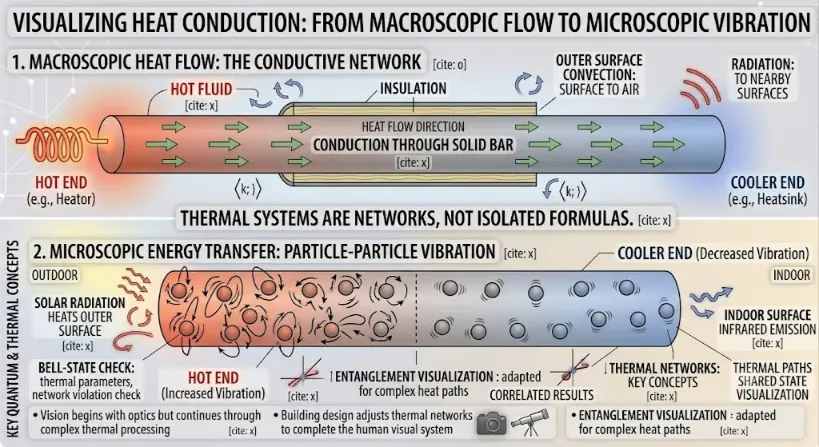
Infographic visualizing heat conduction. Top panel shows the macroscopic flow of heat along a solid bar. Bottom panel magnifies the internal structure to connect macroscopic flow with microscopic energy transfer.
The image is a multi-panel scientific infographic titled “VISUALIZING HEAT CONDUCTION: FROM MACROSCOPIC FLOW TO MICROSCOPIC VIBRATION”, set against a clean white background. It utilizes detailed diagrammatic illustrations and charts to connect the broad concept of heat flow with particle-level energy transfer.
Part 1: Macroscopic Heat Flow: The Conductive Network
The upper half of the infographic details the heat flow along a solid object:
- Solid Bar and Heat Gradient: A long cylindrical metal bar is depicted, transitionally colored from red-orange on the left to neutral grey to soft blue on the right. Labeled text points clarify “HOT END (e.g., Heater)” on the left and “COOLER END (e.g., Heatsink)” on the right.
- Flow Tracking: A glowing coil icon heats the left end. Many small green arrows point from left to right along the bar, labeled “HEAT FLOW DIRECTION” and “CONDUCTION THROUGH SOLID BAR”. Callouts include “HOT FLUID”, “INSULATION”, “OUTER SURFACE CONVECTION: SURFACE TO AIR”, and “RADIATION: TO NEARBY SURFACES”.
Part 2: Microscopic Energy Transfer: Particle-Particle Vibration
The lower half of the infographic provides a magnified, internal view of the energy transfer:
- Magnified Dual View: This section is split horizontally into “OUTDOOR” (metaphorical for high heat, left) and “INDOOR” (metaphorical for lower heat, right) microscopic views of the particle matrix.
- Energy of Vibration: The left microscopic view, labeled “HOT END (Increased Vibration)”, shows particles with large, complex, highly chaotic vibrational arcs. The right view, labeled “COOLER END (Decreased Vibration)”, shows particles with much smaller, subtle vibrational arcs.
Temperature Difference Drives Conduction
Heat conduction needs a temperature difference. If every part of a solid is at the same temperature, there is no net conductive heat flow. Individual particles still move and vibrate, but there is no overall direction for thermal energy transfer.
When one side is hotter than the other, heat flows from the hot side toward the cold side. This continues until thermal equilibrium is approached, unless an external source keeps one side hot and the other side cold.
| Situation | Temperature Difference? | Net Conduction? |
|---|---|---|
| One end of a rod is heated | Yes | Heat flows along the rod |
| Both ends of a rod are at the same temperature | No | No net heat conduction |
| A wall separates warm indoor air from cold outdoor air | Yes | Heat conducts through the wall |
| A well-insulated box is at uniform temperature | No internal gradient | No internal net conduction |
Fourier’s Law of Heat Conduction
The basic law of heat conduction is Fourier’s law. In one-dimensional form, it can be written as:
Q˙ = −kA dT⁄dx
Here, Q˙ is the rate of heat transfer, k is thermal conductivity, A is the cross-sectional area, and dT⁄dx is the temperature gradient.
| Symbol | Meaning | Common Unit |
|---|---|---|
| Q˙ | Rate of heat transfer | W |
| k | Thermal conductivity | W/(m·K) |
| A | Area perpendicular to heat flow | m2 |
| dT⁄dx | Temperature gradient | K/m |
The minus sign shows that heat flows in the direction of decreasing temperature. In many introductory problems, students use the magnitude of the heat-transfer rate, so the equation is often written in a simpler positive form for a flat wall.
Conduction Through a Flat Wall
For steady, one-dimensional conduction through a flat wall of thickness L, the heat-transfer rate is:
Q˙ = kA (Thot − Tcold)⁄L
This equation shows four important ideas:
- Heat transfer increases when thermal conductivity k is larger.
- Heat transfer increases when area A is larger.
- Heat transfer increases when the temperature difference is larger.
- Heat transfer decreases when the wall is thicker.
| Change | Effect on Conduction Rate | Example |
|---|---|---|
| Increase k | Heat flows faster | Copper conducts better than plastic |
| Increase A | Heat flows faster | A large wall loses more heat than a small panel |
| Increase ΔT | Heat flows faster | A hotter stove heats a pan faster |
| Increase L | Heat flows slower | Thicker insulation reduces heat loss |
Thermal Conductivity
Thermal conductivity tells us how easily a material conducts heat. A high value of k means heat passes through the material easily. A low value of k means the material resists heat flow.
| Material Category | Typical Conductivity Behaviour | Common Use |
|---|---|---|
| High-conductivity metals | Conduct heat quickly | Heat sinks, cookware, heat spreaders |
| Low-conductivity solids | Slow heat flow | Insulation, handles, thermal barriers |
| Air-filled materials | Often good insulators | Foam, fibreglass, double glazing |
| Special ceramics | Can resist high temperature | Furnace linings, thermal shields |
| Engineered composites | Designed for selected heat paths | Electronics, aerospace, batteries |
Thermal conductivity is not always constant. It may change with temperature, direction, material structure, moisture content, density, and manufacturing method. Real engineering designs often need measured material data rather than a single textbook value.
Heat Flux
Heat flux is the heat-transfer rate per unit area. It is useful when comparing heat flow through surfaces of different sizes.
q″ = Q˙⁄A
Using Fourier’s law:
q″ = −k dT⁄dx
Heat flux helps engineers describe how strongly heat is passing through a surface. A small electronic chip may have a very high heat flux even if the total heat rate is not large, because the area is very small.
Thermal Resistance in Conduction
Conduction can also be described using thermal resistance. This is useful because heat flow can be treated in a way that resembles electrical current flowing through resistance.
For a flat wall:
Rcond = L⁄kA
The heat-transfer rate becomes:
Q˙ = ΔT⁄Rcond
A large thermal resistance means heat flow is difficult. A small thermal resistance means heat flow is easy.
| How to Increase Thermal Resistance | Why It Works | Example |
|---|---|---|
| Increase thickness L | Heat must travel farther | Thicker insulation |
| Use lower k | Material conducts heat less easily | Foam instead of metal |
| Reduce area A | Less cross-sectional area for heat flow | Narrow thermal bridge |
This idea is developed more fully in the Thermal Resistance page.
Conduction Through Composite Layers
Many real systems contain several layers. A building wall may include plaster, brick, insulation, an air gap, and external cladding. Heat must pass through each layer in sequence.
For layers in series, the total thermal resistance is:
Rtotal = R1 + R2 + R3 + &cdots;
Then:
Q˙ = (Thot − Tcold)⁄Rtotal
This approach is powerful because each material layer can be represented by its own resistance. The layer with the largest resistance often controls the heat loss.
Contact Resistance
When two solid surfaces touch, they may not actually touch perfectly everywhere. Microscopic roughness creates tiny air gaps. These gaps can add resistance to heat flow.
This is called thermal contact resistance. It matters in electronics cooling, engine parts, heat exchangers, bolted joints, thermal interface materials, and laboratory measurements.
| Situation | Why Contact Resistance Matters |
|---|---|
| CPU and heat sink | Thermal paste reduces air gaps and improves heat flow |
| Bolted metal plates | Surface roughness affects conduction across the joint |
| Insulated panels | Poor contact can create unexpected hot or cold spots |
| Heat exchanger plates | Contact quality affects thermal performance |
Steady and Transient Conduction
In steady conduction, temperatures at each point do not change with time. Heat may still be flowing, but the temperature pattern remains fixed.
In transient conduction, temperatures change with time. This happens when an object is first placed in a hot oven, when a cold spoon is placed in hot soup, or when a battery heats up during use.
| Type | Temperature Behaviour | Example |
|---|---|---|
| Steady conduction | Temperature profile stays constant | A wall after indoor and outdoor temperatures have remained steady for a long time |
| Transient conduction | Temperature changes with time | A metal rod warming up after one end is heated |
Transient conduction is important in thermal protection, cooking, electronics startup, battery safety, fire resistance, and cooling of manufactured parts.
Thermal Diffusivity
Thermal diffusivity describes how quickly temperature changes spread through a material. It is defined as:
α = k⁄ρcp
Here, α is thermal diffusivity, k is thermal conductivity, ρ is density, and cp is specific heat capacity.
| Quantity | Meaning |
|---|---|
| k | How easily heat conducts through the material |
| ρcp | How much thermal energy the material stores per unit volume per kelvin |
| α | How quickly temperature disturbances spread |
A material with high thermal diffusivity responds quickly to temperature changes. A material with low thermal diffusivity changes temperature more slowly.
Conduction in Different States of Matter
Conduction can occur in solids, liquids, and gases, but it is usually most important in solids. In fluids, conduction still occurs, but convection often becomes important when the fluid can move.
| State of Matter | Conduction Behaviour | Example |
|---|---|---|
| Solid | Often dominant because particles are closely packed | Heat moving through a metal rod |
| Liquid | Occurs through molecular interactions, but fluid motion may dominate | Heat spreading slowly through still oil |
| Gas | Usually weak because molecules are far apart | Air trapped inside insulation |
The fact that still air is a weak conductor is one reason many insulators work well. They trap air in small spaces so convection is reduced and conduction through the trapped gas remains slow.
Everyday Examples of Heat Conduction
Metal Spoon in Hot Soup
Heat conducts along the metal handle because metals allow thermal energy to move quickly.Cooking Pan on a Stove
Heat conducts from the stove through the base of the pan and into the food.Warm House Losing Heat
Heat conducts through walls, windows, roofs, and floors when the outside air is colder.Tile Floor Feeling Cold
Tile conducts heat away from the foot faster than wood or carpet, so it feels colder even at the same temperature.Ice Melting in the Hand
Heat conducts from the warmer hand into the colder ice, causing the ice to melt.Phone Heating During Use
Heat conducts from electronic components into the phone body and eventually to the surroundings.Applications of Heat Conduction
Heat conduction is important wherever heat must be moved, slowed, spread, blocked, or controlled.
Building Insulation
Low-conductivity materials reduce heat loss in cold weather and heat gain in hot weather.Electronics Cooling
Heat sinks, thermal pads, and metal spreaders conduct heat away from chips and batteries.Cooking and Food Processing
Conduction determines how heat enters pans, grills, ovens, and food surfaces.Engine and Turbine Design
Engine parts must conduct, resist, or redirect heat to avoid damage and improve efficiency.Thermal Protection Systems
Spacecraft, furnaces, and high-temperature equipment need materials that slow dangerous heat conduction.Battery Safety
Battery packs need controlled conduction paths so heat does not accumulate dangerously in one region.Medical and Biological Systems
Heat conduction affects tissue warming, cooling therapy, thermal burns, and medical device design.Materials Engineering
Thermal conductivity affects material selection for insulation, heat spreading, thermal barriers, and manufacturing.Challenges and Practical Limitations
Simple conduction equations are powerful, but real systems often include geometry, changing material properties, contact resistance, moisture, temperature-dependent conductivity, and other modes of heat transfer.
| Challenge | Why It Matters | Example |
|---|---|---|
| Temperature-dependent conductivity | k may change as the material gets hotter or colder | High-temperature furnace walls |
| Contact resistance | Surfaces may not touch perfectly | Heat sink attached to a processor |
| Multidimensional heat flow | Heat may not flow in only one direction | Corners of buildings and complex machine parts |
| Transient behaviour | Temperature changes with time | A battery warming during fast charging |
| Moisture effects | Water can change insulation performance | Damp building insulation |
| Combined heat transfer | Conduction may occur with convection and radiation | A hot pipe losing heat to air |
| Material anisotropy | Heat may conduct better in one direction than another | Composite materials and layered structures |
The practical lesson is that conduction is often the first heat-transfer mechanism students learn, but real thermal design usually requires checking whether convection, radiation, contact resistance, and transient effects also matter.
Future Directions and Emerging Trends
Heat conduction remains important in modern technology because many devices are becoming smaller, hotter, faster, and more energy-dense. Controlling where heat goes is now a major design challenge.
Advanced Thermal Interface Materials
New materials aim to reduce contact resistance between chips, batteries, heat sinks, and cooling plates.High-Conductivity Composites
Engineered composites can spread heat efficiently while remaining lightweight or electrically insulating.Thermal Barriers
Ceramic coatings and multilayer systems protect turbines, engines, spacecraft, and industrial equipment from high temperatures.Battery Thermal Management
Electric vehicles and grid storage systems require careful conduction pathways to avoid hot spots and ageing.Microelectronics Cooling
As chips become more powerful, heat conduction through tiny layers and interfaces becomes increasingly important.Building Energy Efficiency
Better insulation, windows, and thermal-bridge design reduce energy use in buildings.Nanoscale Heat Conduction
At very small scales, heat may not behave exactly like simple Fourier-law predictions, requiring more advanced models.AI-Assisted Thermal Design
Simulation and optimisation tools can help design materials and structures that guide heat more intelligently.Connections with Wider Physics and Technology
Heat conduction connects thermodynamics with materials, energy systems, electronics, buildings, engines, and environmental design.
Thermodynamics
Conduction is one way thermal energy moves because of temperature difference.Heat Transfer
Heat conduction is one of the three major heat-transfer modes, alongside convection and radiation.Thermal Resistance
Thermal resistance provides a practical way to analyse conduction through walls, layers, insulation, and contacts.Combined Heat Transfer
Real systems often combine conduction inside solids with convection and radiation at surfaces.Engineering Thermodynamics
Engines, turbines, refrigerators, heat pumps, and energy systems all require conduction analysis.Materials Engineering
Material selection often depends on whether heat should be conducted quickly or blocked effectively.Learning Pathway Within Heat Transfer
Heat conduction is the first step in the Heat Transfer pathway because it introduces the idea of heat moving because of a temperature gradient.
Heat Conduction
Current page. Learn how heat moves through materials by molecular interactions, electron motion, and temperature gradients.Heat Convection
Study how fluids transfer heat through natural motion, forced flow, boundary layers, and mixing.Thermal Radiation
Explore how heat travels by electromagnetic waves, even through empty space.Thermal Resistance
Learn how resistance models help analyse heat flow through layers, walls, insulation, and interfaces.Heat Exchangers
See how devices transfer heat between fluids in engines, power plants, HVAC systems, and industry.Combined Heat Transfer
Understand how conduction, convection, and radiation work together in real thermal systems.Quick Check: Heat Conduction
Quick Check: Conduction and Temperature Gradient
Q1. What causes heat conduction?
Heat conduction is caused by a temperature difference inside a material or between objects in contact. Thermal energy moves from the hotter region toward the colder region.
Q2. Why do metals usually conduct heat well?
Metals usually conduct heat well because free electrons and lattice vibrations can carry thermal energy through the material efficiently.
Q3. What happens to conduction if wall thickness increases?
For the same material, area, and temperature difference, increasing wall thickness reduces the rate of heat conduction.
Q4. Why is trapped air useful in insulation?
Still air is a weak conductor. Insulating materials trap air in small spaces, reducing both conduction and large-scale convection.
Common Misunderstandings About Heat Conduction
Misunderstanding 1: Cold Flows from Cold Objects to Hot Objects
Cold does not flow as a physical substance. Heat transfers from hotter regions to colder regions because of temperature difference.
Misunderstanding 2: All Solids Conduct Heat Equally
Different solids can have very different thermal conductivities. Copper, wood, glass, foam, and ceramic may conduct heat at very different rates.
Misunderstanding 3: A Material That Feels Cold Must Be Colder
A tile floor and a wooden floor in the same room may be at the same temperature, but tile feels colder because it conducts heat away from the foot faster.
Misunderstanding 4: Insulation Stops Heat Completely
Insulation slows heat transfer. It does not make heat transfer vanish completely when a temperature difference remains.
Misunderstanding 5: Fourier’s Law Always Applies in Simple Form
The simple flat-wall form works best for steady, one-dimensional conduction with constant material properties. Real systems may require more advanced modelling.
Key Terms
- Heat conduction
- Heat transfer through matter because of a temperature difference.
- Thermal conductivity
- A material property that describes how easily heat conducts through a material.
- Temperature gradient
- The rate at which temperature changes with position.
- Fourier’s law
- The law that relates conductive heat-transfer rate to thermal conductivity, area, and temperature gradient.
- Heat flux
- Heat-transfer rate per unit area.
- Thermal resistance
- A measure of how strongly a layer, object, or interface resists heat flow.
- Steady conduction
- Conduction in which the temperature at each point does not change with time.
- Transient conduction
- Conduction in which temperature changes with time.
- Thermal diffusivity
- A property that describes how quickly temperature changes spread through a material.
- Contact resistance
- Extra thermal resistance caused by imperfect contact between surfaces.
Frequently Asked Questions: Heat Conduction
What is heat conduction?
Heat conduction is the transfer of thermal energy through matter because of a temperature difference, usually from a hotter region to a colder region.
Where does heat conduction occur?
Conduction can occur in solids, liquids, and gases, but it is usually most important in solids because particles are closely packed.
What is Fourier’s law?
Fourier’s law relates the rate of heat conduction to thermal conductivity, area, and temperature gradient. It is the main equation used to model conduction.
What is thermal conductivity?
Thermal conductivity is a material property that tells how easily heat passes through a material.
Why do metals conduct heat well?
Metals conduct heat well because free electrons and lattice vibrations transfer thermal energy efficiently.
Why are many insulators full of trapped air?
Still air has low thermal conductivity. Trapping air in small spaces slows heat transfer and reduces convection.
What is steady conduction?
Steady conduction occurs when heat flows but the temperature distribution does not change with time.
What is transient conduction?
Transient conduction occurs when temperature changes with time, such as when a cold object is suddenly heated.
How does thickness affect conduction?
For the same material, area, and temperature difference, greater thickness reduces the rate of heat conduction.
How does area affect conduction?
A larger area allows more heat to pass through, so conductive heat-transfer rate increases with area.
How is conduction different from convection?
Conduction transfers heat through microscopic interactions inside matter, while convection transfers heat through bulk fluid motion.
Why should students learn heat conduction?
Heat conduction is essential for understanding insulation, cooking, electronics cooling, engines, materials, batteries, buildings, and many engineering systems.
Review Questions and Answers
- What is heat conduction?Answer: Heat conduction is the transfer of thermal energy through matter because of a temperature difference.
- What direction does conductive heat flow?Answer: Conductive heat flows from hotter regions toward colder regions.
- What material property controls how easily heat conducts?Answer: Thermal conductivity, represented by k, controls how easily heat conducts through a material.
- What is the flat-wall conduction equation?Answer: For steady one-dimensional conduction through a flat wall, Q˙ = kA (Thot − Tcold)⁄L.
- Why does a thicker wall reduce heat conduction?Answer: A thicker wall gives heat a longer path to travel, increasing thermal resistance.
- What is thermal resistance for a flat wall?Answer: Thermal resistance is Rcond = L⁄kA.
- What is heat flux?Answer: Heat flux is heat-transfer rate per unit area, written as q″ = Q˙⁄A.
- Why can two floors at the same temperature feel different?Answer: A material with higher thermal conductivity removes heat from the foot faster, so it feels colder even if its temperature is the same.
Thought-Provoking Questions and Answers
- Why is conduction both useful and troublesome in engineering?Answer: Engineers often want heat to move quickly in heat sinks and cooling systems, but slowly in insulation and thermal protection systems. The same physical mechanism can be helpful or harmful depending on the design goal.
- Why does material choice matter so much in thermal design?Answer: Materials differ greatly in thermal conductivity, heat capacity, density, strength, cost, and temperature limits. Choosing a material means choosing how heat will move through the system.
- Why can a small electronic chip be difficult to cool even if it produces only modest total heat?Answer: The heat may be produced over a very small area, creating high heat flux. Removing heat safely requires good conduction pathways and low contact resistance.
- How does heat conduction connect comfort with energy efficiency?Answer: Buildings lose or gain heat through walls, roofs, floors, and windows by conduction. Better insulation reduces unwanted conduction and improves comfort while saving energy.
- Why is contact resistance important even when both materials are good conductors?Answer: If surfaces touch poorly, microscopic air gaps can block heat flow. The interface may become the weak point in the thermal pathway.
- What does heat conduction teach us about invisible processes?Answer: It shows that important physical processes do not always involve visible motion. Heat can move through apparently still matter because microscopic particles and electrons transfer energy.
Numerical Problems and Solutions
- A wall has k = 0.80 W/(m·K), area A = 2.0 m2, thickness L = 0.10 m, and temperature difference 20 K. Find the heat-transfer rate.Solution:
- Use Q˙ = kA ΔT⁄L.
- Q˙ = (0.80)(2.0) 20⁄0.10.
- Q˙ = 1.6 × 200 = 320 W.
Answer: The heat-transfer rate is 320 W. - An insulation layer has L = 0.050 m, k = 0.040 W/(m·K), and A = 10 m2. Find its thermal resistance.Solution:
- Use Rcond = L⁄kA.
- Rcond = 0.050⁄(0.040)(10).
- Rcond = 0.050⁄0.40 = 0.125 K/W.
Answer: The thermal resistance is 0.125 K/W. - Using the insulation layer in Problem 2, find the heat-transfer rate if the temperature difference is 25 K.Solution:
- Use Q˙ = ΔT⁄Rcond.
- Q˙ = 25⁄0.125.
- Q˙ = 200 W.
Answer: The heat-transfer rate is 200 W. - A material has k = 205 W/(m·K) and temperature gradient dT⁄dx = −500 K/m. Find the heat flux.Solution:
- Use q″ = −k dT⁄dx.
- q″ = −(205)(−500).
- q″ = 102500 W/m2.
Answer: The heat flux is 1.025 × 10⁵ W/m2. - A composite wall has two layers, each with area 1.0 m2. Layer 1 has L1 = 0.020 m, k1 = 0.20 W/(m·K). Layer 2 has L2 = 0.080 m, k2 = 0.040 W/(m·K). Find the heat-transfer rate for ΔT = 21 K.Solution:
- Find R1 = L1⁄k1A = 0.020⁄(0.20)(1.0) = 0.10 K/W.
- Find R2 = L2⁄k2A = 0.080⁄(0.040)(1.0) = 2.0 K/W.
- Total resistance: Rtotal = 0.10 + 2.0 = 2.10 K/W.
- Q˙ = ΔT⁄Rtotal = 21⁄2.10 = 10 W.
Answer: The heat-transfer rate is 10 W. - A material has k = 45 W/(m·K), ρ = 7800 kg/m3, and cp = 460 J/(kg·K). Find its thermal diffusivity.Solution:
- Use α = k⁄ρcp.
- α = 45⁄(7800)(460).
- (7800)(460) = 3588000.
- α ≈ 1.25 × 10⁻⁵ m2/s.
Answer: The thermal diffusivity is approximately 1.25 × 10⁻⁵ m2/s. - An insulation panel must limit heat loss to 50 W. If k = 0.040 W/(m·K), A = 2.0 m2, and ΔT = 30 K, what thickness is needed?Solution:
- Use Q˙ = kA ΔT⁄L.
- Rearrange: L = kAΔT⁄Q˙.
- L = (0.040)(2.0)(30)⁄50.
- L = 2.4⁄50 = 0.048 m.
Answer: The required thickness is 0.048 m, or 4.8 cm. - A copper rod has k = 400 W/(m·K), length 0.50 m, cross-sectional area 2.0 × 10⁻⁴ m2, and temperature difference 80 K. Find the heat-transfer rate.Solution:
- Use Q˙ = kA ΔT⁄L.
- Q˙ = (400)(2.0 × 10⁻⁴) 80⁄0.50.
- (400)(2.0 × 10⁻⁴) = 0.080.
- 80⁄0.50 = 160.
- Q˙ = 0.080 × 160 = 12.8 W.
Answer: The heat-transfer rate is 12.8 W.
External References for Further Reading
The following references provide useful background on heat conduction, Fourier’s law, and heat-transfer mechanisms.
- OpenStax University Physics: Mechanisms of Heat Transfer — A clear overview of conduction, convection, and radiation.
- OpenStax College Physics: Conduction — A student-friendly explanation of conduction rate, area, thickness, and thermal conductivity.
- NASA Glenn Research Center: Heat Transfer — A concise introduction to heat transfer and thermal equilibrium.
- Physics LibreTexts: Conduction — A supplementary explanation of conductive heat transfer and related equations.
Why This Topic Matters
Heat conduction matters because every thermal system contains materials. Heat must pass through walls, solids, interfaces, layers, chips, pipes, containers, insulation, and structural parts before it can be used, removed, stored, or blocked.
For students, conduction is the entry point into heat transfer. It teaches how temperature gradients drive heat flow, how material properties shape thermal behaviour, and how mathematical models connect physics with engineering design.
For modern technology, conduction is essential in electronics cooling, building efficiency, electric vehicles, energy storage, manufacturing, aerospace protection, medical devices, and sustainable thermal design.
Summary
Heat conduction is the transfer of thermal energy through matter because of a temperature difference. It is especially important in solids, where energy is transferred through particle vibrations, molecular interactions, and, in metals, free electrons.
Fourier’s law describes conductive heat transfer:
Q˙ = −kA dT⁄dx
For a flat wall under steady one-dimensional conditions, this becomes:
Q˙ = kA (Thot − Tcold)⁄L
Conduction is controlled by thermal conductivity, area, temperature difference, thickness, contact quality, geometry, and time dependence. It is the foundation for understanding insulation, heat sinks, thermal barriers, building energy loss, battery safety, electronics cooling, and combined heat-transfer systems.
Reflection Question
If heat conduction can be either helpful or harmful depending on the situation, how should engineers decide when to encourage heat flow and when to block it?