
Heat convection is the transfer of thermal energy by the motion of a fluid. A fluid may be a liquid or a gas, so convection appears in boiling water, room ventilation, weather systems, ocean currents, cooling fans, car radiators, heat exchangers, and the movement of warm air above a hot surface.
This page belongs to the Heat Transfer cluster within Thermodynamics. It builds on Heat Conduction and prepares students for Thermal Radiation, Thermal Resistance, Heat Exchangers, and Combined Heat Transfer.
The central idea is simple: heat can move through a fluid not only by microscopic conduction, but also by the bulk movement of the fluid itself. Warm fluid can rise, cold fluid can sink, fans can push air across hot surfaces, and pumps can drive water through pipes. This motion carries thermal energy from one place to another.
Convection is one of the most visible forms of heat transfer because it often creates motion we can see or feel: steam rising from soup, warm air flowing from a heater, cool air from an air-conditioner, or water circulating in a pot before boiling.
What Heat Convection Really Is
Heat convection occurs when thermal energy is transferred between a surface and a moving fluid, or from one region of a fluid to another because the fluid moves. It combines two ideas: heat transfer and fluid motion.
Near a hot solid surface, fluid particles gain energy by conduction from the surface. If those warmer fluid particles move away and are replaced by cooler fluid, heat transfer continues more effectively. This is why moving air or flowing water usually removes heat faster than still air or still water.
| Heat Transfer Mode | How Energy Moves | Example |
|---|---|---|
| Conduction | Through microscopic interactions inside matter | Heat moving through a metal spoon |
| Convection | Through fluid motion plus heat transfer | Warm air rising from a heater |
| Radiation | Through electromagnetic waves | Sunlight warming the Earth |
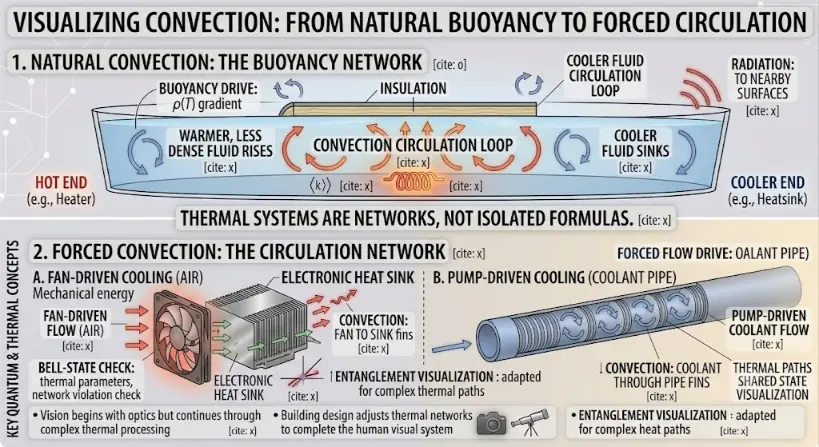
Multimodal visualization of convection, comparing natural buoyancy-driven systems with forced circulation systems. The top panel illustrates a natural loop driven by temperature-induced density changes (buoyancy), while the lower panels demonstrate forced convection using external devices like fans and pumps.
The image is a comprehensive multi-panel scientific educational infographic illustration titled “VISUALIZING CONVECTION: FROM NATURAL BUOYANCY TO FORCED CIRCULATION,” set against a clean white background with subtle geometric and network traces. It adopts a diagrammatic style with soft glowing accents and clear textual labels, linked by a large central horizontal title banner adapted from image_45.png, highlighting the core concept: “THERMAL SYSTEMS ARE NETWORKS, NOT ISOLATED FORMULAS”.
Part 1: Natural Convection: The Buoyancy Network
This upper panel provides a visual model of natural convection driven by buoyancy:- Container and Heating Source: A large, transparent container of water is depicted, similar in layout to Section 1 of image_45.png. A small, glowing heating coil, inspired by the heater in image_45.png, is positioned at the center bottom, labeled “HOT END (e.g., Heater)”.
- Circulation Loop: Swirling red and orange arrows rise from the heated center, labeled “WARMER, LESS DENSE FLUID RISES”. Swirling blue arrows sink in the cooler regions at the top and sides, labeled “COOLER FLUID SINKS”. Together, the arrows form a complete “CONVECTION CIRCULATION LOOP”.
- Verification and Quantum Context: Callouts include “BUOYANCY DRIVE: ρ(T) gradient”, “INSULATION” around the container top, and “RADIATION: TO NEARBY SURFACES”, adapted to the context of water and a container. Quantum kets like |k⟩ and citation brackets are integrated into the diagrammatic flow, suggesting a connection between the macroscopic fluid flow and microscopic concepts.
Part 2: Forced Convection: The Circulation Network
This lower panel illustrates forced convection using two distinct examples, arranged in sub-diagrams adapted from Section 2 of image_45.png:- Sub-Diagram A: Fan-Driven Cooling (Air): On the left, this section shows a magnified view of a complex metal “ELECTRONIC HEAT SINK”, similar in structure to the microscopic matrix of image_45.png. A large fan with red arrows and a callout labeled “FAN-DRIVEN FLOW (AIR)” is to its left. Red “HOT FLUID” arrows approach the sink fins. Air flow is traced through the fins with small green flow arrows and a red infrared emission wave arrow, labeled “CONVECTION: FAN TO SINK fins”. Callouts link concepts, including “FORCED FLOW DRIVE: Mechanical energy”, “BELL-STATE CHECK: thermal parameters, network violation check”, and adapted entanglement and shared state visualization concepts.
- Sub-Diagram B: Pump-Driven Cooling (Coolant Pipe): On the right, this section shows a long pipe section with a callout “PUMP-DRIVEN COOLANT FLOW”. Swirling blue arrows move through the pipe fins, labeled “CONVECTION: COOLANT THROUGH PIPE FINS”. This diagram reinforces forced flow using a different mechanical drive and fluid.
- Summaries and Context: Bullet points at the bottom reiterate summaries from image_45.png: “Vision begins with optics but continues through complex thermal processing” and “Building design adjusts thermal networks to complete the human visual system”. Small icons of a camera and a telescope are present.
Why Fluids Matter in Convection
Convection requires a fluid because a fluid can move as a bulk material. Solids can conduct heat, but they do not usually flow. Liquids and gases can carry thermal energy from one location to another through motion.
| Fluid Type | Convection Behaviour | Common Example |
|---|---|---|
| Air | Often used for cooling and ventilation | Fan cooling a room or computer |
| Water | Transfers heat strongly because of high heat capacity | Radiators, cooling loops, hot-water systems |
| Oil | Useful where water may boil, corrode, or freeze | Transformers, machinery, thermal oil systems |
| Steam | Carries large energy during condensation | Power plants and heating systems |
| Refrigerants | Absorb and release heat during phase change | Air-conditioners and refrigerators |
The strength of convection depends on fluid properties such as density, viscosity, thermal conductivity, heat capacity, and thermal expansion. It also depends on the speed and pattern of the flow.
Natural Convection
Natural convection occurs when fluid motion is caused by density differences due to temperature differences. Warmer fluid often becomes less dense and rises, while cooler fluid becomes denser and sinks.
This motion creates a circulation pattern. The fluid carries heat as it moves, producing convection without the need for a fan or pump.
| Natural Convection Example | What Happens? |
|---|---|
| Warm air above a heater | Air warms, becomes less dense, and rises |
| Boiling water before bubbles form strongly | Warmer water rises while cooler water sinks |
| Sea breeze | Temperature differences between land and sea create air movement |
| Mantle convection | Hotter material rises and cooler material sinks over long geological times |
Natural convection is driven by buoyancy. It is often slower than forced convection, but it is extremely important in buildings, weather, oceans, geology, electronics cooling, and many everyday situations.
Forced Convection
Forced convection occurs when fluid motion is created by an external device such as a fan, pump, blower, or compressor. Because the fluid motion is controlled, forced convection can often transfer heat faster and more predictably than natural convection.
| Forced Convection Example | External Driver | Purpose |
|---|---|---|
| Computer fan | Fan | Remove heat from electronics |
| Car radiator | Water pump and air flow | Transfer engine heat to air |
| Air-conditioning system | Fan and refrigerant compressor | Move heat from indoor air to outside |
| Heat exchanger | Pumps or blowers | Transfer heat between fluids |
| Industrial cooling loop | Pump | Carry heat away from machines or reactors |
Forced convection is central to engineering design because the flow rate can be adjusted. Increasing flow speed often increases the heat-transfer rate, although it may also require more pumping or fan power.
Natural Versus Forced Convection
Natural and forced convection follow the same basic heat-transfer idea, but the source of fluid motion is different.
| Feature | Natural Convection | Forced Convection |
|---|---|---|
| Cause of fluid motion | Buoyancy due to density differences | Fan, pump, blower, or external force |
| Typical flow strength | Often weaker | Often stronger and controllable |
| Energy input required | No mechanical input needed | Mechanical or electrical input required |
| Common example | Warm air rising from a heater | Fan cooling a computer |
| Design control | Limited by geometry and temperature difference | Can be controlled by flow rate and device design |
In real systems, natural and forced convection may appear together. For example, a fan may drive air flow, while buoyancy still affects the way warm air rises.
Newton’s Law of Cooling
A common equation used to model convection between a surface and a fluid is Newton’s law of cooling:
Q̇ = hA(Ts – T∞)
Here, Q̇ is the heat-transfer rate, h is the convection heat-transfer coefficient, A is the surface area, Ts is the surface temperature, and T∞ is the temperature of the fluid far from the surface.
| Symbol | Meaning | Common Unit |
|---|---|---|
| Q̇ | Convection heat-transfer rate | W |
| h | Convection heat-transfer coefficient | W/(m2·K) |
| A | Surface area | m2 |
| Ts | Surface temperature | K or °C for temperature difference |
| T∞ | Bulk fluid temperature far from the surface | K or °C |
The equation is simple, but the coefficient h is not a basic material property like thermal conductivity. It depends on fluid type, flow speed, surface shape, surface orientation, temperature difference, and whether the flow is laminar or turbulent.
The Convection Heat-Transfer Coefficient
The convection heat-transfer coefficient h measures how effectively heat is transferred between a surface and a moving fluid. A larger h means stronger convective heat transfer for the same area and temperature difference.
| Situation | Typical Effect on h | Reason |
|---|---|---|
| Still air | Low h | Weak fluid motion |
| Moving air | Higher h | Fresh cooler or warmer air is brought to the surface |
| Moving water | Often much higher h than air | Water has stronger heat capacity and thermal contact |
| Boiling or condensation | Can be very high h | Phase change transfers large amounts of energy |
| Turbulent flow | Usually higher h | Mixing reduces thermal boundary-layer resistance |
This is why blowing on hot soup cools it faster, why water cooling is often stronger than air cooling, and why heat exchangers are designed to create controlled fluid motion.
Boundary Layers
When a fluid flows over a surface, the fluid very close to the surface is slowed by viscosity. A thin region forms near the surface where velocity changes from nearly zero at the wall to the main flow speed away from the wall. This is called a velocity boundary layer.
A thermal boundary layer also forms when the surface and fluid have different temperatures. In this region, temperature changes from the surface temperature to the bulk fluid temperature.
| Boundary Layer Type | What Changes? | Why It Matters |
|---|---|---|
| Velocity boundary layer | Fluid speed changes near the surface | Affects friction and flow behaviour |
| Thermal boundary layer | Fluid temperature changes near the surface | Affects heat-transfer rate |
| Thick boundary layer | Temperature changes slowly across a larger region | Usually weaker heat transfer |
| Thin boundary layer | Temperature changes sharply near the wall | Usually stronger heat transfer |
Many convection problems are really boundary-layer problems. Engineers often try to reduce thermal boundary-layer resistance by increasing flow speed, using fins, creating turbulence, or improving surface geometry.
Laminar and Turbulent Flow
Fluid flow can be laminar or turbulent. In laminar flow, fluid moves in smooth layers. In turbulent flow, motion is irregular and strongly mixed.
| Flow Type | Flow Behaviour | Effect on Heat Transfer |
|---|---|---|
| Laminar flow | Smooth, orderly layers | Usually lower heat transfer |
| Turbulent flow | Irregular, mixed motion | Usually higher heat transfer |
Turbulence often improves convection because it brings warmer and cooler fluid regions into contact more effectively. However, turbulence also increases friction and pumping power, so stronger heat transfer is not always free.
Important Dimensionless Numbers in Convection
Convection problems often use dimensionless numbers. These numbers compare physical effects such as inertia, viscosity, conduction, convection, and buoyancy.
| Number | Common Symbol | What It Compares | Why It Matters |
|---|---|---|---|
| Reynolds number | Re | Inertial effects to viscous effects | Helps indicate laminar or turbulent flow |
| Prandtl number | Pr | Momentum diffusion to thermal diffusion | Connects velocity and thermal boundary layers |
| Nusselt number | Nu | Convective heat transfer to pure conduction | Used to estimate h |
| Grashof number | Gr | Buoyancy effects to viscous effects | Important in natural convection |
| Rayleigh number | Ra | Buoyancy-driven flow and thermal diffusion effects | Common in natural convection analysis |
Students do not need to memorise every correlation at first. The main idea is that convection depends on flow behaviour, fluid properties, geometry, and temperature difference. Dimensionless numbers help organise these effects.
Nusselt Number and the Meaning of Enhanced Heat Transfer
The Nusselt number compares actual convective heat transfer with heat transfer that would occur by conduction alone across a fluid layer. A common definition is:
Nu = hLc ⁄ kf
Here, h is the convection heat-transfer coefficient, Lc is a characteristic length, and kf is the thermal conductivity of the fluid.
| Nusselt Number | Meaning |
|---|---|
| Nu = 1 | Heat transfer is like pure conduction through the fluid layer |
| Nu > 1 | Fluid motion enhances heat transfer |
| Larger Nu | Stronger convective heat transfer relative to conduction |
This is why the Nusselt number appears so often in convection correlations. It turns complicated flow behaviour into a practical way to estimate the convection coefficient.
External and Internal Convection
Convection can occur outside a surface or inside a passage. The geometry strongly affects the flow and heat transfer.
| Type | Description | Example |
|---|---|---|
| External convection | Fluid flows over an outside surface | Air flowing over a car, aircraft wing, or hot pipe |
| Internal convection | Fluid flows inside a pipe, duct, or channel | Water flowing through a radiator or heat exchanger tube |
Internal convection is especially important in heat exchangers, heating systems, cooling loops, engines, chemical plants, and medical devices. External convection is important in aerodynamics, buildings, electronics, weather exposure, and human thermal comfort.
Convection and Fins
Fins are extended surfaces used to increase heat-transfer area. They are common in heat sinks, radiators, air-cooled engines, transformers, and compact heat exchangers.
A fin works by conducting heat from a base surface into an extended solid shape, then transferring that heat to the surrounding fluid by convection.
| Fin Feature | Thermal Purpose |
|---|---|
| Larger surface area | More area for convection |
| Good conducting material | Heat spreads along the fin effectively |
| Thin repeated fins | Large area in compact space |
| Air flow between fins | Removes heat from fin surfaces |
Fins show why convection and conduction often work together. Heat must first conduct through the solid fin before it can convect into the surrounding fluid.
Boiling and Condensation as Strong Convection Processes
Some of the strongest heat-transfer processes involve phase change. Boiling transfers heat from a hot surface into a liquid as vapour bubbles form. Condensation transfers heat from vapour to a cooler surface as liquid forms.
| Process | Heat Transfer Feature | Example |
|---|---|---|
| Boiling | Large energy transfer as liquid becomes vapour | Water boiling in a kettle |
| Condensation | Large energy release as vapour becomes liquid | Steam condensing on a cool surface |
| Evaporation | High-energy molecules leave the liquid surface | Sweat cooling the skin |
Phase-change convection is central to power plants, refrigeration, heat pipes, electronics cooling, steam systems, desalination, and many industrial processes.
Everyday Examples of Heat Convection
Boiling Water
Warm water near the bottom rises while cooler water sinks, creating circulation before and during boiling.Warm Air from a Heater
Air heated near the heater becomes less dense and rises, helping distribute warmth through a room.Cooling Fan
A fan forces air across a hot surface, increasing convection and removing heat more quickly.Sea Breeze
Temperature differences between land and sea create air movement, producing natural convection on a large scale.Car Radiator
Coolant carries engine heat to the radiator, where air flow removes heat by forced convection.Human Body Cooling
Air movement and sweat evaporation help remove heat from the skin.Applications of Heat Convection
Heat convection is used whenever heat must be carried away by air, water, oil, refrigerant, steam, or another moving fluid.
HVAC and Building Comfort
Heating, ventilation, and air-conditioning systems use forced and natural convection to distribute warm or cool air.Electronics Cooling
Fans, heat sinks, liquid cooling loops, and server cooling systems rely on convection to remove heat from components.Vehicle Cooling Systems
Radiators, coolant pumps, engine jackets, and airflow remove heat from engines, batteries, and power electronics.Heat Exchangers
Heat exchangers use controlled convection between flowing fluids and solid walls to transfer energy efficiently.Power Plants
Steam generators, condensers, boilers, cooling towers, and turbines all involve convective heat transfer.Cooking and Food Processing
Convection ovens, boiling, frying, steaming, and cooling operations depend on fluid motion and heat transfer.Weather and Climate
Atmospheric convection creates clouds, storms, winds, thermal plumes, and vertical heat transport.Industrial Thermal Systems
Chemical reactors, furnaces, drying systems, and process equipment often depend on controlled convection.Challenges and Practical Limitations
Convection is harder to predict than simple conduction because it depends on both heat transfer and fluid mechanics. Small changes in flow speed, geometry, fluid properties, or surface condition can change the heat-transfer rate significantly.
| Challenge | Why It Matters | Example |
|---|---|---|
| Estimating h | The convection coefficient depends on flow and geometry | A fan-cooled heat sink may need testing or simulation |
| Laminar-turbulent transition | Heat transfer can change sharply when flow becomes turbulent | Flow inside pipes and over plates |
| Flow maldistribution | Some regions may receive too little cooling | Heat exchangers and battery packs |
| Pressure drop | Higher flow improves heat transfer but requires more pumping power | Liquid cooling systems |
| Fouling | Deposits reduce heat transfer and increase resistance | Heat exchanger tubes and boilers |
| Buoyancy effects | Natural convection may interact with forced flow | Electronics in vertical enclosures |
| Phase-change instability | Boiling and condensation can be powerful but complex | Heat pipes, reactors, and evaporators |
| Combined heat transfer | Convection often occurs with conduction and radiation | A hot pipe losing heat to surrounding air |
The practical lesson is that convection is powerful but rarely isolated. Real systems often require combined analysis of conduction through solids, convection at surfaces, radiation exchange, and fluid-flow resistance.
Future Directions and Emerging Trends
Heat convection remains important because modern systems are becoming more compact, power-dense, and thermally demanding. Better convection design can improve energy efficiency, safety, comfort, and system reliability.
Advanced Liquid Cooling
Electric vehicles, data centres, and high-performance electronics increasingly use liquid cooling for stronger convection.Microchannel Heat Sinks
Tiny channels can create large surface area and strong convection for compact thermal management.Two-Phase Cooling
Boiling, evaporation, and condensation can remove large heat loads in compact devices.Smart HVAC Systems
Sensors and controls can improve airflow, comfort, and building energy efficiency.Battery Thermal Management
Careful coolant flow design helps prevent hot spots, ageing, and safety risks in battery packs.Climate and Weather Modelling
Better understanding of atmospheric convection improves storm, cloud, and climate prediction.AI-Assisted Flow Optimisation
Machine learning and simulation can help design cooling channels, fans, heat exchangers, and ventilation systems.Low-Energy Thermal Design
Natural convection and passive cooling can reduce energy use in buildings and electronic systems.Connections with Wider Physics and Technology
Heat convection connects thermodynamics with fluid mechanics, energy systems, buildings, electronics, climate science, and engineering design.
Thermodynamics
Convection is one way thermal energy moves because of temperature differences and fluid motion.Heat Transfer
Convection is one of the three major heat-transfer modes, alongside conduction and radiation.Heat Conduction
Convection often begins with conduction between a solid surface and the fluid next to it.Heat Exchangers
Heat exchangers depend heavily on forced convection inside pipes, channels, and flow passages.Combined Heat Transfer
Real systems often combine convection with conduction through solids and radiation between surfaces.Engineering Thermodynamics
Engines, turbines, compressors, cooling loops, and HVAC systems rely on convective heat transfer.Learning Pathway Within Heat Transfer
Heat convection is the second step in the Heat Transfer pathway. After learning how heat conducts through materials, students now learn how fluid motion carries heat.
Heat Conduction
Learn how heat moves through materials by molecular interactions, electron motion, and temperature gradients.Heat Convection
Current page. Study how fluids transfer heat through natural motion, forced flow, boundary layers, and mixing.Thermal Radiation
Explore how heat travels by electromagnetic waves, even through empty space.Thermal Resistance
Learn how resistance models help analyse heat flow through layers, walls, insulation, and interfaces.Heat Exchangers
See how devices transfer heat between fluids in engines, power plants, HVAC systems, and industry.Combined Heat Transfer
Understand how conduction, convection, and radiation work together in real thermal systems.Quick Check: Heat Convection
Quick Check: Fluid Motion and Heat Transfer
Q1. What makes convection different from conduction?
Conduction transfers heat through microscopic interactions inside matter. Convection transfers heat through the motion of a fluid, such as air or water.
Q2. What causes natural convection?
Natural convection is caused by buoyancy. Warmer fluid often becomes less dense and rises, while cooler fluid sinks.
Q3. What causes forced convection?
Forced convection is caused by an external device such as a fan, pump, blower, or compressor that moves the fluid.
Q4. Why does a fan cool a hot object faster?
A fan brings fresh cooler air to the hot surface and carries warmed air away, increasing the convection heat-transfer rate.
Common Misunderstandings About Heat Convection
Misunderstanding 1: Convection Happens Only in Air
Convection can occur in any fluid, including air, water, oil, refrigerants, steam, and molten materials.
Misunderstanding 2: Hot Air Rises Because Heat Itself Rises
Heat does not rise as a substance. Warm air often rises because it becomes less dense than surrounding cooler air, creating buoyant motion.
Misunderstanding 3: Faster Flow Is Always Better
Faster flow often increases heat transfer, but it can also increase noise, pressure drop, energy use, vibration, and erosion.
Misunderstanding 4: Convection Is Separate from Conduction
Convection at a surface begins with conduction between the surface and the fluid next to it. Fluid motion then carries heat away.
Misunderstanding 5: Newton’s Law of Cooling Is Always Simple
The equation Q̇ = hA(Ts – T∞) is simple, but finding the correct value of h can be difficult because it depends on flow, geometry, and fluid properties.
Key Terms
- Heat convection
- Heat transfer involving the motion of a fluid.
- Natural convection
- Convection caused by buoyancy due to temperature-related density differences.
- Forced convection
- Convection caused by an external device such as a fan, pump, or blower.
- Convection heat-transfer coefficient
- The coefficient h that measures how effectively heat is transferred between a surface and a moving fluid.
- Newton’s law of cooling
- The convection model Q̇ = hA(Ts – T∞).
- Boundary layer
- A thin region near a surface where fluid velocity or temperature changes strongly.
- Laminar flow
- Smooth, orderly fluid motion in layers.
- Turbulent flow
- Irregular, mixed fluid motion that often enhances heat transfer.
- Nusselt number
- A dimensionless number comparing convective heat transfer with conduction through a fluid layer.
- Reynolds number
- A dimensionless number used to compare inertial and viscous effects in fluid flow.
- Prandtl number
- A dimensionless number comparing momentum diffusion with thermal diffusion.
- Rayleigh number
- A dimensionless number often used in natural convection to describe buoyancy-driven heat transfer.
Frequently Asked Questions: Heat Convection
What is heat convection?
Heat convection is heat transfer involving the motion of a fluid, such as air, water, oil, steam, or refrigerant.
How is convection different from conduction?
Conduction transfers heat through microscopic interactions inside matter, while convection transfers heat through fluid motion.
What is natural convection?
Natural convection is fluid motion caused by buoyancy. Warm fluid often rises because it becomes less dense, while cooler fluid sinks.
What is forced convection?
Forced convection is fluid motion caused by an external device such as a fan, pump, blower, or compressor.
What is Newton’s law of cooling?
Newton’s law of cooling models convection using Q̇ = hA(Ts – T∞), where h is the convection heat-transfer coefficient.
What does the convection coefficient h mean?
The coefficient h describes how effectively heat is transferred between a surface and a fluid. It depends on flow speed, fluid properties, geometry, and surface conditions.
Why does moving air cool better than still air?
Moving air carries warmed air away from the surface and replaces it with cooler air, increasing the heat-transfer rate.
Why is water cooling often stronger than air cooling?
Water has a higher heat capacity and often provides stronger thermal contact than air, so it can carry away more heat for a given flow arrangement.
What is a thermal boundary layer?
A thermal boundary layer is the region near a surface where the fluid temperature changes from the surface temperature to the bulk fluid temperature.
Why does turbulence often increase convection?
Turbulence mixes the fluid, bringing cooler or warmer fluid to the surface more effectively and reducing thermal boundary-layer resistance.
Where is convection used in engineering?
Convection is used in HVAC systems, radiators, heat exchangers, electronics cooling, engines, power plants, cooking, and industrial thermal processes.
Why should students learn heat convection?
Heat convection helps students understand cooling, heating, ventilation, weather, engines, heat exchangers, electronics, buildings, and energy systems.
Review Questions and Answers
- What is heat convection?Answer: Heat convection is heat transfer involving the motion of a fluid.
- What is the difference between natural and forced convection?Answer: Natural convection is driven by buoyancy due to density differences, while forced convection is driven by a fan, pump, blower, or other external device.
- What equation is commonly used for convection between a surface and a fluid?Answer: Newton’s law of cooling: Q̇ = hA(Ts – T∞).
- What does the convection coefficient h represent?Answer: It represents how effectively heat is transferred between a surface and a fluid.
- Why does warm air often rise?Answer: Warm air often becomes less dense than surrounding cooler air, so buoyancy causes it to rise.
- Why does turbulence often increase convective heat transfer?Answer: Turbulence mixes the fluid and reduces thermal boundary-layer resistance near the surface.
- What is the Nusselt number used for?Answer: The Nusselt number compares convective heat transfer with conduction through a fluid layer and helps estimate the convection coefficient.
- Why are fins useful in convection?Answer: Fins increase surface area, allowing more heat to be transferred to or from the surrounding fluid.
Thought-Provoking Questions and Answers
- Why is convection harder to predict than conduction through a simple wall?Answer: Convection depends on fluid motion, flow speed, turbulence, geometry, surface condition, and fluid properties, while simple conduction may depend mainly on material, thickness, area, and temperature difference.
- Why does stronger cooling often require more energy?Answer: Increasing fan or pump speed can improve convection, but it also requires more mechanical or electrical power and may create pressure losses.
- Why is natural convection attractive for passive cooling?Answer: Natural convection does not require moving mechanical parts or external power, making it useful for quiet, reliable, low-energy cooling systems.
- Why is convection important in climate and weather?Answer: Convection transports heat and moisture vertically in the atmosphere, helping form clouds, storms, winds, and large-scale circulation patterns.
- Why do heat exchangers depend so strongly on convection?Answer: Heat exchangers transfer heat between moving fluids and solid walls, so the convection coefficient on each side strongly affects total performance.
- What does convection teach us about invisible motion?Answer: It shows that heat transfer is often shaped by fluid motion that may be invisible, such as slow air currents, boundary layers, or internal circulation.
Numerical Problems and Solutions
- A hot plate has area A = 0.50 m2, surface temperature Ts = 80 °C, air temperature T∞ = 25 °C, and h = 10 W/(m2·K). Find the convection heat-transfer rate.Solution:
- Use Q̇ = hA(Ts – T∞).
- ΔT = 80 – 25 = 55 K.
- Q̇ = (10)(0.50)(55).
- Q̇ = 275 W.
Answer: The convection heat-transfer rate is 275 W. - A small heat sink has area 0.020 m2, h = 60 W/(m2·K), and temperature difference 35 K. Find the heat removed by convection.Solution:
- Use Q̇ = hAΔT.
- Q̇ = (60)(0.020)(35).
- Q̇ = 42 W.
Answer: The heat sink removes 42 W by convection. - A surface must remove 500 W by convection. If h = 25 W/(m2·K) and ΔT = 40 K, what surface area is needed?Solution:
- Use Q̇ = hAΔT.
- Rearrange: A = Q̇ ⁄ hΔT.
- A = 500 ⁄ (25)(40).
- A = 500 ⁄ 1000 = 0.50 m2.
Answer: The required area is 0.50 m2. - A hot pipe loses 300 W by convection. Its area is 1.5 m2, the surface temperature is 70 °C, and the surrounding air is 30 °C. Find h.Solution:
- Use Q̇ = hAΔT.
- ΔT = 70 – 30 = 40 K.
- Rearrange: h = Q̇ ⁄ AΔT.
- h = 300 ⁄ (1.5)(40) = 300 ⁄ 60.
- h = 5.0 W/(m2·K).
Answer: The convection coefficient is 5.0 W/(m2·K). - A surface at 120 °C transfers heat to air at 20 °C. If h = 15 W/(m2·K), find the heat flux.Solution:
- Heat flux for convection is q″ = h(Ts – T∞).
- ΔT = 120 – 20 = 100 K.
- q″ = (15)(100).
- q″ = 1500 W/m2.
Answer: The convective heat flux is 1500 W/m2. - A fluid has h = 200 W/(m2·K), characteristic length Lc = 0.050 m, and thermal conductivity kf = 0.60 W/(m·K). Find the Nusselt number.Solution:
- Use Nu = hLc ⁄ kf.
- Nu = (200)(0.050) ⁄ 0.60.
- Nu = 10 ⁄ 0.60 ≈ 16.7.
Answer: The Nusselt number is approximately 16.7. - Air flowing over a surface increases h from 8 to 40 W/(m2·K). If area and temperature difference remain the same, by what factor does the convection heat-transfer rate increase?Solution:
- Since Q̇ = hAΔT, heat-transfer rate is proportional to h when A and ΔT are constant.
- Factor increase = 40 ⁄ 8 = 5.
Answer: The convection heat-transfer rate increases by a factor of 5. - A device produces 100 W of heat. It is cooled by convection with h = 50 W/(m2·K) and area 0.040 m2. If air temperature is 25 °C, estimate the required surface temperature.Solution:
- Use Q̇ = hA(Ts – T∞).
- Rearrange: Ts – T∞ = Q̇ ⁄ hA.
- Ts – 25 = 100 ⁄ (50)(0.040).
- Ts – 25 = 100 ⁄ 2.0 = 50 °C.
- Ts = 75 °C.
Answer: The estimated surface temperature is 75 °C.
External References for Further Reading
The following references provide useful background on heat convection, Newton’s law of cooling, natural convection, forced convection, and heat-transfer mechanisms.
- OpenStax University Physics: Mechanisms of Heat Transfer — A clear overview of conduction, convection, and radiation.
- OpenStax College Physics: Convection — A student-friendly explanation of convection and heat transfer by fluid motion.
- NASA Glenn Research Center: Heat Transfer — A concise introduction to heat transfer mechanisms in engineering contexts.
- Physics LibreTexts: Convection — A supplementary explanation of convection and related examples.
Why This Topic Matters
Heat convection matters because many real thermal systems involve moving fluids. Air cools electronics, water removes engine heat, refrigerants move energy in air-conditioners, steam carries energy in power plants, and atmosphere-ocean circulation redistributes heat across the planet.
For students, convection is an important bridge between thermodynamics and fluid motion. It shows that heat transfer is not only about temperature difference and material properties, but also about flow patterns, boundary layers, turbulence, and system geometry.
For modern technology, convection is essential in data centres, electric vehicles, building energy systems, industrial heat exchangers, food processing, medical devices, power generation, climate modelling, and sustainable thermal design.
Summary
Heat convection is heat transfer involving the motion of a fluid. It may occur naturally because of buoyancy or be forced by fans, pumps, blowers, or compressors.
A common model for convection is Newton’s law of cooling:
Q̇ = hA(Ts – T∞)
The convection coefficient h depends on fluid properties, flow speed, geometry, surface condition, and whether the flow is laminar, turbulent, natural, forced, external, or internal.
Convection is central to cooling, heating, ventilation, engines, heat exchangers, electronics, buildings, climate systems, and industrial thermal processes. It often works together with conduction and radiation in real systems.
Reflection Question
If convection can be strengthened by moving fluids faster, but faster flow requires extra fan or pump power, how should engineers balance heat-transfer performance with energy efficiency?