Prepare for University Studies & Career Advancement
General Relativity
General Relativity is Einstein’s theory of gravity. It does not treat gravity simply as an invisible force pulling objects together. Instead, it describes gravity as the result of curved spacetime. Massive objects such as planets, stars, galaxies, and black holes shape the geometry of space and time around them. Other objects then move through this curved geometry along the most natural paths available to them.
This idea changed the meaning of gravity. In Newton’s view, Earth pulls the Moon through space by gravitational force. In Einstein’s view, Earth and the Moon move through a shared structure of spacetime, and their motion reflects the curvature created by mass and energy. Gravity is therefore not just something that happens inside space and time. It is connected to the structure of space and time itself.
General Relativity also explains why clocks run differently in strong gravitational fields, why light bends near massive objects, why black holes can exist, why gravitational waves travel across the universe, and why modern cosmology depends on the geometry of spacetime. For students, it is one of the most powerful examples of how a simple question — what is gravity? — can lead to a new view of the universe.
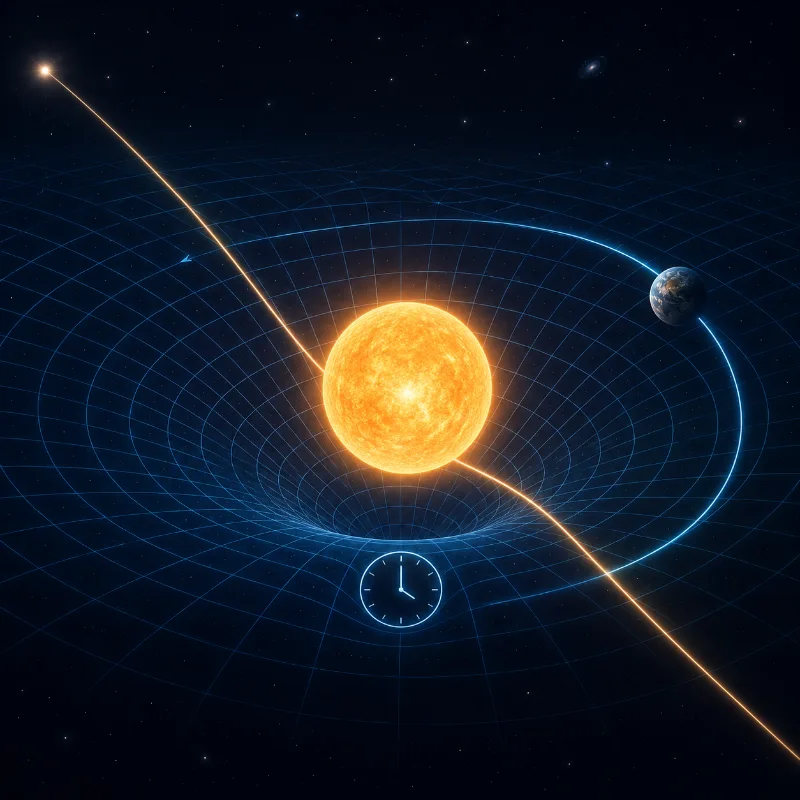
General Relativity describes gravity as curved spacetime: massive objects shape space and time, while planets and light follow paths through that curved geometry.
This illustration introduces General Relativity through the idea of curved spacetime. A massive star bends the surrounding spacetime grid, while a planet follows a curved orbital path around it. A beam of light also bends as it passes near the star, showing that gravity affects not only matter but also light. The clock near the curved region reminds students that gravity can influence the passage of time as well. Together, these visual elements express the central message of General Relativity: mass and energy shape spacetime, and objects move through that shaped geometry.
Special Relativity Within the Relativity Cluster
This navigation section places General Relativity within the Relativity cluster. Relativity serves as the parent hub, while Special Relativity and General Relativity form the two focused child pages: one centred on high-speed motion and light speed, and the other centred on gravity, spacetime curvature, and geometry.
Explains inertial frames, constant light speed, time dilation, length contraction, simultaneity, relativistic momentum, and mass-energy equivalence.
General Relativity
Explains gravity as curved spacetime, including the equivalence principle, geodesics, gravitational time dilation, light bending, and the motion of objects in curved spacetime.
From Special Relativity to General Relativity
Special Relativity deals mainly with observers moving at constant velocity relative to one another. It shows that time, length, simultaneity, energy, and momentum must be understood differently when motion approaches the speed of light. However, Special Relativity does not fully describe accelerated motion or gravity.
Einstein’s next step was to ask whether gravity and acceleration could be understood within a deeper framework. If a person is inside a sealed elevator, it may be difficult to tell whether the floor is pushing upward because the elevator is accelerating in space, or because the elevator is standing on the surface of a planet. This simple thought led to a profound idea: gravity and acceleration are closely connected.
General Relativity extends the insights of Special Relativity into a universe where observers may accelerate, planets orbit stars, light passes near massive bodies, and spacetime itself can be curved. In this way, General Relativity is not a rejection of Special Relativity. It is a broader theory that includes Special Relativity as a special case when gravity is weak or absent and spacetime is approximately flat.
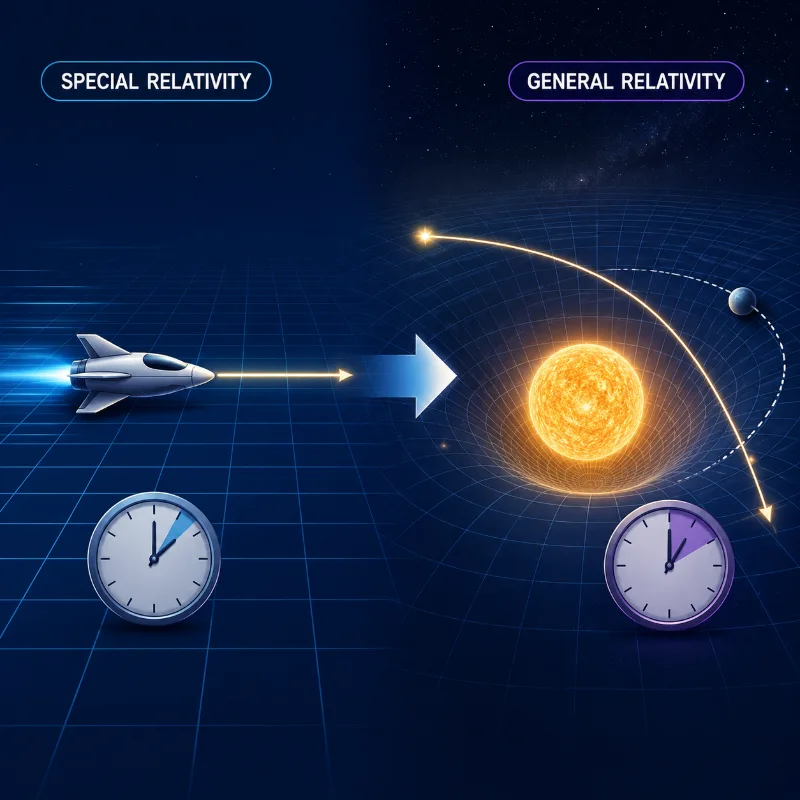
From Special Relativity to General Relativity: Special Relativity describes physics in flat spacetime and inertial motion, while General Relativity explains gravity as the curvature of spacetime caused by mass and energy.
This educational illustration helps students understand the conceptual shift from Special Relativity to General Relativity. On one side, Special Relativity is represented by smooth motion through flat spacetime, emphasizing constant velocity, inertial frames, and the constancy of the speed of light. On the other side, General Relativity is shown through the bending of spacetime around a massive object, illustrating Einstein’s idea that gravity is not a conventional force but the effect of curved spacetime. The image is designed to make clear that General Relativity extends the ideas of Special Relativity to include acceleration, gravity, and the large-scale structure of the universe.
Pause and Think
If Special Relativity explains physics in flat spacetime, why is General Relativity better understood as an extension of Special Relativity rather than a completely separate theory?
The Equivalence Principle: Gravity and Acceleration
The equivalence principle is one of the central ideas behind General Relativity. It states, in simple terms, that the effects of gravity can locally resemble the effects of acceleration. A person inside a closed elevator standing on Earth feels pressed against the floor. A person inside a closed rocket accelerating through empty space may feel the same kind of pressure. Without looking outside, the two experiences can be difficult to distinguish.
This principle helps explain why gravity is not treated merely as a conventional force in Einstein’s theory. Instead, gravity can be understood as a feature of the frame of reference itself. When we feel weight, we may interpret it as gravity pulling us downward. But from the viewpoint of General Relativity, weight is also connected to how the ground, floor, or seat prevents us from following our natural free-fall path through spacetime.
A freely falling object, such as an astronaut in orbit, does not feel ordinary weight. The astronaut is not outside gravity. Rather, the astronaut and spacecraft are falling together around Earth. This is why astronauts in orbit appear weightless. They are not free from Earth’s gravity; they are continuously falling along a curved path shaped by Earth’s spacetime curvature.
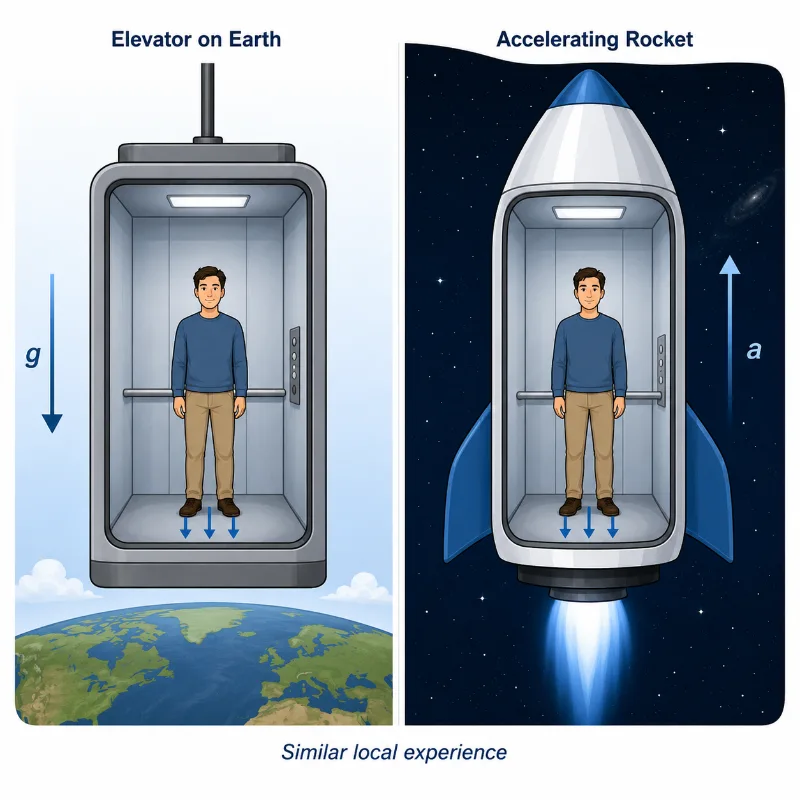
The equivalence principle illustrated: locally, the effects of gravity can resemble the effects of acceleration.
This illustration explains the equivalence principle, one of the key ideas behind General Relativity. It compares two situations: a person standing inside an elevator on Earth and a person inside a rocket accelerating through space. In both cases, the person feels pressed downward in a similar way. The comparison shows Einstein’s insight that gravity and acceleration can be locally indistinguishable. This idea helped shift the understanding of gravity from a simple pulling force to a deeper feature of motion and spacetime.
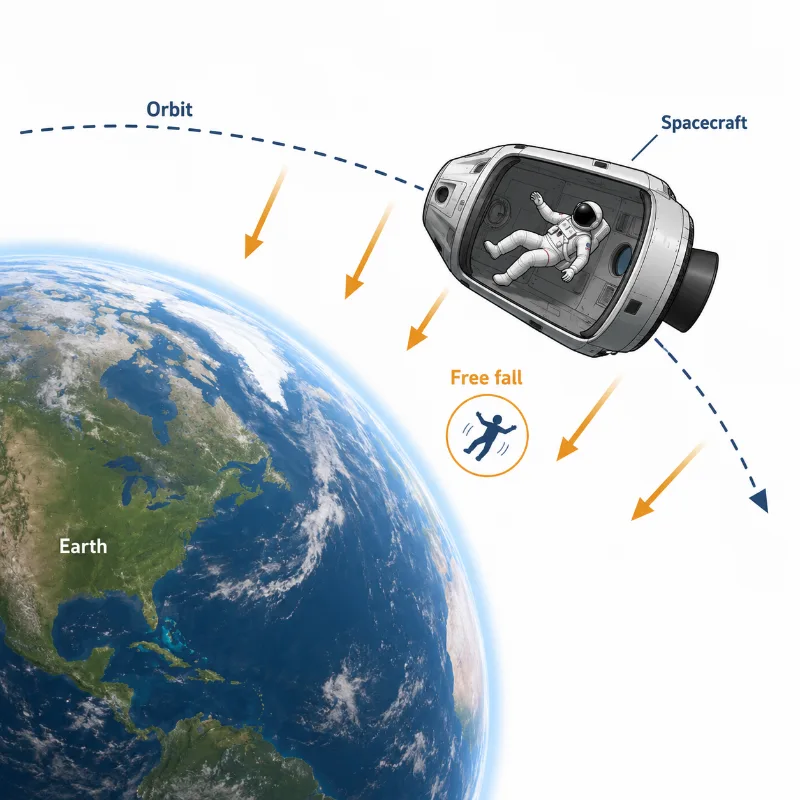
Weightlessness in orbit explained: astronauts appear weightless not because gravity has disappeared, but because they and their spacecraft are falling together around Earth.
This illustration explains an important idea linked to the equivalence principle in General Relativity. It shows an astronaut in orbit around Earth, appearing weightless inside a spacecraft. The image helps students understand that the astronaut is not beyond the reach of gravity. Instead, both the astronaut and the spacecraft are continuously falling together around Earth along a curved path. Because everything inside the spacecraft is falling at the same rate, there is no ordinary support force pressing the astronaut against the floor, and this creates the experience of weightlessness. The picture helps connect gravity, free fall, and orbital motion in a clear and intuitive way.
Interactive Mini-Lab: Gravity or Acceleration?
The equivalence principle becomes clearer when we compare situations that feel similar from the inside. For each case, choose the best explanation before revealing the answer.
1. A person stands inside an elevator at rest on Earth. What does the person feel?
A. Complete weightlessnessB. A downward pull with no support forceC. Weight, because the floor pushes upward on the personD. No effect from gravity
Answer: C. The person feels weight because the floor provides an upward support force. In daily life, this support force is what makes gravity feel like weight.
2. A person stands inside a rocket accelerating upward in deep space. What would the person feel?
A. A sensation similar to standing in gravityB. No force at allC. Only sideways motionD. Time stopping completely
Answer: A. An accelerating rocket can make a person feel pressed against the floor, even when no planet is nearby. This is one of the key insights behind the equivalence principle: locally, acceleration and gravity can produce similar experiences.
3. A person is inside a freely falling elevator. What happens to the person’s apparent weight?
A. It becomes larger than usualB. It becomes zero or nearly zeroC. It points sidewaysD. It becomes unrelated to motion
Answer: B. The person and the elevator are falling together. Because the floor no longer pushes upward in the usual way, the person feels weightless even though gravity is still acting.
4. Why do astronauts in orbit appear weightless?
A. Earth’s gravity has completely disappearedB. They are too far away for gravity to matterC. They and their spacecraft are falling together around EarthD. Their mass becomes zero in space
Answer: C. Astronauts are still under Earth’s gravity. They appear weightless because the spacecraft and everything inside it are continuously falling together around Earth.
Key takeaway: What we call weight is closely linked to support forces. General Relativity begins by noticing that gravity, acceleration, and free fall are more deeply connected than everyday experience suggests.
Gravity as Curved Spacetime
In General Relativity, mass and energy tell spacetime how to curve, and curved spacetime tells matter and light how to move. This statement captures the heart of Einstein’s theory. Instead of thinking of gravity as a force transmitted across empty space, General Relativity describes gravity as the geometry of spacetime itself.
A common analogy is a heavy ball placed on a stretched rubber sheet. The ball bends the sheet, and smaller balls roll along curved paths around it. This picture is useful as a first impression, but it is only an analogy. Real spacetime curvature is not a dent in a two-dimensional sheet. It is a four-dimensional relationship involving three dimensions of space and one dimension of time.
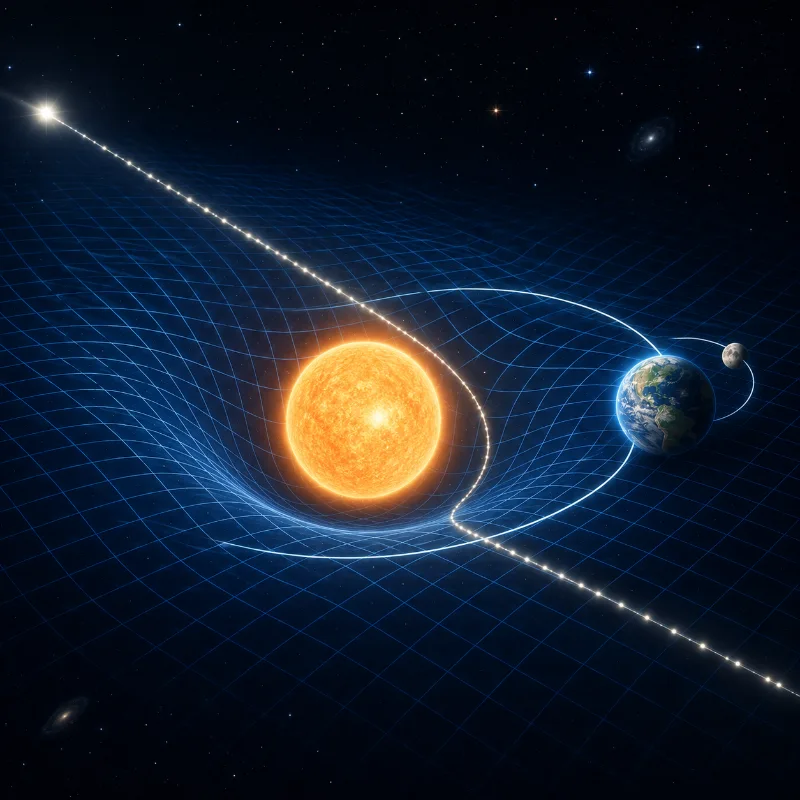
Earth orbits the Sun not because the Sun pulls on Earth through a mysterious invisible string, but because the Sun shapes the spacetime around it. Earth moves along a natural path in this curved spacetime. Similarly, the Moon follows a curved path around Earth, and light passing near the Sun or a galaxy can be deflected because the geometry it travels through is curved.
General Relativity illustrated: the Sun curves spacetime, Earth and the Moon follow natural orbital paths, and light bends as it travels through the curved geometry.
This picture illustrates one of the central ideas of General Relativity: gravity is not shown as an invisible pulling force, but as the curvature of spacetime caused by mass and energy. The Sun is placed in a deep curved region of a spacetime grid, showing how a massive object reshapes the geometry around it. Earth is shown following a curved orbital path around the Sun, while the Moon follows its own path around Earth. A beam of light passing near the Sun is also bent, helping students see that both matter and light move through curved spacetime. The image gives a clear visual introduction to how General Relativity explains planetary motion and gravitational lensing through geometry rather than force alone.
Reflective Question
If gravity is curved spacetime rather than an ordinary pulling force, how does this change the way we understand the motion of planets, moons, and light?
Free Fall and Geodesics
In General Relativity, an object moving only under gravity follows a path called a geodesic. A geodesic is the closest equivalent to a straight line in curved spacetime. In flat space, the shortest path between two points is a straight line. In curved spacetime, the natural path may look curved when viewed from outside, even though the object is following the most natural path available to it.
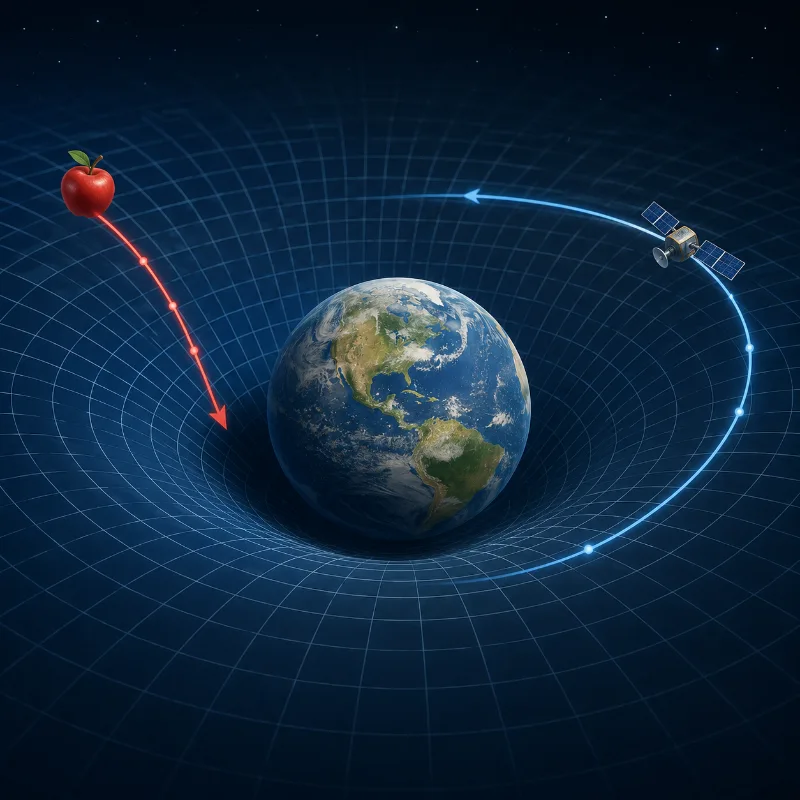
This idea changes how we understand falling. A falling apple, an orbiting satellite, and the Moon circling Earth are all following geodesic paths through spacetime. The apple appears to fall downward because Earth’s surface prevents us from seeing the full spacetime path in the same way we see orbital motion. The satellite remains in orbit because its forward motion and its fall toward Earth combine into a continuing curved path.
Free fall is therefore not a special accident. It is one of the purest forms of motion in General Relativity. An object in free fall is not being pushed by a gravitational force in the Newtonian sense. It is moving naturally through the curved spacetime created by nearby mass and energy.
Free fall and geodesics in General Relativity: falling objects and orbiting bodies follow natural paths through curved spacetime.
This illustration explains the idea of free fall and geodesics in General Relativity. It shows that objects moving only under gravity do not need to be thought of as being pulled by a force in the traditional Newtonian sense. Instead, they follow geodesics, which are the natural paths through curved spacetime. The image may include examples such as a falling apple, an orbiting satellite, or a curved path around Earth to show that both falling and orbiting are forms of free motion shaped by gravity. The diagram helps students see that free fall is not a special case, but one of the clearest examples of motion in Einstein’s theory.
Gravitational Time Dilation
General Relativity predicts that time runs at different rates in different gravitational fields. A clock closer to a massive object, where gravity is stronger, runs slightly more slowly than a clock farther away, where gravity is weaker. This effect is called gravitational time dilation.
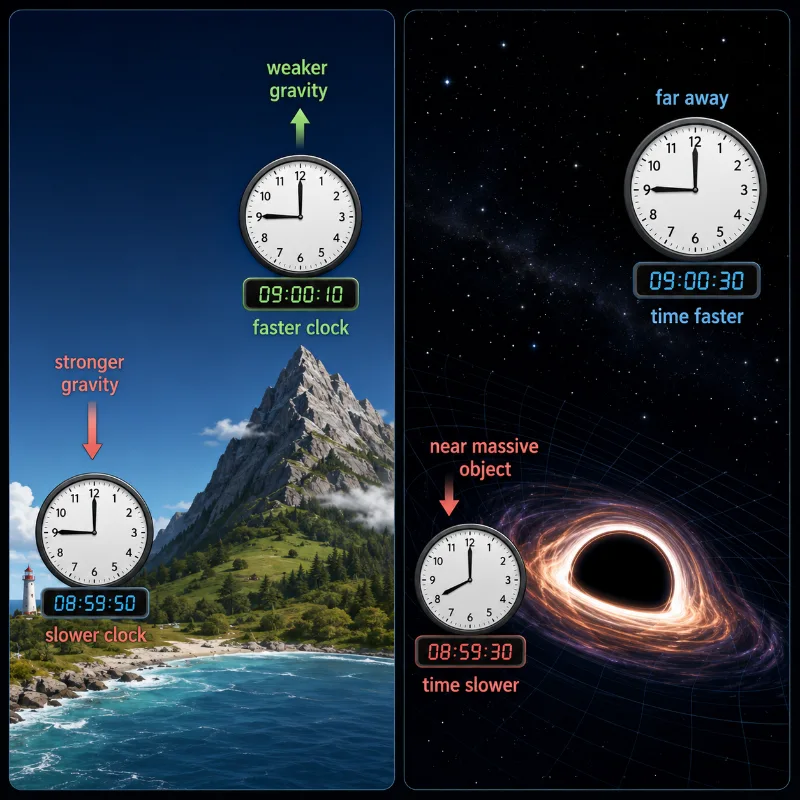
Near Earth, the effect is very small, but it is real and measurable. A clock at sea level runs slightly more slowly than a clock on a mountain, because the clock at sea level is deeper in Earth’s gravitational field. The difference is tiny, but modern atomic clocks are precise enough to detect it.
This idea becomes much more dramatic near very massive and compact objects. Near a neutron star or black hole, gravitational time dilation can become extreme. A distant observer may see clocks near the massive object appear to run much more slowly. This does not mean that time has stopped for the local observer. It means that the rate of time depends on position in a gravitational field.
Gravitational time dilation: clocks run more slowly in stronger gravitational fields and faster where gravity is weaker.
This illustration explains gravitational time dilation, one of the important predictions of General Relativity. On Earth, a clock closer to sea level is deeper in the planet’s gravitational field and runs slightly more slowly than a clock higher up on a mountain, where gravity is weaker. The same idea becomes much stronger near extremely massive and compact objects such as black holes, where a distant observer would measure nearby clocks as running much more slowly. The image helps students see that gravity affects not only motion, but also the rate at which time passes.
Pause and Think
If gravity can change the rate at which clocks run, should we still think of time as the same everywhere in the universe?
Light Bending and Gravitational Lensing
General Relativity predicts that light can bend when it passes near a massive object. This happens not because light has ordinary mass, but because light follows the geometry of spacetime. If spacetime is curved near a star, galaxy, or cluster of galaxies, then the path of light through that region is curved as well.
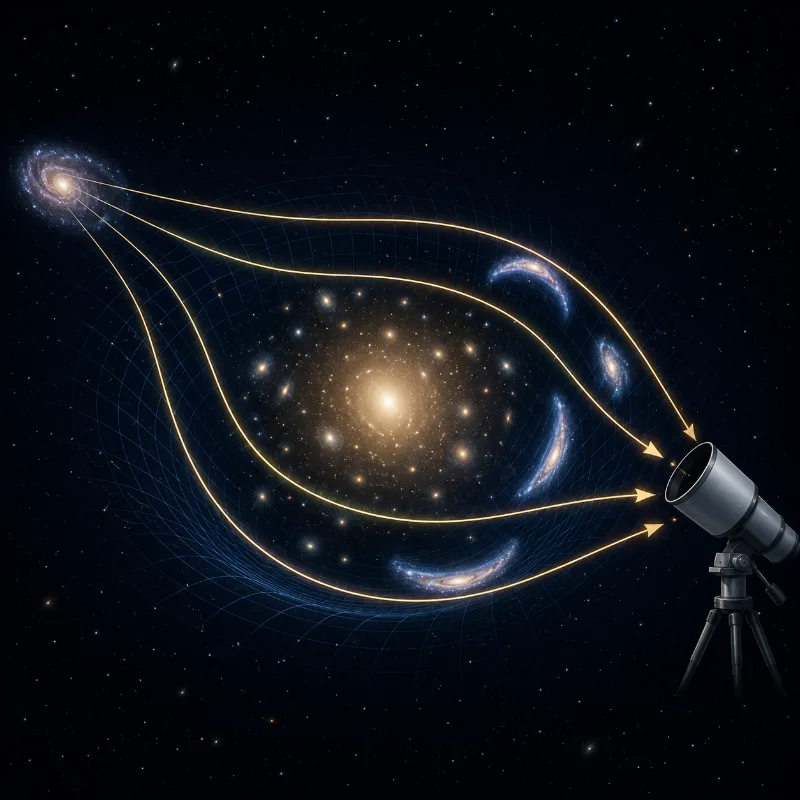
This effect is called gravitational lensing. A massive object can act like a cosmic lens, bending and focusing light from more distant objects behind it. Sometimes this produces distorted arcs, multiple images, or brightened images of distant galaxies. Gravitational lensing allows astronomers to study objects that would otherwise be too faint or hidden to observe directly.
Light bending was one of the earliest major tests of General Relativity. During a solar eclipse, stars near the apparent edge of the Sun can be observed because the Sun’s bright disk is blocked. Their apparent positions shift slightly because their light is bent by the Sun’s gravitational field. This confirmed that gravity affects not only matter, but also light.
Gravitational lensing illustrated: light from a distant source bends as it passes through curved spacetime near a massive object, allowing astronomers to observe distorted or magnified images.
This illustration explains light bending and gravitational lensing in General Relativity. A distant light source sends light toward an observer, but the light does not travel in a perfectly straight path when it passes near a massive object such as a galaxy or cluster of galaxies. Instead, the mass curves spacetime, and the light follows that curved geometry. As a result, the observer may see the distant source distorted, magnified, or appearing in multiple positions. The picture helps students understand that gravity affects not only matter, but also the path of light, making gravitational lensing an important tool in modern astronomy and one of the classic confirmations of General Relativity.
Pause and Think
If light has no rest mass, why does it still bend when it passes near a massive object?
Gravitational Waves
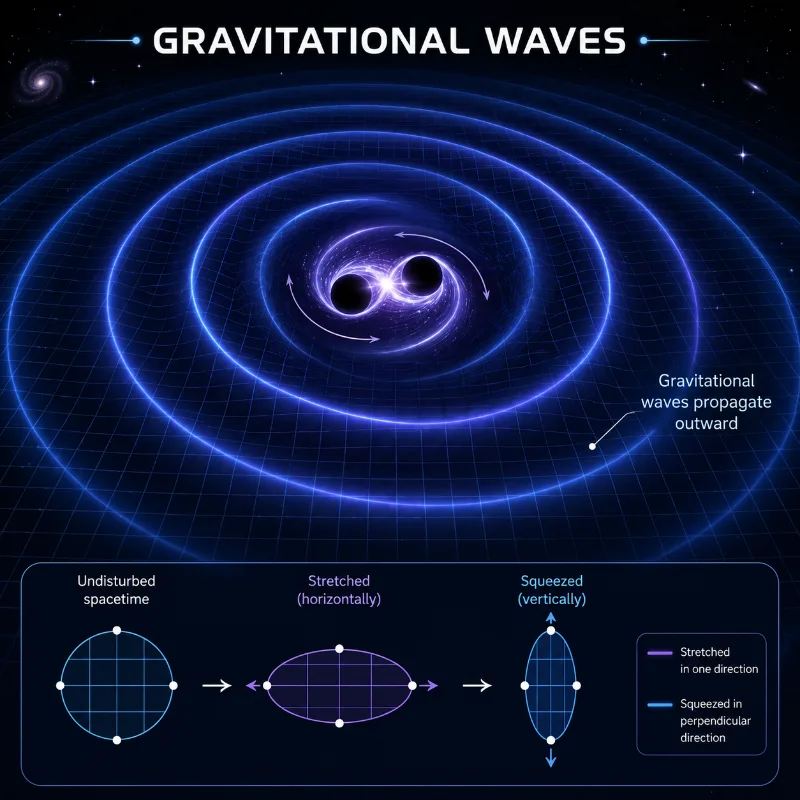
General Relativity predicts that accelerating massive objects can produce ripples in spacetime. These ripples are called gravitational waves. They travel outward at the speed of light, carrying information about violent cosmic events such as merging black holes, colliding neutron stars, and other extreme astrophysical processes.
Gravitational waves are not waves moving through spacetime in the ordinary sense. They are waves of spacetime itself. As a gravitational wave passes through a region, it causes tiny stretching and squeezing effects in space. These changes are incredibly small, but sensitive instruments can detect them by measuring extremely tiny changes in distance.
The detection of gravitational waves opened a new way of observing the universe. Traditional astronomy uses light and other forms of electromagnetic radiation. Gravitational-wave astronomy allows scientists to study events that may produce little or no visible light, giving us a new sense of how massive objects move, collide, and reshape spacetime.
Gravitational waves illustrated: accelerating massive objects can create ripples in spacetime that travel outward across the universe.
This picture illustrates the idea of gravitational waves in General Relativity. Two massive compact objects, such as black holes or neutron stars, are shown spiralling around one another and disturbing the surrounding spacetime. As they accelerate and interact, they generate ripples that spread outward through space like waves. The image helps students visualize that gravitational waves are not ordinary waves moving through space, but tiny distortions of spacetime itself. It also highlights how violent cosmic events can send detectable signals across the universe, opening a new way for astronomers to study invisible or extreme astrophysical phenomena.
Key Idea
Gravitational waves are not waves travelling through space; they are tiny ripples in spacetime itself, produced when massive objects accelerate or merge.
General Relativity and the Expanding Universe
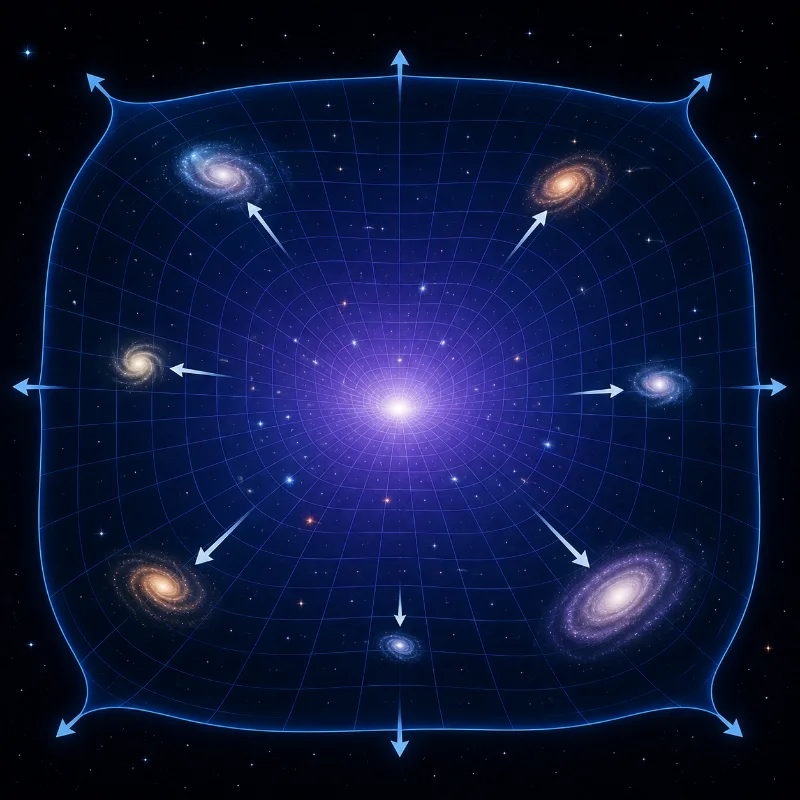
General Relativity is also the foundation of modern cosmology. Cosmology studies the universe as a whole: its origin, expansion, large-scale structure, and possible future. Because General Relativity describes how spacetime responds to mass and energy, it provides the mathematical framework for understanding an expanding universe.
In Einstein’s theory, spacetime is not required to be fixed and unchanging. It can expand, curve, and evolve. When astronomers observe distant galaxies moving away from one another, they are not simply watching galaxies fly through a static space. They are observing the expansion of space itself on cosmic scales.
This connection between gravity and cosmology makes General Relativity one of the deepest theories in science. It links local effects, such as falling objects and orbiting planets, with the largest questions about the universe: why galaxies separate, how the early universe evolved, and how matter, radiation, dark matter, and dark energy shape cosmic history.
General Relativity and cosmology: the universe expands not simply because galaxies fly through space, but because space itself stretches on cosmic scales.
This illustration shows the expanding universe as a stretching fabric of space. Galaxies are shown moving farther apart as the cosmic grid expands outward from an early bright region. The image helps students understand a key idea in modern cosmology: distant galaxies are not merely travelling through a fixed background of space. Instead, the space between galaxies is expanding. General Relativity provides the framework for describing this large-scale evolution of spacetime, linking gravity, matter, radiation, dark matter, dark energy, and the history of the universe.
Real-World Connection
Modern cosmology depends on General Relativity. It helps scientists understand why distant galaxies move farther apart, how the universe expands, and why dark matter and dark energy are central questions in astronomy.
Black Holes as Extreme Curvature
General Relativity predicts that if enough mass is compressed into a small enough region, spacetime curvature can become so strong that an event horizon forms. Beyond this boundary, not even light can escape to distant observers. In this sense, a black hole is not simply a very dense object. It is an extreme spacetime region where gravity, time, light, and geometry are tied together in a dramatic way.
What happens to our understanding of space and time when gravity becomes so strong that not even light can escape?
Experimental Evidence for General Relativity
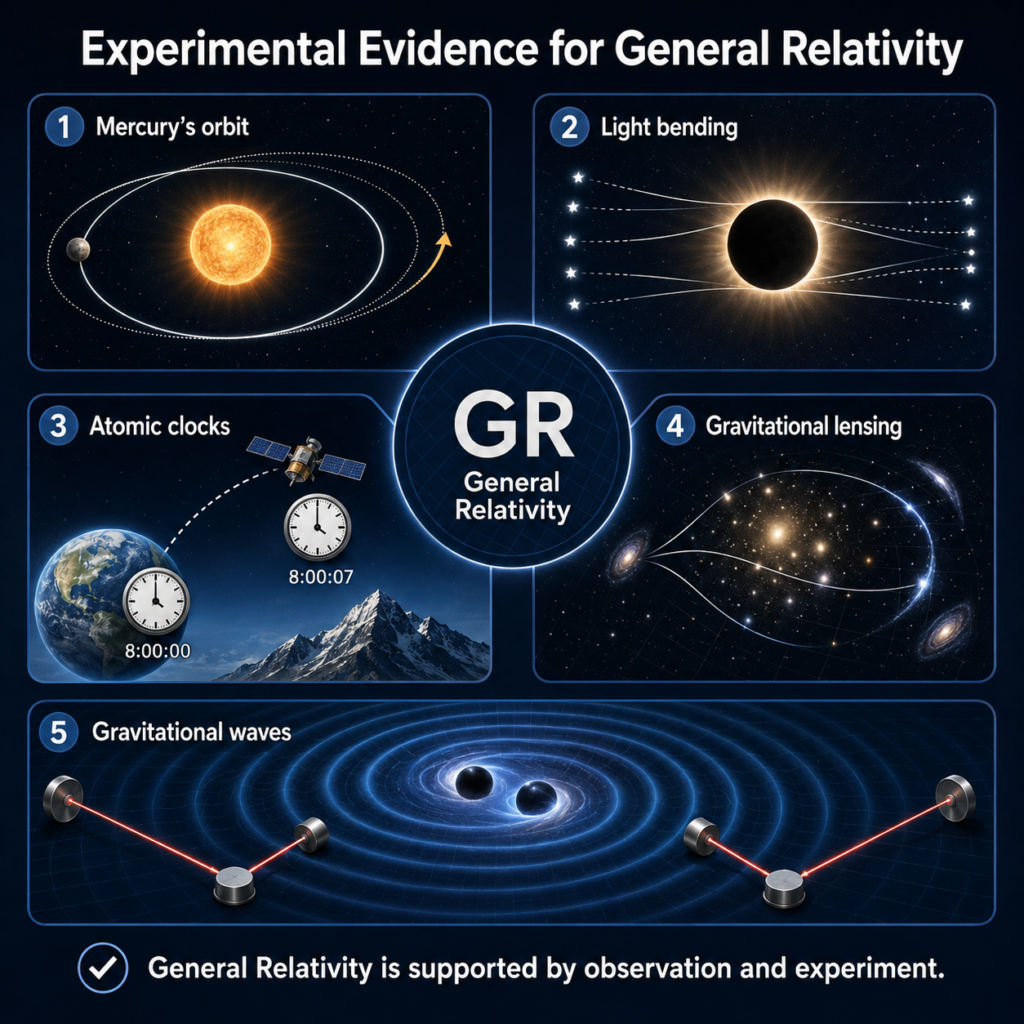
General Relativity is not only a beautiful idea. It has been tested through many observations and experiments. One early success was the explanation of the unusual precession of Mercury’s orbit. Mercury’s path around the Sun shifts slightly over time, and Newtonian gravity could not fully account for the observed amount. General Relativity explained the missing part by accounting for the curvature of spacetime near the Sun.
Another important test was the bending of starlight near the Sun during a solar eclipse. General Relativity predicted that light from distant stars would be deflected by the Sun’s gravitational field. Observations confirmed this prediction and made Einstein’s theory famous around the world.
Modern evidence is even stronger. Atomic clocks confirm gravitational time dilation. Gravitational lensing is observed across the universe. Gravitational waves have been detected from merging compact objects. Satellite navigation systems must account for relativistic effects to maintain accuracy. Together, these confirmations show that General Relativity is not merely a philosophical interpretation of gravity. It is a working scientific theory.
General Relativity is supported by observation and experiment, from Mercury’s orbit and light bending to atomic clocks, gravitational lensing, and gravitational waves.
This infographic summarizes several major lines of evidence supporting General Relativity. Mercury’s orbit shows a small shift that Newtonian gravity could not fully explain, while General Relativity accounts for the effect through curved spacetime near the Sun. Light bending near the Sun shows that gravity affects the path of light. Atomic clocks confirm that time runs at different rates in different gravitational fields. Gravitational lensing reveals how massive galaxies and galaxy clusters bend and focus light from distant objects. Gravitational waves show that violent cosmic events can send ripples through spacetime itself. Together, these observations show that General Relativity is not only an elegant idea, but a tested and working theory of gravity.
Pause and Think
Why is it important that General Relativity is supported by many different kinds of evidence, from Mercury’s orbit and light bending to atomic clocks, gravitational lensing, and gravitational waves?
Applications of General Relativity
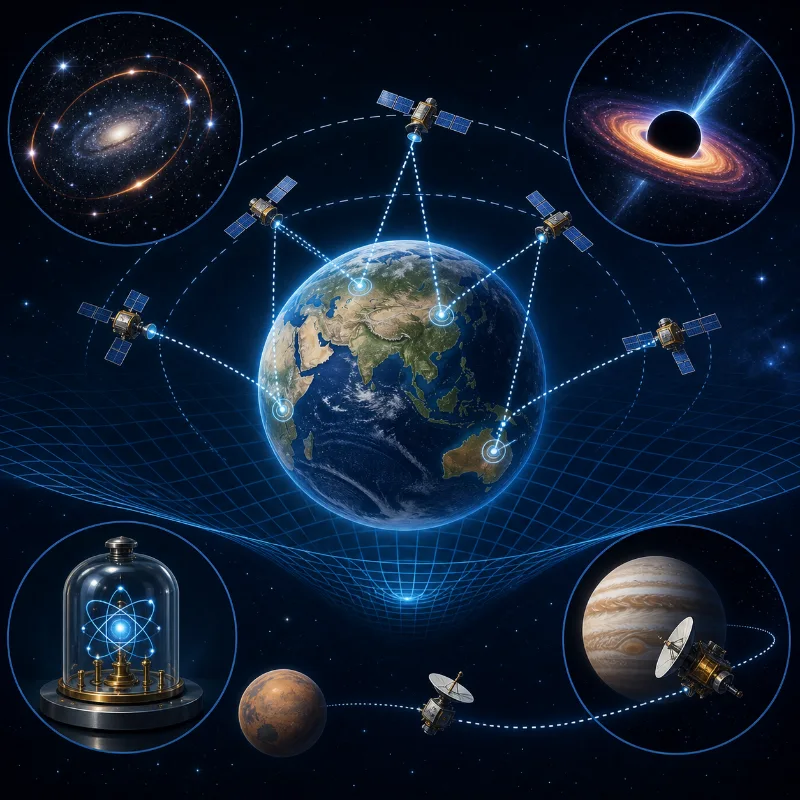
General Relativity has practical and scientific applications across many fields. One of the best-known examples is satellite navigation. Systems such as GPS require highly accurate timing. Satellite clocks experience both motion-related time effects and gravitational time dilation. If these relativistic corrections were ignored, positioning errors would grow quickly.
General Relativity is also essential in astronomy and astrophysics. It is used to interpret gravitational lensing, study compact stars, analyze black holes, model gravitational waves, and understand the large-scale evolution of the universe. Without General Relativity, many modern observations of the cosmos would be incomplete or misleading.
The theory also influences high-precision measurement, space missions, planetary navigation, and tests of fundamental physics. Whenever gravity, time, light, and high precision meet, General Relativity becomes part of the scientific language. It is not only a theory about distant galaxies. It also helps make modern positioning and timing systems work.
General Relativity supports both modern technology and cosmic discovery, from satellite navigation and precision timing to black-hole research, gravitational lensing, and space exploration.
This illustration shows several important applications of General Relativity. Around Earth, satellites support navigation and precision timing, where relativistic corrections are needed for accurate positioning. The atomic clock represents high-precision time measurement, while the images of galaxies, black holes, and planetary missions show how General Relativity is used in astronomy and space science. The picture helps students see that General Relativity is not only a theory about distant objects in the universe. It is also part of the scientific foundation behind modern navigation, timekeeping, gravitational lensing, black-hole studies, and space exploration.
Common Misconceptions about General Relativity
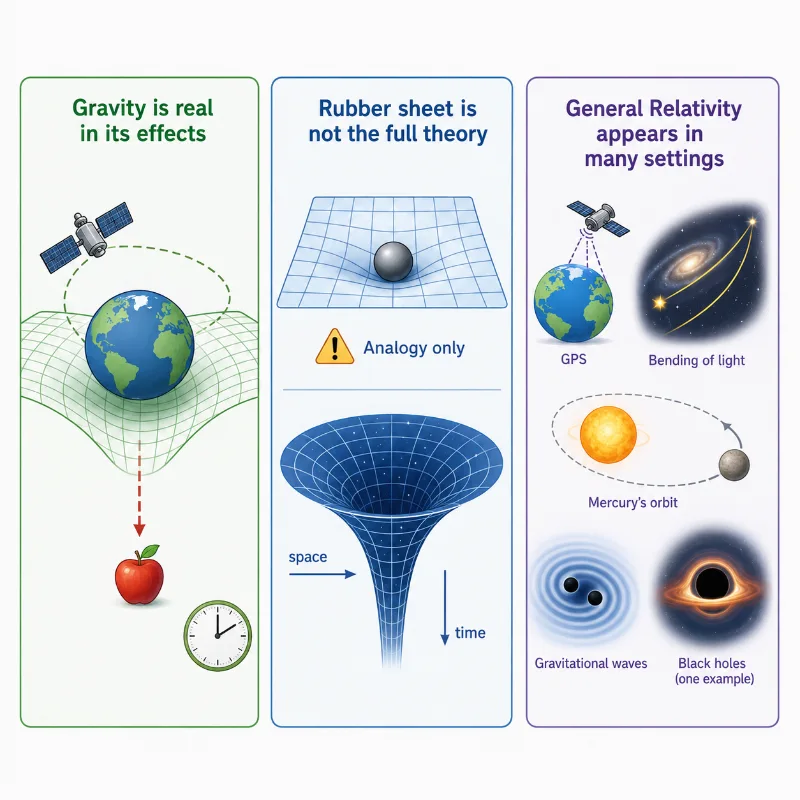
One common misconception is that General Relativity says gravity is “not real.” This is misleading. Gravity is real in its effects: objects fall, planets orbit, light bends, and clocks run differently in gravitational fields. What General Relativity changes is the explanation. Gravity is not treated as an ordinary force acting through space, but as the effect of curved spacetime.
Another misconception is that spacetime curvature is the same as a rubber-sheet dent. The rubber-sheet analogy can help beginners imagine curved paths, but it is incomplete. Real spacetime curvature involves time as well as space, and it does not require an external downward direction. Students should treat the rubber sheet as a helpful picture, not as the full theory.
A third misconception is that General Relativity only matters near black holes. In fact, relativistic gravity appears in many settings, including satellite navigation, atomic clock comparisons, gravitational lensing, Mercury’s orbit, gravitational waves, and cosmology. Black holes are dramatic examples, but they are not the only place where General Relativity matters.
Common misconceptions about General Relativity: gravity remains real in its effects, the rubber-sheet model is only an analogy, and relativistic gravity appears in many parts of modern physics.
This infographic helps students correct three common misunderstandings about General Relativity. First, it shows that gravity is real in its effects: objects fall, satellites orbit, light bends, and clocks run differently in gravitational fields. Second, it reminds students that the rubber-sheet model is only a helpful analogy, not the full theory of spacetime curvature. Real General Relativity involves space and time together, not simply a dent in a two-dimensional surface. Third, the image shows that General Relativity is not limited to black holes. It also appears in GPS, Mercury’s orbit, gravitational lensing, gravitational waves, cosmology, and other areas of modern science.
Interactive Concept Check: Which General Relativity Idea Is Involved?
General Relativity appears in many different situations. For each example below, identify the main idea before revealing the answer.
1. A clock on a mountain runs very slightly faster than a clock at sea level. Which idea is involved?
A. Gravitational time dilationB. Nuclear fusionC. Electrical resistanceD. Chemical bonding
Answer: A. This is gravitational time dilation. A clock higher above Earth is in a slightly weaker gravitational field, so it runs a little faster than a clock deeper in Earth’s gravitational field.
2. Light from a distant galaxy is bent and magnified by a massive galaxy cluster. Which idea is involved?
A. RadioactivityB. Gravitational lensingC. Thermal expansionD. Magnetic induction
Answer: B. This is gravitational lensing. The massive galaxy cluster curves spacetime, and light follows that curved geometry as it travels toward the observer.
3. Two black holes spiral together and produce ripples that travel across the universe. Which idea is involved?
A. Gravitational wavesB. Static electricityC. Brownian motionD. Sound waves in air
Answer: A. These are gravitational waves. They are not ordinary waves moving through air or water. They are tiny distortions of spacetime produced by accelerating massive objects.
4. A satellite navigation system must correct for the different rates of satellite clocks and Earth clocks. Which idea is involved?
A. Relativity in precision timingB. PhotosynthesisC. Plate tectonicsD. Chemical equilibrium
Answer: A. Satellite navigation depends on precise timing. Because satellite clocks are affected by both motion and gravity, relativistic corrections are needed for accurate positioning.
5. A planet follows a natural orbital path around the Sun. In General Relativity, what is this path called?
A. A chemical pathwayB. A geodesicC. A sound pathD. A circuit loop
Answer: B. In General Relativity, a freely moving object follows a geodesic, which is the natural path through curved spacetime.
6. Distant galaxies appear to move farther apart because space itself is stretching. Which idea is involved?
A. Cosmic expansionB. FrictionC. Elastic collisionD. Electric current
Answer: A. This is cosmic expansion. In modern cosmology, distant galaxies move apart not simply because they fly through a fixed space, but because the space between them is expanding.
Key takeaway: General Relativity is not only a theory about black holes. It connects time, light, motion, waves, satellites, and the large-scale structure of the universe.
Frequently Asked Questions about General Relativity
1. What is General Relativity in simple terms?
General Relativity is Einstein’s theory of gravity. It explains gravity not as an ordinary invisible pulling force, but as the effect of curved spacetime. Massive objects such as planets, stars, and galaxies shape the geometry of space and time around them. Other objects then move along natural paths through that curved geometry.
2. How is General Relativity different from Special Relativity?
Special Relativity deals mainly with motion at constant velocity, especially when speeds are close to the speed of light. General Relativity extends this picture by including acceleration and gravity. In Special Relativity, spacetime is treated as flat. In General Relativity, spacetime can be curved by mass and energy.
3. Does General Relativity say that gravity is not real?
No. Gravity is very real in its effects. Objects fall, planets orbit, light bends, clocks run at different rates, and gravitational waves can be detected. What General Relativity changes is the explanation. Instead of describing gravity only as a force acting across space, it describes gravity as the result of curved spacetime.
4. What is the equivalence principle?
The equivalence principle says that, in a small enough region, the effects of gravity can resemble the effects of acceleration. For example, standing in a stationary elevator on Earth can feel similar to being inside a rocket accelerating in deep space. This idea helped Einstein connect gravity, motion, and spacetime geometry.
5. Why do astronauts feel weightless if gravity still acts on them?
Astronauts in orbit are not outside Earth’s gravity. They feel weightless because they and their spacecraft are falling together around Earth. Since everything inside the spacecraft is falling at nearly the same rate, there is no ordinary support force pushing upward on the astronauts. This creates the experience of weightlessness.
6. What is a geodesic?
A geodesic is the natural path followed by an object moving freely through spacetime. In General Relativity, a falling object or an orbiting satellite can be understood as following a geodesic through curved spacetime. This idea replaces the simple picture of gravity as a force pulling objects along a path.
7. Why does gravity affect time?
General Relativity shows that time is part of spacetime, not something completely separate from space. In stronger gravitational fields, clocks run more slowly compared with clocks in weaker gravitational fields. This effect is called gravitational time dilation. It is small near Earth’s surface but becomes much stronger near very massive and compact objects.
8. Why does light bend in gravity if light has no mass?
Light bends near massive objects because it follows the geometry of spacetime. In General Relativity, a massive object curves spacetime, and light travels along paths shaped by that curvature. This is why light from distant stars and galaxies can be bent, magnified, or distorted when it passes near massive objects.
9. What are gravitational waves?
Gravitational waves are ripples in spacetime produced by accelerating massive objects, especially extreme systems such as merging black holes or neutron stars. They are not ordinary waves moving through space. Instead, they are tiny stretching and squeezing disturbances of spacetime itself.
10. Does General Relativity matter in everyday technology?
Yes. General Relativity is important in precision timekeeping and satellite navigation. Clocks on satellites experience time slightly differently from clocks on Earth because of both motion and gravity. These relativistic effects must be corrected so that navigation systems can remain accurate.
11. Is the rubber-sheet picture of spacetime accurate?
The rubber-sheet picture is useful as a beginner’s analogy, but it is incomplete. Real spacetime curvature involves both space and time, not just a two-dimensional surface bending downward. The analogy can help students imagine curved paths, but it should not be mistaken for the full meaning of General Relativity.
12. Why is General Relativity important for understanding the universe?
General Relativity provides the framework for studying gravity on cosmic scales. It helps explain black holes, gravitational lensing, gravitational waves, the expansion of the universe, and the large-scale structure of spacetime. It is one of the foundations of modern astrophysics and cosmology.
Guided Reflection Activities
The following reflection activities are designed to help students think more deeply about General Relativity before moving into advanced mathematics. They may be used for classroom discussion, self-study, video pauses, or review exercises.
Reflection 1: Gravity or Acceleration?
Imagine you are inside a closed elevator with no windows. You feel pressed against the floor. How could this feeling be caused either by gravity or by acceleration?
If the elevator is standing on Earth, the floor pushes upward on you while gravity acts downward. If the elevator is in deep space but accelerating upward, the floor also pushes against you. Locally, the two experiences can feel the same. This is the basic idea behind the equivalence principle.
Reflection 2: Why Does Light Bend?
Light has no ordinary rest mass. Why, then, can it bend near a massive object such as the Sun?
In General Relativity, light follows the geometry of spacetime. A massive object curves spacetime around it. As light travels through this curved geometry, its path can bend. The bending is not explained by treating light as a small ordinary object being pulled in the Newtonian sense. It is explained by curved spacetime.
Reflection 3: Why Do Clocks Run Differently?
A clock at sea level and a clock on a mountain do not run at exactly the same rate. Which one runs slightly slower, and why?
The clock at sea level runs slightly more slowly because it is deeper in Earth’s gravitational field. The clock on the mountain is farther from Earth’s center and is in a slightly weaker gravitational field. This is an example of gravitational time dilation.
Reflection 4: Why Is a Satellite in Free Fall?
A satellite stays in orbit above Earth. Is it free from Earth’s gravity?
No. A satellite in orbit is still under Earth’s gravitational influence. It is continuously falling around Earth. Its sideways motion prevents it from falling straight down to the surface. In General Relativity, the satellite follows a natural path, or geodesic, through curved spacetime.
Review Questions
1. What is the central idea of General Relativity?
General Relativity explains gravity as the curvature of spacetime caused by mass and energy, rather than simply as an invisible force pulling objects together.
2. How does General Relativity extend Special Relativity?
Special Relativity focuses mainly on constant-speed motion in flat spacetime. General Relativity extends the idea by including acceleration, gravity, and curved spacetime.
3. What is the equivalence principle?
The equivalence principle states that, in a small local region, the effects of gravity can resemble the effects of acceleration. This idea helped Einstein connect gravity with the geometry of spacetime.
4. Why do astronauts appear weightless while orbiting Earth?
Astronauts appear weightless because they and their spacecraft are falling together around Earth. Gravity is still acting, but there is no ordinary support force pushing them against the floor.
5. What is a geodesic?
A geodesic is the natural path followed by an object moving freely through spacetime. In General Relativity, falling objects and orbiting planets follow geodesics through curved spacetime.
6. What is gravitational time dilation?
Gravitational time dilation is the effect in which clocks run more slowly in stronger gravitational fields and faster in weaker gravitational fields.
7. Why can gravity bend light?
Light follows the geometry of spacetime. When a massive object curves spacetime, light passing nearby follows a curved path, even though light has no rest mass.
8. What are gravitational waves?
Gravitational waves are ripples in spacetime produced by accelerating massive objects, such as merging black holes or neutron stars.
9. Why is General Relativity important for cosmology?
General Relativity provides the mathematical framework for describing the large-scale structure and expansion of the universe.
10. Why is General Relativity useful in modern technology?
General Relativity is important for precision timing and satellite navigation. Without relativistic corrections, systems such as GPS would gradually become inaccurate.
Reflective Questions
1. Why is it misleading to say that General Relativity proves gravity is “not real”?
Gravity remains real in its observable effects: objects fall, planets orbit, light bends, clocks shift, and waves can pass through spacetime. What changes is the explanation. General Relativity describes gravity not as an ordinary force, but as the result of curved spacetime.
2. Why is the rubber-sheet model useful but incomplete?
The rubber-sheet model helps beginners imagine curved paths, but it reduces spacetime to a two-dimensional surface. Real spacetime curvature includes time as well as space, and it does not require an external downward direction.
3. What does General Relativity teach us about time?
It teaches us that time is not a universal background ticking the same way everywhere. Time is part of spacetime and can be affected by gravity and motion.
4. Why might General Relativity feel less intuitive than Newtonian gravity?
Newtonian gravity fits everyday experience well because it treats gravity as a force between objects. General Relativity is less intuitive because it asks us to imagine space and time themselves as flexible parts of physical reality.
5. Why is gravitational lensing a powerful tool in astronomy?
Gravitational lensing allows astronomers to study distant objects whose light has been bent and magnified by massive galaxies or galaxy clusters. It also provides clues about invisible mass, including dark matter.
6. How does General Relativity change our view of the universe?
It changes the universe from a fixed stage where events happen into a dynamic structure whose geometry can bend, stretch, ripple, and evolve.
Numerical Problems and Solutions
Problem 1: Light-Travel Time from the Sun to Earth
Light from the Sun takes about 8 minutes and 20 seconds to reach Earth. Convert this time into seconds.
Solution:
t = 8 × 60 s + 20 s = 480 s + 20 s = 500 s
Answer: Light takes about 500 s to travel from the Sun to Earth.
Why this matters: General Relativity often deals with light travelling across large distances. Even though light is extremely fast, cosmic distances are so large that travel time becomes important.
Problem 2: Estimating the Sun–Earth Distance
If light travels at approximately 3.0 × 10⁸ m/s and takes 500 s to travel from the Sun to Earth, estimate the distance from the Sun to Earth.
Solution:
d = ct = (3.0 × 10⁸ m/s) × 500 s = 1.5 × 10¹¹ m
Answer: The estimated Sun–Earth distance is 1.5 × 10¹¹ m.
Why this matters: This calculation shows the scale of the Solar System. General Relativity becomes especially important when studying light paths, orbital motion, and time corrections across astronomical distances.
Problem 3: Comparing Clock Rates Conceptually
Clock A is at sea level. Clock B is on top of a mountain. According to General Relativity, which clock should run slightly faster?
Solution:
A clock deeper in a gravitational field runs slightly more slowly. A clock higher above Earth is in a weaker gravitational field. Answer: Clock B (the mountain clock) runs slightly faster than Clock A.
Why this matters: The effect is tiny near Earth, but it is real and measurable with precise atomic clocks. It also matters in satellite navigation.
Problem 4: Satellite Clock Reasoning
A satellite is farther from Earth’s surface than a ground clock. Considering only gravitational time dilation, would the satellite clock run slightly faster or slightly slower than the ground clock?
Solution:
The satellite is farther from Earth and is therefore in a weaker gravitational field. Answer: Considering only gravitational time dilation, the satellite clock runs slightly faster than the ground clock.
Important note: Real satellite timing also includes Special Relativity because the satellite is moving quickly. Navigation systems must correct for both gravitational and motion-related relativistic effects.
Problem 5: Simple Gravitational Time Dilation Approximation
Near Earth, the fractional change in clock rate over a small height difference may be approximated by:
Δt / t ≈ (gh) / c2
Estimate the fractional change in clock rate for a height difference of h = 1000 m, using g = 9.8 m/s2 and c = 3.0 × 10⁸ m/s.
Answer: The fractional change in clock rate is approximately 1.09 × 10⁻¹³.
Why this matters: This number is extremely small, but it is not zero. With very precise atomic clocks, such tiny differences can be measured. This helps students see why General Relativity matters in precision timing.
Problem 6: Schwarzschild Radius of a Black Hole
The Schwarzschild radius of a non-rotating black hole is:
rs = (2 GM) / c2
Estimate the Schwarzschild radius of an object with mass M = 2.0 × 1030 kg, using G = 6.67 × 10⁻¹¹ N·m2/kg2 and c = 3.0 × 10⁸ m/s.
rs = (2.668 × 10²⁰) / (9.0 × 10¹⁶) ≈ 2.96 × 10³ m ≈ 3.0 km
Answer: The Schwarzschild radius is approximately 3.0 km.
Why this matters: This result shows that an object with roughly the Sun’s mass would need to be compressed into a radius of only a few kilometres to become a black hole. The result also gives students a simple numerical bridge to the existing black-hole pages.
Problem 7: Gravitational Lensing Identification
An astronomer observes that a distant galaxy appears stretched into an arc around a massive galaxy cluster. What General Relativity effect is being observed?
Solution:
The massive galaxy cluster curves spacetime. Light from the distant galaxy follows this curved geometry and appears distorted to the observer:
Curved spacetime → bent light path → distorted image
Answer: The effect is gravitational lensing.
Thought Problems
Thought Problem 1: The Falling Elevator
Imagine you are inside a sealed elevator with no windows. Suddenly, the cable breaks and the elevator begins to fall freely. For a short time, you appear weightless. From inside the elevator alone, how could you tell whether you are falling in a gravitational field or floating freely in deep space?
Suggested response: Locally, it may be impossible to tell the difference. This is the heart of the equivalence principle. In a small enough region, free fall in gravity can resemble floating freely without gravity.
Thought Problem 2: The Bending Light Beam
Suppose a beam of light passes near the Sun and bends slightly. Why does this support General Relativity more directly than the idea that gravity only pulls objects with mass?
Suggested response: Light has no rest mass, so the bending of light suggests that gravity is not merely a force pulling massive objects. General Relativity explains the effect by saying that the Sun curves spacetime, and light follows the curved geometry.
Thought Problem 3: The Expanding Universe
If distant galaxies are moving away from one another, does this necessarily mean they are flying through space from a central explosion point?
Suggested response: Not necessarily. In modern cosmology, the expansion of the universe is understood as the stretching of space itself. Galaxies can become farther apart because the space between them expands.
Thought Problem 4: The Rubber-Sheet Analogy
A student says, “Spacetime is just like a rubber sheet with planets rolling around on it.” What is useful about this statement, and what is misleading?
Suggested response: The statement is useful because it helps beginners picture curved paths. It is misleading because real spacetime has three dimensions of space and one dimension of time. It also does not bend downward into an external space in the simple way a rubber sheet does.
Thought Problem 5: Gravity and Technology
Why does a theory about curved spacetime matter for something as practical as satellite navigation?
Suggested response: Satellite navigation depends on extremely precise timing. Since gravity and motion affect clock rates, relativistic corrections are needed. A small timing error can become a large position error.
Thought Problem 6: The Meaning of “Straight”
In everyday life, a straight path usually means a path that does not curve. In General Relativity, an object in free fall may follow the “straightest possible path” through curved spacetime. How can a path be straight in one sense but curved in another?
Suggested response: A geodesic is locally the natural or straightest path through spacetime, even if it appears curved when viewed from outside. This is similar to how an aircraft route on Earth may look curved on a flat map but can still follow the shortest path over a curved globe.
Recommended Reading
General Relativity connects naturally with several nearby topics in modern physics and astrophysics. After studying this page, students may continue with the following readings to deepen their understanding of spacetime, gravity, black holes, and the wider universe.
Continue Your Relativity Journey
Relativity
Start here for the wider relativity cluster, including how space, time, motion, light, energy, and gravity fit together.
Special Relativity
Review the foundation of spacetime, light speed, time dilation, length contraction, and mass-energy equivalence before comparing it with curved spacetime.
Black Holes
Explore how General Relativity leads to one of its most dramatic consequences: regions where spacetime curvature becomes extremely strong.
Event Horizons and Singularities
Learn about the boundary of a black hole and the challenging ideas that arise when gravity is pushed to its extreme limit.
LIGO: What Are Gravitational Waves?
Explore how gravitational waves arise from violent cosmic events and why their detection became a major confirmation of Einstein’s theory.
ESA/Hubble: Gravitational Lensing
Learn how massive objects bend light and how gravitational lensing helps astronomers observe distant galaxies and cosmic structures.