
Chemical thermodynamics explores how energy transformations determine whether chemical reactions occur, how far they proceed, and under what conditions they reach equilibrium. Unlike classical thermodynamics, which focuses on general energy relationships, this field applies thermodynamic principles directly to chemical systems and reactions.
At its core, chemical thermodynamics connects three fundamental quantities—enthalpy, entropy, and Gibbs free energy—to explain reaction spontaneity. It provides a framework for predicting whether a reaction will proceed naturally, how temperature influences outcomes, and how equilibrium is established in systems ranging from simple laboratory reactions to complex industrial processes.
This area of study is closely linked to the laws of thermodynamics, but extends further by introducing chemical potential, equilibrium constants, and phase behaviour. It bridges concepts from statistical thermodynamics and practical applications in engineering thermodynamics, making it essential for understanding real-world chemical and energy systems.
From battery operation and fuel combustion to biochemical reactions in living organisms, chemical thermodynamics provides the language and tools to analyse how energy drives transformation. It allows us not only to describe what happens, but to predict what is possible—and what is not.
Explore Chemical Thermodynamics
Chemical thermodynamics focuses on how energy determines the direction, feasibility, and equilibrium of chemical reactions. It connects fundamental thermodynamic principles to real chemical processes, from reactions in laboratories to large-scale industrial systems.
Thermodynamic Laws
Build the foundation by understanding how energy conservation and entropy govern all thermodynamic processes, including chemical reactions.Energy, Work, and State Functions
Explore how internal energy, enthalpy, and entropy describe the thermodynamic state and determine how energy changes during reactions.Phase Equilibria and Stability
Understand how chemical systems reach equilibrium and how phase changes influence reaction conditions and material behaviour.Microscopic Foundations
Link macroscopic thermodynamic quantities to molecular behaviour through statistical models and probability.Irreversible Processes
Examine how real chemical systems behave away from equilibrium, including transport processes and entropy production.Engineering Applications
Apply thermodynamic principles to chemical reactors, energy systems, and industrial processes where efficiency and feasibility matter.For a full view of all thermodynamics topics, explore the Thermodynamics Overview.
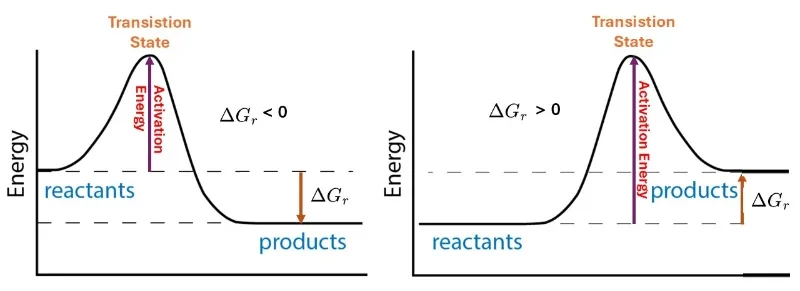
These diagrams illustrate the thermodynamic energy profiles of chemical reactions by plotting energy against reaction progress. In the exergonic reaction, the products have lower energy thanthe reactants, resulting in a negative Gibbs free energy change (ΔGr < 0), indicating a spontaneous process. In contrast, the endergonic reaction shows products at a higher energy level than the reactants, corresponding to a positive Gibbs free energy change (ΔGr > 0), meaning energy input is required. Both diagrams highlight the transition state and activation energy barrier that must be overcome for the reaction to proceed.
What Chemical Thermodynamics Really Studies
Chemical thermodynamics is concerned with one central question: Will a chemical reaction occur, and to what extent? While thermodynamics as a whole studies energy, heat, and work, chemical thermodynamics focuses specifically on how these quantities govern chemical change—the transformation of substances from reactants to products.
At its heart lies the concept of Gibbs free energy, a quantity that brings together energy and disorder into a single criterion. Rather than asking only how much energy is involved, chemical thermodynamics asks whether the combined effects of enthalpy (energy change) and entropy (disorder) favour or oppose a reaction under given conditions.
A reaction is considered spontaneous when it can proceed without external intervention. This does not mean the reaction is fast—it means that, from an energy standpoint, the process is thermodynamically favourable. Chemical thermodynamics therefore distinguishes clearly between feasibility (whether a reaction can occur) and rate (how quickly it occurs), the latter being the domain of kinetics.
Equally important is the concept of equilibrium. Most chemical reactions do not go to completion but instead settle into a balance between forward and reverse processes. At equilibrium, the system reaches a state where macroscopic properties remain constant, even though molecular activity continues. Chemical thermodynamics provides the tools to predict this balance and to determine how conditions such as temperature influence it.
Temperature plays a subtle and powerful role. It shifts the balance between enthalpy and entropy, meaning that a reaction that is favourable under one set of conditions may become unfavourable under another. This sensitivity explains why industrial processes carefully control temperature and pressure to achieve desired outcomes.
In essence, chemical thermodynamics does not track the detailed path of a reaction. Instead, it defines the direction, limits, and energetic constraints within which all chemical processes must operate. It provides the framework that determines what is possible—before any reaction mechanism or rate is considered.
Key Concepts in Chemical Thermodynamics
Chemical thermodynamics is built on a small set of powerful concepts that determine whether reactions occur, how far they proceed, and how conditions influence their behaviour. These ideas translate abstract energy principles into precise tools for analysing chemical systems.
Gibbs Free Energy and Spontaneity
The central quantity in chemical thermodynamics is the Gibbs free energy, which determines whether a reaction is thermodynamically feasible. It combines energy and entropy into a single expression:
ΔG = ΔH − TΔS
where ΔG is the change in Gibbs free energy, ΔH is the enthalpy change, T is the absolute temperature, and ΔS is the entropy change. A negative value of ΔG indicates a spontaneous process, while a positive value indicates that the reaction is not favourable under the given conditions.
This equation reveals an important insight: a reaction can be driven either by energy release (negative ΔH), by an increase in disorder (positive ΔS), or by a combination of both. Temperature determines which effect dominates.
Enthalpy and Heat Effects
Enthalpy represents the heat exchanged during a reaction at constant pressure. Reactions that release heat are exothermic, while those that absorb heat are endothermic.
Although enthalpy alone does not determine spontaneity, it plays a crucial role in shaping reaction behaviour. Many reactions that release energy tend to be favourable, but this is not always the case—entropy must also be considered.
Entropy and Disorder
Entropy measures the degree of disorder or randomness in a system. In chemical reactions, entropy often increases when molecules become more dispersed, such as when a solid dissolves or when gases are produced.
The second law of thermodynamics states that the total entropy of the universe tends to increase. Chemical thermodynamics applies this principle to determine whether a reaction contributes to overall disorder.
Chemical Equilibrium
Most reactions do not proceed to completion but reach a state of dynamic equilibrium, where forward and reverse reactions occur at equal rates. At equilibrium:
ΔG = 0
This does not mean the reaction has stopped, but rather that no net change is observed at the macroscopic level.
Link Between Free Energy and Equilibrium Constant
A key result in chemical thermodynamics is the relationship between Gibbs free energy and the equilibrium constant:
ΔG° = −RT ln K
where ΔG° is the standard free energy change, R is the gas constant, T is the temperature, and K is the equilibrium constant. This equation connects thermodynamic feasibility with measurable chemical composition.
A large value of K indicates that products are favoured, while a small value indicates that reactants dominate. This provides a direct bridge between theory and experiment.
Temperature Dependence of Reactions
Temperature influences both enthalpy and entropy contributions, and therefore affects spontaneity. Some reactions become favourable only at high temperatures, while others are favoured at low temperatures.
This dependence explains why industrial processes often operate under carefully controlled thermal conditions to maximise efficiency and yield.
Applications of Chemical Thermodynamics
Chemical thermodynamics is not confined to theoretical analysis—it plays a central role in understanding and designing processes across chemistry, industry, and the natural environment. By determining whether reactions are feasible and how equilibrium responds to changing conditions, it provides a foundation for real-world decision-making.
Chemical Reactions and Industrial Processes
In industrial chemistry, reactions must be carefully controlled to maximise yield while minimising energy consumption. Chemical thermodynamics guides the selection of temperature and pressure conditions to favour product formation.
For example, in large-scale synthesis processes, reactions are often carried out under conditions where the equilibrium position is shifted toward the desired products. Even when a reaction is thermodynamically favourable, engineers must balance this with practical constraints such as cost and safety.
Energy Storage and Electrochemical Systems
Electrochemical systems, such as batteries and fuel cells, are direct applications of chemical thermodynamics. The feasibility of these systems depends on the free energy change of the underlying reactions.
A negative Gibbs free energy change corresponds to a spontaneous reaction that can produce electrical energy. This principle governs the design of energy storage systems, from portable electronics to large-scale renewable energy grids.
Environmental and Atmospheric Chemistry
Chemical thermodynamics is essential for understanding natural processes in the environment. It helps predict whether pollutants will react, persist, or transform under different atmospheric conditions.
For instance, the stability of compounds in the atmosphere depends on temperature and energy balance, influencing phenomena such as ozone formation, greenhouse gas behaviour, and chemical cycling in ecosystems.
Biological Systems and Metabolism
Living systems rely on chemical thermodynamics to drive metabolic processes. Reactions in cells are organised in pathways where energy-releasing processes power energy-consuming ones.
The concept of free energy is crucial in understanding how organisms maintain order and carry out complex functions, even while obeying the second law of thermodynamics.
Material Stability and Chemical Design
The stability of compounds and materials is determined by thermodynamic principles. Chemical thermodynamics predicts which substances are stable under given conditions and which are likely to decompose or react.
This is particularly important in designing new materials, pharmaceuticals, and chemical products, where stability and reactivity must be carefully balanced.
Equilibrium Control in Laboratory Chemistry
In laboratory settings, chemists routinely manipulate equilibrium to control reaction outcomes. By adjusting temperature, concentration, or pressure, they can shift the balance between reactants and products.
This practical use of thermodynamic principles allows precise control over chemical transformations, making chemical thermodynamics an essential tool in both research and education.
Mini Case Study: The Haber Process and the Balance of Conditions
The Haber process, used to produce ammonia from nitrogen and hydrogen, is one of the most important industrial applications of chemical thermodynamics. It illustrates how thermodynamic principles guide real-world decisions, where ideal conditions are often balanced against practical constraints.
The reaction is:
N2 + 3H2 ⇊ 2NH3
From a thermodynamic perspective, the reaction is exothermic, meaning it releases heat. This suggests that lower temperatures would favour the formation of ammonia, since reducing temperature shifts equilibrium toward the products.
However, there is a competing effect. At low temperatures, although the reaction is thermodynamically favourable, it proceeds extremely slowly. This creates a fundamental tension between thermodynamic favourability and reaction rate.
Chemical thermodynamics alone would suggest operating at low temperatures to maximise yield. In practice, the process is carried out at moderately high temperatures to ensure that the reaction proceeds at a reasonable rate, even though this slightly reduces the equilibrium yield.
Pressure provides another lever of control. The reaction reduces the number of gas molecules (from four to two), meaning that higher pressure shifts equilibrium toward ammonia. Industrial plants therefore operate at high pressures to improve yield, balancing energy costs against production efficiency.
The final operating conditions represent a compromise: high enough temperature for a practical reaction rate, and high pressure to favour product formation. Catalysts are also used to accelerate the reaction without altering the equilibrium position.
This example highlights a key lesson: chemical thermodynamics defines what is possible and favourable, but real systems must also consider kinetics, cost, and engineering constraints. The most effective solutions emerge not from maximising a single factor, but from balancing multiple competing influences.
Common Misconceptions in Chemical Thermodynamics
Chemical thermodynamics introduces concepts that are often misunderstood because they appear intuitive but behave in subtle ways. Clarifying these misconceptions is essential for developing a correct and lasting understanding.
“Spontaneous Means Fast”
A common misconception is that a spontaneous reaction occurs quickly. In reality, spontaneity refers only to whether a reaction is thermodynamically favourable, not how fast it proceeds.
Some spontaneous reactions can be extremely slow because they require overcoming large energy barriers. Reaction speed is governed by kinetics, not thermodynamics.
“Exothermic Reactions Are Always Spontaneous”
While many exothermic reactions are spontaneous, this is not universally true. Spontaneity depends on both enthalpy and entropy, as captured by the Gibbs free energy equation.
A reaction that releases energy can still be non-spontaneous if it leads to a significant decrease in entropy, especially at higher temperatures.
“Equilibrium Means the Reaction Has Stopped”
At equilibrium, forward and reverse reactions continue to occur, but at equal rates. This dynamic balance means that the system appears stable at the macroscopic level, even though molecular activity persists.
Chemical thermodynamics describes this state not as inactivity, but as a condition where no net change is observed.
“ΔG = 0 Means No Energy Is Involved”
When the Gibbs free energy change is zero, the system is at equilibrium—not devoid of energy changes. Both forward and reverse reactions still involve energy transfer, but their effects cancel out overall.
This highlights the difference between individual molecular events and the net behaviour of the system.
“Entropy Always Means Disorder in a Simple Sense”
Entropy is often described as disorder, but this interpretation can be misleading. A more precise understanding is that entropy measures the number of possible microscopic configurations available to a system.
In some cases, systems that appear more ordered at a macroscopic level may actually have higher entropy due to greater molecular freedom.
“Catalysts Change Equilibrium”
Catalysts speed up both forward and reverse reactions equally. They help a system reach equilibrium faster, but they do not change the position of equilibrium itself.
The equilibrium composition is determined solely by thermodynamic factors, not by the presence of a catalyst.
Conceptual Questions and Answers
These questions are designed to deepen understanding by focusing on reasoning rather than calculation. They help connect abstract thermodynamic principles to real chemical behaviour.
Why can a reaction be spontaneous even if it absorbs heat?
A reaction can still be spontaneous if the increase in entropy is large enough to outweigh the positive enthalpy change. According to the Gibbs free energy equation, a sufficiently large positive ΔS term can make ΔG negative, especially at higher temperatures.
Why does a negative ΔG not guarantee that a reaction will occur quickly?
A negative ΔG indicates that a reaction is thermodynamically favourable, but it does not provide any information about the reaction rate. Some reactions are spontaneous but proceed extremely slowly due to high activation energy barriers.
Why does equilibrium not mean that reactants and products are equal in concentration?
Equilibrium refers to a balance of reaction rates, not concentrations. The ratio of products to reactants depends on the equilibrium constant, which can favour either side strongly.
How does temperature influence whether a reaction is spontaneous?
Temperature affects the relative importance of entropy in the Gibbs free energy equation. At higher temperatures, the TΔS term becomes more significant, which can change the sign of ΔG and alter spontaneity.
Why is the relationship between ΔG° and K important in chemistry?
This relationship connects thermodynamic theory with measurable quantities. By linking free energy to the equilibrium constant, it allows predictions about reaction composition and direction to be tested experimentally.
Why do catalysts not affect the position of equilibrium?
Catalysts lower the activation energy for both forward and reverse reactions equally. This speeds up the approach to equilibrium but does not change the thermodynamic balance between reactants and products.
Why is entropy sometimes misunderstood as simply “disorder”?
While disorder is a helpful intuitive idea, entropy is more precisely defined as the number of possible microscopic arrangements of a system. This means that systems that appear ordered can still have high entropy if many configurations are possible.
Chemical Thermodynamics — Summary
Chemical thermodynamics provides a framework for understanding whether chemical reactions can occur and how far they will proceed. By combining the effects of energy and entropy through Gibbs free energy, it defines the direction and limits of chemical change.
A reaction is thermodynamically favourable when the change in Gibbs free energy is negative, reflecting a balance between enthalpy and entropy under specific conditions. At equilibrium, this balance is achieved, and no net change occurs despite ongoing molecular activity.
Temperature plays a critical role in determining reaction behaviour, influencing both energy contributions and disorder. This sensitivity explains why chemical processes must often be carefully controlled in laboratory and industrial settings.
While chemical thermodynamics determines what is possible, it does not describe how fast reactions occur. This distinction between feasibility and rate is essential for understanding real chemical systems.
Together, these principles allow scientists and engineers to predict, control, and optimise chemical processes across a wide range of applications—from energy systems to environmental chemistry and biological processes.
Frequently Asked Questions
What is chemical thermodynamics?
Chemical thermodynamics studies how energy and entropy determine whether chemical reactions occur and how equilibrium is established.
What does Gibbs free energy tell us?
Gibbs free energy indicates whether a reaction is thermodynamically favourable. A negative value means the reaction can occur spontaneously under given conditions.
Does a spontaneous reaction happen quickly?
No. Spontaneity refers only to feasibility, not speed. Reaction rates are governed by kinetics.
What is chemical equilibrium?
Chemical equilibrium is a state where forward and reverse reactions occur at equal rates, resulting in no net change in composition.
How does temperature affect chemical reactions?
Temperature influences both enthalpy and entropy contributions, which can shift the balance of spontaneity and equilibrium.
Do catalysts affect equilibrium?
No. Catalysts speed up the rate at which equilibrium is reached but do not change the equilibrium position.
Chemical Thermodynamics: Numerical Problems and Solutions
1. Calculate the Gibbs free energy change for a reaction with ΔH = −120 kJ/mol and ΔS = −150 J/(mol·K) at T = 298 K.
Solution:
Convert entropy:
ΔS = −150 J/(mol·K) = −0.150 kJ/(mol·K)
Apply:
ΔG = ΔH − TΔS
ΔG = −120 − (298 × −0.150) = −120 + 44.7 = −75.3 kJ/mol
Final Answer: ΔG = −75.3 kJ/mol (spontaneous)
2. A reaction has ΔH = 50 kJ/mol and ΔS = 120 J/(mol·K). Find the temperature above which it becomes spontaneous.
Solution:
At the threshold:
ΔG = 0 ⇒ ΔH = TΔS
T = ΔH⁄ΔS = 50000⁄120 ≈ 416.7 K
Final Answer: T ≈ 417 K
3. Calculate the equilibrium constant K at 298 K for ΔG° = −25 kJ/mol.
Solution:
ΔG° = −RT ln K
ln K = 25000⁄8.314 × 298 ≈ 10.09
K = e10.09 ≈ 2.4 × 10⁴
Final Answer: K ≈ 2.4 × 10⁴
4. If K = 0.01 at 300 K, calculate ΔG°.
Solution:
ΔG° = −RT ln K
ln(0.01) = −4.605
ΔG° = −8.314 × 300 × (−4.605) ≈ 11.5 kJ/mol
Final Answer: ΔG° ≈ +11.5 kJ/mol
5. A reaction has ΔH = −80 kJ/mol and ΔS = −200 J/(mol·K). Determine spontaneity at 250 K and 500 K.
Solution:
ΔS = −0.200 kJ/(mol·K)
At 250 K:
ΔG = −80 − (250 × −0.200) = −80 + 50 = −30 kJ/mol
At 500 K:
ΔG = −80 − (500 × −0.200) = −80 + 100 = +20 kJ/mol
Final Answer: Spontaneous at low T, not spontaneous at high T
6. Calculate ΔG at 298 K if ΔG° = −10 kJ/mol and Q = 10.
Solution:
ΔG = ΔG° + RT ln Q
ΔG = −10000 + (8.314 × 298 × 2.303)
ΔG ≈ −4300 J/mol = −4.3 kJ/mol
Final Answer: ΔG ≈ −4.3 kJ/mol
7. What is ΔG° when K = 1?
Solution:
ln(1) = 0 ⇒ ΔG° = 0
Final Answer: ΔG° = 0
8. Calculate ΔS if ΔH = 40 kJ/mol and ΔG = 10 kJ/mol at 300 K.
Solution:
ΔS = ΔH − ΔG⁄T = 40 − 10⁄300 = 0.1 kJ/(mol·K) = 100 J/(mol·K)
Final Answer: ΔS = 100 J/(mol·K)