
Introduction to Stellar Evolution and Lifespan Kinetics

Analytical Reflection: The Mass-Luminosity Scaling Disparity
Suggested Analytical Response: The stark contrast in evolutionary lifespans is a direct consequence of how the initial mass tensor governs core thermodynamic equations:
1. Gravitational Potentials and Hydrostatic Balancing: A higher mass allocation generates a deep self-gravitational potential well. To counter this intense inward vector and satisfy the equation of hydrostatic equilibrium (\(\frac{dP}{dr} = -\frac{G M \rho}{r^2}\)), the star’s core must establish an exceptionally steep outward pressure gradient. According to the ideal gas law, this requires the core to settle at significantly higher densities and central temperatures.
2. Nuclear Pathway Transitioning: While low-mass stars are restricted to the modest temperature scaling of the proton-proton chain (\(\epsilon_{p\text{-}p} \propto T^4\)), the elevated temperature of the high-mass core cross-sections activates the highly temperature-sensitive CNO cycle (\(\epsilon_{\text{CNO}} \propto T^{16}\)). This transition exponentially shifts the reaction cross-sections, driving a rapid acceleration in core particle collisions and fuel depletion rates.
3. Non-Linear Luminosity Scaling: Because radiative diffusion through the high-opacity stellar interior depends directly on the temperature gradient, the massive star’s bolometric luminosity scales non-linearly to the third or fourth power of its mass (\(L \propto M^{3.5}\)). Consequently, even though the massive star possesses a larger absolute fuel reservoir, it expends this fuel repository at an exponential rate. This dramatically shortens its main-sequence lifetime (\(\tau \propto M^{-2.5}\)) and accelerates its transition into post-main-sequence shell burning phases.
Table of Contents
Transformation Across Stellar Lifetimes
Stellar Physics Core Frameworks
Establishes the foundational equations of stellar structure, providing the mathematical models that integrate mechanical equilibrium, radiative diffusion, global mass distributions, and nucleosynthetic yields across all evolutionary tracks.Star Life Cycles
Tracks the comprehensive progression from gravitational Jeans instability boundaries to terminal configurations, demonstrating how mass dictates core thermodynamic pathways, fuel consumption speeds, and post-main-sequence structural reconfigurations.Stellar Remnants: Neutron Stars and White Dwarfs
Analyzes the quantum mechanics and general relativistic physics of terminal compact remnants, focusing on electron and neutron degeneracy pressures that support non-fusing matter following final mechanical core collapse.Nuclear Fusion Mechanics
Investigates the microscopic quantum tunneling kinetics and temperature-sensitive cross-sections—such as the p-p chain, CNO cycle, and triple-alpha process—that act as the active thermal engines driving macroscale stellar lifetimes.Stellar Nucleosynthesis Networks
Models the elemental transmutation pathways within evolving stars, explaining how exothermic shell burning builds the periodic table up to the iron peak, while endothermic neutron-capture tracks forge the heaviest cosmic matter.Variable Stars and Stellar Oscillations
Examines structural instability phases across the instability strip of the Hertzsprung-Russell diagram, utilizing asteroseismology and acoustic wave propagation vectors to directly audit the internal mechanical reconfigurations of active stars.Stellar Atmospheres and Spectroscopy
Decodes the radiative signatures escaping the photosphere, applying radiative transfer equations and absorption-line spectroscopy to determine effective surface temperatures, bulk fluid velocities, and elemental opacity indices.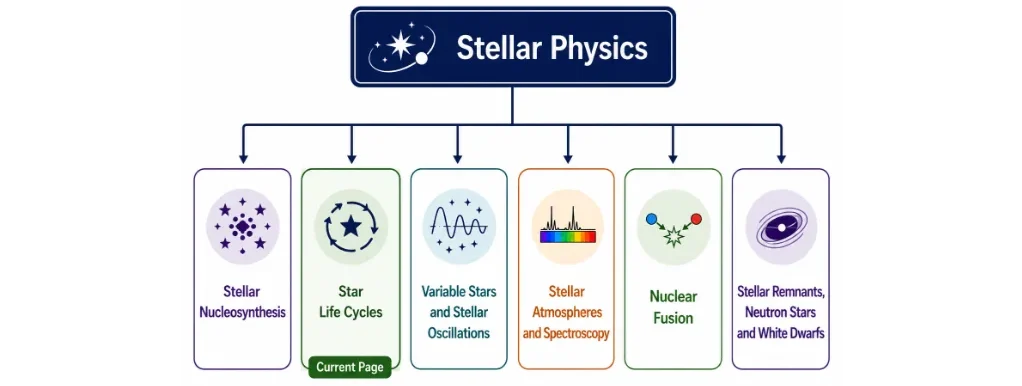
This structure chart presents Stellar Physics as the parent topic and shows its related child pages: Stellar Nucleosynthesis, Star Life Cycles, Variable Stars and Stellar Oscillations, Stellar Atmospheres and Spectroscopy, Nuclear Fusion, and Stellar Remnants Neutron Stars and White Dwarfs. Star Life Cycles is highlighted as the current page, helping students understand how stellar birth, development, and end stages fit within the broader Stellar Physics cluster.
Stellar Formation
Molecular Clouds and Gravitational Collapse
Protostar Formation and Accretion Dynamics
From Protostar to True Main-Sequence Star
Reflection: When Does a Star Truly Begin?
Main Sequence Stage
\[\frac{dP}{dr} = -\frac{G m(r)\rho(r)}{r^2}\]
Analytical Reflection: Why Do Massive Stars Live Shorter Lives?
Post-Main Sequence Evolution
Low- and Medium-Mass Stars
\[3\,^4\text{He} \rightarrow\, ^{12}\text{C} + \gamma + \text{energy}\]
Massive Stars
Analytical Reflection: Why Does Mass Change the Ending?
Stellar Death and Remnants
White Dwarfs
Neutron Stars
Black Holes
\[R_s = \frac{2GM}{c^2}\]
Quick Check: Match the Remnant to the Star
Stellar Life Cycle Summary by Mass
| Stellar Mass Allocation | Thermonuclear Evolutionary Pathway | Terminal Remnant Endpoint |
|---|---|---|
| Low-Mass Red Dwarfs \(0.08 \, M_{\odot} \rightarrow 0.5 \, M_{\odot}\) | Fully convective structure \(\rightarrow\) steady, conservative hydrogen burning via the p-p chain \(\rightarrow\) extremely prolonged main-sequence lifespan (\(\tau \approx 10^{11} \rightarrow 10^{12}\) years) without advanced alpha-capture ignition. | Helium white dwarf (Theoretical black dwarf endpoint far exceeding current cosmic age metrics). |
| Intermediate Intermediate Stars \(0.5 \, M_{\odot} \rightarrow 8 \, M_{\odot}\) | Main-sequence p-p chain burning \(\rightarrow\) shell hydrogen ignition \(\rightarrow\) red giant branch expansion \(\rightarrow\) core helium flash and triple-alpha process activation \(\rightarrow\) planetary nebula envelope ejection. | Carbon-Oxygen White Dwarf (Supported by electron degeneracy pressure; \(M \le 1.44 \, M_{\odot}\)). |
| High-Mass Massive Stars \(M \ge 8 \, M_{\odot}\) | Core ignition dominated by the CNO cycle \(\rightarrow\) highly luminous supergiant phase \(\rightarrow\) advanced exothermic onion-skin shell burning (C, Ne, O, Si) \(\rightarrow\) endothermic iron core formation \(\rightarrow\) Type II core-collapse supernova. | Neutron Star (Pulsar) or general relativistic Black Hole singularity. |
Analytical Reflection: Mass as the Master Variable
Scientific Importance of Stellar Life Cycles
Cosmic Chemical Enrichment
Galactic Evolution
Astrobiology and Planetary Habitability
Testing Extreme Physics Boundaries
Analytical Reflection: Why Do Star Life Cycles Matter Beyond Stars?
Why Study Star Life Cycles
Systematic Tracking of Stellar Evolution Stages
Coupling Stellar Birth with Protoplanetary Disks
Evaluating Fusion as a Long-Term Energy Equilibrium Engine
Analyzing Stellar Death and Cosmic Material Inversion
Validating Theoretical Physics Models via Observational Datasets
Analytical Reflection: What Does a Star’s Life Teach Us?
Frequently Asked Questions: Evolutionary Mechanics & Stellar Lifecycles
What is the formal definition of a star's evolutionary lifecycle?
A star's lifecycle is modeled as a deterministic, mass-dependent series of structural configurations governed by the changing balance between inward self-gravitation and outward pressure gradients. The track starts at the gravitational fragmentation of a cold molecular cloud, transitions through main-sequence core hydrogen burning, moves through post-main-sequence shell conversions, and concludes at a specific compact endpoint—an electron-degenerate white dwarf, a neutron star, or a general relativistic black hole singularity.
By what physical mechanisms does an interstellar gas cloud transition into an active star?
Stellar formation initiates when a region within a giant molecular cloud crosses the Jeans mass threshold, making gravitational collapse inevitable. As the core contracts, it shifts from an isothermal to an adiabatic collapse profile, trapping radiation and thermalizing its lost gravitational potential energy on a Kelvin-Helmholtz timescale to form a protostar. True stellar birth is achieved when central compression drives core temperatures past \(T \approx 10^7\,\text{K}\), enabling protons to cross the Coulomb barrier via quantum tunneling to ignite steady-state hydrogen fusion.
Why is a star's initial mass allocation designated as the absolute master variable of its lifecycle?
Initial mass establishes the absolute magnitude of the inward self-gravitational vector, which dictates the core pressure and temperature parameters required to sustain hydrostatic equilibrium. Mass determines whether a star utilizes the conservative proton-proton chain or the highly temperature-sensitive CNO cycle (\(\epsilon_{\text{CNO}} \propto T^{16}\)). This fixes the non-linear mass-luminosity scaling relationship (\(L \propto M^{3.5}\)), which pre-determines the star's fuel consumption rate, main-sequence longevity (\(\tau \propto M^{-2.5}\)), late-stage nucleosynthetic boundaries, and terminal compact remnant outcome.
What thermodynamic and mechanical states define the main-sequence phase?
The main sequence is the prolonged, steady-state phase during which a star maintains stable mechanical and thermal equilibrium by steadily fusing core hydrogen into helium-4. Hydrostatic equilibrium is preserved because the outward pressure gradient (\(\frac{dP}{dr}\)) matches the weight of overlying shells, while thermal equilibrium ensures the core nuclear energy generation rate matches the bolometric luminosity radiated at the photosphere. This phase represents the diagonal structural anchor of the Hertzsprung-Russell diagram.
What structural reconfigurations occur immediately following core hydrogen exhaustion?
When core hydrogen reserves are depleted, the loss of core thermal pressure disrupts hydrostatic equilibrium, causing the non-fusing helium core to contract under gravity. According to the virial theorem, half of the gravitational potential energy released by this contraction is converted into internal thermal kinetic energy, heating the central region. This thermal flux ignites a surrounding hydrogen shell-burning zone, generating an intense radiative pressure wave that forces the star's outer convective envelope to expand radially into a highly luminous, lower effective surface temperature red giant or supergiant configuration.
What quantum mechanical thresholds regulate whether a star collapses into a neutron star or a black hole?
Massive stars (\(M \ge 8 \, M_{\odot}\)) build an endothermic iron-56 core that lacks thermal pressure support, triggering a rapid Type II supernova core collapse. If the residual core mass sits below the Chandrasekhar mass limit (\(M_{\text{Ch}} \approx 1.44 \, M_{\odot}\)), electron degeneracy pressure halts collapse to yield a white dwarf. Above this threshold, electron capture transforms the core into degenerate neutron matter; if this residual structure remains below the Tolman-Oppenheimer-Volkoff limit (\(M_{\text{TOV}} \approx 2.2 \, M_{\odot}\)), it stabilizes as a neutron star. If the core mass exceeds the TOV limit, gravity overrides neutron degeneracy pressure, forcing a complete collapse past the Schwarzschild radius event horizon (\(R_s = \frac{2GM}{c^2}\)) to yield a black hole.
Why is mapping stellar lifecycles vital for analyzing galactic evolution and cosmology?
Stellar lifecycles act as the primary drivers of cosmic chemical evolution; they transmute primordial hydrogen and helium into the heavy elemental inventory (metallicity) required to construct rocky planets and biochemical systems via stellar nucleosynthesis and neutron-capture tracks (s-process and r-process). Furthermore, energetic feedback loops from stellar winds and supernova shockwaves regulate star formation rates within the interstellar medium, while stellar turn-off points in star clusters allow astrophysicists to determine galactic age scales and calibrate cosmological distance ladders.
Glossary of Key Evolutionary & Remnant Invariants
- Stellar Life Cycle
- The deterministic, mass-dependent evolutionary trajectory of a self-gravitating plasma configuration, mapping its progress from gravitational cloud fragmentation through main-sequence core burning and shell ignition to its terminal compact remnant outcome.
- Molecular Cloud
- A cold (\(T \approx 10 \rightarrow 30\,\text{K}\)), dense interstellar gas reservoir composed predominantly of molecular hydrogen (\(\text{H}_2\)) and sub-micron dust grains, serving as the raw mass allocation for Jeans instability fragmentation.
- Protostar
- A centrally condensed hydrodynamical core formed during early molecular cloud collapse that trapps infrared radiation to transition into an adiabatic state, drawing energy from Kelvin-Helmholtz gravitational contraction rather than nuclear fusion.
- Main Sequence
- The prolonged, steady-state evolutionary phase during which a star maintains stable mechanical and thermal equilibrium by steadily fusing core hydrogen reserves into helium-4.
- Hydrostatic Equilibrium
- The mechanical state where the inward vector of self-gravitation is exactly counterbalanced by the outward vector of gas and radiation pressure gradients throughout the stellar interior, satisfying the relation \(\frac{dP}{dr} = -\frac{G m \rho}{r^2}\).
- Red Giant
- An evolved, low- to intermediate-mass star (\(M \le 8 \, M_{\odot}\)) characterized by a contracting, non-fusing helium core surrounded by an intense, expanding hydrogen shell-burning zone that drives the outer envelope to expand radially.
- Supergiant
- A highly luminous post-main-sequence star (\(M \ge 8 \, M_{\odot}\)) whose extreme gravitational potential permits the sequential core ignition of advanced exothermic alpha-capture networks, forming a stratified internal shell architecture.
- Planetary Nebula
- An expanding, ionized shell of gas expelled via strong, radiation-driven stellar winds from an intermediate-mass star during late evolutionary phases, exposing the central hot core.
- White Dwarf
- A dense stellar remnant (\(\rho \approx 10^6\,\text{g/cm}^3\)) left behind by a low- or medium-mass star, supported against gravitational collapse by quantum electron degeneracy pressure up to the Chandrasekhar mass limit (\(M_{\text{Ch}} \approx 1.44 \, M_{\odot}\)).
- Neutron Star
- An ultra-dense remnant (\(\rho \approx 10^{14}\,\text{g/cm}^3\)) generated during a core-collapse supernova, where electron capture converts the core into degenerate neutron matter supported by neutron degeneracy pressure up to the Tolman-Oppenheimer-Volkoff limit (\(M_{\text{TOV}} \approx 2.2 \, M_{\odot}\)).
- Black Hole
- A terminal general relativistic singularity formed when a collapsing core exceeds the TOV mass limit, forcing complete gravitational collapse past the Schwarzschild radius event horizon threshold (\(R_s = \frac{2GM}{c^2}\)).
- Supernova
- A highly energetic cosmic explosion triggered by the endothermic core collapse of a massive star or the thermonuclear disruption of a white dwarf, driving element dispersion and neutron-capture nucleosynthesis.
Academic & Observational Resources
Summary & Essential Module Invariants
Academic Assessment: Review Invariants & Quantitative Inferences
- What are the primary stages of a star’s evolutionary lifecycle, and what physical metric governs its trajectory?Answer: Stellar evolution initiates with the gravitational fragmentation of a cold molecular cloud, transitions through an adiabatic protostellar phase, and achieves structural stability on the main sequence. Post-main-sequence evolution branches based on the system’s mass allocation, moving through giant or supergiant shell-burning phases before terminating at distinct high-density endpoints—either an electron-degenerate white dwarf, a neutron star, or a general relativistic black hole singularity. Initial mass serves as the master variable governing the entire trajectory.
- How does an interstellar molecular gas cloud transition mechanically into an active protostar?Answer: A star forms when a high-density pocket within a giant molecular cloud crosses the Jeans mass criteria (\(M_J \propto [T^3/\rho]^{1/2}\)), causing gravity to override internal gas and magnetic pressures. As the core contracts, it shifts from an isothermal state to an optically thick adiabatic profile, trapping radiation and thermalizing its lost gravitational potential energy on a Kelvin-Helmholtz timescale to form a warm, accreting protostar.
- What mechanical and thermodynamic conditions define the main-sequence phase?Answer: The main sequence is defined by the coexistence of hydrostatic and thermal equilibrium. Hydrostatic equilibrium ensures that the inward pull of self-gravitation is exactly matched by the outward vector of the internal gas and radiation pressure gradients (\(\frac{dP}{dr} = -\frac{G M \rho}{r^2}\)). Thermal equilibrium ensures that the total nuclear energy generation rate within the core matches the integrated bolometric luminosity radiated at the photosphere.
- By what mechanisms does the absolute mass tensor dictate a star’s evolutionary velocity?Answer: Mass determines the magnitude of the core compression needed to maintain hydrostatic stability. Higher mass concentrations generate steep pressure gradients and elevated central temperatures, driving a transition from the proton-proton chain to the highly temperature-sensitive CNO cycle (\(\epsilon_{\text{CNO}} \propto T^{16}\)). This drives a non-linear scaling in bolometric power (\(L \propto M^{3.5}\)), forcing massive stars to exhaust their nuclear repositories exponentially faster than low-mass stars (\(\tau \propto M^{-2.5}\)).
- What structural reconfigurations trigger the transition of a star into the red giant domain?Answer: Following core hydrogen depletion, the loss of thermal pressure support causes the non-fusing helium core to contract under gravity. According to the virial theorem, half of the released gravitational potential energy is converted into thermal kinetic energy, heating the central region. This extreme thermal flux ignites a surrounding hydrogen shell-burning zone, generating a massive radiative pressure wave that forces the outer convective envelope to expand radially, causing the effective surface temperature to drop into the red spectral domain.
- How do core-collapse supernovae mark the terminal phase of high-mass stellar evolution?Answer: Massive stars sequentially fuse elements up to iron-56, where the binding energy per nucleon curve peaks. Because transmuting iron-group nuclei is endothermic (\(\Delta E < 0\)), attempting to fuse iron strips kinetic energy from the core, causing an immediate drop in pressure support. The core undergoes catastrophic gravitational collapse, compressing the center to nuclear saturation densities and triggering a violent Type II supernova shockwave that ejects the outer envelopes while dispersing synthesized metals into the interstellar medium.
- What formal physics define a white dwarf, and how is its structure sustained?Answer: A white dwarf is a highly condensed, non-fusing compact remnant (\(\rho \approx 10^6\,\text{g/cm}^3\)) left behind after a low- to intermediate-mass star expels its outer envelope as a planetary nebula. Lacking a thermonuclear energy source, it slowly radiates its stored thermal energy over billions of years. It is supported against gravitational collapse by electron degeneracy pressure—a quantum mechanical pressure wave arising from the Pauli exclusion principle that prevents identical fermions from occupying the same quantum state up to the Chandrasekhar limit (\(M_{\text{Ch}} \approx 1.44 \, M_\odot\)).
- What physical properties define a neutron star, and how does it form?Answer: A neutron star forms when a massive star’s core collapse exceeds the Chandrasekhar mass limit, forcing electrons and protons to undergo electron capture (\(p + e^- \rightarrow n + \nu_e\)) to create degenerate neutron matter (\(\rho \approx 10^{14}\,\text{g/cm}^3\)). Supported by neutron degeneracy pressure up to the Tolman-Oppenheimer-Volkoff limit (\(M_{\text{TOV}} \approx 2.2 \, M_\odot\)), these objects conserve the progenitor’s angular momentum and magnetic flux, rotating rapidly to project collimated electromagnetic beams observed as pulsars.
- What role does nuclear fusion play throughout a star’s lifecycle?Answer: Nuclear fusion operates as the primary internal engine that counteracts gravitational collapse, generating the outward thermal and radiative pressure gradients mandatory to preserve hydrostatic equilibrium. Throughout successive evolutionary stages, these core and shell reaction networks act as the primary engines of cosmic chemical evolution, transmuting light primordial elements into advanced atomic species to build the periodic table.
- How do environmental boundaries and binary companion dynamics modulate a star’s lifecycle?Answer: Close stellar interactions and binary companions alter isolated evolutionary tracks by introducing Roche lobe overflow mass-transfer vectors, common envelope phases, and stellar mergers. These dynamics strip outer envelopes or inject fresh hydrogen reserves, altering the effective mass tensor of the star, shifting its position on the H-R diagram, and triggering exotic evolutionary outcomes such as Type Ia supernovae or blue straggler signatures.
High-Level Conceptual & Foundational Research Inquiries
- How do initial variations in giant molecular cloud density gradients and localized temperatures propagate to alter the initial mass function (IMF) of a stellar cluster?Answer: Giant molecular cloud density (\(\rho\)) and temperature (\(T\)) gradients determine the local spatial allocation of the Jeans mass (\(M_J \propto [T^3/\rho]^{1/2}\)). Higher densities and ultra-low temperatures suppress the Jeans mass threshold, driving the cloud to split into a large population of low-mass fragments. Conversely, elevated thermal profiles or magnetic field lines support the gas against early fragmentation, shifting the IMF toward massive protostars that accelerate the chemical evolution of the cluster.
- By what specific physical loops does the birth, main-sequence evolution, and catastrophic death of stars regulate the global structure and star-formation efficiency of a galaxy?Answer: Stellar evolution drives a continuous galactic feedback engine. High-mass stars project intense UV radiation fluxes and rapid stellar winds that inject mechanical energy into the interstellar medium (ISM), heating local gas pools and clearing away molecular clouds to suppress subsequent star birth. Conversely, the propagation of supernova shockwaves compresses low-density gas layers, forcing fragments past their Jeans mass thresholds to trigger new star-formation cycles, while continuously seeding the galaxy with heavy element opacities.
- How does the metallicity index (\(Z\)) of a stellar core modulate its internal radiative opacity, and how does this shift the main-sequence turn-off point of old star clusters?Answer: Elevated metallicity increases the number of bound-free and free-free electron transitions within the stellar plasma, driving a significant increase in internal radiative opacity (\(\kappa\)). This opacity spike slows down the rate of radiative diffusion, forcing the star to establish a larger convective zone to clear its internal energy flux. This alters the mass-luminosity scaling law, causing high-metallicity stars to burn through their core hydrogen allocations along modified timelines, which shifts the calculated turn-off point used to evaluate the age of globular clusters.
- What mathematical and physical degeneracies emerge when modeling late-stage convective overshooting and stellar mass loss, and how do they impact supernova timing predictions?Answer: Convective overshooting models the fluid momentum that carries material past the theoretical boundaries established by the Schwarzschild criterion, mixing unburned fuel into the active core. Estimating this mixing involves non-linear hydrodynamic equations that are difficult to simplify into one-dimensional codes. Uncertainties in calculating this mixing speed introduce significant errors when estimating the mass of the final non-fusing iron core, clouding our predictions of the exact timing, explosion mechanics, and elemental yields of Type II supernovae.
- By what exact magnetohydrodynamic and general relativistic processes do binary stellar interactions yield exotic high-energy phenomena like Type Ia supernovae and kilonovae?Answer: In close binary systems, an evolving star can fill its Roche lobe, initiating a continuous mass-transfer stream onto a degenerate companion. If a carbon-oxygen white dwarf accretes enough mass to cross the Chandrasekhar limit (\(1.44 \, M_\odot\)), the interior pressure triggers a carbon fusion blowout observed as a Type Ia supernova. In double neutron star binaries, gravitational wave emission drains orbital angular momentum, forcing a general relativistic inspiral that culminates in a kilonova merger, initiating rapid neutron-capture nucleosynthesis (r-process) to forge the heaviest elements.
- How can the spatial distribution, ionization states, and chemical metallicity profiles of supernova remnants be utilized to reconstruct the internal structure of the progenitor star?Answer: Supernova remnants expand as a reverse shockwave that captures the velocity and chemical layering of the exploded star. Mapping the spatial distribution and asymmetric expansion vectors of these filaments reveals the internal convection cells, rotation rates, and iron-core parameters present immediately prior to collapse. Concurrently, calculating the relative abundance profiles of silicon, sulfur, and iron-group isotopes via emission-line spectroscopy maps the exact temperatures and densities achieved during explosive nucleosynthesis.
- By what physical mechanisms does asteroseismology map internal density gradients and structural transitions across post-main-sequence stars?Answer: Asteroseismology measures pressure (p-modes) and gravity (g-modes) acoustic waves that propagate through the star’s interior. As these waves encounter internal composition boundaries, density gradients, or structural transitions, their propagation velocities change, altering the oscillation frequencies observed at the surface. Analyzing these frequency splittings allows astrophysicists to compute the size of the degenerate core, map internal rotation profiles, and track the exact position of active shell-burning zones.
- If the core collapse of a massive star yields a hypothetical quark star rather than a neutron star, what changes would be required in our models of the nuclear equation of state?Answer: Discovering a quark star would imply that at supra-nuclear saturation densities, the crushing gravitational pressure forces neutrons to dissolve into a plasma of deconfined up, down, and strange quarks. This would require replacing standard hadronic equations of state with quark-matter state equations, shifting the structural compressibility indices and redefining the absolute maximum mass limits allowed before a compact object must collapse into a general relativistic black hole.
- How do close gravitational encounters, three-body interactions, and stellar mergers in high-density globular clusters alter the evolutionary timelines of individual cluster populations?Answer: High-density stellar environments introduce frequent gravitational perturbations that can strip outer convective envelopes, interrupt steady-state shell burning, or capture companions into close binary systems. Direct physical collisions can fuse two low-mass main-sequence stars into a single, high-mass star. This creates an exotic stellar population known as blue stragglers, which display high surface temperatures and rapid rotation vectors that contradict the standard turn-off age of their host cluster.
- By what explicit physical pathways does the radiative and mechanical feedback of stellar lifecycles regulate the star-formation efficiency of a galaxy over cosmic timescales?Answer: Radiative feedback from young stars injects ionising photons that heat local gas reserves, increasing the sound speed and preventing the gas from collapsing past its Jeans mass threshold. On longer timescales, supernova explosions drive rapid expansions that sweep up gas into dense shells, triggering star birth where the shells collide, while driving galactic winds that blow pristine gas entirely out of the low-mass galactic potential well. This balances the star-formation efficiency over billions of years.
- How will next-generation space telescopes operating across the infrared, X-ray, and gravitational wave spectra revolutionize our empirical data on early protostellar evolution and compact object boundaries?Answer: Next-generation space hardware removes historical observational limitations. Ultra-sensitive infrared arrays penetrate the high dust opacities of molecular clouds to capture the thermodynamics of early protostellar accretion disks and jet channels. Concurrently, high-resolution X-ray tracking and gravitational wave interferometers map the physics of compact object horizons, tracking the actual dynamical behaviors of matter under extreme general relativistic constraints during inspiral and merger events.
- How does the long-term thermodynamic stability of a host star’s main-sequence phase influence the atmospheric retention and biochemistry potential of exoplanetary satellites?Answer: A stable main-sequence star provides a continuous, non-variable bolometric flux that establishes a stable circumstellar habitable zone where liquid water can persist. Concurrently, understanding late-stage stellar reconfigurations—such as red giant expansion profiles, planetary nebula shell shedding, and intense stellar flare activity—allows researchers to calculate the long-term survival limits of planetary atmospheres and biochemical systems.
Numerical Problems and Solutions: Mass Scaling, Thermodynamics, and Gravitational Potentials
- Problem: A main-sequence star possesses an initial mass allocation exactly 5 times that of the Sun (\(M = 5 \, M_\odot\)). Estimate its main-sequence lifetime (\(\tau\)) relative to the solar lifespan using the simplified nuclear fuel expenditure relation \(\tau \propto M^{-2.5}\) derived from the mass-luminosity scaling law.Solution: Substitute the mass parameter directly into the lifetime scaling equation:\[\frac{\tau}{\tau_\odot} = \left(\frac{M}{M_\odot}\right)^{-2.5} = (5)^{-2.5} = \frac{1}{5^{2.5}} = \frac{1}{25\sqrt{5}} \approx 0.0179\]
Answer: The massive star's main-sequence lifetime is approximately \(1.79\%\) (or \(\frac{1}{56}\)) of the Sun’s evolutionary lifespan. - Problem: Assuming the Sun’s total main-sequence stable lifespan is exactly \(\tau_\odot = 1.0 \times 10^{10}\,\text{years}\), calculate the absolute main-sequence lifetime of a intermediate-mass star possessing exactly twice the Sun’s mass inventory (\(M = 2 \, M_\odot\)) using the scaling relation \(\tau \propto M^{-2.5}\).Solution: Apply the scaling factor to the baseline solar lifecycle metrics:\[\tau = \tau_\odot \cdot \left(\frac{M}{M_\odot}\right)^{-2.5} = (1.0 \times 10^{10}\,\text{years}) \cdot (2)^{-2.5}\] \[\tau = \frac{1.0 \times 10^{10}}{4\sqrt{2}} \approx \frac{1.0 \times 10^{10}}{5.65685} \approx 1.7678 \times 10^9\,\text{years}\]
Answer: The expected main-sequence lifetime of the star is \(\tau \approx 1.77 \times 10^9\,\text{years}\). - Problem: A highly luminous blue supergiant star radiates energy at a steady-state bolometric power output of \(P = 1.0 \times 10^{28}\,\text{W}\). Calculate the total integrated energy yield in Joules emitted across an evolutionary span of exactly \(1.0 \times 10^7\,\text{years}\) (\(\Delta t \approx 3.1558 \times 10^{14}\,\text{s}\)).Solution: Compute the linear product of the bolometric luminosity and the total temporal duration:\[E = P \cdot \Delta t = (1.0 \times 10^{28}\,\text{J/s})(3.1558 \times 10^{14}\,\text{s})\] \[E \approx 3.1558 \times 10^{42}\,\text{J}\]
Answer: The aggregate energy emitted by the supergiant over the specified timeline equals \(E \approx 3.16 \times 10^{42}\,\text{J}\). - Problem: During its catastrophic post-main-sequence evolution and final core-collapse phase, a massive star converts a net mass allocation of exactly \(\Delta m = 1.0 \times 10^{17}\,\text{kg}\) of rest mass directly into pure radiative and kinetic energy. Calculate the total energy released using the vacuum speed of light constant \(c = 3.0 \times 10^8\,\text{m/s}\).Solution: Substitute the rest mass defect directly into Einstein's relativistic mass-energy equivalence equation:\[E = \Delta m c^2 = (1.0 \times 10^{17}\,\text{kg})(3.0 \times 10^8\,\text{m/s})^2\] \[E = (1.0 \times 10^{17})(9.0 \times 10^{16}\,\text{m}^2/\text{s}^2) = 9.0 \times 10^{33}\,\text{J}\]
Answer: The catastrophic mechanical collapse releases a total energy yield of \(E = 9.0 \times 10^{33}\,\text{J}\). - Problem: Following core hydrogen exhaustion, an intermediate-mass star expands radially by a factor of exactly 100 (\(R_{\text{giant}} = 100 \, R_{\text{initial}}\)) along its subgiant track. Calculate the resulting fractional change in the star's global surface area (\(A\)).Solution: Because a star behaves as a perfect sphere, its surface area tracks the square of its radius (\(A = 4\pi R^2\)):\[\frac{A_{\text{giant}}}{A_{\text{initial}}} = \left(\frac{R_{\text{giant}}}{R_{\text{initial}}}\right)^2 = (100)^2 = 10{,}000\]
Answer: The star's total surface area expands by a factor of exactly \(10{,}000\). - Problem: During the red giant transition, a star's radius increases by a factor of 100, while its effective surface temperature drops to exactly half of its original main-sequence value (\(T_{\text{giant}} = \frac{1}{2} T_{\text{initial}}\)). Calculate the fractional change in its bolometric luminosity (\(L\)) by applying the Stefan-Boltzmann radiation law.Solution: Set up the ratio using the spherical blackbody luminosity equation (\(L = 4\pi R^2 \sigma T^4\)):\[\frac{L_{\text{giant}}}{L_{\text{initial}}} = \left(\frac{R_{\text{giant}}}{R_{\text{initial}}}\right)^2 \cdot \left(\frac{T_{\text{giant}}}{T_{\text{initial}}}\right)^4\] \[\frac{L_{\text{giant}}}{L_{\text{initial}}} = (100)^2 \cdot \left(\frac{1}{2}\right)^4 = 10{,}000 \cdot \frac{1}{16} = 625\]
Answer: The star's bolometric luminosity expands by a factor of exactly 625 relative to its main-sequence baseline. - Problem: Calculate the approximate gravitational potential binding energy (\(U\)) of a stellar core configuration possessing a mass \(M = 2.0 \times 10^{30}\,\text{kg}\) and a radius \(R = 7.0 \times 10^8\,\text{m}\), applying the uniform-density gravitational tensor approximation \(U \approx \frac{GM^2}{R}\) (where \(G = 6.67 \times 10^{-11}\,\text{N}\cdot\text{m}^2/\text{kg}^2\)).Solution: Substitute the macroscopic physical parameters directly into the potential equation:\[U \approx \frac{(6.67 \times 10^{-11}\,\text{N}\cdot\text{m}^2/\text{kg}^2)(2.0 \times 10^{30}\,\text{kg})^2}{7.0 \times 10^8\,\text{m}}\] \[U \approx \frac{(6.67 \times 10^{-11})(4.0 \times 10^{60})}{7.0 \times 10^8} = \frac{2.668 \times 10^{50}}{7.0 \times 10^8} \approx 3.8114 \times 10^{41}\,\text{J}\]
Answer: The localized gravitational binding energy storing the configuration equals \(U \approx 3.81 \times 10^{41}\,\text{J}\). - Problem: From the perspective of the equations of stellar structure, explain why massive stars maintain significantly compressed evolutionary lifespans relative to low-mass stars, despite possessing a much larger mass repository of hydrogen fuel.Solution: High mass allocations generate extreme self-gravitational potential wells that demand steep outward pressure gradients (\(\frac{dP}{dr}\)) to prevent gravitational collapse. According to the ideal gas law, this requires the core to settle at extreme temperatures and densities. This thermal profile shifts the subatomic cross-sections away from the proton-proton chain and activates the highly temperature-sensitive CNO cycle (\(\epsilon_{\text{CNO}} \propto T^{16}\)), forcing the star's bolometric luminosity to scale non-linearly with mass (\(L \propto M^{3.5}\)).
Answer: The exponential acceleration in core fusion velocity far outpaces the linear increase in available fuel mass, causing massive stars to exhaust their energy reservoirs quickly. - Problem: During late post-main-sequence structural reconfigurations and asymptotic giant branch pulsations, an intermediate-mass star expels exactly \(20\%\) of its initial integrated mass tensor into the interstellar medium via radiation-driven stellar winds. Calculate the fraction of the initial mass allocation that remains confined within the core remnant.Solution: Evaluate the remaining mass allocation using standard linear fractions:\[M_{\text{remnant}} = M_{\text{initial}} \cdot (1.00 - 0.20) = 0.80 \cdot M_{\text{initial}}\]
Answer: Exactly \(80\%\) of the star's original mass inventory remains within the residual core structure.