
Analytical Reflection: Hydrostatic Feedback Loops and Fusion Regulation
1. Hydrostatic Compression: Inward gravitational forces generate an immense pressure gradient (\(\frac{dP}{dr}\)) that compresses the core plasma. According to the ideal gas law (\(P = \frac{\rho k_B T}{\mu m_H}\)), this compression raises the core temperature (\(T\)) and density (\(\rho\)).
2. Properties of the Nuclear Thermostat: The core nuclear energy generation coefficient (\(\epsilon\)) is highly sensitive to temperature due to the Maxwell-Boltzmann velocity distribution and quantum tunneling probabilities (where \(\epsilon_{p\text{-}p} \propto T^4\) and \(\epsilon_{\text{CNO}} \propto T^{16}\)). A minor gravitational contraction causes a sharp increase in the nuclear reaction rates, releasing an immense pulse of thermal kinetic energy.
3. Negative Feedback Expansion: This localized surge in energy increases the internal thermal pressure. When this outward pressure force exceeds the inward pull of gravity, it does mechanical expansion work on the core. The resulting expansion lowers the core density and temperature, which dampens the fusion rate. Conversely, if the core cools, pressure drops, gravity compresses the core, and the temperature rises to re-ignite fusion. This coupled balancing loop prevents runaway changes, stabilizing the star over long timescales.
Table of Contents

This structure chart presents Stellar Physics as the parent topic and shows its related child pages: Stellar Nucleosynthesis, Star Life Cycles, Variable Stars and Stellar Oscillations, Nuclear Fusion, Stellar Atmospheres and Spectroscopy, and Stellar Remnants Neutron Stars and White Dwarfs. Nuclear Fusion is highlighted as the current page, helping students understand how energy generation in stars fits within the broader Stellar Physics cluster.
Thermonuclear Dynamics: Micro-Macro Structural Coupling
Hydrostatic Stability Core
Balances the localized core energy generation rate \(\epsilon\) against the self-gravitational potential well to lock the star into long-term mechanical equilibrium, satisfying the condition \(\frac{dP}{dr} = -\frac{Gm\rho}{r^2}\).Mass-Luminosity Scaling
Establishes the radiative diffusion baseline where core energy production dictates total surface output, yielding the steep main-sequence scaling law \(L \propto M^{3.5}\) for intermediate-mass stars.H-R Diagram Lifespans
Governs the main-sequence lifetime parameter \(\tau \propto M^{-2.5}\) by tracking the exact rate at which core hydrogen inventories are transmuted into helium-4.Photospheric Boundaries
Drives the outward radiative temperature gradient \(\frac{dT}{dr}\), determining the effective surface temperature \(T_{\text{eff}}\) and continuous blackbody spectrum observed via astronomical spectroscopy.Structural Degeneracy Limits
Sets the mass limits where core thermal fusion ceases, dictating the transition to cold equations of state supported by Fermi-Dirac electron or neutron degeneracy pressures.Hydrodynamic Instability Valve
Regulates the thermal and opacity valves (such as the \(\kappa\)-mechanism) that trigger periodic acoustic pulsations when core energy output couples with high-ionization shell envelopes.Core Principles of Thermonuclear Fusion in Stars
The Micro-Physics of the Core: Overcoming the Coulomb Barrier
\[E = \Delta m c^2\]
Hydrogen Burning Networks in Main-Sequence Stars
\[4\,^1\text{H} \rightarrow\, ^4\text{He} + 2e^+ + 2\nu_e + 2\gamma + \text{energy}\]
Helium Burning and Advanced Thermonuclear Stages
\[3\,^4\text{He} \rightarrow\, ^{12}\text{C} + \gamma + \text{energy}\]
Hydrostatic Equilibrium and Evolutionary Tracks
Energy Transport and Observational Signatures
Analytical Reflection: Mass Constraints on Thermonuclear Lifetimes
1. Gravitational Boundary Calibration: A highly massive star establishes a massive self-gravitational potential well. To counter this intense inward vector and maintain hydrostatic equilibrium, the core must generate an immensely steep outward pressure gradient (\(\frac{dP}{dr}\)). According to the equation of state, this requires the core to reach significantly higher temperatures and densities than those found in lower-mass stars.
2. Nuclear Pathway Transition: While the lower-mass star relies on the p-p chain (\(\epsilon_{p\text{-}p} \propto T^4\)), the elevated core temperature of the massive star activates the highly temperature-sensitive CNO cycle (\(\epsilon_{\text{CNO}} \propto T^{16}\)). This shifts the micro-physical nuclear cross-sections, causing a rapid acceleration in the rate of thermonuclear fuel consumption.
3. The Mass-Luminosity Disparity: Because the massive star’s high-temperature core drives an intense radiative energy flux through the interior, its bolometric luminosity scales non-linearly to the third or fourth power of its mass (\(L \propto M^{3.5}\)). Consequently, even though the massive star possesses a larger absolute repository of hydrogen fuel, it expends this energy at an exponential rate. This dramatically shortens its main-sequence lifetime (\(\tau \propto M^{-2.5}\)) and rapidly drives the core to collapse and ignite advanced shell-burning stages.
Quantum Kinetics: The Gamow Peak Window and Thermonuclear Reaction Rates
- The Maxwell-Boltzmann Distribution: Dictates the population density of high-energy particles capable of reacting. The probability of finding particles with high kinetic energies decreases exponentially as $e^{-E / k_B T}$.
- The Quantum Tunneling Probability: Governed by the Gamow factor, which dictates the probability of an ion penetrating the electrostatic barrier. Because the barrier is wider and taller at lower kinetic energies, the tunneling probability drops off exponentially at low energies as $e^{-b / E^{1/2}}$, where $b$ is a constant incorporating the charges and reduced mass of the reacting ions.
\[\text{Reaction Probability Density} \propto \exp\left( -\frac{E}{k_B T} – \frac{b}{E^{1/2}} \right)\]
| Mathematical Term | Physical Parameter | Astrophysical Interpretation |
|---|---|---|
| \(e^{-E / k_B T}\) | Maxwell-Boltzmann Tail | Restricts the number of high-velocity ions available to react within the high-temperature core plasma. |
| \(e^{-b / E^{1/2}}\) | Gamow Factor (Penetration) | Determines the quantum mechanics transmission coefficient past the electrostatic barrier as a function of incoming momentum. |
| \(E_0 = \left(\frac{b k_B T}{2}\right)^{2/3}\) | Gamow Peak Optimum (\(E_0\)) | Identifies the absolute maximum cross-section channel where the product of the tail density and tunneling rate is maximized. |
Analytical Reflection: The Exponent Sensitivity of Reaction Cross-Sections
Suggested Analytical Response: The transition between these fusion networks is a direct mathematical consequence of how charge modifications affect the positioning of the Gamow Peak:
1. Barrier Intensification: The constant $b$ in the tunneling equation is directly proportional to the product of the charges ($b \propto Z_1 Z_2$). While the p-p chain involves single protons ($Z=1$), the CNO cycle requires protons to interact with carbon ($Z=6$). This sixfold increase in the charge product dramatically scales the height and width of the Coulomb barrier.
2. Thermal Elevation: To compensate for the massive drop in tunneling probability caused by a higher value of $b$, the incoming particles must possess significantly higher kinetic energies. Mathematically, the peak energy optimum $E_0 = (b k_B T / 2)^{2/3}$ is forced to migrate to a significantly higher energy channel. This channel can only be populated if the core temperature $T$ rises substantially.
3. Extreme Temperature Sensitivity: Because the CNO cycle’s Gamow Peak resides deep in the high-energy tail of the Maxwell-Boltzmann distribution, a minor modification in core temperature yields an immense fractional change in the number of reacting particles. This causes the nuclear energy coefficient to scale exponentially ($\epsilon \propto T^{16}$). Consequently, high-mass stars feature highly concentrated, convective cores that burn fuel at extreme speeds to balance their intense gravitational potential wells.
Astrophysical Confinement vs. Terrestrial Plasma Engineering
\[^2\text{H} + {}^3\text{H} \rightarrow \, ^4\text{He} + n + 17.6\,\text{MeV}\]
Analytical Reflection: Gravitational Scale vs. Engineered Confinement Density
Suggested Analytical Response: The stark divergence in operating parameters is a direct mathematical consequence of the Lawson criterion, which states that for a fusion reactor to achieve ignition, the product of plasma particle density (\(n\)), energy confinement time (\(\tau_E\)), and plasma temperature (\(T\)) must cross a specific threshold:
1. Stellar Gravitational Invariant: The Sun possesses an immense gravitational potential well that confines core particles indefinitely, yielding a massive confinement time metric (\(\tau_E \sim 10^{10}\,\text{years}\)). Because \(\tau_E\) is so vast, the Lawson product is easily satisfied despite the fact that the p-p chain has an exceptionally low reaction cross-section and operates at a relatively low core temperature (\(1.5 \times 10^7\,\text{K}\)).
2. Terrestrial Magnetic Constraints: In laboratory magnetic confinement devices (tokamaks), structural engineering limits restrict the maximum magnetic field strength (\(B\)). Because plasma pressure is bounded by magnetic pressure (\(P_{\text{plasma}} \propto B^2\)), the maximum achievable plasma density is structurally limited to a near-vacuum state (\(n \sim 10^{14}\,\text{particles/cm}^3\)), which is orders of magnitude less dense than the solar core. Furthermore, turbulent transport limits the laboratory energy confinement time to mere seconds (\(\tau_E \sim 1-2\,\text{s}\)).
3. Thermodynamic Compensation: To compensate for these drastically lower values of density (\(n\)) and confinement time (\(\tau_E\)), terrestrial engineers must modify the remaining variables of the Lawson criterion. They substitute hydrogen for the D-T network, which features a reaction cross-section five orders of magnitude larger than the p-p chain, and elevate the operating plasma temperature to \(T \approx 10^8\,\text{K}\) (nearly ten times hotter than the center of the Sun). This intense thermal energy is mandatory to drive high collision velocities and maximize the fusion reaction rate within tightly constrained laboratory dimensions.
Energy Release Kinetics Through Stellar Nuclear Fusion
\[E = \Delta m c^2\]
\[4\,^1\text{H} \rightarrow\, ^4\text{He} + 2e^+ + 2\nu_e + 2\gamma + \text{energy}\]
\[\frac{dP}{dr} = -\frac{G m(r)\rho(r)}{r^2}\]
\[L_\odot \approx 3.828 \times 10^{26} \, \text{W}\]
Analytical Reflection: Quantitative Inferences on Relativistic Mass Conversion
Suggested Analytical Response: The transition from subatomic mass deficits to macroscopic stellar luminosity is driven by two primary physical factors:
1. The Relativistic Scaling Factor: Although the mass deficit (\(\Delta m\)) per reaction is exceptionally small on an atomic scale, the conversion factor is the square of the speed of light (\(c^2 \approx 9 \times 10^{16}\,\text{m}^2/\text{s}^2\)). This massive multiplier ensures that even a micro-scale loss of rest mass yields a highly concentrated pulse of kinetic energy.
2. Core Particle Density Scales: The total energy output is an integrated sum over a vast number of active particles. The core of a star like the Sun contains an immense repository of hydrogen nuclei operating at extreme densities (\(\rho \approx 150\,\text{g/cm}^3\)) and thermal velocities. The high collision frequency ensures that approximately \(3.7 \times 10^{38}\) protons are converted into helium-4 every second. When this immense reaction frequency is multiplied by the energy yield per reaction, the resulting integrated power matches the macroscopic bolometric luminosity observed at the star’s surface.
Cosmic Chemical Evolution and Thermonuclear Transmutation Networks
Analytical Reflection: Quantitative Inferences on Binding Energy per Nucleon
1. The Iron-Peak Energetic Limit: The curve of binding energy per nucleon tracks a steep upward trajectory for light elements, peaking at iron-56 (\(\approx 8.8\,\text{MeV/nucleon}\)). For elements lighter than iron, combining nuclei increases the binding energy per nucleon, creating a mass deficit that is converted into an outward thermal energy flux. At iron-56, the strong nuclear force attraction matches the electrostatic Coulomb repulsion perfectly, maximizing stability and preventing any further exothermic fusion.
2. Thermodynamic Instability: When silicon burning builds an iron-56 core, any further fusion attempts become endothermic, absorbing kinetic energy from the core plasma instead of releasing it. Deprived of a continuous thermal energy source to counter gravity, the core temperature can no longer maintain the outward pressure gradient needed for hydrostatic equilibrium. This causes the iron core to undergo rapid gravitational collapse.
3. Neutron Capture Activation: The resulting gravitational collapse compresses the core past nuclear saturation densities, triggering electron capture (\(p + e^- \rightarrow n + \nu_e\)) that transforms the core into degenerate neutron matter. The violent shockwave of the surrounding supernova explosion releases an intense flux of free neutrons. This environment bypasses Coulomb repulsion entirely, driving the rapid neutron-capture process (r-process) that builds the heaviest elements in the cosmic inventory.
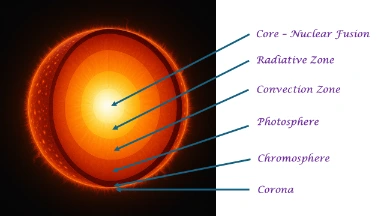
Internal Hydrodynamic Stratification: From Thermonuclear Core to Corona
Analytical Reflection: Radiative Diffusion Timelines vs. Photospheric Decoupling
1. The Random-Walk Mechanism: High-energy gamma photons generated by the p-p chain operate in a state of extreme density (\(\rho \approx 150\,\text{g/cm}^3\)), meaning the mean free path (\(\ell\))—the average distance a photon travels before colliding with a free electron—is fractionally small (\(\ell \approx 0.1 \rightarrow 1\,\text{mm}\ विस्त\)). The photon is scattered in an arbitrary direction after each collision. According to statistical mechanics, the total net displacement (\(d\)) after \(N\) steps scales as \(d = \ell \sqrt{N}\). To cover the vast radius of the radiative zone, a photon must undergo roughly \(10^{24}\) scattering events, stretching the net travel timeline over thousands of years.
2. Thermal Degradation: The interior plasma is not transparent; it is in a state of local thermodynamic equilibrium (LTE). As the photon random-walks through progressively cooler layers, it is continually absorbed and re-emitted by the plasma. This process re-thermalizes the energy, shifting the peak emission wavelength toward lower frequencies according to Wien’s displacement law (\(\lambda_{\text{max}} \propto T^{-1}\)).
3. Photospheric Decoupling: As density drops near the surface, the mean free path expands toward infinity, causing the optical depth (\(\tau\)) to fall below unity. At this boundary, the photon experiences its final scattering event, decouples from the plasma fluid, and escapes into space as visible light reflecting the local temperature profile (\(T_{\text{eff}} \approx 5778\,\text{K}\)).
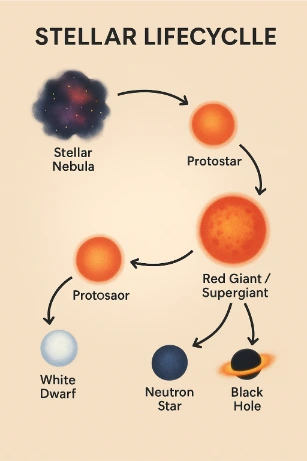
Thermonuclear Control of Evolutionary Pathways
Analytical Reflection: The Virial Paradox of Post-Main-Sequence Contraction
Suggested Analytical Response: The simultaneous core contraction and envelope expansion (the “mirror principle”) is driven by the virial theorem and the ignition of shell burning:
1. The Virial Core Heating Loop: When core hydrogen fusion ceases, the outward thermal pressure drop allows gravity to compress the helium core. According to the virial theorem, half of the gravitational potential energy released by this contraction must be converted into internal thermal kinetic energy (\(\langle K \rangle \propto -\frac{1}{2}\langle U \rangle\)). Consequently, the non-fusing core actually gets significantly hotter as it contracts.
2. Shell Burning Ignition: The extreme thermal energy escaping from the contracting core heats the unburned hydrogen shell immediately surrounding it. This shell crosses the quantum tunneling thresholds and ignites hydrogen fusion. Because this shell rests on a highly condensed core, it undergoes intense compression, causing its nuclear energy generation rate (\(\epsilon\)) to soar.
3. Envelope Expansion: The massive energy flux generated by this active hydrogen shell pushes outward against the surrounding convective envelope. To transport this immense radiative load while maintaining structural stability, the outer layers must expand radially. This expansion increases the star’s surface area, allowing it to radiate the surplus luminosity while causing the effective surface temperature to drop, shifting the star along its evolutionary track into the red giant domain.
The Curricular Significance of Thermonuclear Dynamics
Core Energy Source and Structural Stabilization
Nuclear fusion operates as the primary thermodynamic engine powering stellar systems, converting microscopic rest mass deficits directly into macroscopic bolometric luminosity. Students analyze the mechanical coupling between core energy generation rates and the equations of stellar structure, evaluating how thermal energy flux counters self-gravitation. Mastering this relationship forms the mathematical foundation for predicting stellar lifespans, structural changes, and the fundamental energy balances of the universe.
Astrophysical Foundations of Terrestrial Fusion Engineering
Resolving the physical mechanisms of natural gravitational confinement provides critical insights for replicating controlled nuclear fusion on Earth. Students explore how the Lawson criterion applies differently across solar environments and engineered laboratory systems, evaluating the fluid instabilities and material constraints found in tokamaks, stellarators, and laser-driven inertial confinement arrays. This analysis directly connects theoretical astrophysics with cutting-edge plasma engineering and global sustainability innovation.
Thermonuclear Transmutation and Cosmic Enrichment
Stellar cores function as the primary element factories of the cosmos, driving the chemical evolution of the universe through systematic nucleosynthesis networks. Students track the quantum mechanical pathways that build the periodic table, from steady-state alpha-capture processes up to explosive endothermic neutron-capture tracks. This framework provides the quantitative explanation for the cosmic origin of matter, bridging subatomic physics with planetary chemistry and astrobiology.
Non-Linear Fusion Dynamics and Compact Remnant Evolution
Students evaluate how highly temperature-sensitive nuclear reaction rates (\(\epsilon_{p\text{-}p} \propto T^4\) vs. \(\epsilon_{\text{CNO}} \propto T^{16}\)) regulate stellar lifetimes, internal density gradients, and evolutionary tracks across the Hertzsprung-Russell diagram. Modeling the breakdown of these fusion networks allows students to mathematically predict late-stage structural reconfigurations, including catastrophic core-collapse supernovae, electron-degenerate white dwarf boundaries, and general-relativistic singularities.
Systems Modeling and High-Energy Physics Competencies
Analyzing stellar fusion develops advanced competencies in solving coupled differential equations, boundary value problems, and multi-scale systems modeling. These quantitative analytical skills are directly transferable across plasma physics, aerospace engineering, quantum research, and advanced technological industries, equipping students with the tools needed to address high-level scientific and global energy challenges.
Glossary of Key Thermonuclear & Hydrodynamic Invariants
- Nuclear Fusion
- The process by which light atomic nuclei overcome their mutual repulsive Coulomb barriers via quantum tunneling to synthesize heavier nuclei, converting a localized rest mass deficit (\(\Delta m\)) directly into thermal, kinetic, and radiative energy according to the relativistic relation \(E = \Delta m c^2\).
- Stellar Core
- The high-density, high-temperature central shell of a star bounded by localized thermodynamic thresholds where the particle kinetic energies are sufficient to sustain core thermonuclear fusion networks.
- Proton-Proton Chain
- The dominant hydrogen fusion network operating in lower-mass main-sequence stars (\(M \le 1.3 \, M_\odot\)), which transutes four protons step-by-step into a single stable helium-4 nucleus while generating positrons, electron neutrinos, and gamma-ray photons.
- CNO Cycle
- A highly temperature-sensitive hydrogen fusion network (\(\epsilon_{\text{CNO}} \propto T^{16}\)) that dominates in massive stars (\(M \ge 1.3 \, M_\odot\)), utilizing primordial carbon, nitrogen, and oxygen isotopes as catalytic nuclei to accelerate the synthesis of helium-4.
- Hydrogen Burning
- The prolonged main-sequence thermonuclear phase during which a star sustains hydrostatic equilibrium by fusing its core hydrogen reserves into helium-4, establishing the primary energy baseline of its lifecycle.
- Helium Burning
- An advanced post-main-sequence evolutionary phase triggered when core contraction elevates central temperatures to \(T \approx 10^8\,\text{K}\), enabling alpha particles to cross the increased Coulomb barriers required to synthesize carbon and oxygen.
- Triple-Alpha Process
- The primary thermonuclear network of helium burning, where three helium-4 particles fuse via a highly short-lived, unstable beryllium-8 intermediate configuration to synthesize stable carbon-12 via the Hoyle state resonance.
- Stellar Nucleosynthesis
- The multi-scale nuclear transmutation network inside stars responsible for building the periodic table, utilizing exothermic fusion chains to generate elements up to the iron group and endothermic neutron-capture tracks to synthesize heavier species.
- Radiation Pressure
- The outward mechanical pressure vector exerted by the momentum flux of photons diffusing through stellar plasma, acting alongside gas pressure to balance the inward pull of self-gravitation.
- Main Sequence
- The prolonged, steady-state evolutionary configuration during which a star maintains stable hydrostatic and thermal equilibrium by steadily fusing core hydrogen into helium.
- Iron Fusion Limit
- The absolute thermodynamic cutoff for exothermic nuclear fusion dictated by the peak of the binding energy per nucleon curve at iron-56, where further transmutation transitions from exothermic (\(\Delta E > 0\)) to endothermic (\(\Delta E < 0\)), triggering core collapse.
- Neutrino
- A nearly massless, weakly interacting lepton emitted during core beta-plus decay steps in fusion networks, escaping the stellar interior without scattering to provide an unattenuated real-time probe of core thermonuclear activity.
Academic & Observational Resources
Summary & Essential Module Invariants
Frequently Asked Questions: Thermonuclear Mechanics & Stellar Dynamics
What is the formal definition of nuclear fusion within stellar physics?
In stellar physics, nuclear fusion is modeled as the process by which light atomic nuclei overcome their mutual Coulomb repulsion via quantum tunneling to synthesize heavier nuclear structures. This localized conversion of a rest mass deficit (\(\Delta m\)) directly into kinetic and radiative energy serves as the primary engine driving macroscale stellar luminosity and structural stabilization.
By what mechanical process does nuclear fusion produce a star's structural luminosity?
Fusion converts rest mass into energy according to Einstein's relativistic relation \(E = \Delta m c^2\). In main-sequence stars like the Sun, four protons fuse into a single helium-4 nucleus, yielding a rest mass deficit of exactly \(0.7\%\). This liberated mass deficit is converted into gamma-ray photons (\(\gamma\)), positrons (\(e^+\)), and electron neutrinos (\(\nu_e\)), establishing the radiative diffusion flux that supports the star before escaping the photosphere as bolometric starlight.
What precise thermodynamic conditions are mandatory to ignite core nuclear fusion?
Ignition requires extreme central core temperatures (\(T \ge 10^7\,\text{K}\)) and immense gravitational pressures. These parameters establish high thermal kinetic energy states within the stellar plasma, populated by the high-velocity tails of the Maxwell-Boltzmann distribution. This energy profile allows colliding ions to penetrate the electrostatic Coulomb barrier via quantum tunneling, bringing them within range (\(r \approx 10^{-15}\,\text{m}\)) of the attractive short-range strong nuclear force.
How do core thermonuclear pathways vary between different stellar masses?
In lower-mass main-sequence configurations (\(M \le 1.3 \, M_\odot\)), energy generation is dominated by the step-by-step proton-proton (p-p) chain. In more massive stellar interiors characterized by higher central temperatures, the highly temperature-sensitive Carbon-Nitrogen-Oxygen (CNO) cycle takes over (\(\epsilon_{\text{CNO}} \propto T^{16}\)), using primordial carbon isotopes as catalytic agents to accelerate hydrogen fusion. Post-main-sequence stages ignite successive shell-burning layers (helium, carbon, neon, oxygen, silicon) depending on the initial mass parameter.
What distinguishes the energetics of stellar fusion from terrestrial nuclear fission?
Nuclear fusion combines light nuclei to form tighter, heavier configurations, releasing energy because the product nucleus sits lower on the binding energy per nucleon curve (below the iron-56 peak). Conversely, nuclear fission splits heavy, unstable isotopes (such as uranium-235) into mid-mass fragments, exploiting the declining binding energy slope at high mass numbers. While fusion naturally anchors stellar engines, fission remains the primary mode for artificial nuclear power generation on Earth.
How do shifting thermonuclear networks drive the macroscale evolution of a star?
When core hydrogen is depleted, the localized drop in thermal pressure disrupts hydrostatic equilibrium, causing the core to contract under gravity and heat up. According to the virial theorem, this contraction converts gravitational potential energy into thermal kinetic energy, igniting surrounding shell-burning zones that push the star's outer convective envelope into red giant or supergiant configurations. The mass-dependent limits of these successive burning stages dictate terminal compact remnants, including white dwarfs, neutron stars, or general-relativistic singularities.
How does stellar fusion explain the observed chemical abundance indices of the universe?
Stellar cores operate as the primary element factories of the cosmos through systematic nucleosynthesis networks. Exothermic fusion chains build the chemical inventory up to the iron-56 peak, which marks the absolute thermodynamic cutoff for exothermic transmutation. Elements heavier than the iron group are synthesized via non-fusion slow and rapid neutron-capture processes (s-process and r-process) during late-stage shell burning, supernova shockwave expansions, and binary neutron star mergers, seeding the matter that structures planets and biochemical environments.
Why does mastering stellar fusion mechanics serve as essential preparation for university STEM paths?
Analyzing stellar fusion requires students to synthesize multivariable calculus, boundary value differential equations, quantum tunneling kinetics, and fluid mechanics. Developing these models equips university-bound students with the complex systems-modeling, data inversion, and quantitative competencies mandatory for advanced paths in physics, plasma engineering, space science, and quantitative research fields.
Academic Assessment: Review Invariants & Quantitative Inferences
- What is the formal definition of nuclear fusion, and why does it function as the primary structural stabilizer within stellar interiors?Answer: Nuclear fusion is the process by which light atomic nuclei overcome their mutual repulsive Coulomb barriers via quantum tunneling to synthesize heavier nuclear structures. It acts as the primary stabilizer by converting a rest mass deficit (\(\Delta m\)) directly into a vast outward thermal and radiative pressure gradient that exactly counterbalances the inward vector of self-gravitation, preserving hydrostatic equilibrium.
- What localized thermodynamic conditions dictate the spatial boundaries of an active stellar core?Answer: Active core boundaries are defined by the extreme central temperatures (\(T \ge 10^7\,\text{K}\)) and high particle densities necessary to populate the high-velocity tails of the Maxwell-Boltzmann distribution. These parameters provide colliding ions with the kinetic vectors needed to achieve high-frequency quantum tunneling past mutual electrostatic repulsion fields.
- By what mechanical steps does the proton-proton (p-p) chain reaction operate in lower-mass stars like the Sun?Answer: The p-p chain is a multi-branch thermonuclear network where four isolated protons are systematically transmuted into a single stable helium-4 (\(^4\text{He}\)) nucleus. The network initiates with the weak-force mediated fusion of two protons into deuterium (\(^2\text{H}\)), which captures an additional proton to synthesize helium-3 (\(^3\text{He}\)), ultimately concluding via branches like \(\text{pp-I}\) (\(^3\text{He} + {}^3\text{He} \rightarrow {}^4\text{He} + 2p\)) to release a net energy yield of \(26.7\,\text{MeV}\) per completed cycle.
- What thermodynamic parameters distinguish the Carbon-Nitrogen-Oxygen (CNO) cycle from the proton-proton chain?Answer: While the p-p chain relies on direct proton-proton scattering and scales moderately with temperature (\(\epsilon_{p\text{-}p} \propto T^4\)), the CNO cycle utilizes primordial carbon isotopes as catalytic agents to accelerate hydrogen fusion. The CNO cycle requires higher ignition thresholds and displays an exponential temperature dependency (\(\epsilon_{\text{CNO}} \propto T^{16}\)), causing it to dictate energy production in massive stellar interiors (\(M \ge 1.3 \, M_\odot\)).
- How does the mechanism of quantum mechanical tunneling bypass classical physics limits during stellar fusion?Answer: Under classical mechanics, the thermal kinetic energy within a star’s core is insufficient to overcome the electrostatic repulsion—the Coulomb barrier—of approaching protons. Quantum tunneling resolves this degeneracy by treating ions as wavepackets with a finite probability amplitude of penetrating the repulsive potential barrier, allowing the short-range strong nuclear force to dominate at significantly lower temperatures.
- By what specific mechanism does the energy yield of core fusion counteract macroscale gravitational collapse?Answer: The energy released by core thermonuclear networks generates a continuous outward radiative and gas pressure flux. This creates a spatial pressure gradient (\(\frac{dP}{dr}\)) that exactly matches the localized weight of overlying shell layers, satisfying the fundamental equation of hydrostatic equilibrium and preventing gravitational collapse.
- What is the triple-alpha process, and why does it represent a critical transition point in post-main-sequence evolution?Answer: The triple-alpha process is an advanced thermonuclear network where three helium-4 particles fuse via a highly short-lived, unstable beryllium-8 intermediate configuration to synthesize stable carbon-12 via the Hoyle state resonance. It marks the transition where a star, having exhausted its core hydrogen, undergoes gravitational contraction to ignite helium burning, initiating red giant or supergiant evolutionary phases.
- How do variations in thermonuclear energy generation rates regulate a star’s evolutionary lifespan?Answer: The energy generation rate per unit mass (\(\epsilon\)) controls the consumption velocity of the core’s fuel inventory. Higher energy generation rates drive a non-linear spike in bolometric luminosity (\(L \propto M^{3.5}\)), causing massive stars to exhaust their nuclear reserves exponentially faster and shortening their main-sequence lifespans relative to low-mass stars.
- Why does the absolute mass parameter dictate whether a star relies on the p-p chain or the CNO cycle?Answer: Initial stellar mass establishes the absolute scale of the self-gravitational potential well. Higher mass concentrations generate steeper internal pressure gradients that compress and heat the core, elevating central temperatures past the \(T \approx 1.5 \times 10^7\,\text{K}\) threshold where the CNO cycle’s exponential temperature scaling outpaces the p-p chain.
- How does steady-state and explosive stellar fusion drive the global chemical evolution of the universe?Answer: Exothermic stellar fusion networks systematically transmute light primordial gas into heavier elemental species up to the iron-56 peak. Subsequent catastrophic events, such as core-collapse supernovae and compact object mergers, deploy neutron-capture networks (s-process and r-process) to synthesize the heaviest elements, distributing this enriched material back into the interstellar medium via explosive shockwaves.
High-Level Conceptual & Foundational Research Inquiries
- How could advanced modeling of plasma turbulence and non-ideal magnetohydrodynamics redefine our quantitative metrics of core stellar fusion?Answer: Resolving plasma turbulence, magnetic reconnection loops, and non-ideal MHD interactions within high-density stellar interiors would eliminate historical degeneracies in tracking localized heat and composition transport. Refining these fluid mechanics models allows physicists to accurately map particle diffusion vectors, breaking down uncertainties in how localized turbulence modulates the effective reaction cross-sections and energy transport timelines inside active cores.
- By what specific physical metrics can data from terrestrial magnetic and inertial confinement fusion reactors be used to validate stellar core models?Answer: Laboratory plasma devices supply direct empirical measurements for high-temperature plasma state equations, radiative opacities, and magnetohydrodynamic fluid instabilities under extreme pressure constraints. Resolving the scaling parameters of terrestrial ignition—such as the Lawson criterion thresholds achieved via laser-driven ablation or helical magnetic fields—allows astrophysicists to calibrate theoretical cross-sections and verify the non-linear fluid codes used to simulate stellar interiors.
- Why does an accurate configuration of stellar evolutionary tracks require modeling the core’s sensitivity to minute variations in the nuclear cross-section index?Answer: Because core thermonuclear pathways display exponential sensitivities to temperature (especially the CNO cycle, \(\epsilon_{\text{CNO}} \propto T^{16}\)), a minor deviation in the subatomic cross-section index profoundly shifts the integrated energy flux. This shift alters the core’s expansion scaling laws, accelerating or delaying fuel consumption timelines and changing the spatial boundaries where shell-burning zones ignite across cosmic time.
- How do the extreme density and pressure regimes of self-gravitating stellar cores function as unique testing grounds for physics beyond the Standard Model?Answer: Stellar interiors compress ionized plasma to densities and thermodynamic scales completely unreachable by terrestrial accelerator hardware. Auditing these environments allows physicists to test quantum mechanical limits, search for hypothetical light particles like axions, and constrain neutrino oscillation parameters by analyzing how unattenuated particle fluxes escape from the core.
- What subatomic phenomena dictate the structure of the Gamow peak window, and how do they optimize thermonuclear yields inside stellar interiors?Answer: The Gamow peak window is the mathematical product of two competing exponential functions: the Maxwell-Boltzmann energy distribution, which drops off at high particle energies, and the quantum mechanical tunneling probability, which drops off at low particle energies. The overlapping region forms a highly constrained energy window that dictates the effective reaction cross-section, optimizing the fusion yield by selecting the precise energy channel where tunneling can successfully occur.
- How does transitioning from one-dimensional mixing-length models to three-dimensional hydrodynamic simulations advance our understanding of core-envelope energy transport?Answer: One-dimensional models rely on simplified geometric approximations that smooth out turbulent fluid structures and convective boundary overshooting. Advancing to three-dimensional simulations allows astrophysicists to capture non-linear fluid dynamics, multi-scale vorticity, and localized shear profiles. This resolves the true physical mechanisms driving composition mixing and thermal transport across the radiative-convective boundary interface.
- By what precise nucleosynthetic pathways do post-main-sequence stellar interiors act as the primary engines of galactic chemical enrichment?Answer: Late-stage stellar interiors run successive alpha-capture networks that generate carbon, oxygen, neon, magnesium, and silicon, terminating at the iron-56 peak. The combination of convective dredging—which shifts these metals to the outer envelopes—with mass-loss winds and violent supernova shockwaves ensures these forged atomic species are projected into the interstellar medium, continuously transforming the chemical architecture of subsequent stellar and planetary generations.
- How would the empirical discovery of a minor, alternative light-element fusion pathway alter our calibrations of stellar core lifetimes?Answer: Identifying an alternative, active nuclear pathway would introduce a parallel energy-generation coefficient to the global equations of stellar structure. This alternative thermal source would alter the core’s temperature-pressure scaling laws, modifying the consumption rate of the primary hydrogen fuel repository and forcing a systematic recalibration of main-sequence lifespans and cluster age determinations.
- Why does the iron-56 binding energy peak establish an absolute thermodynamic barrier that controls the onset of core-collapse supernovae?Answer: Iron-56 represents the maximum structural stability configuration on the binding energy per nucleon curve, meaning any subsequent transmutation to heavier elements is strictly endothermic (\(\Delta E < 0\)). When a massive star builds an iron core, attempting to fuse these nuclei strips thermal kinetic energy from the plasma rather than releasing it, causing an immediate drop in core pressure that triggers a catastrophic, general-relativistic core collapse.
- How does multi-messenger astronomy—integrating electromagnetic, neutrino, and gravitational wave datasets—break deep degeneracies when mapping stellar core mechanics?Answer: While electromagnetic observations are bounded by the high optical opacities of the photosphere, real-time neutrino detection captures unattenuated particles directly from active core reactions, providing a clear map of current fusion rates. Combining this data with the gravitational wave signatures generated by macroscale mass movements during core collapse allows astronomers to construct a complete, multi-dimensional map of the physics governing stellar interiors.
- What unique thermonuclear and magnetohydrodynamic constraints govern energy production inside extreme stellar environments like blue supergiants?Answer: Blue supergiants operate under extreme mass scales that elevate core temperatures, forcing energy production to rely almost exclusively on the CNO cycle while driving radiation pressure to its upper mechanical limits. These intense thermal gradients set up massive convective zones that interact with rapid rotational velocities, creating unique magnetohydrodynamic dynamos that modulate the core’s stability and shape its mass-loss behaviors.
- By what physical mechanisms does core thermonuclear fusion drive the external magnetohydrodynamic phenomena observed in stellar atmospheres?Answer: The massive energy flux generated by core fusion drives large-scale thermal buoyancy currents within the outer convective shell. The movement of this highly ionized plasma sets up a macroscopic fluid dynamo that twists, amplifies, and shear-stresses localized magnetic field lines, projecting intense magnetic flux loops through the photosphere that manifest externally as solar flares and coronal mass ejections.
Numerical Problems and Solutions: Relativistic Mass-Energy Deficits & Core Kinetics
- Problem: In the fundamental thermonuclear synthesis of four hydrogen nuclei into a single helium-4 nucleus, the resulting structural mass defect is approximately \(\Delta m = 4.7 \times 10^{-29}\,\text{kg}\). Calculate the total kinetic and radiative energy yield (\(E\)) in Joules, assuming a vacuum speed of light constant \(c = 3.0 \times 10^8\,\text{m/s}\).Solution: Substituting the subatomic rest mass deficit directly into the relativistic mass-energy equivalence relation:\[E = \Delta m c^2 = (4.7 \times 10^{-29}\,\text{kg})(3.0 \times 10^8\,\text{m/s})^2\]Squaring the velocity constant and combining terms:\[E = (4.7 \times 10^{-29}) (9.0 \times 10^{16}\,\text{m}^2/\text{s}^2) = 4.23 \times 10^{-12}\,\text{J}\]
Answer: The energy yield released per individual transmutation cycle is \(E = 4.23 \times 10^{-12}\,\text{J}\) (approximately \(26.4\,\text{MeV}\)). - Problem: The Sun sustains steady-state radiative equilibrium by emitting energy at a macroscale bolometric rate of \(P_\odot = 3.9 \times 10^{26}\,\text{W}\). Estimate the total rest mass converted into raw energy per second (\(\text{kg/s}\)).Solution: Rearranging Einstein's relativistic equation to isolate the mass conversion rate metric where \(E = 3.9 \times 10^{26}\,\text{J}\) over a one-second baseline:\[m = \frac{E}{c^2} = \frac{3.9 \times 10^{26}\,\text{J}}{(3.0 \times 10^8\,\text{m/s})^2}\]Evaluating the denominator scalar fields:\[m = \frac{3.9 \times 10^{26}}{9.0 \times 10^{16}} \approx 4.3333 \times 10^9\,\text{kg/s}\]
Answer: The solar engine converts approximately \(m \approx 4.33 \times 10^9\,\text{kg}\) of matter into pure energy every second. - Problem: Assuming each individual thermonuclear reaction network cycle releases an energy packet \(E_{\text{rxn}} = 4.2 \times 10^{-12}\,\text{J}\), calculate the total number of fusion events occurring per second inside the solar core to maintain a global luminosity of \(P_\odot = 3.9 \times 10^{26}\,\text{W}\).Solution: The total reaction frequency is the quotient of the aggregate power output and the discrete energy yield per interaction:\[R = \frac{P_\odot}{E_{\text{rxn}}} = \frac{3.9 \times 10^{26}\,\text{J/s}}{4.2 \times 10^{-12}\,\text{J/reaction}}\] \[R \approx 9.2857 \times 10^{37}\,\text{reactions/s}\]
Answer: The solar core maintains a reaction baseline of approximately \(9.3 \times 10^{37}\) fusion events per second. - Problem: Estimate the total integrated energy yield in Joules if a mass allocation of exactly \(M_H = 1.0\,\text{kg}\) of pure hydrogen is completely processed into helium-4 via core fusion networks, assuming a mass conversion efficiency index of exactly \(0.7\%\).Solution: Isolate the active rest mass deficit by applying the conversion index, then insert the value into the relativistic equation:\[\Delta m = M_H \times 0.007 = 1.0\,\text{kg} \times 0.007 = 0.007\,\text{kg}\] \[E = \Delta m c^2 = (0.007\,\text{kg})(3.0 \times 10^8\,\text{m/s})^2\] \[E = 0.007 \times (9.0 \times 10^{16}) = 6.3 \times 10^{14}\,\text{J}\]
Answer: The complete fusion processing of a kilogram of hydrogen liberates \(E = 6.3 \times 10^{14}\,\text{J}\) of energy. - Problem: Perform a comparative efficiency analysis by calculating the ratio between the energy released from the thermonuclear fusion of \(1.0\,\text{kg}\) of hydrogen (\(\approx 6.3 \times 10^{14}\,\text{J}\)) and the chemical combustion energy yield liberated by burning \(1.0\,\text{kg}\) of standard coal (\(E_{\text{coal}} \approx 3.0 \times 10^7\,\text{J}\)).Solution: Set up the dimensionless scaling ratio between the nuclear and chemical energy densities:\[\text{Ratio} = \frac{E_{\text{fusion}}}{E_{\text{coal}}} = \frac{6.3 \times 10^{14}\,\text{J}}{3.0 \times 10^7\,\text{J}}\] \[\text{Ratio} = 2.1 \times 10^7\]
Answer: Thermonuclear fusion generates approximately \(2.1 \times 10^7\) (21 million) times more energy per unit mass than classical chemical combustion. - Problem: Given that the solar core converts matter at a steady-state rate of \(4.3 \times 10^9\,\text{kg/s}\), calculate the total accumulated rest mass lost by the Sun over a temporal duration of exactly one standard sidereal year (\(\Delta t \approx 3.1558 \times 10^7\,\text{s}\)).Solution: Compute the linear product of the mass conversion velocity and the total temporal duration:\[\Delta M = \frac{dm}{dt} \cdot \Delta t = (4.3 \times 10^9\,\text{kg/s})(3.1558 \times 10^7\,\text{s})\] \[\Delta M \approx 1.3569 \times 10^{17}\,\text{kg}\]
Answer: The total solar mass deficit accumulated over a one-year baseline equals \(\Delta M \approx 1.36 \times 10^{17}\,\text{kg}\). - Problem: Estimate the total remaining main-sequence lifespan (\(\tau\)) of the Sun assuming its absolute mass is \(M_\odot = 2.0 \times 10^{30}\,\text{kg}\), given that structural models dictate only the innermost \(10\%\) of this mass inventory is hot enough to undergo fusion, and using a constant mass depletion velocity of \(4.3 \times 10^9\,\text{kg/s}\).Solution: Determine the active core mass capacity and evaluate the lifespan quotient:\[M_{\text{core}} = 2.0 \times 10^{30}\,\text{kg} \times 0.10 = 2.0 \times 10^{29}\,\text{kg}\] \[\tau = \frac{M_{\text{core}}}{dm/dt} = \frac{2.0 \times 10^{29}\,\text{kg}}{4.3 \times 10^9\,\text{kg/s}} \approx 4.6511 \times 10^{19}\,\text{s}\]Convert the raw seconds metric into sidereal years:\[\tau = \frac{4.6511 \times 10^{19}\,\text{s}}{3.1558 \times 10^7\,\text{s/year}} \approx 1.4738 \times 10^{12}\,\text{years}\]
Answer: Based on this simplified linear fuel constraint, the absolute limits of the mass repository yield a maximum theoretical timeline of \(\tau \approx 1.5 \times 10^{12}\) years (note: standard non-linear solar models restrict active main-sequence lifetimes to \(\approx 1.0 \times 10^{10}\) years due to advanced helium core ash choking). - Problem: If the central core temperature (\(T\)) of a main-sequence stellar structure increases slightly due to a localized gravitational contraction, explain the resulting change in the nuclear energy generation rate per unit mass (\(\epsilon\)).Solution: The energy generation rate is heavily dependent on temperature because the probability of crossing the Coulomb barrier via quantum tunneling tracks the high-velocity tail of the Maxwell-Boltzmann distribution. For stars utilizing the p-p chain, energy scales as \(\epsilon_{p\text{-}p} \propto T^4\), whereas stars governed by the CNO cycle scale as \(\epsilon_{\text{CNO}} \propto T^{16}\). Any increase in core temperature causes an exponential spike in the reaction cross-section and fusion frequency.
Answer: The core fusion rate increases rapidly, driving a sharp expansion in localized thermal and radiative pressure. - Problem: A highly luminous blue giant star produces a steady-state power output of \(P = 1.0 \times 10^{28}\,\text{W}\). Estimate the total rest mass converted into energy per second (\(\text{kg/s}\)) to sustain this radiation profile.Solution: Isolate the mass parameter using Einstein's relativistic mass-energy equation:\[m = \frac{E}{c^2} = \frac{1.0 \times 10^{28}\,\text{J}}{(3.0 \times 10^8\,\text{m/s})^2}\] \[m = \frac{1.0 \times 10^{28}}{9.0 \times 10^{16}} \approx 1.1111 \times 10^{11}\,\text{kg/s}\]
Answer: The high-mass stellar engine converts matter at a rate of \(m \approx 1.11 \times 10^{11}\,\text{kg/s}\). - Problem: From the perspective of classical electrodynamics, explain why sustaining thermonuclear fusion requires the maintenance of extreme temperatures inside stellar cores.Solution: Atomic nuclei are composed of positively charged protons, meaning they exert a mutual electrostatic repulsion force governed by Coulomb's law:\[F_e = \frac{k_e q_1 q_2}{r^2}\]This repulsion sets up a powerful Coulomb barrier. To ignite fusion, the nuclei must be brought close enough (\(r \le 10^{-15}\,\text{m}\)) for the short-range strong nuclear force to override this repulsion. High core temperatures supply the immense thermal kinetic energy needed to generate rapid particle velocities, enabling colliding ions to approach one another close enough to tunnel through the Coulomb barrier.
Answer: Extreme thermal energy is mandatory to provide the high-velocity particle vectors needed to penetrate mutual electrostatic repulsion fields.