
Software maintenance and evolution are crucial phases in the software lifecycle, ensuring that applications remain functional, secure, and relevant long after their initial deployment. While the term “maintenance” may suggest routine bug fixes, it encompasses a broader set of activities such as performance optimization, adaptability to new environments, security updates, and feature enhancements. A foundation in software development and fluency in programming languages and paradigms equips students with the skills needed to effectively manage and extend existing codebases.
Good maintenance begins with strong foundations. Systems that follow robust software architecture and design principles are easier to update and modify. These principles, often guided by software engineering practices, allow developers to isolate modules, refactor outdated components, and scale new features efficiently. Equally important is ensuring that any changes are backed by rigorous software testing and quality assurance to prevent the introduction of new bugs during updates.
In today’s interconnected world, software must often evolve to remain compatible with broader infrastructures. This includes adjusting to changes in telecommunication systems and standards or adapting to newer forms of wireless and mobile communications. For systems embedded in physical devices, as in embedded systems and IoT development, updates must be handled with special care to avoid disruptions in mission-critical or real-time applications.
User demands and business requirements evolve too, prompting design adaptations that improve usability and accessibility. Collaboration with teams focused on human-computer interaction and UX ensures that systems remain intuitive as new features are added. Similarly, updates to mobile applications must account for platform changes, new screen resolutions, and evolving user expectations.
Maintenance tasks often intersect with back-end web development, where changing APIs, database schema evolution, or cloud service migrations may require careful planning. In full-featured environments like full-stack development, updates must be synchronized across both server and client sides. Working knowledge of web development tools and workflow helps manage version control, testing pipelines, and deployment strategies efficiently.
Web-based platforms often undergo design refreshes and structural updates to reflect branding, improve navigation, or accommodate new content. This calls for collaboration with specialists in front-end developers and web design. For dynamic platforms, changes to content management systems may also be necessary to better support evolving media types or workflows.
As security threats grow in complexity, maintenance includes proactive measures like patches and configuration updates. Awareness of network security and web security principles enables developers to respond swiftly to vulnerabilities and compliance requirements. Performance is another concern—knowledge in web performance optimization allows for continuous refinement that enhances load time, responsiveness, and resource usage.
Modern applications are also evolving in how they engage users and deliver value. Developers rely on web analytics to monitor user behavior, leading to informed updates and iterative design. Teams working on e-commerce platforms or integrating search engine optimization (SEO) tactics must stay aligned with digital trends to maintain visibility and usability.
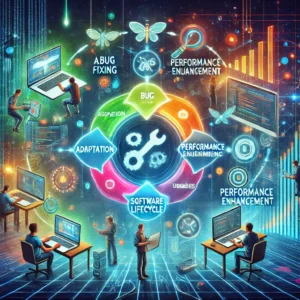
This illustration portrays software maintenance as an ongoing cycle rather than a one-time repair job. At the center, a wrench-and-gear symbol suggests hands-on engineering work—diagnosing issues, applying patches, and refining code. Surrounding it is a circular “software lifecycle” loop, emphasizing that maintenance repeats: bugs are fixed, systems adapt to new requirements, and performance is improved as usage grows. Dashboard charts and glowing interface panels hint at real-world signals that drive maintenance decisions: error logs, user feedback, security alerts, and performance metrics.
Software Lifecycle & Evolution Navigation
Explore how long-term software evolution connects with other engineering modules across the Software Development cluster. Each section details strategies for refactoring, debt reduction, and deployment control.
Software Development Overview
Establishes the macro-level software creation lifecycle. It shows how initial planning and greenfield architecture transition into post-deployment maintenance, patch management, and long-term evolution.
Software Maintenance & Evolution
Provides engineering strategies for refactoring legacy codebases, managing technical debt, applying security patches, and executing zero-downtime upgrades over multi-year software lifespans.
Software Architecture & Design
Details modular decoupling patterns and encapsulation boundaries that allow existing software components to be modified, extended, or replaced without breaking downstream system dependencies.
Software Engineering
Applies disciplined methodologies (Agile, DevOps, version control governance) to control maintenance schedules, manage change requests, and maintain code quality during continuous updates.
Software Testing & Quality Assurance
Covers automated regression testing, CI/CD safety nets, and test-driven refactoring to ensure routine maintenance updates do not introduce unexpected defects into production.
Programming Languages & Paradigms
Examines how type safety, memory models, and language deprecation policies impact code maintainability, static refactoring tools, and polyglot migration projects over time.
HCI & User Experience (UX)
Guides iterative UI redesigns, accessibility upgrades, and usability modifications based on post-launch analytics, heatmaps, and continuous user feedback loops.
Mobile Application Development
Focuses on mobile app store release management, operating system SDK updates, backwards compatibility testing, and client-side patch deployments across mobile devices.
Embedded Systems & IoT Development
Manages field device firmware updates, secure Over-the-Air (OTA) flashing, dual A/B partition rollbacks, and long-term hardware support lifecycles.
Key Topics in Software Maintenance and Evolution
Refactoring and Legacy System Modernization
Over time, software codebases accumulate technical debt and structural complexity:
- Refactoring: The disciplined process of restructuring existing code without altering its external runtime behavior to improve readability, reduce complexity, and eliminate code smells.
- Legacy System Modernization: Upgrading mission-critical legacy software to align with modern cloud and API standards using techniques like incremental refactoring, wrapping interfaces, or re-architecting monoliths into microservices.
Bug Fixes and Performance Tuning
Post-release engineering requires reactive defect repair and proactive system optimization:
- Corrective Bug Fixes: Isolating root causes, reproducing defects, writing regression tests, and deploying security hotfixes based on issue severity metrics.
- Performance Tuning: Optimizing execution speed, database indexing, caching strategies, and memory footprints to handle increased user throughput.
Version Control and Release Management
Managing code changes across distributed teams requires structured versioning controls:
- Version Control (Git): Branching strategies (GitFlow, Trunk-Based Development) that isolate release candidates, manage pull request reviews, and enable rapid commit rollbacks.
- Release Management: Orchestrating deployment pipelines across staging, canary, and production environments to minimize service downtime.
Software Decommissioning
System retirement is a formal lifecycle phase requiring data migration, API deprecation notices, compliance archiving, and controlled service shutdown procedures.
Applications of Software Maintenance and Evolution
Proactive lifecycle maintenance delivers continuous value across commercial software deployments:
- Sustaining Market Relevance: Continuously updating software with modern features, payment protocols, and user interface refinements.
- Enhancing System Reliability: Systematically applying preventive security patches and bug fixes to maintain high availability SLAs.
- Extending Software Lifespan: Delaying expensive complete system rewrites by modernizing core components incrementally over decades.
Why Study Software Maintenance and Evolution
Understanding software evolution prepares engineers for real-world production environments where greenfield development represents only a fraction of technical work:
- Long-Term Lifecycle Perspective: Recognizes that over 70% of total software lifecycle costs occur after initial production release.
- Legacy Code Mastery: Develops skills in reading, navigating, documenting, and safely refactoring un-documented legacy codebases.
- High Career Demand: Prepares engineers for crucial site reliability engineering (SRE), DevOps, system architecture, and maintenance leadership roles.
Engineering FAQs: Maintenance Types & Modernization
What are the four primary types of software maintenance?
The four standardized maintenance categories are: Corrective (fixing defects and errors), Adaptive (updating the system to maintain compatibility with new OS, hardware, or cloud environments), Perfective (enhancing performance, usability, or features based on user feedback), and Preventive (refactoring code and updating dependencies to prevent future defects).
What is Technical Debt, and how does it accumulate during software evolution?
Technical debt represents the implied cost of future rework caused by choosing quick, suboptimal code solutions over better, well-architected implementations. It accumulates through rushed release deadlines, inadequate testing, outdated documentation, and un-patched third-party dependencies. If unmanaged, technical debt eventually halts new feature development.
How does the Strangler Fig Pattern facilitate legacy monolith migration?
The Strangler Fig Pattern incrementally modernizes a legacy system by replacing specific functional modules with new microservices behind an API gateway. Over time, incoming traffic is redirected from the legacy monolith to the new services until the legacy application is completely “strangled” and can be safely decommissioned.
Why are automated regression tests essential during code refactoring?
Refactoring modifies internal code structure while preserving external behavior. Automated regression test suites (unit, integration, contract tests) act as a safety net, instantly alerting developers if an internal code modification accidentally breaks existing external system functionality.
How do Semantic Versioning (SemVer) rules govern API maintenance?
Semantic Versioning uses a
MAJOR.MINOR.PATCH numbering system. PATCH increments indicate backwards-compatible bug fixes; MINOR increments denote backwards-compatible feature additions; and MAJOR increments signal breaking API changes that require consumers to update their integration code.Interactive Knowledge Verification & Practice Problems
Quick Check: Maintenance Core Concepts
1. What is the difference between corrective and preventive software maintenance?
Answer: Corrective maintenance reacts to and repairs existing defects reported in production. Preventive maintenance proactively refactors code, updates libraries, and improves structure to prevent potential future failures before they occur.
2. What is software refactoring and why is it conducted?
Answer: Refactoring is the process of modifying internal source code structure without changing its external runtime behavior. It is conducted to clean up code smells, improve readability, reduce complexity, and make future updates easier.
3. How does adaptive maintenance help systems survive environment changes?
Answer: Adaptive maintenance updates a system to ensure compatibility with external operational changes, such as new operating system versions, updated database drivers, revised regulatory policies, or cloud infrastructure migrations.
4. What role do CI/CD pipelines play in continuous software evolution?
Answer: CI/CD pipelines automate build, test, and deployment checks whenever code updates are committed. This allows maintenance teams to ship small, low-risk patches and updates frequently while maintaining system stability.
Thought-Provoking Architectural & Evolution Questions
1. How can predictive AI models transform software maintenance workflows?
Answer: AI and predictive analytics inspect historical commit logs, error metrics, and resource usage patterns to forecast system failures and identify error-prone code modules before bugs manifest in production, shifting maintenance from reactive to predictive.
2. What risks and rewards accompany continuous user feedback loops?
Answer: Continuous feedback ensures updates align with real user needs, driving user engagement. However, un-filtered feedback risks information overload, conflicting user priorities, and feature bloat if updates are not governed by clear roadmap goals.
3. How does eco-friendly / green computing influence modern software maintenance?
Answer: Sustainable maintenance optimizes algorithms to reduce CPU usage, minimizes memory bloat, and optimizes cloud resource scheduling, directly lowering data center energy consumption and operational carbon footprints.
Numerical Engineering Problems & Solutions
Problem 1: Codebase Maintenance Refactoring Savings
A software system has $200{,}000$ lines of code with an average maintenance cost of $\$0.05$ per line per month. If refactoring reduces the codebase size by $15\%$, calculate the monthly cost savings.
A software system has $200{,}000$ lines of code with an average maintenance cost of $\$0.05$ per line per month. If refactoring reduces the codebase size by $15\%$, calculate the monthly cost savings.
Solution:
- Lines eliminated: $$ 0.15 \times 200{,}000 = 30{,}000\text{ lines} $$
- Original monthly cost: $$ 200{,}000 \times \$0.05 = \$10{,}000 $$
- Monthly cost savings: $$ 30{,}000 \times \$0.05 = \$1{,}500 $$
Problem 2: Automated Bug Fix Labor Hours Reduction
An application receives an average of $100$ bug reports per month, each requiring $2\text{ hours}$ of manual repair time. Implementing test automation reduces repair time per bug by $40\%$ and drops overall bug reports by $20\%$. Calculate the net monthly labor hours saved.
An application receives an average of $100$ bug reports per month, each requiring $2\text{ hours}$ of manual repair time. Implementing test automation reduces repair time per bug by $40\%$ and drops overall bug reports by $20\%$. Calculate the net monthly labor hours saved.
Solution:
- Original labor hours: $$ 100 \times 2 = 200\text{ hours} $$
- New bug report volume: $$ 100 \times (1 – 0.20) = 80\text{ reports} $$
- New fix time per bug: $$ 2 \times (1 – 0.40) = 1.2\text{ hours} $$
- New total labor hours: $$ 80 \times 1.2 = 96\text{ hours} $$
- Net labor hours saved: $$ 200 – 96 = 104\text{ hours} $$
Problem 3: Preventive Maintenance Cost Delta
An enterprise spends $\$50{,}000$ annually on software maintenance. Implementing preventive maintenance practices reduces emergency critical patch costs by $\$12{,}000$. Calculate the new annual maintenance cost.
An enterprise spends $\$50{,}000$ annually on software maintenance. Implementing preventive maintenance practices reduces emergency critical patch costs by $\$12{,}000$. Calculate the new annual maintenance cost.
Solution:
- New annual cost: $$ \$50{,}000 – \$12{,}000 = \$38{,}000 $$
Problem 4: Downtime Reduction & Operational Time Saved
During a 30-day month ($43{,}200\text{ minutes}$), a production service experiences $0.5\%$ downtime. Infrastructure improvements reduce downtime incidents by $20\%$. Calculate the original downtime in hours and the hours saved per month.
During a 30-day month ($43{,}200\text{ minutes}$), a production service experiences $0.5\%$ downtime. Infrastructure improvements reduce downtime incidents by $20\%$. Calculate the original downtime in hours and the hours saved per month.
Solution:
- Original downtime in minutes: $$ 43{,}200 \times 0.005 = 216\text{ minutes} $$
- Original downtime in hours: $$ \frac{216}{60} = 3.6\text{ hours} $$
- Hours saved via $20\%$ reduction: $$ 3.6 \times 0.20 = 0.72\text{ hours} \approx 43.2\text{ minutes} $$
- New downtime: $$ 3.6 – 0.72 = 2.88\text{ hours} $$
Problem 5: Agile Project Cost Savings & Time Compression
A legacy modernization project originally budgeted for $6\text{ months}$ at $\$300{,}000$ total cost ($\$50{,}000/\text{month}$). Adopting Agile delivery reduces duration by $25\%$ while monthly burn rates remain constant. Calculate the new project duration and total cost savings.
A legacy modernization project originally budgeted for $6\text{ months}$ at $\$300{,}000$ total cost ($\$50{,}000/\text{month}$). Adopting Agile delivery reduces duration by $25\%$ while monthly burn rates remain constant. Calculate the new project duration and total cost savings.
Solution:
- New project duration: $$ 6 \times (1 – 0.25) = 4.5\text{ months} $$
- New total project cost: $$ 4.5 \times \$50{,}000 = \$225{,}000 $$
- Total cost savings: $$ \$300{,}000 – \$225{,}000 = \$75{,}000 $$
Problem 6: Refactoring Bug Density Reduction
A $250{,}000$-line software application exhibits a bug density of $0.8\text{ bugs}$ per $100\text{ lines}$. Code refactoring reduces bug density by $25\%$. Calculate the original bug count and new bug count.
A $250{,}000$-line software application exhibits a bug density of $0.8\text{ bugs}$ per $100\text{ lines}$. Code refactoring reduces bug density by $25\%$. Calculate the original bug count and new bug count.
Solution:
- Original bug count: $$ \frac{250{,}000}{100} \times 0.8 = 2000\text{ bugs} $$
- New bug density: $$ 0.8 \times (1 – 0.25) = 0.6\text{ bugs / 100 lines} $$
- New bug count: $$ \frac{250{,}000}{100} \times 0.6 = 1500\text{ bugs} $$
Core Documentation & External References
Software Maintenance & Evolution — Learning & Wrap-Up
Summary
- Continuous Maintenance Discipline: Balance corrective, adaptive, perfective, and preventive maintenance activities to maximize codebase lifespan.
- Technical Debt Governance: Systematically track debt metrics and conduct iterative refactoring under automated regression test safety nets.
- Incremental Legacy Modernization: Leverage modernization patterns (Strangler Fig, API Abstraction) to transition monoliths to scalable microservices without service interruption.
- Release Governance: Enforce Semantic Versioning, automated CI/CD deployment pipelines, and structured decommissioning workflows.